Kelly Dilliard: Introduction, May 3, 2015

NOAA Teacher at Sea
Kelly Dilliard
(Almost) Onboard NOAA Ship Gordon Gunter

May 14 – June 5, 2015

Mission: Right Whale Survey
Geographical area of cruise: Northeast Atlantic Ocean
Date: May 3, 2015

Personal Log

Hello from South Dakota! My name is Kelly Dilliard and I am a college professor at Wayne State College (WSC) in Wayne, NE. Wayne State College is one of three schools with the Nebraska State College System and it is located in northeast Nebraska. I actually live in Vermillion, South Dakota, due north of Wayne and commute to school every day. My husband, Mark Sweeney, is an Earth Science Professor at the University of South Dakota in Vermillion. We are located about 45 minutes northwest from Sioux City, Iowa and about an hour south of South Falls, South Dakota.

Map of locations.
Map of eastern Nebraska and parts of Iowa and South Dakota showing locations of where I am coming from.
Photo of me at Malibu Beach.
Me at a cove beach near Malibu, California in July of 2014. Taking lots of photographs and videos to use in my teaching.

I teach all sorts of Earth Science courses at WSC including Introduction to Geology, Environmental Geology, Historical Geology, Rocks and Minerals, Oceanography, and Introduction to Meteorology. I try to create a hands-on experience for my students, but teaching in Nebraska has its drawbacks. We are far from some of the best geology sites and from the ocean, so instead of taking my students to the rocks or the ocean, I try to bring the rocks to my students in the form of specimens, photographs, and videos.  I believe that my students benefit from exposure to these samples and from the experiences that I bring into the classroom.  I hope this experience out at sea will help me bring more of the ocean to them.  As I teach mostly to future science teachers, I also hope this experience will open them up to taking similar opportunities to gain useful experiences to use in their own classroom.

Family at Black Canyon of the Gunnison.
My husband, Mark, myself, and our puggle, Penny Lane, at Black Canyon of the Gunnison National Park, Colorado, July of 2014.

As a youngster I had an interest in two sciences… geology and oceanography. I spent time in Hawaii when I was in fourth grade and fell in love with volcanoes and humpback whales. When it came to deciding on a major in college, I decided on geology and I have been actively engaged in researching and teaching about the Earth for the past 20 years. I am originally from eastern Pennsylvania, but through my graduate and professional career have lived in various states across the United States. I have three degrees in Geology, including a PhD from Washington State University.

Me and my brother in front of sign
My brother and I in April of 1986 standing by the map of the “Save the Whales” walk we took part in.

While I have an interest in oceanography and teach an oceanography class, I have never actually taken a formal oceanography course. I applied to the NOAA (National Oceanic and Atmospheric Administration) Teacher at Sea (TAS) program to gain some ocean research experience and to bring that experience back into my classroom. The Teacher at Sea program is celebrating it’s 25th Anniversary this year and is, as I am finding out, a wonderful program (link to TAS program)! I was selected to take part in a Right Whale Survey off the Northeast Coast on board the NOAA ship the Gordon Gunter (see the ship’s website for information and photographs). I never dreamed that I would also be getting exposed to a “what could have been” experience, that is, if I had decided to study oceanography and whales 20 years ago as an undergraduate.

So let me tell you a little about what I have learned so far about the North Atlantic Right Whale.  The North Atlantic Right Whale (Eubalaena glacialis) is an endangered species and is protected under both the U.S Endangered Species Act and the Marine Mammal Protection Act. Right whales were heavily targeted by whale hunters, being prized for their high blubber content, the fact that they float when killed, and their relative sluggishness. They were the “right” whale to hunt. Right whales are baleen whales like the humpback whale, but feed mainly by skimming through prey at or near the surface of the ocean. Right whales are recognized by their callosities, or rough skin (white in color due to whale lice!), on their heads. For more information on Right Whales check out the NOAA Fisheries article on them.

Right Whales
North Atlantic Right Whales. You can see their callosities. Photo credit: NOAA Fisheries

Next week I will be flying to Boston, Massachusetts and meeting up with the Gordon Gunter at the Woods Hole Oceanographic Institute. But before then, I have to finish off the semester, participate at the WSC graduation, put in my garden (hopefully), and pack for my trip. The next time you should hear from me, I should be aboard the Gordon Gunter.

Map of home and WHOI
Map indicating where I live/work and where I will be leaving from for the Right Whale Survey.

Jessie Soder: Geology on Georges, August 17, 2011

NOAA Teacher at Sea
Jessie Soder
Aboard NOAA Ship Delaware II
August 8 – 19, 2011 

Mission: Atlantic Surfclam and Ocean Quahog Survey
Geographical Area of Cruise:  Northern Atlantic
Date: Wednesday, August 17, 2011

Weather Data
Time: 12:00
Location:  41°19.095 N, 71°03.261
Air Temp:  22°C (°F)
Water Temp:  21°C (°F)
Wind Direction: South
Wind Speed: 7 knots
Sea Wave height:  0
Sea Swell:  0

Science and Technology Log

Gulf of Maine: Including Georges Bank

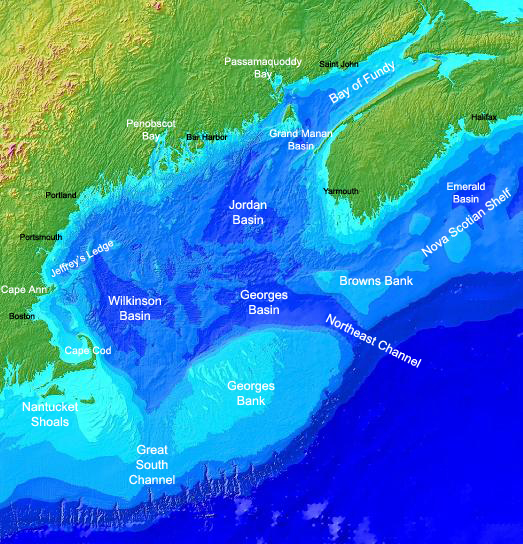
So far, we have spent this entire trip on Georges Bank.  This famous geographical location off the east coast of the United States is something that I had only heard about before this trip.  After several tows over the past week I have been able to see a variety of materials brought up from the ocean floor of Georges Bank.  I have seen loads of clams, empty shells, sand, mud and clay, and smooth polished rocks.  We have even pulled up a few boulders that must have weighed a couple of hundred pounds.  It was the smooth polished rocks that caught my attention. How would a rock from the bottom of the ocean become smooth and rounded?  It probably meant that Georges Bank must not have always been the bottom of the ocean.

During the Wisconsin Glaciation the ice reached its maximum around 18,000 years ago.  The Laurentide ice sheet paused in the area of Georges Bank and Cape Cod and left behind a recessional moraine that created these landforms.  This ice also had several meltwater streams flowing from it and these streams were responsible for the polishing the rocks and cutting some of the canyons found on the seafloor today.  The Northeast Channel off the northeast side of Georges Bank was the principle water gap for most of the meltwater.

Smooth Polished Rocks From the Ocean Floor

Georges Bank is a huge oval-shaped shoal bigger than Massachusetts that starts about 62 miles offshore.  It is part of the continental shelf and its shallowest areas are approximately 13 feet deep and its deepest areas 200 feet.  In fact, thousands of years ago Georges Bank used to be above water and an extension of Cape Cod.  About 14,000 years ago the sea rose enough to isolate this area and it was home to many prehistoric animals such as mastodons and giant sloths.  Today, traces of these animals are sometimes found in fishing nets!  These animals died out about 11,500 years ago when the sea level rose further and submerged the area.

Georges Bank is a very productive fishing area in the North Atlantic.  (The Grand Banks is more productive, but not as geographically accessible as Georges Banks.)  Why is Georges Bank a prime feeding and breeding area for cod, haddock, herring, flounder, lobsters, and clams?  It has to do with ocean currents.  Cold, nutrient rich water from the Labrador Current sweeps over the bank and mixes with warmer water from the Gulf Stream on the eastern edges of Georges Bank.  The mingling of these two currents, plus sunlight, creates an ideal environment for phytoplankton, which is food for the zooplankton.  In fact, the phytoplankton grow three times faster here than on any other continental shelf.  All of this plankton feeds the ecosystem of fish, birds, marine mammals, and shellfish that flourish on Georges Banks.

Personal Log

Yesterday we left Georges Bank for stations off the coast of Rhode Island.  After dark, I stepped out on the back deck and Jimmy pointed out the lights of Nantucket and Martha’s Vineyard.  We were in sight of land for the first time in a week.  It wasn’t long before people had their cell phones out and were making calls.

A few times during this trip I have thought about sailors in the past and how they would leave for months, and even years, at a time and not have contact with their families and loved ones until they returned.  I have had email contact this entire time, yet I am really excited to go home to see those that I miss.  I can hardly imagine what it would be like to be gone for a year with no contact at all.

Throughout this trip I have been getting to know others on this cruise.  I have learned that several of them have families and young children at home.  Many of them are at sea for many weeks, or months, a year.  After being on this cruise, I have gained a lot of respect for people who choose to work on the ocean for a living.  It takes a certain type of person who can work hard, maintain a positive attitude, and live away from their home and loved ones for extended periods of time.  It has been an honor to work with these people.

Christine Hedge, September 14, 2009

NOAA Teacher at Sea
Christine Hedge
Onboard USCGC Healy
August 7 – September 16, 2009 

Mission: U.S.-Canada 2009 Arctic Seafloor Continental Shelf Survey
Location: Chukchi Sea, north of the arctic circle
Date: September 14, 2009

Dr. Hall standing by the hovercraft before it is inflated

Weather Data from the Bridge 
Latitude: 720 46’N
Longitude: 1580 24’W
Temperature: 350F

Science and Technology Log 

Doing science in the Arctic is challenging.  The weather is difficult, the ice is ever changing, and the expense of operating an icebreaker, aircraft, or helicopter is quite high.  So, how else can people get out onto the ice to study the ocean and the geology of the seafloor? One interesting project uses a hovercraft (think air hockey), which skims over the ice on a cushion of air. Using a hovercraft to study the most inaccessible places in the Arctic is not a new idea. But, Dr. John K. Hall, a member of our science party has taken this idea and run with it.   John has a long history of polar exploration under his belt. Including 13.5 months floating around the Arctic on a 90 square kilometer, 60-meter thick ice sheet known as Fletcher’s Ice Island (T-3) during the 1960’s. His latest project has been to purchase and equip a hovercraft to go where icebreakers cannot (areas of VERY thick ice).

Norwegian students parked on the ice doing research. The white tent protects the scientists while they collect data through a drill hole in the ice.

The hovercraft was completed in 2007.  She is called the R/H Sabvabaa, which is the Inupiaq word for “flows swiftly over it.”  This hovercraft was designed specifically for doing science in Arctic conditions. It is equipped with all the comforts of home and all the latest technology.  From this research platform scientists have access to echosounding and seismic equipment to study the sea floor.  They can also park the Sabvabaa easily on a floe, get out on the ice to drill, photograph, and collect samples from under the ice.  This small 40-foot vessel (it fits in a semi-truck container) has great potential as a way for scientists to collect data in heavy ice conditions.  For more information about the Sabvabaa check out this website.

Classroom on the Ice 

Could you imagine being one of the first people to ride the hovercraft over the pack ice?  Since 2008, 16 lucky Norwegian high-school students have had that honor.  A competition was held as part of the Norwegian International Polar Year (IPY) program.  This competition set out to find Norwegian students ages 14-18 who are interested in careers in polar geophysics. A pair of students and a pair of researchers worked from the Sabavaa for one-week intervals. During their time on the Sabvabaa, the winning students participated in geophysical, geological, and oceanographic studies on drifting ice. They also had 4 encounters with polar bears!  What a great opportunity for these students. If you are interested in the student blogs from these trips (which are written in Norwegian) do a Google search for Sabavaa and have Google translate them.

FOR MY STUDENTS: Remember, not all scientists work in labs wearing white lab coats!  Many researchers lead exciting and adventurous lives. 

Paul Henkart teaching Nikki Kuenzel and Christina Lacerda.

Personal Log 

As an educator, one of the best parts of this expedition has been to watch the mentoring that goes on. The scientists and professors in the science party have decades of research experience to share. It is not unusual to find one of these veteran Arctic explorers sharing their expertise with graduate students from the University of New Hampshire. Not only do these “mentor scientists” have great technical expertise. They are also really good at explaining complex ideas in a very simple way.   This has been wonderful for me since my background is in biology – so geophysics has been a challenge. The graduate students on board are not only learning science from the masters – they are hearing great adventure stories about past polar adventures before we had helpful technologies such as GPS and multibeam echosounders. Everyone on the Healy is in “learning mode”.  The Coast Guard crew, teachers at sea, scientists, and students are constantly asking questions and sharing expertise.

Christine Hedge, September 9-11, 2009

NOAA Teacher at Sea
Christine Hedge
Onboard USCGC Healy
August 7 – September 16, 2009 

Mission: U.S.-Canada 2009 Arctic Seafloor Continental Shelf Survey
Location: Chukchi Sea, north of the arctic circle
Date: September 9-11, 2009

Positions 
From Latitude: 790 6’N/ Longitude: 1550 47’W
To Latitude: 780 3’N/ Longitude: 1590 41’W

Alex Andronikov labels and bags rock samples for further study.
Alex Andronikov labels and bags rock samples for further study.

Science and Technology Log 

Exploring the Unknown 
Geologically speaking, parts of the Arctic Ocean are some of the least explored areas on earth because they are often covered with thick ice. Geologists know there is an ultra-slow spreading center (where seafloor pulls apart) called the Gakkel Ridge.  They know where major features such as abyssal plains, plateaus, and ridges are, but the story of how this area formed is still the subject of much discussion. Where exactly are the plate boundaries in the Arctic?  Which direction are they moving?  Which forces formed the Arctic Basin?  These are great questions that geologists continue to investigate. In 7th grade we study plate tectonics.  Our textbooks contain maps showing where the plates are pulling apart (divergent boundaries), pushing together (convergent boundaries), and sliding past one another (transform boundaries). I had never noticed before this trip that clear plate boundaries are not shown under the Arctic Ocean.

FOR MY STUDENTS: There are some great animations showing plate movements at this site.

Looking Back in Time with Rock Samples 

Kelley Brumley and Alex Andronikov are geologists on board the Healy. They have been analyzing the data collected by the echosounding instruments to better understand the forces at work here. But what they have really been looking forward to is seeing what type of rock the seamounts, ridges, and plateaus below the Arctic Ocean are made of, and how these features were created.

Our first 2 dredge sites brought up muddy sediment and lots of:

  • Ice rafted debris: These are rocks that are frozen into ice that breaks from shore and carried out to sea. They can come from glaciers, or river deltas or any shoreline.  Some show glacial striations (scratches left behind by glaciers).
  • Coated sediments: These are crumbly, compressed mounds of sediment coated with a dark precipitate.
Dredge #2 was a muddy affair.  Using the hose, I helped separate the sediment from the rocks.  That’s me in the turquoise gloves!
Dredge #2 was a muddy affair. Using the hose, I helped separate the sediment from the rocks. That’s me in the turquoise gloves!

The next 3 dredges broke off rock samples from the steep slopes over which they were dragged. This was what the geologists were hoping for – samples of bedrock.  The rock samples that were dredged up show us that the geological history of the region is very complex.  Analyzing the chemistry and mineral composition of these rocks will help to answer some of the questions Kelley, Alex, and other Arctic geologists have about this part of the Arctic Ocean.  The rocks are cleaned, carefully labeled, and shipped to Stanford University, the University of Michigan, and the USGS (United States Geological Survey) for further study. Who knows, maybe the rocks that were collected today will help to clarify models for the geologic history of this part of the Arctic Ocean.

Personal Log 

On September 11, I was able to call my students in Indiana. Jon Pazol, (ARMADA teacher at sea) has an Iridium satellite phone that he graciously allowed me to borrow.  How fun to stand on the helicopter pad of the Healy and field questions from Carmel, Indiana.

Rock samples from a successful dredge operation
Dredges sometimes bring up more than rocks and sediment. This arthropod came up with one of the dredge samples.
Calling my students.  You can see in the background that there is much more ice than a few days ago.
Calling my students. You can see in the background that there is much more ice than a few days ago.

Christine Hedge, September 5, 2009

NOAA Teacher at Sea
Christine Hedge
Onboard USCGC Healy
August 7 – September 16, 2009 

Mission: U.S.-Canada 2009 Arctic Seafloor Continental Shelf Survey
Location: Beaufort Sea, north of the arctic circle
Date: September 5, 2009

Weather Data from the Bridge  
Latitude: 770 13’N
Longitude: 1370 41’W
Temperature: 290F

Science and Technology Log 

The two icebreakers are tying up side-by-side so that we can visit each other.

More Ways to Use Sound to See Beneath the Sea Floor 

Today we “rafted” with the Louis (the ships tied together side by side). I have been eager to see the science instruments that the Canadian ship is carrying. Once the ships were securely tied together we could just walk back and forth between them and tour the Canadian vessel.

The Healy has been breaking ice so that the Louis can have an easier time collecting data using seismic reflection profiling.  The goal is for the Canadian scientists to determine how deep the sediments are in this part of the Arctic Basin.  The sound waves their instrument sends out can penetrate about 1500 meters below the seafloor. Using sound they can “see” inside the earth – amazing!

FOR MY STUDENTS:  Remember your Latin/Greek word parts?  Look up “seism”. 

Seismic sled being hauled out of the water on the Louis. (Photo courtesy of Ethan Roth)

Here is how it works. The Louis steams forward at a low speed following in the path that the Healy has created through the ice. The Louis tows behind a weighted sled with 3 airguns suspended from the bottom.  This sinks about 10 meters below the water. Attached to the sled is a long tube filled with hydrophones (underwater microphones) called a streamer.  This streamer is about 400 meters long and stretches out behind the ship. It is best for the ship to move continuously so that the streamer will not sink or float to the surface.

FOR MY STUDENTS: Try to picture a 400-meter long “tail” on a ship. That is longer than 4 football fields. 

The airguns create a huge air bubble in the water.  When it collapses, it creates a sound pulse.  Two of the guns use a low frequency, which will penetrate deep into the sea floor but will create a low-resolution image.  The other gun uses a high frequency, which does not penetrate as deep but gives a high-resolution image.  The 16 sound recorders in the streamer record the echo created by these sounds reflecting from the sediment layers below the sea floor. The final product this instrument creates is an image of a cross section through the Earth. Scientists can look at these by observing this geologic history, the scientists are looking back in time. You can imagine that ice can cause lots of problems when a ship is towing a 400-meter long streamer behind it.  This is why we are working on collecting this data together.  One ship breaks, the other collects the seismic reflection data.

Steamer on deck of Louis. The blue steamer is out of the water and lying on deck when we visit the Louis.

Personal Log 

The crew has been looking forward to the two ships tying up together for the entire cruise.  Everyone is curious about the other ship. What are the staterooms like?  What is the food like? How is their bridge different from our bridge? And of course there is shopping!! Both of the ship stores had their best Louis and Healy gear ready for the eager shoppers.

After learning about the science instruments aboard the Louis, it was nice to finally see the seismic sled, streamers, and the computer nerve center where the seismic images are received. The ships are pretty different in their appearance.  The Louis is an older vessel and has wooden handrails, panels cover the wires in the ceiling, and there are some larger windows with actual curtains.  The Healy was built to be a science research icebreaker and so has many large spaces for science and looks generally more industrial. The Louis was an icebreaker first and some of their science spaces have been added later and are less spacious.

The bubble created by the airguns on the Louis. (Photo Courtesy Pat Kelley USCG)
The bubble created by the airguns on the Louis. (Photo Courtesy
Pat Kelley USCG)

Shopping and tours were fun but the most anticipated events of the day were the evening meal, contests and games.  The ship’s officers exchanged gifts in a formal presentation and then we had an amazing buffet together.  Personnel from both ships enjoyed scallops, halibut, salmon, shrimp, lobster, pork, beef, cheese, salads, and desserts. This was an exceptional meal and a great social event.  The idea of having Teachers at Sea (TAS) was a new one for most Canadians I spoke with and as we talked they seemed to think this TAS would be a great idea to stimulate interest in young Canadians about maritime careers.  The evening concluded with some friendly competitions between the crews and the science parties.  This entire event was a lot of work for the Coast Guard crews.  The science party really appreciates all the hours they put into planning this event!

Behind the wheel on the bridge of the Louis S. St. Laurent.