NOAA Teacher at Sea Caitlin Fine Aboard University of Miami Ship R/V Walton Smith August 2 – 7, 2011
Mission: South Florida Bimonthly Regional Survey Geographical Area: South Florida and Gulf of Mexico Date: August 9, 2011
Personal Log
The last days of the survey cruise followed a pattern similar to the first days. Everyone got into the schedule of working 12-hour shifts and everyone accepted their role and responsibilities as a member of the team.
We all (morning and night shifts) ate dinner together and often (if there were no stations to be sampled) sat together to play board games, such as Chinese checkers.
Maria and I in the "stateroom" we sharedThe scientific team plays Chinese checkers
We also all watched the sunsets together — each one was spectacular!
Science team at sunset
On the night of August 6th, we were towing the Neuston net through an area that had so many jellyfish that we could not lift the net out of the water. We had to get another net to help lift the heavy load. We all took bets to see how many jellyfish we had caught. I bet 15 jellyfish, but I was way off — there were over 50 jellyfish in the net! There were so many, that as we were counting them, they began to slide off the deck and back into the water. I have a great video that I cannot wait to share with you in September!
Moon jellies sliding off the deck!Science equipment in the truck
The ship arrived back in Miami on Sunday night around 7:30pm. It was amazing how quickly everyone unloaded the scientific equipment and started to go their separate ways. Because the NOAA building (Atlantic Oceanographic and Meterological Laboratory, AOML) is located right across the street from where the Walton Smith docks, we loaded all of the equipment into a truck and delivered it to the AOML building.
This was great because I got a quick tour of the labs where Lindsey, Nelson and others run the samples through elaborate tests and computer programs in order to better understand the composition of the ocean water.
Lindsey in one of the NOAA labs
In reflecting upon the entire experience, I feel extremely fortunate to have been granted the opportunity of a lifetime to participate in Teacher at Sea. I was able to help with all aspects of the scientific research from optics, to chemistry, to marine biology as well as help with equipment that is usually reserved for the ship’s crew, such as lowering the CTD or tow nets into the water.
There were many moments when I felt like some of my students who are struggling to learn either English or Spanish. There are a lot of scientific terms, terms used to describe the equipment (CTD and tow net parts), and basic boat terminology that I had not been exposed to previously. I am thankful that all of the members of the cruise were patient with my constant questions (even when I would ask the same thing 3 or 4 times!) and who tried to explain complex concepts to me at a level that I would understand and be able to take back to my students.
I am using the GER 1500 spectroradiometer
It makes me reflect again on everything I learned during my MEd classes in Multicultural/Multilingual Education — a good educator empowers students to ask questions, take risks, ask more questions, helps students access information at their level, is forever patient with students who are learning language at the same time that they are learning new concepts, provides plenty of hands-on experiments and experiences so students put into practice what they are learning about instead of just reading or writing about it.
A porthole on the R/V Walton Smith
As we sailed into Miami, a bottlenose dolphin greeted us – sailing between the two hulls of the catamaran and coming up often for air. It was so close, that I could almost touch it! Even though I was sad that the survey cruise was over, it was as though the dolphin was welcoming me home and on to the next phase of my Teacher at Sea adventure: I return to the classroom in September loaded with great memories, anecdotes, first hand-experiences, and a more complete knowledge of oceanography and related marine science careers to help empower my students so that they consider becoming future scientists and engineers. Thank you Teacher at Sea!
NOAA Teacher at Sea Caitlin Fine Aboard University of Miami Ship R/V Walton Smith August 2 – 6, 2011
Mission: South Florida Bimonthly Regional Survey Geographical Area: South Florida Coast and Gulf of Mexico Date: August 4, 2011
Weather Data from the Bridge Time: 10:32pm
Air Temperature: 30°C
Water Temperature: 30.8°C
Wind Direction: Southeast
Wind Speed: 7.7knots
Seawave Height: calm
Visibility: good/unlimited
Clouds: clear
Barometer: 1012 nb
Relative Humidity: 65%
Science and Technology Log
As I said yesterday, the oceanographic work on the boat basically falls into three categories: physical, chemical and biological. Today I will talk a bit more about the chemistry component of the work on the R/V Walton Smith. The information that the scientists are gathering from the ocean water is related to everything that we learn in science at Key – water, weather, ecosystems, habitats, the age of the water on Earth, erosion, pollution, etc.
First of all, we are using a CTD (a special oceanographic instrument) to measure salinity, temperature, light, chlorophyll, and depth of the water. The instrument on this boat is very large (it weights about 1,000 lbs!) so we use a hydraulic system to raise it, place it in the water, and lower it down into the water.
Lindsey takes a CO2 sample from the CTD
The CTD is surrounded by special niskin bottles that we can close at different depths in the water in order to get a pure sample of water from different specific depths. Nelson usually closes several bottles at the bottom of the ocean and at the surface and sometimes he closes others in the middle of the ocean if he is interested in getting specific information. For each layer, he closes at least 2 bottles in case one of them does not work properly. The Capitan lowers the CTD from a control booth on 01deck (the top deck of the boat), and two people wearing a hard hat and a life vest have to help guide the CTD into and out of the water. Safety first!
Once the CTD is back on the boat, the chemistry team (on the day shift, Lindsey and I are the chemistry team!) fills plastic bottles with water from each depth and takes them to the wet lab for processing. Throughout the entire process, it is very important to keep good records of the longitude and latitude, station #, depth of each sample, time, etc, and most importantly, which sample corresponds to which depth and station.
We are taking samples for 6 different types of analyses on this cruise: nutrient analysis, chlorophyll analysis, carbon analysis, microbiology analysis, water mass tracers analysis and CDOM analysis.
The nutrient analysis is to understand how much of each nutrient is in the water. This tells us about the availability of nutrients for phytoplankton. Phytoplankton need water, CO2, light and nutrients in order to live. The more nutrients there are in the water, the more phytoplankton can live in the water. This is important, because as I wrote yesterday – phytoplankton are the base of the food chain – they turn the sun’s energy into food.
Sampling dissolved inorganic carbon
That said, too many nutrients can cause a sudden rise in phytoplankton. If this occurs, two things can happen: one is called a harmful algal bloom. Too much phytoplankton (algae) can release toxins into the water, harming fish and shellfish, and sometimes humans who are swimming when this occurs. Another consequence is that this large amount of plankton die and fall to the seafloor where bacteria decompose the dead phytoplankton. Bacteria need oxygen to survive so they use up all of the available oxygen in the water. Lack of oxygen causes the fish and other animals to either die or move to a different area. The zone then becomes a “dead zone” that cannot support life. There is a very large dead zone at the mouth of the Mississippi River. So we want to find a good balance of nutrients – not too many and not too few.
The chlorophyll analysis serves a similar purpose. In the wet lab, we filter the phytoplankton onto a filter.
I am running a chlorophyll analysis of one of the water samples
Each phytoplankton has chloroplasts that contain chlorophyll. Do you remember from 4th grade science that plants use chlorophyll in order to undergo photosynthesis to make their own food? If scientists know the amount of chlorophyll in the ocean, they can estimate the amount of phytoplankton in the ocean.
Carbon can be found in the form of carbon dioxide (CO2) or in the cells of organisms. Do you remember from 2nd and 4th grade science that plants use CO2 in order to grow? Phytoplankton also need CO2 in order to grow. The carbon dioxide analysis is useful because it tells us the amount of CO2 in the ocean so we can understand if there is enough CO2 to support phytoplankton, algae and other plant life. The carbon analysis can tell us about the carbon cycle – the circulation of CO2 between the ocean and the air and this has an impact on climate change.
The microbiology analysis looks for DNA (the building-blocks of all living organisms – kind of like a recipe or a blueprint). All living things are created with different patterns or codes of DNA. This analysis tells us whose DNA is present in the ocean water – which specific types of fish, bacteria, zooplankton, etc.
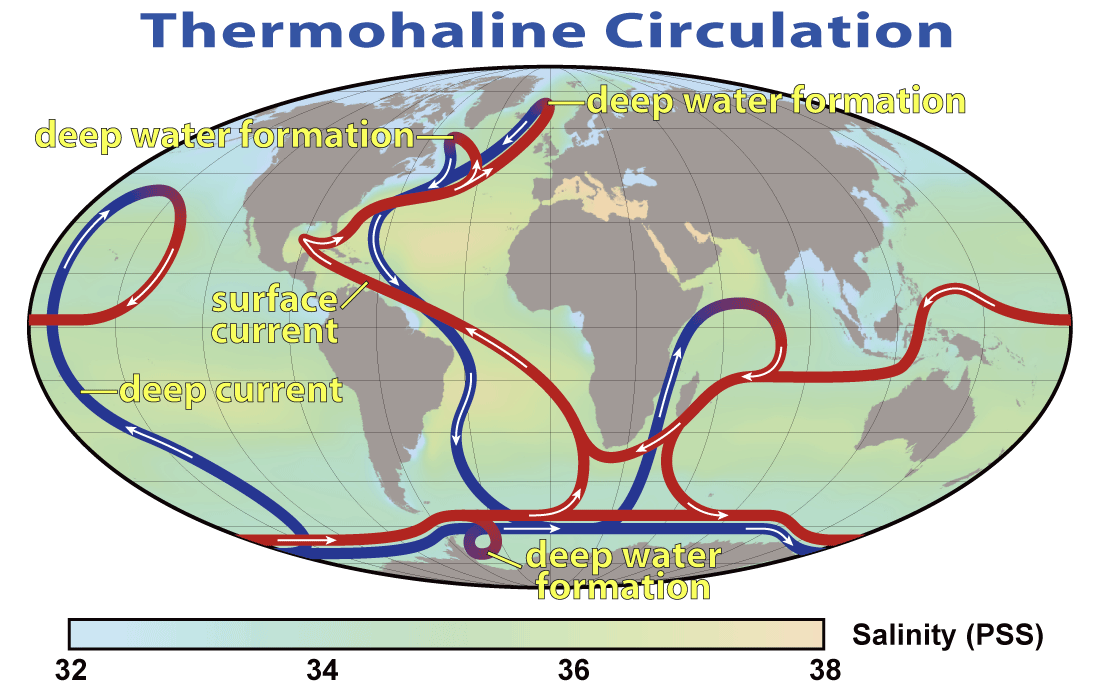
The water mass tracers analysis (on this boat we are testing N15 – an isotope of Nitrogen, and also Tritium – a radioactive isotope of Hydrogen) helps scientists understand where the water here came from. These analyses will help us verify if the Mississippi River water is running through the Florida Coast right now. From a global viewpoint, this type of test is important because it helps us understand about the circulation of ocean water around the world. If the ocean water drastically changes its current “conveyor belt” circulation patterns, there could be real impact on the global climate. (Remember from 2nd and 3rd grade that the water cycle and oceans control the climate of Earth.) For example, Europe could become a lot colder and parts of the United States could become much hotter.
This is an image of the conveyor belt movement of ocean currents
The last type of analysis we prepared for was the CDOM (colored dissolved organic matter) analysis. This is important because like the water mass tracers, it tells us where this water came from. For example, did the water come from the Caribbean Sea, or did it come from freshwater rivers?
I am coming to understand that the main mission of this NOAA bimonthly survey cruise on the R/V Walton Smith is to monitor the waters of the Florida Coast and Florida Bay for changes in water chemistry. The Florida Bay has been receiving less fresh water runoff from the Everglades because many new housing developments have been built and fresh water is being sent along pipes to peoples’ houses. Because of this, the salinity of the Bay is getting higher and sea grass, fish, and other organisms are dying or leaving because they cannot live in such salty water. The Bay is very important for the marine ecosystem here because it provides a safe place for small fish and sea turtles to have babies and grow-up before heading out to the open ocean.
Personal Log
This cruise has provided me great opportunities to see real science in action. It really reinforces everything I tell my students about being a scientist: teamwork, flexibility, patience, listening and critical thinking skills are all very important. It is also important to always keep your lab space clean and organized. It is important to keep accurate records of everything that you do on the correct data sheet. It can be easy to get excited about a fish or algae discovery and forget to keep a record of it, but that is not practicing good science.
It is important to keep organized records
It is also important to stay safe – every time we are outside on the deck with the safety lines down, we must wear a life vest and if we are working with something that is overhead, we must wear a helmet.
I have been interviewing the scientists and crew aboard the ship and I cannot wait to return to Arlington and begin to edit the video clips. I really want to help my students understand the variety of science/engineering and technology jobs and skills that are related to marine science, oceanography, and ships. I have also been capturing videos of the ship and scientists in action so students can take a virtual fieldtrip on the R/V Walton Smith. I have been taking so many photos and videos, that the scientists and crew almost run away from me when they see me pick up my cameras!
Captain Shawn Lake mans the winch
The food continues to be wonderful, the sunsets spectacular, and my fellow shipmates entertaining. Tomorrow I hope to see dolphins swimming alongside the ship at sunrise! I will keep you posted!!
Did you know?
The scientists and crew are working 12-hour shifts. I am lucky to have the “day shift” which is from 8am to 8pm. But some unlucky people are working the “night shift” from 8pm to 8am. They wake-up just as the sun is setting and go to sleep right when it rises again.
Animals seen today…
zooplankton under the dissecting microscope
– Many jellyfish
– Two small crabs
– Lots of plankton
A sampling of zooplankton
– Flying fish flying across the ocean at sunset
– A very small larval sportfish (some sort of bluerunner or jack fish)
Some moon jellyfish that we collected in the tow net
NOAA Teacher at Sea
Maureen Anderson
Aboard NOAA Ship Oregon II (NOAA Ship Tracker) July 25 — August 9, 2011
Mission: Shark Longline Survey Geographical Area: Southern Atlantic/Gulf of Mexico Date: August 3, 2011
Weather Data from the Bridge
Latitude: 32.50 N
Longitude: -079.22 W
Wind Speed: 17.75 kts
Surface Water Temperature: 28.60 C
Air Temperature: 29.90 C
Relative Humidity: 71%
Barometric Pressure: 1009.06 mb
Science and Technology Log One reason the shark longline survey exists is because the populations of many types of sharks are in decline. There are several reasons for this – finning is one reason. “Finning” is the process where the shark’s fin is removed from the rest of its body. Since usually only the fin is desired, the rest of the body is discarded. Shark fins are used for things like shark fin soup – a delicacy in Asian cultures. When the fin is cut off and the rest of the body stays in the water, the shark can not swim upright and eventually dies. While some regulations have been passed to prevent this, shark finning still occurs. Sharks are also overfished for their meat. As a result many shark species have become vulnerable, threatened or endangered. Large sharks can take longer to reproduce. Therefore, they are more likely to be threatened or decline in their numbers.
There are different categories of extinction risk, from "least concern" to "extinct" (photo courtesy of IUCN)Sharks are at the top of the food chain. They are apex predators. (photo courtesy of Encyclopaedia Britannica)
Sharks are at the top of the food chain. They keep prey populations in control, without which the marine ecosystem would be unstable.
This is why the mission of the shark longline survey is important. The identification tags and roto tags used during this survey along with the data collected will help scientists assess the abundance of species in this area. They can then provide recommendations for shark management. On average, we are collecting data on 10 sharks per line (or 10%), although our catch rates are between 0% and around 50%. With 50 stations in all, that would be data on approximately 500 sharks (on average).
There are more than 360 species of known sharks. Below is a list of some that we have seen and measured during our survey. The IUCN red list (International Union for Conservation of Nature and Natural Resources) classify these sharks with a status:
Atlantic Sharpnose Shark – Least Concern
Blacknose Shark – Near Threatened
Silky Shark – Near Threatened
Tiger Shark – Near Threatened
Lemon Shark – Near Threatened
Dusky Shark – Vulnerable
Sandbar Shark – Vulnerable
Scalloped Hammerhead – Endangered
During my shift, we sometimes catch things we do not intend to catch. We might reel in fish or other sea creatures that get caught on the hooks. This is called “bycatch”. While everything is done to try to catch only the things we are interested in studying, bycatch occasionally happens. The fish are only on our line for 1 hour, so their survival rates are pretty good. Our bycatch data is a very important element and also contributes to management plans for a number of species like snappers and groupers.
Our longline gear includes two high flyer buoys, and hooks that are weighted down so they reach the bottom.
Just the other day, we caught a remora (a suckerfish that attaches itself to a shark’s side). Remoras and sharks have a commensalism relationship – the remora gets leftover food bits after the shark eats, but the shark gets no benefit from the remora. We quickly took down its measurements in order to get it back into the water quickly. Other bycatch included an eel, and black sea bass.
This sharksucker is an example of bycatch.This moray eel accidentally found its way onto a hook.Bycatch - a black sea bass.This otolith (tiny white bone in center) helps this red snapper with its sense of balance.
We also caught a red snapper. Our chief scientist, Mark, showed me the two small, tiny ear bones called “otoliths” in the snapper’s head. These bones provide the fish with a sense of balance – kind of like the way our inner ear provides us with information on where we are in space (am I upside down, right side up, left, right?). You can tell the age of a snapper by counting the annual growth rings on the otoliths just like counting growth rings on a tree.
Personal Log
My experience aboard the Oregon II has given me a better understanding of the vulnerability of some shark species. While many of us may think that sharks can be threatening to humans, it is more accurate the other way around. Sharks are more threatened by humans than humans are threatened by sharks. This is due to our human behaviors (mentioned above).
Today I saw dolphins following our boat off the bow. There were about 6 or 7 of them all swimming together in a synchronized pattern (popping up for air all at the same time). It was really quite a treat to watch.
I’m also amazed by the amount of stars in the sky. With the lights off on the bow, you can really see a lot of stars. I was also able to see the milky way. There have been many storms off the horizon which are really cool to watch at night. The whole sky lights up with lightning in the distance, so I sat and watched for a while. With tropical storm Emily coming upon us, we may have to return to port earlier than planned, but nothing is set in stone just yet. I hope we don’t have to end the survey early.
Species Seen :
Tiger Shark
Atlantic Sharpnose
Nurse Shark
Barracuda
Remora
Black Sea Bass
Snowy Grouper
Atlantic Spotted Dolphins
Loggerhead Turtle
Homo Sapiens
NOAA Teacher at Sea
Becky Moylan
Onboard NOAA Ship Oscar Elton Sette July 1 — 14, 2011
Mission: IEA (Integrated Ecosystem Assessment)
Geographical Area: Kona Region of Hawaii
Captain: Kurt Dreflak
Science Director: Samuel G. Pooley, Ph.D.
Chief Scientist: Evan A. Howell
Date: July 13, 2011
Ship Data
Latitude
1940.29N
Longitude
15602.84W
Speed
5 knots
Course
228.2
Wind Speed
9.5 knots
Wind Dir.
180.30
Surf. Water Temp.
25.5C
Surf. Water Sal.
34.85
Air Temperature
24.8 C
Relative Humidity
76.00 %
Barometric Pres.
1013.73 mb
Water Depth
791.50 Meters
Science and Technology Log
Results of Research
CrustaceansChief Scientist guiding the CTD into the ocean
Beginning on July 1st, the NOAA Integrated Ecosystem Assessment project (IEA) in the Kona region has performed scientific Oceanographyoperations at eight stations. These stations form two transects (areas) with one being offshore and one being close to shore. As of July 5th, there have been 9 CTD (temperature, depth and salinity) readings, 7 mid-water trawls (fish catches), over 15 acoustics (sound waves) recordings, and 30 hours of marine mammal (dolphins and whales) observations.
The University of Hawaii Ocean Sea Glider has been recording its data also.The acoustics data matches the trawl data to tell us there was more mass (fish) in the close to shore area than the offshore area. And more mass in the northern area than the south. This is evidence that the acoustics system is accurate because what it showed on the computer matched what was actually caught in the net. The fish were separated by hand into categories: Myctophid fish and non-Myctophid fish, Crustaceans, and gelatinous (jelly-like) zooplankton.
Variety of Non-Myctophid Fish caught in the trawl
The CTD data also shows that there are changes as you go north and closer to shore. One of the CTD water sample tests being done tells us the amount of phytoplankton (plant) in different areas. Phytoplankton creates energy by making chlorophyll and this chlorophyll is the base of the food chain. It is measured by looking at its fluorescence level. Myctophids eat phytoplankton, therefore, counting the amount of myctophids helps create a picture of how the ecosystem is working.
The data showed us more Chlorophyll levels in the closer to shore northern areas . Phytoplankton creates energy using photosynthesis (Photo = light, synthesis = put together) and is the base of the food chain. Chlorophyll-a is an important pigment in photosynthesis and is common to all phytoplankton. If we can measure the amount of chlorophyll-a in the water we can understand how much phytoplankton is there. We measure chlorophyll-a by using fluorescence, which sends out light of one “color” to phytoplankton, which then send back light of a different color to our fluorometer (sensor used to measure fluorescence). Myctophids eat zooplankton, which in turn eat phytoplankton. Therefore, counting the amount of myctophids helps create a picture of how the ecosystem is working. The data showed us more chlorophyll-a levels in the closer to shore northern areas.
Bringing in the catch
The Sea Glider SG513 has transmitted data for 27 dives so far, and will continue to take samples until October when it will be picked up and returned to UH.
Overall the mammal observations spotted 3 Striped dolphins, 1 Bottlenose dolphin, and 3 Pigmy killer whales. Two biopsy “skin” samples were collected from the Bottlenose dolphins. A main part of their research, however, is done with photos. They have so far collected over 900 pictures.
Looking at all the results so far, we see that there is an area close to shore in the northern region of Kona that has a higher concentration of marine life. The question now is why?
We are now heading south to evaluate another region so that we can get a picture of the whole Eastern coastline.
Personal Log
In the driver's seatKrill
And on deck the next morning we found all kinds of krill, a type of crustacean. Krill are an important part of the food chain that feed directly on phytoplankton. Larger marine animals feed on krill including whales. It was a fun process finding new types of fish and trying to identify them.Last night I found a beautiful orange and white trumpet fish. We also saw many transparent (see-through) fish with some having bright silver and gold sections. There were transparent crabs, all sizes of squid, and small clear eels. One fish I saw looked like it had a zipper along the bottom of it, so I called it a “zipperfish”. A live Pigmy shark was in the net, so they put it in a bucket of water for everyone to see. These types don’t ever get very big, less than a foot long.
I have really enjoyed living on this ship, and it will be sad to leave. Everyone treated me like I was part of the group. I have learned so much about NOAA and the ecosystem of the Kona coastline which will make my lessons more interesting this year. Maybe the students won’t be bored!
NOAA Teacher at Sea
Heather Haberman Onboard NOAA Ship Oregon II July 5 — 17, 2011
Mission: Groundfish Survey
Geographical Location: Northern Gulf of Mexico
Date: Saturday, July 09, 2011
Weather Data from NOAA Ship Tracker Air Temperature: 30.4 C (86.7 F)
Water Temperature: 29.6 C (85.3 F)
Relative Humidity: 72%
Wind Speed: 6.69 knots (7.7 mph)
Preface: Scroll down the page if you would like to read my blog in chronological order. If you have any questions leave them for me at the end of the post.
Science and Technology Log
Topic of the Day: Plankton, the most important organisms on the planet.
Say the word plankton to a class full of students and most of them will probably think of a small one-eyed cartoon character. In actuality plankton are some of the most important organisms on our planet. Why would I so confidently make such a bold statement? Because without plankton, we wouldn’t be here, nor would any other organism that requires oxygen for life’s processes.
Plankton are a vital part of the carbon and oxygen cycles. They are excellent indicators of water quality and are the base of the marine food web, providing a source of food and energy for most of the ocean’s ecosystem’s. Most plankton are categorized as either phytoplankton or zooplankton.
Question: Can you identify which group of plankton are the plants and which are the animals based on the prefix’s?
Simple marine food web. Image: NOAA
Phyto comes from a Greek word meaning “plant” while planktos means “to wander”. Phytoplankton are single-celled plants which are an essential component of the marine food web. Plants are producers meaning they use light energy from the sun, and nutrients from their surroundings, to photosynthesize and grow rather than having to eat like animals, which are consumers. Thus producers allow “new” energy to enter into an ecosystem which is passed on through a food chain.
Because phytoplankton photosynthesize, they also play an important role in regulating the amount of carbon dioxide in our atmosphere while providing oxygen for us to breathe. Scientists believe that the oceans currently absorb between 30%-50% of the carbon dioxide that enters into our atmosphere.
Did you know: It is estimated that marine plants, including phytoplankton, are responsible for 70-80% of the oxygen we have in our atmosphere. Land plants are only responsible for 20-30%.
Diatoms are one of the most common forms of phytoplankton. Photo: NOAA
Question: Since phytoplankton rely on sun and nutrients for their energy, where would you expect to find them in greater concentrations, near the coast or far out at sea?
Red and orange indicate high concentrations of phyoplankton. Concentrations decrease as you go down the color spectrum. Image from NASA's SeaWiFS mission
Notice the greatest concentration of phytoplankton occur near coastal areas. This is because they rely on nutrients such as nitrogen and phosphorus for their survival. These nutrients are transferred to the sea as rains wash them from our land into the rivers and the rivers empty the nutrients into the sea. We’ll address the problems this is causing in my next blog.
Did you know: The ocean is salty because over millions of years rains and rivers have washed over the rocks, which contain sodium chloride (salt), and carried it to the sea.
It is easy to identify water that’s rich in phytoplankton and nutrients because the water is green due to the chlorophyll pigment plankton contain. The further away from the nutrient source you get, the bluer the water becomes because of the decrease in the phytoplankton population.
This tool is called a Forel/Ule scale. It is used to obtain an approximate measurement of surface water color. This helps researchers determine the abundance of life in the water.
Let’s go up a step in the marine food web and talk about zooplankton. Zoo is Greek for animal. Most zooplankton are grazers that depend on phytoplankton as a food source. I’ve learned that larval marine life such as fish, invertebrates and crustaceans are classified as zooplankton until they start to get their adult coloration. After hatching from their eggs marine larva are clear and “jelly like” which is an adaptation that helps them avoid being eaten by predators. Camouflage is their only line of defense in this stage of development.
A zooplankton sample we collected aboard the Oregon II using a neuston net. Notice the small juvenile fish and all of the clear "jelly like" larva.
When plankton samples are collected two different methods are used. One method uses a neuston net which skims the surface of the water for 10 minutes. See the video below to watch a sample being collected.
I am securing the neuston net to the metal frame by lacing it with a line (rope for all of you land lovers)..
The second method is using the bongo nets which are deployed at a 45 degree angle until they are a meter shy of the ocean floor, then they are brought back up. This method collects samples from the vertical water column rather than just the surface. The samples we collect with the bongo net look much different from the samples we collect with the neuston net. Bongo samples are filled with more larva and less juveniles.
Bongo nets getting ready to be lowered into the water column. They are called bongo nets because they resemble bongos. Photo: SEFSC
Plankton surveys are done in an effort to learn more about the abundance and location of the early life stages of fish and invertebrates. All of the samples we collect are preserved at sea and are then sent to the Sea Fisheries Institute in Poland. This is where all of the identification of fish larva and other zooplankton takes place. This information is then used by researchers to study things such as environmental quality requirements for larva, mortality rates, population trends, development rates and larval diets.
On the right is the "cod end", or plankton collection chamber, which attaches to the end of the nets. We then sieve the contents of the cod end and funnel it into a jar along with some preservative.
Personal Log:
My last log mentioned bycatch as one of the bad things about bottom trawling. Another problem associated with bottom trawling is the destruction of habitats as the net and “doors” sweep along the ocean floor. So far we have had two nets tear as a result of this collection method. It’s a good thing they keep ten extra nets onboard as back ups!
Here are some of the extra nets that are kept on deck.
Aside from the nets tearing off there has also been a problem with the wire that deploys the net. It has been twisting which prevents the “doors” from opening the net wide enough for a good sample collection. The crew has tried extending all of the wire off of the reel in an effort to untwist it. It seems to be working well, but we still need to keep a close eye on it.
I have also had the opportunity to be the hottest I have ever been in my entire life. We had an abandon ship drill where everyone had to get into their immersion suits. Picture yourself in the Gulf of Mexico, standing on a black deck, in the middle of the day, in July, while putting on a full body jump suit made of neoprene. Hopefully we won’t have to use them at any point during the cruise.