David Altizio May 24-26 2010

NOAA Teacher at Sea
David Altizio
Onboard NOAA Ship Fairweather
May 17 – May 27, 2010

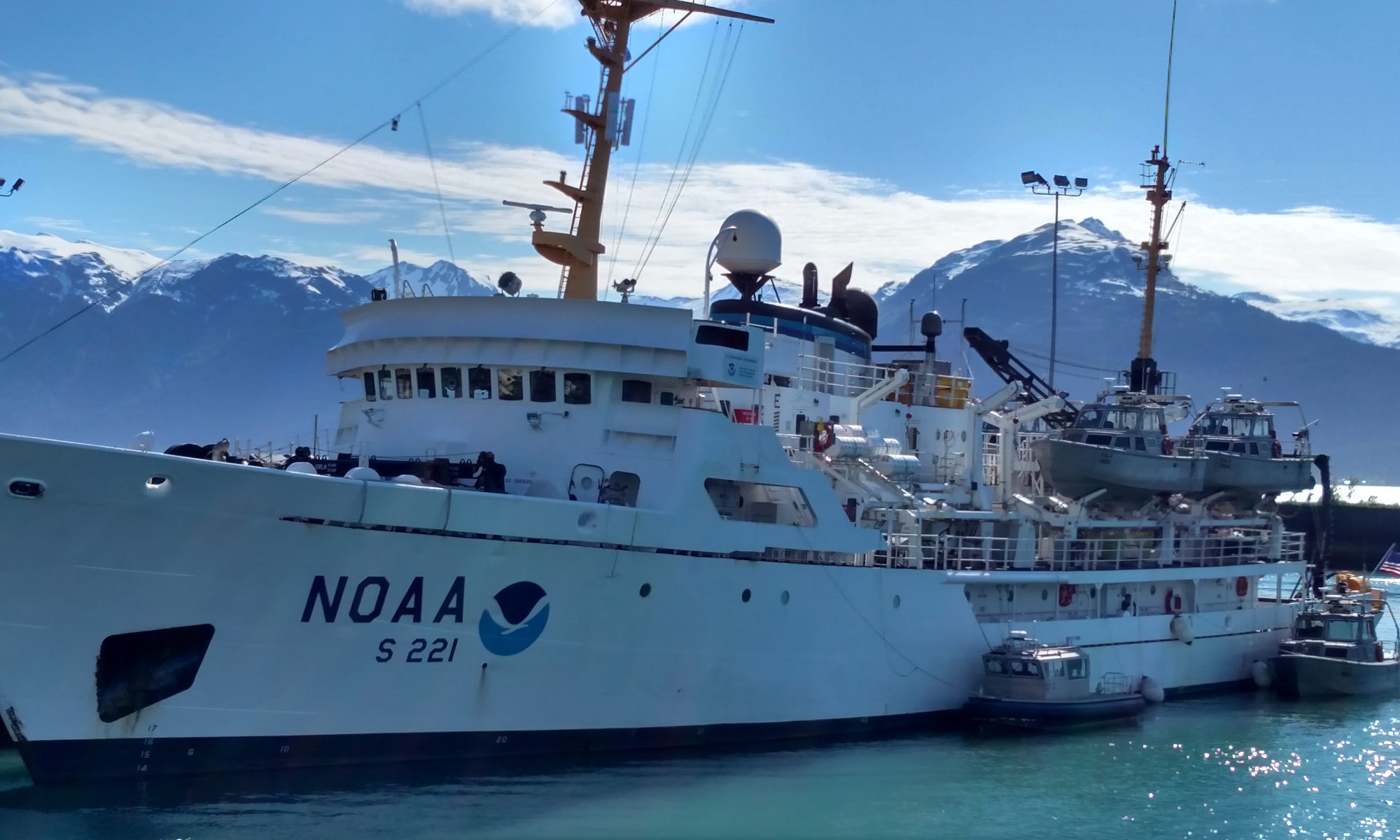
NOAA ship Fairweather
Mission: Hydrographic survey
Geographical Area of Cruise: SE Alaska,
from Petersburg, AK to Seattle, WA
Dates: Monday, May 24 and Tuesday, May 25,
Wednesday, May 26

Weather Data from the Bridge

Position: Hassler Harbor
Time: 0800 on 5/24
Latitude: 550 13.06’ N
Longitude: 1310 27.15’ W
Clouds: Light drizzle
Visibility: 8 miles
Position: Inside Passage
Winds: Light with variable directions
Time: 0800 on 5/25
Waves: Less than one foot Latitude: 52024.5’N
Dry Bulb Temperature: 11.20C
Longitude: 128030.0’W
Wet Bulb Temperature: 10.00C
Clouds: Mostly Cloudy
Barometric Pressure: 1006.4 mb
Visibility: 10 + miles
Tides (in feet):
Winds: 10 knots from the NE
Low @ 0439 of 0.1
Waves: One to three feet
High @ 1055 of 13.1
Dry Bulb Temperature: 11.00C
Low @ 1637 of 2.2
Wet Bulb Temperature: 10.10C
High @ 2254 of 16.4
Barometric Pressure: 1009.1 mb
Sunrise: 0422
Sunset: 2105

Science and Technology Log

On Monday we were testing one of the multi‐beam sonar transmitters that had not been working properly on the Fairweather, in Hassler Harbor near Ketchikan, AK. In order to verify that the device is working properly the ship went back and forth over an area that has previously been mapped from all different directions. This is called patch testing. Ideally you are looking for no difference in the data from one test to another test.

Me,at the helm,driving the Fairweather.
Me, practicing using the line throwing device.

While on board Monday, we also practiced using a line throwing device. This piece of equipment can be used for ship to ship rescue operations, or to get a line onto a pier if needed, or for other rescue operations. The device is powered by 3000 lbs. of compressed air. Today we only fired a test line, but the real one can travel almost 200 meters. Being prepared and knowing what to do in the case of an emergency is extremely important while out at sea. Not only was I allowed to use the device, but so was anyone else on board who had not learning how to use it properly.

Marine aneroid barometer measures air pressure.
Digital anemometer showing wind speed and wind direction.

I have also been collecting and recording the weather data from the bridge of the ship. These observations are made every hour. There are many different meteorological instruments on the Fairweather. The atmospheric pressure is recorded using an aneroid barometer. The dry and wet bulb temperature readings were taken off of a sling psychrometer, just outside of the bridge. The wind direction and wind speed were taken from a digital anemometer and verified using the vectors of the wind direction and the heading of the ship. The visibility, wave height and the cloud cover are estimated visually by observing them from the bridge of the ship.

One of the ship’s officers, tracking our plot by hand on the chart.
Me taking the temperatures off of a psychrometer outside of the bridge.

I was also given the opportunity to man the helm and drive the Fairweather, for about 10 minutes as we headed south towards British Columbia, Canada. The bridge of the Fairweather has a many different screens, monitors, sensors and gauges. In order to see where we are going there are digital charts, which have our path projected on them. Also, some of the ship’s officers will verify our position along our course by hand. The depth to the bottom is determined by a fathometer, which works by using SONAR, not as complex as the multi‐beam mapping but more similar to a fish finder. In many maritime activities the depth is measured in fathoms. One fathom is approximately 1.8 meters or 6 feet. Knowing where you are and where other vessels are is extremely important.

Some of the Fairweather’s navigation systems.
Digital fathometer, measuring depth to the bottom using SONAR

The Fairweather has enough beds to hold a maximum of 58 crew members. The ships personnel is divided between: NOAA Corps officers, survey, deck, engineers, stewards,  electronics technician and visitors. There are almost 15 NOAA officers on the Fairweather, including the CO (commanding officer), XO (executive officer), FOO (field operations officer), and all the way thru captain lieutenant commander, 3rd mate, lieutenant, and ensigns. The survey group has approximately 10 people including the chief survey technician, senior, regular, and assistants.

More of the Fairweather’s navigation systems.

Digital readout of ship’s GPS (global positioning system) for precise latitude & longitude, speed in knots, and heading in degrees.

The deck group has 12 people and they help to maintain the deck areas, drive the launch boats, and help out in the anchoring and docking processes. There are 10 engineers who  make sure the ship is running properly. There are three stewards (cooks) who are amazing and make sure everyone is fed very well. There are 2 electronics technicians, and anywhere from two to five visitors, such as teachers at sea, technology support, mission/NOAA related personnel.

My stateroom on the Fairweather’s.
Fairweather’s store.

The Fairweather was originally commissioned in October 1968, deactivated in 1989 but a critical backlog of surveys for nautical charts in Alaska was a motivating factor to reactivate it in August 2004. The home port for the Fairweather is Ketchikan, AK and it operates mostly in Alaskan coastal waters. It is designed and outfitted primarily for  conducting hydrographic surveys in support of nautical charting, but is capable of many other missions in support of NOAA programs. The ship is equipped with the latest in hydrographic survey technology – multi‐beam survey systems; high‐speed, high‐resolution side‐scan sonar; position and orientation systems, hydrographic survey launches,  and an on‐board data‐processing server. It is 232 feet long, with a beam of 42 feet. It weighs 1,591 tons and the hull is made of welded steel. The Fairweather has a range of 6,000 autical miles, can stay at sea for 30 days, and has an average cruising speed of 12 knots.

The galley (kitchen) on the Fairweather.
Dish washing station on the Fairweather.
Mess hall (dining area) on the Fairweather.
One of the food storage areas on the Fairweather.

The staterooms on the Fairweather are fine for two people to live in. There is a bunk bed, dresser/desk area, closets, sink, small refrigerator, and a TV. The food on the Fairweather is really good, not just for being at sea, but really good with a lot of different options. There is also a small store where you can buy candy, soda and clothing with logos and images of the ship. There is a small workout room that people do use to keep active. There are three different food storage areas, one for dry goods, a refrigerated area, and a freezer. The Fairweather also has laundry facilities and a sick bay.

Laundry room on the Fairweather.
Fairweather at Customhouse Cove.

Personal Log

It is hard to believe that we are already heading south towards Seattle, WA. I have really enjoyed my time onboard the Fairweather and will never forget these experiences. Being a Teacher at Sea is amazing and I highly recommend it. I have seen so many different and new things that I can now add to my “teacher toolbox”.

On Monday, being able to learn how to use the line throwing device was very cool, but that was not the highlight of my day. I was also given the opportunity to man the helm, and drive the Fairweather for about 10 minutes. It is amazing that a ship this big is so responsive to small changes in the angle of the rudders. It was sort of like driving a really big car, in the sense that when you turn the wheel right the ship goes right and turning left makes the ship go left. There is a lot to do when at the helm. You have to make sure that we are following the correct heading, going the proper speed, not heading towards any other vessels or obstructions such as logs or other debris, and in water that is deep enough for the ship. As much fun as it was it was a little nerve racking, my palms were definitely sweaty.

Along the Inside Passage

I did have the help of four other NOAA officers to assist me and help me know what to do. It is not only up to the person at the helm to make decisions about what to do or which course to follow. The Fairweather is definitely a place where the junior officers are being trained and learning what to do in all types of situations. This aspect of helping and learning was prevalent in many aspects of what I observed while onboard the Fairweather and was great to see.

A while after I manned the helm, the seas got a little rougher as we went through Dixon entrance which marks the boundary between SE Alaska and British Columbia Canada. Here we were exposed to ocean swell from the Pacific Ocean/Gulf of Alaska. I was very glad this did not go on for too long. I made the mistake of trying to write this log while the ship was rocking and rolling a little bit. Not such a good idea. One of the officers told me to put down the computer, go out on the stern (back) of the ship, and look at land along the horizon. Being outside in the fresh air, while looking at land made me feel much better.

The sick bay on the Fairweather.

The rest of the trip towards Seattle has been very nice. The seas have not been too rough, and I am really enjoying the scenery as we go through the inside passage of British Columbia, Canada. Coming home and going back to New Rochelle High School will definitely be a change from the last two weeks. I will never forget the places, people and the science I have been exposed to in my time on the Fairweather in SE Alaska. We are now in the Puget Sound, and Seattle is almost in sight and I am ready to be home, back in New York.
Signing out, David Altizio Teacher at Sea

David Altizio, May 22 – 23, 2010

NOAA Teacher at Sea
David Altizio
Onboard NOAA Ship Fairweather
May 17 – May 27, 2010

NOAA ship Fairweather
Mission: Hydrographic survey
Geographical Area of Cruise: SE Alaska,
from Petersburg, AK to Seattle, WA
Dates: Saturday, May 22 and Sunday, May 23

Me standing on the rocks, making tidal observations.

Weather Data from the Bridge

Position: Customhouse Cove                  Position: Customhouse Cove
Time: 0800 on 5/22                                   Time: 0800 on 5/23
Latitude: 550 56.01’ N                              Latitude: 55006.5’N
Longitude: 1310 13.75’ W                       Longitude: 131013.7’W
Clouds: Mostly Cloudy                               Clouds: Mostly Cloudy
Visibility: 10 miles                                      Visibility: 10 miles
Winds: 6 knots from the NW                     Winds: 6 knots from the SE
Waves: Less than one foot                         Waves: Less than one foot
Dry Bulb Temperature: 12.20C         Dry Bulb Temperature: 11.00C
Wet Bulb Temperature: 10.20C        Wet Bulb Temperature: 9.80C
Barometric Pressure: 1015.0 mb     Barometric Pressure: 1010.0 mb
Tides (in feet):                                             Tides (in feet):
Low @ 0224 of 2.8                                         Low @ 0335 of 1.5
High @ 0828 of 12.2                                      High @ 0943 of 12.4
Low @ 1436 of 1.6                                          Low @ 1537 of 2.0
High @ 2105 of 14.6                                      High @ 2159 of 15.4
Sunrise: 0424                                               Sunrise: 0423
Sunset: 2100                                                 Sunset: 2101

Science and Technology Log

On Saturday morning I went out and made observations at a tide gauge in Customhouse Cove. We took measurements over a three hour period every six minutes for a one minute interval. We used a pair of binoculars to read the tide staff, which was about 20 feet away, to the nearest millimeter. The purpose of taking this reading over a period of one minute is because the water is constantly moving both toward the shoreline and away from it. This interval ensures that you can get the most accurate reading as possible.

Tide staff, used for measuring rising and falling tides

On Sunday, I again went out on a small launch boat. This time we needed to complete a few more holidays using the multi‐beam sonar, then we went to two small islands, Smeaton and South Twin, to recover the GPS (global positioning systems) base stations.

Computer screen,showing live acquisition of multi-beam SONAR data from one of the holidays.

The GPS base station data is recorded daily, while the survey project is underway. The data is then uploaded during the processing phase and used to correct the precise position of the Fairweather and its launches to within a few centimeters of accuracy. This allows the survey technicians to know the exact horizontal position when all of the data was collected by the multi‐bean sonar. Sunday was the last day that data was collected on this project, and that is why we recovered both of the GPS bases stations.

Me,in the process of removing one of the GPS base

When the tide gauge was established for measurements, during April of 2010, a three hour period of observations was made, similar to what I did on Saturday morning. In the time since April, observations are to be made each week for at least 1‐2 hours. Due to the remote nature of some of the tide gauge locations this is not always possible. The purpose of the observations of the rising and falling tide is to establish the vertical location of the tide gauge sensor, which is submerged below the surface, in relation to the tide staff. These observations help in correlating the height observed on the tide staff, with benchmarks that were previously installed by the Fairweather crew along the beach.

Maritime activities throughout the world depend on accurate tidal and current information for safe operation. NOAA’s National Ocean Service collects studies and provides access to thousands of historical and real‐time observations as well as predictions of water levels, coastal currents and other data.
Ocean tides move in response to gravitational forces exerted by the moon and sun. Since the moon is much closer to the Earth it is the dominant force that affects Earth’s tides. Whichever side of the Earth is facing the moon experiences a greater gravitational attraction, and the oceans get pulled towards it causing a bulge.

Me, holding the rod for leveling measurements (with the Fair weather in the background).

When the highest part or crest of the wave reaches a particular location, high
tide occurs; low tide corresponds to the lowest part of the wave, or its trough. The difference in height between the high tide and the low tide is called the tidal range. Here, in SE Alaska there is almost a 15 feet difference between high and low tide.

Me,reading the level off of the leveling rod(again with the Fairweather in the background).

Most coastal areas, experience two high tides and two low tides every lunar day. Almost everyone is familiar with the concept of a 24‐hour solar day. A lunar day is the time it takes for a specific site on the Earth to rotate from an exact point under the moon to the same point under the moon the next day.

One of the benchmarks on the beach.

On Saturday afternoon, we went back to the tide gauge to take elevation levels of five benchmarks on the beach. The purpose of these measurements is to establish a vertical height of the tide gauge with five existing benchmarks. When the gauge was started in April 2010, the same measurements were made. We verified that the opening and closing measurements were within an acceptable range. After taking height measurements, I helped take out one of the prototype tide gauges since the data was not needed anymore. The regular gauge was later removed on Sunday.

Part of the tide gauge instruments, solarpanel, GPS transmitter.

I was able to help out with these height measurements by holding a rod on top of the benchmarks, while another member of the crew looked through a scope and read the levels off of the rod. We also documented the entire site by taking photographs.

A humpback whale tale.

Personal Log

The weather on Saturday was probably the best I have had in SE Alaska so far. It was sunny and in the low 60’s. I learned a few days ago, that when you are out at sea and it is sunny you need sunscreen and a baseball hat in order to not get sunburn. As I told you, on Saturday morning I was dropped off by a small boat to observe the level of the tide. Nothing too exciting, but the weather made it just fine. Since we were very close to the ship, I was able to come back on and have “hot” lunch rather than sandwiches and stuff. In the afternoon, we went back to the same tide gauge and I helped out with elevation studies is the easiest way to say it. This was better than the morning for me.

In the morning one other guy and I were literally dropped off on a barely exposed rock just offshore from the tide gauge. When we started there was water between the two of us, but we knew the tide was dropping so we were fine. However, we were sort of stranded there until the small boat picked us up for lunch. We had to take levels of the water every six minutes. Sounds boring but it went by rather quickly. As the tide dropped small tidal pools were exposed and I was able to explore. There was tons of sea life. It reminded me of Point Loma near San Diego, where I vacationed once. While we were there, of course there were bald eagles and even a few seals.

In the afternoon we actually went onto the beach and I got to explore a little. First time on land since Ketchikan; which we are still very close to. I was in my full on geologist mode, breaking and smacking rocks to see what they looked like on the inside. I saw some cool stuff, possibly some small flakes of gold, garnet crystals, and maybe some silver flakes. The captain (CO) also came along with us, which was pretty cool.

Dinner was good. Baked potato bar, some interesting tofu dish (most people ate prime rib, very rare, uncle Jerry style), salad, and coconut lemon cake for dessert. I am getting spoiled from all this good food. I watched another amazing sunset from Customhouse Cove on Saturday (that makes 3 from the same anchor spot).

Sunset on Saturday 5/22

Sunday, the weather was not as nice as Saturday; at least it did not rain. However I really did enjoy the day. The crew that I was with was great. We all got along very well. I was able to get onto land three times and explore and climb around on the rocks. Also we saw two humpback whales, a bunch of seals, more Dall’s porpoises, and yes more bald eagles.

Being able to go onshore was really special for me. I was not sure this was something I would be able to do. From here we will start making our course to Seattle. We were just told that we WILL be going through the “inside passage” which is supposed to be absolutely spectacular. I can’t wait.

For now the project is almost complete. There is only a small amount of data and bottom samples that need to be collected. I am enjoying my time onboard the Fairweather. Everyone has been very nice. I have developed a routine. I get up at 0640, breakfast begins at 0700, there is a safety meeting on the bow of the ship at 0800, then if you are on a launch you leave and come back in the late afternoon. Dinner is served at 1700, then after dinner we have a debriefing meeting to discuss the day’s work and any problems that may have been encountered.

As I said I have a little routine. Even the breakfast steward (cook) knows me by now. I come into the mess hall (dining area) and ask for my usual. Three scrambled eggs with scallions and cheese. I also have one piece of toast, three strips of bacon, some hash browns and fresh fruit, some coffee and orange juice. Not too bad. If you are doing survey work from the ship there is hot lunch at 1200, otherwise on the launches it is a bag/picnic style lunch. Yes I know I am getting spoiled with all of this good food.

Me enjoying my time on shore.
Sunset on Sunday 5/23

David Altizio, May 21, 2010

NOAA Teacher at Sea
David Altizio
Onboard NOAA Ship Fairweather
May 17 – May 27, 2010

NOAA teacher at Sea: David Altizio
NOAA ship Fairweather
Mission: Hydrographic survey
Geographical Area of Cruise: SE Alaska,
from Petersburg, AK to Seattle, WA
Date: Friday May, 21

Weather Data from the Bridge

Position: Behm Canal to Customhouse Cove,
Shoalwater Pass and Princess Bay
Time: 0800 on 5/21
Latitude: 550 23.26’ N
Longitude: 1300 57.13’ W
Clouds: Overcast
Visibility: 10 miles
Winds: light with variable directions
Waves: Less than one foot
Dry Bulb Temperature: 10.00C
Wet Bulb Temperature: 8.50C
Barometric Pressure: 1016.5 mb
Tides (in feet):
Low @ 0111 of 3.7
High @ 0713 of 13.1
Low @ 2011 of 1.0
High @ 2011 of 14.4
Sunrise: 0421
Sunset: 2058

Dall’ porpoises racing along side the Ambar launch boat

Science and Technology Log

I spent the morning on the smallest and most maneuverable of the launch boats on the Fairweather called an Ambar. Unlike the other launch boats that I was previously on, this one does not have a sheltered area so full cold weather/rain gear was needed. Our task was to collect sediment samples from the bottom of Shoalwater Pass and Princess Bay. We were the first of four launches to go out on this day. As we were being lowered down from the ship everybody started to notice porpoises all around us.

Me getting ready to lower the bottom sampler to determines edimentsizes of the channel floor.

Once the Ambar was deployed the porpoises began racing alongside the boat. They stayed with us for a few minutes.It was an awesome sight and an experience that I will never forget. Later, at lunch I was talking with the CO (commanding officer) and he told me that he had never quite seen so many porpoises ride alongside a launch boat for such a long time.

What I saw were Dall’s porpoises (Phocoenoides dalli)a species that is only found in the North Pacific; from the Bering Sea and the Gulf of Alaska (spring to summer) and in coastal waters as far south as Baja California (fall to winter). Their unique body shape makes them easy to distinguish from other porpoise species. They have a very thick body and a small head. Their coloration is much like an Orca (killer whale), with their bodies being black with white patches on their underside. Dall’s Porpoises are hugely active and playful creatures. They will often zigzag around at great speed on or just below the surface of the water creating a spray called a “rooster tail”. They often appear and disappear quite suddenly. They will approach boats and ride alongside, but may lose interest, unless the boat is travelling quickly.

Here is one of the Dall’s Porpoises surfacing for air.

Dall’s are usually larger than other species of porpoises, growing up to 2 or 3 meters in length and weighing between 280 to 450 lbs. This species of porpoise can live as long as 15 to 20 years. They feed mostly on squid and a variety of fish. They are the fastest of all porpoises; they can swim at or up to 35 miles per hour. They often appear in small groups. Today, I would say there were at least 15 to 20 of them, but they were so fast and difficult to count.
After the excitement, we drove over to Shoalwater Pass and began collecting our first of eight bottom samples. The information gathered from these samples is very helpful to ships that might be anchoring in a particular area. For example, if you anchor in deep mud, the anchor could become trapped or stuck in the mud, or if the bottom is very rocky the anchor would not be able to set into the bottom at all.
In order to collect the bottom sediments we had to lower down a heavy sampler and allow it to hit the bottom. In deeper water this was definitely more difficult. As you can see, we had to pull the sampler up by hand and hope that it had closed and collected sediments. It did not close every time we lowered it, so some of the site required more than one drop which made the task even harder.

Here I am pulling up the bottom sampler.Not as easy as it looks.

Of the eight bottom samples we collected, they ranged from sticky mud to angular stones, to pebbles. The classification system used for bottom samples includes the following names: mud, clay, silt, sand, stones, gravel,boulders, lava, coral, and shells. After they are named, if they are sediments they are then classified by size range and then adjectives are added to specifically describe the sample, such as: fine, medium, coarse, broken, sticky,
soft, stiff, volcanic, calcareous, hard, soft, light, dark, small, medium, and large.

Here is one of the bottom samples that we collected.

After each sample was taken we used a laptop (that can get wet) with a GPS receiver attached to it to log our exact positions. This information will be part of the charts that will be made when the area is completely surveyed.

Chart of sediment size ranges.
Tough notebook laptop,yes it can get wet.

Personal Log

As already stated one of the highlights of my trip so far has been the Dall’s porpoises that raced alongside us. That is something that I will never forget. This was not the only wildlife sighting of the day. When we were transiting from one sample area to another, I spotted a bald eagle and pointed it out to two of the other guys on my boat. What happened next was awesome.
Once we saw the eagle, which as I have told you are all over the place, we noticed another smaller bird in front of it. The eagle was chasing him and was hot on his tail. Suddenly the smaller bird had nowhere to go and did a nosedive into the water. This was so cool. Then the eagle proceeded to circle the smaller bird from above so as to say stay down there. I also saw numerous whale spouts from a distance, too far to tell what type. While back on the Fairweather for lunch a stellar sea lion was swimming right along the starboard side of the ship. When I went outside to see him, he surfaced, came out of the water about chest high looked right at me and swam away, never to be seen again.
SE Alaska is truly a special and magical place. Not just for wildlife, the scenery is absolutely spectacular. I can’t wait to see what another day brings with it.

Animals Seen Today

Dall’s porpoises Bald eagle chasing smaller birds A few stellar sea lions along the starboard side of the Fairweather Whale spouts from a distance