Geographic Area of Cruise: North Atlantic Ocean, Slope Sea
Date: July 23, 2025
Weather Data:
9:14 AM Eastern Time
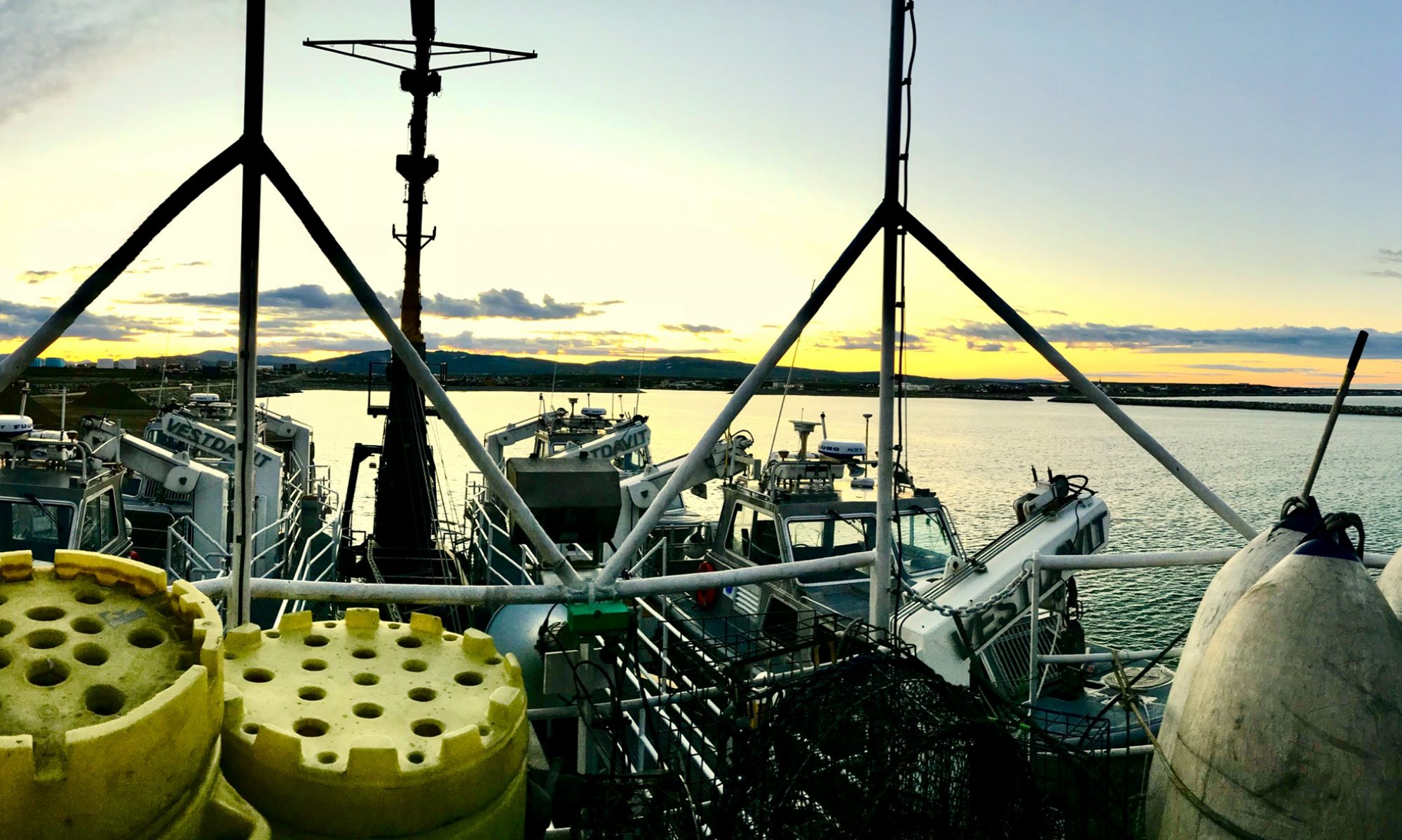
A view of this morning. The water and breeze are calm. NOAA Ship Pisces is sailing at a speed of 10 knot (just about 12 mph).
The current temperature is 23°C (°73F).
The wind speed is 11 knots (13 mph). Source: Windy app.
We’re close to Newport, where Pisces will dock! She’ll dock at Naval Station Newport.
A view of Rhode Island.
Science Log
Uplift Education, Mighty Primary scholars: There’s been a lot of science work lately! Last time, I wrote about the four tasks for our science mission.
Let’s recall: Can you think, share, and then act out these tasks with your parents?
I’ve just finished another sunset shift (3 PM – 3 AM watch) so I’m feeling more tired than usual. But it’s been exciting sampling bluefin tuna larvae and seeing lots of planktons! Here are some updates on each task:
Computers for CTD data
Fun: Watching the computer screens as the CTD instrument goes deep into the ocean felt like playing a video game.
Challenge: Staying focused while recording (writing down) numbers carefully. There’s a lot of data! This task was the most challenging for me. It requires understanding CTD data well so all crews know how to control it.
*Note to self: Don’t forget to hit “save” and “backup” buttons!
Learned: Have a sticky note or notepad handy! Just like taking notes in class, I was always recording numbers on paper and double-checking the numbers. They can be easy to forget with so much going on.
It was awesome seeing how conductivity, temperature, and data really can tell us the best conditions to sample larval bluefin tuna.
Have your notes handy!This task requires paying close to how temperature, conductivity, and depth interact.
Data is fun. For me, the CTD is still a but confusing but I’m a lot more confident using it now. I’m still learning more about it, but it was a great time learning from everyone.
The CTD, live in action! Can you try reading and analyzing (studying) these numbers?
Washing Bongo nets
Fun: Spraying the nets with the water hose was like a mini water fight. This is my favorite task. Once emptied out from the nets, seeing all the planktons caught is super interesting.
Challenge: The nets are heavy when they’re full of seawater and plankton. Plankton are also so small, so I was constantly worried about spraying the nets down too hard. I didn’t want to hurt them, especially when trying to spray down the corners.
Learned: We wash the nets carefully to make sure we collect every tiny creature for research.
The “spray” function was the best because water wasn’t projected too strongly.
It’s important to wear protective gear. I had to learn how to put it on and off quickly before this task.
Bongo nets being retrieved. This is a view from the bridge, where NOAA Corps Officers are supporting with ship controls during net pick up and drop off.
Inside the bridge while during this task. Red light is used so that it doesn’t distract your eyes and focus from seeing other lights. It is dark and very quiet inside during night time. NOAA Corps officers explained to me what’s happening inside the bridge during this task.After they’ve been washed down into trays, it felt great looking at different types of planktons!
We had to make sure the deck was clean and clear before the next station, or stop, for deploying the bongo nets,
Let’s see what we discovered!
When you’re back to school, we’ll identify them all together!
Some plankton samples.They were so small!
Drifter Traps
Scientist Kristen with the drifter traps before their deployment. Do you remember them from one of the earlier posts? Photo credit: Sarah Glancy
A few days into starting our missions, we began deploying them into the waters at night and then recovering them in morning. Photo Credit: Amanda Jacobsen
Some collected samples. Photo credit: Amanda Jacobsen
Preserving samples
Fun: Using science tools made me feel like a real marine scientist.
Challenge: It’s tricky to label each sample correctly and handle them gently.
Learned: Preserving the samples keeps them safe so scientists can study them later under microscopes.
Plankton samples were stored in bottles filled with ethanol, to help preserve (protect) DNA and genetic properties.
We had to be careful to use the right solution when preparing bottles for storage. We don’t want them preserved in seawater!
Did you know: Storing planktons in ethanol (a special kind of alcohol) keeps them from rotting. Ethanol acts like a superhero freeze so scientists can study them later. Without it, samples would break down and we’d lose all their important properties. Photo credit: Amanda Jacobson
Identification (ID)
Fun: Looking at different sea creatures under the microscope is like exploring a new world.
Challenge: It takes patience and practice to tell tiny fish and plankton apart. Even years of practice and studying!
Learned: Looking into the microscope lenses, it helped to take off my glasses for better focus.
Observing planktons under a microscope requires close attention to details.
Dave was excited to have identified bluefin tuna larvae!
Because the ship can get rocky, both my feet and my hands had to be as still as they can be.
Scientists Kristen and Sarah are trying to stay still while observing samples. Imagine trying to take a picture while you’re rocking back and forth!
Once identified, we made sure samples are ok to be stored.
Samples of larval bluefin tuna were stored in these vials, or small sample bottles!
Here are some planktons I saw under the microscope… We will describe and then identify them once we’re back to school!
Activity: Microscope Sample Fun! We will look at real microscope pictures and become scientists! Students, if you’d like: draw, label, and describe what you see in each photo. Zoom into each photo if possible. Use adjectives to describe color, shape, and texture when talking about each sample. Don’t forget the small details! We will discuss these samples once back to school.
Bluefin fish larvae! Photo credit: Autumn MoyaMore bluefin fish larvae samples. Photo credit: Autumn Moya
Crew members aboard NOAA Ship Pisces.
It really does take a team to make the “science” work.
Even though crew members on NOAA Ship Pisces are in different teams, everything on the ship and throughout this mission requires collaboration, understanding, and patience.
Can you tell your parents a time when you had to work in a group with different classmates? What was it like? Did you get along with everyone? What happened when you didn’t? How did everyone work together to get the task done?
These four tasks wouldn’t have been possible without the hard work of these crews: Steward, NOAA Corps, engineer, electronics, survey, and deck.
Personal Log
My days at sea are long, just like a school day might be for you. Once I finish my shifts at 3 AM, I’ve been going to straight to my stateroom for a shower and then bedtime. Because my roommate wakes up at 4 AM for his ship work, I must stay quiet, just like you would at home sharing a room with a brother or sister.
I’ve been waking up at 11 AM, just in time to get ready and then eat lunch. Until 3 PM, I have time to take care of my personal needs.
Staying active while sailing is important! There’s fitness equipment for exercising. Rooms are available throughout the day and night for crew members to use. Because they’re small spaces, we try to keep them clean, tidy, and to a small number of people.
Running on the treadmill feels like doing the wobble line dance! You have to remain balanced with the shop rocking back and forth.
Fishery work can get messy. I’ve been able to do laundry during free time every few days.
Pictured: Survey Technician Ian and Ensign Cheney,. There were times when I ran out of clean shirts to wear after a watch. But, no problem! There’s a store in the lounge area with shirts, sweaters, and hats that can be purchased. They have awesome NOAA Ship Pisces designs on them. Buying them supports crew members through awesome events and activities.
It’s also important to take care of our overall health, just like we do throughout the school day with brain breaks or with visits to the nurse. There’s a medical room I’ve been going to for medicine, including pills for seasickness or body pain. I’ve also been reminded of ways to keep both my body and mind healthy. These reminders are posted all over NOAA Ship Pisces because when you’re away from family and friends, it can feel difficult.
To learn more about crew members and what they do, there was time to tour different parts of NOAA Ship Pisces.
Autumn and I were taking photos outside when we decided to go into the bridge and learn more about its operations.
The bridge of a NOAA ship is like the ship’s control center. It’s where NOAA Corps Officers take turns on watch all day and night to make sure the ship is sailing safely. The bridge has been supporting our science mission by making sure NOAA Ship Pisces is in the right spot for sampling.You can see navigation, communication, and engine controls! This means that the ship’s location and route is always known for all crew members. They control the ship while we survey throughout all four tasks. With some of the NOAA Corps Officers who’ve been showing and explaining all operations of the Pisces. Pictured: Ensign Howsman and Lieutenant Urquhart.Lieutenant Musick has been a big support as well throughout this mission!
We also learned that the engines of a ship are equally as important.
This is Chief Engineer, Adam Butters. He’s the leader who takes care of all the machines on the ship. He and his crew make sure everything works properly, like the engine, power, and water. They help fix things when they break and keep the ship running smoothly so the crew can do their jobs safely! Chief Engineer Adam Butters giving us a tour and explanation of all the engine system we saw.
The engineer crew.
Below was a tour of important engines needed for the ship to sail safely. The machines were incredible! It was amazing to see how hard the engineering team works to make sure the mission was possible for us.
It got loud and hot in the engine room! We had to wear earplugs to protect our ears.
It was fascinating to learn so much about ship engines. These engines help the ship move through the ocean, just like your legs help you walk. They burn fuel to make power, turning giant propellers under the water to push the ship forward.
Next up was a tour of the Acoustic Room. Inside, scientists and technicians use sound waves (through special computers and instruments) to hear all sorts of sounds underwater. These sounds help them find the ocean floor, see how deep the water is, and spot sea animals.
In our mission, we collaborated with an awesome survey technician, Ian!
Ian makes sure our machines, especially CTD, works correctly and safely. He can help fix them if goes wrong.
With Ian, I also learned about special tools used to map the ocean floor. This is called hydrography. It’s like making a giant map of what’s under the sea! Here’s a tour the Acoustic Lab.
There’s even a disco ball there!
Of course, we can’t forget our electronics technician, Alex!
Without him, we wouldn’t have had internet on the ship. Alex helps fix and take care of all the ship’s important electronics, like computers, radios, and screens. Thanks to Alex, the science and the fun can keep going!
Now, it’s your turn to be scientists…
Uplift Education, Mighty K-12 students: My time on sea’s coming to an end. I’m returning soon to Texas, so this isn’t goodbye…
It’s a “SEA” you later!
However… I now pass this adventure to you:
Reflection questions for you:
What do you think would happen if we didn’t collect ocean data using tools like the CTD?
Why do you think it’s important to study larval bluefin tuna?
Even if scientists complete this mission, what do you think you could discover or protect when you become a scientist one day?
The amazing science crew! They look forward to seeing you at sea and working with you, future Mighty scientists!
As I’m about to sail back… I can’t help but wonder… could one of you be the next ocean explorer?
To family, friends, community, NOAA Ship Pisces crew members, readers, and supporters of NOAA’s work & cause: Once back in Texas, I look forward to sharing my experiences with you in an upcoming conclusion post. Please stay tuned!
Texas A & M- Bachelor of Science in Marine Engineering
Technology
Wage Mariners-civil service federal employee (nonmilitary)
Do you have any plans for future education?
Currently investigating at master’s programs in Nuclear Engineering
Engineering aboard Fairweather
Generator
Boiler
Reverse Osmosis Machine
Reverse Osmosis Machine
Controller
Main engine
Air compressor
Fire main
Marine Sanitation Device
How did you find out about your current position at NOAA?
I met a NOAA recruiter at a job fair at Texas A & M, submitted resume and 3 weeks later I got the call! After that the lengthy background check and physical for Federal employees, I came to work at NOAA aboard Fairweather.
1) When you were a child, what was your dream career?
I wanted to be an astronaut when I was young. I looked into aeronautical engineering and attended a Federal Service academy – the United States Merchant Marine Academy. My Dad is an engineer and contractor, so I grew up on job sites and always had the mindset of math and science. I knew my career would be something in the STEM field
2) What was your
favorite subject in school?
My favorite class was
differential equations. Why I like
engineering so much is everything is one big puzzle, and differential equations
is like one big puzzle.
3) Why is what you do important to on the ship?
Engineers on ships are
essentially the lifeblood of the ship, we keep the ship moving. We are the electricians, plumbers, the
mechanics, and even the firefighters.
The ship can’t go anywhere without engineers!
4) What would you tell an elementary school student about your work that is important to you?
I enjoy solving the puzzles. When something goes wrong, I enjoy finding out why something is not working and then solving the problem. That is what is so rewarding — figuring out what is wrong and fixing it!
5) Where do you do most of your work?
In the engine room. That’s where I spend my 8-hour shifts. The engineering room is on A & B deck — the 2 bottom-most levels of the ship. That is where most of the mechanisms that run the ship are located.
6) What tool do you use in your work that you could not live without?
A crescent wrench! Mine is handy because it can measure and tell
you the exact size of the nut which makes things a lot easier!
7) If you could invent any tool to make your
work more efficient and cost were no object, what would it be and why?
I would invent a tool
that could reach bolts at odd angles.
Like a magnetic wrench that could adjust to the size bolt head you need
and could bend around the odd angles and apply torque when I need it.
8) What part of your job with NOAA did you least expect?
I never expected to be in Alaska!
9) How could teacher help students understand and appreciate NOAA engineering opportunities?
I think it would be
valuable to have better understanding of what we engineers do! It’s a
really cool job, with a really good salary, and very few people know there are
positions like this available.
10) What is your favorite part of your day when you are working and why?
Every day is a little
different, you are never doing the same thing over and over again. Something is always breaking and needs
immediate attention.
11) What was your favorite book growing up?
My favorite book
series when I was growing up was Junie B. Jones! I come from Florida and loved Jacques Cousteau.
He inspired me to become a scuba diver
at 17.
12) What do you think you would be doing if you were not working for NOAA?
I would be still be
working on a boat!
13) Do you have an outside hobby?
I love camping and hiking, I’ve hiked 40 miles
of the Appalachian Trail and
would like to hike the rest!
Geographic Area of Cruise: Seattle, Washington to Southeast Alaska
Date: June 6, 2018
Weather Data from the Bridge
Seattle weather is sunny, with a high near 75 with South Southwest wind 5 to 7 miles per hour and becoming calm.
Science and Technology Log
There are five different ways to steer NOAA Ship Rainier using the rudders, or vertical blades submerged in the water. All methods rely on a steering pump to activate hydraulic fluid to move the rudders.Three different methods can be done with electricity from the Bridge, or the front windowed area of the ship. The first electrical method is autopilot which simply sets the course of the ship. The second method is hand and helm which uses a wheel to steer the ship. The third method from the bridge is called non follow up and uses a dial to mark the course. The other two methods utilized occur from back of the ship, or the aft, and include the electrical powered trick wheel and manually operated hand pump steering.
Junior Officer Airlie Pickett steering the ship using hand and helm
Steering allows you to follow a course and can efficiently be done by using the two rudders which are located behind the fifteen foot propellers on either side of ship Rainier. The left-hand, or port side, rudder and starboard, or right side, rudder steer the ship using water pressure. When the rudders are straight the water moving from the propeller to the rudder will keep the boat moving directly forward. When the rudder moves to the right, the back of the boat moves to the left which moves the bow of the boat to move towards the right. The rudder moves in the direction of less pressure, causing the stern and boat to move in that direction.
Trick wheel steering uses electricity to power the steering pump when steering cannot be done from the Bridge. It uses hydraulics which creates power from oil pressure to move the rudders. Rainier is a 50 year old ship that still functions on hydraulics, while most modern ships use low initial cost, simple design pneumatic which uses a compressed gas to create the fluid pressure. In order to activate trick wheel steering at the aft, a toggle pin must be removed to disconnect steering from the bridge and a gear must be put onto its thread. A sound powered phone that doesn’t require electricity operates by using the sound pressure from a person’s voice to create an electrical current which is then converted back to sound by the receiver. This allows for communication of the course to steer between the bridge and the steering aft. The instructions include a degree and a left or right rudder command.
The steering system on the ship is run on hydraulics, whether the steering originates from the bridge or the aft. There are three solenoids at the controller which change electrical power to hydraulic signals in the aft. Solenoids are also in the transmissions of cars and are coils of metal in a helix shape that act as electromagnets. The energy generated from the solenoid moves a shaft with gears that is connected to two pumps. The fulcrum connected to the navigation bar moves from the power generated by the change in pressure from the liquid. The one pump activated pushes hydraulic fluid to the rudder pumps which then move the rudders and steer the ship. Each pump has cylinders and pistons inside of it with the hydraulic fluid, or oil, that creates the change in pressure for the closed system to work.
Hydraulic steering system in the aft of the boat
Personal Log
Amanda Flinn, hydrographic survey technician, has a smile and laugh that makes you feel readily welcomed. When I first met her on Saturday in the mess room watching Game of Thrones, her friendly demeanor immediately put me at ease. I thoroughly enjoyed getting to know her on our walk to Pike’s Marketplace which was filled with moments of genuine laughter. Amanda is a sincere individual with a vast understanding of hydrography.
Amanda’s knowledge about surveying has been accumulated over the past eight months that she has worked on Rainier. Her passion for data processing and map generation became apparent after chatting with her in the Holodeck, the annex survey space behind the plot room on the F deck of Rainier. She shared several maps that were generated from the Channel Islands’ project that was conducted over a six to eight week time period. A highlight of her first survey in the Southern islands of California, included observing the island of basalt rock columns at Castle Rock.
Amanda in front of a launch boat on ship Rainier
Amanda’s passion for rocks led her to study Geoscience with a minor in Oceanography at University of Connecticut. Her college experience in the state where she grew up prepared her for her current surveying position. Her responsibilities during surveys include collecting data in launches and processing data in the evenings. Amanda’s recent promotion from assistant survey technician to an H.S.T, or hydrographic survey technician, proves her competency.
Amanda learned about a job opening with NOAA after her first harp performance last June while living in New Hampshire. She serendipitously met a woman married to a survey technician on the Thomas Jefferson, another NOAA vessel that had a position opening. Since Amanda was looking for hydrographic work, she took a bus into Boston to explore the survey vessel and liked what she saw. She eagerly applied to NOAA and soon had a phone interview and was asked her ship preference. Since Amanda wanted to explore the West coast and travel to Alaska, she chose S-221, survey ship Rainier.
Amanda was hired in October and has loved her experience of sailing on a ship and being on the ocean. One of her favorite parts about surveying includes getting up close to rocks on the launches, or small boats when surveying. While some people find it challenging to be away from family, Amanda appreciates the sea exploration that takes her to natural scenery along the West coast with beautiful sunsets daily. Since she loves it so much, she can see herself continuing to call Rainier home for several more years before returning to live on land someday.
Amanda became qualified in data acquisition last October and began her first round of surveying at the Channel Island Marine Sanctuary in November. A typical day out at sea when surveying includes waking up, eating breakfast, meeting on the fantail, surveying on launches all day with a break for a soup and sandwich lunch. This is followed by eating dinner and beginning evening processing. The sheet manager assigns different sections and prepares all data for the next day.
While being out in the launches and collecting data is her favorite part, Amanda also enjoys processing data. She utilizes Caris and Pydro-Explorer, software Pacific Hydrographic branch has developed for NOAA ships to remove noise from the pixelated images of the two and three dimensional maps generated from the surveys. For quality control, she completes cross lines tests and junction analysis to ensure that new and old surveys match up. Amanda worked on data processing in Newport, Oregon while the ship was dry docked in Portland for the winter season and hopes to complete the report for the Channel Island survey soon.
Mission: Juvenile Pollock Survey Geographic Area of Cruise: Gulf of Alaska Date: September 13, 2017
Weather Data from the Bridge
Latitude: 55 06.6N
Longitude:158 39.5W
Winds: 20 S
Temperature: 11 degrees Celsius (51.8 degrees Fahrenheit)
Up. Down. Up. Down. Left. Right….no I’m not in an aerobics class. High winds and seas cause my chair to slide across the floor as I type.
Thus far we’ve been working 12 hour shifts, 24 hours a day. Today we’re sitting about twirling our thumbs as 12 feet seas toss us about. It’s not too bad actually, but it is bad enough to make operations unsafe for both crew and equipment. I’ve been impressed with the safety first culture on-board the Oscar Dyson. Hopefully, it’ll calm down soon, and we can start operations again.
Science and Technology Log
Ship support systems for power, water, sewage treatment, and heating/cooling are all several levels below the main deck, which makes ship engineers a bit like vessel moles. These hard working guys ensure important life support systems work smoothly. Highlights from my time with them include a lesson on the evaporator and engines.
The evaporator, which for some reason I keep calling the vaporizer, produces the fresh water drinking supply. The evaporator works by drawing in cold seawater and then uses excess engine heat to evaporate, or separate, the freshwater from the seawater. The remaining salt is discarded as waste. On average, the evaporator produces approximately 1,400 gallons of water per day.
*Side note: the chief engineer decided vaporizer sounds a lot more interesting than evaporator. Personally, I feel like vaporizer is what Star Trek-y people would have called the system on their ships.
The evaporator in action.
The Oscar Dyson has 4 generators on board, two large, and two small. The generators are coupled with the engines. Combined they produce the electricity for the ship’s motors and onboard electrical needs, such as lights, computers, scientific equipment, etc.
I even got to see the prop shaft.
Personal Log
This week I also spent time in the Galley with Ava and Adam. (For those of you who know me, it’s no surprise that I befriended those in charge of food.) Read on for a summary of Ava’s life at sea story.
Me: How did you get your start as a galley cook?
Ava: When I was about 30 years old, a friend talked me into applying to be a deck hand.
Me: Wait. A deck hand?
Ava: That’s right. I was hired on to a ship and was about to set out for the first time when both the chief steward and 2nd cook on a different ship quit. My CO asked if I cook to which I replied “for my kids,” which was good enough for him. They immediately flew me out to the other ship where I became the 2nd cook. 12 years later I’m now a Chief Steward.
Me: Wow! Going from cooking for your kids to cooking for about forty crew members must have been a huge change. How did that go?
Ava: To be honest, I made a lot phone calls to my mom that first year. She helped me out a lot by giving me recipes and helping me figure out how to increase the serving sizes. Over the years I’ve paid attention to other galley cooks so I now have a lot of recipes that are my own and also borrowed.
Me: What exactly does a Chief Steward do?
Ava: The Chief Steward oversees the running of the galley, orders food and supplies, plans menus, and supervises the 2nd Cook. I’m a little different in that I also get in there to cook, clean, and wash dishes alongside my 2nd Cook. I feel like I can’t ask him to do something that I’m not willing to do too.
Me: So you didn’t actually go to school to be a chef. Did you have to get any certifications along the way?
Ava: When I first started out, certifications weren’t required. Now they are, and I have certifications in food safety and handling.
There are schools for vessel cooking though. My daughter just recently graduated from seafarers school. The school is totally free, except for the cost of your certification at the very end. For people interested in cooking as a career, it’s a great alternative to other, more expensive college/culinary school options. Now she’s traveling the world, doing a job she loves, and putting a lot of money into her savings.
Me: Talking with crew members on this ship, the one thing they all say is how hard it is to be away from family for long stretches of time. A lot of them are on the ship for ten months out of the year, and they do that for years and years. It’s interesting that your daughter decided to follow in your footsteps after experiencing that separation firsthand.
Ava: I was surprised too. Being away from friends and family is very hard on ship crew. Luckily for me, my husband is also part of the NOAA crew system so we get to work and travel together. Nowadays I’m part of the augment program so I get to set my own schedule. It gives me more flexibility to stay home and be a grandma!
Did You Know?
Nautical miles are based on the circumference of the earth and is 1 minute of latitude. 1 nautical mile equals 1.1508 statue miles.
Location: 56o20.5N 166o07.1W (We are currently ~ 170 miles due east of the Alaskan Peninsular National Wildlife Refuge!)
Weather from the bridge: 51o F, Wind 8-10 knots from 285o, high thin clouds, seas 2-3 ft (1 hour after I wrote this we were socked in with fog, which is fairly common for this part of Alaska during this time of year.)
Science and Technology Log:
Fairweather was commissioned in 1968 and has 2 engines. The engines are pretty ridiculously big. They are diesel combustion engines and run similarly to a diesel tractor engine.
Karla Martinez standing next to one of the engines for scale. She is an oiler, and currently the only female member of the engineering crew. Go Karla!!
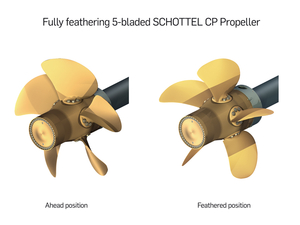
She was built with Controllable Pitch Propellers. This technology is fascinating!! It allows for very fine control of the ship’s motion.
An image of a CPP propeller with blades in two different positions to show the axis of movement. Image courtesy of Schottel website.
The CPP technology works by turning each of the propeller blades on its individual axis. In this way, the propellers never have to change the direction of spin, but instead the spin continues the same direction but the ship can come to a stop and then reverse direction. This differs from the fixed propeller system that is on the small launches. The Fairweather’s propeller blades are about 3 feet each in size for a total propeller diameter of 7 feet.
She also has a bow thruster which can be used in certain circumstances. The bow thruster enables the bow to move from side to side while the stern of the ship is static. It is essentially a propeller mounted into a tunnel/hole in the bow giving thrust perpendicular to the typical direction of travel. For a large ship like Fairweather, this is especially helpful when moving in and out of docking locations.
The next two technologies are of particular interest for my environmental science classes. Because the ship is often at sea for extended periods, it is necessary to make fresh water from the salt water. Typically Fairweather will take on ~16,000 gallons of water in port, but evaporators will be used to generate supplemental freshwater when it is needed.
This is the seawater intake for one of the evaporators.
The evaporators on Fairweather are flash (plate) evaporators and they can generate around 160 gallons of water per hour when operating optimally. The evaporators are running a distillation process by evaporating the water using heat from the boilers at a low pressure and then separating the freshwater from the brine (highly saline water). Because of the constant removal of salt from the water, the evaporators need to be cleaned often for best use.
This is one of the flash evaporators. Inside the pressure is lowered and the temperature runs at about 170 degrees F. While this is below the normal boiling point of water, the water will still vaporize and condense due to the low pressure
The brine is then discharged and the freshwater is added to the supply tanks. When leaving the tanks, it is pumped to higher pressure and further treated through filters and with UV light to kill off any bacteria that may have made it through. That water is stored in a hydropneumatic tank at high pressure so that water can be delivered to all parts of the ship without the need for continuously running pumps.
People eat and drink and then they pee and poop. They also like to shower and brush their teeth and wash their hands. They also need water to drink and cook with and to make coffee and tea. Obviously there is also a lot of gray water (sinks and showers) and black water (toilets) that is produced on a ship of this size carrying ~40 people. So what is done with all of it? Well, blackwater goes through the MSD (marine sanitation device) before it is discharged outside of 3 nautical miles from land. MSDs are standard on all ships and work similarly to land based sewage treatment on a much smaller scale. Gray water can be acceptably discharged as is in most places, but must be stored within NDZs or No Discharge Zones.
Guidelines for discharge
Other necessary technologies on the ship are the refrigeration system, the boilers and the generators. But I won’t go into all of those processes. It’s just amazing to me that there are so many things that must be accounted for on a ship if it will be at sea for multiple days!
Crew of the Day! Engineering
If you’re going to get pictures of the engineering crew, you have to find the rare times when lots of them are together… you can find a good group at mealtimes or when the ship is being docked and they all need to be on the boat deck! L-R: Sean, Kyle, John, Mick and Ray
L-R Sean, Connor, John, Mick, Alex, Eddie… and even with all my stealth, I’m still missing a couple from the group pictures!
The Engineering crew on this ship is a highly eclectic bunch! They are also a REALLY difficult group to get together for pictures. They have about a 40 year span in age and include folks from all over the world with a great diversity of backgrounds. There are several levels within the engineering crew. The entry level position is termed a wiper, next is an oiler, and then engineering utility, and junior engineer. These positions are unlicensed, analogous to enlisted positions in the military. The licensed positions are 3rd Engineer, 2nd Engineer, 1st Engineer and Chief Engineer. There are five licensed engineers on board right now and another six in the department who are oilers and junior engineers.
Anything that is mechanized, motorized, has an electric cable going to it, or needs to be oiled or lubed, those things all fall under the watchful eye of the Engineering crew. One of the young 3rd Engineers, Connor (nicknamed Titan because he really is giant) also describes them overseeing “Hotel Services” – plumbing, lighting, heating & cooling. The crew keeps a 24 hour watch whenever the ship is underway, and can take over aft steering if something were to fail with the bridge steering. They are also on watch whenever the small launches are being deployed or replaced to their cradles. If the bow thruster is being used, a crew member will also watch to see that it engages properly for use.
The well-being of the ship is in the hands of the Engineers and therefore the Chief Engineer reports directly to the Commanding Officer (where all other department heads report to the Executive Officer). The CO and the Chief Engineer really share the task of running the ship, but ultimate responsibility lies with the CO.
Personal Log:
The food! OH MY GOODNESS!!! The food on Fairweather has been terrific. There are two amazing cooks here currently. Tyrone, who is the Chief Cook, has been with Fairweather for 5 years. Prior to that, he cooked for the Navy. Kathy is the Chief Steward (which means she is in charge of the kitchen and develops the daily menus) and has been with NOAA ships cooking in some capacity for almost 20 years! You’ll learn more about her in my next blog… The Interview Issue!
So, here’s a sampling of what’s been on the menu since I’ve been here: Prime Rib, Lobster, Argentinian flap steak with Chimichurri, Halibut with some crazy good pesto type sauce… I am going to leave the ship about 10 pounds heavier than when I got here. So, this is not what you always get on NOAA ships, but this particular pairing of Kathy and Tyrone makes some serious magic!!