
NOAA Teacher At Sea
Robert Ulmer
Aboard NOAA Ship Rainier
Underway from June 15 to July 3, 2013
Current coordinates: N 56⁰40.075’, W 134⁰20.96’
(southeast of Point Sullivan in Chatham Strait)
Mission: Hydrographic survey
Geographical area of cruise: Southeast Alaska, including Chatham Strait and Behm Canal, with a Gulf of Alaska transit westward to Kodiak
Log date: June 25, 2013
Weather conditions: Misty rain under a blanket of thick clouds and fog, 13.76⁰C, 84.88% relative humidity, 1001.09 mb of atmospheric pressure, very light variable winds (speed of less than 1.5 knots with a heading between 344⁰ and 11⁰)
- Remember that headings on a ship are measured around a full 360⁰ circle clockwise from north. Therefore, 344⁰ and 22⁰ are only 38⁰ apart directionally.

Explorer’s Log: The crew of NOAA Ship Rainier
Especially as we leave the confines of childhood, society views us, at least in part, by our intentional decisions about which people make up our circle of friends and our group of colleagues. Certainly such outside judgments can be unfair when based only on short-term glimpses, predisposed biases, or moments misunderstood for lack of context, but I think that long-term observations of our personal associations can provide meaningful information about us.


My closest circle of friends – intentionally – is populated by a rich gumbo of personalities, ideas, ideals, physiques, insights, humors, tastes, preferences, and behaviors, all of which serve to stimulate my mind, activate my creativity, enrich my soul, entertain my spirit, and motivate my direction. In other words, they are the scaffolding that supports me and the team that carries me along through so many parts of my own explorations. Jasmine’s appreciation of intelligence and beauty, Collin’s sharp wit, Reece’s focused intensity, Dad’s analysis, Mom’s honesty, Lisa’s support, Grandma Madeline’s generosity, Aunt Marilyn’s and Uncle Marc’s welcome, Aunt Lynn’s spunkiness, Cheryl’s cool, Dillon’s quiet observation, Jack’s vision, Teresa’s organization, Bob’s perspective, Katy’s goodness, Chris’s enthusiasm, Emilee’s wonder, Kyle’s repartee, Casey’s lyricism, Will’s genuineness, Rien’s kindness, Tyler’s motivation, Zach’s creativity, Brian’s investment in service, Matt’s passion for justice, Gary’s sense of direction, Tommy’s helpfulness, Silas’s wordsmithery, Loubert’s jocularity, Jonathan’s love….

And then add the brilliant and rich colors and flavors and voices of my larger group of friends and acquaintances: the teachers, administrators, students, and neighbors who daily contribute their own stories and wisdoms to my experiences, and the result – again, intentionally – is very nearly a portrait of me… or at least the me that I aspire to become in my own journeys.
(For my varied generations of readers, think of the Magnificent Seven, the Fellowship of the Ring, and/or the Order of the Phoenix. This is my posse.)
In other words, we often are judged and almost always are defined by the company we keep.

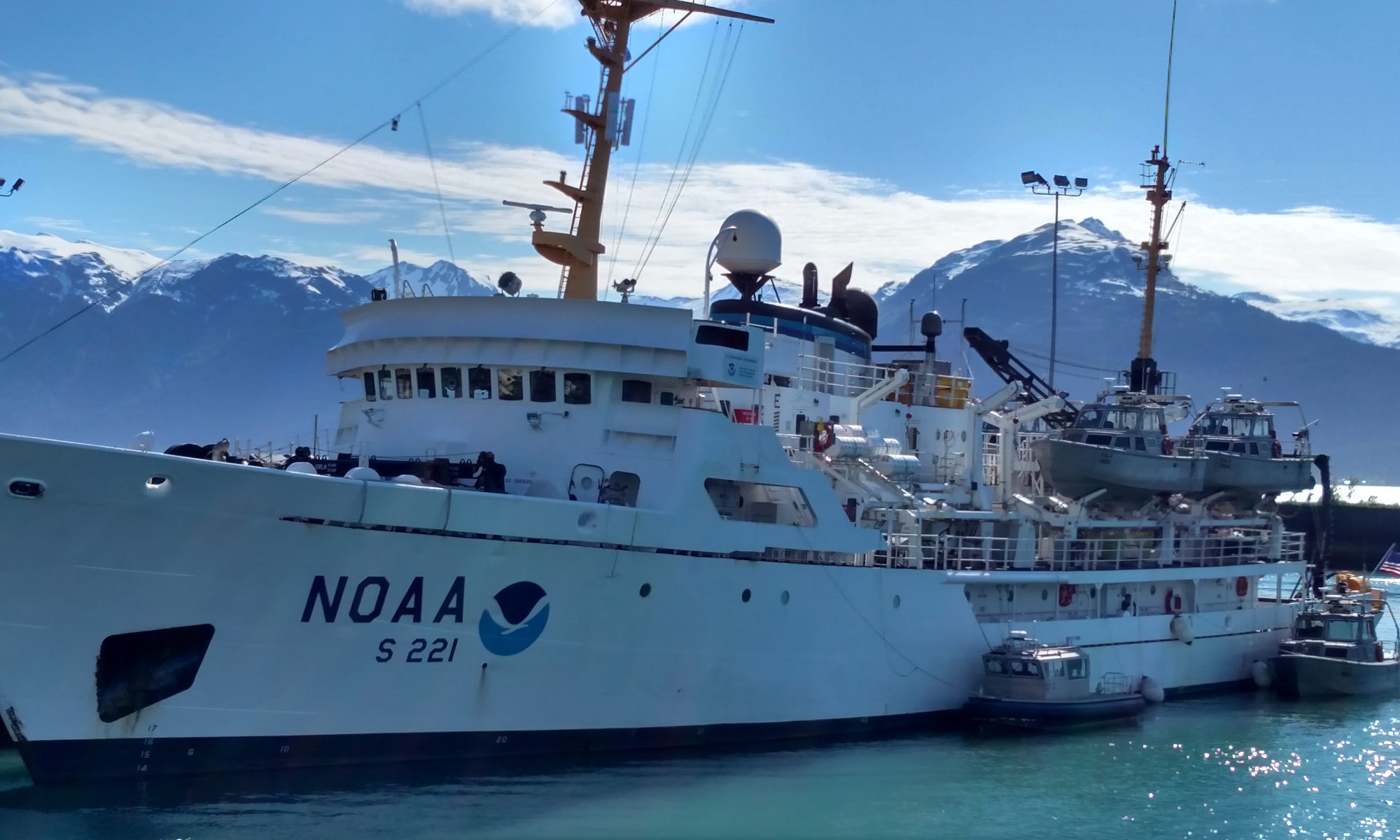
The NOAA Ship Rainier is no exception. Beyond the mechanical body of the ship herself, the personnel here are the essence of the vessel that carries them.

Smart and funny, resourceful and dedicated, skilled and hard-working, the crew members of NOAA Ship Rainier are an impressive bunch, all of whom have enriched me in the short time that I’ve been aboard, and all of whom do their jobs and interact in ways that produce superb results. And the wholeness of their shared strengths, talents, and personalities is far greater than the sum of their individual aspects, as always is the case when a team is well-assembled.

For more than 150 (and sometimes more than 250!) days per year, the men and women aboard ships in the NOAA fleet sacrifice time away from their own homes, friends, and families – and regularly that remoteness isolates them from news, television, phone, and internet for days or weeks at a time – in service to the public at large through their assigned missions at sea. Currently, nearly four dozen crew members serve aboard Rainier in several departments, each of which serves its own set of functions, but all of which are unified by their shared mission, like the instrumental sections of an orchestra in the production of a symphony.
NOAA Commissioned Officer Corps
The NOAA Commissioned Officer Corps, sharply outfitted aboard ship in their navy blue ODUs (operational dress uniforms), is one of the seven uniformed services in the United States government. For this leg of the mission, the officers aboard Rainier serve under Acting Commanding Officer (ACO) Mark Van Waes and Executive Officer (XO) Holly Jablonski to perform three sets of functions: administrative, navigational, and participatory. As the administrators of the ship, the officers are responsible for everything from payroll to purchases, and communications to goodwill. In the navigational capacity, the officers are responsible for charting the courses to be traveled by the ship and moving the vessel along those courses, sometimes with helm in hand and sometimes by giving the command orders to effectuate those maneuvers. Finally, aboard Rainier and her sister hydrographic vessels, the junior officers are trained members of the hydrographic survey team, participating at all levels in the gathering and processing of data regarding the floor of the sea. Ultimately, the NOAA Commissioned Officer Corps members work to define the missions of Rainier and oversee the execution of those missions.

Deck Department

Beyond the uniformed NOAA Corps crew members, Rainier also employs many highly-skilled civilian merchant mariners who work around the clock to support the officers in the duties of navigation and sailing of the ship while it is underway. Essentially, while following the decisive command orders of the Officer Corps, the Deck Department handles the endless details involved in steering the ship and its smaller boats, along with deploying and anchoring those vessels. Under the departmental leadership of Chief Boatswain (pronounced “bosun”) Jim Kruger, the members of the Deck Department all hold various levels of U.S. Coast Guard ratings in navigational watch-standing and deck operations, and their experiences and proficiencies earn them respect with regard to many facets of decision-making and operations on the bridge.
(The NOAA Corps and the Deck Department together have been responsible for the passage of NOAA Ship Rainier through the waterways of Southeast Alaska during my weeks aboard. To see a cool video of NOAA’s travel through Alaska’s Inside Passage made using stop-motion photography by Ensign John Kidd, click here.)

Survey Department
The members of the Survey Department aboard NOAA Ship Rainier are civilian scientists (working hand-in-hand with survey-trained NOAA Corps officers) who have been trained in the specialized work of conducting surveys of the sea floor using single-beam sonar, multi-beam sonar, tidal gauges and leveling devices, CTD devices (to gather data about conductivity, temperature, and depth of the water column), and several very highly-technical components of computer hardware and software packages.

From Hydrographic Assistant Survey Technicians (HASTs) upward through the ranks to Chief Survey Technician (CST) Jim Jacobson, they are superb problem-solvers and analysts with undergraduate- and graduate-level degrees in the cartography, biology, geography, systems analysis, and many other fields of scientific expertise, and one survey technician aboard Rainier is an experienced mariner who transferred into the Survey Department with a broad educational background ranging from the humanities to computer science. The members of the Survey Department spend countless hours gathering, cleaning, analyzing, and integrating data to produce nautical charts and related work products to make travel by water safer for everyone at sea.


Physical Scientists

NOAA physical scientist Kurt Brown joins Rainier in surveying the sea floor of Chatham Strait.
One or two physical scientists join the ship’s crew for most of the field season from one of two NOAA Hydrographic offices (in Seattle, Washington and Norfolk, Virginia), where their jobs consist of reviewing the hydrographic surveys submitted by the ships to make sure that they meet NOAA’s high standards for survey data, and compiling those surveys into products used to update the approximately 1000 nautical charts that NOAA maintains. The ship benefits from the physical scientists’ time on board by having a person familiar with office processing of survey data while the surveys are “in the field,” and also by receiving an extra experienced hand for daily survey operations. The physical scientists also get a refresher on hydro data collection and processing along with a better understanding of the problems that the field deals with on a daily basis, and they bring this up-to-date knowledge back to the office to share with coworkers there.
Engineering Department

The Engineering Department is a combination of U.S. Coast Guard licensed Engineering Officers (CME, 1AE, 2AE, and 3AE) and unlicensed engineering personnel (Junior Engineer, Oiler, and GVA). Their work is concerned with the maintenance of the physical plant of the ship — everything from stopping leaks to making mechanical adjustments necessary for Rainier‘s proper and efficient running in the water. The engineers are skilled craftsmen and craftswomen who wield multiple tools with great dexterity as needs arise.
Electronics Technicians

The Electronics Technician aboard NOAA Ship Rainier (some ships have a larger department) has the important role of making sure that the many computerized systems — both hardware and software — are properly networked and functional so that navigation and survey operations can proceed effectively and efficiently. Having trained on radar equipment with the U.S. Navy “back in the days of glass tubes,” ET Jeff Martin is an expert’s expert, adept at prediction and troubleshooting, and skilled at developing plans for moving systems forward with the ship’s mission.
Steward Department


The Steward Department runs the galley (the ship’s kitchen) and currently is composed of four crew members aboard Rainier. Specifically, they are responsible for menu preparation, food acquisition, recipe creation, baking, and meal preparation for the 40+ people who must eat three meals (and often have snacks) spread across the entire day, both underway and at port, including special meals for away-from-the-galley groups (like launch vessels and shore parties), when local goods (like fish, fruits, and vegetables) are available, and/or for crew members or guests with dietary restrictions. An army moves on its stomach. The meals aboard this ship, by the way, show great diversity, technique, and nutritional value, including grilled fish and steaks, vegetarian casseroles, curried pastas, homemade soups, fresh salads, and a wide variety of delicious breakfast foods, snacks, and desserts.

So those are the current citizens of the seagoing vessel NOAA Ship Rainier, harmonizing within a common chord, travelers who together explore the seas by working together to achieve their unified mission. They are the excellent company that I keep on this leg of the exploration.
As you endeavor upon your own journeys, remember always to choose your company wisely so that your efforts are supported when challenging, insulated when vulnerable, motivated when difficult, and celebrated when successful. And once you are surrounded by those good people, keep exploring, my friends.

Personal Log: Enjoy yourself along the way
Although they all work long, hard hours at their many assigned tasks, members of the team aboard NOAA Ship Rainier also enjoy one another’s company and occasionally get to have a good time. Sharing an isolated, moving home barely 70 meters long with four dozen people for several weeks at a time guarantees social interaction, and the sounds of testimonies of laughter and friendship regularly fill the air in and around the ship, both among the workstations and away from the ship.


Since joining the crew of Rainier just a week and a half ago – and beyond the many exciting excursions that are simply part of the regular jobs here – I already have been invited to join various smaller groups in exploring a town, dining in a local eatery, watching a movie, climbing a glacier, fishing in the waters of Bay of Pillars, walking on a beach, and kayaking through beautiful Red Bluff Bay past stunning waterfalls, huge mountains, and crystal-clear icy streams, including a spontaneous hike into the deep and wild, verdant and untrammeled woods above the shore, following uncut paths usually trod only by deer and bears on their way to the frigid water running down from the snow-capped peaks high above.


Truly, the people aboard Rainier know how to enjoy the gift of life. And I feel honored, flattered, privileged, and happy to be included among these new friends on their great adventures.


