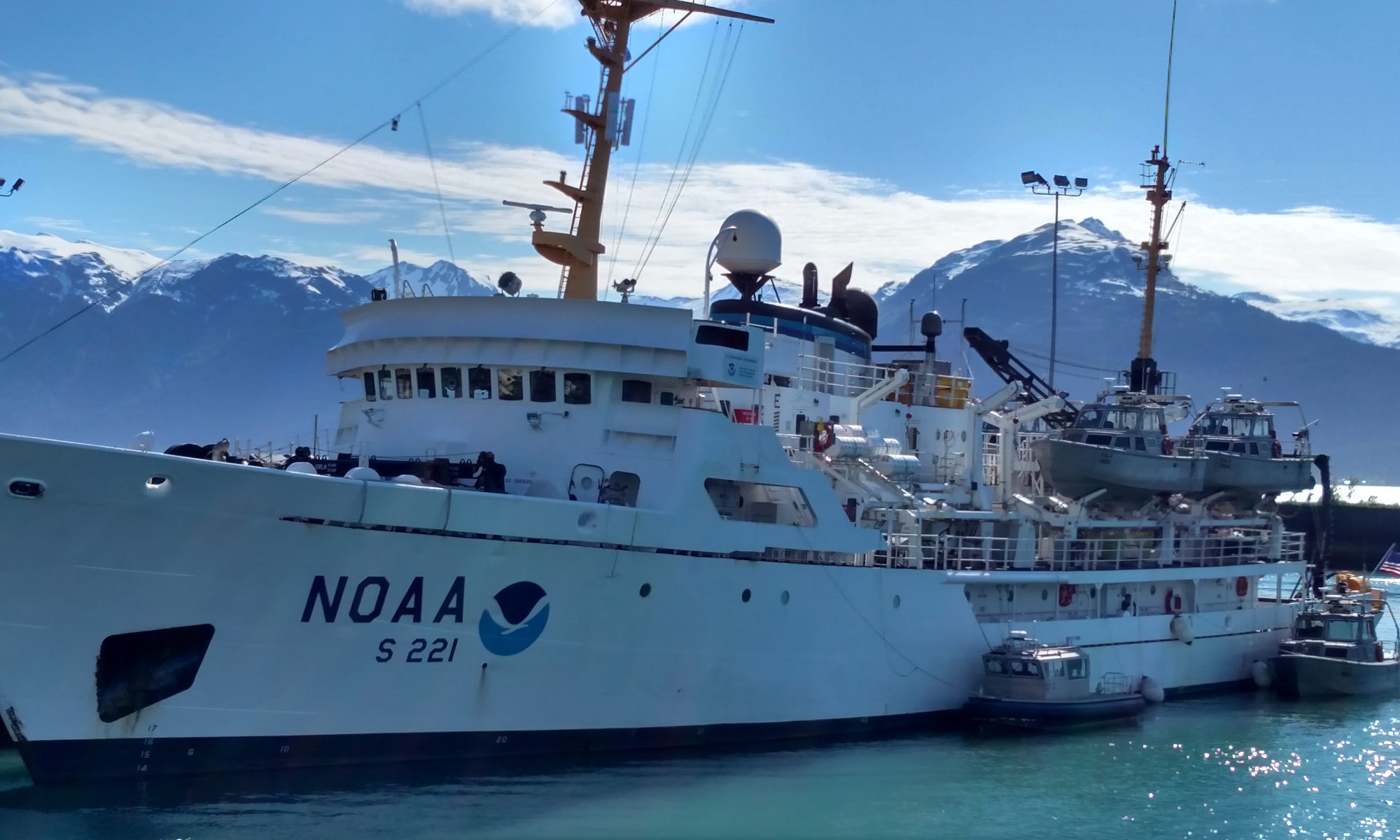
Lindsay Knippenberg: A Tour of the Oscar Dyson, September 8, 2011

NOAA Teacher at Sea
Lindsay Knippenberg
Aboard NOAA Ship Oscar Dyson
September 4 – 16, 2011

Mission: Bering-Aleutian Salmon International Survey (BASIS)
Geographical Area: Bering Sea
Date: September 8, 2011

Weather Data from the Bridge
Latitude: 54.14 N
Longitude: -166.57 W
Wind Speed: 27.33kts
Wave Height: up to 17 ft
Surface Water Temperature: 8.4 °C
Air Temperature: 7.7 °C

While hiding from the storm in Dutch Harbor for the past two days, I had plenty of time to explore my new home onboard the Oscar Dyson. The Dyson is 209 ft in length and is like a small city. Everything that I would need during my two-week cruise, including a laundry room, would be available to me onboard. To show you what life is like onboard a ship, I decided to go on a little tour of the Dyson and take some pictures of the different areas of the ship. If you are interested in  more in-depth specifications of the ship, check out the Oscar Dyson’s website.

Science and Technology Log

Let’s start in the scientific areas of the ship. I have been spending most of my time working with the fisheries team in the fish lab. When we are done trawling and the fishermen bring in the net, they dump our catch onto a large conveyor belt. As the conveyor belt slowly moves, we sort our catch by species. Once we are done sorting, we also process the catch by weighing, measuring, and taking samples of the organisms. To learn more about this process, see my blog post from September 4th.

The Fish Lab. This is where the fish are brought in and processed.

Next to the fish lab is a wet lab. A lot goes on in the wet lab. Some scientists are identifying plankton under microscopes, other scientists are dissecting fish stomachs to see what the fish are eating, and some scientists are filtering water from different depths of the ocean looking for chlorophyll.

The Wet Lab. Scientists study the ocean water, use microscopes, and dissect fish stomachs in this lab.

When you pass through yet another door, you end up in another lab called the dry lab. There are several computers and other pieces of machinery that control the instruments that are lowered over the side of the ship at our sampling stations. This room is where a lot of the oceanography data is collected. I will talk about what they do and the data that they are collecting in another blog.

The Dry Lab. Jeanette is watching the data come in from one of the instruments.

The last lab is across the hall and it is called the acoustics lab. This room is mostly composed of computers and lots of large screens to track where the fish are underneath the boat. Stay tuned for more on acoustics later.

The Acoustics Lab. Paul is using acoustics to watch the fish swim under the boat.

Personal Log

I know that many of you have been wondering…Where do I sleep? What do I eat? What do I do when I am not playing with fish? And do I get to take a shower after playing with fish all day? Hopefully these pictures will help you to get a better idea of what life is like on the ship. It is no cruise ship, but I’m not “roughing it” by any means.

Let’s start with my room. The rooms are actually a lot larger than I thought that they would be. Everyone has a roommate and I am sharing a room with the Chief Scientist, Ellen Martinson. Each room has two bunks, a desk with an internet connection, two lockers for storing gear, a refrigerator, drawers for more storage, and a bathroom.

Mine and Ellen's room.

Ahh…the bathroom. Each room has its own bathroom with a sink, shower, and toilet. Before I got here I had imagined having one large bathroom for each floor or group of rooms, so this was a pleasant surprise. Even better was that it was much larger than any bathroom I have ever seen on a boat. The shower even has a bar to hold onto when you are trying to shower in rough seas, which I have found quite useful.

My Bathroom...it's so huge for a boat.

So what do I eat? It is more like what have I not eaten. The food has been excellent and there is always a variety of choices to choose from. Breakfast is from 07:00 – 8:00 and consists of eggs, bacon, sausage, pancakes or french toast, oatmeal, and today there was even quiche. I’m not a big breakfast person so I have been eating cereal and fruit for most breakfasts. Lunch is from 11:00 – 12:00 and is my favorite meal of the day. The cook makes amazing soups and there is usually a good sandwich to pair it with. If you don’t want soup and sandwich, there is usually burgers, quesadillas, or chicken fingers to choose from. If you don’t think that you can make it until 17:00 (or 5pm) when dinner is served again, don’t worry. There are usually fresh-baked cookies in the galley at around 15:00. If you still are hungry at dinner time, then you are in for a treat. So far for dinner I have had pork chops, spaghetti, leg of lamb, steak, and chicken ala king. Of course you would have to finish dinner with dessert and coffee. How about homemade chocolate cake and a scoop of ice cream? And you can’t just serve a regular cup of coffee. How about a mocha latte made from the espresso machine in the galley?

The Galley. Lots of good food can be found here.

What happens if you eat too much and get sick? Don’t worry, the ship has a medical officer and infirmary if you need medicine. We have had some pretty rough seas during our cruise so it is nice to know that there is somewhere that I can go if I am feeling sick or if I need more medicine.

Not feeling well. Don't worry, the ship has a medical officer and infirmary.
Not feeling well? Don't worry, the ship has a medical officer and infirmary.

What do I do when I’m not playing with fish in the fish lab? Well, there are lots of things to do to keep yourself busy. You could workout in one of two workout rooms. You could choose from over 500 movies to watch in the lounge. You could clean your fish-smelling clothes in the laundry room. My personal favorite is to go up to the bridge and check out what is going on outside. From here you can see for miles and there are usually lots of seabirds to see and if you are lucky you can even see a whale or porpoise passing by.

Wash your dirty clothes at the ship's laundry room.
Relax in the lounge and watch a movie.
Eat too many cookies today? Work off those extra calories in one of the ships two workout rooms.
Check out the bridge to look for sea birds and whales.

Lindsay Knippenberg: I Made It! September 3, 2011

NOAA Teacher at Sea
Lindsay Knippenberg
Aboard NOAA Ship Oscar Dyson
September 4 – 16, 2011

Mission: Bering-Aleutian Salmon International Survey (BASIS)
Geographical Area: Bering Sea
Date: September 3, 2011

Weather/Location Data for Unalaska, AK
Latitude: 53°54’0”N
Longitude: 166° 32′ 36″ W
Wind Speed: Calm
Air Temperature: mid 50’s°F

Personal Log

It was a long day of traveling. I flew from Washington DC to Seattle to Anchorage to Cold Bay to Dutch Harbor.

Whew…I made it to Unalaska. After an entire day of sitting on airplanes and running through airport terminals, I am finally here. I can’t believe how beautiful it is here. The surrounding mountains are a stunning green color and there have even been some sightings of blue sky between the normal grey clouds. I am also amazed at how warm it is. It almost got up to 60°F today, but I was told that the weather can change here pretty quickly. We have already heard of bad weather coming our way next week. The National Weather Service issued a Gale Warning with predictions of wind gusts of up to 50 knots and waves above 20 feet. I had better take my seasickness medications.

The beautiful town of Unalaska.

We don’t ship out until tomorrow, so we decided to take advantage of the nice weather and explore Unalaska. Unalaska is much bigger than I thought that it would be. It is a major international fishing port and is one of the larger cities in Alaska with about 4,000 residents. Life in Unalaska revolves around fishing. Most residents are either commercial fishermen, work in the processing facilities, support the fishermen through stores and other services, or work in the ship yards where the seafood is shipped to all parts of the world. The name of the harbor where all of this is going on might be familiar to you. It is called Dutch Harbor and is where the show “Deadliest Catch” is filmed about the commercial crab fishermen. Crab is not the only type of commercial seafood coming out of Dutch Harbor. Pollock, Cod, Halibut, Rock Sole, and Mackerel are just a few of the other commercial fisheries in Dutch Harbor.

A World War II bunker on top of Bunker Hill in Unalaska (Photo Credit: Jillian Worssam).

For those of you interested in history, Dutch Harbor also has historical significance from World War II. Dutch Harbor was the only land in North America, besides Pearl Harbor, that was bombed by Japanese Zeros during World War II. In our exploring around the island today, we saw evidence of Armed Forces’ bunkers, Quonset huts, and barracks still visible amongst the green hills of Unalaska. The National Park System opened a WWII National Historic Area and Visitor Center in 2002 in Unalaska and I hope to have time to visit it either before or after my cruise.

Enjoying the beach at Summer Bay in Humpy Cove. In 1997 this was the site of a 47,000 gallon oil spill.
Enjoying the beach at Summer Bay in Humpy Cove. In 1997 this was the site of a 47,000 gallon oil spill

What’s the best place to go on a beautiful, sunny day in Unalaska? The beach, of course. We didn’t go to the beach to get sun tans or to go for a swim. We went to check out the tide pools. I love tide pools! It is amazing how resilient the little creatures are that live in the tide pools. When the tide is in they are completely submerged under water and then six hours later they are above the water level when the tide goes out. To make life even harder, they are also smashed by huge waves crashing on them as the tide goes in and out. It is a tough life, but there was such a diversity of life that they must be pretty tough and have some helpful adaptations. As I explored amongst the rocks, I found sea anemones, barnacles, mussels, and lots of different types of seaweeds. On our way back to the van, we also found a stream leading back to a brackish lake and the salmon were running. They are amazing creatures to watch too. The amount of energy that they exert and the sacrifice that they make to reproduce is incredible.

I am now a member of the female dominated science team onboard the Oscar Dyson.

Unfortunately we couldn’t spend our entire day exploring. The plan for the rest of the day is to get settled onboard the Dyson, have a science team meeting to discuss the science that we will be doing and the logistics associated with the different stations and sample sites, and have a safety meeting with the crew of Dyson to discuss life onboard the ship and emergency situations. I am so excited to go out to sea tomorrow and actually start fishing.

Kevin Sullivan: Bering Sea Bloom, August 28 – September 2, 2011

NOAA Teacher at Sea
Kevin C. Sullivan
Aboard NOAA Ship Oscar Dyson
August 17 — September 2, 2011

Mission: Bering-Aleutian Salmon International Survey (BASIS)
Geographical Area:  Bering Sea
Date:  August 28 – September 2, 2011

Weather Data from the Bridge
Latitude:  56.95N
Longitude: 162.93 W
Wind Speed:  10 Knots
Surface Water Temperature: 10.5 C
Air Temperature:  55F
Relative Humidity: 97%

Science and Technology Log:

Well, at this time tomorrow, the Oscar Dyson will be tied up in port at Dutch Harbor.  This is our end destination for Leg I of the BASIS survey.  I will write-up a summary/conclusion either at that time or shortly after getting back into town.  For now, I will fill you in on some material that I promised.  As noted in earlier blogs…I have been intentionally writing in a trophic bottom up approach.  That is, I started my first blog entries with descriptions of the primary producers, the Phytoplankton.  I covered this extensively and correlated it to the oceanographic work that has been going on aboard this ship.  It seemed logical to work from the base of the food chain and work my way up the trophic levels to the more complex consumers.

However, before I close the chapter on Phytoplankton take a look at the picture I took below.  When I stepped outside and saw this, I thought I had been transported to the Caribbean.  Clear skies, calm seas, tropical blue waters are not typical descriptions for the Bering Sea.  If you look closely enough, you can even see the shadow of the clouds on the surface of the sea.   Science is the field of making observations, forming hypothesis, designing and conducting experiments and drawing conclusions about the natural world we live in.  So…what would you make of this observation?  What has caused this temporary “mirage” of tropics?  Clearly something is going on here.

Coccolithophores
Coccolithophores 08-28-11

Well, although not 100% certain, the most likely explanation is what would be called a Coccolithophore bloom.  These are single-celled algae which are characterised by special calcium carbonate plates as seen in photo below under magnification.

Coccolithophore
Coccolithophore

Under certain conditions, (some speculate that wind pattern changes fail to mix the water column favoring cocolithophore blooms as opposed to other plankton) coccolithophores can create large blooms turning the water brilliant shades of blue pending on the species of coccolithophore blooming at the time.  Ed (Chief Scientist) was telling me of a major bloom that had occurred back in the late 90’s.  I researched it a bit and the following picture is of this bloom in the same general vicinity where we are now.  Amazing to think of how microscopic plants can influence a region on the scale of an entire sea and be seen from space. *Note: this is not a false colored Image

Coccolithophore Bloom 98 Bering Sea

There is also some speculation that these types of blooms may be linked to sub-average runs of salmon (and even impact seabirds negatively in the area).  Some hypothesize that this may be due to the idea that salmon prey heavily upon euphausiids (see picture I took below on 08-28-11 and the one centered beneath for a closer look taken from NOAA) and the euphausiids have difficulty subsiding on the extremely small coccolithophores.  Remember what I was saying about visualizing the flow of energy as a pyramid and the effects of taking out a few or many blocks that make up the base of the food chain.

euphausiids 08-28-11
Euphasiid
Euphasiid

Ok, to make this easier for the reader, I am going to stop this blog here and start a new one dedicated to the zooplankton…..I got a little sidetracked with the whole coccolithophore bloom event…….

Personal Log

Earlier this morning we were greeted with some higher winds and consequently some larger seas.  As my friend back East says conditions got “Sporty.”  Here is a picture from where we launch the CTD.  Winds were out of the SW gusting to 30 knots and seas were in the 10′ range with some larger swells thrown into the mix to keep things interesting.

Bering 09-01-11
Bering 09-01-11

Caroline Singler, August 31, 2010

NOAA Teacher at Sea: Caroline Singler
Ship: USCGC Healy
Mission: Extended Continental Shelf Survey
Geographical area of cruise: Arctic Ocean
Date of Post: 31 August 2010

Back to School – Tuesday 31 August 2010

Midnight in the Arctic Ocean
Location and Weather Data from the Bridge
Date: 31 August 2010 Time of Day: 00:00 (12:00 a.m. local time); 07: UTC
Latitude: 76 º 37.6 ‘ N Longitude: 138 º 31.2 ‘ W
Ship Speed: 8.7 knots Heading: 197 º (SSW)
Air Temperature: 0.19 ºC/ 32.3 ºF
Barometric Pressure: 1009.0 mb
Humidity: 98.8 %
Winds: 6.3 knots W Wind Chill: -5.3 ºC/ 22.4 ºF
Sea Temperature: -0.3 ºC Salinity: 25.32 PSU
Water Depth: 3666.9 m
This is a special message for my new Earth Science students, members of the class of 2014 who are participating in 9th Grade Orientation at Lincoln-Sudbury Regional High School today. I am sorry that I cannot be there with you. I am excited to be your teacher this year – you are important to me, and I look forward to getting to know you when I return. You are in the caring and capable hands of Mrs. Iskandar during my absence. Please be respectful of her and thank her for agreeing to cover my classes for the next week in addition to her normal responsibilities in the Science Department.
As you can see, I am a bit too far north to get there on time. I am currently in the Arctic Ocean on board the U.S. Coast Guard Cutter Healy. The ship icon on the map below shows where I was at midnight on 31 August, which was 3 a.m. in Massachusetts. The red lines on the map show different places that we have been during the last month.
Map of Locations
Map of Locations

We left Dutch Harbor, Alaska (pictured on the right) on Monday 2 August, cruised North through the Bering Sea, and have been in the region of the Arctic known as the Beaufort Sea and the Canada Basin for the last four weeks. I am here participating in an oceanography research expedition as a representative of the NOAA Teacher at Sea program. The research mission is called the Extended Continental Shelf Project. It is an international, multiyear effort between the United States and Canada to map the seafloor and the subsurface in the Arctic Ocean off the coasts of the two countries. Healy (pictured on right) and the Canadian Coast Guard Ship Louis S. St. Laurentare both icebreaker ships designed specifically for scientific expeditions in the polar regions. We made it as far north as 82.5º North and are now moving south again. There is still ice around us now, but not as much as we saw just a few days ago. I have been taking a lot of pictures, and I can’t wait to share them with you. Here are just a few from the last couple of days.

USCGS Cutter Healy
USCGS Cutter Healy
Arctic ocean at night
Louis at Sunset
Louis at Sunset

A week from now, on Monday, 6 September, we will leave the Healy by helicopter at Barrow, Alaska, the northernmost town in the United States. I expect to be back at school on Friday, 10 September.

Ice
Ice
Breaking Ice
Breaking Ice

Before then, I hope you will take some time to look through my blog and read about some of the things I have seen and done. Then, I would appreciate it if you would send me a short email at this address: caroline.singler@healy.polarscience.net Introduce yourself to me and then either make a comment or ask a question about the Arctic, either based on something you read in my blog or just something you wonder about and would like to know. I will do my best to answer all your questions, and I will give you an extra credit homework grade for your effort.

Enjoy your first week of high school. Don’t get too overwhelmed by the size of the building or the crazy way the class schedule works. You will get used to it in no time. Have fun.

I’m looking forward to hearing from you. I will see you soon.
Miss Singler

Caroline Singler, July,28 – August 1, 2010

NOAA Teacher at Sea: Caroline Singler
Ship: USCGC Healy

Mission: Extended Continental Shelf Survey
Geographical area of cruise: Arctic Ocean

Date of Post: 2 September 2010

The Journey Begins – 28 July to 1 August 2010

Approaching Dutch Harbor

I left home at 5:30 a.m. on Thursday 28 July for what ended up being nearly 20 hours of travel. At the end of the day, I was exhausted but relieved to have successfully reached my destination, Dutch Harbor, Alaska. The trip from Anchorage to Dutch is 790 miles but required 2 refueling stops along the way and took more than 3 hours. It’s never a sure bet that a plane will be able to land, so we were fortunate to make a safe landing in the rain and wind.

View from Unisea Inn
While in Dutch Harbor, I stayed at the Unisea Inn. It’s not exactly luxury accomodations,and I couldn’t believe there was actually a hotel there when the shuttle driver dropped me off, but it was clean and there was lots of hot water, and my room looked out over the small boat harbor, which was much nicer than the nearby fish processing plants! I spent the last few days wandering around Dutch Harbor and Unalaska. The cool weather was a welcome relief after the hot, humid summer we’ve had back home. I did have to pull out the rain gear, but while it’s often cloudy, it rarely rains for long. The sky is constantly changing, and as the sky changes, everything around looks different as well. It’s been great to just be out walking around since I will be on a ship for the next 5 weeks. Here’s a view of Dutch Harbor from a hill near town.
View of Dutch Harbor
Bald Eagles
Bald Eagles
Puffins
Puffins
When I woke up this morning, I realized it was the last time I’d wake up on land for a while. That was a strange feeling. Late this afternoon we boarded the Healy. I unpacked my bags and I’m ready to go, but we don’t leave port until tomorrow afternoon. I’ll post more after I’ve learned more about the ship’s computer system.Caroline