Eric Heltzel, October 11, 2005

NOAA Teacher at Sea
Eric Heltzel
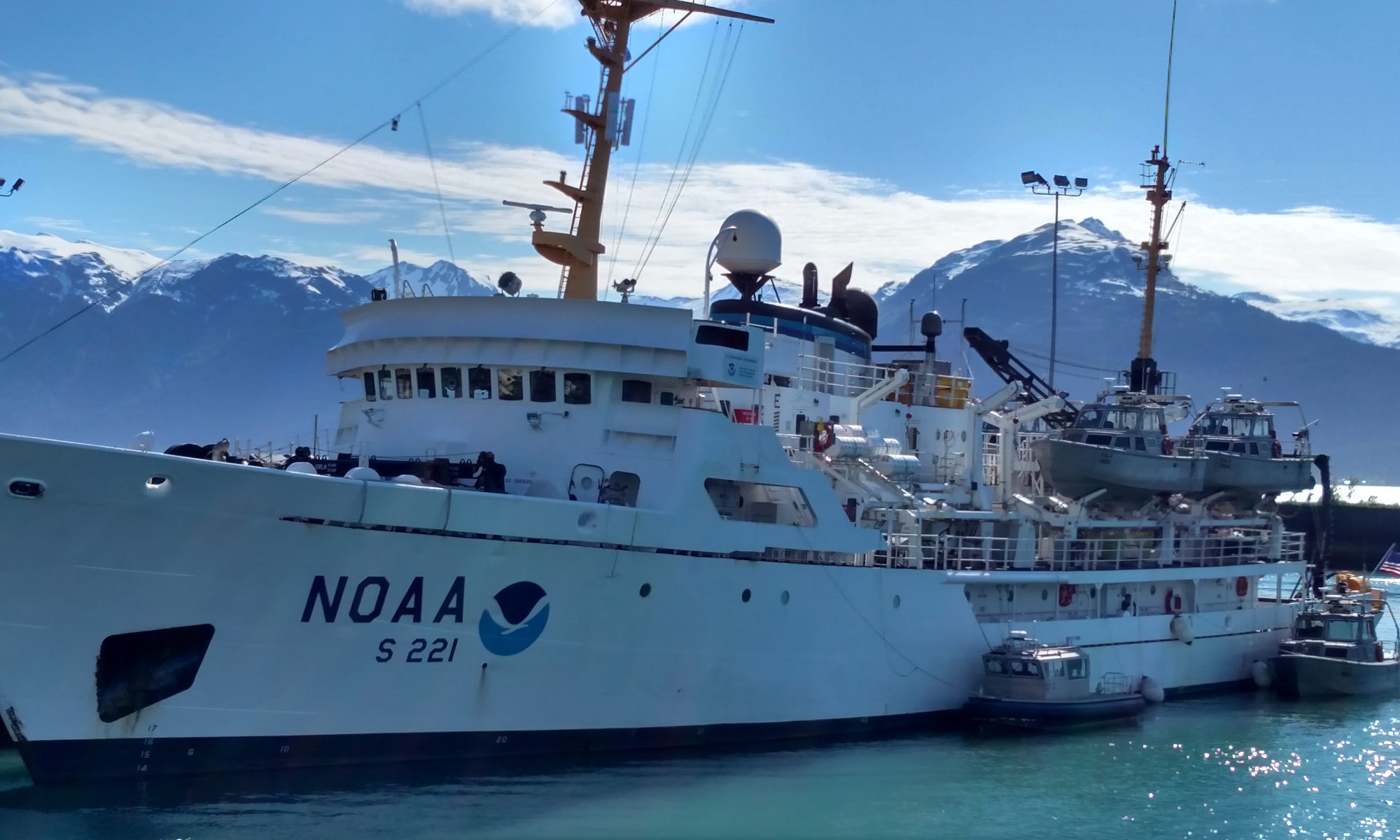
Onboard NOAA Ship Ronald H. Brown
September 25 – October 22, 2005

Mission: Climate Observation and Buoy Deployment
Geographical Area: Southeast Pacific
Date: October 11, 2005

Weather Data from Bridge

Temperature: 25.5 degrees C
Clouds cover: 6/8, stratus, altocumulus
Visibility: 12 nm
Wind direction: 245 degrees
Wind speed: 13kts.
Wave height: 3 – 5’
Swell wave height: 3 – 5’
Seawater Temperature: 28.7 degrees C
Sea level Atmospheric pressure: 1005 mb
Relative Humidity: 82%

Science and Technology Log 

The throbbing heart of the RONALD H. BROWN is the engine room and the associated systems.  Last night Assistant Engineer Wayne Smith gave me a tour.  I was impressed with the complexity and effectiveness of the systems.

The core of the power is six Caterpillar diesel engines.  These function as electric generators for the ship’s systems.  The three largest of these are dedicated to the propulsion of the ship. The ship is propelled and maneuvered by two aft thrusters and one bow thruster. The thrusters are propellers that have the ability to be rotated 360 degrees. Each thruster is driven by and independent Z-Drive that is actuated by an electric motor and shaft.  Under normal sailing only the two aft thrusters are in use.  The bow thruster is engaged when the ship is maneuvering into dock or holding a position.  As I write, we are holding position 0.25 nautical miles from the Stratus buoy.  By engaging the Dynamic Positioning System a location for the ship is established via GPS and a computer controls the direction and rpm of the thrusters.  This allows the BROWN to hold a position without having to drop anchor.  I was surprised to learn that this ship has no rudder—it is steered via the Z-Drive of the thrusters.

Since the BROWN is a research vessel it has on board many sophisticated electronic instruments.  The current running through its wires is like our household current, about 115 volts.  Because of the sensitive nature of some of the equipment there are outlets labeled “clean power”. This current runs through a secondary motor which ensures that there will be no power spikes that could damage electronic equipment.

Ventilation is very important and there are several air conditioning systems that control the temperature in most of the ship.  Different areas have independent thermostats so the ship is quite comfortable.  The science labs are generally kept quite cool.  Freshwater is supplied by using heat from the engines to evaporate seawater.  The condensed steam is run through bromine filters to ensure no bacteria in the water tanks.  The water is extremely soft, having no salts in it.  Wayne chuckled at the idea of people buying bottled water to drink on ship because the water provided is as pure as water gets.

The NOAA research vessel RONALD H. BROWN was launched in 1997.  It is the largest ship in the fleet and provides a state of the art research platform.  The versatility and capabilities of this ship and expertise of the crew allow up to 59 people to sail for extended periods of time and perform sophisticated oceanographic and atmospheric research.  I feel privileged to be along on the Stratus 6 cruise.

Personal Log

Wow! I can see my shadow.  This is cause for staying out on deck. We have been sailing under overcast skies since we crossed the equator.  I’m sitting out on the bench on the 03 deck beneath the Bridge. There’s a breeze blowing from the southeast but I’m comfortable in a light jacket and shorts.  It has been a surprise to be traveling in tropical waters with overcast skies and cool temperatures.  It makes me realize that we get a lot of sunny days in Wyoming.

At 1415 today we had a meeting outlining the program for tomorrow.  Jeff Lord from WHOI is coordinating the buoy recovery program.  He is very organized and has gone through step by step how it will be done.  It will be a very interesting, very busy day tomorrow.  It is very important to the success of this cruise that we recover all of the instruments and buoy safely.  At 0640 the acoustic release will be activated and the floats attached to the mooring will be released from the anchor.  The depth here is 4400 m and it will take the floats about 40 minutes to reach the surface.  This will be a major operation involving everyone on the ship.

Eric Heltzel, October 9, 2005

NOAA Teacher at Sea
Eric Heltzel
Onboard NOAA Ship Ronald H. Brown
September 25 – October 22, 2005

Mission: Climate Observation and Buoy Deployment
Geographical Area: Southeast Pacific
Date: October 9, 2005

Weather Data from Bridge

Temperature: 25.5 degrees C
Clouds cover: 6/8, stratus, altocumulus
Visibility: 12 nm
Wind direction: 245 degrees
Wind speed: 13kts.
Wave height: 3 – 5’
Swell wave height: 3 – 5’
Seawater Temperature: 28.7 degrees C
Sea level Atmospheric pressure: 1005 mb
Relative Humidity: 82%

Science and Technology Log 

After Dr. Lundquist and I have a successful radiosonde launch we return to the computer terminal and watch the measurement data come in.  My favorite display is a color-coded graph showing temperature, dew point, and relative humidity graphed against the altitude of the radiosonde. The main area of study is taking place where we are in the eastern Pacific off the coast of northern Chile.  In this area there is a large, semi-permanent layer of stratus clouds.  The effects these clouds have on the ocean temperature, and vice versa, is one of the reasons for choosing this area to study.

As the balloon ascends from the ship the temperature cools at the dry adiabatic rate. The dew point goes down but not as rapidly.  Usually at an elevation of about  600 meters the dew point and temperature intersect.  On the same screen green line showing relative humidity hits 100% as we would expect.  This marks the base of the cloud layer.

As the radiosonde ascends another 200 to 400 meters the temperature shoots way up, as much as 8 degrees C.  This indicates the top on the cloud layer where the sun is shining brightly. As the balloon continues to ascend the temperature once again cools consistently at the dry adiabatic rate.  It’s about negative forty degrees C at an altitude of 20 kilometers.  In this part of the atmosphere the relative humidity approaches zero and the dew point stays well below the air temperature.  This suggests the upper air is descending and is stable. The bottom 800 meters is referred to as a marine boundary layer.

Despite the constant cloud cover there is very little precipitation in this area.  Temperatures at the ocean level are surprisingly cool as evidenced my most of the crew wearing long pants and jackets or sweatshirts.  Atmospheric and oceanic data in this area are very sparse. One goal of the Stratus Project is to gather more information so we can better understand the interrelationships between ocean and atmosphere.

Personal log

As I write this I am on my watch in the main science lab.  I’m preparing to launch a Drifter in about 15 minutes and I will launch a weather balloon at 13:00.  It’s really fun to throw things into the ocean and release balloons into the atmosphere and see where they go.

Our ETA at the Stratus mooring site is 17:30.  We are approaching the end of southerly leg of our cruise. There are about six days of work scheduled at the buoy site.  It should be interesting.

Eric Heltzel, October 8, 2005

NOAA Teacher at Sea
Eric Heltzel
Onboard NOAA Ship Ronald H. Brown
September 25 – October 22, 2005

Mission: Climate Observation and Buoy Deployment
Geographical Area: Southeast Pacific
Date: October 8, 2005

Weather Data from Bridge

Temperature: 25.5 degrees C
Clouds cover: 6/8, stratus, altocumulus
Visibility: 12 nm
Wind direction: 245 degrees
Wind speed: 13kts.
Wave height: 3 – 5’
Swell wave height: 3 – 5’
Seawater Temperature: 28.7 degrees C
Sea level Atmospheric pressure: 1005 mb
Relative Humidity: 82%

Science and Technology Log 

I’ve been working with the meteorological team from NOAA in Boulder, Colorado. I’ve been teamed with Dr. Jessica Lundquist to manage the 13:00 weather balloon launch. Balloons are launched four times a day at intervals of six hours.  A balloon carries an instrument called a radiosonde to a height often exceeding 20 kilometers.  Eventually the balloon ruptures and the instrument and spent balloon fall to earth.

When preparing a radiosonde we take the battery pack and add water to activate it. As the battery is soaking, the sonde is attached to the computer interface/radio receiver, and it is activated and calibrated.  It is necessary to have real-time weather measurements to input into the sonde so it has a comparison to ensure accuracy.  A radio transmitting frequency is selected then the sonde is detached from the interface and attached to the battery.  While it is still in the lab, we make sure that data is being transmitted.  If all of this goes correctly the radiosonde is set to launch.

We take the activated radiosonde out to the staging bay, which looks a bit like a garage. There are two overhead doors, a workbench, and bottles of helium.  We inflate the balloon with helium to a diameter of about five feet.  When it is inflated we close the balloon with a zip-tie, then attach the radiosonde by its hook, and close it with another zip-tie. We call the Bridge and let them know we are about to launch a balloon.

Now comes the tricky part, walking out on the fantail of the rolling ship carrying a large balloon in one hand and the radiosonde in the other.  Today there 16-knot winds coming from the SE and a wind generated by the ship’s speed of an additional 10 knots from due south.  To complicate matters further, the superstructure of the ship blocks the wind and creates erratic eddies. We check the wind direction and decide on which corner of the fantail will give us the cleanest launch.  Walking aft, the balloon is buffeted by the wind. It pulls and pushes you in various directions while you try to maintain balance on the heaving deck.  When you reach the railing, you hold your hands out and release the balloon and radiosonde. If it clears the A frame and the other equipment you stand and watch your balloon ascend until it enters the cloud layer and disappears.  We call the Bridge and let them know the balloon is away.

Now we return to the Lab to check that our sonde is sending out data.  Measurements of temperature, relative humidity, and atmospheric pressure are taken and sent back every two seconds. The GPS tracking device allows us to know wind speed, wind direction, altitude, and location of the radiosonde.  The measurements of temperature and relative humidity allow the computer to calculate the dew point.  Data streams in until the balloon reaches an elevation where the atmospheric pressure of  about 30, the balloon fails and the radiosonde falls to earth. Tomorrow: More about radiosonde information.

Questions to Consider 

-What is an eddy?

-What will happen to the volume of the balloon as it rises in the atmosphere?

-Why does atmospheric pressure decrease as elevation increases?

-What is the relative humidity when dew point and air temperature are the same?

-What is the adiabatic rate?

-What is a temperature inversion?

Personal log

I am a Pollywog.  Yes, that’s right. I’m one of those slimy little creatures with a spherical body and a tail. At least that’s what the Shellbacks tell us.  A pollywog is a person who has never sailed across the equator and gone through the ceremony and initiation to move onward. Shellbacks are people who have been through these rites.  I made the mistake of admitting that I don’t know what a Shellback is.  I fear that admission will come back to haunt me.  Initiation is approaching. I don’t know what I’ll have to do. I’ll keep you posted.

Eric Heltzel, October 7, 2005

NOAA Teacher at Sea
Eric Heltzel
Onboard NOAA Ship Ronald H. Brown
September 25 – October 22, 2005

Mission: Climate Observation and Buoy Deployment
Geographical Area: Southeast Pacific
Date: October 7, 2005

The adopted buoy, ready for deployment
The adopted drifter buoy, ready for deployment

Weather Data from Bridge

Temperature: 18.6 degrees C
Sea level Atmospheric pressure: 1014 mb
Relative Humidity: 78%
Clouds cover: 6/8,stratocumulus, cumulus, cirrus
Visibility: 12 nm
Wind direction: 140 degrees
Wind speed: 13kts.
Wave height: 3 – 5’
Swell wave height: 6 – 8’
Seawater Temperature: 18.6 degrees C
Salinity: 35.25 parts per thousand
Ocean depth: 4476 meters

Evanston High School, your adopted Drifter is in the water! 

Lara Hutto is a Research Associate II at Wood’s Hole Oceanographic Institution in Massachusetts. She and I deployed our Drifter Buoy off the port side stern of the fantail at 19:01 UTC (the time at the Prime Meridian) on October 6, 2005. Our Drifter serial number is 54410.

The sock of the drifter buoy is unfurled

To: Heltzel’s Oceanography/Meteorology students:  The NOAA decals you signed were placed on the dome of our drifter.  All of your names and the name of Evanston High School are floating freely in the eastern Pacific off the west coast of Peru.  You should be able to track it on the Drifter web page. Should anyone find it they will be able to identify who adopted Drifter 54410.

Update: the EHS drifter is streaming in data from the eastern Pacific. Check it out here. I can’t access this website from the ship but Kevin O’Brien of NOAA says that data is being sent by our adopted drifter.  Check it out and let me know what you find.

Science and Technology Log 

Drifters are a wonderful tool for gathering information about earth’s oceans.  They have a spherical top which provides flotation and contains the electronics of this device.  These include a temperature probe for measuring the surface seawater temperature and a GPS tracking signal. This device is battery powered and is regularly sending out information on seawater temperature and location.

When deployed a fabric tube (sock) extends downward to a depth of between 10 and 15 meters. This is attached to the floating sphere by cable. The sock reduces the effect of winds and surface waves on the movement of the Drifters.  The data is gathered via satellite and plotted. This helps us figure out movements of the ocean waters at the surface.

An entire person can easily fit inside the sock

Compared to many of the instruments that are attached to the Stratus mooring, Drifters are simple.  They are easily deployed because the unit activates itself once it hits the water.  A magnet is attached to the dome and it holds the switch in an off position. Once the magnet is removed, the switch is activated and The Drifter is on the job.  The magnet is attached with water-soluble glue so once in the water the glue dissolves, the magnet falls off, and the Drifter is activated. The sock is also rolled up and held in position with water-soluble tape.  Once in the water this also dissolves and the sock extends downward. The ingenious design of Drifters makes them very easy to deploy.  These are sent out with any type of ship so Drifters have been placed in many of the world’s oceans. Life expectancy on a Drifter is one to two years.

Questions to Consider 

How might the information gathered from Drifters be useful?

What are some ways that the oceans and the atmosphere affect one another?

Personal Log

My quarters are in the low part of the ship.  I have no natural light to tell whether it is night or day. As I lay in my bunk I can hear the sounds of the ship pushing downward through the waves. Sometimes it sounds like gurgling water, sometimes like something solid is striking the hull, other times like the sound of rapids on a river.  When I’m nearly asleep I imagine I am at home in Wyoming and the sounds I hear are of a raging blizzard outside my window. I go on deck of the RONALD H. BROWN and look at the tropical eastern Pacific waters.  Toto, this definitely isn’t Wyoming!

Eric Heltzel, October 6, 2005

NOAA Teacher at Sea
Eric Heltzel
Onboard NOAA Ship Ronald H. Brown
September 25 – October 22, 2005

Mission: Climate Observation and Buoy Deployment
Geographical Area: Southeast Pacific
Date: October 6, 2005

Eric on the bridge of the RON BROWN

Weather Data from Bridge, 07:00 

Temperature: 19.1 degrees C
Sea level Atmospheric pressure: 1012 mb
Relative Humidity: 78%
Clouds cover: 8/8, stratocumulus
Visibility: 12 nm
Wind direction: 160 degrees
Wind speed: 6kts.
Wave height: 3 – 5’
Swell wave height: 3 – 5’
Seawater Temperature: 18.3 degrees C

Science and Technology Log 

The science team from the Upper Ocean Processes Group is busy preparing instruments to be deployed on the mooring of the Stratus 5 Buoy. Each instrument must be physically examined to ensure that it is properly mounted in its rack.  Then these instruments are awakened to make sure that they are working properly. They are hooked up to a computer so that their operation and calibration can be tested.

The Stratus Buoy
The Stratus Buoy

Today I had a look at a mechanical current meter.  These were designed by Senior Scientist, Dr. Bob Weller as part of his Doctoral work at Scripps Institute. The instrument is housed in an aluminum cylinder that is 2 feet long and 7” in diameter.  The canister is water tight utilizing two interior rubber seals. Extending from one end is a 3’ long PCV mast that has two propeller mounts on it. At each mount are two sets of propellers on either side of the hub.  The two mounts are set at 90 degrees to one another. When water flows through the propellers revolutions are measure and the data is stored in a chip inside the canister.  The number of revolutions per given unit of time gives the velocity of the current.  Having two sets of propellers set at 90-degree angles allows the direction of the current to be determined.

There is also a second type of current meter that uses measurements of sound waves to determine current velocity.  Several of these will be deployed on the mooring along with the mechanical current meters.  Using two types of instruments allows the team to compare results.  The mechanical units have been used for about 20 years and they are known to be reliable and accurate.  Placing the acoustic velocity meter nearby will help determine the accuracy of these devices.

Questions to Consider 

Why are all the instrument cases cylindrical in shape?

Why is a “sacrificial zinc anode” placed on each end of the mechanical current meter?

How could the direction of a current be determined using two sets of propellers at 90- degree angles to one another?

Why build canisters out of aluminum?