Nancy Lewis, September 25, 2003

Nancy Lewis
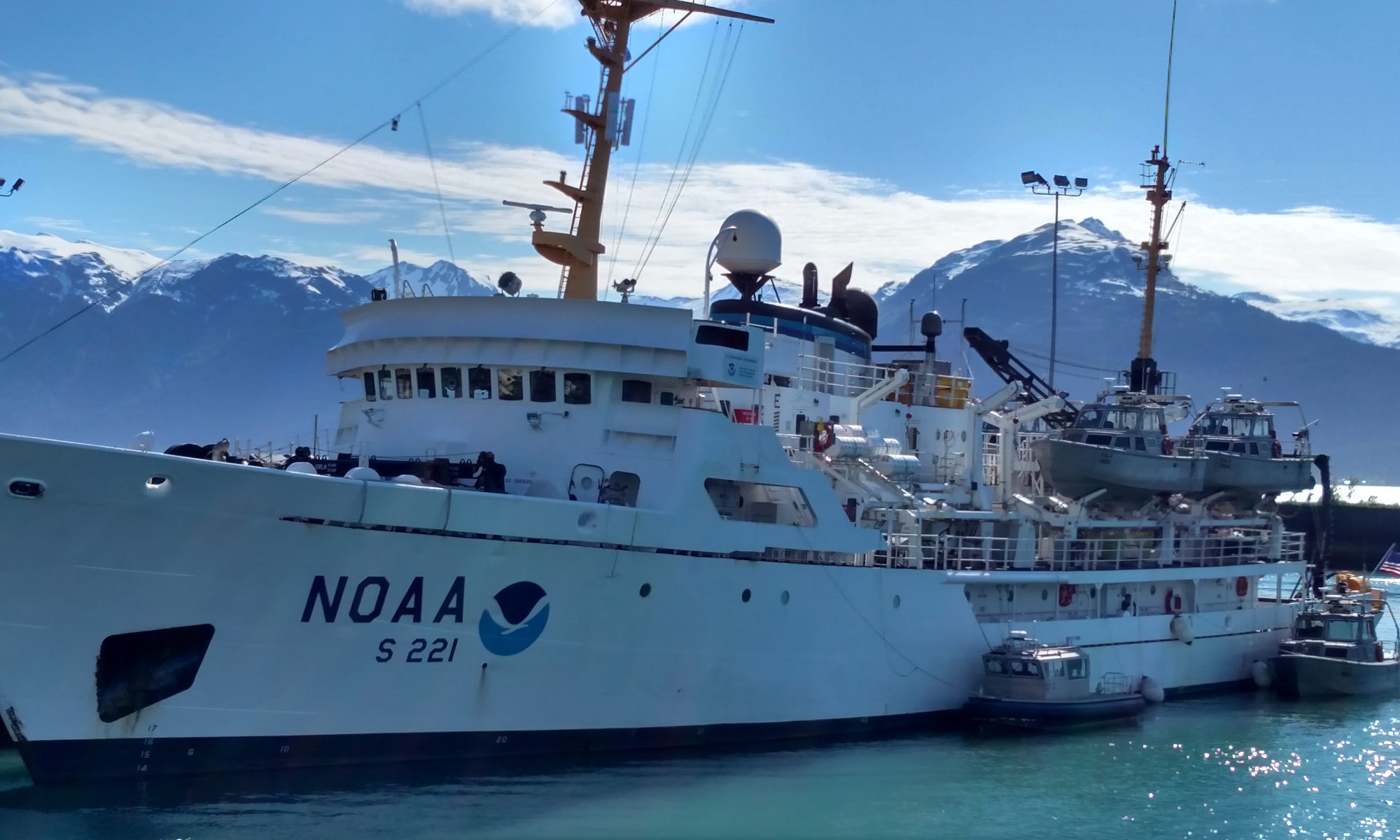
Onboard NOAA Ship Ka’imimoana
September 15 – 27, 2003

Mission: Tropical Atmosphere Ocean (TAO)/TRITON
Geographical Area: Western Pacific
Date: September 25, 2003

Transit to Honolulu, HI:  Approximate arrival:  evening of 9/28//2003

1600-1700:  Fantail BBQ

1800:  Wog Talent Show

Weather Observation Log:  0100

Latitude:  12 degrees, 29.6’ N
Longitude:  145 degrees, 30.0’ W
Visibility:  12 nautical miles
Wind direction:  120 degrees
Wind speed:  9 knots
Sea wave height:  3-4 feet
Swell wave height:  5-7 feet
Sea water temperature:  28.0 degrees C
Sea level pressure:  1013.4 mb
Dry bulb pressure:  28.0 degrees C
Wet bulb pressure:  25.7 degrees C
Cloud cover:  6/8 Cumulus, cirrus

Science and Technology Log

Yesterday,  I asked the question:  “What is the difference between climate and weather?” Understanding the distinction is important, and is often confused by students, who often hear the two terms used interchangeably.

Very simply,  weather is what is happening at any given moment in terms of temperature, rainfall, winds, humidity and storms.  We all know that the weather can change from hour to hour and day to day.  Climate, on the other hand,  is the overall weather pattern and conditions for a given area or region over a period of time.  Thus,  we may say the climate for large areas of the continental U.S. is temperate, while the climate of Pacific islands is tropical.  The Big Island of Hawaii, with its two 13,000 foot mountains, has at least 9 climate zones.

We know that the earth has undergone times in its past of major climate change.  At one time, the polar ice extended down into areas of the United States that today are ice free. We know that even very small changes in ocean temperatures can create conditions that have far-reaching effects around the world.  Scientists are still attempting to understand the interaction of the atmosphere and oceans in order to be able to better predict and prepare for climate changes.  The climate observation system provided by the TAP/Triton array and maintained by the KA’IMIMOANA is an important link in the global effort to completely understand the complex relationships between air, sea, land, and human actions and how these affect climate and weather.

Personal Log

Today I spent a lot of time preparing for the Wog Talent Show, in addition to answering my email and writing this log.  I thought I would share with you part of my little act, which was a dramatization of the Legend of Fenua Enata, the creation myth of the Marquesas Islands. It was set to some very nice island music from the island of Rarotonga, in the Cook Islands.

The buoy that was dedicated to Taiohae School was painted and named by the students: “Fenua Enata,” which they told me was their word for their islands. The term “Marquesas” was the name given to the islands by the first European to come to Fenua Enata.

Legend of the Fenua Enata

A long time ago, when the sun was shining on the sea, the first man, Atea and the first woman, Atanua had no house.

So Atanua told Atea:  “We do not live well without a house”.  Atea did not answer.

He thought:  “I do not know how to build a house.”

Then he thought,  “I have the divine power of the Mana.  I will ask the gods.”

One evening Atea said to his wife Atanua: “Tonight I will build you a home.  I know how.”

It was dark and Atea’s voice was like a spell singing in the silent nothingness:

AKA OA E, AKA POTO E, AKA NUI E, AKA ITI E E

E E, AKA PITO E, AKA HANA E, HAKA TU TE HAE

The spell was finished, the work began, the site was chosen in the middle of the ocean.

Two sturdy posts were erected:  these became UA POU

A long beam was placed on top of them;  it became HIVA OA

The front posts and the rafter covering the roof was NUKU HIVA

Nine woven coconut palm leaves, laid end to end as thatch became FATU IVA

The weaving of the thatch took a long time as did the making of the sennit.

Time passed quickly as Atea worked and worked without stopping.

Suddenly Atanua shouted:  “O Atea e,

The light of dawn is turning the sky to red”:  it is TAHUATA

“O Atea e, Moho, the morning bird just sang”: It is MOHOTANI

Atea kept digging a hole for the litter of fronds, sennit and hau bark,

Until finally he said:  “This is UA HUKU”.

Then the sun lit up the sky illuminating the ocean and the new dwelling place.

Atanua cried out:  “Ir is EIAO”.

Thus, the Land of Men, Fenua Enata, was created.


Question of the Day:  What is the thermocline?


Aloha from the KA,

Nancy Lewis

Nancy Lewis, September 24, 2003

Nancy Lewis
Onboard NOAA Ship Ka’imimoana
September 15 – 27, 2003

Mission: Tropical Atmosphere Ocean (TAO)/TRITON
Geographical Area: Western Pacific
Date: September 24, 2003

Sunrise:  0613
Sunset:  1828

0600:  All wogs on bow

Transit to Honolulu

Time Change:  Set your clocks back one hour to Hawaii time

Weather Observation Log:  0100

Latitude:  9 degrees, 57.8; N
Longitude:  141 degrees, 41.6’ W
Visibility:  12 nautical miles (nm)
Wind direction:  130 degrees
Wind speed:  7 knots
Sea wave height:  2-3 feet
Swell wave height:  4-6 feet
Sea water temperature:  27.8 degrees C
Sea level pressure:  1012.2 mb
Dry bulb pressure:  27.0 degrees C
Wet bulb pressure:  26.0 degrees C
Cloud cover:  7/8 Altocumulus, cumulus, altostrattus
Air temperature:  27.0 degrees  C

Science and Technology Log

The phenomenon known as El Nino will be the subject of our discussion today.  El Nino is a recurrent weather phenomenon that has been known for years by fisherman along the coasts of South America.  During an El Nino, the normally strong easterly tradewinds weaken, bringing warmer than normal currents eastward to the the coasts of Peru and Ecuador.  Fishing drops off, and there can be catastrophic effects in weather all the way from Australia and Indonesia to both American continents.

During the unpredicted El Nino of 1982-83,  the effects began to be felt in May.  West of the dateline, strong westerly winds set in.  Sea levels in the mid-Pacific rose several inches, and by October,  sea level rises of up to one foot had spread 6000 miles east to Ecuador. As the sea levels rose in the east, it simultaneously dropped in the western Pacific, destroying many fragile coral reefs.  Sea temperatures in the Galapagos Islands rose from the low 70 degrees Fahrenheit to well into the 80s.  Torrential rains on the coast of Peru changed a dry coastal desert into a grassland.  Areas from Ecuador, Chile and Peru suffered from flooding as well as fishing losses, and that winter there were heavy storms pounding the California coast, the rains that normally fall in Indonesia. The effects of this El Nino to the world economy were estimated to be over $8 billion.

During the 1920s, a British scientist, Sir Gilbert Walker, pioneered work in what he called the Southern Oscillation Index. Using data from barometric readings taken on the eastern and the western sides of the Pacific Ocean, Gilbert discovered that when the pressure rises in the east, it falls to the west, and vice-versa.  When the pressure is in its high-index, pressure is high on the eastern side.  The pressure contrast along the equator is what drives surface winds from east to west.  When the pressure is in the low index,  the opposite condition occurs.  Easterly winds usually disappear completely west of the dateline, and weaken east of that point.

The TAO/Triton array is part of an international effort to be understand, in order to be able to predict and prepare for such events as El Nino and its counterpart, La Nina.  Formerly, data was collected from historical records, instruments at tide gauging stations, and also the observations made by ships transiting the ocean.  The data that is being collected will be able to help scientists hone their understanding of the complex relationship between the atmosphere and the oceans.  We have only recently become aware of the profound effects that climate changes in far flung points on the globe have for many parts of the inhabited world.  It is a sobering fact to realize that oceans cover 71% of our planet, and that, next to the sun, the oceans are the biggest determinant of climate and weather.

Personal Log

The buoy operations are over and we are now steaming our way back to the KA’s home port of Honolulu.  The ship is basically moving at approximately 10 miles an hour, so in 10 hours, we only travel 100 miles.  Our estimated time back is sometime Sunday evening.

Fishing lines have been set out off the fantail, and the crew is beginning to clean up the gear, power washing the deck and acid cleaning the sides for our grand entry back in Hawaii.  Tonight in the mess lounge, we had the “wog Olympics”  where we competed in such races as rolling olives on the floor with our noses.

My usual routine has calmed down a bit, but we are still making videos.  Some of them have to be tossed and redone if  I flub my lines too much.  It was raining today, the sky a mass of almost evil-looking clouds.

We also had periods of rain and drizzle.  I paid a visit to the bridge asking for any old navigation charts, and came away with a bundle.

I am also busy rehearsing my “act” for tomorrow night’s performance on the fantail after a barbecue dinner.  We wogs are expected to provide the evening entertainment for the honorable shellbacks.

Tonight for the first time,  I watched some television.  We have programming provided by the Armed Forces Network.  I’d like to take this opportunity to send my best wishes for a safe return to all those men and women serving in the current conflict in the Middle East, and most especially to PFC Noel Lewis and all those in his unit.
Question of the Day:   What is the difference between weather and climate?

Aloha from the KA!

Nancy Lewis

Jane Temoshok, October 23, 2001

NOAA Teacher at Sea
Jane Temoshok
Onboard NOAA Ship Ronald H. Brown
October 2 – 24, 2001

Mission: Eastern Pacific Investigation of Climate Processes
Geographical Area: Eastern Pacific
Date: October 23, 2001

Latitude: 20º S
Longitude: 78º W
Air Temp. 16.0º C
Sea Temp. 17.0º C
Sea Wave: < 1 ft.
Swell Wave: 2 – 4 ft.
Visibility: 8 – 10 miles
Cloud cover: 8/8

Science Log

Doldrums and Horses

We are in the doldrums. It’s true. The ocean looks like a lake. No wind, no waves, nothing. I went to the captain and asked him about it, and he gave me information about doldrums and horse latitudes. Apparently there is a belt of low pressure at the ocean surface near the equator. It is usually overcast (stratus clouds again) and it is incredibly still. This was really, really bad for the sailors of the old days (no wind, no go). In fact, the horse latitudes (which are similar to the doldrums) were so named because ships that were stuck here for long periods of time used to throw their horses overboard to conserve water and lighten the load. For us though it is wonderful (love those engines!). With no wave or wind to slow us down we have made excellent time. In fact, we have slowed down on purpose (we can’t arrive in Chile too early) so the crew can go fishing. If they are successful we will have a bar-b-que on the deck tonight!

Travel Log

Just after my last webcast I went out on the deck and saw a HUGE leatherback turtle! The water was so calm it was easy to spot him. The Boson thought it was as big as a Volkswagen Beetle! Then we saw a few more off in the distance. I don’t have any reference material out here so I can’t find out much about them. So here’s your question…

Question of the day:
How large do leatherback turtles get, and what do they eat?

Only 2 more days until land,
Jane

Jane Temoshok, October 21, 2001

NOAA Teacher at Sea
Jane Temoshok
Onboard NOAA Ship Ronald H. Brown
October 2 – 24, 2001

Mission: Eastern Pacific Investigation of Climate Processes
Geographical Area: Eastern Pacific
Date: October 21, 2001

Latitude: 20º S
Longitude: 85º W
Air Temp. 18.7º C
Sea Temp. 18.6º C
Sea Wave: 3 – 4 ft.
Swell Wave: 4 – 5 ft.
Visibility: 10 miles
Cloud cover: 5/8

Science Log

What to do when you haven’t got a clue?

This is the question that the folks in the ETL vans want you to think about. We were talking about the idea that scientists love to question the world around them and find ways of quantifying their observations and proving their theories. But another aspect of being a scientist is being a problem solver. Taniel and Duayne in the radar van were getting a “funny” reading from their computer and they didn’t know why. Could it be a malfunction in the computer or the radar? Perhaps it was raining and causing the radar to see things differently. Maybe the sensors weren’t lined up properly. There were many ideas and they had to go through each one. They agreed that to solve the problem they both had to brainstorm lots of ideas together and then rule them out one by one. In this case they also sent email to their lab in Colorado for advice. In the end they did figure it out and fix the problem. Taniel and Duayne look at it as kind of a puzzle and they keep trying until they have put it together. It’s called perseverance!

Travel Log

The science on board is just about complete. Now thoughts are turning to preparing to leave the ship on Thursday. So much of the equipment must be put away and this takes man and machine power and a lot of coordination. Remember, when we get off the ship another science group with completely different needs will be coming onboard. Most of their stuff is onboard in a big trailer that was loaded months ago in Seattle, Washington. Can you imagine packing for a trip that you won’t take for six months?

Photo descriptions: Today’s Photos: Different aspects of getting ready to depart. Boxes and crates and cranes!

Only 4 more days until land,
Jane

Jane Temoshok, October 15, 2001

NOAA Teacher at Sea
Jane Temoshok
Onboard NOAA Ship Ronald H. Brown
October 2 – 24, 2001

Mission: Eastern Pacific Investigation of Climate Processes
Geographical Area: Eastern Pacific
Date: October 15, 2001

Latitude: 19º S
Longitude: 85º W
Air Temp. 18.4º C
Sea Temp. 18.6º C
Sea Wave: 2 – 3 ft.
Swell Wave: 3 – 4 ft.
Visibility: 10 miles
Cloud cover: 8/8

Science Log

Moorings

The overall purpose of this cruise called EPIC on NOAA Ship BROWN is to collect data in a variety of forms that will allow scientists a better understanding of the science of climate change. In charge of this leg of the trip is a scientist from Woods Hole Oceanographic Institution in Massachusetts named Bob Weller. Although there is science going on all the time onboard, a major event of the cruise will be to retrieve and replace a mooring at 85W. A mooring is a type of buoy, something that is set into the ocean with a long rope that leads down to an anchor. Hopefully it stays put for a year and up to 4 years. Attached to the mooring are many, many scientific instruments that will collect data over a long time. This particular mooring is very large and has been in the ocean for a year. We expect to reach it sometime this afternoon and we will stay “on station” for 5 or 6 days until the job is done.

Much of the large equipment on board the ship is here solely for the purpose of retrieving this mooring. It weighs thousands of pounds and is extremely expensive. It is also a dangerous procedure when being lifted out of the water. Imagine the biggest crane you have ever seen at a construction site moving big things around. Now imagine that the crane and the items being moved are both bobbing on the water. That gives you an idea of what will be going on. Bob brought 3 men who are experts in this type of mooring operation along, Jeff, Willy and Paul. They have been training us on how to handle the ropes and the winches and some other equipment to make it go smoothly. It will take about a day just to lift it on board safely (several hours just to reel in the rope!). Then we spend the next day cleaning it and putting it away. I wonder what kinds of things will be stuck on it?

On board, there is a brand new mooring ready to be put into the same spot. That will take another whole day! Following that the scientists spend time making sure that all the instruments are working properly before we continue on our cruise.

During these days “on station” the other scientific groups will be launching balloons, studying clouds, taking water samples, and measuring wind speeds. The crew is hoping to go fishing near the mooring and have a bar-b-que! I’m just hoping for continued good weather.

Travel Log

As we travel east and change longitude we change time zones. So this morning, we “lost” an hour, which means we are now only 1 hour different that east coast time. Some people on board forgot to set their clocks and missed breakfast!

Question of the day: Sea life (mussels, barnacles, little fish) can be a problem for the scientists. They often attach themselves to the ropes and instruments and can interfere with the data being collected. Sharks may even bite into the cables and poke holes in them. Scientists are looking for ways to prevent this. Can you think of ways that might help?

Keep in touch,
Jane