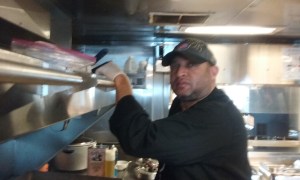
At present, there are 31 people onboard the NOAA Ship Oscar Dyson, and each plays a vital role in making sure that everything runs as it should. One person whose job touches each and every one of us is Judy Capper, the Chief Steward. One might think that being onboard a ship for three weeks would mean limited food choices, or lots of peanut butter and jelly sandwiches, but so far every meal onboard the NOAA Ship Oscar Dyson has been abundant and delicious. From shrimp kabobs to stuffed pork loin to homemade soups to delicious baked goods, Judy keeps everyone onboard fed and happy.
I got a chance to talk to Judy about her job and her journey to becoming a NOAA Chief Steward. Judy’s first career was in the corporate world (including Hewlitt-Packard) but being the oldest of 5 siblings, she has been cooking since the age of 12. An interest in cooking led her to study culinary arts at UCLA and other locations. She then took seamanship training at Orange Coast College. At the time, she owned a sailboat, and enjoyed cooking and entertaining on the boat. The captain loved her cooking and asked if she would be interested in cooking on some sailboat charters. That led to working on yachts and supply ships, and lucky for us, in 2015, Judy was hired by NOAA. Judy loves her job as a NOAA Steward. She says it is never boring and allows her to be creative. Her advice for anyone interested in following in her footsteps is to eat in good restaurants so that you develop your taste buds, get good training, and watch cooking shows.
Judy Capper, Chief Steward Extraordinaire
Science and Technology Log
Last night we used a different kind of net, known as a Methot net, in order to collect macroscopic zooplankton. Named after its designer, Richard D. Methot, it is a single net with a large square opening or mouth attached to a rigid steel frame. The net is deployed from the stern and towed behind the vessel.
Deploying the Methot Net
The Methot uses fine mesh (e.g. 2×3 mm) but has openings that are slightly larger. This design allows the net to be towed at high speeds. A flowmeter suspended in the mouth of the Methot net measures the flow of water moving through the net. Scientists use the flowmeter data to calculate the volume of water sampled.
The flowmeter
Watching the crew preparing to launch the Methot net was a lesson in teamwork. Everyone knew their job, and they reviewed what each would do when. They even discussed what hand signals they would use (“If I make this movement, that means XYZ”).
The Methot net did catch a lot more krill than I had seen before, as well as many jellyfish.
One of the many Chrysaora melanaster we came across.
Fun Jellyfish Facts:
Jellyfish are
invertebrates, and have no brain, heart, eyes, or bones. Instead they have a bag-like body that feels
like slippery jello and tentacles covered with small, stinging cells. They sting and paralyze their prey before
eating it. A jellyfish sting can be
painful, but it is not usually harmful for humans. However, some people may be allergic to the
venom, and will have a reaction.
Weather from the bridge: 48o F, 1-2 knot wind from, Completely overcast,
Executive Officer Michael Gonsalves in his overwhelming (because of all the things he does) office.
An Interview with XO (Executive Officer) Michael Gonsalves
How long have you been with NOAA?
I’ve been here for 13 years…I’ve been on the ship for about 6 months.
What brought you into NOAA?
Certainly I’ve always had an interest in the ocean and in the environment. One of my undergraduate degrees was in oceanography. So I think that’s what steered me towards NOAA. My other undergraduate degree was in math, so I liked the idea of being able to apply math in an environmental setting.
As a side note, XO Gonsalves also has a MS in Applied Math and a PhD in Marine Science
What is it that you do – what is the job of an executive officer?
The Executive Officer position is second in command. So if anything should happen to the CO (commanding officer) I would assume command. Though that is a contingency; that is not my actual job… All administrative work goes through me. For example, the budget, payroll, travel, performance, disciplinary actions, scheduling, arranging all port logistics, …getting augmenters to come out to the ship to fill in… I do everything to allow everyone else to do their job. My job is not the mission. My job is keeping the ship safe and logistically ready to execute the mission.
This is typically a step on the path to becoming a CO, is that correct?
Typically, that’s right. Usually the average NOAA Corps officer will have four sea assignments. Basically every five years, give or take, they will be going back to sea. The first will be as a junior officer, an Ensign. The second is as an Operations Officer who will be coordinating the mission [of that ship]. On the hydro ships that means coordinating the hydrographic science. The third sea tour will be as an Executive Officer and the fourth, around year 15, will be as a Commanding Officer.
I know that NOAA Corp officers spend roughly two years at sea and then three at a land billet. So what has your path been thus far?
I lingered in nearly all of my assignments by a little bit. My first assignment was here, on Fairweather, just after she was reactivated. It was a very skeletal crew. I had opportunities to be trained quickly. We only had two launches at the time. There were so few boats, there were so few people trained in doing things, it was in the crew’s best interest to qualify me because very few people were qualified to do anything.
My first land assignment was at the University of Southern Mississippi. It was a double billet. Number one, it was full-time university training. There was also working with an inter-agency group, The Naval Oceanographic Office and the Army Corps of Engineers, both also conduct survey operations. It’s a nice inter-agency group with similar issues and problems and we can share best practices and things like that. Their particular niche is airborne laser bathymetry, so they are working from an airplane.
Back to University of Southern Mississippi, what was the degree you were pursuing?
Initially it was a master’s degree as a one year program. As it happened, there was a project that I could work on of suitable interest to the joint LIDAR center. We all agreed that I could continue to work on it. The university felt that it was dissertation worthy. So I received my Ph.D.
What was your second tour at sea?
My second tour was as an Operations Officer on Fairweather’s sister ship, Ranier. All three of my assignments thus far have been on hydro ships. There is something to be said for that. It’s a little bit tricky to bring someone in from the outside. It’s a steep learning curve.
My second land assignment was working for the NOAA Operations Branch in Washington D.C. This is a part of the Hydrographic Surveys Division. They govern the field units on the large scale. So I was making the big decisions for what the hydro ships would be responsible for during that particular season. We determined what type of coverage would be needed in each area. That is then the information that the Operations Officer on the ship is working from.
What made NOAA so attractive to you?
Giving service to the US government was a big part. I happily pay my taxes. I appreciate having a police force and knowing that my meat is safe. So that was definitely a big part of it. But NOAA also has a unique mission that I found attractive. And the variety is important to me – just knowing that every couple of years the assignment will change.
And what is it that keeps you going while you’re out here at sea? Is there anything you miss or are looking forward to when this sea tour is complete?
People are tricky and a lot of my job involves personnel. The whole job keeps me going, really. I do miss Washington, D.C. – the public transport, the museums and the shows. There are so many things to do and see. There are a lot of jobs in D.C. and I am making clear that is a desire for the next land billet.
Junior officers, ENS Calderon and ENS Carroll on the bridge working on the computer navigation system. Both also are intimately involved with the surveying program.
A quick one question survey for the junior officers on the ship… Why did you choose a hydrographic survey ship? A collection of the answers I received are below:
To have the opportunity to be much more deeply involved with the science
My background is math or math/mapping
To be in Alaska
This is a route to pursue flying with NOAA Corps
Didn’t want the technical skills developed in prior work to go to waste
Had already worked on fisheries ships with Department of Fish and Wildlife
As with all officers in our uniformed services; NOAA Corps officers have had degrees conferred prior to service. Most of the degrees are math and science. The hydrographic survey ships tend to attract the math, physics, and geological science degrees for obvious reasons. Many then go on to pursue advanced degrees as did LCDR Gonsalves, the focus of my interview.
An interview with Kathy Brandts and Tyrone Baker; Ships Stewards
How long have you been cooking for NOAA Ships and what were you doing prior?
Chief Cook Tyrone Baker, master of the grill
T: I cooked for the Navy for 20 years out of school. When I finished, I went to work for a casino for a while – still cooking. Then NOAA called me up (he had put in an application a while before and forgotten about it) and here I am! That was back in 2005.
K: I started out in the Coast Guard…I wanted to be a bosun [boatswain] mate, which is what everyone wants to do. But it was going to take a long time to make grade, and hardly anyone wants to be a cook because it’s a lot of work. I decided to go through their school, which was two months. That was when it started, in ’94. My first ship assignment was the Polar Star, which was an ice breaker.
Kathy Brandts, Queen of the kitchen – also known as the Chief Steward. This is the day she let me cook a bit with her.
Kathy, why did you get out of the Coast Guard and what finally got you to NOAA?
K: All of the land assignments were being contracted out to [private companies]. So I was never going to get a chance to cook on land. So I decided that wasn’t for me. I got out after my four and a half years. I landed in Seattle, and that’s where NOAA was based. I had heard about them when I was in the Coast Guard. I knew they were hiring, talked with somebody, and essentially got hired on the spot. And I was in Alaska! I started out in the augmentation pool, I worked on Discovery and then on Ranier. Then a permanent position came up and I jumped at it. I didn’t really get along with the Chief Steward, though – so I left NOAA and worked for Keystone Ski Resorts in Colorado at their stables. [She spent several years on land at that point.]
The Chief Steward on Ranier tracked me down [in Colorado] and asked me to come back. There was talk of Fairweather coming back online and I wanted the Chief Steward job. I didn’t have the experience at that point, so I took a year off and went to Culinary School. I applied for the Chief Steward job on Fairweather and got it. I was on Fairweather from 2004-2013. [She is now the Chief Steward on Ruben Lasker, another NOAA ship, but is helping out on this leg]
Why be a ship cook?
T: I’ve been so many places and seen so many things I wouldn’t have otherwise seen. I’ve really been all around the world. I’ve been in almost every port of the world. How many people can say that? I wouldn’t trade it.
K: I was a restaurant cook for a while. I hated it. You’re either going 9 million miles an hour or there’s nothing. There’s a lot of alcoholism and drug use in that industry and they live a different life. The service industry… (laughs). And people are either sailors or they’re not. I think, much to my chagrin, I found it out after I quit the Coast Guard.
T: Yes, I agree. I’m a sailor. It was why I joined the Navy.
What are the best and most rewarding things about what you do?
T: I just really like it. I enjoy the cooking. I enjoy the work.
K: I like good food and I like when people are appreciative of what I do. And we’re all stuck out here together, why not make it the best that it can be. Meal time is what you look forward to when you’re on a ship.
GVA Dave – he just joined Fairweather and was actually helping out the stewards on this leg, but now he’s where he’s supposed to be in the deck department.
Crew member of the Day: Electronic Technician (ET) Charlie Goertzen
Charlie Goertzen, tech guy extraordinaire!
So today as we pulled into Kodiak, the news came in that the long awaited new televisions were here. Immediately, Charlie was notified. And he will work hours to make sure that each crew member has a working television in their room.
He is the guy that keeps the connectivity going in pretty difficult conditions. He has to spend a lot of time keeping various computer components talking to each other. He has to content with all of the complaints about lack of bandwidth, slowness of applications, slowness of wireless – and he does his best to keep things optimized and clean and efficient all the time. Two of the things he loves the most are the ocean and working with electronic components. He gets both of them all the time!
NOAA Teacher At Sea Liz Harrington Aboard NOAA Ship Oregon II August 10 – 25, 2013
Mission : Shark/Red Snapper Bottom Longline Geographical area of cruise: Western Atlantic Ocean and Gulf of Mexico Date: Aug 25 , 2013
Weather: current conditions from the bridge:
Partly Sunny
Lat. 30.15 °N Lon. 88.46 °W
Temp. 80 °F (26.9 °C)
Humidity 82 %
Wind speed 8.26 knots
Barometer 30.08 in (1018.75 mb)
Visibility 10 mi
Science and Career Log
It has been just over two weeks since I boarded the Oregon II. In that time I have had the chance to speak with many people who work aboard the ship. These people are either members of the NOAA Corps, members of the scientific team or civilian mariners employed by NOAA. The NOAA Commissioned Officers Corps is one of the seven uniform services of the United States. Corps graduates operate NOAA’s ships and aircraft and work in positions to support NOAA’s environmental and scientific missions. Their job assignments alternate between sea duty (or air duty if associated with the aviation program) and land duty. It is an interesting career that offers the opportunity to travel as well as to be a participant in NOAA missions.
Of the five ship officers, four are members of the NOAA Corps: the Executive Officer (second in command of the ship) LCDR Eric Johnson, Operations Officer LTJG Matthew Griffin, Navigation Officer Brian Adornato and Junior Officer Rachel Pryor. The Commanding Officer, Master Dave Nelson, is a civilian captain who has spent his life on the water and has worked his way up from a deck hand. All of the ship’s officers are friendly, knowledgeable and professional. I’m in great hands with them in charge.
During some free time away from her NOAA Corps duties, ENS Rachel Pryor would sometimes help the day shift. Here she teaches Micayla how to remove otoliths.
Officers and Chief Scientists often discuss the best possible course when sites are clustered together.
One possible route for the day. This may change depending on weather, tide and currents.
The deck crew who worked the day shift with me consisted of the Chief Boatswain Tim Martin and the Skilled Fishermen Chuck Godwin and Mike Conway. They work well together and they were very helpful to me while I was learning the deck routines. The Chief Boatswain (pronounce bō´ sun) supervises members of the deck crew and oversees all deck operations, including safety, training and maintenance.
There are four NOAA scientists onboard, two for each shift. Scientists Lisa Jones and Eric Hoffmayer are both on the night shift with the three volunteers Dave, Al and Muri. The day shift is covered with research biologists Kristin Hannan and Amy Schmitt, along with volunteers Mikayla, Cliff and Daniel. Kristin is the Chief Scientist for this leg of the cruise, so she is in charge of making the decisions dealing with the scientific portion of the cruise. This involves coordination between herself, officers on the bridge (where the ship is being driven) and the deck shift leader. This role is rotated among the some of the scientists. Lisa will be the Chief Scientist for the next leg of the cruise.
Kristin and Tim are ready to set the line. They will receive word from the bridge when the ship has reached the correct coordinates.
One important job on this ship that I have to mention is the Chief Steward, which is held by Walter Coghlan. Walter is in charge of feeding everyone on board and he is great at what he does. As a Chief de Cuisine, he is very well trained and it shows in his meals. When living aboard a ship I think the food takes on more importance. It is not easy to keep everyone happy but Walter is doing it. The menu always has a number of choices and the meals are prepared fresh daily. I’m eating like a queen.
Chief Steward Walter Coghlan keeps everyone well fed.
Personal Log
My days aboard the Oregon II are coming to an end. We had been working our way north along the western coast of Florida. Now the fishing has stopped and we are traveling along the panhandle towards the home port of Pascagoula, Mississippi. This morning, far on the horizon, I could just barely make out the rectangular shapes of beachside hotels and condominiums. But the fishing remained good to the end with two different shark species being caught. One was an Angel Shark (genus Squatina), which I’m told is not normally caught on a longline. The other was a Cuban Dogfish(Squalus cubensis), which was the first one caught this season. So, we are ending on a good note. We will now travel to the harbor entrance off the coast of Pascagoula. We will wait until morning and arrive at the dock bright and early.
I have mixed feelings about the going to shore. I’m happy to be going home to see my family and begin school, but I am sorry this experience is coming to an end. I have enjoyed every minute of this trip. Of course it is the people that have made it so rewarding. They have been so friendly and welcoming to me. The science has been very interesting to me as well. I have lots of stories to share and a new interest in sharks. Back at school we’ll be following the sharks with the satellite tags. One part of this experience that I hadn’t put much thought into before coming is the life at sea. Living aboard a ship is a unique experience with the limited amount of space, the 24/7 schedules, the weather and the constant motion of the waves. It bonds the people into a big family, one that I’m going to miss but will be talking about for a long time.
New Term- Dock rock = The sensation the ground is moving after spending time at sea.
David holds an Angel Shark caught on the last haul back. (photo courtesy of David Seay)
Liz with Tile Fish (photo courtesy of Micayla Keipert)
Pale Spotted Eel can be difficult to measure.
There is lots of life on this piece of coral that was brought up on the line.
Cliff weighs a Barracuda.
Tagging a Nurse Shark
Everything aboard a ship needs to be secured due to the motion of the waves. The doors are secured with a hook like this one.
Getting ready for the haul back – rain or shine. (photo courtesy of Micayla Keipert)
Chuck and Kristin remove a hook from a Sandbar Shark.
“The Day Shift”. In back from left: Cliff, Daniel, Kristin and Micayla. Front from left: Liz and Amy. (Photo courtesy of Tim Martin)
Scientists Kristin Hannan and Amy Schmitt prepare to weigh a shark that has been brought up on deck.
One last picture before leaving the Oregon II. (photo courtesy of Lisa Jones)
NOAA Teacher At Sea: Elizabeth Warren Aboard NOAA Ship Pisces
Mission: Reef Fish Surveys Geographical Area of Cruise: Gulf of Mexico Date: July, 10 2010
Another day.. more and more
Footage from the Camera Array
Weather Data from the Bridge: Temperature: Water: 30.3 ℃ (which is 86.5℉ ) Air: 29.6 ℃ Wind: 2.55 knots Swell: .2 meters Location: 27. 51° N, 93.18° W Weather: Sunny, Humidity 62%, 25% cloud cover
Science/Technology Log:
Chip from Temperature Depth Recorder
Each time we drop the camera array at a site attached to the aluminum case is a little device called a Temperature Depth Recorder or a TDR. It measures exactly that. As the camera array sinks to the bottom it records the temperature and depth. When the camera array is brought back on board the ship one of the scientists unclip it and bring it into the lab. To get the information off you hit it once with a magnet that communicates with the chip inside telling it you want to download the information. Then the scientist places a stylus on the device and it downloads the information to the computer. The data is saved under the name of the site and then the information is entered into a spreadsheet that converts the information to the psi to meters. To clear the TDR you hit it four times with the magnet and when it flashes red it is clear! This is a picture of Kevin explaining to Anne Marie and I how to work the TDR.
At every site a CTD is also dropped into the water. A CTD (Conductivity Temperature Recorder) gives a hydrographic (use your Greek roots) profile of the water column. The CTD is attached to the bottom of a rosette or carousel that also contains water sampling bottles. Attached to the rosette is also a conductive wire that sends information to the lab. Mike, the survey technician, comes into the lab after every camera array is dropped and runs the CTD process. The CTD is placed in the water and allowed to acclimate for 3 minutes before they begin taking readings. The CTD is dropped to the bottom of the seafloor and Mike monitors from the dry lab. Also, once a week Mike also uses the water bottles. To take a sample they use a remote from inside the dry lab to trigger the bottles to close them. The thing that kept sticking in my mind is that at one point all of this was done by hand, someone had to do the math and all of these tests!
CTD
Data from the CTD
In the morning Kevin goes through the video footage from the previous day and for each site he identifies what is on the bottom of the seafloor “sandy flat bottom”, “rock shelf” and then he identifies briefly any fish that he sees. When he is doing this process being in the lab is necessary because he will call us over anytime he sees a neat fish and explain how he can tell what the species is. Today, we dropped the camera array in 8 different sites within Bright Bank sites. The two chevron fish traps brought up a whole lot of nothing. On the bandit reel we caught one fish. It was a sand tile fish (Malacanthus pulmieri). Anne-Marie weighed and measured him and then we threw him back. I was really proud of her because she doesn’t really like fish, but she put gloves on and did everything! Today was a little frustrating it even got Kevin a little down.
Frustrated Kevin
Personal Log:
Chief Steward Jessie Stiggins
Kevin calls living on board being “lovingly incarcerated” beacuse you are stuck here but you are well taken care of. For instance, Ohhh, the food! The Chief Steward, Jessie Stiggins is keeping us well fed. Every morning the meals are posted in the mess for everyone to see. We learned from Captain Jerry that food on the ship is very important and is actually a part of the contract. In the contract it states that lunch and dinner must include a prepared dessert. “Plain cake shall not constitute a prepared dessert but a cake with icing shall.” We have had dessert with every meal! Some of the desserts are Coconut Crème Pie, French Silk Pie, White cake with fluffy whip-cream frosting and strawberries, cookies, and pecan pie to name a few. Plus there is a freezer full of ice cream which oddly enough I haven’t gotten into yet. Right now, I’m in seafood heaven… we have had halibut, calamari, and catfish. Throughout the trip it has just gotten more impressive! We’ve had stuffed chicken breasts, rack of lamb, filet mignon, lobster, a taco bar, the amberjack that Ryan caught, and pulled pork. Jessie is saving the menu’s for us so we can show them off when we get back.
Me piloting the ship
A few nights ago, Captain Jerry let Anne Marie and I drive the ship. He explained that we were driving a 52 million dollar vessel with 30 lives on board, as if I wasn’t nervous already. We were moving to the next days work area so the bridge would be driving there all night. Anne Marie went first and I listened as Captain Jerry and Ensign Kelly Schill explained how to drive and the proper language. Everywhere you go on the ship there is certain etiquette for the way you talk and the way you dress. (No tank tops in the mess and closed toe shoes everywhere but your stateroom.) When you are steering you are following a set course with a gyroscopic compass as well as a digital heading reading, you are steering the rudder by degrees. You state the heading in single digits so 173 would be one seven three. We were driving in the dark so they had all the lights off and they even had red flashlights so they wouldn’t ruin their night vision. Anne Marie and I both got a chance to turn the ship in circles. Anne Marie even did a Williamson turn, which is done when there is a man overboard. You turn 60° to the left and then an equal amount to the other side so you are back on your course but turned around to pick up the person who is overboard. When she was doing this, the ETA to the next way point changed from 6:10 am to NEVER. We both laughed pretty hard! Dynamic Positioning system that is the automatic pilot is called Betty, she talks to the crew on the bridge and is extremely polite. The Captain promised to show us how to turn the DP on and off. Everything on the bridge is electronic. You can click a button and see how much fresh water is on board, how much fuel, which engines are working and even wake someone up! I’m consistently in awe of how much technology goes into running a ship of this magnitude. Tomorrow Chief Engineer Garett is giving us a tour of the engine room. In fact he told me he is going to make us espresso and then take us down! I’m really, really, having a great time!
The water here is so blue! It’s a different shade of blue than the Pacific or Puget Sound. It’s bluer than green that’s the difference, there is no green. Even the seaweed isn’t green it’s a brownish yellow color, it’s called sargassum. The exchange intern Jose used a line and a hook to catch some so I could bring it back to show off. Looking over the side you often spot giant fish swimming along because the visibility is so high. This made me think of a lot of questions to ask Kevin tomorrow: Are there algae/plankton blooms in the Gulf? If so where do they happen? Does the temperature vary depending on the time of year or is it always warm? What do hurricanes do to the sea creatures? Have you noticed a rise or fall after a hurricane?
Being on board a ship makes me feel like I’m 7 years old again and I don’t want to go to bed because I’m sure my parents are making me miss whatever fun thing they are doing at night. I don’t want to go to my stateroom, I wish I could be everywhere at once, on the bridge talking to the Captain and asking questions, listening to the stories of the crew, watching them fish, talking to the birders up on the flying deck, sitting in the lab and listening to the scientists joke or explain how to identify a fish or a coral or an algae. I wish I were able to be out here longer although, I have to say having a shorter cruise does make me appreciate every minute.