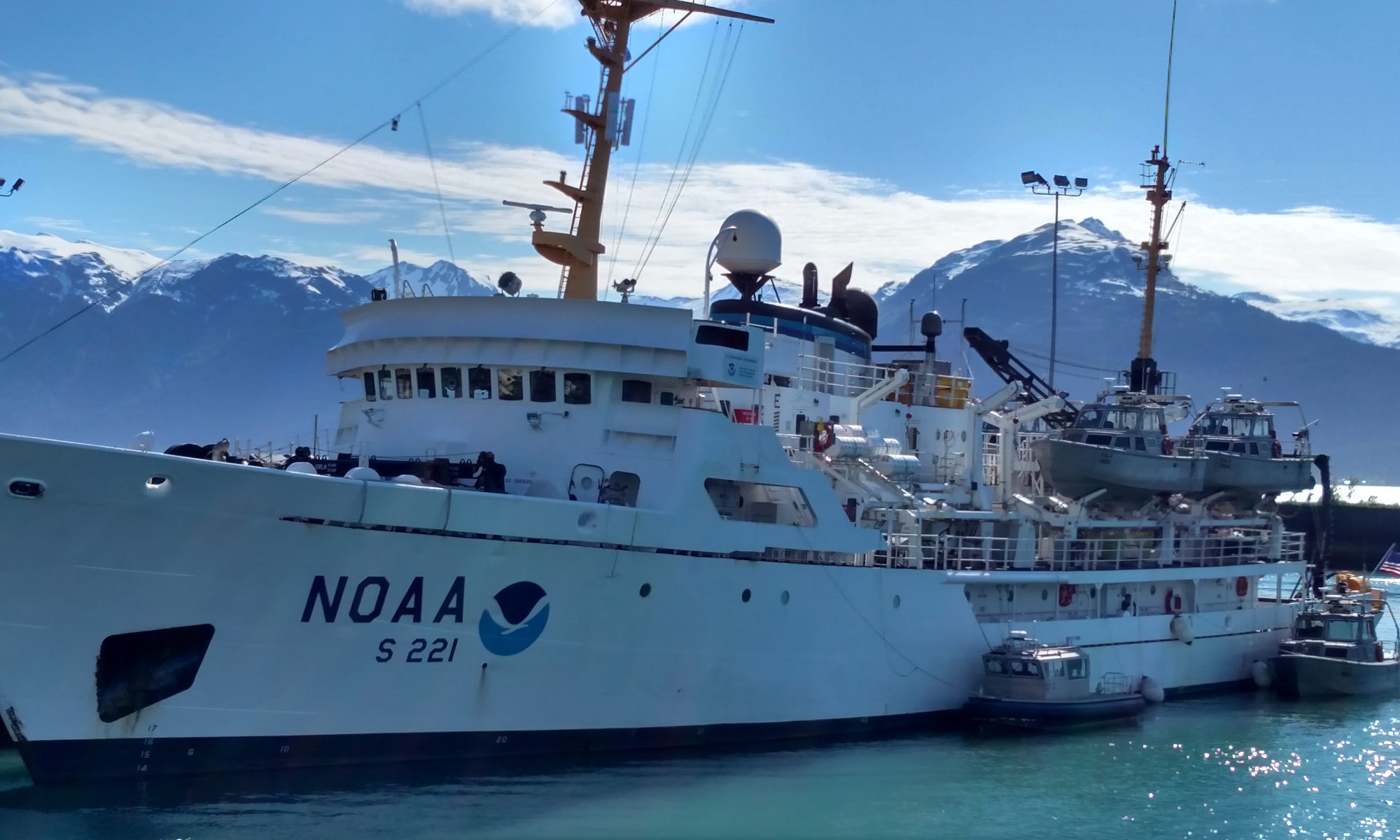
Lacee Sherman: Teacher in the Fish Lab, June 12, 2018

NOAA Teacher at Sea

Lacee Sherman

Aboard NOAA Ship Oscar Dyson

June 6 – June 28, 2018


Mission: Eastern Bering Sea Pollock Acoustic Trawl Survey

Geographic Area of Cruise: Eastern Bering Sea

Date:  June 12, 2018

Weather Data from the Bridge on 6/12/18 at 13:00

Latitude: 56° 15.535 N

Longitude: 161° 17.273 W

Sea Wave Height: 2-3 ft

Wind Speed: 8.8 knots

Wind Direction: 30°

Visibility: 10+ nautical miles

Air Temperature: 7.7° C

Water Temperature: 7.52°C

Sky:  Blue with scattered clouds

TAS Lacee Sherman and Alaskan Pollock!!
TAS Lacee Sherman in the fish lab with an Alaskan Pollock. Photo credit: Sarah Stienessen


Science and Technology Log

There are many different types of samples that are taken on NOAA Ship Oscar Dyson.  Some of the samples collected on the ship are for the projects of the scientists that are here currently, and other samples are brought back for scientists working on related NOAA projects.  The scientists that I am working with are based out of NOAA in Seattle, Washington.

CTD through Port Hole
View through a port hole of the Hero Deck on NOAA Ship Oscar Dyson of a scientific instrument called a CTD. The CTD is sent to the bottom of the ocean and back at specific locations. The CTD collects information related to conductivity (salinity), temperature, and depth. The grey bottle attached to the side collects a water sample that will be analyzed later.

One of the projects that I have been helping with most frequently is processing the trawl samples once they have been collected.  When a trawl sample is collected, a large net is lowered off the stern of the ship that will collect the sample of fish (hopefully mostly pollock)  and other living things. The net also functions as a vessel to hold scientific instruments that collect other types of information. There is a camera (cam trawl) that is attached to the net and this records video that can be watched through a computer to actually see what is being caught in the net.  

Cam Trawl Jellyfish
Picture of a jellyfish captured by the Cam Trawl

Another useful instrument is the FS70, a sonar device that rides above the opening of the trawl net to ping on the fish going into it. Viewed from a screen on the Bridge in real time, this gives the scientists an idea of exactly how many fish are going into the net, so that they can adjust the depth of the net, or change the length of time for the trawl survey.  The goal for each trawl sample is to collect at least 300 pollock.

Pollock on length board
Photo of an Alaskan Pollock on a length board. Photo credit: Sarah Stienessen

Once the net has been brought in after haulback, the opening at the codend (bottom) of the net is released to allow the sample to be put in a metal tub called the table.  The table is capable of holding approximately 1 ton, or 2,000 pounds worth of fish.  Sometimes if there is more than can fit on the table, the crew will split the catch in half so that we are only measuring a portion of what was collected.  The rest of the fish are stored in another tank on the deck.  If we don’t end up with enough pollock on the table, we may need to pick through the other half that was saved on deck until we get enough. Measuring too few of them may not represent the accurate length compositions of the pollock.

On June 11th we collected trawl sample #7.  This haul was filled with mainly jellyfish, with pollock and a few herring.  The weight of this haul was very close to the amount that the table can hold so it was decided to split the catch.  Once we looked at what was put on the table and we realized that it wasn’t going to be enough pollock, Mike and Sarah jumped into the spare tank and pulled out all of the fish (whole haul) so that we would have enough to get as close to that 300 number as possible.

Funny in the fish lab
Photo of Sarah Stienessen and Mike Levine in the fish lab with a recent haul on the conveyer belt. TAS Lacee Sherman can be seen in the background sorting the haul. Photo Credit: Denise McKelvey

When the fish come into the fish lab, we sort out the different species and put them into separate baskets.  Each basket is weighed by species and input into a system called CLAMS (Catch Logging for Acoustic Midwater Surveys).  After all of the species have been sorted, a percentage of each species will be measured by length.  Another percentage of each species will be measured by length and weight.


From the pollock sample collected, 30 will be randomly picked to have their otoliths removed.  The otolith is the ear bone of the fish and it can be used to determine the age of that specific pollock.  They have rings, similar to tree rings that can be counted.  For information click here.

Pollock Otoliths
An otolith sample taken from an adult pollock in a glass jar.

Personal Log

I have not been shy with anyone onboard about the fact that I would love to see whales if they are around the ship.  I feel like this has almost turned into a game at my expense, but I don’t mind.  There have been multiple times when there have been “whales” and as soon as I run up the 3 flights of stairs and get to the Bridge, the whales are suddenly gone.  I think they are secretly timing me to see how quickly I can run up the stairs!  The exercise is good for me anyways.

I’ve finished two books already, which has been really nice.  I know that I love to read, but never really take the time anymore because it always seems like there is something else that I should be doing instead.  There’s a bookshelf here in the lounge, so I’ll find another to read after I finish the last one that I brought.

I try to spend some time outside every day, and it is so peaceful.  I don’t think I’ll ever get tired of waking up and looking at the ocean.  I don’t want to take any bit of this experience for granted.  I am so grateful that I have this opportunity and I want to take in as much of it as I can.  As I get to know more people on the ship I am starting to get to learn more from everyone about exactly what they do and why they chose to make this their profession.

Flying Bridge Selfie 6/10/18
Photo of TAS Lacee Sherman on the Flying Bridge of NOAA Ship Oscar Dyson

Everyone thinks of scientists, NOAA Corps officers, and engineers as being very serious all of the time, but that couldn’t be further from the truth.  Professionalism is incredibly important and is always the focus, but there is also space for fun.  Every other day there is a photo competition where a picture is taken somewhere on the ship and you need to find out where it was taken and submit your answer.  There are also plastic Easter eggs that keep popping up everywhere filled with positive messages, or candy.  The “Oscar Dyson Plan of the Day” sometimes has puzzles to figure out on it as well as important information such as location, meal times, sunrise/sunset times and any other important information.

Easter Egg return zone

Did You Know?

There are 6 different species of flatfish found in the Bering Sea.  There are 2 species of Flounder, 3 of Sole, and 1 Plaice.


Allan Phipps: Looking Ahead: The Future of NOAA Fish Surveys? August 10, 2012

NOAA Teacher at Sea
Allan Phipps
Aboard NOAA Ship Oscar Dyson
July 23 – August 11, 2012

The Oscar Dyson at anchor in Captains Bay during calibration procedures.
Mission: Alaskan Pollock Mid-water Acoustic Survey
Geographical Area: Bering Sea
Date: August 10, 2012
.

Location Data
Latitude: 53°54’41” N
Longitude: 166°30’61” E
Ship speed:  0 knots (0 mph) In Captains Bay at Dutch Harbor during calibration.

Weather Data from the Bridge
Wind Speed:  17 knots (19.5 mph)
Wind Direction: 184°
Wave Height:   1-2 ft
Surface Water Temperature: 10.2°C (50.4°F)
Air Temperature: 12.5°C (54.5°F)
Barometric Pressure:   1005.9 millibars (0.99 atm)

Science and Technology Log:

Imagine a time when fish surveys could be done through remote sensing, thus eliminating the need to catch fish via trawling to verify fish school composition, length, weight, and age data.  During our “Leg 3” of the Alaska Pollock Acoustic Midwater Trawl Survey, we caught, sorted, sexed, and measured 25 tons of pollock!  While this amounts to only 0.002% of the entire pollock quota and 0.00025% of the pollock population, wouldn’t it be nice if we could determine the pollock population without killing as many fish?

Cam-Trawl sitting on deck after several successful trawls.

Introducing the “Cam-Trawl,” a camera-in-net technology that NOAA scientists Kresimir and Rick are developing to eventually reduce, if not eliminate, the need to collect biological specimens to verify acoustic data.  Cam-Trawl consists of a pair of calibrated cameras slightly offset so the result is a stereo-camera.

The importance of setting up a stereo-camera is so you can use the slightly different pictures taken at the same time from each camera to calculate length of the fish in the pictures.  Eventually, a computer system might use complex algorithms to count and measure length of the fish that pass by the camera.  If the kinks are worked out, the trawl net would be deployed with the codend open, allowing fish to enter the net and flow past the camera to have their picture taken before swimming out of the open end of the net.  Some trawls would still require keeping the codend closed to determine gender ratios and weights for extrapolation calculations; however, the use of Cam-Trawl would significantly reduce the amount of pollock that see the fish lab of the Oscar Dyson.  On this leg of the survey, the NOAA scientists installed the Cam-Trawl in a couple of different locations along the trawl net to determine where it might work best.

Installing Cam-Trawl into the side of the AWT trawl net so the NOAA scientists may capture image data during trawls.

Below are some photos taken by Cam-Trawl of fish inside the AWT trawl net.  Remember, there are two cameras installed as a stereo-camera that create two images that are taken at slightly different angles.  In the photos below, I only picked one of the two images to show.  In the video that follows, you can see how scientists use BOTH photos to calculate the lengths of the fish captured on camera.

Pollock (Theregra chalcogramma) as seen by Cam-Trawl.
A Sea Nettle (Chrysaora melanaster)  jellyfish at top right, Chum Salmon (Oncorhynchus keta ) at bottom right, and Pacific Herring (Clupea harengus) on the left as seen by Cam-Trawl installed in the AWT trawl net.

Another NOAA innovation using stereo cameras is called “Trigger-Cam.” Trigger-Cam is installed into a crab pot to allow it to sit on the ocean floor.  For this type of camera deployment, the NOAA scientists removed the crab pot net so they would not catch anything except pictures.

Trigger-Cam back on the deck of the Oscar Dyson after a successful test run.

The real innovation in the Trigger-Cam is the ability to only take pictures when fish are present.  Deep-water fish, in general, do not see red light.  The Trigger-Cam leverages this by using a red LED to check for the presence of fish.  If the fish come close enough, white LEDs are used as the flash to capture the image by the cameras.

Skilled Fisherman Jim lowering down the “heart” of Trigger-Cam for a trial run. On this dip, Trigger-Cam went down to 100 meters. Several of these tests were done before installing Trigger-Cam into a crab pot.

The beauty of this system is that it uses existing fishing gear that crab fishermen are familiar with, so it will be easily deployable.  Another stroke of brilliance is that the entire device will cost less than $3,000.   This includes the two cameras, lights, onboard computer, nickel-metal hydride batteries, and a pressure housing capable of withstanding pressures of up to 50 atmospheres (500 meters) as tested on the Oscar Dyson!  Here is a short animated PowerPoint that explains how Trigger-Cam works.  Enjoy!

Here are a couple of picture captured by the Trigger-Cam during trials!
Two pictures taken from Trigger-Cam during testing.
While these pictures were captured during tests in Dutch Harbor, they do provide proof-of-concept in this design.  With a cheap, easily deployable and retrievable stereo-camera system that utilized fishing gear familiar to most deck hands, Trigger-Cams might contribute to NOAA’s future technology to passively survey fish populations.
NOAA scientists Kresimir Williams (in center), Rick Towler (on right), and me, after assembling and testing another stereo-camera system for a NOAA scientist working on the next cruise. Kresimir and Rick designed and built Trigger-Cam!

Personal Log:

A little fun at sea!  We needed to do one last CTD (Conductivity, Temperature, Depth), and decided to lower the CTD over deep water down to 500 meters (1,640.42 ft)!  Pressures increases 1 atmosphere for every 10 meters in depth. At 500 meters, the pressure is at 50 atmospheres!!!  We wondered what would happen if… we took styrofoam cups down to that depth.  We all decorated our cups and put them in a net mesh bag before they took the plunge.  Here is a picture showing what 50 atmospheres of pressure will do to a styrofoam cup!

Three styrofoam cups that went 500 meters deep in the Bering Sea! These cups were originally the size of the undecorated white styrofoam cup in the background.

We missed the Summer Olympics while out on the Bering Sea.  T-T  We did get in the Olympic spirit and had a race or two.  Here is a little video in the spirit of the Olympics…

All for now… We are back in Captains Bay, Dutch Harbor, but are calibrating the hydroacoustic equipment at anchor.  Calibration involves suspending a solid copper sphere below the ship while the NOAA scientists check and fine-tune the different transducers.  This process will take about 7 hours!  We have been out at sea for 3 weeks, are currently surrounded by land, but must wait patiently to finish this last and very important scientific task.  If the calibration is off, it could skew the data and result in an inaccurate population estimation and quotas that may not be sustainable!  This Landlubber can’t wait to have his feet back on terra firma.  The thought of swimming crossed my mind, but I think I’ll wait.  Then we will see if I get Land Sickness from being out at sea for so long…

Anne Mortimer: Cam-trawl, July 14, 2011

NOAA Teacher at Sea
Anne Mortimer
Onboard NOAA Ship Oscar Dyson
July 4 — 22, 2011 

Mission: Pollock Survey
Geographical area of cruise: Gulf of Alaska
Date: July 14, 2011

Weather Data from the Bridge
Conditions: sunny and windy
Air Temperature: 10.1 ⁰C
Sea Temperature: 7.6 ⁰C
Wind direction: 237 ⁰C
Wind speed: 20 knots
Wave height: 2-3 ft.
Swell height: 5-6 ft.

Science and Technology Log

My last blog I said that I would talk more about the cam-trawl. This technology was created by scientists working on the pollock survey. The purpose behind the cam-trawl is to be able to put a net in the water with an open cod-end (basically a net with an opening at the end), and have images of the number, species, and size of fish that went through the net. Of course, sometimes some fish would have to be brought on deck so the otoliths and stomachs could be taken back to the lab in Seattle. Overall, this could eliminate taking so many research-based fish and/or invertebrate samples. When cam-trawl is used on acoustic-trawl surveys, the echograms can be matched up with the stereo-camera  images which can provide more data about the distribution of fish or other marine organisms in the water.

How the cam-trawl works: it is a stereo-camera system that takes snapshots of whatever comes through the net. These images allow the research team (including me on this leg) to determine the approximate number, species (some, not all), and size of fish that go through the net.

cam-trawl image
This still image from the cam-trawl shows a salmon and pollock against a black “curtain.”

The pictures are taken at the same time, but because of the slight difference in camera position, they look similar but not identical. You can mimic this with your eyes by looking at an object with only your right eye, then switching to looking with only your left eye. Did you see the same object but from a slightly different perspective? This is called disparity, or parallax (astronomers often use parallax to estimate the distance of far-away stars or other celestial objects). The program that was written for the cam-trawl (also by this research team) can then calculate the approximate size of the fish based on their relative positions.

In this photo, I’m using the cam-trawl measuring program to measure a sample of fish.
This screen shot shows the stereo-images and the yellow measurements that I’ve added. Using the lengths that I’ve chosen for the program, it calculates the approximate length (in meters) of the fish.

Personal Log

After several windy days with lots of swell, I’m happy to be in calmer waters. I’ve been working on the computer for some of the time which doesn’t go well with swell. I have also found it to be very tiring and tense on my body to be in constant motion and prepared to grab whatever I can to stay upright. I can’t tell you how hard it is to use a treadmill or take a shower in rough seas! BUT, for the time being, it’s calm and I just watched a great sunset over Kodiak island with a few humpback whale blows in the distance. If you are still wondering about the salmon in the picture above, it’s a chum!

Species Observed
humpback whales
northern fulmars
tufted puffins
black-footed albatross
storm petrels
porpoises (yesterday)

Anne Mortimer: Swell Sleeping, July 12, 2011

NOAA Teacher at Sea
Anne Mortimer
Onboard NOAA Ship Oscar Dyson
July 4 — 22, 2011 

Mission: Pollock Survey
Geographical area of cruise: Gulf of Alaska
Date: July 12, 2011

Weather Data from the Bridge
Conditions: Foggy and windy, changing to partly sunny and windy
Air Temperature: 10.1 ⁰C
Sea Temperature: 7.6 ⁰C
Wind direction: 237 ⁰C
Wind speed: 20 knots
Wave height: 2-3 ft.
Swell height: 5-6 ft.

Science and Technology Log

Last night we had a “splitter” catch. The scientists found an area that they couldn’t pass up fishing, so at about 9pm the trawl was put in the water. The 540 ft. long Aleutian wing trawl brought in lots of pollock and Pacific ocean perch, a type of red-colored rockfish.  A catch is called a splitter when it is so big it won’t all fit on the table. To get a weight of the whole catch, the deck crew use a crane to weigh the net, then empty it out.  Then the catch is dumped into a bin that is split in two parts. Only one part of the bin is then raised, putting a sub-sample on the table to be worked-up. It took a long time to process all of the catch. We separated the species on a conveyor belt system, then the messy stuff happens. I mentioned that otoliths and stomachs are collected, but I don’t think I emphasized just how gross this can be. To sex the fish, we use a scalpel to slice the fish down the side, then look for larger pink-colored ovaries or a stringy, twisted looking testes. To collect otoliths, the fish skull is cut just behind the eyes and cracked open. The otoliths are then picked put with tweezers. If you are really good at pulling otoliths, you can pull both at once, which can be very challenging. My double-take record is only 2 in a row, but I’ve pulled both at once at least 5 times now!  The last messy thing is stomach collection. You can imagine what this entails, I’m sure. I’m happy to say that I’ve only had to hold the baggie for the stomach, not cut any out! Processing this catch took several hours– we didn’t end until after 1am.

red rockfish
This red-colored fish is a pacific ocean perch, or P.O.P. to a fish biologist.
Pacific ocean perch

When I am not processing a trawl or on the bridge observing, I have been working to annotate some videos from the cam-trawl. The cam-trawl is a stereo-camera system that takes snapshots of whatever comes through the net. This cam-trawl was designed by several of the scientists on the pollock survey. They are hoping it will help lead to less actual fish samples needed if the images can accurately provide evidence of species, numbers, and sizes. Some trawls would still have to be taken aboard for sexing, weights, and otolith and stomach samples.  Annotating the images basically means that I click through the images, counting each species of fish or invertebrate (usually jellies) that I see. This can very tedious, but the whole idea of the project is very exciting. I’ll talk more about the cam-trawl and this technology in my next blog.

Personal Log

Yesterday was my first real encounter with rocking and rolling on the Oscar Dyson. The winds were blowing at about 30 knots (that’s about 35 mph), and there was a lot of swell. Swell waves are long-wavelength surface waves that could have originated from a storm hundreds or thousands of miles away. The combination of these two made for a very rocky ride until we hid behind an island until sunrise. Since I go to bed at 4:30am, it wasn’t long before the boat was headed back out to unprotected waters, and I was rudely awakened by the swell. To say I didn’t have a swell sleep is an understatement. I had to take a nap this evening to compensate for my lost hours!

Story Miller, July 29, 2010

NOAA Teacher at Sea: Story Miller
NOAA Ship: Oscar Dyson

Mission: Summer Pollock III
Geographical Area: Bering Sea
Date: July 29, 2010
 
Time: 1922 ADT
Latitude: 59°47N
Longitude:178°14W
Wind: 5 knots (approx. 5.8 mph or 9.3 km/h)
Direction: 9.8° (N)
Sea Temperature: 10.1°C (approx. 50.2°F)
Air Temperature: 8.7°C (approx. 47.7°F)
Barometric Pressure (mb): 1015
Wave Height: 0 – 1 feet
Swell Height: 1 – 2 feet
Scientific Log:
I decided that it would be beneficial to provide some information regarding some of the animals I have seen over the past week.
Short-tailed Albatross (Phoebastria albatrus)
Yesterday morning during breakfast, one of the NOAA Corps Ensigns came down to tell me that there was a Short-tailed Albatross off the port side (left side) of the boat. This was a very special event, especially if you are an avid birder because currently there are about 2000-2500 in the world. The short-tailed albatross is one of three species of albatross living in the North Pacific Ocean and is the largest of all seabirds in this location. This bird has a wingspan of approximately two meters. One could conclude that the bird I saw was younger because young short-tailed albatross have “chocolate brown” feathers when young and as they grow larger they turn white. This bird likes to eat squid, small fishes like pollock, and zooplankton. The albatross population dwindled because the birds were very easy to access due to them only nesting on a couple islands in Japan and they were not afraid of humans. As a result they were really easy to kill and because there was a high market value for their feathers, hunters pursued them to near extinction. In fact it is said that in 1953 there were only about 10 pairs left in the world.
Northern Fulmar (Fulmarus glacialis)
Northern Fulmar
Northern Fulmar
This species of bird has been consistently following our ship since we left Dutch Harbor. They are primarily a pelagic bird which means that unless they are breeding, they are living out at sea throughout the year. The Northern Fulmar can be found in a range of different colors depending on where they were born. Generally, the darker birds are found in the southern parts of Alaska and the white are found farther north. However, if you are on the Atlantic side of the US the pattern is just the opposite with the darker birds originating in the high Arctic and the light are found farther south! These birds typically feed on squid and small fish.  One fact that I find fascinating about the Northern Fulmars is that they have the ability to launch their puke up to 6 feet as a defense mechanism! I shall now remember it as the projectile vomiting bird!
Black-legged Kittiwake (Rissa tridactyla)
Black-legged Kittiwake
One interesting fact about this bird is that it has only three functional toes, hence the tri prefix in its scientific name. These birds are white and their wings are gray. Because I grew up in the desert, my untrained eye mistakenly identified them as a seagull but thanks to USFWS scientists Marty Reedy and Liz Labunski, I am now informed of the differences! This bird is also pelagic and their breeding season is during this time. These birds feed on small fish and they are found around the coasts of Alaska, the Bering Sea, and in the northern Canadian Atlantic Coast. When the black-legged Kittiwake feeds, it usually catches its prey on the surface of the ocean but it has been known to plunge underwater. Typically they feed on zoopankton.
Red-legged Kittiwake (Rissa brevirostris)
As stated in its name this bird has bright coral red legs and is typically shorter than the Black-legged Kittiwake. These birds are most commonly found mostly in the Pribilof Islands and there are only about five or six places in the world where they breed, all of which are in the Bering Sea.
Short-tailed Shearwater (Puffinus tenuirostris)
These birds are known to breed off Australia. In the summer they migrate to Alaska, a trip of about 9000, and have been known to take as little as six weeks! In Australia they are important in the Aboriginal culture in Tasmania and are commercially harvested for food, feathers, and oil. These birds usually eat crustaceans but are also known to eat fish and squid. To catch their prey, they will plunge or dive into the water. One interesting adaptation is that they are able to convert their food to oil and the benefit is that oil does not have as much weight as an ingested animal which allows the birds to travel long distances.
Fork-tailed Storm-Petrel (Oceanodroma furcata)
When I first saw these birds I thought a bat was flying over the water due to a slightly more erratic flight pattern than the smooth flights of the other birds I have observed. These birds typically feed at the surface of the water. Fork-tailed Storm-Petrels are also pelagic, living approximately 8 months at sea and when they do return to their breeding grounds in late-spring, they will dig burrows in the soil or find ideal nest locations in rock crevices. The baby chicks are thought to have a unique adaptation for survival. Sometimes the parents leave the baby alone for many days to look for food. During this time the baby’s body head drops into a state of torpor until the parents return and raises its body temperature.
Pomarine Jaeger (Stercorarius pomarinus)
These birds are capable of backward somersaults in the air and take part in acts of piracy as they have been known to harass other birds until the lesser bird gives up its food. The Pomarin Jaegers primarily feed on lemmings and even have a reproductive period that is dependent on the brown lemming! According to the USFWS they are “the only avian predator that digs for lemmings.”
Smooth Lumpsucker (Aptocyclus ventricosus)
Smooth Lumpsucker
Lumpsuckers live in cold waters in the Northern Hemisphere. They have a disk underneath their body that allows them to cling to rocks. “All but a few lumpsuckers have spiny tubercles on the head and body” (2002).  There are 27 species of lumpsuckers and 10 are confirmed to occur in Alaska with 3 more species are known to be near Alaska. These fish can be found on the bottom of the sea, usually on the continental shelf.
Personal Log:
The suction disk of the Smooth Lumpsucker
After my shift ended yesterday, I hung out on the bridge and looked at seabirds and tried to find evidence of land (Russia) since we are so close. The day was clear and sure enough, right after supper, Russia was spotted! While I have not been out to sea that long, the idea of land coming into view was an exciting feeling. Perhaps the feeling was because the land belonged to Russia and I had never been there before or that the sighting of land broke up the monotony of the never-ending stretch of moving water. I feel that the feeling was derived from a little bit of both. While I was searching for Russia, I had the opportunity to observe a Fin Whale about one mile (~1.5km) ahead of the boat. A few times, it came out of the water enough so that you could see its total back and dorsal fin! For me, Fin Whales have been the most commonly spotted.
This morning, after repeatedly launching the experimental Cam-Trawl with no results, we finally snagged a picture of a fish early this morning! The picture was very dark and the fish, mostly a blur but it was obvious that the image was a fish! This is yet another example of how a scientist must be patient as it is common in real-life experiments, as opposed to structured labs in the classroom, to have tests fail multiple times before useful results occur!
The first fish photographed by the Cam-Trawl!
In the evening, I decided to spend time on the bridge again and watch for whales. I was in luck yet again as I was able to see two Humpback whales! They were swimming very close to the ship, but not close enough for the zoom on my camera! I was able to watch them for a good twenty minutes before they “fluked” (showed their tail) and dove deep underwater!
Overall it was a very interesting couple of days!
Citations:
Denlinger, L.M. 2006. Alaska Seabird Information Series. Unpubl. Rept., U.S. Fish and  Wildl. Serv., Migr. Bird Manage., Nongame Program, Anchorage, AK
Mecklenburg, C.W., Mecklenburg, T.A., & Thorsteinson, L.K. (2002). Fishes of alaska. Bethesda, MD: American Fisheries Society.
USFWS scientists Liz Labunski and Marty Reedy
Animals Viewed:
Walleye Pollock
Pacific Herring
Smooth Lumpsucker
Shrimp (unidentified) but they looked like what I have for dinner!
Jellyfish
Fin Whale
Humpback Whale
Short-tailed Albatross
Northern Fulmar
Something to Consider:
Many people, including myself, enjoy watching animals but never learn what their common names are! We take for granted the wonders of Mother Nature that we see everyday and sometimes disregard them as being “normal.” However, what you see may not be normal for other people, such as seeing high populations of bald eagles in Dutch Harbor and Unalaska! It is never too late to learn and if, for example, you move to a different location with different flora and fauna, you can share with your new friends the environment from which you came! I find when traveling to other countries or other locations in the “Lower 48” that they assume Alaska is always cold, snowy, and that penguins live there (which they don’t)! When I take my pictures with me, it is exciting to see other people’s reactions and the conversations afterward are always engaging!
Now would be a great time to photograph the animals and plants you see inhabiting the land surrounding your home. You never know when you may bump into an avid “birder” or other animal specialist that could tell you their names. Or, if you are feeling particularly enthusiastic on a foul weather day, there are many identification books available in your local library.