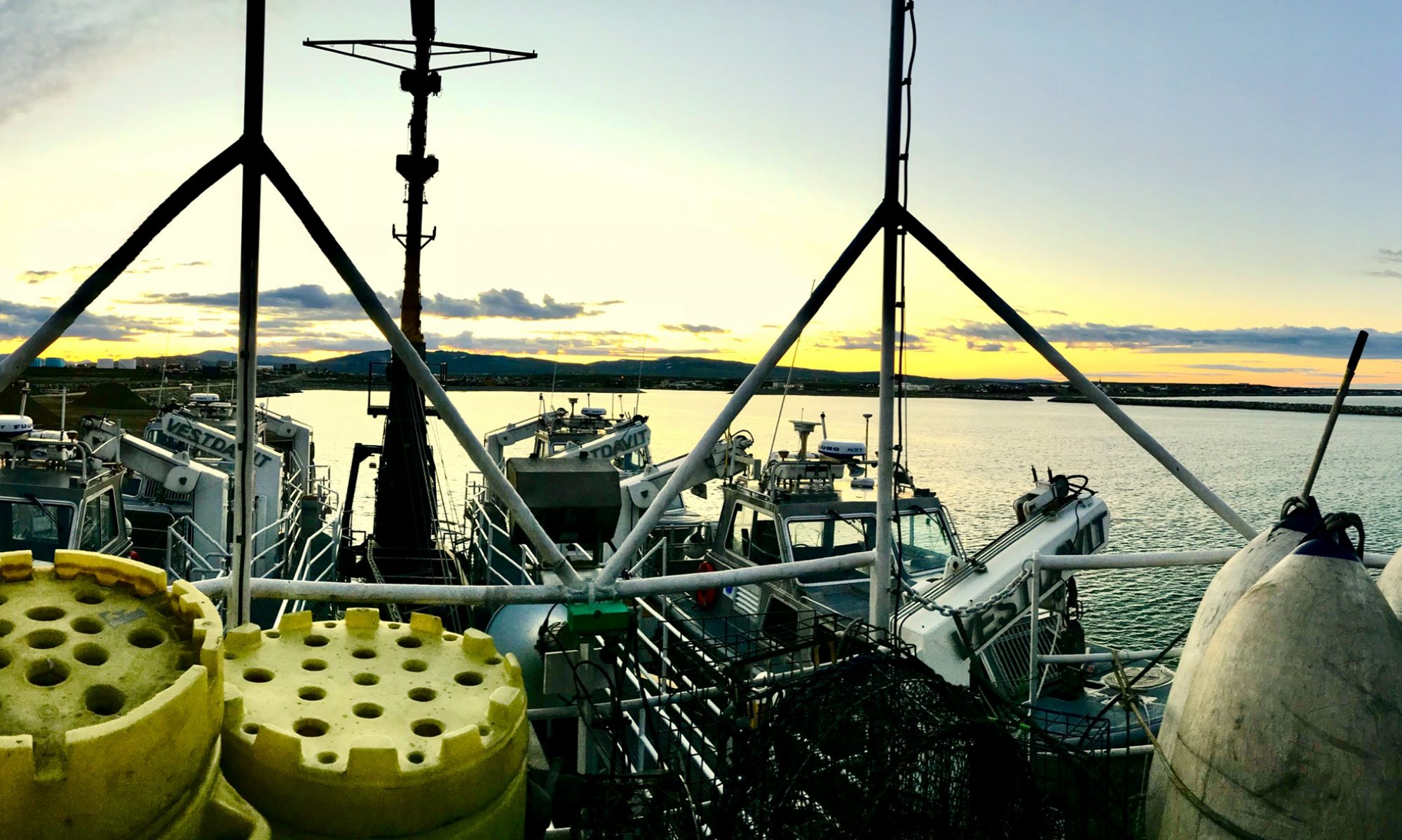
Debbie Stringham, July 11, 2005

NOAA Teacher at Sea
Debbie Stringham
Onboard NOAA Ship Fairweather
July 5 – 15, 2005

Mission: Hydrographic Survey
Geographical Area: North Pacific, Alaska
Date: July 11, 2005

Weather Data

Shumagin Islands, AK --on shore in Eagle Harbor.
Shumagin Islands, AK –on shore in Eagle Harbor.

Location: Shumagin Islands, AK
Latitude: 55 17.7’ N
Longitude: 160 32.1’ W
Visibility: 8 n.m.
True Wind Speed: 12 kts.
True Wind Direction: 190
Sea Wave Height: 1 ft.
Swell Wave Height: none
Swell Wave Direction: none
Sea Water Temperature: 11.7 C
Sea Level Pressure: 1014.0 mb
Sky Description: Cloudy, Drizzle
Dry Bulb Temperature: 11.5 C
Wet Bulb Temperature: 10.0 C

Daily Log 

Returning to ship due to stormy seas.

Last night, some of the crew, including myself, went ashore while anchored in Eagle Harbor. I was eager to learn of the geology of the Shumagin Islands, but have had no opportunity to take samples from shore. It is not so much the composition of the rocks that I’m interested in as the process and time frame of which they formed. I collected both rounded pebbles from the beach and oxidized, angular fragments from a cliff face. I’m extremely impressed by the magnitude of folding, faulting, and glaciation process that are apparent–even from the deck of the ship many miles away. Upon inquiring, I have discovered that there is only one crew member who has any geologic text on the area and she is not on board for this leg.

This morning, I was once again assigned to a launch that would collect bottom samples, but the unfortunate event of well-developed seas and high winds drove us back to the ship. Our sunny weather for the past two days is definitely at an end and our bottom sampling is postponed until further notice.

On this leg, the ship does not have any tide stations to install, but I inquired as to how that affects data collection anyway. Tide stations are used as vertical control on water depths. The Chief Survey Technician said that local tidal data is collected from a primary station on Sand Point and vertical corrections are made to the hydrographic survey data as it is collected. If the data were not corrected to the Mean Lower Low Water (MLLW), the depths displayed on hydrographic charts could mislead ships navigating in shallow waters.

Question of the Day 

Why is knowledge of atmospheric sciences helpful in navigating ships?

Answer from Previous Day 

SONAR stands for Sound Navigation and Radar. Essentially, the purpose is to emit sound waves and capture their echo as they bounce off of the sea floor or other objects to determine shape, position, and/or location. Marine organisms use a similar type feature to detect prey.

Debbie Stringham, July 10, 2005

NOAA Teacher at Sea
Debbie Stringham
Onboard NOAA Ship Fairweather
July 5 – 15, 2005

Mission: Hydrographic Survey
Geographical Area: North Pacific, Alaska
Date: July 10, 2005

“FISH” Collects sound velocity data while vessel is moving.

Weather Data 

Location: Eagle Harbour, Shumagin Islands, AK
Latitude: 55 06.8’ N
Longitude: 160 06.9’ W
Visibility: 10 nm.
True Wind Speed: 16 kts.
True Wind Direction: 340
Sea Wave Height: 1 ft.
Swell Wave Height: none
Swell Wave Direction: none
Sea Water Temperature: 12.0 C
Sea Level Pressure: 1011.5 mb
Sky Description: Partly Cloudy
Dry Bulb Temperature: 15.5 C
Wet Bulb Temperature: 12.5 C

Science and Technology Log 

This morning, I assisted a survey technician entering the bottom sampling data we collected on yesterday’s launch. I also read through training materials about the SeaBat Mutlibeam Survey System and learned  how the system works.

“FISH” winch. Instrument attached collects sound velocity data.

Basically, there are six parts to the system: the multibeam sonar, data acquisitioning software, beacon receiver, SeaBird Water “FISH” winch. Instrument attached collects sound velocity data. Column Profiler, Velocity Probe, and data processing software. When activated, the system generates “pings” that are transmitted through the water column. Those “pings” collide with targets and return echo signals to the receiver. The hydrophones convert the pressure from the echo into an electrical signal. The signal is amplified and the software processes it and displays the information on the computer.

In order to understand SONAR, one must also understand sound. Sound is produced by a vibrating source that causes compression waves which are detectable pressure changes. The speed of the propagation depends on the medium it is traveling through. For instance, sound travels about 390 meters per second in air and 1500 meters per second in water. The velocity of sound in water is dependent on three main factors: salinity, temperature, and pressure.

I interviewed an Ensign on the crew this afternoon about the career paths she had taken to be a part of NOAA. She received her bachelor degree in Marine Studies with an emphasis in marine mammals. She was investigating the Peace Corps and the Navy when she came across NOAA and decided to enroll in their three month officer’s basic training. After three months of studying radar and navigation, she was assigned to the FAIRWEATHER for two years at sea. After her two years are complete, should she decide to continue, she will then be assigned to a three year term in a land-based position. In order to qualify for officer’s training, one needs a bachelor’s degree in any science or engineering related field.

Question of the Day 

What does SONAR stand for?

Answer from Previous Day 

Looking at the nature of the sea floor is important because of implications relating to anchoring, dredging, structure construction, pipeline and cable routing, and fisheries habitat.

Debbie Stringham, July 9, 2005

NOAA Teacher at Sea
Debbie Stringham
Onboard NOAA Ship Fairweather
July 5 – 15, 2005

Mission: Hydrographic Survey
Geographical Area: North Pacific, Alaska
Date: July 9, 2005

Debbie Stringham pulling lines for bottom sampling

Weather Data 

Location: Eagle Harbour, Shumagin Islands, AK
Latitude: 55 06.8’ N
Longitude: 160 06.9’ W
Visibility: 10 nm.
True Wind Speed: 16 kts.
True Wind Direction: 340
Sea Wave Height: 1 ft.
Swell Wave Height: none
Swell Wave Direction: none
Sea Water Temperature: 12.0 C
Sea Level Pressure: 1011.5 mb
Sky Description: Partly Cloudy
Dry Bulb Temperature: 15.5 C
Wet Bulb Temperature: 12.5 C

Science and Technology Log 

Today, I was assigned to go on a bottom sampling launch. The purpose of these launches is to collect floor samples to determine the nature of the sea floor. The instrument used is called a bottom sampler and looks like a large heavy metal pipe about a foot in length and four inches in diameter. There is a large metal spring attached to the top of it along with a scooping mechanism that clamps shut when it hits the sea floor. On the other end, is an O-ring where a line can be strung through and attached to a pulley.

Bottom Sampling Device

First, the designated sampling locations are decided by where they lie in relation to the coast. There are collection standards that regulate where sampling can occur and how often. If the region is deemed anchorage, then samples may be taken 1200 meters apart. If the region is not considered anchorage, then the samples need to be spaced 2000 meters apart. Using a Digital Terrane Model (DTM), the survey technician chooses an arbitrary point and fans out from there, choosing collection locations in accordance with the regulations above.

Once the bottom sampling is underway, the boat will use a Global Positioning System (GPS), to locate where a sample will be taken from. The survey technician will open the scooping mechanism and lower it over the side of the boat. When the bottom sampler hits the bottom, it will be brought back to the surface where the sample, if any, will be analyzed and recorded. If no sample is retrieved after three attempts, then the sea floor is recorded as hard. Survey technicians use abbreviated terms to describe the bottom samples. For example: crs S = coarse sand, brk Sh = broken shells, gy M = gray mud, med P = medium pebbles.

Question of the Day 

Why is looking at the nature of the seafloor material important?

Answer from Previous Day 

In the early days of sailing, the steering board (eventually to become starboard) was on the right hand side of the ship. And the side of the ship that was usually tied up to port was the left hand side. Sailors began calling the right side of the ship (when facing front) the starboard side and the left hand side of the ship port.

Mavis Peterson, June 29, 2005

NOAA Teacher at Sea
Mavis Peterson
Onboard NOAA Ship Fairweather
June 21 – July 9, 2005

Mission: Hydrographic Survey
Geographical Area: North Pacific, Alaska
Date: June 29, 2005

Lat.:54 56.5’N
Long.:160 16.7’W
Visibility: 10+
wind direction: 308
wind speed: 10
Sea wave height: 1
swell wave height: 4
sea water temperature: 9.5
sea level temp.9.6
sea level pressure: 1013.6
cloud cover and type: mostly clear, few high cum. clouds

Science and Technology Log 

Today was another slow day. I spent some time on the bridge just observing and watching. I worked on some lesson plans, sat in on one interview with Matt, and looked at a lot of ocean. I observed a transmission of weather information to the National Weather Service and visited with John French a “weatherman,” as his degree is in atmospheric science.  He was very knowledgeable and we discussed the uses of the information that is being gathered on this ship and compared that to what other NOAA ships are doing. This ship gathers information and uses it to make charts and maps.  Some of the other NOAA ships serve as a platform for scientist to do their special projects. We also discussed the incredible differences in background that the crewmembers have. From past fishermen to specialists in several different areas, the combination gives the ship a well-rounded crew.

Personal Log 

Not much to report.  I spent my free time reading.  The rock and roll of the ship certainly is sleep-inducing. I don’t think any emails are getting through to me.

Mavis Peterson, June 28, 2005

NOAA Teacher at Sea
Mavis Peterson
Onboard NOAA Ship Fairweather
June 21 – July 9, 2005

Mission: Hydrographic Survey
Geographical Area: North Pacific, Alaska
Date: June 28, 2005

Weather Data 

Lat.:55 o7.2 N
Long.: 160 07.4W
Visibility:  1
Wind direction: 123
True wind speed: .9 knts
Swell wave height: 1
Sea water temperature: 9.15 C
Dry bulb 19.8
Wet bulb 9.0
sea level pressure: 1011.5
Cloud cover and type: cumulus overcast

Science and Technology Log 

I was fortunate to sit with some of the crew at the breakfast table this morning and was able to take part in a discussion regarding what we were doing today.  This gave me an opportunity to ask some questions.  I’m getting the idea of the science that is taking place here, but conversation today helped me understand the connections that I have been missing.  For example there are about eight programs that are used on board to gather and process the data. There are four important data gathering devices that are merged together: The exact time, the GPS location, the motion of the ship and the sonar.  Interestingly, as in many computer programs there is a “Bug” that they call the “Midnight Bug” that causes them to sometimes, not always, lose data for about half an hour.  The question is whether to stop and circle around and pick up what was missed or to continue. There are pros and cons and are decided by those colleting the data.  The information gathered on this ship is processed quickly.  This is an advantage because if there is an error or discrepancy the ship has not already moved out of the area so they can adjust or redo immediately.  Of course this allows for accurate information to be gathered.

An aside on time:  All NOAA ships use the same Greenwich Time no matter what time zone they are in. This saves confusion when crossing time zones.  Midnight here, in this time zone is 4:00 in the afternoon.  That is then the beginning of a new day.  There are three ways the ship can gather bottom data. (1.) When the main ship is “hydroing” as we will be doing for the next few days, 24 hours a day the ship is sonarring the bottom in a wide swath in deep water. (2.) When the water is too shallow for the ship to hydro that is when the launches are sent out to do basically the same thing, although they use less power because the water is not as deep.  (3.) The third way of collecting information is by shoreline observations, using the flat-bottomed small boat and physically eyeballing the area, taking notes and pictures and entering that data into the programs when they return to the ship. I discovered today that although all the ships in the fleet that are doing the same type of science use the same programs, they may not be using them in exact manner.  I would liken this to the example that although all fourth grade teachers must meet the same state standards of curriculum, they don’t all approach the task in the same way. An example is how the scientists “draw lines” of an area to be hydroed.  The FAIRWEATHER marks off polygon areas that need to be scanned.  This can be done in any fashion, across-up and down or in any pattern as long as the whole area gets covered. Other ships opt to draw in lines to follow in a selected area.  If they can’t follow the lines because of swells, or whatever, then they are out of luck as far as surveying that day. However because we are scanning the channel with the ship today, we are following lines.

I am going to observe a training demonstration at 1:00 P.M. in the boiler room and then tour the boiler room.  The training session went as planned.  It was how to use the oxygen mask and how and when to use the fire extinguishers.

Personal Log 

I spent a couple of hours listening and asking questions of those present, and then I worked on some lesson plans after lunch.  I also spent a little while at the bridge.  It is a beautiful day, bright and sunny. I will be going out on one of the smaller boats tomorrow.  I spent the rest of the day answering emails and working on lesson plans.  These are pretty heavy concepts for fourth graders, but I am getting some ideas simplified to their level.