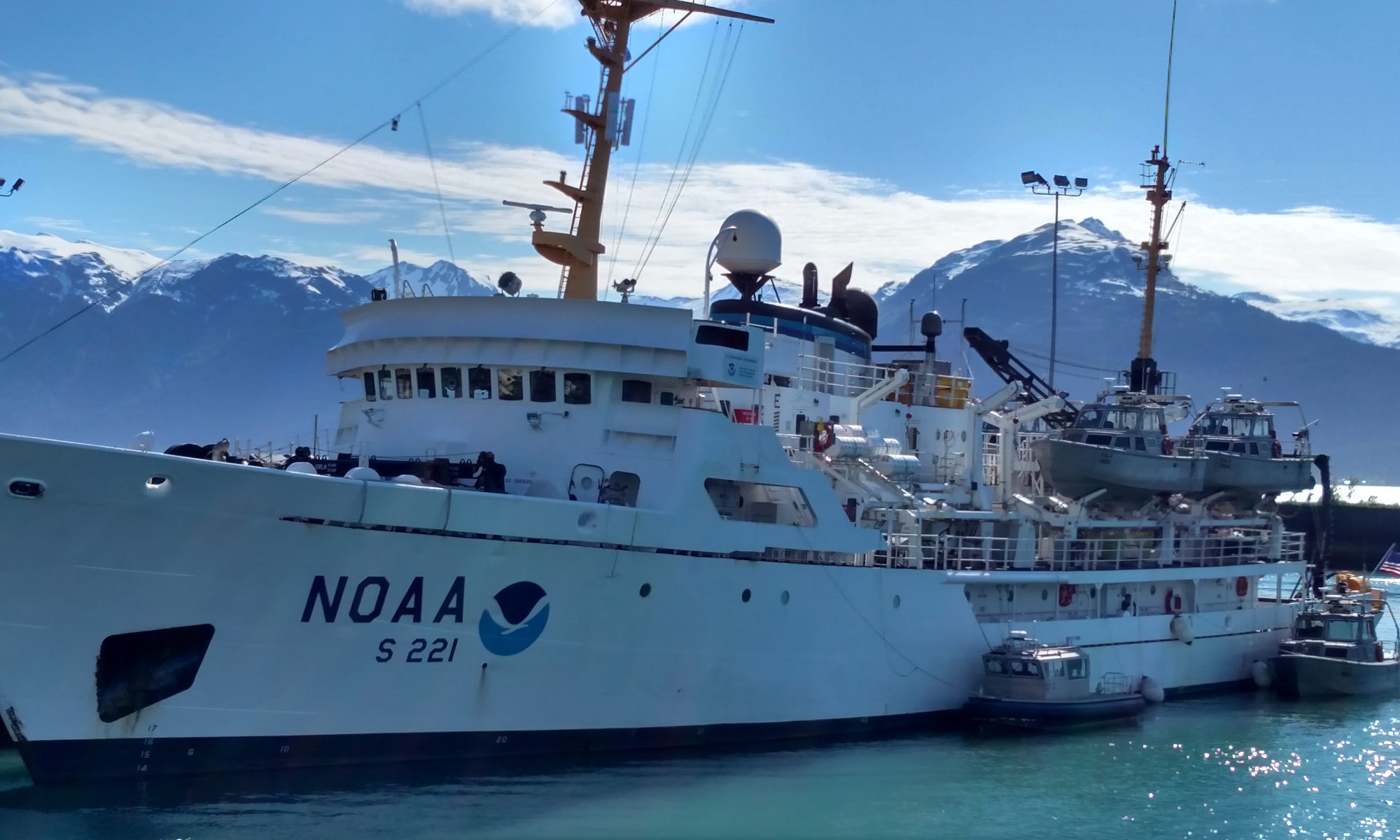
NOAA Teacher at Sea Tom Savage On Board NOAA Ship Henry B. Bigelow June 10 – 19, 2015
Tuning in to Sei Whales
Mission: Cetacean and Turtle Research Geographic area of Cruise: North Atlantic Date: June 16, 2015
Weather Data from the Bridge
Air temperature: 13 C
Wind speed: 10 knots
Wind direction: coming from the North West
Relative humidity: 95%
Barometer: 1004 millibars
Personal Log
Today is my third day at sea and I’m enjoying every moment; time onboard the ship flies. Although time onboard is dwindling, lots of discovery remains. Sunday brought sunny skies and warm temperatures, another perfect day for whale identification. It has been a real joy working with this exceptional group of professionals. Everyone is very supportive of each other and mission focused.
Science and Technology Log
The mission of this cruise is Cetacean research, but what exactly is a Cetacean? Cetus is a Latin word used in the context of biology defined as “whale”. Whales and dolphins are included within this order of classification. As stated in my earlier blogs, we are focusing on sei whales, pronounced ‘say” and beaked whales.
Why study sei and beaked whales? These whales are some of the least studied and scientists know relatively little about them. Information collected so far on sei whales: they have poleward migration trends, feed on small fish, krill and copepods (small crustaceans), and are thought to be populated along boundaries of elevated sea floors such as Georges Bank. Along the border of Georges Bank, upwelling of small prey occur due to ocean currents creating a perfect feeding ground for whales. Sei whales will also skim the ocean surface for food. Unfortunately, due to this feeding habit, many sei whales are struck and killed by large ships.
The other type of whale we are searching for are beaked whales. These whales are extremely difficult to identify due to their feeding and swimming behaviors. They are deep divers and spend a lot of time at depths of more than a thousand feet feeding on squid and fish. When they surface, they are inconspicuous and not acrobatic, and they are very difficult to see. Because they are found offshore in very deep waters, there are few opportunities to study them. Most of what is known about these species comes from individuals that have stranded on beaches where people can find them.
Acoustician scientist, Chris, analyzing a spectrogram
One method scientists on board use to detect the presence of sei whales is to listen for them using hydrophones (underwater microphones). For this cruise, the acousticians are deploying sonobuoys: short term recorders that can transmit live audio feed through VHF channels. Sei whales generate tonal calls and produce a “down sweep “ from high to low frequency with a range from of 80 – 30 Hz. Sei whales are classified as a Baleen Whale.
Baleen whales produce tonal calls typically under 1 kHz. For some species, like the humpback whale, song is known to be produced only by males, presumably to attract mates. After deploying the sonobuoy, we quickly began receiving signature tonal calls of sei whales. A sound spectrogram is used to interpret and project these acoustics on a graph with frequency on the y axis (vertical) and time on the x axis (horizontal). The darker plots indicate that the whale is close and lighter plots are weaker signals. Sometimes they will call in doubles or triple sweeps. Below is an example of a sei whale tonal call of the coast of Nova Scotia. Can you find the call?
Sei whale acoustic sample recorded off the coast of Nova Scotia.
Scientists are not sure at this point what purpose these calls serve; for example, they could be used to maintain contact between individuals, attract mates, or advertise feeding areas.
Atlantic White Sided Dolphin Photo taken by Hillary Moors-Murphy
Scientists are also trying to understand the oceanographic and habitat factors that are correlated with sei whale distribution. One question is what kind of prey are in the areas where sei whales are and are not found. In the evening hours, fishing nets are deployed to take a sample of organisms present in the ocean at that location. Shallow nets, called bongos, are used to take samples of zooplankton in the water down to 200m. Tonight, we are in deeper waters and the mid-water trawl net went down to 650 meters for 45 minutes. The net is then pulled in and fish are identified, counted and entered into a computer database. As mentioned above, sei whales like to feed on copepods and small arthropods. Guess what we pulled out of the bongo nets last night?
Weather: Partly cloudy. Winds 5-10 knots. Waves 1 meter
Science and Technology:
Collecting plankton is a very important activity for the scientists on the ship. Everyday and night they collect the very tiny plants and animals we refer to as plankton. Plankton is very important because it supplies the world with oxygen and it is the beginning of many food chains.
This is what we collect using the bongo nets.
The bongo nets are used to collect the plankton from the water. There are two bongo drums connected together and lowered into the water. Each one has a cylinder container connected to the end of the net with holes covered with mesh so that the water can flow out, but the mesh catches the plankton.
Tiny plants and animals that drift in the ocean currents flow into the nets. When the nets are brought back onto the ship, they are rinsed so that nothing is lost. The material collected is then rinsed into sieves and into jars with preservatives. The scientists that use the plankton for research decide which preservatives will be added. Sometimes it is in ethanol and sometimes in formalin, it is up to the scientists at the lab. All of these jars are sent to the lab on land and sometimes the material may be sent to labs in Poland to be examined.
To know how far the nets need to be lowered the scientists work with the deck crew and the bridge. Everyone makes sure the nets go very deep into the water, but that the nets do not touch the bottom. If they did touch the ocean floor there is a good chance that the nets would be damaged.
They also need to monitor how much water flows through the nets while the nets are in the water. To do this there are small flow meters connected to the nets. Before the nets go into the water, the numbers on the flow meter are put into the computer. After the nets come back up the numbers are again entered into the computer. Looking at the difference between these two numbers let the scientist know how much water flowed through the nets.
Here is the flow meter on the bongo net.
The main reason plankton surveys are conducted is to collect samples for estimating the number and place where fish larvae can be found.
When we are doing the CTD, we must give the weather conditions: cloud cover, height of waves, and the color of the water.
Here I am checking the sky and water.
Checking the water color
Careers: The people behind the scenes
The Chief Steward Walter Coghlan is a delightful person to watch in the kitchen and a lifesaver for me while I was under the weather. Walter has been with NOAA since 2008 and with his 21 years in the Navy, this Saturday, June 21st, will mark the 30th year at sea for him.
In the Navy, Walter was on various ships such as the USS Lexington and USS John F Kennedy. He even was a cook on a mine sweeper during the war. In the Navy he was a Culinary Specialist, he said that while on the USS John F Kennedy, President Ronald Reagan (everyone near Amboy and Dixon knows who that is) came aboard and asked for Walter to make fried chicken.
Walter also completed Finishing School for Chefs and for three years he served as the chef at the White House. This was when President George Bush was in office.
On the ship he has a budget of $10,000 per month to feed over thirty people three meals a day and provide snacks. His day starts around 4:30 AM and ends around 6:30 PM. He is certified as a Chief Cuisine and he is a superb chef. His future goal is to retire in one year and spend time with his family.
Chief Steward Walter and 2nd Cook Steve in the kitchen.
2nd Cook is Steve Daley. Steve is on his first trip on the NOAA Ship Oregon II. He is a augmenter, which means he is a sub and fills in where and when he is needed.
Steve is a Army veteran where he was a cook for eleven years. After the Army, Steve worked at the Pennsylvania Dept. of Correction where he taught culinary classes for 20 years.
Steve is also a wonderful chef and working in the small kitchen space must be difficult at times.
You can believe me when I say that eating on this ship was as good as eating at a fancy restaurant at home!
Engineers:
Sean Pfarrer is the Chief Marine Engineer on the NOAA Ship Oregon II. Due to my schedule the only time I saw Sean was when he was eating, so I was not able to interview him.
1st Engineer Richard Brooks
1st Engineer is Richard Brooks. He just joined the NOAA team on this trip and will be with NOAA for two years. Before that he was an engineer on the big oil tankers. He talked about being on the big oil tankers and pointed out the differences between them. He explained how some of the tankers are so big they can not go close to land and smaller tankers will either take fuel to them or from them. It is amazing how much information he has about the different ships.
Richard would sometimes make a trip through the wet lab after our catch to see what we caught.
Down in the engine room.
2nd Engineer David Carlise
2nd Engineer is David Carlise. David was in the Coast Guard for four years. He has traveled all over the world on ships and had many stories of his adventures to share with us. After leaving the Coast Guard, David was a Commercial Fisherman for 17 years where he was the captain. He was a Merchant Marine and was the engineer for a cargo boat, tub boat, and a tanker. He will be getting off in Galveston and flying to the state of Oregon for his next assignment on another ship.
Ship’s electricalJunior Engineer Jerry Britt
Junior Engineer (JUE) Jerry Britt joined NOAA in 2010, He was in the Navy for 20 years in charge of 40 guys as an engineer.On the NOAA Ship Oregon II, Jerry could be called the maintenance man, he fixes everything mechanic. He gave Robin and I a tour of the engine room, it is very noisy and very hot down there, but amazing to see what makes the ship sail! Jerry explained how everything works down below our feet. The electrical board is huge! And seeing the crank shaft of the engine was really cool!
Wiper Otha Hill
Wiper Otha Hill, also known as OC, has been with NOAA since 1984. He has worked on the ship Oregon II for 18 years and worked on four other NOAA ships. One of the ships was a weather ship in Chile! He has also worked on Union Ships in the engineering dept., built ships for four years, was a welder and a Junior Engineer and spent six years working on big ships.
As the Wiper, Otha, cleans, paints, and assists with everything that needs something done to it in the engine room area.
These are the people that have very important jobs on this ship. When the shower drain is plugged or the air conditioning goes out, everyone is looking for these men!
Mike and Chuck bringing in the nets.
Personal:
There are signs that my sea adventure is winding down. The water is green, I am seeing more oil rigs, and Ensign Laura Dwyer opened the ship’s store!
Green water
Oil rigs
Ensign Laura Dwyer opens the ship’s store!
Even on the NOAA Ship Oregon II you can shop!
Today the dolphins were back following the ship. They came right up to the stern of the ship, it was amazing watching them slap the water to let the other dolphins know where the fish were!
Frigate bird
The other night and again today we saw Frigate birds flying near the ship. Some say that seeing this bird will bring you good luck….hope so! The Frigate (Fregata) is a seabird that can have a wingspan of over 2 meters. They are a large bird, closely related to the pelicans. For more information check out this website: http://a-z-animals.com/animals/frigatebird/
I cannot wait to share my photos and everything that I have learned. The various species of fish, that you can only tell apart by looking at that one little dot on the bottom of their body or because their eyes are closer together that the other fish (that is the same shape and color and looks just like them) or the shrimp and crabs that are so numerous it has taken me this entire trip to look over the books in the dry lab with their names and information.
My bunkmate, Chrissy and me.
Even though my bunkmate, Chrissy Stepongzi and I did not spend a lot of time together (we worked opposite shifts), I can say she was there when I was sick and has a great sense of humor. She graduated with a Major in Biology and worked as a high school sub for two years. For Chrissy the best part of this job is being on the ship and when she is on land she likes to spend time with her cat and dog.
Yes, I have picked up fish of all sizes and shapes. Yes, I can tell if they are a boy or girl. Yes, I have taken the heads off of shrimp. Yes, I have had wet feet for over ten hours everyday. AND yes, I have survived. I do miss my family, my dog (Ginger) and all the students at Central, but I would come back to this ship in a minute!
The Night Shift-Taniya, Andre, me, and Robin (Photo by Kim Johnson)
I feel so fortunate to have been selected for this and even more fortunate to have been able to sail on the NOAA Ship Oregon II with everyone. Kim Johnson went above and beyond to make sure I was involved and learning something new everyday….thanks! And Taniya, Andre, and Robin will forever make me laugh when I think back on how much time we spent together…the work, the songs, the stories, have all made lasting memories!