Kiersten Newtoff: Thar She Blows! January 22, 2025

NOAA Teacher at Sea
Kiersten Newtoff
Aboard NOAA Ship Pisces
January 6 – January 29, 2025

Mission: Atlantic Marine Assessment Program for Protected Species (AMAPPS)
Geographic Area of Cruise: North Atlantic Coast
Date: January 22, 2025
Data from the Bridge: N38°12’0″, W74°47’0″. It’s currently 38°F outside — it snowed on deck last night! We have about 24kn of wind but it’s dying down quickly.

Team Spotlight: Marine Mammal Observers
(I was doing cute names previously, but realized it’s probably more important to use the actual job names…)

From Fins to Feet and Back Again

A bird’s eye view of a group of common
dolphins swimming along the bow of
the Pisces. It’s hard to see, but there is a
striped dolphin mixed in. Credit: Kelsey.
NEFSC permit #27066.

Cetaceans are a group of marine mammals that includes whales, dolphins, and porpoises. There are other groups of marine mammals too such as seals, otters, and manatees, but this cruise is mostly focusing on cetaceans. Upon first look, it’s not a far reach to think that cetaceans are fish, but they are indeed mammals – they are born with fine sensory hairs and they have mammary glands to support their young.   I teach evolution in one of my classes and the story of cetaceans is quite fascinating. Life began in the seas as the land was toxic. As algae oxygenated the world, evolution on land became a race. Land was a frontier where no other organism lived, which meant nothing was around to eat you. The land plants dominated and vertebrates like Tiktaalik soon followed. What was once a barren wasteland now supported dinosaurs. Evidence points that the common ancestor of cetaceans were land-based, even-toed ungulates (hooved animals), with hippos being their closest present-day ancestor. As with most questions in science, answering “why” is nearly impossible, but understanding natural selection can get us a good hypothesis about this transition. Some ancestral ungulates probably lived closer to shores and may have even waded into the water to eat fish. Those that just happened to have limbs that made them swim or dive a little bit more than others had access to more food, so they are the ones who survived and reproduced. Add in another 5-10 million years and you have the whales – organisms that can move gracefully through water and have an abundant food source.

Whale art thou?

What the Marine Mammal Observers do is pretty much in their name: they observe marine mammals. On this trip, they are most interested in cetaceans but also record other species of note (sharks, sunfish, seals, etc.). These simple observations have a big impact. We can create models using the data to estimate the distribution and abundance of species. This AMAPPS winter cruise is to better understand distribution at a time of the year that we have limited data. Unfortunately, winter means less than ideal conditions, but some data are better than no data!

On the flying bridge. Michelle is in the foreground looking through a large standing binoculars called the big eyes. Behind her is Cheryl who is standing, and Kelsey who is seated. Other observers can be seen in  the background.
Michelle operates the “big eyes” on the port side while another observer is on the starboard side. Cheryl is behind her, about to switch with Kelsey to do naked eye detections and data recording.

While marine mammal surveys can be conducted by small boats and aerial surveys, they are usually limited to close to shore. These trips offshore fill in missing gaps about cetacean abundance and distribution. Of particular note are beaked whales, which can be found in deep water. The number of vessels or land points that are able to confidently spot them is limited. Most of the data that comes from beaked whales are from washed up carcasses. By following transect lines, the Pisces science team can do a wide swath of surveying in the ocean and record a large variety of species with trained observers using big eyes (see picture; really large mounted binoculars) with support from bioacoustics. If the conditions are just right, the science team can also collect a DNA sample from an organism, which can help us determine their sex, subpopulation, trophic level of diet, pregnancy, and more. This is especially important for the Gervais beaked whale because we know very little about them. If on this trip we were to get a visual sighting, an acoustic signature, AND a biopsy of one – we all may just wipe our hands and say we can go home now. No cap. (I think I used that right…)

These species maps are critical in conservation – you can’t really protect the species if you don’t know much about them. By doing these observational studies over long periods of time, we can assess how climate change and habitat availability are impacting the species. In conjunction with the zooplankton team, they help us to understand what’s happening lower in the food chain and changes in these organisms can percolate to the top. These data can help to establish timelines on when it is safe to be drilling or doing construction or shift shipping lanes so that humans have less interactions with marine mammals. Fishing bycatch is a major cause of death in whales, so understanding whale migration patterns, breeding, and wintering grounds can help establish safe fishing zones.

Our data gets used by the Navy, Bureau of Ocean Energy Management, and NOAA. It’s really important to get it right.
Yin

Let’s Be Real about the Wildlife Biology World

As a warning, this section is not full of rainbows and sunshine. There is a real problem in wildlife biology (whether it’s marine mammals or birds or megafauna) that is really important for folks to know that are trying to get into this field.

When you think about a job, you likely are imagining a job that is generating revenue for a company. Your role is helping the company make money, and they pay you to help them make money. But the conservation world lacks this mechanism. Funds for conservation are limited to grants from other organizations, or funds from the state or federal level so they can meet environmental regulations. While those funds exist, very few are regular – there may be enough money this year to sponsor 5 researchers, but next year maybe for only 2. It’s feast or famine.

A common dolphin that has jumped out of the water. The side of the dolphin is much darker than other common dolphins due to melanism, which is an overproduction of melanin.
A melanistic (produces the dark pigment melanin more than typical) common dolphin spotted on the trip. Credit: Michelle. NEFSC permit #27066.

Because of this lack of funding, many organizations simply cannot afford to pay for people to complete the work, or they can only supply income for short contracts. If you want to get experience in a wildlife field, you likely will have to volunteer or take unpaid internships. Perhaps you find a paid position, but the working conditions are not compensated appropriately, or you take a ‘volunteer position’ but you have to pay a fee to get involved. And these companies aren’t trying to exploit people, it’s just the unfortunate reality of funding in the conservation world. And let’s be real, the wildlife biology field is fun and there are lots of people who want to volunteer. While that may be a great thing for these organizations, it means the diversity in the workforce is limited to those who have the financial ability to be there. Wildlife biology jobs are also in short supply, so you need a lot of experience or education to be competitive.

There’s not much that we can do about it, but the conversations are starting. It’s important to know what you are getting yourself into, especially when considering where you may go to college and the tuition, as it may be quite a while before you are able to pay off student loans. Keep your prospects open and don’t pigeonhole yourself into one path. Perhaps consider specializing in statistics, as all fields of biology (and just careers in general) have a strong need for statisticians.

Statistics will get you anywhere in the world, in any field.
Sam

Meet the Marine Mammal Observer Team

Kelsey is on the left ans Sam is on the right on the flying bridge. Kelsey is seated and Sam is standing next to her. Both are wearing mustang suits, which are bulky clothing to keep warm.
Kelsey (left) and Sam (right) on the flying bridge, where observations take place when the weather is good enough.

As a quick note, many folks in environmental fields in the government (like NOAA) are contractors. Contracts can be short term (such as a single cruise) or longer term depending on project goals and needs.  You’ll learn about the jobs that the marine mammal team hold when not working with NOAA.

Meet Michelle, who works as a protected species observer for TetraTech (which is also the company my mom worked at for many years!). In this position, she mitigates for potential impacts on protected species and does environmental compliance for the offshore energy industry (wind mostly, but also oil and gas). Her master’s degree focused on Indo-Pacific dolphins in Hong Kong and Taiwan, particularly looking at the impact of boat traffic and construction on their populations.  She volunteered for Allied Whale and was a commercial fisheries observer for NOAA.

As an undergrad, Kelsey specialized in marine mammal biology through field courses, internships, and research in Alaska, New Zealand, and Texas. These experiences led to roles as a protected species observer, supporting marine mammal research, industry mitigation, and conservation efforts from land, sea, and air. Her master’s research focused on community-based conservation to reduce human impacts on cetaceans; her ongoing PhD in Australia furthers this by developing acoustic techniques to reduce humpback whale entanglements. She also enjoys sharing her passion for the ocean through environmental education when the opportunity arises!

Coming from the Greater Atlantic Fisheries office is Cheryl, a marine resources management specialist. Having gone to school in central NY, marine mammals weren’t really on her radar. Afterwards she worked for a company in Hawaii narrating whale watches and dolphin tours which jump started her love for marine mammals. From there she did a master’s and Ph.D. with marine mammals. While her position is usually at the office, she is able to take advantage of research cruises to see where the data is coming from to better inform her management work.

Close-up view of Yin in an insulated mustang suit on the flying bridge. The large binoculars, called the big eyes, are directly behind her.
Yin poses with the big eyes because we are excited about science! Credit: Yin.

Sam has been working with the AMAPPS mission for about 10 years with both observations and data analyses to support reports and scientific papers. He has a Ph.D. in Marine Science and has worked with fish and marine mammals. He also taught at Northern Virginia Community College for five years, which isn’t too far from where I teach!

And last, but certainly not least, is Yin who got started in the NOAA research cruise world after graduate school. Her research focused on how tourism impacts dusky dolphins in New Zealand, as well as describing their acoustic behavior. She had a friend who did Eastern Tropical Pacific cruises with NOAA and recommended that Yin apply for the next one. Yin worked for NOAA for 10 years but is now in a contracting role, which grants her the flexibility for more adventures.

A Day in the Life of a Marine Mammal Observer
Watching for dolphins.
Bad weather, go to the bridge.
We see nothing, sigh.

As I’m putting in the finishing touches on this post, the sea has changed substantially and warrants a new haiku.

Are Those Calm Seas?
Finally, calm sea.
No white caps, slow wind, warm air.
Of course, it’s foggy.

Breaking into the Marine Mammal World
The team shared a lot of different tips for people who are interested in marine mammals.

  1. When in college, do as much hands-on work, volunteering, and internships as you can.
  2. Meet and network at the Marine Mammalogy Conference. Their website also has a lot of great resources for students who want to get started in the marine mammal world. The Cascadia Research Collective has good advice too.
  3. Develop as many additional skills as you can: statistics, GIS, math, invertebrates, oceanography, small engines, soldering, coding, and photography all are helpful.
  4. Positions exist at the bachelor’s level, but you likely will need at least a master’s, if not a Ph.D. because of how competitive the field is getting. More education may also lead to more networking opportunities.
  5. It’s a small world, meaning everyone talks to everyone. Your work ethic will get out there.
  6. Try many things in the marine world, not just marine mammals. You will gain a lot of experience that is transferrable to the marine mammal world.
  7. Similarly, if this path is daunting, you can work other positions on the ship (see my other blogs for highlights!) that gets you involved with the science.
  8. And finally….

It’s really important to be kind.
Yin

A view of two computer screens side by side. The background is a closeup of Kiersten looking through the big eyes. The image is oriented like a mirror across the screens, so that Kiersten is "looking" at herself.
Here’s a bonus image! I came into the dry lab this morning to find this on the computer monitors. Just so artsy. Photo cred: Kelsey. Layout cred: Annamaria

Michelle Greene: Visual Sighting Team, July 23, 2018

NOAA Teacher at Sea

Michelle Greene

Aboard NOAA Ship Gordon Gunter

July 19 – August 3, 2018


Mission: Cetacean Survey

Geographic Area: Northeast U.S. Atlantic Coast

Date: July 22-23, 2018

Latitude: 40° 35.213″ N

Longitude: 66° 6.692″ W

Sea Surface Temperature: 23.4° C (74.1° F)

Knots: 7.85 knots

Science and Technology Blog:

The visual sighting team started early this morning at 6:00 am and had rotating shifts of 30 minutes each until 7:00 pm.  The different shifts included watching with regular binoculars on the port and starboard sides, watching with the big eyes on the port and starboard sides, and being the data recorder for sightings.  I had the opportunity to shadow scientists in each of these positions throughout the first day and actually performed the duties on the second day.

Members of the Cetacean Survey Visual Team on Lookout

One of the important jobs the data recorder has is to input the environmental conditions at a certain point in time.  The first measurement to input is the percent of cloud cover which is just a number from 0 to 100. Then the glare magnitude is determined on an ordinal scale from 0 to 4 with a value of zero meaning none and a value of four meaning severe.  After determining the glare magnitude, the percent of glare cover is determined.  Since the two sets of big eyes cover from 90 degrees left of the bow to 90 degrees right of the bow, the glare covering this spaced is what is determined.  The data recorder also has to determine the degree angle and height of the ocean swell.  Swell is not the wind waves generated by local weather.  It is the wind waves that are generated by distant weather systems.  Then the Beaufort scale is used to determine the amount of wind on the ocean.  The scale was developed by Sir Francis Beaufort of the United Kingdom Royal Navy in 1805.  The scale ranges from 0-12.  A zero score means the surface is smooth and mirror like, while a score of 12 means there are hurricane force winds.  Rain or fog is also determined by the data recorder.  Finally, the data recorder has to determine a subjective condition of the weather overall.  This is on an ordinal scale from 1 to 4 with 1 being poor and 4 being excellent.

When a marine animal is sighted by one of the observers, the data recorder has to input several measurements about the event.  The bearing of the location of the animal has to be determined using the big eyes.  Also, the big eyes have a scale in the lens called reticles that determines distance from the ship to the animal.  A conversion scale can then be used to determine how far away the animal is in meters or nautical miles.  The number of animals sighted, including any calves that are in the group, has to be given.  The group’s swim direction has to be determined based on bearing from the ship.  If possible, the species of the group has to be given.  Since the objective of this survey is to find the occurrence of Mesoplodons in the North Atlantic Ocean, determining the species is very important.  Also the observer has to give the initial cue as to what determined the identification of the species.  Several different cues are available such as the body of the animal, the blow of a whale or dolphin, or the splash.

The software used to input the occurrence of a marine mammal automatically inputs the GPS of a sighting.  The initial route for this survey is a zig zag pattern out of Rhode Island towards Georges Bank.  There are several canyons with very deep waters (over 1,000 meters) which is where the Mesoplodons make foraging dives to get food.  Instead of making a straight line through the canyons and only making one pass through the area, using zig zag routes gives the survey a better chance of locating Mesoplodons.  The chief scientist uses the information from sightings to track a path for the ship to take the next day.  Sometimes the acoustics team hears possible Mesoplodons.  If the acoustics team can find a convergence of the area of an animal, they will tell the ship to go at a slower rate or turn.

The map here shows the sightings of Mesoplodons from the beginning of our journey and the zig zag pattern taken by the chief scientist.  The first day of our journey, a storm was coming up the East Coast.  The Gordon Gunter‘s Commanding Officer (CO) determined that we could run from the storm by going east in a straight line direction instead of doing the zig zag motion.  The CO was correct, because we did not have bad weather.  The ocean had a lot of high swells which made the boat rock tremendously at times but no rain.

GU18-03_Map_24July2018_wLegend
A map of the daily route of the Gordon Gunter based on sightings.


Personal Log

I have found my favorite place to be on the visual sighting team…being the data recorder.  Statistics is my passion, and being the data recorder puts me in the middle of the action getting mass amounts of data.  It also helps that the data recorder sits in a high chair and can see a wide area of the ocean.  The scientists have been very helpful in finding me a milk crate, because that chair is so high I cannot get onto it without the milk crate.  Being the data recorder can be intense sometimes, because multiple sightings can be made at the same time.  In any free time I have, I will fill in as the data recorder.  It is lots of fun!

Data Recorder
Favorite place to be on the visual team – Data Recorder

One thing that was a little intimidating to me at first was the intercom system.  I would hear things like, “Fly Bridge Bridge.”  Then the data recorder would say “Bridge Fly Bridge.”  I had no clue of what they were talking about.  Then all of a sudden it made sense to me.  In “Fly Bridge Bridge,” someone from the Bridge is calling up to us on the Fly Bridge.  The Bridge has a question or wants to tell the people on the Fly Bridge something.  Since I figured it out, I am ready to go.

I have learned so much on this cruise in the short time I have been aboard the Gordon Gunter.  My head is exploding with the numbers of lessons that I can incorporate into my statistics classes.  I have also talked with the acousticians, Jenny, Joy, Emily, and Anna Maria, and have come up with lessons that I can use with my algebra and calculus classes as well.  The scientists have been very generous in sharing their knowledge with a science newbie.  Being a math teacher, I want to be able to expose my students to all kinds of content that do not deal with just the boring math class.  Being a Teacher at Sea has opened up a whole new experience for me and my students.

We have an interesting participant in our cruise that I was not expecting but was happy to meet…a seabird observer.  Before this cruise I did not know there were birds that pretty much lived on the surface of the ocean.  These birds have been flying around the ship which is about 100 nautical miles from shore.  The seabird observer documents all sightings of seabirds and takes pictures to include in his documentation.

Did You Know?

Reticles are the way a pair of binoculars helps observers to determine the distance to an animal; however, the conversion from reticles to distance is not an instantaneous solution.  Based on the height of a pair of binoculars on the ship, reticles can mean different distances.  A conversion chart must be used to determine actual distance.

Check out this article on how to estimate distance to an object with reticles in a pair of binoculars:

Using reticle binoculars to estimate range

Animals Seen

  1. Sperm whales (Physeter macrocephalus)
  2. Fin whales (Balaenoptera physalus)
  3. Cuvier’s beaked whale (Ziphius cavirostris)
  4. Risso’s dolphins (Grampus griseus)
  5. Bottlenose dolphins (Tursiops truncatus)
  6. Common dolphin (Delphinus delphis)
  7. Great shearwater bird (Puffinus gravis)
  8. Cory’s shearwater bird (Calonectris borealis)
  9. Wilson’s storm petrel bird (Oceanites oceanicus)
  10. Leach’s storm petrel bird (Oceanodroma leucorhoa)
  11. White-faced storm petrel bird (Pelagodroma marina)
  12. Red-billed tropicbird (Phaethon aethereus)

Vocabulary

  1. acoustician – someone whose work deals with the properties of sound
  2. bearing – the direction from your location to an object in the distance starting at 0° which is located at absolute north.  For example, if an animal is spotted at 90°, then it is due east of your location.
  3. blow of a whale – the exhalation of the breath of a whale that usually looks like a spray of water and is an identifying feature of different species of whales
  4. bow of a ship – the point of the ship that is most forward as the ship is sailing (also known as the front of the ship)
  5. cloud cover – the portion of the sky that is covered with clouds
  6. foraging dive – a type of deep dive where a whale searches for food on the ocean floor
  7. glare – the light reflected from the sun off of the ocean
  8. nautical mile – a measurement for determining distance on the ocean which is approximately 2025 yards (or 1.15 miles) or 1852 meters
  9. port side of a ship – when looking forward toward the bow of the ship, the left side of the ship is port
  10. starboard side of a ship – when looking forward toward the bow of the ship, the right side is starboard

Staci DeSchryver: Fair Winds and Following Seas, July 8, 2017

NOAA Teacher at Sea

Staci DeSchryver

Aboard NOAA Ship Oscar Elton Sette

July 6 – August 2, 2017

Mission:  HICEAS Cetacean Study

Geographic Area:  South of Oahu, heading toward the Big Island

Current Location:  20.20 N 156.37 W

Date:  July 8, 2017

Weather Data From the Bridge: 


Science and Technology Log

We have arrived!  Today members of the incoming crew on Oscar Elton Sette picked me up from Waikiki and we made our way over to Ford Island for training.  The HICEAS study is seven “legs” long, each lasting about a month with a one week break in between legs – ours is the first “leg” of the mission, and the training took place for all scientists and crew who would be traveling and conducting research through any of the four parts of the mission.  In August and September, two of the legs will run simultaneously, so the project is significant in size with respect to time, manpower, and data collection.  We had a very full house of various research teams, some of which will overlap among the various legs of the trip.  The full crew is a tight family, with hugs and greetings all around during breaks and meal times.  How nice to know that leaving for 28 days (some of them longer) doesn’t necessarily mean leaving your family.

PIFSC_20100926-S86_B-01784.JPG
Wanted:  pseudorca (Alias: False Killer Whales) For High Crimes of Adorableness and shyness from ships.  Photo Credit:  NOAA Fisheries/Corey Sheredy

During training, scientists reviewed procedural protocols to follow for different species sightings and learned the protocol changes for a few other species.  The primary target for this particular leg of the HICEAS is pseudorca, or False Killer Whale.  They are a socially interesting bunch – a little reminiscent of the hallways at Cherokee Trail High School.  Whereas most whale species travel as a “class” in one large group all together, pseudorca behave as though all day every day is passing period.  The entire group of pseudorca may travel together (similar to being in school all day), but they don’t all congregate together in the same location.  They are a rather “cliquey” bunch – with smaller groups milling about together on their own in different corners of the main group but all keeping at least somewhat in eyesight or earshot of the other groups.  Because of this, scientists must identify the group, and then each individual subgroup, making note of any groups that join up or split apart.  We haven’t spotted any pseudorca yet, but with some time, talent, and a little luck, we will soon!

In a broad sense, the search for cetaceans on a daily basis is executed a little something like this:  Three mammal observers take their positions at port (left), center, and starboard (right) on the “flying” bridge – or the topmost deck of the ship.  There is also a space reserved just right of center for the Seabird observers.  Each observer will rotate through these three positions for a total of a two-hour shift.  If, for example, an observer begins at the port side “Big Eye” station, they will scan the water in search of cetaceans for 40 minutes from that position, rotate to the center, and then finally to the starboard side.  Where does the starboard side observer go when he or she has completed the rotation?  There’s plenty to do onboard and to help with until the next two-hour rotation begins.  There are two seabird observers working alongside the mammal observing team, and they alternate in two-hour rotations, so only one bird observer is on the flying bridge at a time in an official capacity.  All visual observers work from sunrise to sunset.

Each position at the marine mammal observation area is responsible for visually sweeping the ocean’s surface during observations.  The two side observers are only responsible for scanning from 0 degrees (the bow of the ship) to 90 degrees to their direct left on the port side, or direct right on the starboard side.  They use a very imposing pair of binoculars called the “Big Eyes” to scan their respective areas.  These binoculars are impressive in size and abilities.  They can bring even the smallest birds far on the horizon into sharp focus.  The center observer does not have Big Eyes, but stands ready to take data if there is a sighting.  He or she can scan the area in general, but the big eyes offer much more detailed observation abilities at a much greater distance.  The center observer is also responsible for keeping time on the rotations, monitoring the weather, the sun’s position in the sky, and Beaufort sea state.

While the visual observers are on the flying bridge, two scientists work in the acoustics lab to listen for cetacean vocalizations.  The two groups work in parallel universes, but only the acousticians can cross dimensions.  In other words, if the visuals see cetaceans, they can tell the acoustics about what they are seeing, but if the acoustics scientists hear vocalizations, they will not tell the observers.    More often than not, the acousticians will hear clicks, whistles, and moans from the acoustics lab well before the visuals make a sighting, because the acoustics team has a large advantage over the visuals team.  The visuals team is restricted to what they can see at the surface, and the acoustics team can “see” many miles away and deeply into the water column, which significantly increases their volume of searchable space.

When the acousticians “see” or hear a vocalization, they plot the distance from the ship. They continue to listen for vocalizations and continue with the plots.  Eventually, they have enough data to narrow down the potential location of the cetacean to two spots. This process is not unlike earthquake triangulation, except the observers can narrow down the location to two spots, rather than just one.  There will be much more to come as to how this process works in future blogs, so stay tuned!  

Personal Log

At the end of training today, Dawn, one of the ornithologists (that’s a seabird “pro”) informed us of the third and far lesser-known Pearl Harbor Memorial, USS Utah.  Utah was the very first ship capsized by Japanese bombs on the early morning of December 7th, 1941.  Found on the opposite side of the island from USS Arizona, the Utah is only accessible by folks who have military clearance to get on the base, making the memorial incredibly secluded from exposure to the general public.  Utah took 64 lives with her when she sank, and a small monument now stands on the shore as a memento to the crew lost that fateful morning.  What makes Utah interesting is that she still stands partially above water, her mangled and rusted metal piercing through the water’s surface like the grasping hand of a drowning sailor.  There was a brief attempt by the military to right and raise her, but it proved futile, and they made the call to leave her remains be.  Her finest and final duty is to serve her watch over the men caught in her belly on the day she fell prey to the Axis forces.

Utah found herself in the wrong place at the wrong time on the morning of December 7. She was moored on a pier normally reserved for aircraft carriers, and her flat and shiny deck betrayed her identity to the incoming Japanese pilots.  Due to this mistaken identity, the Japanese attacked her on appearance, and she capsized almost instantly.  More interesting is that much like the beginning of a bad cop movie, she was nearing her retirement.  She was in port awaiting her execution date,  friendly-fire style, her technological abilities waning and falling out of favor compared to the newer commissioned ships.  Her final resting place was originally supposed to be somewhere in the Pacific as a victim of a practice bombing drill by the Air Force.  The Japanese pilots got to her first.  She wasn’t even at work that day.

Utah was built in 1909 and commissioned in 1911, the second of two Florida-class battleships built for service during World War I.  After a long stint in the service as a battleship, the Utah was re-appropriated as an auxillary ship for gunnery training and target practice for the allied forces.  On the day of the attack, the aircraft carriers that should have been in-port at the time were out to sea, and so Utah moored in one of the empty spaces intended to be held by the aircraft carriers.  In the confusion of the attack, it was determined that Utah was a carrier, and the Japanese navy opened fire.  The Chief Water Tender, Peter Tomich, served bravely as he assisted crew in their evacuations when the abandon ship call came over the ship’s systems.   While everyone was running off the ship, Tomich was running back onboard. He lost his life in that selfless move and is remembered as a hero of the day.

Today Utah sits idly close to shore alongside what used to be a dock.  Her neighbor is NOAA Ship Okeanos Explorer, and just a little further up the harbor, our ship, Oscar Elton Sette.  It was sobering honor to be so close to the memorial before we left port, and though USS Utah is one of the smaller memorials on Ford Island, I certainly will not forget her.

Species Report:

Number of cetaceans seen visually:  0 so far

Number/types of cetaceans “seen” acoustically:

*Blainsville’s Beaked Whale

*Sperm Whale

*Dolphins

Birds Seen:

Frigate Bird

Shearwaters

Red Footed Booby

Brown Footed Booby

Land Bird who shouldn’t have been out so far in the ocean (so possibly my spirit animal).  Let’s hope he eventually finds his way home.

Tom Savage: Whales to the Left, Whales to the Right, June 12, 2015

NOAA Teacher at Sea
Tom Savage
On Board NOAA Ship Henry B. Bigelow
June 10 – 19, 2015

Mission: Cetacean and Turtle Research
Geographic area of Cruise: North Atlantic
Date: June 12, 2015

Weather Data from the Bridge
Air temperature: 18 C
Wind speed: 10 knots
Wind direction: coming from north west
Relative humidity: 90%
Barometer: 1015 millibars

Personal Log

Today is my second day at sea and I can finally walk to various places on the ship in less time. I have found sleeping on the ship to be very easy as the ship rocks back and forth. I really enjoy being at sea; it is very tranquil at times and I am not rushed to go anywhere except my assigned duty locations. While on deck observing, the sights and smell of the ocean invokes memories of my former home in Bar Harbor, Maine.

After a full day of observing whales in the sunshine I was very excited to conduct some star-gazing at night. At 2200, as I opened the first hatch outside, I walked into a wall of fog and was reminded quickly that I am miles offshore on Georges Bank in June!

Science and Technology Log

Sighting whales yesterday was very slow, but today made up for it. The weather was perfect, as the sky was mostly sunny with few high cirrus clouds early. Today I was assigned to the Flying Bridge for observations all day. There are three stations and we rotate every thirty minutes. The stations are Big Eyes on port and starboard sides and a computer in the center for data entry. We use different terms for orientation on the ship. For instance, the front of the ship is called the bow. While facing the bow, the left side is called the port and the right side starboard.

DiscussingSightings
Discussing sightings on the “Fly Bridge”

My rotation began on the port side of the ship using the “Big Eyes”. After a half hour, your eyes become tired, strained and shifting to the computer to enter whale sighting helps. At the computer we enter whale sighting data called out by observers.

LookingThroughBigEyes
Looking through the “Big Eyes”. Do you see anything?

In addition to recording the identification of animals; other important attributes are called out by the observers such as bearings and direction headings. Looking through the “big eyes”, a range finder is located from center with a scale from 0 – 24, and is called the reticle. To properly calculate distance, the observer needs to adjust the “Big Eyes” to align zero with the ocean horizon. This is very difficult since the ship is always in motion. The “Big Eyes” in the image above is not correctly aligned. There is a chart we used to translate the reticle values to distance.

An early morning break was followed by an amazing hour of multiple whale sightings. Fin, humpback whales and pods of Atlantic white-sided dolphin sightings were all around the ship. One humpback whale came within twenty feet of the boat. The afternoon was less active but we tracked pilot whales later which were not seen during morning rotations.

ViewFlyBridge
View from the “Fly Bridge” looking down on the “Rolling Bridge”


Until next time, happy sailing!

~ Tom


Adam Renick, Searching for Cetaceans and Wrapping Up, June 25, 2013

NOAA Teacher at Sea
Adam Renick
Aboard NOAA Ship Oscar Elton Sette
June 12–26, 2013 

Mission: Kona Integrated Ecosystems Assessment http://www.pifsc.noaa.gov/kona_iea/
Geographical area of cruise: The West Coast of the Island of Hawaii
Date: Tuesday, June 25, 2013

Weather Data
Current Air Temperature: 77° F
Sea Surface Temperature: 77° F
Wind Speed: 3 knots

Finding the Cetaceans…
 
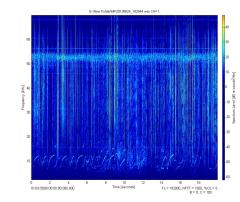
In the final days of our research cruise we set out to get an assessment of cetacean activity in the Kona area that we have been studying. In addition to the ongoing active acoustics, CTD and DIDSON sampling, we have added two new tasks to the science team to find as many cetaceans as possible. We have set up a hydrophone, which is a sound recorder that sits in the water and is pulled by the ship, to listen for the clicks, whistles and any other sounds dolphins and whales might make.

For examples of sounds cetaceans make please check out this website. When the sounds from the cetaceans are received the wave frequencies are recorded using some very interesting software that helps us determine the type of marine mammal it is and where it is located. Specifically locating and identifying the cetaceans requires the cooperation of many people and is not necessarily as simple as I am making it sound here.

Melons
The recording of a pod of approximately 150 Melon-Headed Whales. Credit: Ali Bayless

The sounds of Pilot Whales. Credit: Ali Bayless

While the acoustics team and the ship’s crew are listening and seeking out the animals we also assist in the effort by making visual observations from the highest deck of the boat called the “flying bridge”. Here one or two people who are in communication with the science team below use binoculars and “big eyes” to visually find and identify marine mammals.

Blog5 013
Looking through the “big eyes”

Some of my personal observing highlights of this operation include a sperm whale, a pod of approximately 150 melon-headed whales and smaller pods of spinner dolphins, rough-toothed dolphins, rough-toothed dolphin and pilot whales.

SE 13-04 Melon Heads
Visual observations of the Melon-Headed Whales.
Photo: Chad Yoshinaga

Rough-toothed_Dolphins
Rough Toothed Dolphins
Photo: Ali Bayless

Wrapping Up the Journey…
 
I cannot express enough gratitude to the members of the science team and the crew of the Sette for making my NOAA Teacher At Sea experience so rewarding. There are so many elements of this trip that are worth pause, reflection and appreciation. My emotions ranged from excitement just being at sea for 15 days and living a lifestyle that is unique and different than my own, the contemplative awe of the vast and complicated ocean ecosystem and the exhilaration when one of its own breaches the surface to give us a peek at it. In the end, I think my greatest appreciation gained along this journey was learning to slow myself down to the pace of nature in order to better observe and understand it.What’s next for me? NASA Teacher In Space… 2014 here I come!

Just kidding (is that even possible?) Until then I guess I should practice my moon-walking on Kilauea crater until I head back to my amazing wife and life in San Diego. Thanks for reading and, whatever you are doing out there in the world today, make a memory.