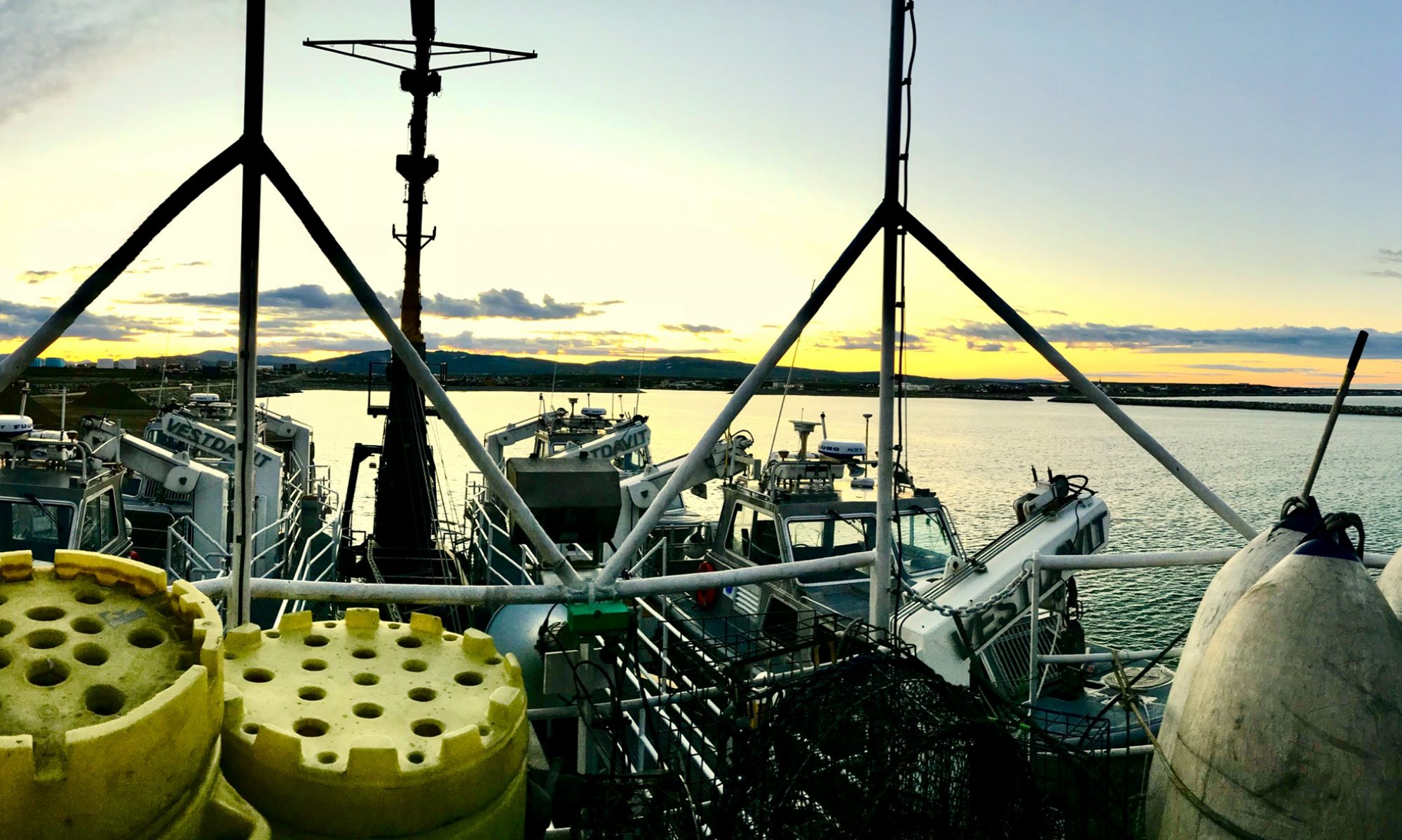
Richard Chewning, June 10, 2010

NOAA Teacher at Sea
Richard Chewning
Onboard NOAA Ship Oscar Dyson
June 4 – 24, 2010

NOAA Ship Oscar Dyson
Mission: Pollock Survey
Geographical area of cruise: Gulf of Alaska (Kodiak) to eastern Bering Sea (Dutch Harbor)
Date: June 10, 2010

Weather Data from the Bridge

Position: Bering Sea
Time: 2147 hours
Latitude: N 56 48.280
Longitude: W 161 48.549
Cloud Cover: Overcast with fog
Wind: 9.2 knots from NE
Temperature: 4.6 C
Barometric Pressure: 1010.8 mbar

Science and Technology Log

In addition to hosting fish biologists studying walleye pollock, the NOAA ship Oscar Dyson also has groups of researchers studying birds and marine mammals aboard. Both the birders and marine mammal observers are conducting supplementary projects taking advantage of the Dyson’s cruise track. As the Dyson sails back and forth across the Bearing Sea along equally spaced parallel transects, these researchers are able to survey a wide area of habitat, investigating not only what animals are present and absent in these waters, but also how many are present (called abundance). These surveys are considered passive since these researchers are not actively directing the ship’s movements but are surveying along the cruise track laid out by the fish biologists.

Our migratory bird observers are Liz Labunsky and Paula Olson from the United States Fish and Wildlife Service (USFWS). They are members of the North Pacific Pelagic Seabird Observer Program and are providing data for the Bering Sea Integrated Ecosystem Research Project. Pelagic seabirds are birds found away from the shore on the open ocean. Liz is from Anchorage, Alaska and has been involved with this project since 2006. Calling Gloucester, Massachusetts home, Paula is new to these waters but has spent years studying the birds of Prince William Sound as part of the ecosystem monitoring efforts resulting from Exxon Valdez oil spill.

Liz and Paula: an office with a view

Liz and Paula work for two-hour alternating shifts from the bridge. They continuously survey an area of water 300 meters by 300 meters in size. They are looking for birds both on the water’s surface and flying through the air. Liz and Paula must have quick eyes and be very familiar with a wide variety of birds. Identifying birds on the move can be very challenging. Often you only have only a few seconds to train your binoculars on your target before your query becomes a spot on the horizon. In addition, the same species of bird can vary greatly in appearance. Liz and Patti may only see a handful of birds over an entire morning but can also witness hundreds at any given moment!

Black-footed albatross
Northern fulmar

One constant challenge for observers aboard moving vessels is counting the same bird multiple times. For example, you will often spot northern fulmars flying laps around the Dyson when underway. To avoid introducing this bias (or error) in their survey, flying birds are only counted at certain time intervals called scan intervals. The frequency of these scan intervals are determined by the speed at which the Dyson is traveling. For example, when the Dyson is traveling 12 knots, birds flying are counted every 49 seconds. If the Dyson is traveling slower, the time is reduced.

Shearwaters
Shearwaters

While very familiar with the coastal birds of Georgia, I have been introduced to several new species of birds found in the Bering Sea. I have become a big fan of the tufted puffin. Easily identified by their reddish orange bills, tufted puffins resemble little black footballs when flying. These birds dive in the frigid waters to catch fish, their favorite prey. The black-footed albatross is another bird new to me identified by the white markings around the base of the beak and below the eye along with its large black feet. One of my favorite observations with Liz and Patti was identifying a group of northern fulmars so tightly packed on a piece of driftwood that it showed up on the ship’s radar!

Personal Log

Just before my shift ended around 1545 hours, a call came over the radio from Yin, one of the Dyson’s three marine mammal observers. She reported that a large number of humpback whale blows had been spotted on the horizon. A blow refers to the spray of water observed when a whale surfaces for a breath of air. Like all mammals, whales have lungs and must surface to breath. The humpback whale is a baleen whale that feeds on krill (small marine invertebrates that are similar to shrimp) and small fish in the summer. Krill is a major link in the marine food web, providing food for birds, marine mammals, and fish such as pollock. Baleen whales have plates made of baleen instead of teeth that are used to separate food from the water. Baleen resembles a comb with thick stringy teeth. Think of the movie Finding Neo when Marlin and Dory are caught in the whale’s mouth.

There be whales here!

Not sure how many whales constitute a large group, I eagerly headed to the bridge to see if I could catch a glimpse of this well-known marine mammal. I quickly climbed four companionways (a stair or ladder on a ship) up to the flying bridge from the main deck where the acoustics lab is located. Upon reaching the highest point on the vessel, I was told that I was in for a treat as we were approaching a massive aggregation (a group consisting of many distinct individuals or groups) of humpback whales. Whales often travel in small social groups called pods, but this gathering was much larger than usual. This gathering was more than a single pod of whales as there were so many blows you didn’t know which way to look!

The Dyson’s CO (Commanding Officer), Commander Michael Hoshlyk, carefully maneuvered through the whales affording the growing gathering of onlookers a great view. Observations from the Dyson’s fish biologists and birders supported the hypothesis from marine mammal observers that these whales were almost certainly gathered together to feed. Evidence to support this conclusion included acoustic data and the presence of large numbers of seabirds. The Dyson’s transducers showed large acoustic returns that were most likely from plankton (organisms that drift in the water) such as krill. There were also countless numbers of shearwaters (medium-sized long winged sea birds) gathered where the whales were swimming. Estimating the number of whales and shearwaters proved difficult because of their large numbers. The first group of whales numbered at least 50, and we later encountered a second group of humpbacks that numbered around 30. The shearwaters numbered in the thousands! I was able to capture some great pictures of the flukes (the horizontal tail of the whale used for propulsion) and blows of the humpbacks by holding my camera up to the powerful BIG EYES binoculars. Looking through the BIG EYES gave me the sensation being so close that I almost expected to feel the spray of water every time the whales surfaced for a breath. I counted myself fortunate to see this inspiring and unforgettable sight. Along with the beautiful weather, the opportunity to see these amazing creatures of the deep made for a very enjoyable cruise to the beginning of the pollock survey.

Viewing humpback whales equals a Kodak moment!

New Word of the Day – Bearing

You will often hear the word ‘bearing’ used on the bridge of the Dyson. A bearing is a term for direction that relates the position of one object to another. For example, the Dyson’s lookout might call out, “Fishing vessel, bearing three one five degrees (315°)”. This means the fishing vessel is in front of and to the left of the ship when facing toward the bow. A bearing does not relate distance, only direction. The area around the Dyson is divided into 360 equal parts called degrees. One degree is equal to 1/360th of a circle. When calling out a bearing, degrees allow for precise communication of an object’s relative position to that of the Dyson. The Dyson always has a member of the deck crew stationed on the bridge serving as lookout when underway. The lookout’s responsibility is to monitor the water around the Dyson for boat traffic, hazards in the water, or any other object important to the safe navigation of the ship.

Blue sky and blue water
Sunrise over the Aleutians

Katie Turner, July 18, 2008

NOAA Teacher at Sea
Katie Turner
Onboard NOAA Ship Miller Freeman
July 10 – 31, 2008

Mission: Pollock Survey
Geographical Area: Eastern Bering Sea
Date: July 18, 2008

The ship
The ship

Science and Technology Log 

Where is the Bering Sea?

The Vessel 

NOAA Ship MILLER FREEMAN is a 215 foot fishery and oceanographic research vessel, and one of the largest research trawlers in the United States.  She carries up to 34 officers and crew members and 11 scientists.  The ship is designed to work in extreme environmental conditions, and is considered the hardest working ship in the fleet.

She was launched in 1967 and her home port is Seattle, Washington. MILLER FREEMAN has traditionally been used to survey walleye pollock (Theragra chalcogramma) in the Bering Sea.  These surveys are used to determine catch limits for commercial fisherman.  In 2003 NOAA acquired a new fisheries research vessel, the NOAA Ship OSCAR DYSON. OSCAR DYSON is to eventually take over MILLER FREEMAN’s research in Alaskan working grounds, allowing MILLER FREEMAN to shift her focus to the west coast. OSCAR DYSON was built under a new set of standards set by the International Council for the Exploration of the Sea (ICES), which reduces the amount of noise generated into the water below, while MILLER FREEMAN is a more conventionally-built vessel which does not meet the ICES standards.  The assumption is that marine organisms, including pollock, may avoid large ships because of the noise they make, thus altering population estimates.  It is therefore important for scientists to know the difference between population estimates of the two ships. This is done through vessel comparison experiments, in which the two ships sample fish populations side by side and compare their data.  The primary purpose of this July 2008 cruise is to complete a final comparison study of the two ships and measure the difference in the pollock population data they collect.  

Image of the eruption of Okmok, taken Sunday, July 13, 2008, by flight attendant Kelly Reeves during Alaska Airlines flights 160 and 161.
Image of the eruption of Okmok, taken Sunday, July 13, 2008,
by flight attendant Kelly Reeves during Alaska Airlines
flights 160 and 161.

The Location 

The Bering Sea covers an area of 2.6 million square kilometers, about the size of the United States west of the Mississippi.  The maximum distance north to south is about 1,500 kilometers (900 miles), and east to west is about 2,000 kilometers (1,500 miles).  The International Date Line splits the sea in two, with one half in today and the other in tomorrow. The area is also bisected by a border separating the Exclusive Economic Zones (EEZ) of Russia and the United States. The EEZ is the area within a 200 mile limit from a nation’s shoreline; where that nation has control over the resources, economic activity, and environmental protection. More than 50% of the U.S. and Russian fish catch comes from the Bering Sea. It is one of the most productive ecosystems in the world.  The broad continental shelf, extensive ice cover during the winter, and the convergence of nutrient-rich currents all contribute to its high productivity. It is a seasonal or year round home to some of the largest populations of marine mammals, fish, birds, and invertebrates found in any of the world’s oceans.  Commercial harvests of seafood include pollock, other groundfish, salmon and crab.  The Bering Sea has provided subsistence resources such as food and clothing to coastal communities for centuries.

Aleutian Island volcaneos

Repairs and Delays 

Anchorage high school teacher, Katie Turner, arrives at the pier in Dutch Harbor, Alaska
Anchorage high school teacher, Katie Turner,
arrives at the pier in Dutch Harbor, Alaska

While all aboard were anxious to begin this Bering Sea Cruise, the ship could not sail until crucial repairs could be made.  During the previous cruise a leak was discovered in the engine cooling system that brought the ship in from that cruise early.  The location of the leak was the big mystery.  After days of testing and a hull inspection by divers the leak was located.  It was in a section of pipe that runs hot water from the engine through the ship’s ballast tanks and into a keel cooler on the outside of the ship’s hull, where it is cooled before circulating back to the engine. This turned out to be a very labor intensive job and workers spent days draining and cleaning the tanks before the leak could be repaired.

In the meantime, a repair to one of the engine’s cylinders required a part that had to be shipped from Seattle via Anchorage (about 800 miles northeast of Dutch Harbor). To complicate the arrival of this part, a nearby volcano erupted, spewing ash 50,000 feet into the path of flights to and from Dutch Harbor.   Alaska has many active volcanoes. The Aleutian Island arc, which forms the southern margin of the Bering sea, comprises one of the most active parts of the Pacific’s “ring of fire”. This tectonically active area has formed due to the subduction of the Pacific plate beneath the North American plate. So far we do not have a definite departure schedule.  Each day spent at the dock is one day less for the scientific team to complete the goals of the cruise.  Meanwhile, OSCAR DYSON is completing its survey in the Bering Sea, and anticipates the arrival of MILLER FREEMAN to complete the comparison study.

NOAA Teacher at Sea, Katie Turner, gets a tour of the bridge and quick navigation lesson from Ensign Otto Brown
NOAA TAS, Katie Turner, gets a tour of the bridge and quick navigation lesson from Ensign Otto Brown

Personal Log 

I arrived in Dutch Harbor on July 9th with a forewarning that repairs to the ship would be necessary before heading out to the Bering Sea, and that I would have some time to explore the area. I have managed to keep busy and take advantage of opportunities to interview the crew, hike, and find my way around town. The weather in Dutch Harbor has been exceptional with many sunny days. It’s uncommon for a NOAA research ship to spend so much time at the dock, and we attracted the attention of a newsperson from the local public radio station. Commanding Officer Mike Hopkins and Chief Scientist Patrick Ressler were interviewed by KIAL newsperson Anne Hillman while MILLER FREEMAN was delayed for repairs in Dutch Harbor. Unalaska Island has few trees and along with other islands on the Aleutian chain is known for its cool and windy weather. There are no large mammals such as bear on the islands but small mammals, such as this marmot, are common along with many species of birds and a wide variety of wildflowers, which are in bloom this time of year.

Chief Scientist Patrick Ressler explains how he uses acoustic equipment to study pollock in the Bering Sea.
Chief Scientist Patrick Ressler explains how he uses acoustic equipment to study pollock in the Bering Sea.
A marmot spotted on a ridge alongside the road up Mt. Ballyhoo on Amaknak Island
A marmot spotted on a ridge alongside the road up Mt. Ballyhoo on Amaknak Island
A Bald Eagle guards the crab pots stored near the pier
The view from Mt. Ballyhoo on Amaknak Island. Lupine, a common plant found on the island, is in bloom in the foreground
The view from Mt. Ballyhoo on Amaknak Island. Lupine, a common plant found on the island, is in bloom in
the foreground
Black Oystercatchers take flight over the harbor

Learn more about the Bering Sea ecosystem at these Web sites: 

http://www.avo.alaska.edu/volcanoes/aleutians.php http://www.worldwildlife.org/what/wherewework/beringsea/index.html http://www.nature.org/wherewework/northamerica/states/alaska/preserves/art19556.html http://www.panda.org/about_wwf/where_we_work/europe/what_we_do/arctic/what_we_do/marine/bering/index.cfm

Rebecca Himschoot, July 8, 2007

NOAA Teacher at Sea
Rebecca Himschoot
Onboard NOAA Ship Oscar Dyson
June 21 – July 10, 2007

Mission: Summer Pollock Survey
Geographical Area: North Pacific Ocean, Unalaska
Date: July 8, 2007

Weather Data from Bridge 
Visibility: 10 nm (nautical miles)
Wind direction: 346° (NNW)
Wind speed:  light
Sea wave height: less than 1foot
Swell wave height: less than 1 foot
Seawater temperature: 8.8°C
Sea level pressure: 1019.4 mb (millibars)
Cloud cover: stratus

NOAA ship OSCAR DYSON

Science and Technology Log: Who was Oscar Dyson? 

The 206-foot OSCAR DYSON is one of the newest ships in NOAA’s fleet, and was commissioned in 2005.  The OSCAR DYSON is home ported in Kodiak, Alaska, and sails primarily in the Gulf of Alaska, the Aleutian Islands, and the Bering Sea, researching fish stocks, marine mammals, and seabirds, observing weather, sea and environmental conditions, and conducting habitat assessments.

The ship is a stern trawler, and is outfitted with two trawl nets, among others, to support the annual fish surveys and biological assessments that are conducted in support of commercial fisheries, primarily pollock.  The OSCAR DYSON is outfitted with a Scientific Sonar System, which can accurately measure the biomass of fish in the survey area. Trawling is used to collect specific biological data, such as length, weight, and gender of the sample.  Weather, sea and environmental data are also collected continuously using hundreds of sensors on board, such as the Acoustic Doppler Current Profiler (ADCP), which measures ocean currents. The OSCAR DYSON can also assist in maintaining and deploying stationary buoys to collect similar information for a specific area at depth over time.  

In support of the science mission of the OSCAR DYSON, the ship has been built to minimize sound.  By decreasing the hull noise, scientists are better able to observe fish without disturbing their natural behavior.  Another special feature of the OSCAR DYSON is a retractable centerboard that carries many of the sensors used in scientific studies. By lowering the sensors over 10 feet below the hull, the acoustic data collected by the scientists is less affected by the ship’s noise.  When retracted, the scientists and crew aboard the OSCAR DYSON are able to access the sensors for maintenance and replacement as needed.

Oscar Dyson
Oscar Dyson

The ship’s namesake, Oscar Dyson, was an innovative leader in fisheries in Kodiak. He came to Alaska in 1940, where he worked for the Army Corps of Engineers to build infrastructure in Southwest Alaska.  Immediately after the war he began fishing out of Kodiak. He fished crab and shrimp, and was a leader in the development of the pollock fishery. Dyson also was a founding partner in All Alaskan Seafoods, the first company controlled by fishermen who owned both the vessels and the processing plants. Oscar Dyson served on the North Pacific Fisheries Management Council for nine years, and fished until his untimely death in 1995. In an interview with the Kodiak Daily Mirror in 1981, Dyson commented, “You’ve got to love the water first, or you’ll never make it.”

Personal Log 

My leg of the summer Pollock survey is drawing to a close, and we have ended with some different kinds of trawls.  We’ve collected jellyfish and plankton, and we’re still hoping to trawl using a special net that opens and closes, enabling the scientists to target multiple sets of fish at multiple depths in one cast.  We’re ending with much improved weather, which has been a welcome change for everyone.

The crew of the OSCAR DYSON has made this experience particularly memorable, with scientists explaining their work in detail and crewmembers sharing their knowledge willingly. I’ve toured the engine room, spent time on the bridge, eaten once-in-a-lifetime meals, talked commercial fishing with the deckhands and even learned to tie some knots and splice lines with their help. It has been an amazing learning experience!

Barney Peterson, August 21, 2006

NOAA Teacher at Sea
Barney Peterson
Onboard NOAA Ship Rainier
August 12 – September 1, 2006

Mission: Hydrographic Survey
Geographical Area: Shumagin Islands, Alaska
Date: August 21, 2006

Weather Data from Bridge 
Visibility: 10 n.m.
Wind direction:  light airs*
Wind speed:  light airs*
Seawater temperature: 11.1˚C
Sea level pressure: 1012.0
Cloud cover: cloudy

* “light airs” means there is little or no wind

Science and Technology Log 

I have now been out on the survey boats twice and am scheduled to go out again this afternoon. Each survey boat is set up a little differently and some work better in shallower depths than others. They use the same basic systems to create profiles of the ocean bottom.  The survey technicians and NOAA Corps officers have been great at explaining how their equipment works. On the hull (bottom) of each survey boat is a transducer, a device that sends and receives pulses of sound waves. As the sound waves strike the seabed they bounce back to the receiver. Those that come back soonest are those that bounce off objects closest to the sonar device.

However, as the sound waves are transmitted straight down into the water, they spread out from the transducer in a cone shape.  This means that waves on the outer edges of the cone normally travel farther before returning than do the ones that go straight down.  The waves that come back to the receiver first show the tops of objects that are closer to the boat. This works fine for objects straight down, but remember, the waves that are on the outside of the cone travel a little farther and take a little longer to reach things.  That means that they may strike against the tops of higher objects, but they will still take a little longer to return than echoes from objects of the same height that are directly under the receiver.

This is where the sophisticated software comes into translating the echoes that the transducer receives. When the survey boats begin work, and every four to six hours after that, the crew uses a device called a CTD to read the temperature and conductivity of the water all the way to the seabed under the boat.  Both temperature and chemical make-up of the water affect how fast sound waves can travel through it.  Knowing how fast the sound waves can be expected to travel helps the receiver understand whether echoes are  coming back from the tops of rocks (or fish, whales, shipwrecks, etc.), from straight down under the boat, or from the edges of the cone.

Screen shot 2013-04-08 at 4.16.45 PM

There are other considerations to analyzing the echoes too.  It is important to have information on the height of the waves and the swell of the water at the time readings are being made.  (Remember the sound waves are sent out from the bottom of the boat and the boat is floating on the top of the water.) This way the echo patterns analysis can take into account whether the boat is leaning a little to the right or left as it goes up or down with the swell of the water.  That lean affects the angle at which the beam is aimed to the seabed from the bottom of the boat.  The level of the sea surface changes with the tides, so the software also figures in the lowest level that probably will occur due to changes of tide. This is all linked to the time that surveys are made, (because tides change with the time of day, month, and year) the date and the exact geographical position for each bit of information is very important.  This depends upon satellite and GPS technology.

The transducers send out pings faster or slower (pulse rate) and with a stronger or weaker signal, depending upon how deep the water is in the main area of the survey.  The power is set higher for deeper water.  The cone of the beam spreads out wider in deeper water so the resolution, or focus, is not as great.  This is acceptable because objects that are hazards to navigation are generally sticking up from the bottom in shallower water.  (Something sticking up 2 meters from the bottom in water 50 meters deep would still be 48 meters below the surface at its highest point.  That same object in 10 meter water would only allow 8 meters of clearance for ships on the surface.)

There are many other considerations to using the sonar information for making good charts. Every day I have the opportunity to ask a few more questions and learn a little more about this technology.

Personal Log 

This evening I got to go out in a kayak with the XO.  We paddled away from the ship and followed the shoreline north around the island until we entered the next bay.  The waves were small, but sometimes there was a pretty good gust of wind so I really had to pay attention as I was getting used to the feel of the little boat.  About 100 yards from the ship a sudden gust caught my hat and took it off into the water.  We were not able to recover it. On the cliffs above the second bay we spotted Bald Eagles and gulls of several kinds.  One of the eagles was really concerned about what we were doing and either circled over us or sat on the high bluff and watched us the whole time we were in the area.  Its mate flew back and forth through the area calling to it as it watched us.

We were hoping to see a waterfall that we had heard came down the side into this bay, but we never did sight it. The shoreline was beautiful with steep rock walls or narrow rocky beaches and mountains rising right up from the edge.  The hillsides look like they would be smooth and easy to walk on, but the vegetation is actually thick, deep, brush and provides very uneven footing.

Our return to ship was much faster than the trip out because the wind was at our back and pushing us all the way.

Question of the Day 

How were most of the islands in the Aleutian Chain formed?

Philip Hertzog, August 12, 2005

NOAA Teacher at Sea
Philip Hertzog
Onboard NOAA Ship Rainier
July 25 – August 13, 2005

Mission: Hydrographic Survey
Geographical Area: Aleutian Islands, AK
Date: August 12, 2005

Weather Data from Bridge

Latitude: 56˚ 00.3’ N
Longitude: 158˚ 45.7’ W
Visibility:  10 nm
Wind Direction: light
Wind Speed: airs
Sea Wave Height: 0 feet
Sea Water Temperature:  12.2˚ C
Sea Level Pressure: 1006.0 mb
Cloud Cover: 1, cumulus, altocumulus

Science and Technology Log 

Last evening we stopped and fished for a few hours off the Barren Islands located between Kodiak Island and the Kenai Peninsula.  I caught three rockfish with a 12-pound test line (compared to 60-pound used by others) by slowly reeling in the fish and letting them run to prevent breaking my line.  A few other people caught rockfish and lingcod, but no one came near reaching their limit like at Albatross Banks.

After cleaning my fish, I went up to the flying bridge around 11:30 pm to watch the evening sky. The flying bridge sits above the main bridge and forward of the ship’s smoke stack.  It offers the best view on the ship with an open deck and observation platforms.  Jonathon Anderson stood watch on the center platform looking ahead for any whales that might surface in front of the RAINIER.  A small diameter metal tube runs down from the flying bridge to the main bridge, which serves as a communication link by shouting into it. In addition to calling down any whale sightings, Jonathon let the bridge know of any light buoys or vessels he spotted.  The deck crew takes turn standing watch on the flying bridge, which usually starts at dusk and ends at sunrise.

The main bridge maintains a quiet dignity.  Before entering the bridge, you must obtain permission from the officer of the deck.  People talk quietly and infrequently while on the bridge. The conversations focus on ship’s business, but mostly quiet dominates the bridge as the officers concentrate on handling the ship safely.  An officer always scans the horizon to look for potential danger to the ship.  A second officer maintains record books and frequently plots the ship’s location on charts.  A helmsman, usually a deck crewmember, steers the wheel under direction of the officer of the deck.  The CO comes on the bridge when problems arise and is the only one allowed to sit in the Captain’s Chair.

Here are photographs of the bridge and deck crewmember Dennis Brooks serving as helmsman:

After I spent a few minutes on the flying bridge, Corey Mussey and Allison Thueur relieved Jonathon of watch duty. Allison came on board with us in Kodiak as a new General Vessel Assistant. Corey stands watch with her as part of her training, but she will eventually be on her own.  Allison previously worked on sailboats in the Caribbean and enjoys life on board. Allison told me she makes a point of teaching any visitors to the flying bridge the name of at least one star.  She showed me a star and then pointed out several other constellations.  Allison then made Corey point out the star he learned from her the previous night.

I stayed on the flying bridge for 45 minutes and looked at two distant volcanoes to the west silhouetted against a faded orange skyline.  To the east, the dark outlines of mountains on the Kenai Peninsula slowly approached us as we headed towards Homer and our final transect runs starting at 2:00 am.  What a wonderful way to spend my last evening at sea on board the RAINIER.

My journey aboard the RAINIER ended at 8:00 am as we pulled into Kachemak Bay and tied up at the Alaska State Ferry Terminal in Homer.

hertzog_log19_img_3

I want to thank the senior officers for giving me the freedom to explore the ship and allowing me to participate in all aspects of ship life.  I end my log entries with a little bit of information on each of them.

Commander Guy Noll
Commander Guy Noll, Commanding Officer

Commander Guy Noll captains the RAINIER. Commander Noll grew up in Olympia, Washington (in my own neighborhood) and has three children.  His oldest daughter will enter the Eighth Grade this fall in a school district north of Seattle. The Commander served on board the RAINIER as an Ensign earlier in his NOAA career and returned as Executive Officer about six months ago.

In June he received a promotion to Commanding Officer (CO) during a formal ceremony in Seattle.  The Commander has many years of experience in conducting hydrographic surveys and I found him to be one of the most knowledgeable people on board in charting technology.  He also is an expert fisherman, though I observed that his command duties severely limit this recreational activity.


Commander Julia Neander, Executive Officer (XO)
Commander Julia Neander, XO

Commander Julia Neander serves as our Executive Officer (XO). The XO is second in charge, sets the ship’s schedule, and makes administrative arrangements for mooring in harbors like Kodiak and Homer.  She also deals with personnel issues, makes room assignments, and resolves disputes among the crew.  In many ways, XO Neander’s job is similar to that of an assistant principal at a school while the CO acts as the principal.

Commander Neander went to Montana State University (at the same time I did) and once circled the Earth over the course of a year on a NOAA ship. Her husband served on the RAINIER as XO and they have a five year-old son.


Lieutenant Ben Evans, Field Operations Officer (FOO)
Lieutenant Ben Evans, Field Operations Officer

Lieutenant Ben Evans runs all of the mapping efforts as the Field Operations Officer (FOO).  As the FOO, Lt. Evans makes decisions on all aspects of survey work.  He organizes the junior officers in the field and constantly monitors the radio to resolve any technical problems the survey crew encounters on the launches. Lt. Evans also looks over the quality of the sonar data and determines its acceptability.  He oversees the officers processing the data on board the Rainier and works long hours to make sure mapping efforts run smoothly.  Lt. Evans grew up in upstate New York near Lake Ontario.  To the right is the FOO out in the field trouble shooting the HOR CON.


Again, I thank the Senior Officers and all the crew of the RAINIER for the wonderful experience

Personal Log 

My voyage has officially ended aboard the RAINIER as her Teacher at Sea.  I’ll spend tonight on the ship and then stay in a hotel tomorrow night before flying back to Washington State.

As I write this, I hear laughter in the hallway from the Junior Officers for the first time since we left Mitrofania. Commander Neander stops by with her five-year-old son and says good-bye to me as she leaves to spend a weekend with her family away from the ship. Other people talk about plans for the weekend: going to Anchorage, renting a hotel room, going camping, and eating in a fine restaurant.  A joyous mood seeps throughout the RAINIER as people prepare for two days off after three weeks at sea.

What a journey for me.  I got to touch base with technical fieldwork that I had done prior to teaching. Before the RAINIER, I had spent no more than two continuous days aboard a ship. I learned how a ship at sea operates like a small community, like a family.

I look forward to meeting my new students in a few weeks and telling them about the RAINIER. Both Mike Laird (the other teacher) and I have started to use our experience to modify lesson plans for the fall.

The RAINIER departs in a few days for the uncharted waters of the Southwestern Alaskan peninsula. Miles of coastline and deep water await her as she carries out a mission to update decades-old nautical charts that will then safely guide mariners engaged in commerce or pleasure.  Goodbye to the RAINIER and may fair seas greet you on your mission…

Goodbye, RAINIER!

Question of the Day 

Would you like to live on a ship like the RAINIER for a year?  What are the pros and cons of living a seafaring life?