Marla Crouch: The Adventure Is About to Begin, May 22, 2013

NOAA Teacher at Sea
Marla Crouch
Sailing Aboard NOAA Ship Oscar Dyson
June 8 — 26, 2013

Marla
Marla Crouch.

Mission: Pollock Survey Geographical area of cruise: Gulf of Alaska Date: May 21, 2013 – Upcoming cruise dates June 6 – 26, 2013 Weather Data from the Bridge: as of 0500 Wind Speed 20.97 kts Air Temperature 5.40°C Relative Humidity 91.00% Barometric Pressure 1,031.50 mb Latitude: 55.72 Longitude:-157.36 Hi, I’m Marla Crouch I live in Issaquah, WA, about 17 miles east of Seattle.  I teach Earth Sciences and I am the Robotics Club Adviser at Maywood Middle School, in the Issaquah School District. On June 6, 2013 I will head north to Alaska to begin my adventure as a NOAA Teacher At Sea.  I’ll be updating this blog about three times a week, so check back often.  Let me know if you have answers to the questions I’ve posted. Science and Technology Log While I am aboard the Oscar Dyson I will be working with the Scientist Team doing a Pollock Survey. The Alaskan Pollock or Walleye is member of the cod family and is the most valuable fish crop in the world. Products made from Pollock were valued at $1 billion in 2010.

Pollock
Pollock, Courtesy of Google Images

During the survey we will be checking population size and characteristics including age and gender. The Science team will calibrate and monitor equipment used to find the schools of pollock that swim in the mid-water depths of the ocean (330 – 985 feet). Samples of the population will be caught using cone-shaped nets.

Personal Log The last time I cruised Alaska’s water, I was on a cruise ship gliding through the Inland Passage along Alaska’s southeast shores. This time I’m headed about 900 miles west to the island of Unalaska, in the Aleutian Islands and the open waters of the Bering Sea and the Gulf of Alaska. My Teacher At Sea experience embarks from Dutch Harbor, AK. Here I will meet the NOAA ship Oscar Dyson; I’ll introduce myself to the ship’s crew and science team and settle in for the 19 day fishery cruise.

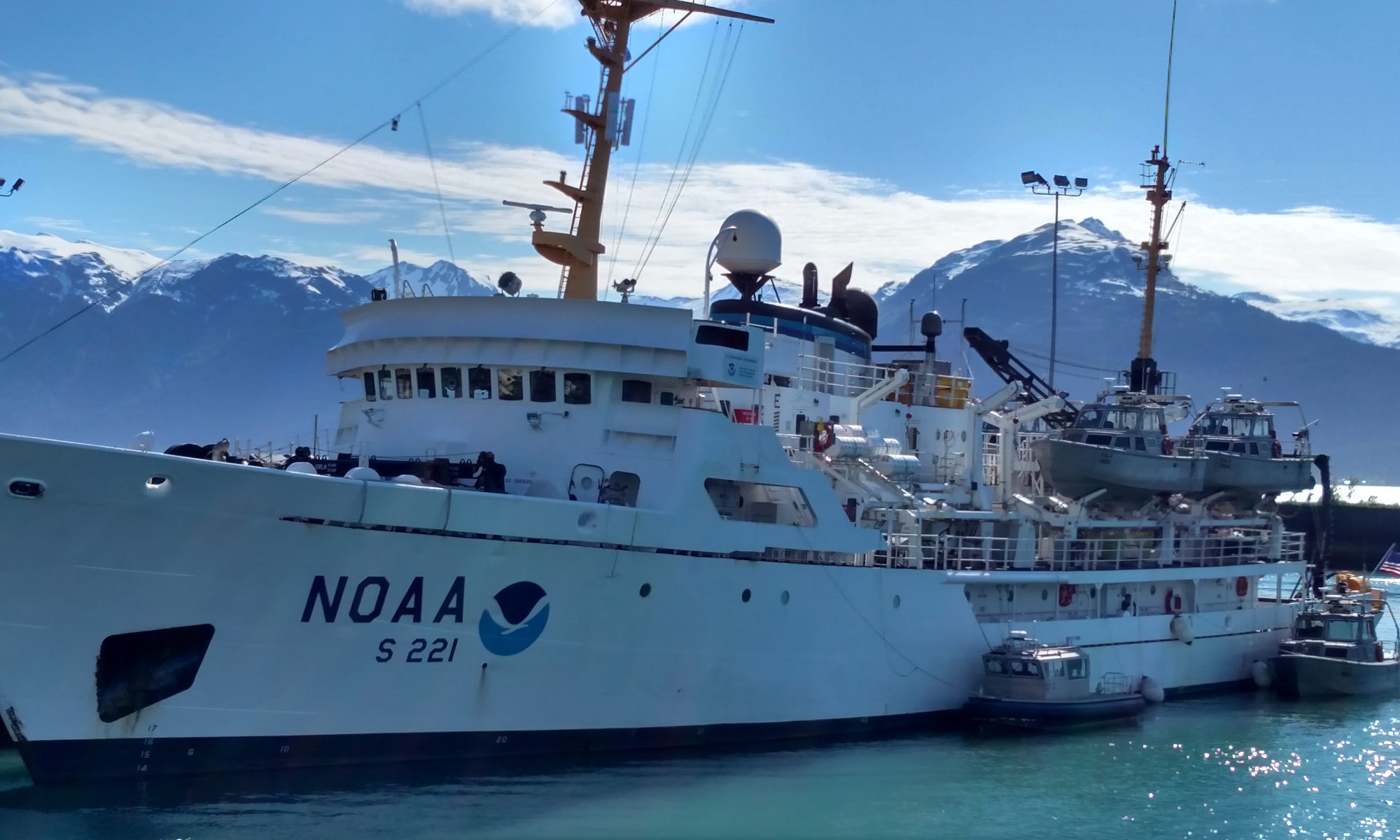
Oscar Dyson, courtesy of NOAA

Have you ever wondered why ships/boats are referred to as “she?” Answer, no one knows for sure as the origins have been lost in oral history. I’ll be interested in finding out how the Oscar Dyson crew refers to her. The NOAA ship Oscar Dyson is 63.8m long, 15m wide and displaces 2479 metric tons when fully loaded. The Dyson can be at sea up to 40 days and travel 12,000 nmi before replenishing supplies. Okay, Ladies and Gentlemen, your turn to do the math. Tell me what are the dimensions of the Dyson in feet? I’ll help; here is the conversion ratio, 1m: 3.28ft. Next question: convert nautical miles to statue miles 1mi: 1.15nmi.

Drawing of NOAA Ship Oscar Dyson

The Oscar Dyson was launched in Pascagoula, MS in October 2003 and commissioned in 2005 in Kodiak, AK. The mission of the Dyson is to protect, restore and manage the use of living marine, coastal, and ocean resources through ecosystem-based management. The ship observes weather, sea state and environmental conditions, studies and monitors fisheries, and both marine birds and mammals. Check out the video below of the launching of the Dyson.

Video courtesy of http://www.moc.noaa.gov/od/ (animation 6) In preparation for my trip I did a little research on Dutch Harbor and the island of Unalaska.  Unalaska is one of approximately 100 stratovolcanic islands spanning 1250 miles in Aleutian Islands chain. The Port of Dutch Harbor is the only deep draft, ice-fee port from Unimak Pass west to Adak and north to the headwaters of the Bering Straits. Annually, more than 1.7 billion pounds of seafood are shipped from Dutch Harbor. Island history includes settlements by the Unangan (Aleut) people roughly 9,000 years ago, architectural and cultural influences from Russia, the invasion by Japanese forces and the internment of American civilians in WWII. The WWII Aleutian Campaign is one of the deadliest battles in the Pacific theater. A note for our students studying WWII: check out the National Park Service web site for the Aleutian World War II.

Did You Know? I’ve learned a new word, Williwaw. I think I’ll add this word to our study of Catastrophic Events.   What is a Williwaw?  You tell me.  Here is a hint, if the ship encounters a Williwaw I may be searching for the Dramamine.

Frank Hubacz: Unimak Pass, May 4, 2013

NOAA Teacher at Sea
Frank Hubacz
Aboard NOAA ship Oscar Dyson
April 29 – May 10, 2013


Mission: Pacific Marine Environmental Laboratory Mooring Deployment and Recovery

Geographical Area of Cruise: Gulf of Alaska and the Bering Sea

Date: May 5, 2013

 Weather Data from the Bridge (0300):

Partly cloudy, S Winds, variable, currently 3.71 knots
Air Temperature 2.8C

Relative Humidity 73%

Barometer 1025.1 mb

Surface Water Temperature 0.10 C

Surface Water Salinity 31.66 PSU

Seas up to 5 ft

Science and Technology Log

Once we completed our mooring work from Gore Point through to Pavlof Bay, we sailed on to Unimak Pass, nearly 400 miles away, and then entered into the Bering Sea.  Unimak Pass is a strait (wide gap) between the Bering Sea and the North Pacific Ocean in the Aleutian Island chain of Alaska.  Upon arrival at our first station, we started the process of deploying our CTD sampling unit at predetermined points as well as MARMap Bongo casts(discussed in my next blog) when specified, within a region forming a rectangular “box” north of the pass.  If you have been following my voyage using NOAA ship tracker, hopefully you now understand why we appeared to have been “boxed in” (I can hear the groans from my students even out here in the Bering Sea). It is important to understand the ocean waters of this region given that it is a major egress between the North Pacific Ocean and the Bering Sea.  Therefore it serves as an important pathway between these two water bodies for commercially important fish stock as well as serving as a major commercial shipping route.

Unimak Pass
Unimak Pass

 A CTD (an acronym for conductivity, temperature, and depth) is an instrument used by oceanographers to measure essential physical properties of sea water.  It provides a very comprehensive profile of the ocean water to help better understand the habitat of important marine species as well as charting the distribution and variation of water temperature, salinity, and density.  This information also helps scientist to understand how variations in physical ocean properties change over time.  The  CTD is made up of a set of small probes attached to a large stainless steel wheel housing. The sensors that measure CTD are surrounded by a rosette of water sampling bottles (niskin bottles) that individually close shut by an electronic fired trigger mechanism initiated from the control room on-board the ship.  The rosette is then lowered on a cable down to a depth just above the seafloor.  The science team is able to observe many different water properties in real time via a conducting cable connecting the CTD to a computer on the ship. A remotely operated device allows the attached water sampling bottles to be closed (sample collected) at selective depths as the instrument ascends back to the surface.


CTD Unit
CTD Unit
Here I am in my hot rain pants helping to deploy the CTD
Here I am in my hot colored rain pants helping to deploy the CTD.  Notice the niskin bottles?
Monitoring the drop with Peter
Monitoring the CTD deployment
Data screens in the lab

On this cruise, our CTD was equipped to collect real-time water column measurements of conductivity, temperature, density, dissolved oxygen, salinity, chlorophyll levels, and light as the unit traveled down through to a set point just above the ocean floor.  Additionally, water samples for determining concentrations of nutrients (nitrate (NO3-1), nitrite (NO2-1), ammonium (NH4+), phosphate (PO4-3), and silicates (SiO4-4), dissolved oxygen, dissolve inorganic carbon, and chlorophyll were measured at specified depths within the water column as the unit was raised back to the surface.  Replicate measurements of some chemical constituents measured on the ascent are completed to help support the reliability of  the dynamic measurements of these same species made on the drop.  All of the nutrient samples are then frozen to -80C and brought back to the lab on shore for analysis.  Dissolved oxygen, dissolved inorganic carbon, and chlorophyll samples are also treated according to unique methods for later detailed analysis.

The sampling begins!
The sampling begins from a niskin bottle!
Filling the sampling vials to be stored for later analysis
Peter placing samples in the freezer
Scott preparing the chlorophyll samples

Our first CTD cast from the “Unimak Box” began with my shift, a bit after midnight, on May 3rd and ended 32 hours later on May 4th.  The science crew worked nonstop as they completed 17 different CTD casts. Again, it was impressive to see the cooperation among the scientists as each group helped one another complete CTD casts, launch and retrieve Bongo nets, and then collect the many different samples of water for testing as well as the samples of zooplankton caught in the bongo nets.  My task was to collect nutrient water samples from each CTD cast.  As the water depth increased so did the number of samples that were collected.  During our sampling water depths ranged from approximately 50 meters (5 samples) up to 580 meters (11 samples).  On our last cast the air temperature was -2.3o C with water temperature reading 2.90 C. Seas were relatively calm and we were able to see many different islands in the Aleutian chain.

Personal Log

It was rewarding to be able to help the team collect water samples for nutrient testing, especially given that we are able to sample many of these same nutrient species in our chemistry lab at Franklin Pierce.  I want my students to know that I practiced “GLT” when collecting nutrient samples making certain to rinse each sample bottle and sampling syringe at least three times before each collection.  Want to know what “GLT” references…ask one of my students!

My most “interesting” time on board ship happened during our first night of CTD testing along one of the lines of the Unimak Box.  At 2:45 am Peter, Douglas, and I were recording flow meter values from the previous bongo net tow on the side quarter-deck.  I was writing values down on a clip board as Peter read the values off to me.  I happened to glance over the deck towards the sea when I noticed an unusually large wave about 2 meters out from the boat traveling towards us.  Suddenly it crashed on top of us knocking us to the deck floor.  Water flooded all around us and through the doors of our labs.  I immediately grabbed onto one of the ship’s piping units and held on tight as the water poured back off the deck.  In an instant the sea was calm again after the “rogue” wave released its energy on our ship.  Because Peter and I fell onto the deck our clothes became completely soaked with icy cold seawater.  Upon standing, we checked on each other and then immediately began retrieving empty sampling bottles and other lab paraphernalia as they floated by in the water emptying off the deck.  Douglas was able to hold-on to the CTD and remained standing and dry under his rain suit.  This is the first, and I hope the last, “rogue” wave that I ever experience.  Fortunately, no one was lost or injured and we were able to retrieve all of our equipment with one exception…the clip board of data log entries that I was holding!

I must admit that I am disappointed at the limited internet access while on board ship.  I find it somewhat disheartening that I have not been able to write the consistent blogs promised to you telling of my adventures.  Hopefully this will improve as we change course and you will continue to follow along.

IMG_7099
View as I traveled to work!
Islands of the Aleutians.
IMG_7055
Island hopping!
IMG_7029
Not all islands are completely snow covered.


Do you know what this is?

Read my next blog to find out what this is!
Read my next blog to find out!

Set tags and categories(include your name)

Rebecca Himschoot, July 4, 2007

NOAA Teacher at Sea
Rebecca Himschoot
Onboard NOAA Ship Oscar Dyson
June 21 – July 10, 2007

Mission: Summer Pollock Survey
Geographical Area: North Pacific Ocean, Unalaska
Date: July 4, 2007

Weather Data from Bridge 
Visibility: less than 1 nm (nautical miles)
Wind direction: variable
Wind speed:  light
Sea wave height: 4 feet
Swell wave height: 2-3 feet
Seawater temperature: 7.6°C
Sea level pressure: 1020.4 mb (millibars)
Cloud cover: stratus

US Fish and Wildlife Service seabird observer, Tamara Mills

Science and Technology Log: Special Studies 

Bird observer Tamara Mills has to keep track of many things.  From her post on the bridge of the OSCAR DYSON, Tamara locates and identifies multiple species of seabirds around the ship, and then records the information to be entered in the North Pacific Pelagic Seabird Database (NPPSD). She identifies and counts the many fulmars, murres, kittiwakes and other seabirds that are within 300 meters of the ship, often using binoculars to help correctly identify each bird before she records it. As the data are entered into the database, the computer automatically records the GPS location of the ship.

Tamara is a biologist with the US Fish and Wildlife Service, but she’s sailing on the NOAA research vessel OSCAR DYSON in order to add data to the NPPSD.  Seabird observations are frequently done in the nesting colonies, but the colonies are where the birds spend the least of their time.  In fact, roughly half of all seabirds may not be nesting in a given year, so that they would never be seen or counted in a land-based survey.  USFWS has therefore collaborated with other agencies to place observers, like Tamara, on “vessels of opportunity,” or research vessels where seabirds can be monitored and counted. USFWS seabird observers can be found on Coast Guard vessels, on NOAA ships, and on the Fish and Wildlife Service’s own research vessel. 

A northern fulmar photographed by Tamara on board the OSCAR DYSON

Along with counting seabirds, Tamara is also logging marine mammal sightings.  In 2006 USFWS seabird observers spent 168 days at sea and completed 14, 263 km of survey transects in the Bering Sea, some areas of the Gulf of Alaska, and the Aleutian Islands. In all this work they spotted 69 species of seabirds and 16 species of marine mammals.  Until this recent work, no information had been added to the NPPSD since the 1970’s and 1980’s.

“We want to get an up-to-date picture of what’s really out there,” Tamara said. “These data could be useful in studying climate change or in the event of an oil spill. It may also be possible to link what we’re finding in the bird surveys to the acoustic fish information that’s being collected, and we might then be able to correlate the types of birds we see and their densities when certain kinds of fish are present.”

Personal Log 

The Bering Sea was calm today!! We actually had some sun and were able to trawl and process without hanging on to railings and tables and such.  Tomorrow we should head for our final transect, and we have nearly collected the minimum number of otoliths we set out to, so the cruise is beginning to wind down.  We have plans for an Independence Day barbecue if the weather cooperates later in the day.

Question of the Day

Answer to yesterday’s question (What is conductivity?): Conductivity is the measure of the ability of a solution to carry an electrical current, and is used to measure salinity.