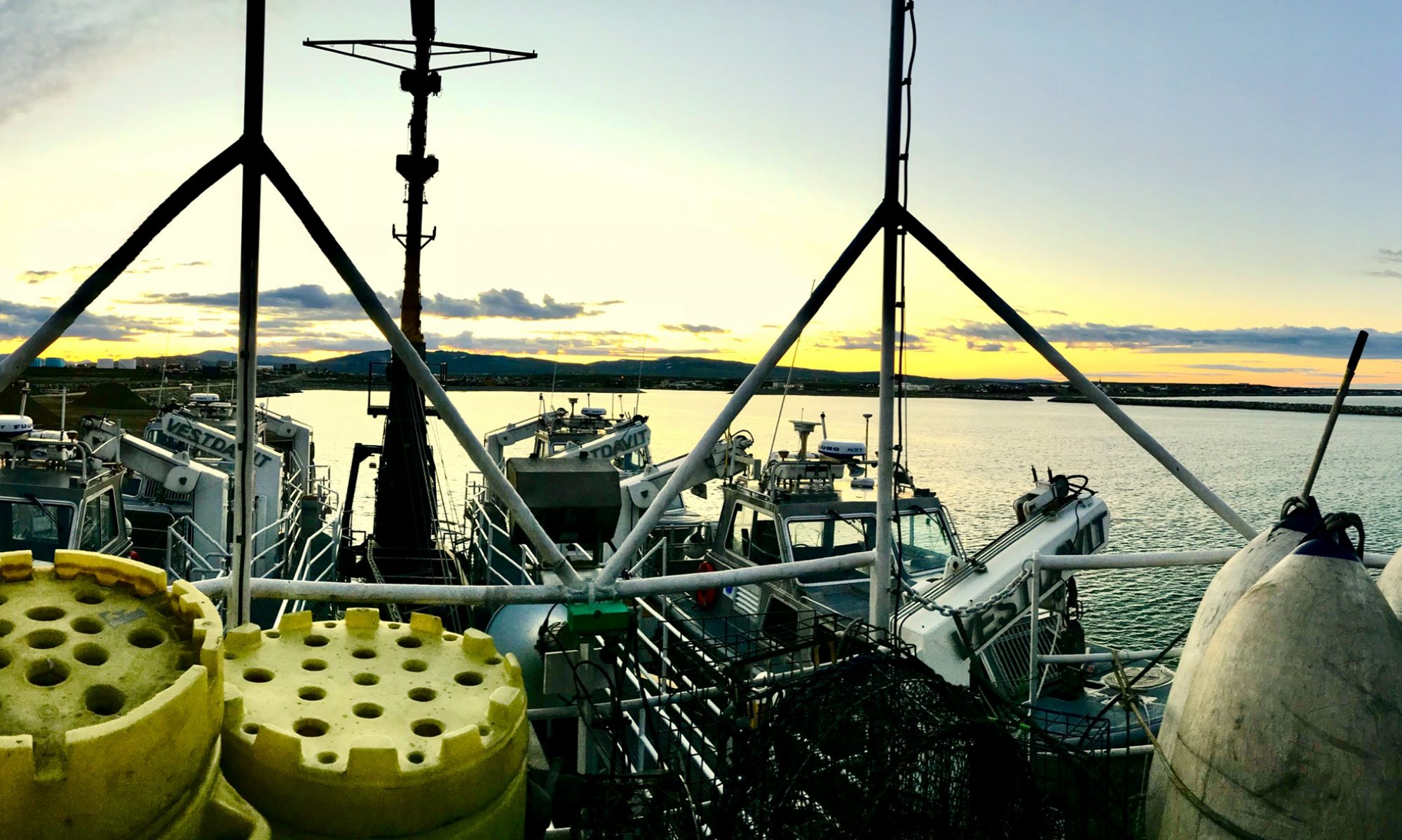
Jenny Gapp: Let Them Eat Hake! August 14, 2023

NOAA Teacher at Sea

Jenny Gapp (she/her)

Aboard NOAA Ship Bell M. Shimada

July 23 – August 5, 2023 

Mission: Pacific hake (Merluccius productus) Survey (Leg 3 of 5)
Geographic Area of Cruise: Pacific Ocean off the Northern California Coast working north back toward coastal waters off Oregon.
Date: Monday, August 14, 2023

Weather Data from Portland, Oregon
Friday, August 11, 2023 (one week from our final trawl)
Sunrise 6:06am PDT | Sunset 8:24pm PDT
Current Time: 2:53pm PDT
Location: 45. 59578° N, 122.60917° W (Portland International Airport)
Visibility: 10 miles
Sky condition: A few clouds
Wind Speed: 6.8 mph
Wind Direction: NW
Barometer: 1016.80 mb
Air Temp: 82° F
Relative Humidity: 37%
Speed Over Ground (SOG): 0 knots as I sit on my front porch at home!
Willamette River water temperature: 74°F

Monday, August 14, 2023
Sunrise 6:10am PDT | Sunset 8:19pm PDT
Current Time: 2:53pm PDT
Location: 45. 59578° N, 122.60917° W
Visibility: 10 miles
Sky condition: Clear
Wind Speed: 10 mph
Wind Direction: WNW
Barometer: 1010.10 mb
Outdoor Air Temp: 105°F (record ended up at 108°F)
Relative Humidity: 21%
Indoor Air Temp: 78°F (our AC consists of several Doug Fir trees)
Speed Over Ground (SOG): 0 knots as I sit at my computer in my home office space. 
Willamette River water temperature: 75.02°F

Science and Technology Log
I’ll start my last blog post with some vocabulary… and a sports analogy. Apologies in advance, I’m testing out some sports jokes to appeal to my 5th-grade sports fans who are skeptical about science. My hope is that the vocabulary (at least) will aid in understanding the following narrative about NOAA Ship Bell M. Shimada’s Leg 3 centerboard retraction.

Don’t worry, it’s not too complicated. It isn’t that different from how rookie Trail Blazer Ibou Badji (Center) was removed for knee surgery at the end of last season… or how the other Center, Jusuf Nurkic, was ejected after an altercation with an opponent and then retracted for the remainder of the same season with plantar fasciitis… Where have all the Centers on the board gone? At least there is more certainty of Shimada’s centerboard returning than Nurkic (even though he has three years on his contract left)!

Vocabulary

Acoustics – In our case, acoustics refers to an entire branch of physics concerned with the properties of sound. Yes, acoustics can also refer to how your voice sounds when singing in the shower.

Sonar – A system for the detection of objects underwater by emitting sound pulses and detecting or measuring their return after being reflected by the objects. The vocabulary words that follow are all related to the sonar system on the Shimada.

Centerboard – A retractable hull appendage, similar to the keel on a sailboat.

Ping – To emit a signal and then listen for its echo in order to detect objects. Sean Connery may have introduced you to the concept. “Give me a ping, Vasili. One ping only, please.” (Captain Ramius, The Hunt for Red October, 1990)

Hertz – One hertz (Hz) is equal to one event per second. The unit’s most common usage is to describe periodic waveforms (as is used in acoustics) and in musical tones. Kilohertz (kHz) is equal to 103, megahertz (mHz) is equal to 106 .

a graphical representation of the spectrum of soundwaves. from left to right, a red line meanders up and down at increasing frequencies (2 Hz, 20 Hz, 200 Hz, 2 kHz, 20 kHz, 200 kHz, 2 MHz) and decreasing wavelengths (170 m, 17 m, 1.7 m, 17 cm, 17 mm, 1.7 mm, 172 um.)  The labeled wavelengths are compared to images about the same size: a baseball field (170 m), a tractor trailer (17 m), two people holding hands (1.7 m), a sub sandwich (17 cm), a penny (17 mm), the width of a quarter (1.7 mm), and grains of salt (172 um). Ranges of frequencies are labeled "infrasound" (2 Hz to 20 Hz), "audible sound" (20 Hz to 20 kHz), and "ultrasound" (20 kHz to 2 MHz).
Spectrum of soundwaves illustration from BYU Acoustics Research Group

Transducer – A device that converts variations in a physical quantity, such as sound, into an electrical signal, or vice versa. On the Shimada, the transducer emits a ping.

Transceiver – A device that both transmits and receives communication. There are five transceivers on the Shimada, one for each frequency—measured in kHZ—that the scientists monitor. Walkie-talkies are one example of transceivers.

Note: I have a habit of calling things by their incorrect names, and had some confusion about how a “transponder” fits into these “trans” terms. A transponder is a blend between “transmitter” and “responder.” Essentially, a device that receives a radio signal and emits a different signal in response. They are used to detect and identify objects. If you have a car key fob that locks and unlocks your doors remotely (or starts your engine), then you are walking around with a transponder. Transponders are also commonly found in airplanes.

Echosounder – A type of sonar. The Shimada uses a wideband transceiver (WBT) scientific echosounder system for the hake survey.

Echogram – The visualization of sound once the transceiver “listens” to the acoustic return pinged off objects.

Cleaning up is often a sign of good things coming to an end. Whether it’s scraping glitter glue off the tables of my library, or fish scales off stainless steel in the Shimada, both signal the end of a productive work period. On Friday night, August 4th, the Wet Lab crew conducted a deep clean of the space after the last trawl. On Saturday, the net was streamed one last time (for Leg 3 anyway) on our way back to Newport, Oregon. Creatures like pyrosomes, flatfish, and young-of-the-year (YOY) hake that had been stuck in the net were flushed out after a period of time waving goodbye in surface waters. YOY is used interchangeably with the term “fingerlings” in the vocabulary of fish development.

Jenny, wearing overalls, rubber boots, rubber gloves, kneels on one knee to scrub an overturned plastic basket on the aft deck. there is a bucket of cleaning solution to her right and a stack of three more baskets to her left.
In which I get to “swab the deck”… or swab the baskets in this case.

Another event that occurred Saturday was the raising of the centerboard. The centerboard is always raised at sea and cleaned once in port. “Biofouling mitigation” is the fancy term for centerboard cleaning. This is to ensure sea life, such as barnacles, do not adhere themselves to the surface. A build-up of these stowaways could interfere with the sonar. Hmm, I sense potential here for another sports analogy… something about fouls.  

The Survey Crew coordinates with the bridge and the engineers to retract the centerboard. Transducers are mounted on the centerboard so they can be lower than the hull. This reduces bubbles and noise. In the Shimada’s case, bubbles are air pockets created by the movement of the ship’s bow. A centerboard extends the distance between sonar equipment and the activity of bubbles gathered near the hull. When seas are rough enough there can actually be a data dropout that appears as a white line on the echogram.  

Elysha stands at metal box, with indicator lights and switches, mounted on a wall. She holds a corded phone receiver up to her ear with her left hand. With her right hand she reaches toward a button or dial on the control panel.
Elysha Agne, at the centerboard control panel.

Fully extended, the centerboard is 3.4 m below the hull of the ship and 9.15 m below the baseline sea surface. There is a manual option for retracting the centerboard, but it is generally only used if there’s a problem. Automatic operations are the norm, and were used when I observed the procedure.

Officers on the bridge slow the ship to 0 knots. The bridge confirms with survey technicians which position the centerboard should be moved to. A control panel for the centerboard is located one deck below the acoustics lab. I stood with Senior Survey Technician, Elysha Agne, to observe the process for retraction. NOAA Corps crew actually push the button on the bridge for retraction, but Agne communicates over the phone with them to confirm what the centerboard control panel is indicating.

close up view of a metal panel - a red circle, surrounded by a yellow ring, on a red background. over the center of the circle, there's a beige-colored smear of what must be tiny barnacles.
Barnacles on a Shimada transducer after three legs of the 2023 hake survey. Photo taken by Elysha Agne.

Just down the passageway from the control panel are the double watertight doors that provide access to the instrument pod on the retracted centerboard. I include a picture of these doors in the Hook, Line, and Thinker section of blog post, “Let’s Get Specific in the Pacific.”

Once the button is pushed and the centerboard is ostensibly moved, Agne confirms the indicator lights on the control panel and looks through the porthole on the watertight doors nearby to confirm the white letter “R” (for “retracted) is visible on the appendage. Agne turns off the transducers (no pinging) before retraction starts in case the transducers accidentally go out of the water.

This is important because sound travels differently through air than in water. If the transducer were still pinging while a crewmember had their head through the open centerboard access doors—that wouldn’t be good for human ears. The transducer can actually be damaged beyond repair if it pings in the air. The centerboard actually has holes in it, so it fills with water when lowered, then drains as it is raised. I could hear the water draining during the retraction process. 

Career feature

CO Slater, wearing a blue NOAA Corps uniform, stands at a white metal post (housing what must be the gyro repeater) near a railing aboard NOAA Ship Bell M Shimada. He holds his right hand up, pointing out over the bright blue ocean, and looks in the direction he points.
CO Slater at one of Shimada’s gyro repeaters.
CO Slater, wearing a blue NOAA Corps uniform, sits in his Captain's Chair on the bridge. Facing away from us, he holds his binoculars up to his eyes to scan the horizon.
CO Slater sits in his Captain’s Chair and inspects the horizon.

Joshua Slater, CO (Commanding Officer)
Give us a brief job description of what you do on NOAA Ship Bell M. Shimada.

I’m responsible for the safety of the ship and its 41 crewmembers (depending on the voyage), including safe navigation, accomplishment of science missions, project management, budget, personnel, and training of the crew.

What’s your educational background?

I have a Bachelor’s in Marine Biology and a Master’s in Marine Sciences both from the University of North Carolina, Wilmington. I grew up in a Navy family, so we moved all around the world. I don’t consider one place home over another. After graduation, I wanted to go to either California or Hawaii. I got a job as a contractor with NOAA doing free-diving and scuba in Hawaii as a Marine Debris Technician. I removed derelict fishing gear and nets off the coral reefs of the northwestern islands. I joined NOAA Corps after that. I attended the U.S. Merchant Marine Academy in King’s Point, New York. In the Corps, there’s a 2:3 rotation ratio in years spent on assignments at sea and on land.

I started out on NOAA Ship McArthur II. We sailed from Seattle out to Hawaii, down to South America, Mexico, and up the West Coast of the U.S. to Canada. My assignment after that was emergency response for incidents at sea such as hurricanes and chemical spills. One of those projects was on the Deepwater Horizon oil spill response down in the Gulf of Mexico. My next ship was in South Carolina on NOAA Ship Nancy Foster, where I worked from Massachusetts to Key West, to Galveston, Texas. After that were land assignments in Washington DC, then Chief of Operations at NOAA’s Marine Operations Center for the Pacific (MOC-P) in Newport, Oregon. I’ve bounced between MOC-P and the Shimada in that land-to-sea ratio since then.

In the NOAA Corps, you start out as an Ensign (pronounced “en-sin”). Within 2-3 years you usually get promoted from ensign to Lieutenant junior grade. During your first sea tour, you need to learn how to drive the ship, keep everyone safe, and understand the basics of ship operations. During your second sea tour, you help coordinate logistics for operations. On the third sea tour you’re running all the administrative functions (hiring, firing, discipline), and on the fourth time out hopefully you are experienced enough to be considered for the ship’s Captain, overseeing the safety of the whole ship, and making sure operations are done efficiently. So, as you work your way through your career you also get promoted. Beyond the rank of Lieutenant junior grade, there’s Lieutenant, Lieutenant Commander, Commander, Captain, and then Admiral.

For civilians, Ship Captain and CO may be viewed as interchangeable. In NOAA Corps you can be a commanding officer and be any number of different ranks. In the civilian world, the ship’s boss is called “Captain” or “Master.” Since NOAA Corps stems from military origins, they use “Commanding Officer.”

What took you by surprise about sailing on the ocean?

What took me by surprise was the amount of operations we could do in less-than-ideal weather. You might have a calm day on shore, but at sea it’s usually windy and you have waves of some sort. We do the best we can given the situation.

Why are conditions rougher further out at sea?

A few things. Currents. Wind. Sometimes headlands protect you from wind when you’re closer to shore. How big the waves get is a combination of how strong the wind blows, how long it blows, and over what distance of water. That’s called the fetch. That gives the time needed for the swell to fully develop based on the wind. Wind at a short distance is a wave. Once you get beyond where the wind is that localized phenomenon, further away it’s the swell. While our wind may be calm here, we may still have a big swell because there’s a storm off Hawaii or Alaska. We’re not feeling the wind but we’re feeling the side effects. Or we could just be in the wind, it’s blowing 50, and not that bad right now, but give it 12 hours to develop, 24 hours, and it’s going to be a lot worse. You do what you can given what you have to work with. The ship is seaworthy and can handle a lot of different conditions. 

an illustration of the surface of the ocean, if it were contained in a square angled toward the viewer. an orange arrow entering the square from the left is labeled Wind; a blue arrow exiting the square to the right is labeled "direction of wind advance." near the arrow, small curved white lines indicate small waves emanating out in all directions, but in the direction of the arrow there are many more; farther to the right, they spread out some; all the way to the right, they are large waves. This progression is labeled "ripples to chop to wind waves," then "full developed seas," then "changing to swell." An oval with a point at the back describes the center of the image, where most of the waves are, and a nearby measurement bar marks the length of that shape as the length of fetch.
An illustration of fetch. Image origin.

What’s the biggest weather you’ve been in on the Shimada?

Probably 20-foot waves, although waves are not consistently one height, they’re a range. They may be normally 16-18 feet, but you might get a 22-foot wave come through. The ones I’ve been in consistently were about 20.

At what point is it not safe to conduct operations?

It depends what the wind is, what the swell is, whether they’re from the same direction or opposing directions, or 90 degrees off. Sometimes our whole project is in the trough, which means the waves are hitting us from the sides, so we’re rolling a lot. The way transects are laid out for trawling and sampling gets us rolling a lot. If it’s really bad we’ll angle our way from one location to another. We do have safety standards for operations. Once the wind is above a certain limit, or the waves above a certain range in height, we’ll reassess. Usually, we reassess the operation if wind is over 30 knots, but we’ve done ops in 40 knots before. We’ve also done ops in 16-foot waves. There are a lot of variables to be considered, including the type of operation we’re attempting to execute.

We’ll get people who have never been out here before, or we’ll get people that are so focused on the science, they don’t think about safety. My job is to make sure they don’t forget about safety! We have a daily safety meeting of department heads on the ship. There are weekly drills at sea. During monthly safety meetings, we go over accidents in the NOAA fleet. It’s a lot easier to learn from other people’s mistakes. We all want to come home with our fingers and toes!

What advice do you have for a young person interested in ocean-related careers?

Grow where you’re planted. In NOAA Corps, you don’t get to necessarily choose the jobs where you go next. A board of officers chooses for you, based on your skill set and the needs of the service at that time. For example, I can list my preferences, but there’s no guarantee I will get any of them. There have been many times where officers haven’t even received their second or third choice. My advice to everyone is, you may not want to go to a particular assignment or a particular part of the country, but you’re there, so make the most of it. Every place I have been assigned has good qualities, good things to offer. Those are what I choose to focus on. When I talk to some people, they never seem happy no matter where they are.  I think that is a mindset issue. One of my favorite quotes is, “Positivity is a superpower.” The term “Shimada-tude” got its start in the early days of the ship’s service to NOAA and is all about positivity. We want to like what we do and want people to like coming out to sea. We want them to have a good experience, and treat everyone with respect. 

Do you have a favorite book?

Growing up I often looked for the Newbery Prize Medal seal or the Newbery Honor seal on a book cover when I was walking through the library. I figured if somebody liked it I might as well try it. It’s hard to pick just one book. I tried a lot of the classics and have made my way through most of “The 100 Greatest Books Ever Written.” Some were enjoyed while others were not. I remember taking an interest in The Odyssey and The Iliad, by Homer; Robinson Crusoe, by Daniel Defoe; Shipwrecked, by Robert Louis Stevenson; The Phantom of the Opera, by Gaston Leroux; and Dracula, by Bram Stoker—to name a few. 

Lately, I’ve been reading more and more about financial education. One book I recommend is The Richest Man in Babylon, by George Samuel Clason. It uses fictitious ancient parables to give you sound monetary advice, and that is something that I don’t think is really taught anymore.

As for children’s literature, I’ve recently read a few of the Harry Potter books with my son. I remember reading and enjoying The Chronicles of Narnia series, by C.S. Lewis, Island of the Blue Dolphins, by Scott O’Dell; and Where the Red Fern Grows, by Wilson Rawls. 

NOAA Fishwatch logo, reading: FishWatch U.S. Seafood Facts, NOAA, www.FishWatch.gov


Floating (Food) Facts (& Opinions)

Here’s the part where we “Let them eat hake.” If you can get your hands on some hake through a company like Pacific Seafood (headquartered in Clackamas, Oregon), then you can decide for yourself whether all this fuss over hake is worth the hype.

Hake (Pacific Whiting) is the most abundant commercial stock on the Pacific Coast.

If you aren’t into hake but consume other seafood, use Fish Watch. NOAA Fisheries hosts sustainable seafood profiles with current information on marine fish harvested in the U. S.

The first couple of paragraphs on the Fish Watch site define “sustainable seafood:”

“Sustainable seafood is wild-caught or farmed seafood that is harvested or produced in ways that protect the long-term health of species populations and ecosystems. The United States is a global leader in sustainable seafood. U.S. fishermen and seafood farmers operate under some of the most robust and transparent environmental standards in the world. If the seafood you purchase is caught or farmed in the United States, you can feel confident you’re making a sustainable seafood choice. 

Marine wild-capture fisheries in the United States are scientifically monitored and regionally managed. They are enforced under 10 national standards of sustainability through the Magnuson-Stevens Act—exceeding the international standards for eco-labeling of seafood.”


You may have stood in front of the seafood counter and noticed those green (best choice) and yellow (good alternative) labels. I have yet to see red, which means avoid, which seems counter to the marketing impulse of grocery stores. These labels are based on the Monterey Bay Seafood Watch guidelines. Here’s a pocket guide for my West Coast friends. There are a handful of seafood guides you can consult, but not all are created equal. This article from 2017 captures the frustration consumers sometimes have about what fish to choose.

Part of my confusion is often based on the many names a single species has! For example, I just now learned (on the NOAA Fish Watch site) that Bocaccio are rockfish and are the Oregon Red Snapper I recall from shopping trips and meals as a kid. For me, the thing that makes NOAA’s Fish Watch site superior to the rest is the comprehensive overview of each species profiled. You get detailed sections on Population Status, Appearance, Biology, Where They Live, Fishery Management, and Harvest all in one place. Bon appetit!

photograph of a hake, cutout and superimposed on a stylized background. text reads: Wild Pacific Hake (Whiting). A North Pacific Speciality. Wild Pacific Hake (Whiting) is unique to the waters off the coast of Oregon and Washington. But chefs worldwide like this sustainable fish for its rich, white flesh, flaky texture, and mild and slightly sweet flavor. Calories: 90 per serving. Protein: 18.31 g per serving. Fat: 1.31 g per serving. Omega-3: 260 mg per serving.
Image of a hake with nutritional information from American Seafoods.
image of plated Garlic Baked Whiting on a bed of rice, garnished with lemon and parsley.

Garlic Baked Whiting
Ingredients

4 whiting fillets
Kosher salt
Freshly ground black pepper
5 Tbsp butter, melted
2 cloves garlic, minced
¼ tsp red pepper flakes
Juice and zest from 1/2 a lemon
1 lemon, sliced into rounds
Parsley for garnish
Directions

    Preheat oven to 400°. Season whiting with salt and pepper and place on a small baking sheet.
    Mix together butter, garlic, red pepper flakes, lemon juice, and zest then pour over whiting fillets. Place lemon rounds on top and around fillets.
    Bake whiting for 10-12 minutes or until fish is fork tender.
Hake recipe courtesy of Pacific Seafood.
Click to enlarge.
image of plated spicy baked whiting with sides of couscous and asparagus

Spicy Baked Whiting
Ingredients

4 Pacific whiting fillets
2 Tbsp olive oil

Rub ingredients:
1 tsp garlic powder
1 tsp dried parsley
1 tsp onion powder
1 tsp red pepper flakes
1 tsp of lime juice
2 tsp of seasoned salt
Directions

    Preheat oven to 400°F.
    Mix all rub ingredients together.
    In a baking pan, coat fish with olive oil. Then coat the fish in the spice mixture.
    Place the fish the oven and bake for 10-15 minutes until fish is flaky.
Hake recipe courtesy of Pacific Seafood.
Click to enlarge.


Personal Log

Fog persisted on our steam north back to Newport. Without the temptation of visibility on the flying deck, I took extra time vacuuming the stateroom… that’s a joke because vacuuming a 4-person stateroom takes all of 5 minutes. In truth, my roommate and I took care to leave our space Pine-Sol fresh for Leg 4. After packing away my gear I bounced around the ship like you might in a hotel room—surreptitiously checking drawers for items you may have forgotten. That last nautical mile seemed to take forever. I kept looking out of the portholes in the acoustics lab to see nothing but white. Excitement for home began to build once it was time to gather on the flying deck and peer through the misty water vapor. Yaquina Bay Bridge slowly materialized, an elevated street floating in the sky, weirdly disembodied from the solid ground that usually frames it. As we went under the bridge the fog disappeared. Beyond, an 80° Oregon summer in the Willamette Valley beckoned. The Wet Lab Crew ate dinner together while the crew of the Shimada safely docked and worked with the port crew to reattach the gangplank. After hugs and handshakes all around it was time to part. My drive home was uneventful save a dramatic sky. 

A HUGE thank you to the Shimada crew aboard Leg 3! You welcomed me, answered my questions, allowed me to look over your shoulder, tolerated me taking photographs of you, and clarified things I didn’t understand. You all are amazing. I appreciate your labor and am thrilled to have witnessed you all working in sync to do science! My students at Peninsula thank you as well—even if they don’t know it yet. Your time and attention will enhance not just one, but many ocean-related lessons I share with them in the forthcoming year. A special thanks to my blog editors: Chief Scientist Steve de Blois and XO CDR Laura Gibson. Your feedback polished these meanderings and gave me confidence that I correctly represented NOAA and the hake. 

You Might Be Wondering…

What Next?

To complete my commitment to NOAA as a Teacher at Sea I agree to blog, write one science-related lesson, one career-related lesson, and either present at a conference or publish an article about my experience. I’m back in my school building this week and will soon be working on lessons. At least part of the science lesson will follow the path of hake otoliths (ear bones) from the ocean to the lab back on land. Many thanks to Liz Ortiz, Fisheries Technician, for helping me connect the dots on how the otolith contributes to our understanding of Pacific whiting (hake) life cycles. I’ve decided to publish an article, although I will likely also present at a conference in years to come. I have reviewed children’s books for the national journal, School Library Connection, since 2011, and will start my query for publication there.

view over the aft deck (probably from the flying deck) of NOAA Ship Bell M. Shimada back at Yaquina Bay, and the Yaquina Bay Bridge. In this photo, the sky is bright blue and clear, and the water is calm and bright blue as well.
The sky was blue when we left Yaquina Bay on Day 1, not so on Day 14.
A brief video reflection of Leg 3.

Hook, Line, and Thinker

Do you eat or consume products harvested from the ocean? Where do those products come from?

If the country of origin for products consumed isn’t the U.S. does that country have an equivalent of NOAA that gathers data and prioritizes sustainability in its policies? For context, consider this recent article from NPR: Demand for cheap shrimp is driving U.S. shrimpers out of business. I’m doing a homemade pad thai recipe this week and reading this motivated me to pay attention to where my shrimp came from. All the shrimp choices at Fred Meyer (Kroger) were imported so I went elsewhere (paid more) and found some from the Gulf of Mexico, harvested in U. S. waters. 

While you’re eating your own pad thai with U. S. shrimp, or Pacific whiting mac ‘n cheese, consider NOAA Fisheries first-ever National Seafood Strategy, just released on August 9th, 2023.

A Bobbing Bibliography: Reflections of a Librarian at Sea

Additions to the Science Crew’s Reading Recommendations:

Chris Hoefer, OSU marine mammal & seabird project – The Three-Body Problem, science fiction by Liu Cixin (Scientific American article about the concept behind the name.)

Samantha Engster, eDNA Scientist – The Shell Collector, short stories by Anthony Doerr

***

Parting thoughts from your Teacher-Librarian at Sea as inspired by quotes from a few children’s literature classics.

“Look at that sea, girls—all silver and shadow and vision of things not seen. We couldn’t enjoy its loveliness any more if we had millions of dollars and ropes of diamonds.”
Lucy Maud Montgomery, Anne of Green Gables

In my current reading of this quote, I can’t help but immediately extract the tension between commerce and being. It seems to be a theme I have returned to again and again throughout my blog posts. To be, to exist on our planet, is dependent on a healthy ecosystem, and a healthy ocean. NOAA Fisheries leans on the scientific method to tackle a barrage of pressures: consumer demand, climate change, economic prosperity, pollution.

We would do well to remember that NOAA is made up of ordinary people. The government, by the people and for the people. Many of these you have met in my interviews. I was at a dinner party recently (since I’ve returned to land) and there’s always someone in the crowd who makes half-joking remarks about “the government.” What? You killed fish in the name of science? What? Do the fisherman have the same opportunity to trawl? C’mon. Who do you think “the government” is made up of? Your uncle with a Ph.D. in physics. Your daughter with a passion for birds. “Things not seen,” are confusing, intimidating, sometimes scary. NOAA is utterly transparent. The amount of unfettered data available for citizen scientists to freely examine on the internet is mind-boggling. Keep asking questions, then ask more questions! Then do some research—ask a librarian for help!

“The sea, the sea, the sea. It rolled and rolled and called to me. Come in, it said, come in.”
― Sharon Creech, The Wanderer

It said “Come in” the loudest when smooth and glassy. While there were no swimming opportunities on board the Shimada, I have since returned to swimming at my local health club. While doing laps and staring at the dirt, hair bands, and Band-Aids at the bottom of the pool I thought about the chemicals, hair bands, and Band-Aids at the bottom of the ocean. This is not what the sea meant when she said, “Come in.” NOAA Fisheries is an integral part of the solution to the problems that face us as a species. Homo sapiens is only one of many species that have a right to thrive—both for our benefit and their own.


“The castle of Cair Paravel on its little hill towered up above them; before them were the sands, with rocks and little pools of salt water, and seaweed, and the smell of the sea and long miles of bluish-green waves breaking for ever and ever on the beach. And oh, the cry of the seagulls! Have you ever heard it? Can you remember?”
― C.S. Lewis, The Lion, the Witch and the Wardrobe

While perusing a glossary of nautical terms in the downtime after a marine mammal watch, I discovered “caravel” a small, highly maneuverable sailing ship used by the Portuguese in the 15th and 16th centuries. The Niña and the Pinta, of 1492 notoriety, were caravels. I wondered whether this term had inspired C. S. Lewis’ naming of Cair Paravel. I will not remember the cry of seagulls so much as I will the cat-like meow of the common murre, at least that’s what they sounded like to me at the time. I’m a compulsive Googler, so that’s how I came upon this Minecraft version of Cair Paravel.

It made me think of my students and how NOAA scientists are the stars of real-world exploration and discovery. Scientists are also world-builders of a sort—reports on their findings influence policy-makers, lawmakers. As science moves forward, it continuously corrects itself as new things are discovered. Listening to the latest science can make or break the world.  

And oh, the cry of the scientists! Have you ever heard it? Can you remember? 

screenshot from a video game showing a castle near the ocean
A Minecraft version of Cair Paravel.
photo of a hatchetfish and a lanternfish on a metal table, facing one another. Jenny has added speech bubbles so that the hatchetfish says: "So, what did you think of the Teacher at Sea experience on the Shimada?" and the lanternfish replies: "It was illuminating - and that's not just my photophores talking!"
A hatchetfish and a lanternfish reflect on the Teacher at Sea experience.

Michelle Greene: Acoustics Team…Do You Hear What I Hear?

NOAA Teacher at Sea

Michelle Greene

Aboard NOAA Ship Gordon Gunter

July 19 – August 3, 2018


Mission: Cetacean Survey

Geographic Area: Northeast U.S. Atlantic Coast

Date: July 24-25, 2018


Latitude: 40° 2.629″ N

Longitude: 67° 58.954″ W

Sea Surface Temperature: 23.3° C (73.9° F)

Sailing Speed: 1.80 knots


Science and Technology Blog:

Today I had the opportunity to shadow the acoustics team in the dry lab.  The acoustics team uses a linear array or a prototype tetrahedral array of hydrophones to listen to the sounds that whales and dolphins make under the water.  So far in this journey, the team has only used the linear array.  The array has been towing behind the ship with the “line” of hydrophones parallel to the surface of the water about 10 meters below the surface.

Linear array of hydrophones

The hydrophone is the black device in the cable

When the array is deployed, the acoustics team uses a computer software called PAMGuard to record the sounds and track the clicks and whistles of whales and dolphins.  PAMGuard can be programmed to record sounds in any frequency range.  On this cruise, acoustics is looking at sounds up to about 100,000 hertz.  A human being can hear from about 20 Hz to about 20 kilohertz with normal human speech frequency between 1,000 Hz and 5,000 Hz.  The optimal hearing age for a person is approximately 20 years of age and declines after that.

Beaked whales click at a frequency too high for human hearing; however, PAMGuard can detect the clicks to help the acousticians possibly locate an animal.  PAMGuard produces a real-time, time series graph of the location of all sounds picked up on the array.  A series of dots is located on a continual graph with the x-axis being time and the y-axis being bearing from the ship. The array picks up all sounds, and PAMGuard gives a bearing of the sound with a bearing of 0° being in front of the ship and a bearing of 180° being behind the ship.  The ship creates noise that is picked up by all the hydrophones at the same time, so it looks like a lot of noise at 90°.  The acousticians must sift through the noise to try to find click trains.  Rain and heavy waves also create a lot noise for the hydrophone array.  The acoustician can click on an individual dot which represents a sound, and then she can see a Wigner plot of the sound which is a high resolution spectrogram image of the sound.

A screenshot of a spectrogram from PAMGuard

Scientists have determined what the Wigner plot image of a beaked whale sound should look like.

Wigner plot of a True's beaked whale (Mesoplodon mirus) or a Gervais' beaked whale (Mesoplodon europaeus)
Wigner plot of a True’s beaked whale (Mesoplodon mirus) or a Gervais’ beaked whale (Mesoplodon europaeus)


Wigner plot of a Cuvier's beaked whale (Ziphius cavirostris)
Wigner plot of a Cuvier’s beaked whale (Ziphius cavirostris)

When a Wigner plot image looks to be a possible Mesoplodon, the acoustician starts tracking a click train on the time series graph in hopes of getting the sound again.  If the acoustic signal repeats, the acoustician then adds it to the click train.  Each time the acoustician adds to a click train, the bearing to the new click is plotted on a graph.  The array cannot calculate the actual location of an animal, so a beam of probability is plotted on a chart.  Then the acoustician uses the angle of each click in a click train to determine a possible location on the port or starboard side of the ship.  If the click train produces a sound that can be localized with the convergence of beams to a certain point, the acoustician can call the visual team to look on a particular side of the ship or ask the bridge to slow down or turn in a certain direction.  Mesoplodons have average dive times of between 15 and 20 minutes and foraging dive times of up to 45 minutes, so there is a time delay between getting the clicks and seeing an animal.

PAMGuard map of a sighting of a beaked whale

The objective of this cruise is to find the occurrence of beaked whales, but PAMGuard does not record just beaked whale clicks, so several other whales and dolphins are heard by the array.  Sperm whales (Physeter macrocephalus) have clicks that can be heard by the human ear with an average frequency of 10 KHz.  Sperm whales have a synchronized click train.  It can be thought of as “click click click click…” with about 0.5 to 1.0 second between each click.  Scientists believe the clicks are used for echolocation.  Since it is very dark in the ocean and light does not travel far underwater, sperm whales use their clicks as sort of flashlight for locating food which usually consists of squid.  When a sperm whale senses the location of food, it produces a rapid series of clicks called a buzz.  After the buzz, the animal makes a dive.  If the dive is not successful, in other words the whale did not get food, then clicks return to their normal pattern until another attempt is made.  Clicks are also used for social interaction between sperm whales.  Sperm whales have been very vocal on the cruise so far.

Personal Log

I have been spending my days rotating between the visual sighting team and the acoustics team.  Even when I am not scheduled to be there, I am in acoustics.  I find listening to the sounds very interesting.  I had no idea whales made clicking sounds.  I knew dolphins whistled, but clicking is not a term I was familiar with until this cruise.  We have had several episodes where many dolphins will go by the ship.  When that happens, the whole plot in PAMGuard almost turns black from all of the dots on the screen.  It is amazing to hear all of the clicks and whistles from the dolphins.  My favorite whales right now are sperm whales.  I can now look at the screen and see the clicks and know it is a sperm whale.  I get so excited.

Getting a Mesoplodon click train is like watching a whale lover’s version of Storm Chasers.  When a possible Mesoplodon click train is detected, everybody gets excited in hopes of seeing a beaked whale.  I can really understand how the visual sighting team relies on the acoustics team to find a location.  We have two people on big eyes and two people on binoculars, and the ocean is all around us.  We have a high probability of missing a Mesoplodon, so having the acoustics team getting a click train with convergence in a certain direction helps to focus the visual sighting team in sighting an animal.  The reverse idea is also true.  When the visual sighting team sees a Mesoplodon, they call down to acoustics to see if a click train can be detected.

Life aboard the Gordon Gunter has been a real classroom for me.  I think I learn something new about every five seconds.  Since I have been out of college, I have not dealt with biological sciences much, so this math teacher is relearning some key information about marine animals.  I have really enjoyed seeing the passion in everyone’s eyes for the beaked whales.  When we get a sighting of a beaked whale on the flybridge, everyone rushes to that side of the ship in hopes of just getting a glance at the elusive creature.  When we get a Mesoplodon click train, the acousticians get really excited.  One evening, we got a sustained click train for a Sowerby’s beaked whale (Mesoplodon bidens).  One of the acousticians was not in the dry lab, so I went to try and find her with no luck.  She was really upset when she returned, because she had not been there to see it.  I hope to develop that kind of passion in my students, so they can become great thinkers about life in their futures.

Did You Know?

  1. Even though Moby Dick was a fictional sperm whale, real life event inspired Herman Melville to write the novel.  Check out this page on those events:  https://oceanservice.noaa.gov/facts/mobydick.html.
  2. Sperm whales use an organ in the front of their head, something called the spermaceti organ, to make their clicking sounds.  Check out this PBS article: http://www.pbs.org/odyssey/odyssey/20010809_log_transcript.html.

Animals Seen

  1. Sperm whales (Physeter macrocephalus)
  2. Fin whales (Balaenoptera physalus)
  3. Cuvier’s beaked whale (Ziphius cavirostris)
  4. Risso’s dolphins (Grampus griseus)
  5. Manta ray (Manta birostris)
  6. Whale shark (Rhincodon typus)

Vocabulary

  1. (Ocean) Acoustics – the study of how sound is used to locate whales and dolphins and how whales and dolphins communicate
  2. Bridge – the room from which the boat can be commanded
  3. Click train – a series of whale clicks
  4. Dry lab – a lab that primarily uses electronic equipment such as computers
  5. Echolocation – a process used by whales and dolphins to locate objects.  A whale will emit a pulse, and the pulse then bounces off an object going back to the whale.  The whale can then determine if the object is food or something else.
  6. Flybridge – an open platform above the bridge of a ship which provides views of the fore, aft, and sides of a ship
  7. Hertz – a measure of sound frequency.  For example, when you hear someone singing in a low (or bass) voice, the frequency of the sound is low.  When someone is singing in a high (or soprano) voice, the frequency of the sound is higher.
  8. Hydrophone – a microphone that detects sound waves under water
  9. Spectrogram – a visual representation of a sound
  10. Wigner plot – a high resolution spectrogram

Michelle Greene: Visual Sighting Team, July 23, 2018

NOAA Teacher at Sea

Michelle Greene

Aboard NOAA Ship Gordon Gunter

July 19 – August 3, 2018


Mission: Cetacean Survey

Geographic Area: Northeast U.S. Atlantic Coast

Date: July 22-23, 2018

Latitude: 40° 35.213″ N

Longitude: 66° 6.692″ W

Sea Surface Temperature: 23.4° C (74.1° F)

Knots: 7.85 knots

Science and Technology Blog:

The visual sighting team started early this morning at 6:00 am and had rotating shifts of 30 minutes each until 7:00 pm.  The different shifts included watching with regular binoculars on the port and starboard sides, watching with the big eyes on the port and starboard sides, and being the data recorder for sightings.  I had the opportunity to shadow scientists in each of these positions throughout the first day and actually performed the duties on the second day.

Members of the Cetacean Survey Visual Team on Lookout

One of the important jobs the data recorder has is to input the environmental conditions at a certain point in time.  The first measurement to input is the percent of cloud cover which is just a number from 0 to 100. Then the glare magnitude is determined on an ordinal scale from 0 to 4 with a value of zero meaning none and a value of four meaning severe.  After determining the glare magnitude, the percent of glare cover is determined.  Since the two sets of big eyes cover from 90 degrees left of the bow to 90 degrees right of the bow, the glare covering this spaced is what is determined.  The data recorder also has to determine the degree angle and height of the ocean swell.  Swell is not the wind waves generated by local weather.  It is the wind waves that are generated by distant weather systems.  Then the Beaufort scale is used to determine the amount of wind on the ocean.  The scale was developed by Sir Francis Beaufort of the United Kingdom Royal Navy in 1805.  The scale ranges from 0-12.  A zero score means the surface is smooth and mirror like, while a score of 12 means there are hurricane force winds.  Rain or fog is also determined by the data recorder.  Finally, the data recorder has to determine a subjective condition of the weather overall.  This is on an ordinal scale from 1 to 4 with 1 being poor and 4 being excellent.

When a marine animal is sighted by one of the observers, the data recorder has to input several measurements about the event.  The bearing of the location of the animal has to be determined using the big eyes.  Also, the big eyes have a scale in the lens called reticles that determines distance from the ship to the animal.  A conversion scale can then be used to determine how far away the animal is in meters or nautical miles.  The number of animals sighted, including any calves that are in the group, has to be given.  The group’s swim direction has to be determined based on bearing from the ship.  If possible, the species of the group has to be given.  Since the objective of this survey is to find the occurrence of Mesoplodons in the North Atlantic Ocean, determining the species is very important.  Also the observer has to give the initial cue as to what determined the identification of the species.  Several different cues are available such as the body of the animal, the blow of a whale or dolphin, or the splash.

The software used to input the occurrence of a marine mammal automatically inputs the GPS of a sighting.  The initial route for this survey is a zig zag pattern out of Rhode Island towards Georges Bank.  There are several canyons with very deep waters (over 1,000 meters) which is where the Mesoplodons make foraging dives to get food.  Instead of making a straight line through the canyons and only making one pass through the area, using zig zag routes gives the survey a better chance of locating Mesoplodons.  The chief scientist uses the information from sightings to track a path for the ship to take the next day.  Sometimes the acoustics team hears possible Mesoplodons.  If the acoustics team can find a convergence of the area of an animal, they will tell the ship to go at a slower rate or turn.

The map here shows the sightings of Mesoplodons from the beginning of our journey and the zig zag pattern taken by the chief scientist.  The first day of our journey, a storm was coming up the East Coast.  The Gordon Gunter‘s Commanding Officer (CO) determined that we could run from the storm by going east in a straight line direction instead of doing the zig zag motion.  The CO was correct, because we did not have bad weather.  The ocean had a lot of high swells which made the boat rock tremendously at times but no rain.

GU18-03_Map_24July2018_wLegend
A map of the daily route of the Gordon Gunter based on sightings.


Personal Log

I have found my favorite place to be on the visual sighting team…being the data recorder.  Statistics is my passion, and being the data recorder puts me in the middle of the action getting mass amounts of data.  It also helps that the data recorder sits in a high chair and can see a wide area of the ocean.  The scientists have been very helpful in finding me a milk crate, because that chair is so high I cannot get onto it without the milk crate.  Being the data recorder can be intense sometimes, because multiple sightings can be made at the same time.  In any free time I have, I will fill in as the data recorder.  It is lots of fun!

Data Recorder
Favorite place to be on the visual team – Data Recorder

One thing that was a little intimidating to me at first was the intercom system.  I would hear things like, “Fly Bridge Bridge.”  Then the data recorder would say “Bridge Fly Bridge.”  I had no clue of what they were talking about.  Then all of a sudden it made sense to me.  In “Fly Bridge Bridge,” someone from the Bridge is calling up to us on the Fly Bridge.  The Bridge has a question or wants to tell the people on the Fly Bridge something.  Since I figured it out, I am ready to go.

I have learned so much on this cruise in the short time I have been aboard the Gordon Gunter.  My head is exploding with the numbers of lessons that I can incorporate into my statistics classes.  I have also talked with the acousticians, Jenny, Joy, Emily, and Anna Maria, and have come up with lessons that I can use with my algebra and calculus classes as well.  The scientists have been very generous in sharing their knowledge with a science newbie.  Being a math teacher, I want to be able to expose my students to all kinds of content that do not deal with just the boring math class.  Being a Teacher at Sea has opened up a whole new experience for me and my students.

We have an interesting participant in our cruise that I was not expecting but was happy to meet…a seabird observer.  Before this cruise I did not know there were birds that pretty much lived on the surface of the ocean.  These birds have been flying around the ship which is about 100 nautical miles from shore.  The seabird observer documents all sightings of seabirds and takes pictures to include in his documentation.

Did You Know?

Reticles are the way a pair of binoculars helps observers to determine the distance to an animal; however, the conversion from reticles to distance is not an instantaneous solution.  Based on the height of a pair of binoculars on the ship, reticles can mean different distances.  A conversion chart must be used to determine actual distance.

Check out this article on how to estimate distance to an object with reticles in a pair of binoculars:

Using reticle binoculars to estimate range

Animals Seen

  1. Sperm whales (Physeter macrocephalus)
  2. Fin whales (Balaenoptera physalus)
  3. Cuvier’s beaked whale (Ziphius cavirostris)
  4. Risso’s dolphins (Grampus griseus)
  5. Bottlenose dolphins (Tursiops truncatus)
  6. Common dolphin (Delphinus delphis)
  7. Great shearwater bird (Puffinus gravis)
  8. Cory’s shearwater bird (Calonectris borealis)
  9. Wilson’s storm petrel bird (Oceanites oceanicus)
  10. Leach’s storm petrel bird (Oceanodroma leucorhoa)
  11. White-faced storm petrel bird (Pelagodroma marina)
  12. Red-billed tropicbird (Phaethon aethereus)

Vocabulary

  1. acoustician – someone whose work deals with the properties of sound
  2. bearing – the direction from your location to an object in the distance starting at 0° which is located at absolute north.  For example, if an animal is spotted at 90°, then it is due east of your location.
  3. blow of a whale – the exhalation of the breath of a whale that usually looks like a spray of water and is an identifying feature of different species of whales
  4. bow of a ship – the point of the ship that is most forward as the ship is sailing (also known as the front of the ship)
  5. cloud cover – the portion of the sky that is covered with clouds
  6. foraging dive – a type of deep dive where a whale searches for food on the ocean floor
  7. glare – the light reflected from the sun off of the ocean
  8. nautical mile – a measurement for determining distance on the ocean which is approximately 2025 yards (or 1.15 miles) or 1852 meters
  9. port side of a ship – when looking forward toward the bow of the ship, the left side of the ship is port
  10. starboard side of a ship – when looking forward toward the bow of the ship, the right side is starboard

Michelle Greene: Setting Sail on the Gordon Gunter, July 20, 2018

NOAA Teacher at Sea

Michelle Greene

Aboard NOAA Ship Gordon Gunter

July 20-August 3, 2018

Mission: Cetacean Survey

Geographic Area of Cruise: Northeast U.S. Atlantic Coast

Date: July 20, 2018

Weather Data from the Bridge

Latitude: 41° 31.838′ N

Longitude: 71° 19.018′ W

Air Temperature:  26.7° C (80° F)

Conditions: Sunny

Science and Technology Log

Beaked whales are elusive creatures that roam all of the world’s oceans.  The purpose of this cetacean cruise is to find the occurrence and distribution of beaked whales in the northeast Atlantic off the coast of Rhode Island and Massachusetts.  The beaked whale is a toothed whale from the family Ziphiidae.  Several types of beaked whales have been spotted in this region including the True’s beaked whale (Mesoplodon mirus) and the Cuvier’s beaked whale (Ziphius cavirostris).

To find the occurrence of beaked whales, the scientists are using several different methods.  The first method is a visual sighting of the animals.  High-powered binoculars, affectionately termed “big eyes” can see animals from several nautical miles away.  Then regular binoculars are used to scan the areas closer to the ship.  The second method scientists are using is by passive acoustics.  Acousticians are using two different types of listening devices to try to hear the whales.  The first device is called a linear array.  In this device, four hydrophones are attached to a tube in a linear pattern.  The array is then towed in the water behind the ship, and acousticians can hear the whales when they communicate.  The acousticians can then determine how far the whale(s) is(are) from the device.  However, with this type of array, it is difficult to calculate how deep the whale is in the water.

In an effort to improve detection of the depth of a beaked whale, a new array has been designed.  This tetrahedral array is designed so that the four hydrophones are placed in a way that is not linear two-dimensional space but in a more three dimensional space, so scientists can detect not only the distance of a whale but the depth.  We will be testing a new prototype of this array during this cruise.

Personal Log

Arriving the day before the Gordon Gunter sailed allowed me to see some pretty interesting things.  I got to help two of the scientists put up the “big eyes.”  These binoculars are really heavy but can see very far away.  On the day we sailed, we were able to zero the binoculars which means we set the heading on the binoculars to zero with the ship’s bow based on a landmark very far away.  We could not zero them the day before, because there was not a landmark far enough away to get an accurate reading.

The Gordon Gunter is one of the larger ships in the NOAA fleet according to several of the scientists who have been on many cruises.  It took me a while to figure out where all of the doors go and how they open.  I did not realize how hard it was to open some of the doors.  According to the XO, the doors are hard to open because of the pressure vacuum that exists in the house of the ship.  There is not really a reason for the vacuum to exist.  It is just the nature of the ship.

Life on board the Gordon Gunter has been very interesting for the first day.  Before leaving port, we had a fleet inspection.  We had to do all of our emergency drills.  Safety is very important on a ship.  We had to do a fire emergency drill where everyone had to meet at a muster station and be accounted for by one of the NOAA officers.  Then we had to do an abandon ship drill.  Then once we got sailing a short time, we had to do a man over board drill.

Donning the immersion suit in case of an abandon ship order was not a thrill for me but was comical in retrospect.  I am only 4’ll”, and the immersion suit I was given is made for someone who is over six feet tall.  When I tried on the suit, I had two feet of immersion suit left at the bottom.  When the NOAA officer came to inspect, he said I definitely needed a smaller suit.

One of the best features of my cruise so far has definitely got to be the galley.  The Gordon Gunter has the best cook in Miss Margaret.  She is the best and makes awesome food.  She has made cream cheese from scratch.  She makes the best smoothies.  I can only imagine what we are going to be getting for the rest of the cruise.

Did You Know?

All marine mammals, including the beaked whales, are protected under the Marine Mammal Protection Act.

Check out this website on what the law states and what it protects:

https://www.fisheries.noaa.gov/topic/laws-policies#marine-mammal-protection-act

Joan Shea-Rogers: Do You Hear What They Hear, July 8, 2018

NOAA Teacher at Sea

Joan Shea-Rogers

Aboard NOAA Ship Oscar Dyson

July 1-22, 2018

Mission: Walleye Pollock Acoustic Trawl Survey

Geographic Area of Cruise: Eastern Bering Sea

Date: July 8, 2018

Weather Data from the Bridge

Latitude: 53º N

Longitude: 166ºW

Sea Wave Height: 1.5 feet

Wind Speed: 25 Knots

Wind Direction: SW

Visibility: 15 miles

Air Temperature: 52ºF

Water Temperature: 46º F

Barometric Pressure: 1010.61mb

Sky: Overcast

Science and Technology Log

What kinds of fish live in the Bering Sea? How many pollock are in the Bering Sea? Where are the pollock in the Bering Sea? How big are the pollock in the Bering Sea?

Those are just a few of the questions that the fisheries biologists on NOAA Ship Oscar Dyson work to answer during each voyage. In my last blog, I talked about the need to manage the pollock fishery in order to protect this important ocean resource because it provides food for people all over the world. It is important, then, to be able to answer the above questions, in order to make sure that this food source is available each year.

How do they do it? There are two main sources of information used in the Acoustics-Trawl (or Echo Integration Trawl) survey to determine the abundance and distribution of pollock in a targeted area of the Bering Sea. One is acoustics data, and the other is biological-trawl data.

Acoustics:

Acoustic data is continuously collected along a series of parallel transects with a Simrad EK60 scientific echo integration system incorporating five centerboard-mounted transducers (18-, 38-, 70-, 120-, and 200- kHz). In other words: There are 5 sound wave producers (transducers) attached to the bottom of the ship, each one emitting sound waves at different frequencies. This allows scientists to look at different organisms in the water column. Different types of organisms reflect different amounts of energy at different frequencies. The amount of acoustic energy reflected by an individual animal is called the target strength, and is related to the size and anatomy of the species. For example, a fish with a swimbladder (like pollock) reflects more energy than a fish without a swimbladder because its properties are very different from the surrounding water. Some ocean dwelling organisms don’t have swim bladders. Flatfish stay on the bottom so they don’t need the buoyancy. Floating organisms like jellyfish don’t have them. These organisms will look differently than pollock on an echogram because they have a smaller target strength.

Transducer
Transducer

Transducers convert mechanical waves (sound waves) into an electrical signal and vice versa (like both a loudspeaker and a microphone combined). They contain piezoelectric materials sensitive to electricity and pressure: if a voltage is applied to them, they make a pressure or sound wave (transmit), and when a sound wave passes over them, it produces a voltage (receive). When a sound wave (echo from a fish) is received, electoral signal is sent to a computer, which displays the signals as pixels of varying colors as the ship moves along (depth changes up and down on the left of the image, and time and location changes along the bottom of the image). This datum is used to estimate the number and type of fish in the water column, and to determine where the ship should fish next.

The size and colors on the images (called echograms) represent the backscatter at different depths and is related to the density of fish and their target strength. But, since they are dots on a screen, specific identification is not possible. The scientists assume certain strong signals are pollock based on the information they have but, those dots could be other fish. To determine what kind of fish are in the water column at this location, how many are there, and how big they are, other data must be obtained. Biological Trawl Data provides that additional information. More about that in my next blog post……I bet you can’t wait!

Personal Log

The Calm Before the Storm:

So far my trip has been smooth sailing, literally. As NOAA Ship Oscar Dyson sails across the Bering Sea there is a bit of rocking the ship experiences at all times. This is easy enough for one to get used to and sometimes it even becomes comforting, like being rocked to sleep as a child. You adjust to the motion. Over the past couple of days I have been hearing talk of a storm coming our way. On a ship, there are many preparations that occur in order to get ready for a storm. Many items are always secured, such as shelves that have a wall in front so that things don’t fall off. There are “handle bars” in showers and next to toilets (think about that). Along hallways and stairways there are handrails on each side. Mini refrigerators in staterooms are bolted to walls. In fact most things are bolted to walls or stored in containers that are bolted to the wall. In the mess hall (dining room) condiments on tables are in a box so they can’t slide off.

Why do you think this coffee mug is shaped like this (wider at the bottom than the top)?


At-Sea Coffee Mug
At-Sea Coffee Mug

Ans. The wider bottom of the mug above prevents it from sliding as the ship rocks.

Our bulletin board reminds us to secure for bad weather. This morning, I put small items in drawers, stowed books on shelves and packed my equipment (phone, laptop, camera, chargers and small items in a backpack that can be safely secured in my locker (the “closet” in my stateroom).

In talking to my shipmates with at sea experience, I am getting lots of helpful hints about storm preparations and strategies to use during the storm. Here are some of those suggestions:

*always hold on to railings with both hands when walking or going up steps. At all other times, remember to keep one hand for you (to do whatever you are doing) and one hand for the ship (to hold on).

*keep something in your stomach at all times, even if you are not feeling well

*eat saltines

*drink lots of water

*when sleeping in your bunk, place pillows between you and the edge so as not to roll off (I will definitely follow this one, as I am on the top bunk) It also depends upon which direction the ship is rolling. Pillows may need to be put between your head and the wall to prevent head bumps

*go to the lower parts of the ship because the top part will sway more with the waves

I also have been wearing patches to prevent seasickness. Hopefully they will continue to help. Only time will tell how we weather the storm (pun intended). Let’s hope it moves through quickly.