Mission: Long Line Shark/ Red Snapper survey Leg 1
Geographic Area:32 nautical miles SE of Key West Florida
Date: July 28, 2018
Weather Data from the Bridge: Wind speed 11 knots, Air Temp: 27.6c, Visibility 10 nautical miles, Wave height 1 foot
Science and Technology Log: As we move through the Gulf of Mexico headed to our first research station, I didn’t have a job most of the day, so I sought to find out more information about what makes the great Oregon ll function to serve it’s crew of 28. One of the Engineers kindly offered me a tour of the engine room to see what lies below the service decks.
The ship is powered by twin 900 horse power engines that turn the propeller shaft up to 12 knots. When sailing between work stations, generally both engines are used, and when long line fishing begins, only one engine provides power as the ship moves around 2- 3 knots. The ship holds up to 70,000 gallons of fuel, and when both engines are running,1,000 gallons are used daily. There is also a bow thruster engine near the front of the ship that is much smaller and helps with finer movements at the dock, in stations, or when seas get rough.
There are 2 large electrical power generators that provide electricity to the ship for the multitude of research computers and data collectors. While out at sea, Oregon ll is always tracking weather data, water quality, live radar from above the ship, and also sonar from below the ocean. The generators also provide power for all the creature comforts you would need in any living environment, as this ship is the crew’s home during each leg of the trip. At times when less power is needed, one generator is shut down to conserve energy for later use.
The Oregon ll also provides it’s own clean water for equipment and human consumption. The Water Purification System uses Reverse Osmosis to take salt water from the ocean and turn it into potable water to wash, cook, clean with, and drink. A Reverse Osmosis System uses high pressure and pushes impure water through a semi-permeable membrane which allows clean water through the membrane, while allowing impurities (such as salt, bacteria, and sediment) to be blocked from coming through, and discharges the impurities back into the ocean.
Personal Log: I am having a great time getting to know the crew and their many jobs around the ship, and how each one affects the other. This symbiotic relationship is the heart of what makes every mission successful. There are the Ship’s Officers who chart the course, drive the ship, and oversee all Crew Members. The Deck Department makes sure the work areas are safe and equipment is working correctly. The Fishermen are in charge of the process of the Long Line Survey, from preparation, to process, to clean-up. The Engineering Department makes sure the interior of the ship and it’s equipment are functioning properly, which is a very wide ranging. I certainly wish I had these guys around my house during those tricky repairs!
The Steward Department is in charge of ordering, cooking, serving, and cleaning up of all meals for the crew. Finally, the Electronic Department has the complicated job of installing, operating, and fixing any electronic equipment. Let me tell you, there are miles of wires running through this ship and all of it is used to make the mission successful. All data is continually collected, and preserved for later study. Some of the water and weather data is uploaded to the NOAA website for the public’s use as well.
I really enjoyed hearing the wide ranges of places in America the Oregon ll crew come from. It is also impressive to hear the various places all around the world they’ve sailed before joining NOAA, and which other NOAA ships they’ve been crew members on. The diverse experience each crew person has in their field has really helped the mission many times over since I’ve been here. One thing I know is true is that each of them is happy to tell you about their families, and how much they love them and miss them while they’re away. Many of them have long seasons away from the ones they love, and count the days until they can come home.
Fun Fact: NOAA Ship Oregon ll turned 50 years old last year, and was honored for making the half century mark of service. It was built in 1967, right in it’s home port of Pascagoula, Mississippi
Animals Seen Today: Bottlenose Dolphin, Atlantic Spotted Dolphins, Flying Fish, Jelly Fish
Air Temperature: 10.1° C (Manual Reading from the Bridge)
Barometric Pressure: 992.7 mb
Visibility: 6 nautical miles
Sea Wave Height: 3 feet
Sky: Overcast
Science Log:
How do the scientists aboard NOAA Ship Oscar Dyson estimate the number and biomass of pollock in the Eastern Bering Sea? By using the science of statistics, of course! When political strategists want to determine what percentage of voters support a specific candidate or issue, they take a sample from the population of all registered voters. Voters in this sample are then asked about their preferences and statistical techniques are employed to extrapolate the results from the sample to the entire population and measure the margin of error. Similar statistical techniques are employed by the scientists on NOAA Ship Oscar Dyson, but as you can imagine it is more difficult to sample pollock than voters that can be called on the phone!
Before each pollock survey begins, a set of transects is created for the Eastern Bering Sea. These transects are paths for the ship to follow along which the scientists sample the pollock. As you can see below, the transects for this survey are a fixed distance apart and cover the entire area of interest. Generally, the transects are straight lines created to be perpendicular to the ocean depth grade. This allows for the scientists to encounter a variety of species as well as different ages of pollock to gain a robust picture of the ocean life in the area.
The transects for this survey leg can be seen as the straight lines. The other markings are places where the trawls have been done and other scientific instruments have been deployed.
The NOAA Ship Oscar Dyson follows the transects during daylight hours, continuously recording water column acoustic backscatter data using EK60 instruments mounted on the bottom of the centerboard. Scientists monitor the backscatter images, and when they observe sufficient pollock or other fish aggregations they use the trawling nets to take a random sample of the fish and other ocean life they observed. The trawling net is 140 m long with a vertical mouth opening of 25 m and horizontal mouth opening of 35 m. The net is deployed from the back of the ship and dragged at a fixed depth for an amount of time determine by the lead scientist to ensure a large enough sample. Once the trawling net is hauled in, the sample of marine fish and invertebrates is processed in the wet lab and entered into a database. Later the pollock numbers and weights by length are combined with recorded acoustic data to create a robust estimate of the pollock population in the Eastern Bering Sea.
View of trawling nets being hauled in from the bridge.
View of trawling nets being hauled in from the deck.
After the catch comes in, the first job in processing the sample is to sort the specimens from the trawling net. The first part of the net to come in is called the pocket net. This small net, also called a recapture net, has a fine mesh and is designed to capture small species such as krill, age 0 pollock and jellyfish which slip through the meshes of the large trawl. After the pocket net is processed, we process the codend, the closed end of the net and the main section where larger fish enter and are captured. The fish in the codend are sorted by species. The scientists can choose to measure the length of all the pollock in the haul or, if it is a particularly large catch, split the haul and measure length of a subsample of pollock. Other species are also identified and their length is measured for later estimates of the total biomass that pollock make up as compared to other species. Smaller species such as krill are weighed in aggregate instead of individually.
The codend of the trawling net.
Sample analysis consists of measuring the lengths of approximately 200-400 adult pollock in the catch using the magnetic length board. This is just one of the numerous software and instruments created by the MACE (Midwater Assessment and Conservation Engineering) group at NOAA in Seattle to make analysis easier and more automated. The length distribution of the adult pollock helps scientists determine the approximate age distribution of pollock in the sample and it also helps them compare this distribution to other samples taken in the Eastern Bering Sea. A subsample of about 50 pollock from the haul is taken to get more in-depth measurements. From these pollock, we measure both the length and weight and a subsample from the 50 is taken to determine the gender, measure maturity (i.e. what stage in the life cycle the pollock is at), and collect the otolith (ear bone), which gives a more accurate measurement of the pollock’s age.
TAS Emily Cilli-Turner
measuring the length of pollock from a haul.
Personal Log:
At this point, I am getting used to life at sea and have a nice routine. The beginning of my shift, from 4am to a little past 7am, starts at sunrise and during which we resume our path along the transect. No trawling operations are conducted at night, but there is still excitement. If the underwater acoustics show that the pollock are at an appropriate depth, we can go pole fishing off the boat. NOAA scientist Mike Levine is interested in post-capture mortality of pollock and the feasibility of tagging pollock. Thus, he would like to catch pollock using a fishing pole, which puts much less stress on the pollock and increases the chance of their survival after the catch, instead of the trawling nets.
NOAA scientist Mike Levine with a pollock caught with a fishing pole.
As an instructor of mathematics, I have little knowledge of fish biology, but the scientists are great teachers! I have been given a crash course on fish anatomy using specimens from the catch and I have learned how to sex the fish as well as how to collect the ovaries and the otoliths (ear bones). If you asked me a week ago if I ever thought I would know so much about pollock after just a couple days on board, I would have laughed. It has been great being the student and being able to learn so much in such a short time with real hands-on experience!
Did You Know?
Most of the personnel that are responsible for piloting and maintaining the ship are part of NOAA Corps, which is one of the seven uniformed services of the United States.
Mission: Mapping Deep-Water Areas Southeast of Bermuda in Support of the Galway Statement on Atlantic Ocean Cooperation
Weather Data from the Okeanos Explorer Bridge
Latitude: 28.34°N
Longitude: 64.14°W
Air Temperature: 28.16°C
Wind Speed: 17.34 knots
Conditions: partly sunny
Depth: 5060.32 meters
Science and Technology Log
Understanding the physical properties of seawater such as temperature, salinity, and depth are important parameters for studying ocean processes. Fortunately, A CTD is an acronym for an electronic instrument that is used on research vessels to measure three important factors: conductivity, temperature, and depth. These data points are key exploration components used aboard the Okeanos Explorer.
Conductivity is a measure of how well a solution conducts electricity and it is directly related to salinity. When salinity measurements are combined with temperature readings, seawater density can be determined. This is crucial information since seawater density is a driving force for major ocean currents.
The CTD itself is housed in a steel container and is surrounded by a ring of plastic bottles. These water sampling bottles can be individually triggered at various depths to collect water samples allowing scientists to analyze water at specific depths at a particular place and time. The entire structure is connected to a rosette that is lowered by a hydrographic winch crane, and this rosette is capable of making vertical profiles to depths up to 6,800 meters.
CTD unit aboard the Okeanos Explorer
Features in the deep ocean such as hydrothermal vents and underwater volcanoes are associated with changes in chemical properties of seawater, so CTDs are used to measure chemical and physical properties associated with these structures. For instance, changes in water temperature may indicate the presence of hydrothermal vents or volcanoes. Since these features are located in deep waters, a CTD will be raised and lowered throughout the water column as the ship moves over the survey area. Although a CTD cast has not been completed on our expedition, these procedures require effective communication between scientists in the lab and the hydrographic crane operator. Scientists in the lab can monitor the CTD measurements in real time in the lab, and communicate depth for water capture in the rosette bottles to the crane operator. Once back on board, scientists can retrieve the water samples from the bottles and take them into the lab for further analysis.
CTD rosette complete with water sampling containers
Personal Log
We have continued to map the survey area, load XBTs, and take sunphotometer readings throughout the course of the week. Since they are few and far between, everyone looks forward to turns. The entire turning process requires effective communication with the bridge and survey team and can take approximately 15 to 20 minutes to complete.
A turn pictured in the Seafloor Information System (SIS) program
Aside from waiting for turns, we have been playing daily trivia or bingo as well as card games including cribbage! Since the cribbage tournament is underway, we have been practicing, playing, and watching other games. There have been some serious upsets and victories so the finals are going to be interesting for sure.
Okeanos Cribbage Tournament BracketSavannah vs. Charlie!Fernando vs. Christian!
We learned that we are heading back to Norfolk for dry dock towards the end of July so we will need to stop surveying soon to transit back to Virginia. It is crazy to think that we only have a couple more days at sea!
A double rainbow seen from the boat deck!
Savannah, Sally, and I enjoying the view!
Did You Know?
Some CTD instruments are so fast that they measure the conductivity, temperature, and depth 24 times each second! This provides a very detailed description of the water being tested.
Mission: Mapping Deep-Water Areas Southeast of Bermuda in Support of the Galway Statement on Atlantic Ocean Cooperation
Weather Data from the Okeanos Explorer Bridge
Latitude: 28.34°N
Longitude: 64.14°W
Air Temperature: 28.16°C
Wind Speed: 17.34 knots
Conditions: Partly Sunny
Depth: 5060.32 meters
Brian Caldwell
Brian has a true passion for exploration and science, so being part of the NOAA Corp is a perfect fit for him. Brian has an extensive educational background and enjoys advancing his knowledge about the ocean. Prior to NOAA, Brian worked as a civilian mariner for a sail training program. He served as both a captain and educator and taught non-traditional education courses about the ocean. In addition, he worked on the NOAA ship Rainier as a wage mariner.
Brian began his schooling at Miami Dade College and earned an Associate’s degree in Biology. He then attended Georgetown University and majored in Biology with a minor in Physics. During his time at Georgetown, he was the captain of Georgetown Sailing Team. Upon graduation, Brian continued his schooling and started his graduate degree abroad at the University Of Wales School Of Ocean Sciences.
After 9/11, Brian honorably served in the United States Army for ten years. He completed eight combat deployments in Iraq and Afghanistan and even conducted additional graduate work in Military History and a program in Italian Studies. After his commendable involvement with the military, Brian applied and was accepted to the NOAA Corp. Once he graduated from Basic Officer Training at the Coast Guard Academy, he began his career with NOAA. He is now working on the Okeanos and continues to be fascinated with ocean exploration and discovery. Brian loves adventure and travel, so he considers himself very fortunate to be able to experience both while working at sea. Brian has learned that it is important to be flexible in life and never stop learning.
Back at home but there’s still so much to share! I’ll wrap up my amazing experience as a Teacher at Sea by introducing three more members of the NOAA Ship Oregon II family: Alonzo Hamilton, Executive Officer Andrew Ostapenko and Commanding Officer Captain Dave Nelson. At the start of my adventure, I wrote about flexibility. The Teacher at Sea Program also stresses that cruises “require high-intensity work that demands physical adeptness, endurance, and fortitude”. These three exemplify how fortitude, the ability to endure through life’s challenges and change, brings rewards throughout life.
Fishery Biologist Alonzo Hamilton
Alonzo Hamilton, left, and Taniya Wallace, right, enter species into FSCS.
Alonzo Hamilton has been a fishery biologist for 34 years! He likes to say that he stumbled into NOAA. He graduated from community college before enrolling at Jackson State University, a historically black university in Mississippi with a full scholarship. Actually, he was offered two scholarships, one for minority biomedical researchers to become a surgeon and the other for general studies. He arrived on campus to discuss his options in the science department. It turned out that the biomedical research scholarship was given to another recipient. On the bright side, it made the decision to accept the general studies funding much simpler. Now he had to make a choice of which field to pursue. As he explored the halls of the science building, he happened upon the office of the head of the marine science program and popped in to ask some questions. After learning about the program, he decided to apply his scholarship toward coursework in this field.
After college, he began working on a research project for the Navy which paid for a master’s degree. Soon after, President Reagan froze research funding for the Navy. Fortunately, Alonzo was tipped off that NOAA did very similar research with an active, albeit smaller budget. So began a 34 year career as a NOAA fishery biologist.
Being an African American scientist in the deep south came with challenges, but he reminded his supervisors and others around him that, “I won’t limit myself to your box”, which has carried him through a long and storied career. Today, he is happy that he gets “paid to play in the ocean”, which sounds like a pretty good deal to me.
Executive Officer (XO) Andrew Ostapenko
Andrew Ostapenko
Most of the NOAA Corp officers you meet have a degree in science. I had the fortune of sailing with one of the few who doesn’t— the XO, LCDR Andrew Ostapenko. XO has a degree in political science from the University of St. Thomas in St. Paul, Minnesota. His goal was to become a lawyer, but after considering the job prospects and the lifestyle—”no one ever calls lawyers when they are happy”, and they never retire —he looked into some other options. In 2005 he applied for the NOAA Corps. Although he didn’t have a science degree, the general education requirements at the University of St. Paul, which included calculus, chemistry and physics, met the NOAA Corps requirements.
Since joining NOAA, LCDR Ostapenko has held a variety of assignments. In Maryland he managed budgets and projects for the National Centers for Environmental Prediction, a part of the National Weather Service that provides forecasts for the nation. He worked in small boat life cycle management as a Port engineer/small boat officer in Norfolk, Virginia, disseminating policies across the NOAA fleet.
His sailing experience began on NOAA Ship Thomas Jefferson which performs hydrographic surveys that map the oceans to continuously update and improve nautical charts. He was a member of the first crew on NOAA Ship Reuben Lasker, accompanying her from Wisconsin where she was built to her homeport of San Diego. Last but not least, XO has been an augmenting officer for three months on NOAA Ship Oscar Dyson, another fisheries survey vessel based in Alaska where high seas and storms are a part of a normal day’s work.
NOAA assignments are three years for shore tours and two years for sea tours. LCDR Ostapenko currently has about a year left with Oregon II. As XO shows, there is no danger of getting stuck in mundane office job as a NOAA Corps officer.
The Captain
Captain Dave Nelson of NOAA Ship Oregon II
“Lunch is on me!” invites the captain if you arrive to the galley after him. Captain Dave Nelson is the commanding officer (CO) of NOAA Ship Oregon II, and he’s gone a long way to realize that title. This is his 10th year as the captain of Oregon II, but he’s worked onboard since 1993. He refers to himself as a “hawsepiper”, urging me to look it up on the internet. Informally, it means to have started at the bottom as a deckhand and working up to becoming a captain. Captain Nelson is a Mississippi native and grew up shrimping and fishing with his dad. After high school he went to work on commercial boats that bring supplies to oil rigs. After over a decade, he felt that he needed a plan for the future– a stable pensioned job. He serendipitously stopped into the NOAA office as he was driving by on a day that someone had just quit and there was an opening to fill. The rest is Oregon II history.
The progression as a civilian begins with being a deckhand and progressing to Chief Boatswain. It takes 750 days at sea to qualify for the first license, the 3rd Mate license administered by the U.S. Coast Guard. It then takes 1100 more days to be eligible to test for the Masters license to become a captain. In 2008 the prospective captain lived in Seattle on a NOAA ship for 12 weeks for a prep course for the Masters exam. At this point, it’d be almost 30 years since he had been a student; not only did he have to learn the material for the test, he also had to learn how to study again. Soon-to-be Captain Nelson committed seven days a week for the entire 12 weeks to study and reviewing material to pass. He knew he wanted it.
CO Nelson’s joking attitude belies the pressure of being the captain of a ship. It’s a tremendous responsibility because he is accountable for everything, particularly the safety of everyone onboard. Every decision is made or approved by the captain and he sends reports to his supervisors every day.
He is one of a few captains in the NOAA fleet who is a civilian; most NOAA Commissioned officers rotate between boats every two years. This means that he is always training the new officers joining Oregon II from ensigns like Andy Fullerton and Chelsea Parrish to XO’s like Andrew Ostapenko. It takes a lot of patience; everyone comes in with different strengths, weaknesses and of course, personalities. The key, he says, is to “treat people like people” no matter who they are.
Personal Log
I somehow made it through almost three weeks living on Oregon II without falling down any stairs or tripping and landing on my face over a bulkhead door. Sure enough, it was hard to fall asleep at home without the rocking of the boat, but I’m happy to have my own shower again.
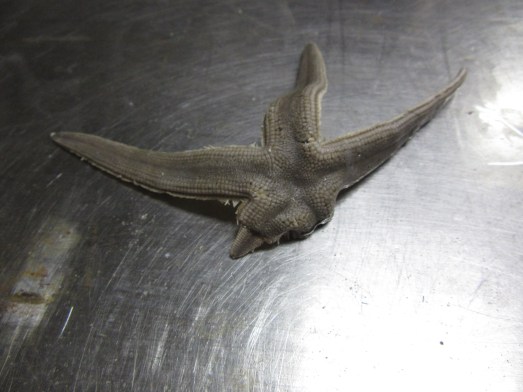
I’m so excited to show my students photos of so many of the things that I cover in class, or that they ask about, such as starfish regenerating lost arms and a video of wiggling tube feet on a severed arm (I accidently broke it off). I imagine they’ll also get to see critters they haven’t imagined-arrow and calico crabs, triggerfish, batfish…
A sea star that is regenerating its lower left arm.
I can’t believe how much I learned in such a short time about life and work at sea, careers, seafood, NOAA and its online resources. What I’ve shared in blogs is such a small fraction of everything I’ve experienced. I’m extremely grateful to everyone on Oregon II for being so welcoming and friendly, and for being so willing to speak with me. Although there were some setbacks, I got the chance to visit the lab and meet the wonderful scientists who showed me around. It’s hard work, but everyone agrees that it’s meaningful, rewarding and exciting.
Since coming home, my colleagues have commented that this is a once in a lifetime opportunity; that thought has crossed my mind as well. But watching everyone work, this is the everyday life of NOAA crew. I can’t help but think how few decisions it might have taken, maybe only 2-3 different choices, that might have made this my regular life too.
Did You Know?
NOAA Ship Oregon II earned the Gold Medal Award for rescuing three people off the coast of Cape Canaveral on Florida’s east coast. (This is where NASA’s Kennedy Space Center is located.) In 1998 when Captain Nelson was still a deckhand, he was woken from sleep between his watches. At about 2:30pm, a small overturned boat was spotted with a man, woman, and young girl on top. Captain Nelson was a small boat driver then; he launched a boat from Oregon II to rescue them and bring them to the Coast Guard.
NOAA Ship Oregon II earned the Gold Medal Award in 1998 for rescuing three people off of the coast of Florida.
Captain Dave surmises that they left port in Miami almost 200 miles south and got swept up in the Gulf Stream, a strong current of water that originates in the Gulf of Mexico and flows to Canada, affecting the climate even to Europe. It can create choppy conditions that capsized their boat.
They were extraordinarily lucky; the ocean is vast so the chances of Oregon II coming by and being spotted were slim. Their boat was too small to be detected by radar; if it had been dark, they might have been run over. Those are three people who are alive today because of NOAA Ship Oregon II.