Jacqueline Omania: Sunset on the Seamount and Raising Sanctuary Stewards, July 26, 2025

a dramatic sunset photo with only the highest part of the box visible in silhouette. there is a line of gray clouds at the horizon, with fiery orange reds beyond, and and in the breaks, thin gaps of light blue aquamarine in the sky. the ocean is calm.

NOAA Teacher at Sea

Jacqueline Omania

Aboard NOAA Ship Reuben Lasker

July 14- July 24, 2025

Mission: Oceanographic and Biological Monitoring of Davidson Seamount

Geographic Area: Davidson Seamount/Monterey Bay National Marine Sanctuary

Date: July 26, 2025

Weather Data: 15°C/ 59°F in Berkeley, CA

Science and Technology Log: 

Our mission ended and I disembarked in Alameda on Thursday morning. The Lasker is now headed back to its home port of San Diego. We accomplished the seven days of transects and had two additional days of data collection in which we did several more deep CTD drops (to 2400m) and two more full days of bird and mammal observations. Our total bird and mammal observations were 1333 with 986 birds and 347 mammals. Leach’s Storm Petrel and Red-necked Phalarope were the most common birds. Fur seals and whales (both unidentified) were the most common marine mammals with Fin whales coming in third. Besides these observations, we also observed 14 ocean sun fish (Mola mola), 12 sharks and 20 pieces of floating plastic and styrofoam. It was jarring and painful to see a plastic bottle floating by so far from land. This data will be added into the long term study of the Davidson Seamount which has been happening every few years since 2010. The past missions have been in 2010, 2015, 2018, 2022 and 2024. Thus, together with our work this year, we are building a story of the life above and below the seamount.

Overall, we surveyed over 500 miles and the ship traveled twice that- 1000 miles- since it doubled back in the night, collected more CTD samples, and then transited to the next line. Overall, we did 86 CTD casts and collected 81 eDNA samples which will give us a picture of the character and life of the ocean below the surface. This picture will complement our observations above the water and allows us to know how animals interact with their environment so we can work to conserve them. Given the fact that 95% of the ocean is unexplored, it feels amazing to be part of this effort and contributing to our understanding of the Monterey Bay National Sanctuary and specifically the Davidson Seamount.

In the down time between observation efforts on the flying bridge (highest deck on the Lasker), I had the chance to interview the two early career scientists- Kylie Marozsan and Melissa Ashley. Everyday Kylie and Melissa added so much enthusiasm and positivity to our work and I was inspired by how much they have accomplished in their lives so far. I believe they are great role models to my 5th grade students and the middle and high school students I mentor.

two women lean in and smile for a photo, each holding a styrofoam bird - the bird on the left is wrinkled and shrunken compared to the smooth, larger bird on the right.
Melissa and Kylie holding ocean ‘shrinky dinks’ (projects compressed by adding them to the CTD drops)

—————————–

a woman wearing a jacket, sunglasses, a baseball cap, and gloves, sits at a laptop on the flying bridge and turns to smile for the camera. in the background, out of focus, we see two other crewmembers looking out at the ocean.
Kylie entering bird and mammal data

Early career scientist- Kylie Marozsan 

Kylie is from Pennsylvania and is a rising senior at the University of Miami majoring in marine biology/ecology and minoring in microbiology/immunology. Beyond her studies, she is president of the marine mammal rescue team; a team of volunteers who are basic stranding certified so they can assist local officials with rescuing marine mammals. She is here as a NOAA Hollings Scholar.

What is a NOAA Hollings Scholar?

It is an eight-week program where students intern in NOAA between their junior and senior year of college. You fill out an application, write an essay and send in your resume. Then you have access to possible placements. I saw a post by Chad King, research ecologist for Monterey Bay National Marine Sanctuary, interviewed and did a site visit. While I have been at the Monterey Bay National Marine Sanctuary, I have worked on improving the sanctuary’s video database, assisted with microplastic field work on both the beach and the ocean, and participated in this 10 day research cruise aboard the Reuben Lasker. On July 29th, I will present my summer work at the NOAA Headquarters in Silver Spring, Maryland.

What do you enjoy about your experience?

I am enjoying the research with the Monterey Bay National Marine Sanctuary. The experience is well rounded with both field work and office work and being on a research crew. 

What has been a challenge?

Moving to a new place, adjusting to a new climate with my first “adult” job and living on my own have all been challenges. Yet, the people and everyone have been so welcoming and kind.

Why is this work important?

We have been given a beautiful planet; we must do what we can to protect it and we can’t protect the people we love without protecting the place we love.

When did you know you wanted an ocean focused career?

Ever since the 6th grade I loved Shark Week on the Discovery Channel. Shark Week happens for a week every summer. I loved it so much I messaged the filmmaker that I wanted to do his job and he told me “live the life you dream”.

What is a book/ activity you recommend to someone who wants an ocean focused career?

I recommend the book Silent Spring by Rachael Carson. It is an eye-opening book about the chemicals in our world written by a woman. It made me more aware about products and their sustainability. Silent Spring discusses how pollution from land can accumulate and hurt all different levels of ecosystems including the ocean.

For activities- go snorkelling! You can learn a lot from what’s out there.

——————————-

Early career scientist- Melissa Ashley

a woman wearing a life jacket, a hard hat, and latex gloves leans next to the CTD apparatus to hold a plastic sample bottle (and inserted plastic bag) next to the spigot of a tall gray water sample bottle
Melissa collecting water for eDNA sampling

Melissa is from San Jose, California. She grew up going to northern California beaches and loved visiting the Monterey Bay Aquarium. In high school, she enjoyed marine biology so much that she led a marine biology club that did dissections, presentations and river clean-ups. She graduated from the University of San Diego in environmental and ocean sciences and then received her master’s degree from the Middlebury Institute of International Studies in Monterey. She focused on ocean and coastal management. Melissa now lives in Monterey and is a California Sea Grant Fellow.

What is a California Sea Grant Fellow?

It is a one year placement in a state agency focused on marine and coastal policy. I have been with Monterey Bay National Marine Sanctuary since February. Over the past ten years, we have seen a decline in bull and giant kelp throughout different parts of northern and central California believed to be attributed to a combination of marine heatwaves, sunflower sea star die-offs and a sea urchin population surge. Since we aren’t able to restore all of the kelp that has been lost, I am helping identify which kelp bed locations throughout the sanctuary are the most important to people who rely on them. One of the things I love most about being a fellow at a marine sanctuary is the chance to be involved in such a wide range of work. While I don’t typically work with seabirds or eDNA in the office, trips like this highlight the many different roles that go into managing a sanctuary.

Why is your work important?

My work is important because it helps bridge science and policy. Studying marine resources is incredibly important, but without strong policy, we can’t protect the resources that we study. Long term, I’d like my work to help protect the marine resources that we study, but also help the people that rely on these resources for their livelihoods. 

What do you enjoy about your work?

On this mission, I love learning about so many new marine mammals and sea birds- like the Cook’s Petrel which you can only see offshore. It’s also been so fun getting to meet and spend time with such a dedicated and passionate team on board also enjoying getting to know everyone on board.

What is a challenge?

I’d say my biggest challenge right now is just adjusting to life at sea. It’s very comfortable here on the ship, but sometimes we’re stationary for long periods of time. As someone who likes being active, I have to make an effort to find different ways to stay active – whether that’s going to the ship’s gym in the evening or having impromptu dance parties during our breaks on the flying bridge! 

When did you know you wanted an ocean focused career?

Ever since elementary school, I’ve loved both art and science, and I’ve always been curious about the natural world. As I watched documentaries online, I discovered that while the ocean is beautiful and inspiring, it also faces many threats. Studying environmental and ocean sciences in college felt like a natural path. It took some time, but I eventually found the policy space. Working in policy allows me to combine science, law, and policy-making it a perfect fit where I can draw on all my different interests.

What is a book/ activity you recommend to someone who wants an ocean focused career?

A couple of my favorite books I’ve read are California Against the Sea by Rosanna Xia and Seaweed Chronicles by Susan Hand Shetterly. 

In terms of activities, try getting involved by volunteering to help with beach cleans up or starting a club of your own at school. If you’re in high school, community college courses and summer programs are a great way to explore topics of interest too. In high school, I participated in UC San Diego’s Academic Connections program where I lived on a college campus for three weeks and took a marine ecology class at Scripps Institute of Oceanography.

—————-

More Learning from the Science Team

eleven people, dressed warmly, stand for a group photo on the deck of NOAA Ship Reuben Lasker, with a pretty teal and yellow sunset in the background. Jacqueline is in the photo all the way to the right.
Last sunset with the entire science team:  Front: Amity, Mike, Holly/ Back: Rudy, Chad, Mel, Kylie, Jim, Julie, Erica and Jacqueline

During the moments in which we were ‘off effort’- not observing birds and mammals- I was able to have in-depth conversations with each member of the science team. I learned so much during these exchanges and would like to share some excerpts from our conversations. Since Chad, Mike and Holly were featured in a previous blog, I will focus on Rudy, Erica, Jim, Amity and Julie.

Erica Burton (marine ecologist)

My favorite movie is Incredible Mr. Limpet because he loved the ocean so much, he wished for it and fell into the ocean and became a fish. I also recommend the book Dove by Robin Graham about a boy who sails around the world.

Advice: Don’t be afraid to take courses to find out what you like and don’t like; you never know what will be of interest. Volunteer in your community to do community science with all your friends.

Jim Tietz (Point Blue Marine Scientist)

New learning: A ‘spark bird’ which is the bird that gets you interested in birding. For me, it was the American Kestrel, which is a very beautiful bird I found in my neighborhood while in college. It led me to get a book out and learn to identify birds in my yard. It is important to get out into nature and have people show you animals and plants where you live.

I recommend The Song of the Dodo by David Quammen because it describes how scientists have approached evolutionary problems.

Rudy Wallen (Point Blue Marine Scientist):

Story: I saw my spark bird when I was five at grandfather’s farm in Wisconsin. I was walking near the barn and kicking up insects with my steps. The bird swooped by and banked -stretching its wings and flaring its tail- and I saw a deep iridescent blue black color, a midnight steely blue, and then an orange rust color on the underside. I still have a snapshot of that moment; it is frozen in time for me.

Julie Howar (Point Blue Marine Scientist)

Advice: Go to the beach and look around. Focus on looking at little things- especially things you might think of as ‘gross’- something dead even. Look and really see what is there… on a rock, or under a rock. Also when an opportunity presents itself, take it if you can. (Julie speaks from experience as she travelled to Antarctica on the Polar Duke as part of a volunteer research team to study krill in 1994.)

Amity Wood (Education and Outreach Coordinator for Monterey Bay National Marine Sanctuary):

Advice: Explore nature! Get out to the tidepools, an estuary, a beach, and only take binoculars or a magnifying glass. Bird watch, take photos, and draw or paint what you see! It’s amazing what you’ll become excited about from opening your mind and senses to your natural surroundings. Humans are a part of nature and we should make connections daily.

Personal Log:

a dramatic sunset photo with only the highest part of the box visible in silhouette. there is a line of gray clouds at the horizon, with fiery orange reds beyond, and and in the breaks, thin gaps of light blue aquamarine in the sky. the ocean is calm.
Last sunset over the Pacific Ocean. View from the bow of Reuben Lasker.

In these 10 days at sea, crossing 1000 miles of ocean, I spent days on end with no ship or land in sight. I was outdoors, invigorated by the fresh breeze, from early morning to after sunset. From the flying bridge, I looked out in full circle for miles into the horizon and watched the waters change as the skies changed – from cobalt to teal to silver and from glassy to rippled to white capped. With each rock and sway, the ocean spoke to us with her breath and reminded us that she is the one who sustains us.

As the project progressed, I learned that science takes time and patience. I honed my observation skills as I began to master my binoculars. With practice, I changed from my first days of missing every sighting, to being able to spot whale spouts on the horizon, a shark fin drifting by in the distance and to identifying birds- such as storm petrels and Red-necked Phalaropes- as they crossed our bow. As my patience grew, I became accustomed to the long days of observation and eagerly awaited each experience with the hope of new discoveries. Yet, we had days where there rarely was a bird or mammal in sight. We also had long waits- up to 1 hour 45 minutes- for the CTD rosette to descend and return from a 2400m drop. However, in these times, each scientist had so much to share to keep up the positive spirit. In the wet lab, Erica had a box of amusing finger fidgets, long lasting candies and a waterproof card game. On the flying bridge, people shared stories, favorite songs (click the link to listen), jokes and a range of crunchy snacks. There was always joy and laughter. 

The story of science is also a story of the people who make it happen. We were 36 people alone on the ocean, on the Reuben Lasker, doing science as a team. The science couldn’t happen without the ship crew; our 11 member science team was supported by 25 crew. Each person aboard was unique and yet everyone was bound together by a desire to further understand our ocean and to protect it. For me, since I too love the ocean and science, being part of such a community was both fulfilling and awe-inspiring. I leave with a deep sense of hope that our work will have a lasting impact for the good of the ocean.

Now my mission continues at home, as I work to pass on this curiosity and joy of exploration to the next generation of sanctuary stewards. As my students and I study the 50 states (a 5th grade standard), we will also learn about the 18 national marine sanctuaries with a focus on the Monterey Bay National Marine Sanctuary and the work of this cruise. We will identify, study and monitor birds (‘being on effort’) right where we are- on our school grounds. Thus, I hope to empower my students as explorers of the natural world with the same joy and wonder I have experienced.

Did you know?

a brown and white bird, with a bit of red at the neck, flies low over very smooth water
Red-necked Phalarope in front of the bow. Photo Credit: Jim Tietz

Red-necked Phalaropes breed in the Arctic tundra and winter at sea. They are only seven inches long. The females are brightly colored and fight fiercely over males. Yet, once they lay their eggs, they lose interest and the males incubate and raise the young. Meanwhile, the females seek out new males and lay a new clutch. On our cruise, the Red-necked Phalaropes and other birds were attracted to the night lights of the ship. After this was discovered, the ship turned its outside lights off at night to protect the birds.

a close-up professional image of a bird floating on the water. the red neck is very visible in this view.
Red-necked Phalarope. Photo Credit: eBird

Final Thanks …

I’d like to thank the Teacher at Sea program and specifically Emily Susko for offering me this special experience in my local Monterey Bay National Marine Sanctuary. I am also grateful to Chad King and the entire science team for allowing me to learn, sample, observe, appreciate and wonder with them. And finally, thank you to the entire crew of Reuben Lasker that transported us safely to the Davidson Seamount and back.

Jacqueline, in her Teacher at Sea shirt and hat, poses for a photo on the dock in front of NOAA Ship Reuben Lasker. We can see the NOAA logo, the letters N O A A, and the hull number R 228 painted on the hull.
Back on land in front of Reuben Lasker
group photo of Jacqueline, wearing her Teacher at Sea hat and t-shirt, with seven NOAA Corps Officers in their blue uniforms. this photo was taken on the flying bridge overlooking the bow. the sky is cloudy.
With the NOAA Corps Officers
view of a bulletin board in a glass case displaying a collage of photos. nautical maps paper the background; on top are the words OUR CREW and then a variety of many photos, some articles, some labels celebrating all the people on the ship.
The crew of the Reuben Lasker
a group selfie of seven people - Jacqueline in the middle - dressed warmly on an outer deck; a beautiful sunset is visible behind them. This photo appears in a frame with the words: "Our last BEAUTIFUL sunset on the Davidson Seamount!" and "It's been a fantastic research cruise with Monterey Bay NMS & Point Blue Conservation Science."
Some of the science crew on the last sunset

Dorothy Holley: Introduction, July 25, 2025

NOAA Teacher at Sea

Dorothy Holley

Aboard NOAA Ship Pisces

July 31 – August 15, 2025

Introduction

Hello! My name is Dorothy Holley and I have been teaching Science in North Carolina for my whole career. While North Carolina does touch the Atlantic Ocean, I live in the capital city of Raleigh, about two and a half hours from the beach. And that’s just it…. my family, my students, my community….. we all think about going to the beach. But what is beyond the sand and the surf? The OCEAN!! Over 70% of the world is water!! That is a LOT of science lab space!!

For the next two weeks, I am going to be a NOAA Teacher at Sea. NOAA stands for the National Oceanic and Atmospheric Administration. NOAA is one of the seven uniformed services of our government, whose roots stretch back to 1807 when President Thomas Jefferson established the Survey of the Coast to create nautical charts for safe navigation. Today NOAA is responsible for weather forecasting, severe weather prediction, climate monitoring and research, ocean and coastal management, deep-sea exploration, as well as data collection and dissemination. In other words, NOAA helps us live better by supporting the economy, protecting life and property, and promoting environmental stewardship. 

a political map of North Carolina, showing Raleigh to be roughly central to the state
Map of North Carolina. Raleigh is in the center. (Credit: World Atlas)

A couple of years ago, I worked in Washington, DC, to grow as an education leader. I wanted to understand how science education was being supported and how I could better prepare my students for life after high school. One of my first “field trips” was to NOAA offices in Maryland where I saw science being used to improve our quality of life.

a courtyard and tidal pool (creating waves that break against a wall) in front of buildings
NOAA headquarters

The picture below shows a Tide Predicting Machine that was designed by the U.S Coast and Geodetic Survey in 1895. Construction began in 1896 and was completed in 1910. The machine was used continually until 1965, when it was replaced by a computer.   

a tide predicting machine - a large metal machine with many moving levers and dials - inside a glass case, on display. there are framed historic photographs of the machine located in and around the glass case.
Tide Predicting Machine, used until 1965

I also got to tour a NOAA “Hurricane Hunter.” These planes fly right into the eye of Hurricanes to gather important and real-time data.

Dorothy, in a blue suit, stands for a photo in front of an airplane on a tarmac - we can see the NOAA logo beyond the wing
Dorothy Holley in front of a Hurricane Hunter
view of a seat inside the airplane on tracks so that it can slide back and forth; a stack of computers or radio equipment in front the chair
Hurricane Hunter airplanes are modified for the mission!

The stickers on the bottom of the plane are like the stickers our football players put on their helmets each season to recognize special achievements on the field.

stickers on the belly of the airplane: first, three rows of flags of different nations; then four rows of red hurricane-shaped stickers containing storm names and dates
Real time data was collected from all of the Hurricanes listed here on the belly of the airplane
close up view of some of the storm stickers, red stickers shaped like a hurricane spiral: they read EPAC Bonny 1976, Frances 1976, Gloria 1976, Emily 1987, Floyd 1987, Florence 1988, Humberto 2001, Iris 2001, Michele 2001
Close-up view of the stickers commemorating the storms this Hurricane Hunter surveyed

Last December, some of the other teachers at West Johnston High School and I participated in a teacher workshop on RESILIENCY. We visited a ghost forest and the second oldest federal marine laboratory in the nation. This NOAA facility in Beaufort, NC conducts scientific research to help us understand and preserve coastal environments, manage sustainable fisheries, and maintain coastal resilience. 

four women in jackets and coats pose for a photo on a beach. behind them, we can see sun bleached stumps and knees of dead cypress trees
Teachers at West Johnston High School in a ghost forest on the NC coast.

As a Teacher at Sea, I will sail on NOAA Ship Pisces to better understand and relate the jobs of the scientists and the science being used. The Teacher at Sea program was established in 1990 and has been in existence for 35 years. Teachers from all 50 states as well as four territories have logged over 20,000 days at sea, sharing thousands of blog posts, conducting more than 100,000 hours of ocean-based research, and relating countless stories of science application.  To become a Teacher at Sea, I had to fill out a lengthy application (which included asking people to write letters of reference on my behalf), attend virtual training sessions, read and fill out quite a bit of paperwork, and speak with a seasoned team of NOAA specialists who are invested in helping teachers make connections for their students. Charts, maps, and calendars have been consulted, checked, and analyzed!

view of a time capsule with a plaque that reads: This geodetic mark was established to commemorate 200 years of science, service, and stewardship to the nation by NOAA and its predecessor agencies and to mark the location of NOAA's 200th Celebration Time Capsule. The materials reflect the essence of NOAA in the year 2007, as well as the agency's rich history, preserved for the benefit of NOAA's future community. Sealed in December, 2007, to be opened in 2032.
NOAA’s 200th Celebration Time Capsule and Geodetic Mark

One special opportunity for me as a Teacher at Sea will be to deploy a DRIFTER and for us to monitor and analyze the drifter data. The Global Drifter Program began in 1979 with over 1,000 drifters already deployed. We can make predictions about marine debris, animal larvae paths, and oil spills, and then track our drifter after it is deployed. This data will ultimately help us make more accurate weather forecasts and track storms and hurricanes.

illustrated diagram of a drifter buoy. a white ball floats at the water line; this is labeled "Surface float - designed for moving on the surface with currents." The float has an Antenna, labeled: "the drifters transmit the data they collect as well as their position via satellite." Data is depicted as a gray triangle extending up from the antenna to a satellite in the sky, which is communicating with a satellite dish on land. Beneath the float, down into the water, extends a black cable, thicker toward the float. It's labeled: "Sensors: Sea Surface Temperature sensor and various measuring systems." The cable connects to what appears to be gray cylindrical tube, waving in the water labeled "Drogue: The buoys have some form of subsurface drogue or sea anchor."
Drifter information
A drifter ready to be deployed! Photo by TAS ’24 Tonya Prentice

I will share my NOAA Teacher at Sea journey here for you to read and to see. You are welcome to ask questions here on the blog and I will ask the team for help in answering them.

I can’t wait to begin this incredible journey!

Fair winds and safe sailing!

Cheryl Milliken: We’re Steaming across the Gulf, July 26, 2025

view of NOAA Ship Oregon II in port in the evening. We can see the NOAA logo, the letters N O A A, and part of the hull number (R332)

NOAA Teacher at Sea

Cheryl Milliken

Aboard NOAA Ship Oregon II

July 26 – August 10, 2025

Mission: Bottom Longline Survey

Geographic Area of Cruise: Atlantic Coast of Florida

Date: July 26, 2025

Weather Data from the Bridge

Latitude: 29° 32.4’ N

Longitude: 087° 53.2’ W

Wind speed: 8 knots (peak 36 knots)

Wave height: 3’ swell (wind waves 1-2’)

Air temp.: 32.6° C

Sky: Cumulus and cirrus clouds, ⅜ cloud coverage

Science and Technology Log

Although we are going to spend a couple of days steaming before we reach our sampling stations on the Atlantic (east) side of Florida, crew and staff having been gearing up to prepare for the work ahead. 

Personal Log

After a stormy start that delayed our departure by a day, I’ve officially embarked on my journey aboard NOAA Ship Oregon II. Though the thunderstorms on Wednesday and Thursday scrambled flight plans, the extra day in Pascagoula turned out to be a gift — a chance to explore this small but vibrant coastal city and ease into ship life.

I moved into my stateroom Thursday morning, a cozy space shared with Lila Xenakis, a grad student from Florida Tech researching sharks. The room is compact but comfortable, featuring a bunk bed, a personal sink, and a mini-split A/C unit that’s been a lifesaver in Mississippi’s sweltering July heat. Although Lila and I are on different watch shifts (she will work from midnight until noon, while I will work from noon until midnight), we had a great time getting to know each other before departure.

Photos, L to R: Bunk bed and sink viewed from your door; our storage cabinets behind the door; cabinet in our room with emergency gear and a foldout desk.

Lila and I walked 6 miles (three each way) to see the beach. Top 5 things we saw there:

5.  Buffett Bridge – apparently, Jimmy Buffett lived here as a child, so they named this bridge in his honor. You can also see his house, but it was not along our route.

 4. The trains and bridge – many trains pass through Pascagoula, and they need to cross the Pascagoula River. The CSX Transportation railroad drawbridge, a bascule bridge (according to my research), is operated by a bridge tender in Mobile, AL. It was eye-opening to see such long trains coming through this city (I counted 44 cars on one train Thursday evening) and to think about all the industry going on in the southern states.

Photos, L to R: Buffett Bridge along Pascagoula coast; train coming over Pascagoula River; pogie boat passing under drawbridge.

3. Downtown Pascagoula – full of local color, murals, and culinary gems like “Jack’s by the Tracks,” where I chose shrimp and grits one night and mahi mahi tacos the next. The sushi might be the local favorite, but I have no regrets. We spent some time with other crew members, who have been very helpful and kind in welcoming us aboard.

2. Coastal nature – we walked past towering Southern Magnolias and graceful Coastal Live Oaks, plants that rarely survive back home on Cape Cod. The beach itself, rebuilt after Hurricane Katrina (2005) and restored post–Deepwater Horizon oil spill (2010), stands as a testament to the Gulf’s resilience and the hard work of conservation teams.

Photos, L to R: live oak on our route; magnolia in bloom; beach.

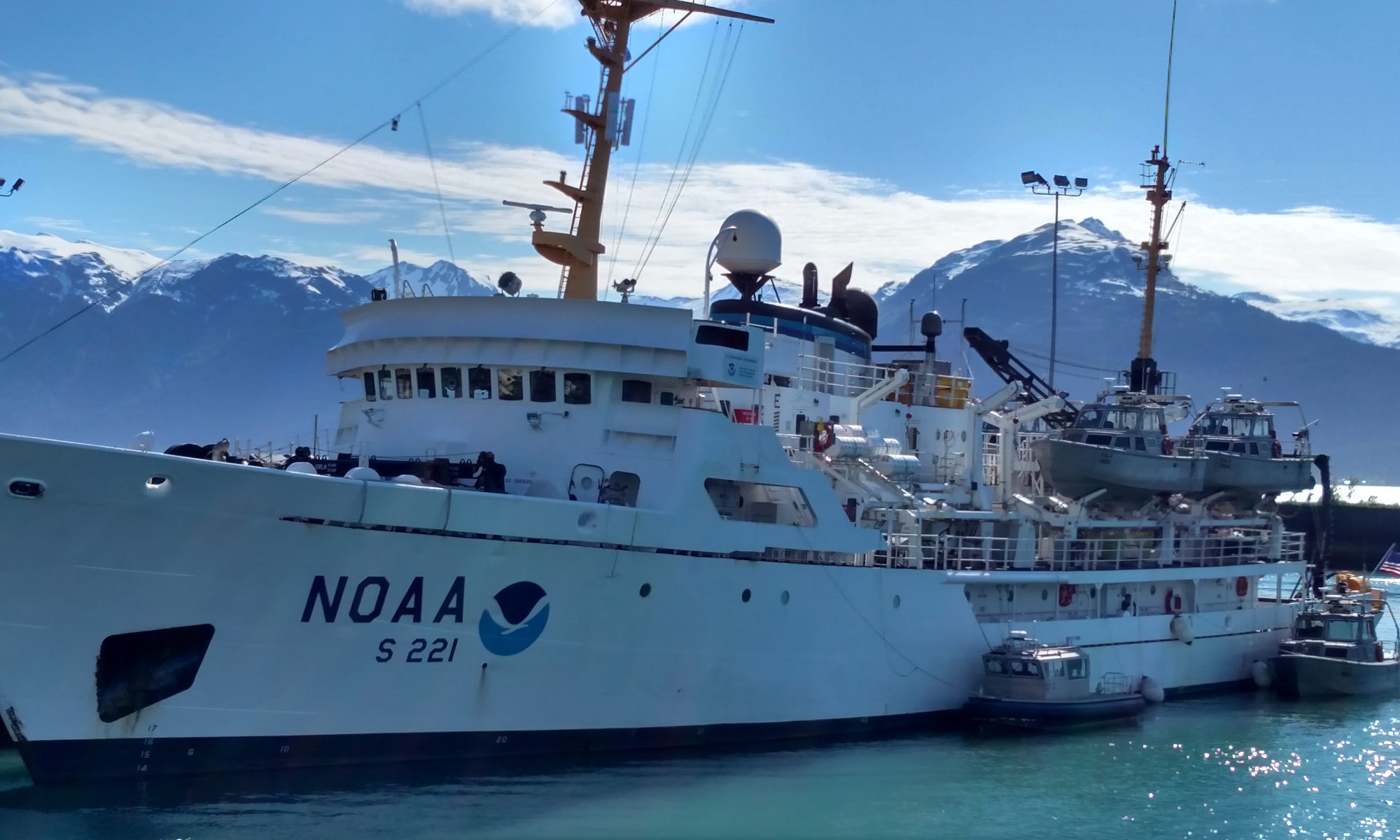
1. NOAA Ship Oregon II – our home for the next couple of weeks! Built in 1967, this vessel has aged gracefully, with modern updates and full air conditioning throughout. Getting around her isn’t always straightforward (still learning how to get from the stern to the flying bridge), but I’m eager to call her home as we head into the Gulf.

Photos, Clockwise from left: NOAA Ship Oregon II docked in Pascagoula; plaque on Oregon II acknowledging its origin at Ingalls Shipbuilding in Pascagoula, MS; view of forward deck from above.

Special thanks to my friend, Laura, for showing me around Ocean Springs, MS, on Thursday! We had a great time exploring such a charming place.

Did You Know?

The Gulf is home to more than 1,443 finfish species, 51 shark species, and at least 49 species of rays and skates. Source: sign hanging in the hallway of NOAA Fisheries building in Pascagoula, MS.

Animals Seen Today:

  • Many birds in port and on the way out to the middle of the Gulf:
    • Brown pelicans – they sit on every channel marker out of Pascagoula
    • Laughing gulls 
    • Black skimmer – striking black and white with distinct orange and black bill
    • Sandwich terns – identified by yellow-tipped bills like mustard smears
  • Bottlenose dolphins! (Tursiops truncatus) – right next to NOAA Ship Oregon II in the Pascagoula River!

Sinh Nguyen: 5 Takeaways from My 5K Runs at Sea, July 24, 2025

NOAA Teacher at Sea

Sinh Nguyen

Aboard NOAA Ship Pisces

July 7, 2025 – July 24, 2025

Mission: Larval Bluefin Tuna Slope Survey

Geographic Area of Cruise: North Atlantic Ocean, Slope Sea

Date: July 24, 2025

Conclusion Log

On my first day sailing aboard NOAA Ship Pisces, I stood on the treadmill with my head held high. “I got this,” I told myself while setting my usual running metrics.

Exercise treadmill positioned on metal flooring of a ship surrounded by electrical tubes and wiring, cabinets, and engine system parts.
The treadmill was bolted down on the lower deck. Tucked among the engine systems.
Lower deck of a ship with a punching bag hanging in the left foreground. There's a big metal drawer, large wood-top island table, and exercise equipment in the background.
It smelled like metal and salt. The air felt like a humid Texas summer: warm and dense.

“You’ve been training these past few months,” I reminded myself. “This will just be another run.” A few seconds in, I stumbled. Hard. The treadmill hadn’t budged… but I sure did! I’d swerved off and landed (thankfully feet first) on the floor.

Fast forward to my final days at sea: I’d completed consecutive 5K runs on that same treadmill. Boy… it wasn’t easy. But neither were the science mission nor my time at sea, and that’s where the reflection begins.

  • Close up of an exercise treadmill console showing a person's most recent workout.
  • Close up of a person's wristwatch screen showing how much they ran.
  • Asian man with glasses and upper arm tattoo sits and smiles on a ship deck to cool off after exercising.

I’ve been thinking about how much my time at sea mirrored my time on the treadmill. Here are five takeaways from running at sea; and what they taught me about science and teaching.

A man holds up a jar half full of some liquid to two women. In the background, two other women are standing and working at a counter. Text overlay reads, "Accept help. You're also a learner."

Accept help. You’re also a learner.

Small silver gray Lasko fan placed on the lower deck floor next to an exercise treadmill.
Next to the treadmill was a fan. During my runs, engineer crew members would pass by on their rounds and turn it on. They checked in (made sure I was cooling off) and reminded me I wasn’t doing this alone.

When I began the Teacher at Sea program, I had no experience with NOAA fisheries research or oceanography. I’d never lived on a ship. Let alone been out in deep water.

Three people stand together aboard a ship and smile for the camera with blue ocean water and sky behind them. The man in the middle is wearing jeans and a button up while the woman and man on the ends are in black boots and navy blue uniforms that say NOAA Corps.
Every part of the mission, from scientific terminology to ship protocol and living, was unfamiliar.

Although, I wasn’t expected to know it all, my science team was patient. Like any great teacher, they scaffolded the learning: they explained terms, modeled procedures, and gradually released responsibility until I could confidently take on the tasks myself. To be among top scientists in their field. To feel welcomed, supported, and taught… was humbling.

A large group of people stand on a ship deck listening to one man speaking and explaining information. The text "Begin steadily, avoid burnout." is overlaid on top of the image.

Begin steadily, avoid burnout.

There were moments, especially early on, when I wanted to try and do everything, even after my 12-hour shifts. I went from 0-100 fast, thinking that was the way to show commitment. A few days in, I was hit hard by exhaustion.

Over-the-shoulder image of a man at the command deck of a ship with a view of the sea at sunrise/sunset ahead.Asian man with glasses photographed in mid-motion smiling/laughing at the camera.
The same lesson applied to my runs. I’d start too fast and burn out too early.

Eventually, I learned to pace myself, both on and off the treadmill. I set boundaries, made time for rest, and remembered that sustainability matters more than speed.

Asian man with glasses, backwards yellow baseball cap, and navy blue Teacher at Sea t-shirt stands on a ship and smiles for a photo with ocean water and blue sky behind him
I learned that I could be more helpful, more present, and more productive when I prioritized well-being.
Two women with ponytails sit at a wooden table on a ship deck surrounded by barrels, thick ropes, and other equipment. Overlay text says, "Stay flexible. Conditions will change."

Stay flexible. Conditions will change.

Shout-out to Emily Susko (program coordinator) for helping making this experience possible before, during, and even after the sail. Her patience reminded me that plans shift, even with the best preparation.

As a teacher, I know this well: you can write the perfect lesson plan, but students and life will take it in different directions.

Zoomed out image of a man standing against the inside walls of a ship deck and waving at the camera
The same applies at sea. From unpredictable weather to equipment delays, we had to adapt constantly.

Not everything was in our control but our responses and mindsets were. Flexibility didn’t mean lowering expectations. It meant adjusting our mindset and staying ready for the unexpected.

Even on the treadmill. It was calm and cool on some days but rocky and shaky on others. Eventually, I adapted, adjusted my balance, and kept going.

Close up shot of three individuals at work, leaning over a table with various research equipment. Overlay text reads, "Stay grounded in your 'Why.'"

Stay grounded in your “Why.”

Our mission was to survey larval bluefin tuna. Some stations yielded many while others, none. But each time mattered.

Four women with light skin tones wearing orange life vests, ocean overalls, and hard hats pose for a photo as they complete nighttime work on a ship.
We weren’t focused on isolated results but were focused on contributing to the larger scientific picture.

There were lonely moments at sea. I missed land, my family, and friends. But I reminded myself why I was there: my students back home. This “why” connected my work at sea with my work in the classroom, and kept me grounded.

Asian man wearing glasses and orange ocean overalls kneels and smiles on a ship deck near a table and research equipment
Whether I was preserving fish samples or logging data at 2 AM, I knew I was part of something bigger that would outlast the sail itself.
Four women stand with their elbows on the walls of the ship deck overlooking water with land, city buildings, and other vessels in view. Text overlay reads, "Remain curious and humble."

Remain curious and humble.

One of the most memorable moments came after a shift. It was a quiet night. The storm had calmed, winds had slowed down, and Pisces‘s lights had dimmed. I walked out to the back deck alone.

Nothing surrounded me but ocean. I looked up and saw the Milky Way. Lots of stars above while I was surrounded by nothing but the ocean. I paused, stunned by the beauty. My mind loaded with curiosity and with many questions.

That moment was a reminder that there’s so much I don’t know. So much to still wonder about. And that wonder is a gift I’ll bring back to my students.

I will come home with the renewed motivation to bring the ocean back to my school community, not just through facts, but through curiosity. I want students to look at the world, land, sea, or sky, and feel and then share that same awe.
Man wearing glasses, backwards yellow ball cap, shorts and NOAA Teacher at Sea shirt standing on a ship deck, looking to his right with a sunset/sunrise in the distance
I’m grateful to NOAA’s Teacher at Sea Program for reminding me that learning is lifelong, and that the unknown is not something to fear… but to explore.

As educators, we wear many hats: teacher, learner, mentor, student. At sea, I was all of them. For that, I thank all crew members aboard who made this mission possible:

Metal glass cabinet containing multiple profile photos thumbtacked onto a map and labeled "NOAA Ship Pisces Crew."

Of course… I can’t forget the science crew:

Close up image of a brown-haired man with light skin tone smiling. A blurry, lit-up Christmas tree in the background.
Chief Scientist Dave Richardson
A woman with long blonde hair wearing a beanie and warm clothing  stands for a photo against the ship railing.
Allison Black
Close up image of a blonde woman wearing glasses and an orange shirt smiles for a photo. Green trees and a cityscape can be seen behind her.
Chrissy Hernández
Brown-haired woman with medium skin tone smiles for a photo with a sunset/sunrise ocean view behind her.
Autumn Moya
Brown-haired woman wearing shorts and t-shirt kneels on the ground to work on a piece of equipment.
Amanda Jacobsen
Close up profile image of a woman with light skin tone and sunglasses propped up on her head. There is a sunrise/sunset rocky shoreline in the background.
Kristen Walter
An older woman with light skin tone wearing glasses and a blue hoodie sits on a ship deck with her legs propped up against the inner side walls.
Elisabeth (Betsy) Broughton
Woman with dirty blonde, long curly hair wears an orange vest and hard hat as she crouches to work on research equipment.
Sarah Glancy
Nine individuals in casual clothes stand and crouch on a ship deck together for a group photo.
The science crew aboard NOAA Ship Pisces for the larval bluefin tuna mission.

Science crew: I’ll carry everything I’ve felt, seen, heard, and learned from y’all with me into every lesson I teach.

  • Asian man wearing glasses, yellow backwards ball cap, and NOAA Teacher at Sea shirt stands and works at the a ship control panel.
  • Over the shoulder view of a man standing at a ship control panel with multiple windows overlooking the sea ahead.
Asian man wearing glasses, jeans, and NOAA Teacher at Sea shirt stands on dock next to a big white NOAA ship and smiles for the camera. Overlay text says, "If you're an educator interested in this opportunity, I highly encourage you to apply for the 2026 sail season."

If you’re an educator interested in this opportunity, I highly encourage you to apply for the 2026 sail season.

Jacqueline Omania: Guadalupe Fur Seals and the Lasker’s Dream Team, July 22, 2025

Jacqueline, wearing her Teacher at Sea shirt and hat, poses in a line with four female NOAA Corps officers in blue uniforms against a rail of the flying bridge. the sky is cloudy and the sea is calm and blue-gray.

NOAA Teacher at Sea

Jacqueline Omania

Aboard NOAA Ship Reuben Lasker

July 14- July 24, 2025

Mission: Oceanographic and Biological Monitoring of Davidson Seamount

Geographic Area: Davidson Seamount/Monterey Bay National Marine Sanctuary

Date: July 22, 2025

Weather Data from the Bridge

Latitude: 35° 45.51’ N

Longitude: 122° 36.14’ W

Wind Speed: 18 knots

Wave Height: 3’

Air Temperature: 15.6°C/60°F

Sky: Overcast

Science and Technology Log: 

We have now finished our planned transects and are using our two additional days at sea to repeat two of the transect lines. This will allow us to see changes along the lines with observations 5 days apart. Our deep drops for eDNA (the genetic material shed by organisms in the water) will be at 2400m.

I have had a chance to help with the collection of samples of eDNA. The process begins right after the CTD rosette is lifted to the deck. Water is collected from the specific Niskin bottle that was filled at the various depths- either surface (0 m.), 500 m., 1000 m. or 2400 m. Next, the water samples are taken to the wet lab, where under laboratory conditions, they are filtered to collect eDNA which is then stored for future processing by MBARI.

I loved having a chance to participate in collecting the sample. Working with the equipment reminded me a lot of the joy I had in my college chemistry classes and it felt amazing to be making a contribution to science that will help understand this very special environment of Monterey Bay National Marine Sanctuary. 

I have also been learning more about the ocean by looking at the CTD (water conductivity (salinity), temperature, and depth) profiles with the Reuben Lasker survey technicians, CC and Jaclyn. The survey technicians observe and record the data as the rosette descends. They also monitor how deep the rosette descends based on what they see on the sonar data, which is showing the overall distance to seamount. At the targeted depths and with a press of a mouse button, they close the Niskin bottle caps to capture water for eDNA sampling.

photo of a computer screen depicting a graph with multiple lines. Depth is shown on the y-axis. Multiple x-axes correspond to Flourescence (green line), temperature (red line), oxygen (blue line.) beneath the computer monitor are decorated foam shapes. there is a NOAA sticker on the top left of the monitor.
CTD Data Monitoring

The data screens in the lab show how oxygen, temperature, salinity and chlorophyll change as we descend. At the surface the water temperature is 15°C (59°F) while at 1000m it is 3.5°C (38.3°F) and at 2400m it is 1.9°C (35.4 °F). Salinity at the surface is 33.25ppt, at 1000m it is 34.4ppt and at 2400m it is 34.65 ppt. Oxygen is 0.6 ml/L at the surface and is at its lowest 0.2 ml/L between 600 – 800m. The oxygen rises again as you go deeper than 800m and at 2400 it’s more than 2.0 ml/L. Chlorophyll is at its maximum at 43 m and is an indicator of the amount of phytoplankton in the upper layer of the ocean. Phytoplankton (microscopic algae) is the base of most food webs in the ocean. Thus, this data helps us better understand the ecosystem of the deep ocean.

Our seabird and marine mammal counts are going well, though we had the slowest day on Monday with only 47 animal sightings (11 mammals and 36 birds). Yet, all together for the week (with the 994 sightings shared in the last post), we had a total of 1,041 animal sightings for the 500 miles of survey.

As we repeated the survey line (16W) today (Tuesday), we had an exciting sighting of a pod of seven orcas! I have never seen orcas in California. I’ve also become far more skilled at sighting whale blows on the horizon and spotting sharks from the two black triangles peeking out of the water as they glide by. The various types of seabirds – like Leach’s Storm Petrels and Red-necked Phalaropes- are now second nature to me. Some of the most exciting moments have been finding the waving flippers of Guadalupe fur seals as they drift by clinging to a branch of kelp.

So far, I have probably put in 50 hours of observation time and I have been delighted in every moment of it. It is a bit like an easter egg hunt in the ocean. I have learned so much thanks to the support of the scientists who always think of me when any special sighting arises. Everyone makes the extra effort to make sure I have a chance to see it too. 

the back of a fin whale - including its tiny dorsal fin - is visible above the otherwise calm surface of a gray ocean
Fin Whale Sighting! Photo Credit: Jim Tietz

Personal Log

I have been savoring the days at sea and the ever changing colors of the ocean from the deepest blue to silvery greys. I spend most of my days outdoors on the flying bridge perfecting my observation skills. Our shifts are complemented with delicious meals, after dinner card games and evenings in the gym. Life couldn’t be better and it is a real privilege to be part of this experience. Beside participating in science, I have been very busy interviewing people to better understand how everyone works together to make the mission successful. I’d like to share the stories of some of the people I have met.

NOAA Corps and the Crew: The Team at Sea that Makes Science Possible

Besides the 11 of us on the science team, we have the team that runs the ship composed of seven NOAA Corps officers and 18 crew. The crew includes survey technicians, electronics technicians, engineers, deckhands and stewards. NOAA Corps is one of the eight uniformed services of the United States. They are commissioned officers who support NOAA’s scientific and navigational missions by operating NOAA ships and aircraft. The Commanding Officer of the Lasker, CDR Aaron Maggied, shared that some NOAA Corps officers fly planes as hurricane hunters to collect data for forecasting hurricanes. Others, like himself, sail ships to make sure our ocean and its inhabitants are studied so that we can better understand and responsibly manage our natural resources, like our current sanctuary project. He also mentioned that early in his career he was called on to help in the Deepwater Horizon oil spill response effort in 2010. The officers have all been very supportive of having a teacher on board and readily answer any questions about their work.

a group photo of seven NOAA Corps officers (four women, three men) in blue uniforms along a railing on the flying bridge. the sky is cloudy and the ocean is calm, blue gray.
NOAA Corps
Jacqueline, wearing her Teacher at Sea shirt and hat, poses in a line with four female NOAA Corps officers in blue uniforms against a rail of the flying bridge. the sky is cloudy and the sea is calm and blue-gray.
Women of NOAA Corps

Lt Cdr. Kelli-Ann Bliss Interview

portrait photo of a woman in a blue NOAA Corps uniform on the flying bridge, with the ocean visible in the background
LCDR Kelli-Ann Bliss

Kell was the first officer I met on the ship. She welcomed me at the entrance to Coast Guard Island in Alameda and escorted me to the ship, kindly carrying my heavy duffle on her shoulders. 

What is your job?

On Reuben Lasker, I am the XO, which stands for Executive Officer, and second in command. I have a background in science, like all NOAA Corps officers, and I support the scientists on the ship during sea assignments, and in different capacities when on land assignments. I work on the bridge and sail the ship safely to help the scientists get the data they need. This work is important because we need to understand how our planet works so we can survive as a species. I also mentor the Junior Officers (JOOD) as they work toward being Officers of the Deck (OOD). I also manage the crew details (payroll, vacation, staffing, approving  purchasing, etc.) like an administrative assistant.

How did you come to NOAA?

I grew up in Rhode Island and spent summers sailing with my family all over New England. I went to Maine Maritime Academy and earned a degree in marine science. I worked in a lab on Cape Cod doing water testing after college. My college classmates encouraged me to apply for NOAA.

I have been in the NOAA Corps for 16 years and have been on 8 different NOAA ships. I have also served on various land assignments — including in Antarctica for 13 months. In Antarctica, I was half of a team with a NOAA technician. We were running experiments and collecting samples on behalf of scientists in their home locations. While staying over the winter, I enjoyed the gorgeous auroras (natural light displays in the sky) and the flat, snowy landscape of Antarctica. Currently I am stationed in Louisiana and awaiting the completion of the newest NOAA ship to the fleet, the NOAA Ship Oceanographer, where I will also serve as XO. My tasks will be much the same as here on Reuben Lasker, but additionally, I will hire the new crew and be part of the team that gets her ready for scientific missions. 

What do you love about your job?

I love being at sea. You are in a new place every day and it is gorgeous. There is always something new to learn either through presentations, different weather conditions, or a new tool or technology on the ship.

What is your greatest challenge?

As you go up in the ranks, there is a lot of paperwork, which tends to mean a lot of sitting – but there’s always the ability to go up and stand a watch on the bridge to break it up. I also work to keep harmony and help to set a positive culture with the team which starts at the top.

When did you know you wanted to have an ocean focused career?

In middle school in Coventry, Rhode Island, I joined the shell club and learned all about shells and their history. For example, the ancient Romans boiled the murex shell and infused the purple color into fabric. Once a month, the club would travel to Boston and connect with the Malacological Club at Harvard and I would be exposed to even more people who were passionate about shells. I knew that I wanted to study science. For college, my family wanted me close by so I chose Maine Maritime Academy, this allowed me to merge my interests in science and being on the water.

What do you recommend to students who are interested in an ocean focused career?

Stay curious and ask questions. There are many ways to get into the field and people will share their knowledge. Always keep learning.

————————————–

Interview of JOOD Camille Cube (Junior Officer of the Deck)

I met Camille Cube on my first visit to the bridge. I was so impressed by the calm and confident way she was steering the ship. In conversation, we were happy to discover that we both had Filipino roots. Camille kindly agreed to be interviewed.

portrait photo of a woman in a blue NOAA Corps uniform standing on the bridge
ENS Camille Cube

What is your job/position?

I am the newest officer. My rank is Ensign and my position is called JOOD (Junior Officer of the Deck). I am learning to safely drive the ship and ensure everyone’s safety onboard. To steer the ship, I use navigational charts, radar, look out the windows, and other tools.

How did you come to NOAA? 

I grew up in Northern Virginia. Then, I went to the University of Washington and majored in Environmental Science. I love the environment of both land and sea. During college, I did many internships. Two were with NOAA Fisheries. I also studied at Friday Harbor Labs on San Juan Island; in this 11 week residential program, I learned marine biology, went tidepooling and saw orcas. I also spent three months as an intern in Cambridge, England with the International Whaling Commission. After graduating from college, I worked for NOAA Fisheries in Sacramento (CA) as a natural resource and management specialist. I joined the NOAA Corps for a more hands-on experience. I love how the NOAA Corps changes jobs every few years. I will be on Reuben Lasker for two years; three months have passed so far.

How does the NOAA Corps work?

To apply, you fill out an application online, go to an interview and pass medical processing. If you are chosen, you begin three months of training at the US Coast Guard Academy in New London, Connecticut, alongside US Coast Guard officer candidates. This training has hands-on learning about navigation, the parts of a ship, safety, CPR, and fire fighting alongside classroom learning. I learned leadership and public speaking skills in my training and the experience has built my self-confidence. You begin your service as a junior officer and after 120 days of sailing, completing a workbook and proving that you can safely drive the ship, you become OOD (Officer of the Deck) qualified, which means you can drive the ship without supervision.

What is your work day like?

My watch, which is when I am driving the ship, begins at 11:15 p.m. and goes to 3:30 a.m. From 3:30 to 7:00 a.m., I do administrative work and eat breakfast. Sometimes, I exercise in the ship’s gym; our requirement is to work out 180 minutes a week. My second watch is from 7:15 to 11:30 a.m. After that, I am off duty, and I read, sleep or crochet. Right now I am making a purse that looks like a sheep.

What do you love about your job?

I love helping make science happen. NOAA’s work in science is really important. Often we work on research on fish populations and fish are very important for the economy and ecosystem. Collecting weather data is also important for weather forecasters. I love being able to do cool things on the ocean that I was never able to do in the office like steer the ship and see lots of wildlife. I also love the community in NOAA; we support each other, especially the other officers and the crew because we live and work so close together. A shout out to the stewards (ship’s cooks) for making Filipino food that reminds me of my family.

What is your greatest challenge?

Being away from home for long periods of time is a challenge. I live in San Diego now. Even though my husband visits me when we are in port, I have only been able to see my cat Mio once this year.

What was your favorite book in elementary school?

I was obsessed with Percy Jackson and wanted to be a demigod of Poseidon. I wished for water powers!

What do you recommend to students who are interested in an ocean focused career?

If you are near the ocean, get out and explore it in a hands-on way like tidepooling. If you are not near the ocean, watch documentaries and keep learning about the ocean. If you can, join a marine biology club.

I am excited to share information about career opportunities with NOAA with my students and family. I had never heard of this service before and now after experiencing the work of the NOAA Corps, I believe it is a wonderful opportunity. I also learned about another new to me career-the careers of wage mariners. It takes many essential skilled workers to sail these ships that make science happen.

————————————–

Interview of Nick Sampson (Oiler)

I had a chance to interview Nick Sampson. He is a mariner and specifically works as an Oiler. We met in the mess hall (dining room) as he is outgoing and very curious about all the science we are doing on our mission. He also kindly took us on a tour of the engine room with fellow mariner Joe Johnston.

portrait photo of a man in a red shirt and a beanie, smiling.
Oiler Nick Sampson

Nick Sampson is from Jacksonville Florida. He has a 5 year old daughter and his wife is expecting another child soon.

What is your job?

I am an Oiler on the ship which means I check the temperature gauges and maintain the ship. I keep the ship running, secure and dependable. 

What do you love about your job?

I love that I am doing something positive. I enjoy people–I am a people person and I love to learn from others. You can see the world with this job, make good money and learn a lot. I have been to Hawaii, Guam, Saipan, Japan, South Korea, Germany and recently I spent 43 days in Alaska.

What is a challenge in your job?

Learning more about the machinery is a challenge but I am eager to learn. The job is good if you are single, but if you have kids it is difficult to be away. It is still a good job for supporting a family.

How did you know you wanted an ocean focused career?

My older brother is a mariner so I decided to do the same. I graduated from Blue Water Maritime School in Florida and have been working on ships for the last 7 years.

What are your words of advice?

Give it a try! Invest in yourself and you can learn a lot.

The Most Essential Crew: The Stewards

A final shout out- as Camille says- has to go to the stewards. From the first day, the food has been AMAZING!!! The smells of the cooking waft all the way up to the flying bridge. Our meals are at 7 am, 11 am, and 5 pm. Since the crew and scientist work a range of shifts, including the night shift, there is always a wide array of assorted snacks as well as easy to prepare meals like fancy ramen bowls. There are lots of organic choices, a fruit salad bar at breakfast, and a green salad bar at lunch. I have been enjoying the organic grassfed milk in my tea every morning.

The stewards, Arnold Dones and Judeni De Los Reyes, create food with great care and an element of magic. Since both have Filipino roots, they love to make some of the traditional foods like adobo and pancit (my favorite Filipino food). But they also love to test out new recipes. I am still thinking about the cabbage rolls from the first day. They tasted like a special grandmother’s recipe; Arnold shares that he researches recipes and gives them a try. Before working for NOAA, he was a cook for the Navy for 10 years.

Arnold loves his job on Lasker and takes great pride in carefully planning the menu even up to a year in advance. This way he can plan to have the right equipment and the right cooking time. Arnold “loves to cook everything” and likes to explore new foods. “Good food makes everyone function well both in terms of energy and morale. It makes people happy and I love to make everyone happy by giving them the best quality food and snacks.” 

portrait photo of two men in the galley (kitchen); both wear baseball caps; the man on the right wears an apron
Arnold Dones (Chief Steward) and Judeni Delos Reyes (Steward)

Did You Know? 

a fur seal's head and tail flipper are visible above the waters surface; it is surrounded by bull kelp floating or poking up from underneath
Guadalupe Fur Seal Sighting. Photo Credit: Jim Tietz

Guadalupe Fur seals are members of the “eared fur seal” family. They breed on Guadalupe Island (off the coast of Mexico) and on the Channel Islands. They have been making a comeback since they were once hunted to near extinction in the 1700’s and 1800’s. They are now considered “threatened” on the Endangered Species list and research and conservation is helping their recovery. They feed on squid and small fish mostly at night. They dive from an average of 65’ to a maximum of 250’. They rest with their heads under water and their flippers poking out above water as pictured below. On this mission, we have been seeing both Northern Fur Seals and Guadalupe Fur Seals.

illustration of a Guadalupe fur seal
Guadalupe fur seal. Image credit: NOAA Fisheries

Please stay tuned for my final blog from shore…