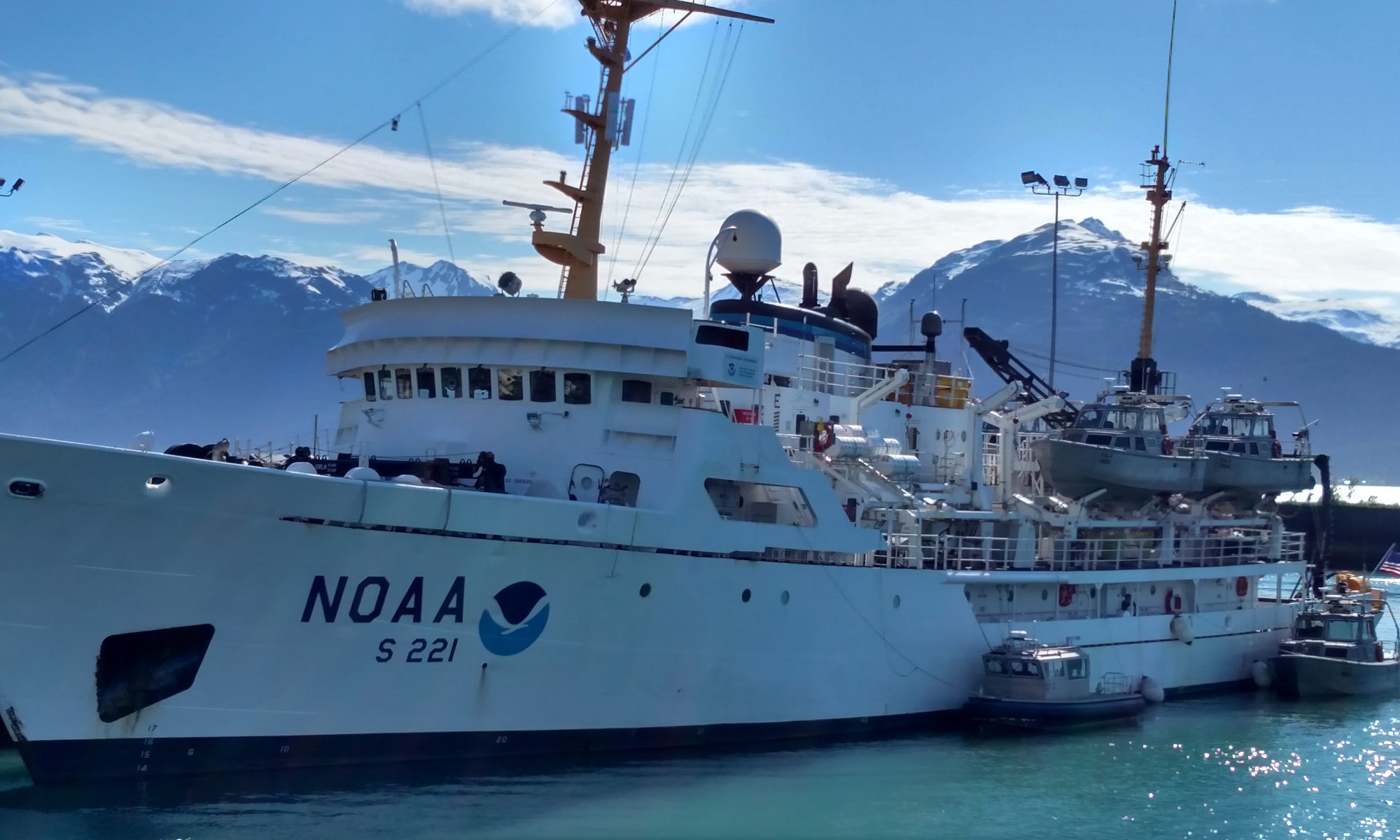
Jessica Cobley: Resurrection Bay, July 28, 2019

NOAA Teacher at Sea

Jessica Cobley

Aboard NOAA Ship Oscar Dyson

July 19 – August 8, 2019


Mission: Midwater Trawl Acoustic Survey

Geographic Area of Cruise: Gulf of Alaska (Kodiak to Yakutat Bay)

Date: 7/30/2019

Weather Data from the Gulf of Alaska:  Lat: 58º  50.39’ N  Long: 150º 14.72’ W 

Air Temp:  14.2º C


Personal Log

Today we had the chance to sail up into Resurrection Bay on the Kenai Peninsula and it was beautiful! In general, transects, or lines the boat collects acoustic information along, run perpendicular to the Gulf of Alaska shelf because that is where pollock are most likely found. Luckily for us, a few of them travel up into bays along the coast and give us a welcomed change of scenery from the open ocean. 

transect map
A map of the transects we followed up into Resurrection Bay.

Why do we survey in bays when pollock are usually open water fish? Well, during the winter, pollock sometimes aggregate to spawn (reproduce) in bays and those areas are documented by the scientists. In the summer, scientists want to see if there are still any pollock present in those areas. Unfortunately, we do not have time to survey all of the bays and so just a few are selected. For this leg, after the next couple of days back on the shelf, we will head up into Prince William Sound, which I am really looking forward to seeing. 

Seward
The town of Seward – can you spot the cruise ship?

While following the transects up into Resurrection Bay, it was fun to see sailboats, fishing boats, helicopters and float planes rushing around us. To my surprise, I also saw masses of RV campers through the binoculars when looking at town. I learned that Seward is a popular place for people to visit from Anchorage and other areas for summer vacations and fishing opportunities. As for those of us on the boat, we also enjoyed the summer weather while sailing through. The sun was shining and it seemed that everyone took a moment to step outside, make a few phone calls home (we had service for a bit!) and soak up the warm weather. All in all, I think everyone feels re-energized going into our final 10 days at sea.

top deck
Enjoying the sunshine from the top deck of the boat


Science and Technology Log 

We stopped to fish near the mouth of Resurrection Bay and found mostly age 1 and 2 pollock, along with a few adults. This shows us that pollock do utilize both the bay and the shelf areas during their lifecycle. Afterwards, we headed back out into the gulf and fished with a net called a Methot net.

A-frame
The Methot net gets lifted up by the A-frame (yellow metal beams). I did not know the A-frame moved before this!

A Methot net is a different kind of net that is specialized to catch Euphausiids (krill). In addition to collecting data on pollock, scientists also collect data on Euphausiids (krill). The net used to collect krill is a bit different than the one used for pollock. There are no pocket nets along the side and instead of the end of the net being mesh, there is a small canister that the net filters krill into. Once we haul in the net, it is time to sort and collect data on the catch, just like the pollock trawls. 

Processing fish in the wet lab.
Processing fish in the wet lab. This one had a lot of jellies! Photo by Darin Jones

It has been back to regular fishing trawls since then, along with comparison trawls. A comparison trawl is when we fish twice over the same area using two different nets. This year, the scientists decided to replace the old survey net with a newly designed one that is a little bit smaller and easier for the deck crew to deploy. Now they need to compare the two nets to make sure the newer net is catching the same species and size of fish. Darin was explaining to me that they have to do approximately 25 comparison trawls on this survey and will continue comparisons during the winter survey as well. If all goes according to plan, they will permanently replace the old net next summer. 

On one of our trawls the other day, we caught a lot of rockfish. Lucky for us, rockfish is a species we can keep and eat on the boat. We are not allowed to keep salmon, crab, halibut or herring since they are prohibited species. You are only allowed to keep those species if you have a special permit. While I wish we could eat the others, rockfish is also really tasty!

Darin filleting
Lead scientist, Darin Jones, filleting dusky rockfish for dinner.


Did You Know?

There is an incinerator on NOAA Ship Oscar Dyson that burns all of our trash from the boat so that we don’t have to keep it aboard for the whole trip. Also, nothing is thrown overboard, not even food scraps. When I was taking a look yesterday, the temperature was over 800 degrees Celsius. Diesel fuel is used as fuel initially, followed by burning sludge from the boat once it gets hot enough. All leftover ash gets put into bins and discarded when back in port.

Thanks for following along!

Cheers, Jess

P.S. We go up and watch the sunrise everyday…it is beautiful out here!

Abigail watches sunrise
Abigail McCarthy watches the sunrise every morning and ranks them. This one earned a “glorious!”

Ragupathy Kannan: From Arkansas to the Atlantic, August 1, 2019

NOAA Teacher at Sea

Ragupathy Kannan

Aboard NOAA Ship Gordon Gunter

August 14 – 30, 2019


Mission: Summer Ecosystem Monitoring

Geographic Area of Cruise: Northeast Atlantic Ocean

Date: August 1, 2019

Weather Data from the Bridge

I’ll update this when I get on board.


Greetings from land-locked Arkansas!

I am thrilled at the chance to embark on an adventure of a lifetime. In the latter half of August, I will be aboard NOAA Ship Gordon Gunter assisting scientists on a Summer Ecosystem Monitoring Survey of the Northeast U.S. Continental Shelf Ecosystem.  I am particularly excited about surveying for marine mammals and sea turtles, although a lot of our work will involve monitoring spatial distribution of plankton.  I cannot wait to learn novel techniques and measurements that I can later incorporate into my classes at the University of Arkansas—Fort Smith. 

While aboard NOAA Ship Gordon Gunter I will blog about my experiences.  My students will follow my blogs and hopefully learn a lot from them.  I hope to make my blog postings fun and informative at the same time.  I will cater to a broad audience, from biology majors and non-majors (college students), to even some school children who are keen on following me and exploring potential science careers.  So don’t be offended if I define basic terms or explain concepts you may have learned decades ago!    

Science and Technology log

I will be embarking on an Ecosystem Monitoring mission.  As my ecology students should know, the term ecosystem refers to a community of organisms along with their physical (or abiotic) environment.  And a community is a group of organisms living and interacting in an area.  To monitor the Northeast U.S. Continental Shelf ecosystem, we will take extensive data on various components, both biotic (biological) and abiotic (physical).  Such measurements are important because they alert us of possible changes in our environment and what that could mean to our well being and that of other life forms.  In effect, we keep a finger on the pulse of our planet.

What is continental shelf?  It’s the relatively shallow (generally up to about 100m or 330 feet depth) area of seabed around land.  Much of this was exposed during glacial periods when water was locked up as ice. This zone teems with life because of its shallow nature, which allows light to penetrate and photosynthesis to occur.  It is therefore vital for the fisheries industry in which many coastal human communities depend on for livelihood.

The Project Instructions document we were all sent (by the Chief Scientist, Dr. Harvey Walsh) indicates that the principal objective of the survey is to assess the “hydrographic, planktonic, and pelagic components” of the ecosystem.  Hydrography (Ancient Greek–hydor, “water” and graphō, “to write”) is a branch of the applied sciences that deals with measurements and descriptions of the physical features of water, like ocean currents and temperature.  Plankton (Greek—errant or wanderer) are organisms, both plants and animals, in the water that drift in the currents (most of them are microscopic).  Pelagic (Greek—of the sea) means oceanic, or belonging to the open seas.

I will be part of an elite multi-disciplinary team, meaning, we will have experts from various disciplines of science. We will be measuring the distribution of water currents and water properties, plankton, sea turtles, sea birds, and marine mammals.  Much of my career I have focused on ecology and behavior of vertebrates, especially birds.  The chance to learn hands-on and in-depth on aspects like water chemistry and plankton biology challenges and excites me.  It gets me out of my comfort zone and has the potential to make me a better-rounded biologist.  After all, I regularly teach the impacts of global warming and ocean acidification on coral reef organisms.  Can there be a better way to hone my teaching skills than actually do these studies hands-on, in the company of world’s leading experts, in a state-of-the-art research ship?

Since much of the survey focuses on measuring plankton distribution and abundance, it begs the question: 

Why are plankton important?

plankton
The wonderfully diverse, beautiful plankton. From planktonchronicles.org

Well, consider this.  Phytoplankton, the plant-like photosynthetic drifters, produce half of all oxygen on earth.  That’s about the same as ALL oxygen produced by land plants!  So that alone should convince you why they are vital. 

But there is more.  Their productivity (meaning, photosynthetic activity that converts sun’s energy into fuel) forms the energetic foundation of the food pyramid, and most of life in sea depends on it. 

So, you take away plankton, and much of oceanic life will collapse.  No fish, no whales, no sea turtles, no sea birds.  Ultimately it will affect all life on earth, including humans. 

The disturbing news is, plankton are in trouble.  Phytoplankton have declined 40% since the 1950s.  Since the beginning of the industrial age, they have dwindled about 1% a year.  There seems a connection between warming waters and this decline.  In the North Atlantic, the melting of Greenland ice has changed the physics and chemistry of ocean waters.  This has resulted in a decline in ocean circulation and its upwelling of nutrients that the phytoplankton depend on. 

So as you read this and take breaths of air, contemplate this: that oxygen you just took in probably came from phytoplankton.  That’s why we need to start with measuring them to monitor our planet’s health.  Our future depends on their well-being!

So I will be blogging quite a bit on these minuscule creatures—what kinds there are out there, how they appear, how to measure their abundance, and so on.  Stay tuned.

Personal Log

For nearly 40 years, I have been mainly a terrestrial ecologist.  I love taking people outdoors and making them into naturalists and field biologists.  My forays into the oceanic realm have been limited.  I once went on a sea birding cruise, which I described in this article.

birding in Trinidad
Here I am leading a birding outing in Trinidad

Earlier, in my college days, I did a number of “turtle walks” – 10 km walks along the beach in my hometown of Chennai, India, to collect Olive Ridley Seaturtle eggs and relocating them to a protected hatchery.  Since 2009, I have taught a tropical biology course in Trinidad, West Indies, where I take the class to a remote beach to observe massive Leatherback Seaturtles nest. A letter of mine on this appeared in the September 2009 issue of National Geographic (below).

National Geographic Note
National Geographic Note by Ragupathy Kannan

Kannan and sea turtle
Here I am with my tropical biology class and a nesting Leatherback Sea Turtle in Trinidad–note the translucent spot on top of head, believed to let light in and help them navigate

So, my exposure to the other 70% of the earth’s surface, the ocean, has been rather limited.  I hope that this NOAA program helps in my quest to fill that void.

My home for two weeks – NOAA Ship Gordon Gunter

NOAA Ship Gordon Gunter
NOAA Ship Gordon Gunter. From http://www.omao.gov.

This is an ultramodern oceanographic research vessel whose main mission is to study marine mammals and other living resources.   “Bigeye” 25 x 150 binoculars are used by scientists to scan for marine mammals.  This includes a scale to enable distance measurement. A hydrophone array is towed to hear and record marine mammal sounds 24 hours a day. 

She was once USNS Relentless, designed to assist the US Navy in collecting underwater acoustical data in support of Cold War anti-submarine warfare operations. After the end of the Cold War, she was transferred to NOAA. In 2010, NOAA used this ship to define the subsurface plume near the BP Deepwater Horizon site. 

I am honored to be assigned to this vessel. I hope you will join me and enjoy and learn from my adventure out in the seas in this amazing ship.

David Madden: Otolithia and The Tragedy of the Commons, July 27, 2019

NOAA Teacher at Sea

David Madden

Aboard NOAA Ship Pisces

July 15-29, 2019


Mission: South East Fishery-Independent Survey (SEFIS)

Geographic Area of Cruise: Atlantic Ocean, SE US continental shelf ranging from Cape Hatteras, NC (35°30’ N, 75°19’W) to St. Lucie Inlet, FL (27°00’N, 75°59’W)

On board off the coast of North Carolina – about 45 miles east of Wilmington, NC (34°18’ N, 77°4’ W)

Pisces Route
Pisces Route as of July 27, 2019


Date: July 27, 2019

Weather Data from the Bridge:

Latitude: 34°18’ N
Longitude: 77°4’ W
Wave Height: 3-4 feet
Wind Speed: 6.68 knots
Wind Direction: 42°
Visibility: 10 nm
Air Temperature: 28.0°C 
Barometric Pressure: 1022.4 mb
Sky: Partly cloudy


Science and Technology Log

Today, with the help of friends Zeb and Todd, I’d like to take a deep dive into the mission of this cruise.  Starting with the fish work up process aboard Pisces, first explained in blog #3.  Below is a picture flowchart I drew up to help visualize what’s going on. 

NOAA Fish Protocol (color)
NOAA SEFIS Fish Survey Protocol

This sequential process is rather straight forward following steps 1-8, rinse (the gear) and repeat. It’s the before and after; what comes before step 1 and after step 8, that’s important; How and where is the data used.  If you follow along into steps 9, 10, 11… you start with the laboratory analysis of the biological samples – otoliths and gonads – used to age the fish, and determine reproductive activity and spawning seasons, respectively.  This information is vital to proper management of fisheries.  Here’s why. 

This cruise, and SEFIS in general, originally came into existence because of red snapper.  Scientists determined around 2009 that the red snapper population in the SE Atlantic was at historically low levels.  Strict regulations were put in place to help the species rebound.  This on its own was a good measure, but only one step.  In order to assess the effect of the regulations, scientists would have to monitor the abundance of red snapper in the region.  However, charting changes in abundance would not be enough with this species (or with many others) due to the nature of its life cycle and reproduction.  See, all populations have a natural age structure balance.  This includes species specific traits – like its survivorship curve (how likely it is for an individual to die at different points in their life – for red snapper and many other reef-associated species it’s incredibly high at their larval and juvenile stages).  It also includes pertinent developmental characteristics such as when the species is reproductively mature.  Like many similar fish, older, mature red snapper have greatly increased reproductive potential, also known as fecundity.  So while the population has been bouncing back in terms of numbers, the number of older, mature, more fecund fish is still considerably lower than historical levels; thus the population is still recovering.  *this information is gathered from the data collected by scientist here on our SEFIS mission, and others like them. 

SEFIS survey site locations
SEFIS survey site locations.

The next step is to share this data with other scientists who will then, in conjunction with other information on the species, analyze the data and bring the results and conclusions of their analyses to policy makers (FYI, the government is moving towards making governmentally gathered scientific data available to the public).  Discussion ensues, and climbs the political decision-making-ladder until allowable catch regulations are determined.  Florida fishers, check here for your current snapper regulations or maybe this Fish Rules app will help.  Fish safe, my friends!

Morning Crew
Morning crew: Mike, Dave, Brad, Me, Todd, Oscar the Octopus, Mike, Zeb
gear
Macabre medieval cutlery? Or otolith extraction gear?

Ultimately this is a tricky and tangled issue of sustainability.  Commercial fishermen are understandably upset, as this can threaten their livelihood.  Although real, this concern is inherently short sighted, as their long term earnings depend on healthy and robust populations, and ecosystems.  The difficult part is to gather the necessary scientific data (very challenging, especially for marine organisms) and marry that to the many financial, social, and political concerns.  Comment below with thoughts and suggestions.  And while you’re at it, here’s a lovely and quick (fish-related) tutorial overview of this situation in general – the tragedy of the commons – and the challenges of managing our resources. 

A quick note about otoliths.  Within the fish processing protocol (above) – the most satisfying part is otolith extraction.  On board competitions abound: people vie for first chair (the spot in the lab that’s the coolest and best lit) and for the sharpest knives and scissors.  Much like a wild west showdown, most important is fastest extraction times.  Dave H opts for the classic chisel-through-the-gills technique, while the rest of us opt for the saw-through-the-skull-with-a-knife-and-crack-the-head-open-just-behind-the-eyes technique.  While Brad looks to perform the “double-extraction” – both otoliths removed in the tweezers at the same time, I look to perform the please-don’t-slice-my-hand-open extraction.  The quest for otoliths is usually straight forward.  But sometimes an ill-sliced cut can leave you digging for the tiny ear bones forever. 

This leaves us with: Why otoliths?  These tiny little ear bones help function in the fish’s vestibular system.  That’s a fancy way of saying the balance and orientation system of the fish.  They help vertebrates detect movement and acceleration, and they help with hearing.  These little bones help you determine your head and body orientation – turn your head sideways, it’s your otoliths who will send the message.  All vertebrates, including you, gentle reader, have them.  This makes me wonder if folks with exceptional balance and proprioception and court awareness have bigger otoliths?  Fish requiring more balance, those that sit and wait to hunt vs. those that swim predominantly in straight lines, have bigger otoliths. 

Otoliths are made of layered calcium carbonate (side question – does ocean acidification impact otolith formation?  Like it does with other calcium carbonate structures in the ocean?)  The fish secretes new layers as it ages: thicker layers during good times, thinner layers during lean times – correlated with summer and winter seasonality – just like with tree rings.  Once you dig out the otoliths, they can be analyzed by on-shore scientists who slice ‘em in half and take a really thin slice, deli-meat-style.  Voila! You can then count up the rings to tell how old the fish is. 

Fish Otolith
From Andrews et al 2019, published in the Journal of Marine and Freshwater Research: Illustration of a red snapper (top right), a photo of a red snapper otolith (top left), and an image of a cross-section of that otolith (bottom) http://www.publish.csiro.au/MF/fulltext/MF18265
cod otolith
From Hardie and Hutchings 2011, published in the journal Arctic: A cross-section of the sagittal otolith of an Atlantic cod.

Retrieved from https://www.researchgate.net/publication/255711740_The_Ecology_of_Atlantic_Cod_Gadus_morhua_in_Canadian_Arctic_Lakes

Black sea bass otoliths
Black sea bass otoliths with fingers for size comparison. Photos from Dave Hoke
Fish Count July 25th
Yesterday’s Fish Count.


Personal Log:

I’ve been continuing my work aboard the Pisces.  Lately the focus has been on conversations with scientists and ship personnel.  The source of most of today’s blog came primarily from conversations with Zeb and Todd.  They were both super helpful and patient in communicating the goals and mission of this cruise and SEFIS.  I’m also trying to contribute some things that might be useful to the NOAA scientists after the cruise is completed, and things that will be helpful to my students now and during the school year – like the drawings and diagrams, along with some upcoming videos (topics include: CTD color and pressure, Underwater footage featuring a tiger shark and hammerhead shark, Waves, All Hands on Deck, and a general cruise video). 

The food and mood of the cruise continues to be good.  * note: my salad eating has taken a hit with the expiration of spinach and leafy greens – it’s amazing they lasted as long as they did – the stewards, Rey and Dana, are amazing! 

General Updates:

  1. The other night I had my first bit of troubled sleeping.  The seas were roaring!  Actually, just about 6 feet.  But it was enough to rock the boat and keep me from falling asleep.  It was almost a hypnic jerk every time the ship rolled from one side to the other.  Special sensations for when my head dipped below my feet. 
  2. Two more book recommendations:  a. Newberry Book Award Winner: Call it Courage, by Armstrong Sperry.  I loved this book as a little boy.  I did a book report on it in maybe the 2nd or 3rd grade.  I spent more time drawing the cover of the report than I did writing it.    B.  A few years ago I read The Wave, by Susan Casey.  Great book about the science of waves and also the insane culture of big wave surfers. 
  3. I haven’t seen all that much lately in terms of cool biodiversity.  The traps did catch some cute swimming crabs, a lionfish, and a pufferfish.   * more below.
  4. Zeb won the Golden Sombrero Award the other day.  This is a momentous achievement awarded to a chief scientist after six consecutive empty fish traps!
  5. Lauren crafted us an extra special tie-dye octopus named Oscar.  He’s wearing the Golden Sombrero in the photo above.     
  6. Only 2.5 days till I’m back home.  Can’t wait to see my family. 


Neato Facts =

Back to general update #3 and today’s neato fact.  Both lionfish and pufferfish are toxic.  But are they poisonous? Or venomous?  Wait.  What’s the difference?  Both poisons and venoms are characterized as toxins, and often they are used interchangeably.  The distinction lies in the means of entry into your body.  Venoms get into you via something sharp – you’re either bitten with fangs or stung with stingers or spines.  Examples include our friend the lionfish, snakes, and bees.  Poisons, conversely, get into you when you eat it.  Examples include pufferfish, poison dart frogs,

Here’s a simple way to remember: Injection = Venom, Ingestion = Poison.  Click these links for interesting lists of poisonous animals, poisonous plants, and venomous animals

Pufferfish
Pufferfish from today’s fish trap.
Lionfish and Pufferfish
Lionfish (Venomous) and Pufferfish (Poisonous). Injection = Venom, Ingestion = Poison http://www.peakpx.com/487337/lion-fish-and-blue-puffer-fish

Please let me know if you have any questions or comments. 

Title: Jessica Cobley: “Camera, Nets, Science!” July 25th, 2019

NOAA ship Oscar Dyson

At sea from July 19th – August 8th

Mission: Midwater Trawl Acoustic Survey

Geographic Area of Cruise: Gulf of Alaska (Kodiak to Prince William Sound)

Date: 7/25/2019

Weather Data from the Gulf of Alaska:  Lat: 58º  50.39’ N  Long: 150º 14.72’ W 

Air Temp:  14.2º C

Personal Log

We have been out at sea now for 5 days and are getting into the swing of things. While the 3:30am alarm isn’t my favorite, everything else has been great!  A typical day starts with some sort of caffeine for everyone and a briefing from the night crew before we take over. Typically, we finish up the 4th camera drop (explained in science log) while it is still dark out and then head up to the bridge to watch the sunrise. 

Sunrise this morning. The bridge (where the ship is driven from) has one of the best vantage points. 

Meanwhile, Darin watches the acoustic readings and looks for schools of fish we might want to come back to and fish once it is light out. At 7am we pause for breakfast and by then Darin has told the crew where to drop the fishing nets. The process of putting the nets out, fishing, and pulling them in takes about an hour and a half at which point the scientists head out to start collecting the catch. I enjoy fishing in the morning because it makes the time go by quickly. We often break for lunch after the first set (a set is one round of fishing) and then get ready to fish again. 

Tossing back a chum salmon from the catch. Unfortunately, but understandably, we are not allowed to keep any salmon for eating. 

I am lucky enough to have a bit of down time between fishing and processing the catch. So far, I have been filling it with sketching, reading, and curriculum planning for this coming school year. I have also started to interview people with different roles on the boat to help give my students an idea of what working out here can entail. More to come on that later. I head back to school the week after this cruise finishes and so the free time to prep is greatly appreciated! 

Once the shift is over at 4pm, I try to exercise before dinner and then wind down before bed. I was pretty excited to see not only a treadmill on board, but a stationary bike, rowing machine and squat rack. Who knew working out would be so easy on a boat in the middle of the ocean! Note: running and doing yoga on a rocking ship is definitely testing my balance skills. 

Science and Technology Log

CAMERA….

As mentioned before, one of the first jobs in the morning is to complete the last camera drop. When it is dark out, the scientists don’t survey along acoustic transects or fish, as explained in my last blog. Instead, they do another project where fish species and densities are recorded in untrawlable areas with a camera near the seafloor. During the camera drop, a large stereo camera gets lowered off of the deck and into the water. Once at the bottom, a colored image is displayed live on our screens while being recorded in the cameras computer. Another part of this job is to communicate with the bridge about the camera movement. I was responsible for this job the other day and decided to write up a radio command cheat sheet to help me remember!

So far, we have spotted halibut, anemones, sea whips, sea stars, rockfish and skate on the camera.

Once finished with a recording session, all of the images are downloaded to be looked at and quantified later on. The images allow scientists to do species identification, counts, and length measurements.

NETS…

Next up? Fishing! And there is more to the fishing nets than you might think. First, there is one main net that narrows and has decreasing sized holes as you get to the end. The very end of the net, called the codend, is where the fish are collected and sampled from. In addition to the main net are pocket nets, also called recapture nets. These are attached to the sides of the main net and have even finer mesh. Pocket nets help scientists track escapement, or the types of fish that are escaping from the main net. Nets get pulled through the water for up to about 45min and are set in the middle of the water column where acoustics data are showing schools of fish.

Emptying one of the pocket nets. Photo Credit: Abigail McCarthy

SCIENCE!

There are a few things that need to happen before we can step on deck to empty the pocket nets. First, we must put on safety gear consisting of life jackets and head protection. Second, we must wait for the ok from Gus, the lead fisherman, who calls, “SCIENCE”, which we all enjoy.


A couple things we have caught so far. Left: Chrysaora Jellyfish. Right: Capelin 

Pocket net contents are emptied into corresponding numbered buckets to be analyzed. The same is done with the codend net. Once on the fish table, we sort out different species and do a combination of counting, weighing, and measuring the samples. 

Did you know?

Capelin fish smell like cucumber. The deck smells very fresh when you catch a lot of them 🙂  

Thanks for following along!

Cheers, Jess

Shelley Gordon: The Serengeti of the Sea, July 26, 2019

NOAA Teacher at Sea

Shelley Gordon

Aboard R/V Fulmar

July 19-26, 2019

Mission:  Applied California Current Ecosystem Studies Survey (ACCESS)

Geographic Area of Cruise:  Pacific Ocean, Northern and Central California Coast

Date:  July 26, 2019

My NOAA Teacher at Sea experience wrapped up yesterday with our 7th, and final, day of the cruise.  Our last day was another observation-only day where we travelled along two transects (lines 5 and 7) and recorded what could be seen from above the water.  I want to wrap up my experience by sharing some information about this observation technique and what I’ve learned about some of the living things we were able to observe on this trip. 

The Serengeti ecosystem in Eastern Africa is well known for its diversity of life and massive annual migrations.  On the wall of R/V Fulmar there is a large map of the three National Marine Sanctuaries (Cordell Bank, Greater Farallones, and Monterey Bay) off the coast of central California with the words “the Serengeti of the Sea” written at the bottom.  Like the Serengeti, the marine ecosystem in this area of the world supports a high diversity of life and intricate food webs.  Many of the species that thrive in these waters migrate from great distances, far greater than the well documented wildebeest migrations in Africa. 

A map of the protected areas off the central California coast.
Image from farallones.noaa.gov

The three National Marine Sanctuaries and adjacent state and federal parks protect a total of 10,676 square miles of habitat, helping to create a thriving ecosystem.  One thing that became clear to me on this cruise is that this is a massive amount of space!  To collect observation data, scientists sit on the flying bridge (or upper deck) and systematically record what they can see as the boat moves at a constant speed of ~10 knots along the transect.  Depending on the weather (we had days that were pretty foggy and other days that were overcast, but pretty clear), you can see several kilometers in any direction.  To complete an offshore observation line, it takes about 2.5 hours.  So, it is a full day to complete 2 observation lines, especially when you include the travel time to and from each line.  During that time, there are times when you can see very little other than wind-blown whitecaps on the surface of the water.  There are other times when there is a frenzy of activity.

(From left to right) Dani Lipski, Dru Delvin, Rachel Pound, Jaime Jahncke, Kirsten Lindquist, and Jan Roletto recording observation data from the flying bridge.

There are four roles is the observation data collection.  Sitting on the starboard side of the boat, Kirsten Lindquist’s job is to identify and describe all of the birds she observes within 200 meters of the side of the boat.  Some examples of “calls” she made include: “Common Murre, 3, zone 2, water” or “Western Gull, 1, zone 1, flying, 270°.”  To explain, she calls out the name of the bird, the number that she sees in the group, the relative distance they are from the boat (zone 1 or zone 2), and what they are doing (sitting on the water, flying, feeding, etc…).  This data is all recorded in the computer by Jaime Jahncke.  Dru Devlin and Jan Roletto (one on each side of the boat) are responsible for observing other things on the surface, including animals, boats, fishing gear, trash, kelp, etc…  An example of a call they relay to Jaime to record is:  “First cue blow, by eye, bearing 270°, reticle 5, observer 9, side 1, traveling, humpback whale, 2, 3, 2.”  There is a lot going on in this data, but it basically explains the observer has seen a group of humpback whales in the distance off the front of the boat (bearing 0°).  The group is swimming along the surface and the size of the group is between 2-3 individuals.  The observers use reticle markings, fine lines in the eyepiece of binoculars, to estimate how far the object is from the boat (reticle 14 is at the boat, reticle 0 is on the horizon).  Using the bearing and reticle numbers, the computer then can use the GPS location of the boat to estimate where that animal was at the time of the recorded observation.  Using all of this data collected over the course of time, scientists are able to put together a picture of where animals, birds, and other objects are frequently seen within the sanctuaries.  This can also help them identify changes in animal numbers or behavior, and/or the need for a change in management strategies.

An example of a map showing humpback whale observation data on ACCESS in 2018.
Image: Point Blue/ONMS/ACCESS

One of the seabird species we saw relatively frequently were Sooty Shearwaters.  These birds are interesting to me because the migrate to the sanctuaries from their breeding grounds in New Zealand, an amazing 6500 miles away!  What’s even more impressive is that their migration is not just from New Zealand to California; they actually complete a circular migration route, first traveling up the western Pacific toward Japan and the Artic, and then they drop down to the pacific coast of North America before returning to their breeding grounds in New Zealand.  We also observed Pink-Footed Shearwaters, which nest off the coast of Chile. 

Sooty Shearwaters taking off from the surface of the water.  Photo:  Dru Devlin

When we were out on the offshore transects beyond the continental shelf break, we were frequently able to observe Black-Footed Albatrosses.  These large seabirds are well known for their long migrations as well.  The population we observed in the sanctuaries nest in the Hawaiian Islands and visit the California coast to feed.  From dissecting Albatross boluses (regurgitated food) with students at Roosevelt, I had previously learned that their diet consists of a lot of squid.  Since squid are actively feeding at night, albatross also do a lot of their hunting at night.  I was curious how they could find their prey and I learned that they have an incredible sense of smell that they can use to detect food.  They are known to follow ships and feed on refuse in the wake, and this seemed to be apparent because when we were collecting samples at stations beyond the shelf break we were often joined by multiple albatrosses.  At one station, I counted 19 Black-Footed Albatrosses floating in a group near the boat.

Two Black-Footed Albatrosses near the boat. Photo: Dru Devlin
A Black-Footed Albatross in flight.
Photo: Dru Devlin

I was also very interested to learn about the way that albatrosses and other large seabirds (including shearwaters) conserve energy during their long flights.  Dynamic soaring allows them to gain energy from the wind above the ocean waves without flapping their wings.  We often observed these birds flapping their wings a few times and then soaring very close to the surface of the water before flapping again.  Apparently, in favorable wind conditions, these birds can us this method to fly great distances without flapping their wings at all, thus conserving energy.

Three humpback whales surfacing. Photo: Dru Devlin

Another animal that I was on the constant lookout for were whales.  These gigantic mammals have always captured my imagination.  On this cruise we were lucky enough to see quite a few humpback whales.  These large baleen whales are known for their acrobatic displays, occasionally launching their body out of the water in an action called breaching.  I was able to observe a few whales breaching, and also several instances of whales rolling on the surface of the water slapping their long flippers or tail at the surface.  One of the highlights was seeing humpbacks lunge feeding at the surface.  Lunge feeding is when the whale opens its mouth widely, engulfing a large amount to water and prey.  The whale then pushes the water out of its throat pouch, leaving the prey behind to consume.  One of the favorite foods of humpback whales is krill.  Using the Tucker trawl net at very deep depths, we were able to collect some large krill samples that will be analyzed back at the lab. 

There are several other species of whales that can be present in the sanctuaries at different times throughout the year, including blue whales, gray whales, fin whales, and minke whales, but we did not positively identify any of those species on this trip.  The scientists on board were specifically surprised that we did not see any blue whales, as they usually observe a few on cruises at this time of year.

Gallery

Here are a few other images of animals that we saw and were able to capture in the camera lens.

Did You Know?

Scientists can use robots to explore the undersea environment?  From October 3rd-11th, scientists from the Greater Farallones and Cordell Bank National Marine Sanctuaries will be partnering with the Ocean Exploration Trust to learn more about life beneath the waves.  Working aboard the Exploration Vessel (E/V) Nautilius, the team will use remotely operated vehicles (ROVs) to explore deep-sea coral reef and sponge habitats.  And, we will be able to follow along live