Michele Brustolon, July 7, 2010

NOAA Teacher at Sea
Michele Brustolon
Onboard NOAA Oscar Dyson
June 28 – July, 2010

NOAA Ship Oscar Dyson
Mission: Pollock Survey
Geographical area of cruise: Eastern Bering Sea (Dutch Harbor)
Date: July 7, 2010

Weather Data from the Bridge

Time: 1500
Latitude: 56.30N
Longitude: 172.05W
Cloud Cover: 100% (8/8)
Wind: 16 knots
Air Temperature: 8.00 C/ 460 F
Water Temperature: 7.30 C/ 450 F
Barometric Pressure: 1011.8 mb

Science and Technology Log

Where am I?
Life aboard a ship is difficult to comprehend until you have experienced it first hand. If you forget something, oh well, and you live with what you have for the duration of your leg. Planning ahead is huge for a mission to the Bering Sea! (Sound familiar students?!) Life at sea can be much slower than I think people believe it to be. On this particular type of cruise, much of the day is spent waiting, watching, and analyzing information. While everyone has their job, some of those jobs require patience and flexibility.

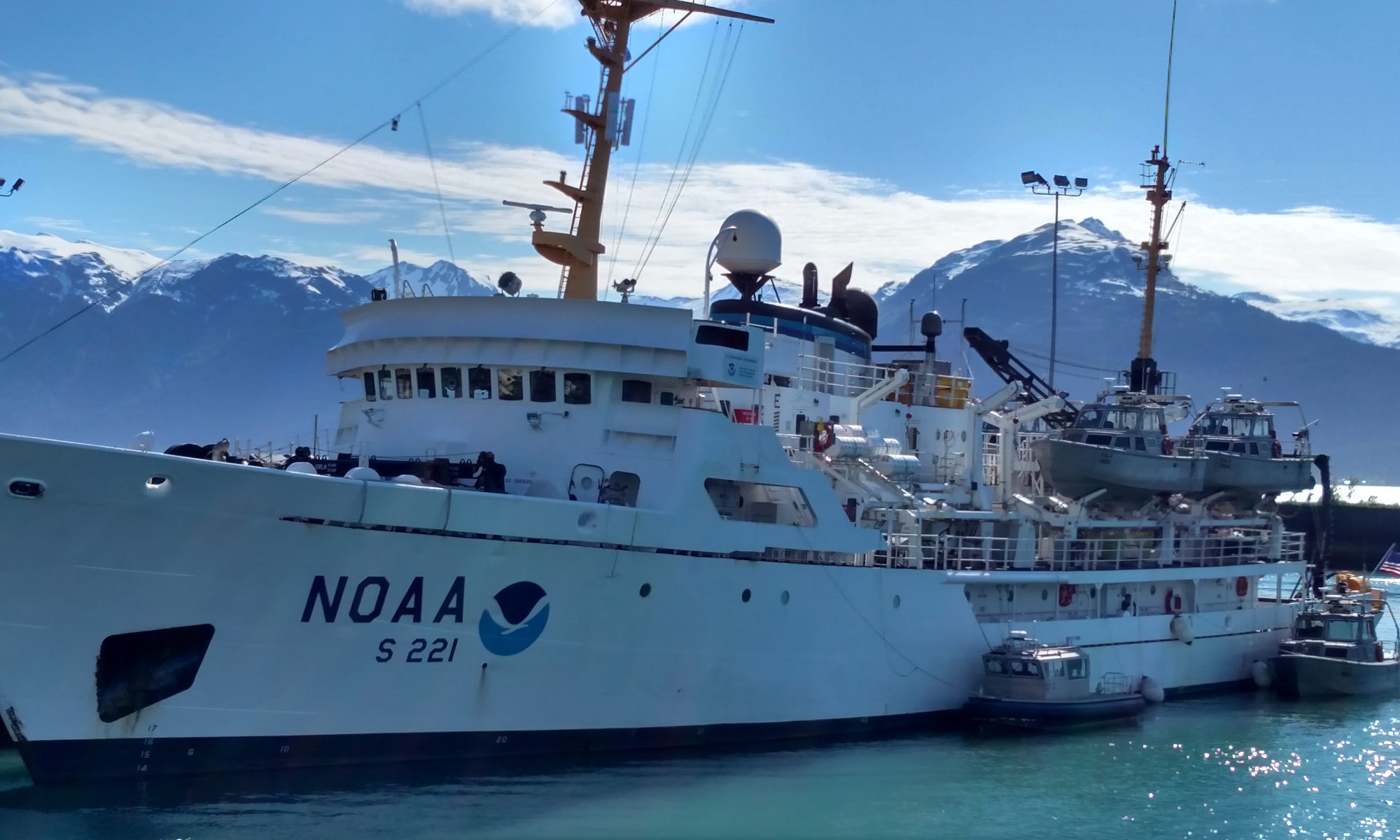
NOAA Ship Oscar Dyson anchored in Dutch Harbor

What happened?

Ever have that moment when a demonstration fails, the cool lab you worked so hard on doesn’t work, there’s a schedule change thrown into your day, or maybe that special dinner you were planning didn’t taste right? It happens on the boat too! You have to be prepared and understand that it is going to happen. Equipment failure, human error; they all happen on board. I arrived in Dutch Harbor on June 26th and we were scheduled for departure on June 27th. There was a broken crank shaft in one of the large generators so our departure from Dutch Harbor was an educated guess at best. Without the generator, we would be in short supply of fresh water for a ship holding 39 people until July 16th. There wasn’t anything that we could do so we took advantage of being in Dutch Harbor for a couple of extra days until we departed on June 29th. Maybe the copper wire was cut before it reached the bottom on an XBT or there was a hole in the trawl net that needed to be mended. That part of life on board is no different than any other environment.

It’s an albatross, an orca, a tree?

Talk about patience…the mammal observers have lots of it. They are on watch constantly looking along the horizon for blowholes and other signs of mammalian life. When observations are slow, anything in the water can become exciting. Earlier this week while I was on the bridge, the mammal observers called down from their observation deck to the bridge because there was an object in the water that we were getting closer to. You could feel the excitement from everyone growing as this magnificent object grew closer. We got our cameras ready because this could be “the” picture of the trip and positioned ourselves to take the shot of our lives. As we approached this rather large piece of unidentified matter, we realized that it was a piece of driftwood with murres hanging out on it. At this point, the adrenaline rushed out of me and laughter took over. None of us could believe how excited we became and how let down we were to find out it wasn’t a mammal at all. Back to the observation deck!

Looking toward the horizon through the “Big Eye”

You can’t force the fish!

My primary job on this boat is to help with the fish surveying. Using the acoustics helps decide when the trawl nets are deployed for fishing. In order for fishing to occur there needs to be at least 2-3 miles of pollock showing up on the transducer screens. Weather also plays a role on what we see on the transducers. We have been very pleased with the weather so far; although it has been foggy, that usually means calmer seas. Later in the week, the weather is supposed to get dicey. When this happens there is a chance that it will be too rough to fish even if we do see the pollock. Look for my journal on weather after the weekend! Since the start of our journey we have fished three times during my shift and deployed the Methot a few times. When we are not fishing we find other things to keep us busy. Some people are analyzing data, checking equipment, or if you are a teacher at sea, you may be documenting all of your experiences. I have never taken so many pictures! The down time gives me a chance to talk to others on the boat to see what other operations are happening. As my friends and family know, I have a hard time sitting still. This is the perfect place for me to be because I have no choice but to slow my pace! It’s REALLY hard, but I think I am doing a pretty good job!

What shift are you working?

Aside from the flexibility needed to work on the ship, you also need to be flexible and patient just to live on board. Remember, you can’t just leave the ship when you need a break! The boat runs 24/7 so there are lots of shifts on the boat. To give you an idea you may be on watch for 4 hours in the dead of the night, or you may be observing mammals from sunrise to sunset. I was lucky to land the 12 hour shift from 0400-1600, but the other fisheries crew comes on for the remaining 12 hours of the day. I say this because with a full crew of 39 people on board and with everyone working different shifts, there is etiquette on board a vessel. If you and your roommate do not have the same shift, it is the unwritten rule not to enter the room while they are sleeping. That means you need to take everything with you for that shift. Not everyone eats during the allotted times that the mess hall is open so food is often set aside so everyone can have their meals regardless of what shift they work. Taking showers need to be short because everyone would like to take a hot shower after 12 hours of working. Appropriate volume is important because there may be people sleeping in the stateroom next to you and you don’t want to wake them while they are trying to sleep when off shift (remember inside voices!). It makes you very aware of your surroundings. I absolutely lucked out because Rebecca (the other TAS) and I have the same shift and same schedule. We have it much easier than most people on the boat that have opposite shifts.

TAS shift- 0400-1600
TAS stateroom (where we sleep)

Can anybody hear me?

Need time away from the hustle and bustle of life back on land? Need to take a break from your TV, cell phone, blackberry, I phone, and the internet…the Bering Sea is the place for you! Even though there is a phone on board that allows you to call off the ship, it is extremely expensive so it is definitely not for everyday use. Phones don’t work here so you can save the batteries in your cell phone or I phone for home. Most of them actually don’t even work on Dutch Harbor either. As far as the internet is concerned, that’s a little trickier. As you may have noticed, my journals took a while to be posted. It is very difficult to send information via internet from the Oscar Dyson. If we are traveling on a northern transect, we may not get internet the entire time. The transect itself could take 2 days to complete running at 12 knots! If we are turning or heading south, we may get lucky for a while. Therefore it takes time to get all the information and pictures sent just to be posted. It is very hard to be patient because I want everyone to know what’s happening and all the cool things we have been doing. Internet is sporadic at best, but keep the emails coming! It is nice to hear from everyone back home!

Transects for Legs I-III for 2010

Animals seen
murres
fulmars
brittle stars- Ophiura sp.
basket star
sand dollars
hermit crabs
2 types of cockles- Clinocardium sp. and Serripes sp.
Tanner crab
Aleutian moonsnail
Arctic moonsnail
jellies- Chrysaora melanaster
krill- euphausiids
amphipods
Dall’s porpoises
flounder- Kamchatka flounder
spiny lumpsucker

Basket star

Word of the day
Dupe: to deceive, fool

New vocabulary
Head: bathroom
Mess hall: cafeteria, where you eat your meals

Bruce Taterka, July 7, 2010

NOAA Teacher at Sea: Bruce Taterka
NOAA Ship: Oregon II

Mission: SEAMAP Summer Groundfish Survey
Geographical Area of Cruise: Gulf of Mexico
Date: Wednesday, July 7, 2010

Trawling in Deeper Waters

Weather Data from the Bridge

Time: 2015 (8:15pm)
Position: Latitude = 27.20.39 N; Longitude = 096.35.21 W
Present Weather: Could cover 90%
Visibility: 4-6 nautical miles
Wind Speed: 15 knots
Wave Height: 2-4 feet
Sea Water Temp: 28.6 C
Air Temperature: Dry bulb = 28.5 C; Wet bulb = 26.7 C
Barometric Pressure: 1008.27 mb

Science and Technology Log

Since setting out on Friday we’ve headed south along the Gulf coast of Texas almost to the Mexican border, and now we’re heading back north but farther offshore, in deeper water. As a result our trawls are pulling up a deep-water assemblage of species different from those we saw in shallower waters a few days ago. There is still no sign of oil in this part of the Gulf, but we’re still taking samples of fish and shrimp for analysis to make sure there’s no contamination here from the BP-Deepwater Horizon oil spill.

Ten-foot seas are predicted for tonight so we’re heading north along the Texas coast, away from the storm, and we’ve put away the fishing gear until it gets calmer.

Last log we talked about FSCS (Fisheries Scientific Computer System). So what is it, how is it used, and what is so great about it?

FSCS, pronounced ‘fiscus’, is an automated system for recording the massive amount of biological and oceanographic data generated 24 hours a day by NOAA scientists during fisheries surveys. During a trawl survey, fish and invertebrates from each haul are sorted, counted and weighed by species. Scientists record data from individual fish, such as sex, weight, length and even stomach contents, resulting in tens of thousands of new data points every day. Before NOAA rolled out FSCS in 2001 aboard the ship Albatross IV, scientists recorded all data by hand, an incredibly tedious process. With FSCS, however, data are recorded digitally which is much faster, allows integration of biological and oceanographic data. It also enables NOAA to obtain critical real-time information to assess and manage the health of the marine ecosystem and individual fish stocks.

FSCS uses a Limnoterra FMB4 (fish measuring board) which has a magnetic pen to upload the length of an organism within a millimeter, and software that annotates all of the data on length, mass, sex, etc. The software has an index of species scientific names and can print labels for specimen samples that are to be shipped to other scientists and to the National Seafood Inspection Laboratory in Pascagoula, MS.

We use FSCS 24 hours a day, and I can’t imagine how NOAA scientists did this work without it.


Personal Log

I’m enjoying my 12-hour shifts processing fish, shrimp and invertebrates on theOregon II. Our noon-to-midnight watch is working well together and starting to bond.

My watch-mates in the Oregon II wet lab.

I’m seeing lots of very cool marine life that we’re hauling up from the bottom of the Gulf with our trawling net. Here are just a few of the things I’ve seen in the past two days:

Singlespot frogfish – Antennarius radiosus.

Note the lure on its snout.

Examining the stomach contents of a catfish.
Red snapper – Lutjanus campechanus.
Camouflage in the Sargassum. Can you spot the crabs?
Sunset
Sunset


Kimberly Lewis, July 7, 2010

NOAA Teacher at Sea Kimberly Lewis
NOAA Ship: Oregon II
July 1 -July  16 2010

Mission: SEAMAP Summer Groundfish Survey
Geographical Area of Cruise: Gulf of Mexico
Date: Sunday, July 7, 2010

July 7, Science is dirty 🙂

Here I am getting ready to enter data about one of the MANY shrimp that I have seen over the past few days.
Personal Log:
This was the first night (day) that I actually slept straight thru. 8 hours of sleep has never felt so good!The scientist aboard the Oregon II have a very important job to do and they work very hard. Sometimes when people think of scientist they think of a nice clean lab with everyone wearing white coats. Not the case here! It not uncommon to be shoveling fish into buckets.

Here is a photo of a bucket of organisms that are being measured.

Our ship’s tracker has not been updated since we left Galveston so if you see we are still there, we are not. Hopefully it will be updated soon.

Well, I do have to go because my shift started 35 minutes ago and there are things to do. I will try to remember to take photos tonight. We collected a sea horse yesterday, but I didn’t get to take my photo before it was discarded, I was out doing a titration.

Bye for now.

Rebecca Kimport, JULY 6, 2010

NOAA Teacher at Sea Rebecca Kimport
NOAA Ship Oscar Dyson
June 30, 2010 – July 19, 2010

Mission: Summer Pollock survey
Geograpical Area:Bering Sea, Alaska
Date: July 6,  2010

In and Around the Bering Sea

Where are we?
Time: 1500
Latitude: 57.59N
Longitude: 171.10W
Cloud Cover: 100%
Wind: 11 knots
Air Temperature: 7.20 C/ 44.960 F
Water Temperature: 5.50 C/ 41.90 F
Barometric Pressure: 1010 mb

Now that I have provided you with information about the importance of pollock and how the Oscar Dyson works to survey the stock in the Eastern Bering Sea, I wanted to answer a few related questions.
What about other species?
In the Bering Sea, pollock are so abundant that our mid-water trawls capture mostly pollock. However, there are a lot of other species in the Bering Sea that scientists are interested in. In addition to the Oscar Dyson, NOAA charters fishing boats (such as the Alaska Knight and the Aldebaron) to trawl on the ocean floor. This allows scientists to see more species in the Bering Sea. These ships trawl all day; sometimes up to 6 trawls a day. The groundfishing boats cover the eastern Bering Sea shelf, extending up to the region around St. Lawrence Island (a wider area than the Oscar Dyson will cover). While the Oscar Dyson focuses on euphausiids and pollock, the groundfishing boats examine everything else found on the bottom.
Who owns the water?
International laws provide countries with an Exclusive Economic Zone (EEZ) within 200 miles of their shoreline. The area we are studying in the Bering Sea can be fished solely by fishing boats operated in the United States. On the other side of the Sea, Russians fish in their own 200-mile zone. However, in the middle there is a “donut hole” which is considered “international waters.” This Donut Hole supported a large pollock fishery in the late 1980’s. Here is a diagram showing the Donut Hole (interesting note, it is also called the Donut Hole in Russia (or at least called Bubleek — the Russian word for a donut hole.))

How do American scientists collaborate with scientists from other countries?
The United States works with other Pacific countries to conduct research on the Pacific Ocean and the Bering Sea. For example, the Oscar Dyson, in addition to hosting two Teachers at Sea, is hosting two Russian scientists from the Pacific Research Institute of Fisheries and Oceanography (TINRO) in Vladivostok, Russia – Mikhail Stepanenko and Elena Gritsay. I had the opportunity to sit down with Mikhail the other night and asked him about his experience and how he ended up on the Oscar Dyson.
Mikhail Stepanenko

Born and raised in Primorye, Mikhail spent a great deal of time at the Ussuri River. He studied biology at The Far East State University in Vladivostok and began researching at sea soon after his graduation in 1968. After the first USA-USSR agreement regarding marine research, Mikhail visited the United States and worked out of La Jolla, CA starting in 1969. He has spent about 5-6 months at sea per year for the last 40 years, including the last 18 summers on the NOAA summer pollock survey (specifically on the Oscar Dyson and its predecessor the Miller Freeman). This wealth of experience has made Mikhail an expert and he is a well-respected member of the Pacific marine science community.

Throughout the years, there have been numerous conferences between stakeholder countries and Mikhail has played an active role in recommending action for working together to maintain the populations of pollock and other fish. Mikhail has served on the Intergovernmental Consultative Committee (ICC) – a six-nation committee that meets biannually to discuss fishing polices in the “donut hole.” In addition, Mikhail worked as a Russian delegate during meetings which led to the creation of PICES (North Pacific Marine Science Organization), an “intergovernmental scientific organization, was established in 1992 to promote and coordinate marine research in the northern North Pacific and adjacent seas.” (Visit their website for more information.) Mikhail was elected Chairman of the Fisheries Science Committee (FIS), a branch of PICES, in 2008 and is currently preparing for their next meeting in October.
Each organization is trying to find the best policies to help understand the organisms through reproduction, population dynamics, stock assessments and fishery management. Mikhail’s wealth of knowledge, collaborative scientific research and commitment to the sustainable fishing benefits all members of the international community and we are lucky to have such a science superstar in our midst.

Rebecca Kimport, JULY 5, 2010

NOAA Teacher at Sea Rebecca Kimport
NOAA Ship Oscar Dyson
June 30, 2010 – July 19, 2010

Mission: Summer Pollock survey
Geograpical Area:Bering Sea, Alaska
Date: July 5,  2010

Celebrating America Day

Independence Day is one of my favorite holidays although more for the activities accompanied with it than for the meaning. I usually celebrate the fourth by enjoying Food, Fireworks and time with Friends. On the Oscar Dyson some of those “F”s were substituted and as the festivities were around Fish, Food, and Flares. After what felt like forever, we finally trawled for fish today. It had clearly been too long for most members of the ship as we were surrounded by the paparazzi as we pulled the fish out onto the table and sorted through the mass of jellyfish. It was great to be actually sorting fish and I became an expert otolith-remover.After our shift finished, we were able to enjoy the holiday properly. Our steward department prepared an excellent Fourth of July BBQ complete with Flag Cake. I was a little surprised that the Oscar Dysonhas a grill on board but it made dinner feel more like an occasion. Weheld the BBQ on the boat deck and the lack of tables provided an opportunity to talk with new and different parties. I was glad that I was able to enjoy the BBQ (as some members of the staff were sleeping or on watch, they weren’t able to relax).
Ray with Cake
Ray with Cake
Also, it couldn’t be Fourth of July without a few colored smoke displays. Luckily, the Oscar Dyson had some expired flares and I was able to convince Operations Officer Sarah Duncan to show me how they worked. Different chemical reactions produce rapid heat and brightly colored smoke. If our boat were in distress, these flares would be used to alert other boats of our location. I was excited to see these flares up close (but not too close – Safety First!) and got some great footage to use when we discuss flame tests and emission spectra.Although our Fourth of July was more low key than in years past — the flare demonstration could not compare to the fireworks display on the Mall and I was in bed by 9 pm – it was a great way to celebrate the holiday.Animals Seen
brown jellies or northern sea nettle- Chrysaora melanaster
pollock- many 1-3 years
smooth lumpsucker
rock sole
fulmarsWord of the day
Propiate: appease