NOAA Teacher At Sea: Elizabeth Warren Aboard NOAA Ship Pisces
Mission: Reef Fish Surveys Geographical Area of Cruise: Gulf of Mexico Date: July, 9 2010
Getting into it!
Sunset
Weather Data from the Bridge: Temperature: Water: 30.5℃ Air: 29.6 ℃ Wind: 2 knots Swell: .3 meters Location: 27. 51° N, 91.48° W Weather: Sunny, Humidity 70%, light clouds
Science/Technology Log
Today we began the SEAMAP Reef Fish Survey.
A little background information: The surveying began in 1992 through now with a few years with no data in the middle where there wasn’t enough funding or boat time. The survey is conducted to show what types of species of fish live around the different types of topographical locations on the seafloor, specifically around the continental shelf (think about the sea floor as if it is a continent, there are mountain ranges, plains, banks, ledges, etc). The survey runs from Brownsville, TX to the Dry Tortuga’s, FL. Currently, I am on the second leg of the survey. The first leg was two and half weeks.
The areas that are surveyed are called blocks they are 10 by 10 nautical miles, these sites are selected randomly from previous bathymetric data, this is the mapping that we did yesterday. At each site an aluminum four stereo camera array and a Seabird 911 CTD is dropped, more information about this tomorrow. The camera pod, which NOAA actually makes in their lab, is composed of specially designed housing units that include two black and white still cameras that take pictures like you would blink your eyes, as well as a color mpeg camera that runs continuously.
Camera Array
Droping the Camera Array
Attached to the aluminum casing is a Temperature Depth Recorder (TDR), more about this later. At each site the pod is dropped over the side of the ship using a hydraulic side A-frame. The camera is left in the water for 45 minutes, once the camera is at the seafloor it begins to record. Throughout the day the cameras save their data to the 180 GB hard drive, all of the day’s drops are then downloaded onto an 2 TB external hard drive and burned to a blue ray disc during the night. This disc is briefly observed by the chief scientist and then later taken back to the onshore lab to identify and count all species of fish.
Chevron Trap
Also throughout the day, 4 sites are randomly chosen to drop either a bandit reel or a chevron fish trap. This random selection is done very scientifically. One scientist asks another to pull up a randomly created number table on the computer, the person at the computer wiggles the mouse and closes his eyes and then calls out one of the numbers that corresponds with the site numbers. A chevron fish trap which is a large wire cage is baited with squid, (Yes!) then left at the site to soak for an hour.
Dropping the Chevron Trap
A bandit reel is a vertical line with ten evenly spaced hooks baited with mackerel. The line is lowered to the sea floor and soaked in for ten minutes. When these fish are brought on board they are weighed, measured, cataloged, and some are frozen to preserve for further research. On this survey groupers, trigger fish, and snapper are frozen and taken back for baseline testing by National Seafood Inspection Laboratory.
Today we were sampling at Sweet Bank. All together we dropped the camera at 7 different sites throughout this block. Science out at sea is 10 minutes of a lot of excitement followed by an hour of waiting. For the first site I observed from inside the lab, watching as they dropped the camera and brought it back up. The first site was early in the day so when they pulled the camera’s up they found that they couldn’t see anything because the light had not yet penetrated to the ocean floor. At the second site I had my first job, I was to go out after they pulled the camera, turn it off, then turn the other knob to configure then turn the camera back on. I was so nervous that I turned the second knob to configure then back to record! Oops!
Cowboys Hardhat
We also dropped the first chevron trap of the day. While the trap was soaking we moved to the third site and dropped the camera. We went back to the fish trap to pick it up. When you go out and there are hydraulic A-frames working you have to wear a hard hat and aPDF (Personal Floatation Device).
Personal Flotation Device
Bob Carter, the electronics technician lent me his helmet. When Captain Jerry was on deck he took issue with the design on the helmet. Anne-Marie and I got all ready and watched as they pulled up an empty fish trap, something had eaten the bait but they escaped capture. We were all dressed up with no fish to go! When we went back in the labs Kevin explained to us that one of the hardest things to learn as a scientist is that zero is a number. Even though it was disappointing that the trap came up empty it did mean something to the data.
We moved on to pick up the camera at the fourth site. At the fourth site we also did a bandit reel. I have no problem getting a little dirty so I helped bait the bandit reel. You have to put the hook through the bait then turn it and pull the hook through again. I got pretty fishy! We waited with baited breath to see if what we could pull up. The crew pulled up the bandit reel and there were two enormous fish caught on the reel. One was red snapper (Lutjanus campechanus) and the other was a red porgy (Pagruspagrus).
Me with a red snapper and a red porgy
We took the fish into the wet lab and measured them. There are three different ways to measure the fish. First you measure the total length which is to the end of the tail. Then you measure the forked length which is to the fork of the tail. Then you measure the standard length which is to the end of the hyplural plate at the end of the vertebrae. Then, the fish is weighed on a scale. All of this is done using the metric system. ( Ahh hah! There is a reason I teach the metric system of measurement! ) Lastly, Joey Salisbury, the watch leader for the scientist crew, checked to see what the sex of the two fish were. With the porgy he could cut him open and check the sex because he wasn’t being kept for Seafood Inspection, another way to tell the sex on some species that are dimorphic ordichromatic, is to look at the color of their lips . For the red snapper, since it had to be kept for inspection we were not able to tell what the sex was.
Dissecting fish in the wet lab
After some cajoling Joey also agreed to pull the otoliths (ear bones) of the porgy for me so I could bring them back to my class. You can tell the age of the fish from their ear bones, you stain them and count the rings just like you would for a tree.
Otolith
While all of this was happening on deck, in the lab the bathymetric mapping was noticing an odd mass, that was eating up everything and leaving behind blank space. Kevin decided to run an oil soaking rag down on the bandit reel to test if the mass was oil. Thankfully, when he pulled the rag back up it was oil free! We decided that the mass on the screen must have been a school of fish.
View of bathymetric mapping data
Dry lab
At each site we were able to do a little bit more of the science. I was able to weigh and measure the second set of fish from the last bandit reel. The fish were so heavy, and they move. I did squeal a little but I’m proud to say I did not scream! The spines on the snapper’s dorsal fin could poke holes in you, so I had to be careful when I picked her up. We could tell she was a female because when we pulled her up the change in pressure blew her air bladder and pushed her ovaries came out. (I know , I know, but remember this is in the realm of science so you all should be saying “how interesting” no ewws out there. )
Holding a Red Snapper
Measuring a red snapper
Personal Log:
Where to start! Yesterday really felt like three days in one. All of the science is so interesting. I keep asking a billion questions and everyone is a hundred percent willing to answer every one. Their patience is greatly appreciated since for every answer they give me I come up with 50 more questions to clarify their answers. They were also extraordinary patient when I made a mistake. I was so embarrassed and worried that I had somehow messed up the video feed! They assured me that I hadn’t messed it up, but for the rest of the day Joey, the watch leader, gave me a hard time about knobs, hatches, and doors. The hatches and doors are incredibly heavy so I have to stop and really pull whenever I go into any hallway, and closing the hatches requires me to have nothing in my hands. At one point during the day I got confused as to which way to turn the hatch, and the crew kept telling me to pull the wrong way.
Heavy doors
Everyone jokes constantly and you have to go with the flow and be a quick. Attempting to come up with comebacks is keeping me on my toes. As most of you know I’m willing to get dirty so any job that dealt with touching things I’m all over it. Baiting the bandit reel and the chevron fish trap were gooey and squishy and I was covered in fish guts and squid parts by the end of the day. I couldn’t have been more thrilled to be smelly and gross! It was pretty funny that they put me in the Cowboys helmet, you know cause you know I watch so much football. Captain Jerry threatened to throw it overboard because he is a Saints fan. The first two days we were conserving water while we were in possible oil impacted waters; today we were given the go ahead to take what the captain called “rock star showers”. Boy, was I in need of one today, at the end of the day I even had a streak of grease up my leg!
The crew is hilarious! They are constantly working everywhere you go. I go down one passageway and they are mopping, another they are vacuuming, down the ladder well and I run into someone sweeping. Think about how important it is to keep the ship clean. As we were standing waiting for the bandit reel to come up one of the crew started to fish with a line and a hook right off the side of the boat.
Fishing off the side of the boat
We caught a mackerel
When they threw the fish heads in from the cut up mackerel they caught a bunch of blue runners (Caranx crysos). I even managed to catch one! I was okay trying to kiss the fish..until he tried to kiss back!
Kissing a fish
At the end of the day, Anne Marie and I went out to the back deck to try and work on our logs but the crew was out their fishing. One of the crew, Ryan, caught a 55 lb greater amberjack (Seriola dumerili) and then turned around and caught another one that was just a little bit smaller! The big one was almost as long as I am tall! The Junior Officer Kurt caught a yellow-edge grouper, which Kevin pulled the otoliths out of for me and Anne-Marie. Every other minute another of the crew would catch another fish. I didn’t get much of my log done I was so distracted by the different fish they kept catching.
55 lb greater amberjack
Yellow-edge grouper
I’m leaving so much out, but I’ll include more in my next log.
NOAA Teacher at Sea Kimberly Lewis NOAA Ship: Oregon II July 1 -July 16 2010
Mission: SEAMAP Summer Groundfish Survey Geographical Area of Cruise: Gulf of Mexico Date: Sunday, July 9, 2010
Scientist first, Teacher at Sea second
Here I am with two other volunteers working the FSCS station. I am measuring shrimp. You can see the other two identifying one of the many species we caught.
Weather Data from the Bridge Time: 1630 (4:30 pm) Position: Latitude = 28.20.93 N; Longitude = 095.58.98 W Present Weather: Could cover 100% Visibility: 4-6 nautical miles Wind Speed: 18 knots Wave Height: 6-8 feet Sea Water Temp: 28.9 C Air Temperature: Dry bulb = 27.2 C; Wet bulb = 25.3 C Barometric Pressure: 1011.56 mb
Science and Technology Log
As you can tell from our previous blogs, we spend a lot of our time on the Oregon II counting, measuring and weighing our catch and loading the data into FSCS. These data are critical to NOAA and the states in managing fish stocks and the Gulf ecosystem. In addition to knowing population size, weights, and lengths of individuals it’s also important to know the sex of the organisms. Information on the male:female ratio helps NOAA and the states assess the ability of the population to reproduce, and to establish sustainable catch levels.
But how do you determine the sex of marine organisms? For most fish and invertebrates you can only tell the sex by internal anatomy, which of course requires cutting the animal open. This is time consuming and not always practical when we have a large catch to process and other tasks take priority, such as preparing samples to be analyzed for contamination from the oil spill which is our top priority right now.
For some organisms, however, sex can be determined externally. One of the things we’ve learned in the past week is how to determine the sex of shrimp, flatfish, crabs, sharks, skates and rays. Here’s how:
Shrimp: the males have a pair of claspers (called petasma) on their first set of legs. The petasma are absent in females. The males use the petasma during mating to grasp the female and transfer the sperm sac.
Male – arrows show the petasmaFemale – petasma are absent
Crabs: On most crab species females have wide plates curving around the rear of the abdomen, while males have a long narrow plate or plates. On females, the eggs develop under the curved plate.
MaleFemale
Female with eggs
Flatfish: When you hold a flatfish up to the light you can see through it, which enables you to do an internal examination without cutting it open. On female flatfish, the gonad extends in a dark red, curved wedge which is absent in the male.
MaleFemale
Personal log:Thursday was slow for the scientists on board as the waves continued to rock the boat too much to drop our nets. The rest of the crew followed their normal duty schedule. It is hard going from night shift to day shift for meetings and then back to nights. I feel like I have spent too many hours in my bunk trying to get back on schedule. Trying to do Yoga on a ship doesn’t work so well, I will be glad to get back to that when I get home.Chef Walter did another fine job with dinner. Prime Rib and scalloped potatoes. I am usually not a prime rib person, but this was excellent. I also found where the ice cream drumsticks are stored…mmmmm.
One of the scientists I work with on night shift said, “we think of you guys as scientific volunteers first, then teachers at sea second”. I will say that is the job I feel like I have been doing. The first few days I barely got my camera out b/c we were so busy. We collected a sea horse one night and I missed taking the photo before the catch was dumped. I was in the next room doing a titration and forgot to tell the rest of the shift to save it for me. 🙁 Since then I have kept my camera close by in a drawer in the wetlab. I am learning and seeing many new things…….. if anyone is a zoology teacher this is the trip for you!
One of my favorite things about science research is that scientists accept that there will be errors. Sometimes things will not go as you plan. While you might have great luck one day, everything might go wrong the next day. Life at sea is similar in that way – while you have some sense of what you will be up against, you have to be flexible for the challenges that may arise. As I reach the halfway point of my trip, I wanted to highlight a few of those challenges as most of my entries have been all about the successes.
XBT Fail As I mentioned earlier, XBTs are a pretty routine part of the day on the Oscar Dyson. On a given day, we might conduct an XBT every one to two hours. In addition to being regular they are also pretty easy. Basically, you drop a torpedo shaped sensor into the water and record data until it reaches the bottom. Sounds straight-forward right? As long as you know where the bottom is. On my second day, I was tasked with throwing the XBT and cut off the sensor before it reached the bottom. (I didn’t realize that the computer would tell me when it reached the bottom. As some of my students would say “Swine.”) While I was teased for my error, this apparently is a common mistake and the fix is easy enough – throw another one.
Talk of Whales I keep missing the orca sightings. Either I am too far from a window or without binoculars when I am told there is a sighting or I am only told hours later. The challenge of course is that cetacean sightings are brief by nature. These air-breathing mammals only need to come up to the surface once every 10 to 20 minutes. If you are not in the right place at the right time, you will miss it. It doesn’t help that there have been several occasions where it has been too foggy to see any whales that weren’t next to the ship. I could mope about my lack of visible evidence, but I instead recognize that I cannot plan a whale sighting and need to be patient if I hope to see them.
A Tree of Hope One afternoon, while stalking the mammal observers on the bridge, we got word on the radio that they had spotted something about a half mile ahead and the mammal observers requested that we slow down to check it out. Everyone on the bridge hustled into action – scanning the horizon with the binoculars and trying to identify what object could be floating on the surface and covered with Murres. As you probably guessed from the title of this section, it was only a tree. We all had a good laugh at ourselves and remembering that there is humor in failure was an experience worth having.
Searching for Fish Just like whales, you can’t force the pollock to stop by at the appointed time. Although I might be ready to fish, there may not be fish in our area of the Bering Sea. On the days when we spent 12 hours waiting for fish, I have to remind myself that the point of the survey is that there are places with no fish. If there were fish everywhere, we wouldn’t need to conduct a survey. As a teacher, I am used to constantly being pulled in several directions at once and it has been a challenge to build up my reserve of patience and to capitalize on my quiet time to get as much as I can out of this experience.
Time Delay Even though there is a great deal of down time, I am finding it hard to make sure I get enough sleep each night. Waking up for the 0400 shift is challenging because I find it hard to convince myself to go to bed at a reasonable hour. My body does not seem to understand that even if the sun is breaking through the clouds for the first time at 8 pm, it is time to go to sleep or that when the alarm rings at 3:30 and it is pitch black outside, it is time to wake up. Even though this is challenging for me, I recognize that the 0400-1600 shift is a preferred shift because I am able to keep my eating schedule on track. Scientists and crew who work an overnight shift eat meals out of order and have to prepare food to heat up later. Time Delay Part 2 You also may have noticed that sometimes the dates and times listed on the posts do not correspond to when they were actually posted. Although the Eastern Bering Sea is behind most of the US time zone wise, we are not THAT far behind. It usually takes me a little time to write up what I have done and get it ready for posting. Also, we don’t always have Internet (as we are in the middle of the ocean). Even as I am posting this, things are changing. Who knows what will be next…
And now for your questions…What else would you like to know about our research, my activities or life on board? Post a question in the comments and I will try to answer in an upcoming post.
NOAA Teacher at Sea Anne Marie Wotkyns Onboard NOAA Ship Pisces July 7-13, 2010
NOAA Teacher at Sea: Anne Marie Wotkyns NOAA Ship Pisces Mission: Reef Fish Survey Geographic Area: Gulf of Mexico Date: Thursday, July 8, 2010
Weather Data from the Bridge
Wind: 7-9 mph Other Weather Features:
Sunny, scattered light clouds
Waves 1’; Swells 3-4’ Location: 28.37.2 N
089.33 W
Science and Technology Log
Hello, my name is Anne Marie Wotkyns and I am participating in the NOAA Teacher at Sea program. I teach 4th grade at J.B. Monlux Magnet School in North Hollywood, California. I joined the NOAA ship Pisces on the evening of July 6 to begin a 6 day cruise in the Gulf of Mexico. I will be posting logs to share the information I learn and the experience of working aboard a scientific research vessel. We will be working on the SEAMAP Reef Fish Survey of Offshore Banks, a project which provides information about the relative abundance of fish species associated with geographic features such as banks and ledges on the continental shelf of the Gulf of Mexico. I’ll be explaining this project more in my next log entry.
Me in front of the Pisces
After meeting the other Teacher at Sea, Liz Warren and bird expert Scott Mills, at the Gulfport Mississippi Airport, we were driven to the NOAA docks in Pascagoula, Mississippi. It was quite late when we boarded the Pisces, so we found the cabin Liz and I would share, explored the ship a bit, and turned in for the night.
Wednesday, July 7 found us eager to get started on our TAS adventure. We started the day at the NOAA office and lab building, adjacent to the ship docks. There we met Kevin Rademacher, Chief Scientist for the SEAMAP (Southeast Area Monitoring and Assessment Program) offshore reef fish survey which we will be participating in on our cruise. He showed us around the NOAA facilities, which house the Southeast Marine Fisheries Offices, Seafood Inspection, and Documentation Approval and Supply Services. The fisheries division deals with resources surveys, harvesting, and engineering related to commercial fishing. The seafood inspection division deals with issues related to seafood safety and chemical and microbiological analysis of seafood. These labs can help determine if the “red snapper” your favorite restaurant serves is really red snapper or a different type of fish! This division will also be testing some of the fish we collect on our cruise for baseline data on fish from areas outside the oil spill for possible later comparison to fish collected within the spill zone.
Me in Front of the Southwest Fisheries Building
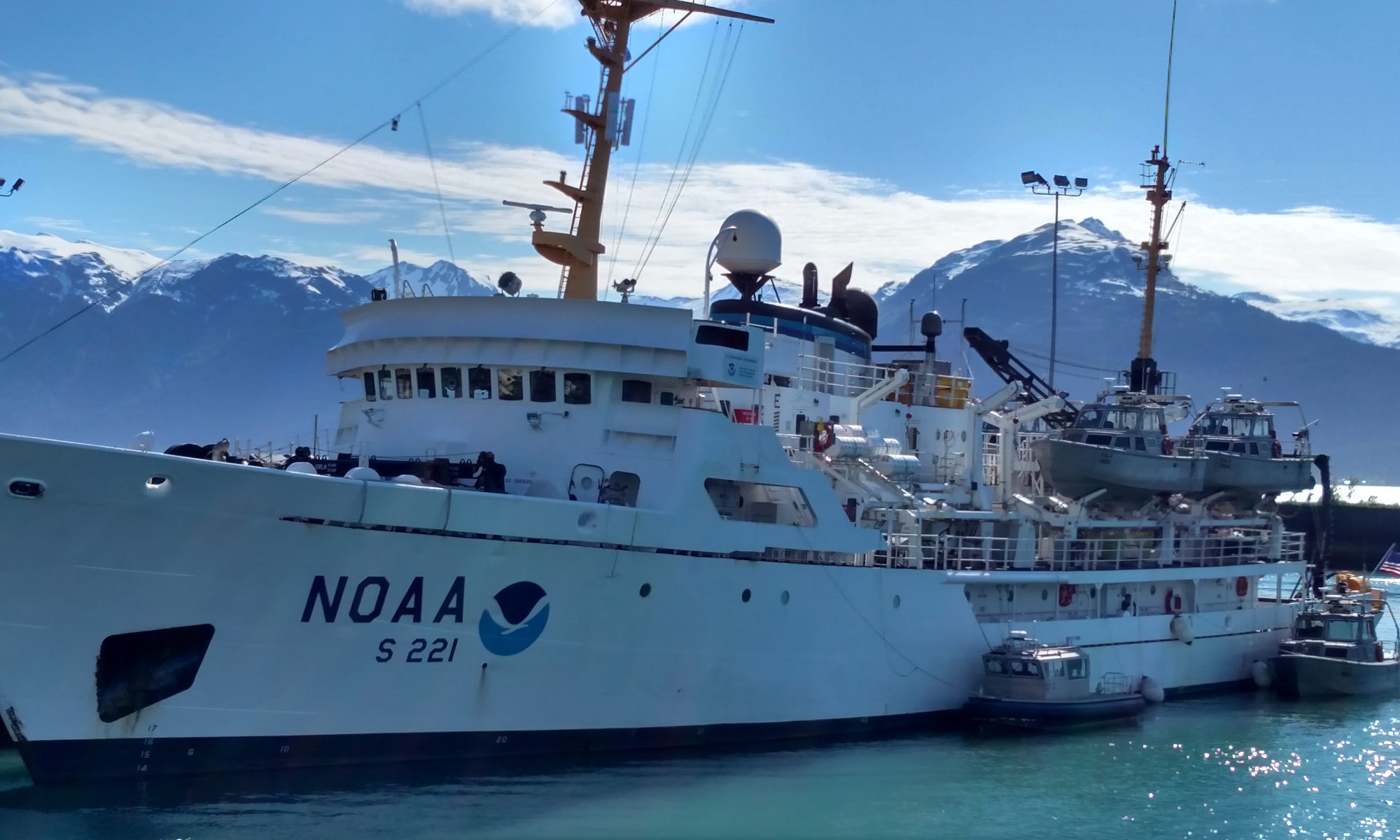
Now a little more about the Pisces, my home away from home for the next 6 days. The Pisces was commissioned in 2009 and is one of NOAA’s newest ships. She is 63.8 meters (209 feet) long, 15 meters (49.2 feet) wide, and has a draft of 6 meters (19.4 feet.) Her cruising speed is 14.5 knots and she can stay out to sea for 40 days if necessary. On this cruise there are 22 crew comprised of a commanding officer, deck officers, engineering officers, deck hands, engineers, stewards, and survey and electronic technicians. There are 6 on our science team and 2 bird observers conducting surveys of pelagic seabirds possibly affected by the oil spill.
NOAA Ship Pisces
After we set sail on Tuesday afternoon, we spent much of the late afternoon up on the flying bridge, the highest deck on the ship. We observed a wide variety of boats and ships in the channels around Pascagoula Bay. Scott and Ron, the bird observers, helped us identify the bird species we saw, including Brown Pelicans, Laughing Gulls, and Sandwich Terns. We also saw several Atlantic Bottlenose Dolphin swimming near the ship. Soon the seas grew rougher and after dinner and a short welcome meeting, we retired to our cabins for the night.
Wednesday morning brought calmer seas, and the start of “science “ on board the Pisces. Before we reached the areas selected for the SEAMAP fish surveys, Chief Scientist Kevin Rademacher wanted to conduct bathymetric mapping of an area called Sackett Bank, off the coast of Lousiana. This involves sailing the ship in a series of overlapping transects 1.6 miles long, .05 miles apart, similar to “mowing your lawn” at home. The ME70 multibeam acoustic system covers a swath of 120 degrees using 27 beams which can detect and map features on the sea floor down to .5 meters in size. This will allow NOAA to produce highly accurate nautical charts of the region. The charts will eventually be available to commercial and sport fishermen, sailors, shipping companies, and anyone else who is interested.
Mapping Sackett Bank
When a ship is conducting activities like this bathymetric mapping or other “Restricted Mobility and Manuevers” work, they hoist a nylon “Ball-Diamond-Ball” to notify other ships in the area that it is restricted in its movement so the other ships can change their course. This message is also sent electronically by VHF radio signal. I happened to be on the bridge while they prepared to start the first transect, so Commanding Officer (CO) Jeremy Adams let me hoist the ball-diamond-ball.
Ball-diamond-ball
Hoisting the ball-diamond-ball
Transect Lines
In this photo, the green boat indicates the position of the Pisces as we conduct the mapping transects.
Tomorrow the plans are to begin the SEAMAP reef fish surveys, “one hour after sunrise” – looks like we’ll be working from about 7 am to 7 pm with the fish! Bring it on!!
Personal Log
After submitting Teacher at Sea applications for 3 years (the first 2 years I was not selected) I am thrilled to be here! The opportunity to participate in a cruise like this on such an amazing ship is truly a once in a lifetime experience!
Here are a few more pictures of life aboard the Pisces.
Stateroom
Desk
Galley
Our cabin is a little small, but very clean and functional. Liz volunteered to take the top bunk, so I have the bottom. I love the little curtains that can enclose the bunk – makes a dark little “cave” for me! And the reading lamp lets me read late at night! We have a flatscreen TV, but so far we have only been able to watch the USA network – one channel only. But we don’t spend much time in the cabin anyway. The bathroom is very similar to a cruise ship bathroom, and the shower has great water pressure – however the ship is under water conservation so showers need to be quick. Notice we’re eating on paper plates with plastic utensils. No dishwashing either! After the ship moves farther from the oil spill they will able to use their salt water to fresh water conversion process and we’ll be able to use water more freely.
Pascy chooses his dinner in the “mess” – sorry – no fish!
In Pascagoula I purchased a small stuffed penguin and named him “Pascy” (for Pasacagoula.) Pascy has been exploring the Pisces so here are some shots of him around the ship!
Pascy helps check off each transect in the acoustics lab.A little coffee is always good in the morning.The cookies here are great!
Another big event today was the fire drill and abandon ship drill. We were assigned “muster stations”, places we would go to in event of an emergency. Part of the drill was to practice donning our “survival suits” – one piece insulated buoyant suits that would keep us afloat and warm if we ever had to abandon ship. The hardest part of the drill was getting the awkward suit on and off – they seem to be one-size-fits all and I seem to be smaller than most sailors!
Even Pascy got to participate in the drill! I don’t think he need to worry about staying afloat or warm in the water! Good thing, because that lifejacket looks a little big!
NOAA Teacher At Sea: Elizabeth Warren Aboard NOAA Ship Pisces
Mission: Reef Fish Surveys Geographical Area of Cruise: Gulf of Mexico Date: July, 8 2010
I’m Here!!!
After a day of travel I’m on the ship! I flew from Seattle in through Atlanta. I went for a walk in the Atalanta airport during my layover, when I finally sat down there were two people laughing about the oil spill. I couldn’t believe it! Of course after they had moved on I thought of all different things I could have said to them.
From Atalanta I flew into the Gulfport Airport in Biloxi. I met the other teacher at sea; Anne-Marie from Los Angeles. Anne Marie teaches 3rd and 4th grade science and language arts at a magnet school. She had spent the previous couple of weeks traveling around the south. We were met by a young marine biologist working on his Master’s degree named Travis.
Travis
At the Shed
Travis is working with NOAA and getting paid to get his Masters degree. Gotta love the sciences! He is doing research on a specific type of shark. He will be going out on a smaller vessel doing long line fishing technique. As the bottom of the scientist barrel he was sent to collect the teachers and a birder named Scott. Travis took us to a fun little outdoor BBQ place called The Shed. According to Travis, The Shed has been on the travel channel. I can understand why.. it was good and very quirky. I love listening to the people here talk with their southern accents.It’s been “darlin”, “hon”, and “ya-all” all over the place.
Signs indicating the impact of Katrina
Yesterday before the ship left Anne Marie and I went on an adventure in Pascagoula. The town was tiny! We were able to walk the entire down town in under an hour. I was trying to find a rubber ducky to bring with me on the ship so we went in every little store we could find. In one of the antique shops we met a retired teacher and her two little dogs. She told us all about the town and how Katrina impacted their lives. She told us how the water in her store had been up to her waist and how businesses can’t survive int he downtown. Everywhere we went there were signs of the impact Katrina had on this area and also the spill. In the downtown one of the shops had been taken over by BP as a claims office. People could go in and file claims due. As if the community hasn’t gone through enough.