NOAA Teacher at Sea
Mary Cook
Onboard R/V Norseman II
March 18-30, 2016
Mission: Deepwater Ecosystems of Glacier Bay National Park Geographical Area of Cruise: Glacier Bay, Alaska Date: Tuesday, March 22, 2016 Time: 7:40pm
Data from the Bridge
Temperature: 37.6°F Pressure: 1013 millibars Speed: 0.0 knots Location: N 58°51.902’: W 137°04.737’
Science Log
Happy Birthday to Cheryl!
This is Cheryl!
Unbeknownst to Cheryl, Chief Scientist Rhian Waller, even though she was very busy preparing for the cruise, brought balloons, streamers, candles, and noisemakers to celebrate Cheryl’s birthday today.
Surprise Birthday Decor
The ship’s chef is secretly making her a cake. The celebration is slated for tonight at dinner. Shhhhh……
This morning, Chief Scientist Rhian Waller announced that we are steaming toward the end of the west arm of Glacier Bay to Johns Hopkins Glacier. This is a place where cruise ships take tourists in the Fall. But the Park Service has it closed during the Spring and Summertime because it’s a harbor seal nursery. The nightshift workers are trying to catch a few winks of sleep before we get there. No one wants to miss it. We are hoping for clear skies. Johns Hopkins Glacier is one of the few glaciers that is advancing instead of receding. As it advances, it is joining the Gilliman Glacier.
Map showing John Hopkins Glacier. Credit: National Park Service
It’s 10:30 am and we’ve arrived sooner than I expected. Johns Hopkins Glacier is really something to see! So massive. Once again everyone is out on deck taking pictures and oohing and aahing.
The glacier has shades of blue and white with streaks of brown and gray. It has a covering of white snow that looks like cake icing. The glassy water is a blue-green color with a multitude of icebergs floating in it. Bob Stone uses a term we all like—“bergy bits”—meaning small pieces of floating ice. He even brought some “bergy bits” onto the ship for us to add to our water or soft drinks. So refreshing!
This slideshow requires JavaScript.
While on deck taking pictures we hoped to see the glacier calve and fall into the sea. It sounds like thunder. We waited and we waited and finally a couple of small ones happened. Also, a couple of snow avalanches slid off the mountains into the water leaving dirty brown streaks along the slopes.
Occasional avalanches leave dirty streaks in the glacier’s white snow covering
Our scuba divers went down for another exploratory look and came up with a first! They found Primnoa pacifica in the West Arm! This is the first Primnoa pacifica ever found here. They described it as spindly and small in comparison to the others found in the East Arm.
The scuba divers continue their search for Red Tree Coral.
The significance of this Red Tree Coral being in the shallow water is that it has been considered a deep-water coral. There are two broad categories of coral: warm-water coral and cold-water coral. Generally, warm-water coral live in shallow, tropical waters. Cold-water coral live in deep water. The emergence of cold-water corals like Primnoa pacifica in the shallow waters of Glacier Bay has caused scientists to re-evaluate their understanding and descriptions of these organisms.
The third and last scuba dive for today was described as “mud, mud, and more mud”. A bit of a disappointment but they did bring up an interesting little critter.
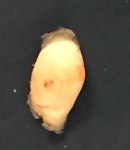
Maybe a sea peach?
This sea peach is a tan color here in the wet lab, but according to Bob, in its natural habitat it has a bright cherry red color.
Birthday party for Cheryl!
Well, it’s finally suppertime! That means “Birthday Party Time!” The ship’s chef, Harry served up a delicious meal of salmon, barbeque chicken, steamed kale, baked summer squash, scalloped potatoes and a big salad. For dessert, he prepared a layered chocolate cake with freshly made whipped cream and strawberries. Everyone sang “Happy Birthday” to Cheryl.
After she blew out the candles we went out on the deck and ate cake with new friends in the view of majestic mountains and glaciers.
A birthday to remember, I’ll say.
Now it’s back to work and the ROV crew is getting ready to deploy Kraken 2 for another night of exploration!
Scientists watch the ROV monitor
Anemone viewed on screen
Personal Log
Today has been a day of anticipation and inspiring wonder. I’ve tried to stay out on deck watching the glacier. Hoping for calving and avalanches. It’s really neat to me that no one else is here. We haven’t seen anyone else except four Park Service employees who boated out to meet us today. I found out that there are over 1,000 glaciers in Glacier Bay National Park! Some of them aren’t even named. I enjoyed watching a couple of bald eagles sitting on icebergs. And the absolute coolest thing has been the discovery of Primnoa pacifica in the West Arm of Glacier! I could feel the excitement in the air!
It’s so thrilling to be a part of this scientific exploration and to learn from these world-class researchers!
NOAA Teacher at Sea Virginia Warren
Mission: Acoustic and Trawl Survey of Walleye Pollock
Geographical Area of Cruise: Shelikof Strait
on NOAA ship Oscar Dyson
Date: 3/20/16 – 3/22/16
Data from the Bridge (3/21/16):
Sky: Snow
Visibility: 8 to 10 nautical miles (at one point it was more like 2 to 3 nautical miles)
Wind Speed: 23 knots
Sea Wave Height: 4 – 6 feet
Sea Water Temperature: 5° C (41°)
Air Temperature: 0° C (32° F)
Barometric (Air) Pressure: 994.3 Millibars
Science and Technology Log:
The purpose of this research survey is to collect data on walleye pollock (Gadus chalcogrammus) that scientists will use when the survey is complete to help determine the population of the pollock. This data also helps scientists decide where and when to open the pollock fishery to fishermen. Data collection such as this survey are critical to the survival and health of the pollock fishery.
As I mentioned in a previous blog post, we use an AWT (Aleutian Wing Trawl) to complete the pollock survey. The AWT has two doors that glide through the water and hold the net open. The cod end of the net is where all of the fish end up when the trawl is complete.
Scale model of the Aleutian Wing Trawl (AWT) net courtesy of NOAA Scientist Kresimir Williams (Source: TAS Melissa George)
Codend of the Net – This is where all the fish are when the trawl is brought up.
Trawl Door
After the trawl is brought back onto the boat, the cod end of net is dumped onto a hydraulic table. The hydraulic table is then lifted up so that it angles the fish down a shoot into the Wet Lab on a conveyor belt.
The door to the shoot is opened allowing fish from the table outside to be dumped down the shoot and on to the conveyor belt inside.
Kim and Virginia sorting fish on the conveyor belt.
Once the pollock come through the shoot and onto the conveyor belt, the first thing that we do is pick out every type of animal that is not a pollock. So far we have found lots of eulachons (Thaleichthys pacificus), jellyfish (Cnidaria), isopods, and squid. We have even found the occasional chinook salmon (Oncorhynchus tshawytscha), rock fish (Sebastes spp.), and a lumpsucker (Cyclopteridea). The pollock continue to roll down the conveyor belt into a plastic bin until the bin is full. Then the bin of pollock are weighed.
Contents of the Trawl
This slideshow requires JavaScript.
The data from every fish we sample goes into a computer system called CLAMS. CLAMS stands for Catch Logger for Acoustic Midwater Survey. While we are taking samples of the fish our gloves get covered in fish scales and become slimy, so to be able to enter the data into the CLAMS system without causing damage there is a touch screen on all of the computers in the Wet Lab.
CLAMS computer system with a touch screen.
Once the pollock are weighed, a sample of the fish are taken to be sexed. To sex the fish, we use a scalpel to slice into the side of the fish. The picture of the chart below shows what we are looking for to determine if a pollock is male or female. Once we know what sex the fish is, we put it into a bin that says “Sheilas” for the female fish and “Blokes” for the male fish.
This chart of the Maturity Scale for Walleye Pollock is hanging in the Wet Lab.
Up-close of the Maturity Scale for female pollock.
Up-close of the Maturity Scale for male pollock.
Kim showing Virginia what to look for when sexing the fish.
Once the fish are in their correct male/female bin, they are then measured for their length using an Ichthystick.
The Ichthystick has a magnet under the board. When the fish is placed on top of the board, a hand held magnet is placed at the fork of the fish tale. Where the hand held magnet is attracted to the magnet under the board tells the computer the length of the fish and the data is automatically stored in the CLAMS program.
IchtystickGetting the length of the starry flounder using the Ichthystick.
The next station is where the stomach, ovaries, and otoliths are removed from the fish and preserved for scientists to research when the survey is over. The ovaries of a female fish are weighed as well. Depending on the size of the ovaries, they may be collected for further research. Once all of the data has been collected from the fish, a label is printed with the data on it. This label is placed in the bag with the stomach or ovaries sample. Kim completes a special project for this survey. She is a stomach content analysist, so she collects stomachs from a sample of fish that will be taken back to her lab to analyze the stomach content of what she collected. She puts the stomach and the label with the fish’s information, into a bag that is placed in a solution of formalin that preserves the samples.
This slideshow requires JavaScript.
The next step is to get the otoliths out of the fish. A knife is used to cut across the head of the pollock. Otoliths are used to learn the age of the fish. The otoliths are placed in a glass vile that has a barcode number that can be scanned and put with all of the fish’s information in CLAMS. This number is used to keep track of the fish data for when the otoliths get analyzed later on.
Getting the Otoliths
This slideshow requires JavaScript.
We also collect length, weight, sex, and stomach samples from other fish that come up in the trawl as well.
Interview with a NOAA Corps Officer: Ensign Caroline Wilkinson Caroline is a Junior NOAA Corps Officer on board the NOAA ship Oscar Dyson. She is always very helpful with any information asked of her and always has a smile on her face when she does so. Thank you Caroline for making me feel so welcomed on board the Dyson!
Ensign Caroline Wilkinson
How did you come to be in NOAA Corps? (or what made you decide to join NOAA Corps and not another military branch?
I graduated from college in May of 2015. I was looking for a job at a career fair at my school and discovered the NOAA Corps. I had heard of NOAA, but didn’t know a lot about NOAA Corps. I wanted to travel and NOAA Corps allowed me that opportunity. I was unsure what type of work I wanted to do, so I decided to join and explore career options or make a career out of NOAA Corps.
What is your educational/working background?
I went to the University of Michigan where I received an undergraduate degree in ecology and evolutionary biology and a minor in physical oceanography.
How long have you been in NOAA Corps?
July of 2015 I started basic training. Training was at the Coast Guard academy in a strict military environment. We had navigation and ship handling classes seven hours a day.
How long have you been on the Dyson?
I have been here since December of 2015.
How long do you usually stay onboard the ship before going home?
We stay at sea for two years and then in a land assignment for 3 years before heading back to sea.
Have you worked on any other NOAA ships? If so, which one and how long did you work on it?
Nope, no other ships. I had no underway experience except a five-day dive trip in Australia.
Where have you traveled to with your job?
We were in Newport, Oregon and then we went to Seattle, Washington for a couple of weeks. Then we went to Kodiak and then to Dutch Harbor.
What is your job description on the Dyson?
I’m a Junior Officer, the Medical Officer, and the Environmental Compliance Officer. As a junior officer I am responsible for standing bridge watch while underway. As a Junior Officer I am responsible for standing 8 hours of watch, driving the ship, every day. As medical officer, we have over 150 drugs onboard that I am responsible for inventorying, administering, and ordering. I also perform weekly health and sanitary inspections and Weekly environmental walkthroughs where I’m looking for any safety hazards, unsecured items, leaks or spills that could go into the water.
What is the best part of your job?
Getting to drive the ship.
What is the most difficult part of your job?
Being so far away from my family and friends.
Do you have any career highlights or something that stands out in your mind that is exceptionally interesting?
During training we got to sail in the US Coast Guard Cutter Eagle. It’s a tall ship (like a pirate ship). We were out for eight days. We went from Baltimore to Port Smith, Virginia and had the opportunity to do a swim call 200 miles out in the Atlantic.
What kind of sea creature do you most like to see while you are at sea?
We have seen some killer whales and humpback whale in the bay we are in this morning. We’ve also seen some albatross.
Do you have any advice for students who want to join NOAA Corps?
You need an undergraduate degree in math or science. There are 2 classes of ten students a year. Recruiters look for students with research experience, a willingness to learn, and a sense of adventure.
Ensign Caroline Wilkinson at the helm.
Personal Log:
I have really been enjoying my time aboard the Oscar Dyson and getting to know the people who are on the ship with me. I love spending time on the Bridge because you can look out and see all around the ship. I also like being on the bridge because I get to witness, and sometimes be a part of, the interactions and camaraderie between the NOAA Corps Officers that drive/control the ship and the other ship workers.
Panoramic view of the NOAA Ship Oscar Dyson‘s Bridge. Look at all of those windows!
Arnold and Kimrie are responsible for making breakfast, lunch, and dinner for all 34 people on the Oscar Dyson. They also clean the galley and all of the dishes that go along with feeding all of those people. They probably have the most important job on the ship, because in my previous experiences, hungry people tend to be grouchy people.
Arnold and Kimrie are the stewards of the Oscar Dyson.
We’ve had a variety of yummy dishes made for us while we’ve been at sea. Breakfast starts at 7 a.m. and could include a combination of scrambled eggs, breakfast casserole, French toast, waffles, chocolate pancakes, bacon, sausage, or my personal favorite, eggs benedict.
Breakfast is served. YUM!!!
Lunch is served at 11 a.m. and seems like a dinner with all of the variety of choices. Lunch usually has some type of soup, fish, and another meat choice available, along with vegetables, bread, and desert. Dinner is served at 5 p.m. and usually soup, fish, and another meat choice available, along with vegetables, bread and desert. I loved getting to try all of the different types of fish that they fix for us and I also really liked getting to try Alaskan King Crab for the first time!!
If you are still hungry after all of that, then there is always a 24-hour salad bar, a variety of cereal, snacks, and ice cream available in the galley. The left-overs from previous meals are also saved and put in the refrigerator for anyone to consume when they feel the need. If we are working and unable to get to the galley before a meal is over, Arnold or Kimrie will save a plate for us to eat when we get finished.
I also tried Ube ice cream, which is purple and made from yams. At first I was very skeptical of any kind of sweet treat being made out of yams, but I was pleasantly surprised that it tasted really good!
Ube ice cream made from yams! Very YUMMY!!!
There is even a place to do laundry on this ship, which I was very happy about because fishy clothes can get pretty stinky!
Laundry Room
I can’t end a blog without showing off some of the beautiful scenery that I have been privileged to see on this journey. The pictures below are of the Semidi Islands.
NOAA Teacher at Sea
Mary Cook
Onboard R/V Norseman II
March 18-30, 2016
Mission: Deepwater Ecosystems of Glacier Bay National Park Geographical Area of Cruise: Glacier Bay, Alaska Date: Monday, March 21, 2016 Time: 7:54pm
Data from the Bridge
Temperature: 45.7°F Pressure: 1007 millibars Speed: 1.9 knots Location: N 58°51.280’: W136°05.795’
Science Log
My lab work: a tray of Primnoa pacifica samples labeled and preserved for reproductive studies
Today, the coral processing continued for genetic, isotope, and reproductive studies, which has been very intensive for the last two days and nights. During the daylight hours, the divers collected samples of the coral in shallow water (30 meters) and during the nighttime hours ROV Kraken 2 collected the coral samples from the deep (210 meters).
Chief Scientist Rhian Waller tells me that the coral processing work will slow down for a few days because we are leaving the known sampling sites and heading into the unknown. Unknown territory for Primnoa pacifica, that is.
According to Rhian, the most important task today has been the completion of this collection series for Primnoa pacifica (Red Tree Coral). With both shallow and deep samples, geneticist Cheryl Morrison will be able to map the spreading patterns of the Red Tree Coral in Glacier Bay!
There were a total of four exploratory dives today. The divers are having a blast! They wore GoPro cameras on their helmets and used “underwater scooters” to go faster and farther during their dive time constraints. A scooter is a handheld engine with a propeller that pulls a diver behind it. Bob Stone describes it to be like sledding underwater!
In addition to the Red Tree Coral, they’ve brought up some really interesting specimens, which include sea stars, nudibranchs, shrimps-one very pregnant shrimp loaded with eggs, a polychaete worm, a bioluminescent ctenophore, sea pens, and sponges.
A sea star and a nudibranch with its tentatcles out
Mary holds a nudibranch
A shrimp and a polychaete worm
Yellow sponge
On one of the dive outings, they took Qanuk and sat him on an iceberg! It was a really beautiful blue iceberg. Blue icebergs have ice crystals that are more tightly packed therefore they reflect more blue light wavelengths than other colors of wavelengths.
This evening, scientists are once again gathered around the monitor to see what the ROV Kraken 2 will discover. So far, we’ve seen crabs, goose barnacles feeding on plankton floating in the water, anemones, poacher sturgeon, sea cucumbers and moon snails. Sounds like a yummy salad, doesn’t it?
Bob looks at the live ROV feed
In this view of ROV live video feed, we see a Tanner crab (cousin of the snow crab)
Personal Log
Today everyone settled into their jobs and it was a smooth operation. The scientists and crew are still brimming with excitement about the possibilities for this voyage. I was glad to get the intensive coral processing completed. Though it’s very important work, it’s tedious and repetitive. One very nice bi-product of working with the coral is the scent. Red Tree Coral smell like cucumbers! Also, we get to see all the other curious types of samples brought aboard such as glowing ctenophores and jumping shrimp! I’m getting to see so many things I’ve never seen before and it’s wonderful to have experts help explain everything. They are genuinely interested in sharing knowledge with me in hopes that I will take it back to the classroom for my students in Scammon Bay. Scammon Bay kids have become important to these world-class scientists! Another cool thing about these scientists, even though they are experts in their fields, they are also eager students for learning something new. Enthusiastic lifelong learners— what an inspiration!
Mary holds a sea star a nudibranch
Where’s Qanuk? Sitting on the ship’s radar above the bridge!
NOAA Teacher at Sea
Mary Cook
Onboard R/V Norseman II
March 18-30, 2016
Mission: Deepwater Ecosystems of Glacier Bay National Park Geographical Area of Cruise: Glacier Bay, Alaska Date: Sunday, March 20, 2016 Time: 6:00pm
Data from the Bridge
Temperature: 38°F Pressure: 1005 millibars Speed: 0.3 knots Location: N 59°02.491’ , W136°11.193’ Weather: Sunny with a few clouds
Science Log
Happy First Day of Spring!
Last night the remotely operated vehicle (ROV) Kraken2 dove and collected many samples of Primnoa pacifica (Red Tree Coral). The science crew excitedly gathered around the monitor to see what Kraken2 was “seeing”-lots of rocks, a few fish, a few shrimp, a few crabs, a couple of sponges, an octopus and lots of beautiful Red Tree Coral attached to the rock faces.
Meet Mr. Shrimp and Mr. Worm
Nudibranch speciman
Sarah, Cheryl, and Bob discuss the ROV’s findings
The ROV Kraken2 is run by a crew of engineers from the University of Connecticut and makes nighttime dives to deeper depths between 130 and 170 meters.
Today we busily processed the coral for genetics, isotopes, and reproduction studies to be conducted later by a series of scientists in various labs scattered across several states.
Cheryl, Kathy, and Mary stand with a large sample of red tree coral hung out to dry
Mary and Primnoa pacifica
For the genetic samples, polyps (one individual) of coral are smashed onto special paper folders that contain a preservative. For the isotope samples, polyps are put into tiny vials then frozen. For the reproductive samples, an intact piece of coral is placed in a 15-milliliter tube and then submerged into formalin preservative. Later the formalin will be poured out and ethanol will be poured into the tubes. Preparing the reproductive samples is my job!
Samples for genetic studies
Coral in a vial to be frozen for isotope studies
Mary working in the wet lab with Cheryl and Kasey
Where’s Qanuk? Working in the wet lab processing red tree coral samples!
Three divers went down four different times collecting samples, all near White Thunder Ridge and Riggs Glacier in the eastern arm of Glacier Bay.
Dr. Rhian Waller prepares for a dive
Three divers in the water
Riggs Glacier is showing numerous crevasses, which are usually snow-covered at this time of year. A crevasse is a big crack on the topside of the glacier.
As the evening approached, the ship steamed to the northernmost end of the East Arm where Muir Glacier was waiting to greet us. Muir Glacier is named for Naturalist John Muir who explored in Glacier Bay during the late 1800’s.
Muir Glacier was once a tidewater glacier at the water’s edge but in the last ten years has melted and receded back up into the valley.
Muir Glacier
Moon rising over Muir Glacier
The sky was clear and the snow-capped mountains and waterfalls were beautifully reflected in the still waters of the Bay. A gibbous moon rose over the mountain peaks just as the Sun was setting.
Personal Log
Today I learned how to process the samples for genetics, isotopes, and reproduction. My responsibility was to put a small branch of coral into a tube of Formalin. Labeling the tubes with place, depth, and species is important so the scientists as they begin working in the laboratory weeks later will know the source of the coral sample.
R/V Norseman II as seen from the RHIB (rigid hull inflatable boat) leaving for a dive outing
As we worked, Chief Scientist Rhian Waller came into the wet lab asking if anyone wanted to ride in the skiff, my heart started beating faster! I didn’t want to be pushy so I kept quiet. Then she said, “Mary would you like to go out on the skiff?” “Yes! I loved to go!” was my reply. I donned the Mustang suit, hardhat, and rubber boots. I grabbed Qanuk and went outside to load into the little RHIB, which had been lowered from the deck on to the water beside the ship’s hull. When everyone was ready, we motored closer to White Thunder Ridge. The diver’s entered the water and explored the region at about 70 feet deep. Meanwhile we waited for them and kept a watch on their bubbles rising to the surface. We used binoculars and viewed five fluffy mountain goats moving along the Ridge! It was cool to see the mountain goats but they were creating a “falling rocks” hazard for those of us down below. Our boat driver decided to move the RHIB away from the Ridge in order to avoid the rocks tumbling down into the water.
Later in the day, when the Norseman II got closer to Muir Glacier, almost everyone was on deck getting that perfect photo of the mountains reflected in the mirror-like waters of Glacier Bay. It was a remarkable scene!
This slideshow requires JavaScript.
So at the end a good day, I am feeling very thankful to be a witness to the scientific work in an effort to better understand this pristine wilderness.
NOAA Teacher at Sea
Mary Cook
Onboard R/V Norseman II
March 18-30, 2016
Mission: Deepwater Ecosystems of Glacier Bay National Park Geographical Area of Cruise: Glacier Bay, Alaska Date: Saturday, March 19, 2016 Time: 8:28pm
Weather Data from the Bridge
Temperature: 38°F
Pressure: 1013 millibars
Speed: 0.2 knots
Location: N59° 01.607’, W136° 10.159’
Weather Conditions: Intermittent light rain
Science Blog
Before the Norseman II left port, the Boatswain conducted all the required ship safety drills with us: fire drill, man overboard, and abandon ship. This is where we learned to don the emergency flotation suit, gathered at the Muster Station for roll call, and went over procedures in case of an emergency. These drills are taken very seriously.
What is a muster station?
Safety first! Hard hat and life vest must be worn when on deck.
Ms. Cook in “Gumby” suit
Where’s Qanuk? Hanging out on the Jacob’s Ladder (emergency rope ladder)
Ranger Greg is a good sport
We left the port of Auke Bay just north of Juneau at around 10 pm Friday night and steamed into Glacier Bay to arrive at Bartlett Cove this morning at 9 am. We disembarked to attend a required safety orientation for Glacier Bay National Park. Ranger Greg informed us that he had recently seen 4 humpback whales headed into the Bay! Also, that orca live in the Bay year round. Many of the channels are ice-free now because it is warmer than usual for this time of year.
After the brief stop at Bartlett Cove, we steamed into the East Arm of Glacier Bay toward White Thunder Ridge. Many of us were on deck with binoculars looking for wildlife and enjoying the scenic snow-capped mountains. We saw birds, otters, moose and mountain goats!
Chief Scientist Dr. Waller conducts science meeting
While en route, Chief Scientist Dr. Rhian Waller conducted a science meeting reviewing the purpose and plans for the cruise, which is to explore, collect samples and data on the presence and emergence of Primnoa pacifica in Glacier Bay. Primnoa pacifica is commonly called Red Tree Coral. NOAA’s Dr. Bob Stone, who first pursued collecting data on the Red Tree Coral in Glacier Bay back in 2004, is working on this expedition. Other than Bob’s documentation, the Primnoa pacifica of Glacier Bay, Alaska is a mystery.
Two dives were conducted below the steep incline of White Thunder Ridge. The divers got into their dry suits, reviewed their plans on how to communicate and collect samples underwater, and then boarded the little boat called a RHIB (rigid-hull inflatable boat). They returned to Bob’s old spot and dove about 72 feet down for sample collection. The dive took about 30 minutes and when they returned with samples, we began processing each one.
Dr. Stone prepares to dive
The black line is the ship’s track. It looks like we went in circles because that’s what we did!The ship was waiting at a distance on the divers to return.
Primnoa pacifica sample red tree coral
Samples for genetic studies
The Primnoa samples will be assessed for three different things: genetics, isotopes, and reproduction. The genetic fingerprints will be useful in determining the generational spreading pattern of the Red Tree Coral in Glacier Bay. The isotopes will aid in understanding what they eat and their place in the food web. The reproduction assessments will identify sex and level of maturity. An interesting observation is that Primnoa pacifica is one of the first corals to seed newly exposed rock faces when glaciers recede. Bob estimates that the tallest of these coral are about 40 years old because that is when the glacier receded past this point. Using that fact, he also calculates their growth rate to be about 2 centimeters per year.
Tonight, the ROV Kraken 2 will be deployed in order to explore deep depths for the presence of the Red Tree Coral. ROV means remotely operated vehicle. More on that tomorrow!
Kraken 2 Remotely Operated Vehicle (ROV)
Personal Blog
I must say it is a pleasure to be aboard the Norseman II with such enthusiastic scientists and crew. The atmosphere on the ship is one of anticipation and this is how I imagine the early explorers of Glacier Bay must have felt. Rhian, our Chief Scientist, described this expedition as exploratory in nature. I’ve always dreamed of being an explorer and now I get to watch some real explorers in action! These guys and gals have done so many cool things like study life in Antarctica, map uncharted territory, design and build new equipment, and travel to the deep ocean in the Alvin submersible. I am so thankful that they are excited to be a part of the NOAA Teacher at Sea program and share with our students in Scammon Bay and beyond. I’ve enjoyed listening as they brainstorm ways to use our eagle mascot, Qanuk, to engage young people in real science and exploration.
So, as I call it a day, I’d like to congratulate our Scammon Bay Lady Eagles who become the Class 1A Alaska State Champions today! Go Eagles! I’m so proud of both our boys and girls teams and their coaches. They’ve worked hard, played smart and represented our community with dignity and respect.
Good night…..