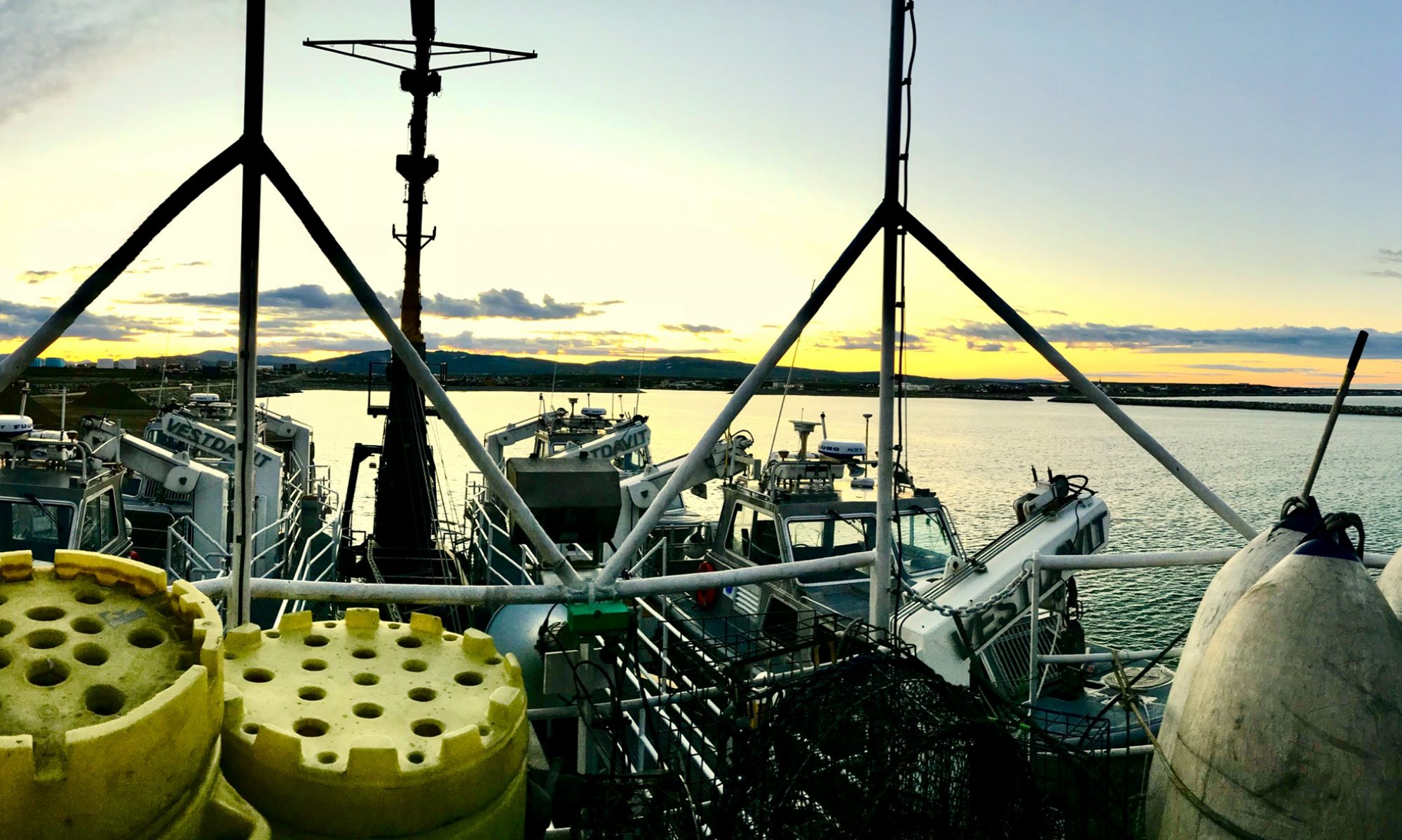
Jenna Cloninger: Finding My Sea Legs on the West Coast, June 12, 2025

NOAA Teacher at Sea

Jenna Cloninger

Aboard Bell M. Shimada

June 11 – June 26, 2025

Mission: Integrated West Coast Pelagics Survey (Leg 1)

Geographic Area of Cruise: Pacific Ocean, California Coast

Today’s Date: June 12, 2025

Track the Ship: Bell M. Shimada

Weather Data Snapshot: 5:18am, Pacific Daylight Time

Currently, the air temperature is 64°F (17°C) with a wind speed of 4 knots and a wave height of 4 feet. The sea looks quite calm from the side deck, and the air feels a little chilly to this Georgia girl. Yesterday, I wore shorts and a sweatshirt and felt fine. Today, I am wearing jeans with a long-sleeve thermal shirt, a T-shirt, and a fleece jacket and am still feeling quite cold. The sun is only just starting to rise, but there is a dense layer of cloud cover and fog in the area at this time of year, so I have yet to witness a true sunrise while at sea. Hopefully the sun will make its appearance at some point today.

Science and Technology Log

Before we can talk about what’s happening on the ship, I need to highlight the amazing visit to the La Jolla location of NOAA’s Southwest Fisheries Science Center on my second day in San Diego. My Teacher at Sea mentor and newfound friend, Melissa Liotta, took me to see where she works and to learn about some of the incredible things happening with her colleagues at the Center. There are too many names and faces for me to remember everyone, but I want to emphasize how genuinely excited everyone was to meet me and to work with me as a Teacher at Sea. It was quite a warm welcome, after flying across the country by myself and not really knowing what to expect when I landed on the west coast for the first time in my life.

Photo of me using large binoculars on a terrace at the NOAA Southwest Fisheries Science Center.

There was one part of this visit that deserves its own highlight, and that’s my tour of the experimental research aquarium at the Center. Melissa introduced me to Kathy Swiney, a research fisheries biologist who studies abalone populations off southern California. What are abalone, you might ask? Abalone are a family of marine gastropods, which are invertebrates related to snails, found within the phylum Mollusca. In other words, they are soft-bodied creatures with hard shells that crawl along the ocean floor. Here is a NOAA article if you would like to learn more about abalone.

Two abalone from the experimental research aquarium at the NOAA Southwest Fisheries Science Center.

I had seriously underestimated how interesting they could be! Kathy explained their anatomy, their reproductive strategies, and NOAA’s conservation efforts to me as I held one of the sweet little creatures in my hands. (My abalone even did a little “dance” where it wiggled its shell – so cute.) Most species of abalone are endangered or vulnerable due to overfishing for their meat and their beautiful shells, and Kathy’s team works to breed abalone that can be reintroduced to the ocean to help supplement wild populations.

Photo of me and Kathy Swiney in the experimental research aquarium. Here, I am holding a live abalone for the first time.

Now, back to the ship. Since this is the first leg of the Integrated West Coast Pelagics Survey, many operations and procedures have been modified to combine data collections from two previously separate surveys, one targeting Pacific hake, and the other targeting a collective group of coastal pelagic species (CPS), including sardine, anchovy, and mackerel. The plan is for the ship to trawl for Pacific hake in the midwater region during the day and to trawl for CPS at the surface region at night, which means the science team is working 24 hours a day to maximize the use of resources while at sea.

Photo of some artwork from the NOAA Southwest Fisheries Science Center that demonstrates some of the sardine, anchovy, and mackerel species we will we targeting on our survey.

While initial operations are underway, I am learning my way around the wet lab, which is where we will be sorting, measuring, and dissecting different fishes after each trawl. There is a lot to learn! As a teacher, I am reminded how overwhelming it can be for my students to learn new vocabulary, concepts, and processes in a short period of time. Each interaction with a member of the science team is like a miniature lesson all on its own, except there are no guided notes handouts or Google Slides for me to refer back to. Although it is overwhelming, it is also exciting to learn more about the oceanographic concepts that I teach to my students each year. This experience is helping me understand how critical it is for teachers to be able to explain concepts in age-appropriate ways and in small enough “chunks” for students to grasp in a single learning session.

Personal Log

Overall, there has been quite a bit of free time for me while we wait for normal operations to begin. While the scientists are busy preparing equipment and setting up their data collection programs, I have had time to get settled into my stateroom and chat with the other scientists about the best ways to avoid seasickness, which has been on my mind since we embarked. (Motion sickness medication, eating light meals and snacks, and looking at the horizon are all common recommendations.) The most interesting adjustment for me is the fact that everything is moving all the time at sea. Whether you’re in the wet lab, in the shower, or walking up and down steep staircases, you are constantly swaying in a corkscrew-like motion as the ship wobbles back and forth in the water. It can be quite disorienting during waking hours, but when it’s time to sleep, I have found the rocking motion to be comforting.

The view from the porthole in my stateroom.

Speaking of waking hours, I’m in the middle of adjusting my sleep schedule so that I am awake from midnight to noon each day. That means that I am going to sleep early in the afternoon and missing dinner so that I can be awake around 11:00pm to begin my shift. I am told that the first three days are the most difficult, but after that, your body starts to settle into the new routine.

Did You Know?

At the research aquarium, I learned about rockfish and something called barotrauma, which is a type of bodily trauma caused by a sudden change in pressure when rockfish are captured and removed from deep water. When rockfish are brought to the surface too quickly, the air inside their bodies expands, leaving them unable to control their buoyancy. When released back into the ocean, these fish may have trouble swimming downward, which leaves them vulnerable to predation at the surface. Other symptoms of barotrauma in rockfish include bulging eyes and a bloated belly sticking out of the mouth. But don’t worry – there is hope for the rockfish! Recompression devices and strategies can be used when a fish is returned to its normal depth, which allows its body to adjust back to its normal state. Here is a NOAA article if you would like to learn more about rockfish barotrauma and recompression.

A friendly rockfish from the experimental research aquarium.

That’s all for this blog post – focusing on this laptop screen while at sea is making me feel a little queasy! I hope to provide more concrete updates on our trawling operations over the next few days, as well as career insights and personal anecdotes about my experience at sea. Thanks for reading!

Jenna Cloninger: From Sleeping with the Fishes to Sailing with the Fishes, June 1, 2025

NOAA Teacher at Sea

Jenna Cloninger

Aboard NOAA Ship Bell M. Shimada

June 11 – June 26, 2025

Mission: Integrated West Coast Pelagics Survey (Leg 1)

Geographic Area of Cruise: Pacific Ocean, California Coast

Today’s Date: June 1, 2025

Embarkation Date: June 11, 2025

Personal Introduction

I have always had a deep love for all things conservation-related, ever since I discovered Steve Irwin, “The Crocodile Hunter,” on television as a small child growing up in Virginia Beach, Virginia. I love animals, I love nature, and I particularly love the ocean. After graduating from high school, I pursued a biology degree with the hope that my passion for the natural world would lead me to a job that I loved.

In 2018, I became a part-time overnight program specialist at the Georgia Aquarium in Atlanta, Georgia. What is an “overnight program specialist,” you may ask? It means that I led educational “sleepover” tours after-hours at the largest aquarium in the United States, and instead of sleeping under the stars, I slept under the sharks. (Literally – sleeping in the tunnel of the Ocean Voyager gallery was like a dream come true.)

a view through a glass tunnel at the aquarium. schools of fish swim on either side, and a large manta ray swims overhead. in the center of the tunnel is an inflatable bed and a comforter.
A view of my inflatable bed in the Ocean Voyager gallery of the Georgia Aquarium, with an appearance by Tallulah, my favorite manta ray, in the upper right-hand corner.

In 2019, after graduating with a bachelor’s degree in biology and with my teaching certification, I became a high school oceanography teacher in Gwinnett County, Georgia. It was an opportunity to take all my knowledge from the Georgia Aquarium and share it on a deeper level. Being a high school oceanography teacher in a landlocked region of Georgia is not always easy, partially because many of my students have never visited the ocean themselves. And as a young adult, I have not had many opportunities to visit the ocean outside of the occasional beach vacation.

To help me gain more experience in the field of marine science, I joined the Georgia Association of Marine Education (GAME) in 2023. Each year, GAME holds a conference for educators from around the state, and I have been lucky enough to attend the last two annual conferences as a representative of my district, Gwinnett County Public Schools. These conferences are held on the Georgia coast, most recently on Jekyll Island and St. Simons Island. These conferences give me opportunities to network with other marine educators, but I am always left wanting “more”.

in the center of the image, in focus, a hand holds a clear plastic cup filled with seashells. in the background, out of focus, we a beach filled with large driftwood pieces
Collection of Shells from Jekyll Island’s Driftwood Beach, November 2023
Jenna holds up a shark with two hands. She's wearing sunglasses and a Georgia Aquarium baseball cap. we can see that she's on the deck of a small boat, with water and marsh in the background past the railing.
Me with a Juvenile Bonnethead Shark, St. Simons Island, October 2024

That’s why this opportunity with NOAA is so phenomenal – I am finally going to experience the concepts that I teach firsthand and gain valuable experiences that I can share with my students upon returning to the classroom in August. For 16 days, I will have the privilege of becoming a student again as I learn from the experts and engage in authentic research at sea.

Preparing for My Mission

Sailing aboard NOAA Ship Bell M. Shimada from San Diego, California, I will be helping the science team with the Integrated West Coast Pelagics Survey. As a Teacher at Sea program participant, my job is to not only aid the research team with daily tasks, but also to communicate the science of our mission to the public in a manner very similar to how I communicate scientific information to my 12th grade students in the classroom.

I am currently typing this blog post from my home in Georgia, where my husband is watching me attempt to pack nearly three weeks’ worth of clothing into a single carry-on suitcase. Participating in a fisheries survey is dirty work, so instead of bringing along my usual summer clothes, I have purchased a variety of secondhand clothing from local thrift stores. Since the climate near the California coast is not nearly as hot and humid as Georgia’s, I have also packed a variety of layers so that I will be warm during my assigned working shift from midnight to noon each day. (There is a second shift from noon to midnight, and each person on the ship is assigned to one shift for the entirety of the cruise.) And in addition to clothing, I have packed plenty of anti-nausea medication, just in case I discover that I am prone to seasickness!

I am looking forward to switching roles from “sleeping with the fishes” and “teaching with the fishes” to “sailing with the fishes” in just a week’s time. Until then, you can track NOAA Ship Bell M. Shimada here and join in my excitement as I prepare to visit the west coast of the United States, and the Pacific Ocean, for the first time!

Kiersten Newtoff: So Long, and Thanks for All the (Whales). February 3, 2025

NOAA Teacher at Sea
Kiersten Newtoff
Aboard NOAA Ship Pisces
January 6 – January 27, 2025

Mission: Atlantic Marine Assessment Program for Protected Species (AMAPPS)
Geographic Area of Cruise: North Atlantic Coast
Date: February 3, 2025

Nearly every blog post was an interview with a group of folks working towards a common goal. Well, for this final post, I’ll interview myself (I’m sure there’s a literary term for this, but alas, English was never my best subject) about how it all went! Also, I hate actually talking about myself, so when someone in real life asks me about the trip, I can just tell them to come here. Plus they get pretty pictures. We all win.

What was your favorite interview? (asked by Rob!)

Honestly, I can’t even remember my answer when Rob asked, but it probably wasn’t that insightful. But now that I am home and reflecting, I think all my interviews with the quietest people on the ship were the best. Once we started talking one on one, so many people opened up about their journey and had great advice for people interested in the field. One memorable moment was with Tom, one of the engineers, who I literally had not even heard him say a word to anyone (partly because he wasn’t around at dinner due to his shift, partly because I don’t pay attention). I just went up to him during lunch and asked “Hi, I’m interviewing everyone on the ship and was wondering if we could chat later” to which he just started talking to me about his time in maritime school and how his class would go tutor at the local high school and tell them about the maritime trade! Like bro, I am not prepared for this yet. We did catch up later and I learned even more cool stuff about him. A lot of the crew kind of just minded to themselves or with their smaller crew, but I am glad I kind of forced myself into each ‘group’ and learned from everyone. It definitely strengthened our relationships throughout the trip. Many people had sailed together for years and learned about each other from my blog! It was cool to hear that I got to share their stories.

How big was the boat?

I’m getting this question a lot, but this was my first legit boat ride, so I have very little frame of reference. Smaller than a Carnival cruise ship. Bigger than a yacht on Below Deck. From the engine area, it takes 7 flights of stairs to get to the flying bridge. Here, take a look at the picture, me for scale.

Kiersten standing in front of the NOAA Ship Pisces, which is docked.
Kiersten standing in front of the NOAA Ship Pisces. Boat is big, Kiersten is small.

Did you know anyone?

Nope! I had lots of mutual connections with folks though! Yin and I shared a connection with someone I went to graduate school with, I had a student in 2013 who ended up working with Rob in California, and someone I met recently who works 5 minutes from my house was a close colleague and (current! friend!) of Allison’s. The ecology world is small!

What was the coolest thing you saw?

I’m not a very decisive person and am really bad at superlatives. So here’s the top 4:

  • Seeing North Atlantic Right Whales, some of the rarest and most endangered whale species in the world, off the coast of Virginia Beach
  • It snowing, and sticking, on the deck
  • Tons of water spouts forming and breaking up
  • Being outside in a T-shirt while in the Gulf Stream

How was the motion sickness?

If you haven’t read the Ode to Scopolamine, you’re missing out on my finest work. But after three weeks, it was mostly “fine.” I only puked once, but had a few instances where I decided being horizontal was in my best interest. At night though, rocking softly in bed – I understand why waterbeds were a thing. The nights where things are crashing around and you are getting airborne while sleeping, not as pleasant. But the meds really helped, thank you modern medicine.

What was living on the boat like?

I was in a bunk room, with the best roommate Tasha. She was mama bear and was always looking out for me when I needed to be horizontal. She was also so fun to work with on deck and she is just a cool person. (But also a literally cool person, we had low key thermostat wars fueled by love). We had three cooked meals a day and limitless snacks (when all the chips weren’t being stolen!) and dessert. I learned you are not allowed to work out in the galley, but that it is also the roomiest place on the ship, so I exercised only 1.5 times. I’d rank boat living 5/7.

What did you learn?

Literally everything. Everything about this experience was brand new to me, except that I knew maybe 20% of the seabirds. Although my master’s was in marine biology, my research was on ecotoxicology of Brown Pelicans, which aren’t around this area this time of year. They have the right idea and hang out in the Caribbean. All the science was new, the boat living was new, the struggling to stand was new. Every day I learned new science or new boat things.

Kiersten looks through Big Eye binoculars. The picture was used as a background photo for a desktop, duplicated across two screens.
One of the ways I really felt like part of the team was going into the acoustics lab and seeing this new snazzy screensaver. I pointed it out to everyone that day. (original pic taken by Kelsey).

What do you do now?

My commitment to NOAA Teacher at Sea isn’t over! While the blog portion is done, the main goal of the program is to disseminate to students the important research by NOAA. I am working on a lesson plan for students that I will be test running in Fall 2025 when I return from sabbatical. I used to do a population sampling lab on grid paper and students learned about and tested the accuracy of different population estimation techniques: point, transect, quadrat, and mark and recapture sampling. I am adapting this activity a bit to actually apply the AMAPPS protocol where students will have to consider a sampling technique, and then how to actually implement it given X amount of time at sea, the need for Y conditions, and following an observational protocol Z. The chief scientist Debi developed a map for me to use with students that shows the North Atlantic with contour lines that students can use to develop their sampling regions based on 6 species of concern I provide them. I’m excited to test this out with students! I’ll also be presenting at the Maryland Collegiate STEM Conference to community college faculty about the NOAA Teacher at Sea experience and with students about all of the careers they can pursue with NOAA. And the program also has an alumni organization to keep previous teachers connected with each other and with the organization!

A meme titled "What gives people feelings of power" with a horizontal bar graph underneath. The smallest bar says 'money'. The second largest bar says 'status'. And the largest, by far, bar says 'being in Kiersten's blog'.
The other thing that really made me feel like part of the team was making it into Ian’s meme of the day. Peak.

Who do you want to thank?

Well of course, my mom, who has always believed in me for all the random things I pursue! Of course, the NOAA Teacher at Sea program for hosting this incredible experience for 35 years! And thank you to everyone who had to approve me to join this cruise – which I’m sure Commander Kliewer and Debi had a bit of say in that! Everyone on the ship who let me bother them with my questions and to everyone who made me feel like one of the team, even when I was clearly an outsider. The people made this trip. The experience was fun, but the people were it. (But I swear, I’m not an extrovert).

So long, and thanks for all the (whales).

PS. Do you feel like you missed a blog post or 10? Here’s a quick index to all of them.

Kiersten Newtoff: Boats, Bolts, and Brain Power. January 30, 2025

NOAA Teacher at Sea
Kiersten Newtoff
(Was) Aboard NOAA Ship Pisces
January 6 – January 27, 2025

Mission: Atlantic Marine Assessment Program for Protected Species (AMAPPS)
Geographic Area of Cruise: North Atlantic Coast
Date: January 30, 2025
Location: Back on land now in Maryland! We ended a few days early, but there’s still much to share!

The Engineers

If the kitchen is the soul of the ship , and deck is the heart, then that makes the engine the muscle.

Meet the engineering department, who’s number one job is to make the boat move. That is of course way oversimplifying it, especially when we are talking about a 209 foot vessel. While every crew member is important to NOAA’s mission, if we didn’t have the engineers, we would be hanging out at a dock for a long time.

Hezekiah stands to the side of an instrument panel, pointing to some data as he poses for the camera.
Hezekiah showing off some data.

I learned from the Chief Engineer, Hezekiah that the Pisces is a diesel electric boat, kind of like a hybrid car. The combination of diesel engines and electrical motors lowers harmful gas emissions and works towards NOAA’s Net Zero emissions goal by 2050. There are 2 large and 2 small generators on board and depending on what the boat needs to do will dictate how many are running at a time. There is redundancy in the system so that if anything happens to one generator, there are backups. There’s also a bow thruster that gets used when standing still; it is managed by the dynamic positioning system to keep the Pisces at a single spot, instead of moving with the current.

You may be thinking that the engineers are just managing the engines (I mean, it is in the name), and you would be partially correct. But they do so much more! They are responsible for everything that is in the underbelly of the ship. This includes fuel systems, potable water, wastewater, incineration, ballast water, and I’m sure a bunch more. Hezekiah and Drew showed me around and I have pictures but I can’t quite tell you what they are because there were so many things to keep track of. As chief engineer, Hezekiah has the ultimate responsibility of the equipment and safety of his team. He has been with NOAA for about a year, permanently stationed to the Pisces.

Evaluate.
Nothing
Gonna
Implode.
Nice,
Engineers
Evade
Repairs.

The titles in the engineering department are so much more straight forward to a civilian like me than the deck crew. Are you ready? The role below Chief Engineer is 1st Assistant Engineer. Then 2nd Assistant Engineer. Then…you guessed it… 3rd Assistant Engineer. Then Junior Engineer, Oiler, and General Vessel Assistant (similar to that on deck, but going the engineering path).

David poses for the camera in the "engineering photo spot" which is in front of computer screens and a table of buttons.
David looking technical in the spot that I have deemed as the “engineering photo spot”.

The 1st Assistant Engineer, David, has been with NOAA for 4 years and serves as the assistant to the chief. In fact, he has all the certifications, trainings, and classes to serve as a chief engineer. He is currently in the augmented pool (I describe this more in the deck crew post), but plans to get assigned to a vessel when there is an opening. His main responsibility is the Shipboard Automated Maintenance Management (SAMM) system. Think of it like an oil change light, but it lets you know everything you should be doing as preventative maintenance on the ship. It’s a great system to address issues with equipment before they even become issues.

How Did You Make Your Way To NOAA?
1. Hezekiah was in the U.S. Navy for 10 years in engineering and then laterally switched to NOAA.
2. Both David and Tom went to SUNY Maritime College and Solomon went to the Mid-Atlantic Maritime Academy
3. Drew started in the galley 1.5 years after high school and worked his way up through the engineer ranks.

The main job of the 2nd assistant engineer is all things fuel. Drew transfers fuel throughout the day between tanks and machinery that removes water, sediment, and other impurities from the fuel. He generates a daily report recording the amount of fuel, ballast, sewage, and potable water for the chief engineer. Like other engineers, he also does 8 hour watches through the belly of the ship to make sure everything is running smoothly. Tom is also a 2nd assistant engineer and added that they will do preemptive maintenance too. As part of the aug pool, Tom jumps around between vessels, though he will be on the Pisces for another month as there is a second leg of the AMAPPS mission. He enjoys being part of the aug pool because of the flexibility he has and he has a clear separation between work and personal life. He enjoys working for NOAA, but plans on working for the Marine Engineers’ Beneficial Association union more in the future. Drew shared with me that the 60 day on, 30 day off schedule that we’ve talked about previously is actually a new system that started about a year ago. Drew shared it means less overtime pay, but he prefers the new system because it’s a better quality of life. Drew started with NOAA in 2005 and is on a permanent placement with the Pisces, only second to the bosun!

The Junior Engineer onboard the Pisces for this leg is Danny. His job is to monitor and record data from various equipment throughout the day. He also has miscellaneous duties throughout the day such as standing watch and repairing mechanical equipment. Danny is shy and didn’t want to talk more about his journey, but I still wanted to make sure he was included!

Solomon is the just starting out in the merchant marine world, serving as a General Vessel Assistant but recently got his credentials to be an oiler. His main responsibility is to help the other engineers, particularly with cleaning (salt water does horrors on metal equipment!). He is part of the aug pool, and other ships may have him doing different responsibilities depending on the mission. He is interested in going back to school to become a reefer electrician (I had to use ChatGPT to figure this out, I thought I heard it wrong on my recording. But I didn’t – “reefer” is short for refrigeration) and he’s interested in still doing NOAA part time as well as working for a union.

What Should I Know About Pursuing This Path?

As you saw, there are quite a few pathways to becoming an engineer in the NOAA fleet. Here are some other tips shared by the guys on getting into this field:

  1. Take as many trades-like classes as you can while you’re in school (particularly high school), such as welding, mechanics, electrical, and construction.
  2. A four-year degree is not required, but that could get you into the door at other companies that have a degree requirement.
  3. The trainings, classes, and certification exams add up, about $35,000 for all the way to chief engineer. Find employers (like NOAA) that covers these costs as you grow and learn.
  4. Because NOAA supports people who want to come in brand new to the field, start at the bottom and try it out for a couple years to see if you like it. You will learn lots of soft skills since you are living and working with people 24/7 that will translate to other jobs.
  5. If you are interested in traveling the world, NOAA may not be a good fit since few ships travel outside of U.S. waters.

Kiersten Newtoff: Bird is the Word. January 27, 2025

NOAA Teacher at Sea
Kiersten Newtoff
NOAA Ship Pisces
January 6 – January 27, 2025

Mission: Atlantic Marine Assessment Program for Protected Species (AMAPPS)
Geographic Area of Cruise: North Atlantic Coast
Date: January 27, 2025. Due to weather, we had to dock a couple days early, but I already had some posts planned out!

The last science crew spotlight is of the best1 crew: team birds! And to wrap it up, a spotlight on the Chief Scientist that put the science crew together: Debi.

Bird is the Word (Have You Heard?)

A photograph of the horizon with 50+ Northern Gannets diving into the water.
A huge flock of Northern Gannets dive bomb into the water for a snickety-snack. Credit: Allison

Okay, so why birds? I think this class of organisms is one of the best for future wildlife biologists to get started in because they are everywhere, both visually and auditorily findable, and their biodiversity is well documented. Birds also serve as an excellent bioindicator of ecosystem health because of their ubiquitous distribution. Many species are at the top of the food chain, so we can see how pollutants biomagnify to the highest trophic levels. Some species are habitat specialists, and their relative numbers can provide insight into our changing world. In the ocean, seabirds and whales share a common meal – so where there are birds, there’s a chance for marine mammals. Likewise, smaller breeding colonies can provide insight to fisheries health that affects both marine life and human sustenance. If there’s a consistent decline, redistribution, or mass mortality in birds, then scientists will investigate the environment to find clues for these changes. It’s likely affecting other organisms too, but we just don’t notice them as quickly. Another reason to study seabirds is:

Because they’re cool.
                          Nick

Meet the Bird Nerds

Allison and Nick pose for the camera and are wearing heavy duty cold weather gear on the flying bridge.
Allison and Nick bundled up on the flying bridge. Credit: Ryan

One of the seabird observers on this cruise is Allison. In undergrad she majored in Zoo and Wildlife Biology and worked as a zookeeper after graduation. A shoulder injury and subsequent surgery took her out of the field for a few months and it was during this time she decided to pursue birds as a full time career, as she had really enjoyed an ornithology course in college. After her recovery, Allison worked as a Coastal Steward for Tuckernuck Island, MA for a few years, working with gulls and shorebirds. She teamed up with a local professor and also did MAPS banding of songbirds on the island. She presented some of their gull research at the Waterbird Society meeting in New Bern, NC in 2016 and participated in a pelagic cruise field trip. That’s when she got hooked onto seabirds. Allison has been a contractor for NOAA since 2019 and usually spends over 120 days a year at sea doing seabird surveys out of the Northeast Fisheries Science Center with EcoMon and AMAPPS. Outside of these tours, she does lots of guest speaking for universities, libraries, birding clubs, and other conservation organizations about birding life on the high seas. Allison maintains many Excel sheets with all sorts of fun data, but the most impressive is her list of the 162 bird species seen on/from the ship!

Birds of the Sea, a haiku
Choppy seas today,
But the birds still fly and zoom.
Was that a puffin?

Indeed, it was a puffin.
Credit: Nick

The other seabird observer onboard is Nick whose journey to birds started after his freshman year in college; he spent the summer in the Bering Sea collecting phytoplankton. There just happened to be a seabird observer on board who taught him a lot between his phytoplankton duties. After graduating, he found a researcher who was working with Adelie penguins near Palmer Station, Antarctica (there’s a live webcam of the penguins!). He “cold-emailed” (comes from the idea of ‘cold calling’ where you reach out to someone who you don’t know) this researcher soon after graduating asking about opportunities to work with him. It took 2 years of Nick getting more experience and sending a few more emails to finally convince the researcher to let him join a research trip in 2008. Nick spends 6-8 months a year doing various field work: marine mammal aerial surveys, studying puffins in Maine, turtle work in North Padre Island, field projects for National Park Service and Fish and Wildlife Service, and many more. In 2013, he was hired by a contracting agency to work on NOAA cruises which he has been doing since. He likes the seasonal work because he gets a lot of time to spend with family, traveling, and just doing what he wants to do.

Meet the Chief Scientist

Debi poses for the camera on the fly bridge.
Debi is bundled up on the fly bridge, likely fixing the tech!

The big science boss lady is Debi, a research fisheries biology at the Northeast Fisheries Science Center in Woods Hole, MA. She is the branch chief of the newly minted Conservation Ecology Branch within the Protected Species Division. Specifically, she focuses on the spatial and temporal abundance of marine mammals, sea turtles, and seabirds. These data are critical in understanding how many of these organisms there are and how many are accidentally taken by humans. She’s also involved with the International Whaling Commission and the head of the US delegation to the Scientific Committee. As branch chief, her duties are split between science and admin tasks. She may start her day working on a publication about harbor porpoise bycatch, and in the afternoon she’s organizing group travel to meet with International Whaling Commission scientists to discuss the status of whales and other related science. Debi started with NOAA as a Ph.D. student out of the Southwest Fisheries Science Center in 1987 and began her professional role in 1991. She’s been working with protected species the entire time, but the species and goals change over the years as we learn more. On this cruise, she leads the teams with scheduling, monitoring weather conditions, double-checking and processing the data, and liaising with the ship. She also designed the tracklines we collect data on; then after the cruise she will analyze the data and hopefully publish the results.

How to Join the Flock

  • Be open to all sorts of jobs. There are so many jobs out there that you don’t even know are jobs.
  • Every job, internship, volunteer opportunity you can learn something. You’ll get as much out of it as you put into it.
  • Be flexible – this field is dependent on grant funding. One year a position may exist, but maybe not next year.
  • Check out the job boards for ornithology opportunities and wildlife biology opportunities
  • Work on building quantitative skills such as statistics, coding, and GIS. Those skills are more likely to get you hired than just having a biological background.
  • Speaking of skills, don’t pigeonhole (heh) yourself to just birds, the more you can do, the more likely you will land a position. Being able to ID mammals or turtles, maneuvering/repairing small boats, manning drones, collecting biopsies, and vessel and aerial surveys are all helpful.
  • Network, network, network. Any internship, job, seminar, or experience you do, get to know the people. They will be critical in finding positions.
  • Reflect on your career and life goals. This kind of work is almost exclusively short-term temporary positions without benefits. Consider how long you want to work in the field before moving to something else, such as graduate school (which having the field experience is really beneficial!).

1There is absolutely no bias in this statement.