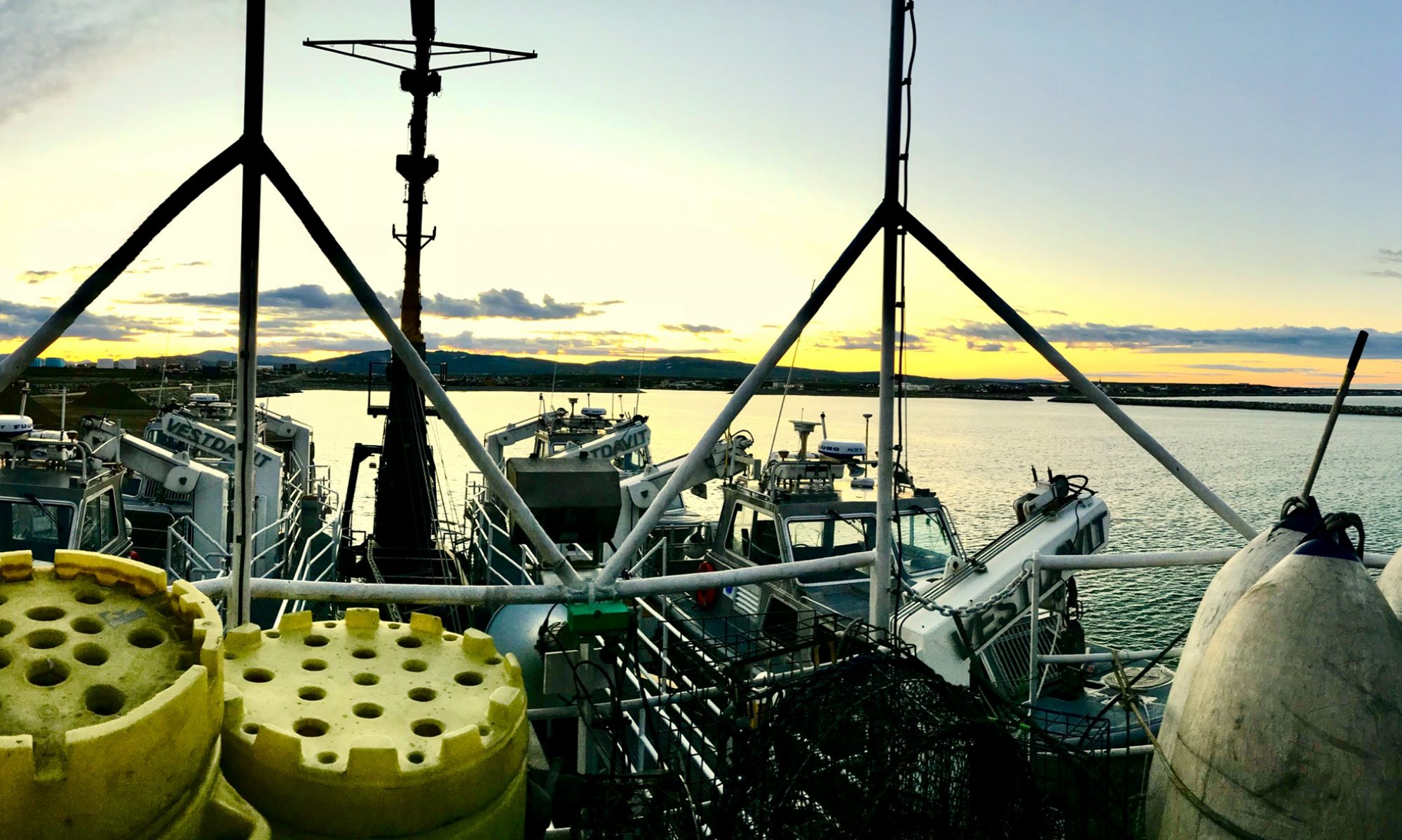
Spencer Cody: Fairweather in Transition – June 5, 2016

Spencer Cody

Onboard the NOAA Ship Fairweather

May 29 – June 17, 2016


Mission:  Hydrographic Survey

Geographical Area of the Cruise:  along the coast of Alaska

Date: June 5, 2016

Weather Data from the Bridge: 

Observational Data:

Latitude: 58˚ 17.882′ N

Longitude: 134˚ 24.759′ W

Air Temp: 15˚C (59˚F)

Water Temp: 8.9˚C (48˚F)

Ocean Depth: 9.7 m (31.8 ft. at low tide)

Relative Humidity: 67%

Wind Speed: 5.2 kts (6 mph)

Barometer: 1,025 hPa (1,025 mbar)

Science and Technology Log:

Fairweather
Yes, the Fairweather needs to be prepared for everything imaginable:  spare parts, lines, tanks, survey equipment, safety equipment, tools, and more.  Preparedness is key to successful mission completion.

Now that I have been on the Fairweather for a few days I have had the opportunity to see much of the ship and learn about how it operates.  If ever there were an embodiment of the phrase newer is not always better, it might be the Fairweather.  Even though the Fairweather is approaching 50 years old, one cannot help but to attain an appreciation for the quality of her original construction and the ingenuity behind her design.  Rooms, compartments, and decks throughout the ship are designed to be watertight and to maximize fire containment.  Multiple compartments can be flooded without putting the entire ship in danger.  The ship is also designed to withstand sea ice due to its densely ribbed construction and extra think hull.  This makes the hull remarkably strong allowing the ship to cut through ice and withstand the additional pressure of ice-covered seas.


155_3414 (2)
One of the two massive Detroit electro-motive diesel engines that propel the ship.  Credit Tommy Meissner for the photo.

The Fairweather is built on redundancy for safety and practicality.  If one system gives out, another can be relied upon to at least allow the ship to get back to port or depending on the system continue the mission.  There are redundant systems throughout the ship involving everything from communications to essentials for sustaining the crew to navigation.  There are even redundant servers in case one set of survey data is compromised or physically damaged the other server may remain untouched.  Storage space is a premium on a ship that needs to be self-sufficient for weeks at a time to address foreseeable and unforeseeable events.  Every free space has a purpose for storing extra equipment, tools, parts, and materials.  Utility and efficiency are running themes throughout the ship.

Personal Log:

152_3311 (2)
The incoming and outgoing commanding officers read off their orders to signify the official change of command of the ship.

Dear Mr. Cody,

Onboard our ship the captain is in charge of the entire crew and ship.  People follow his orders and the chain of command to take care of the ship and its passengers.  It takes a very large crew to take care of all the passengers on a cruise ship and on such a long trip to Alaska and back.  (Dillion is one of my science students who went on an Alaska cruise with his family in May and will be corresponding with me about his experiences as I blog about my experiences on the Fairweather.)

Dear Dillion,

The Fairweather also has a captain whose ultimately responsible for the fate of the crew and the ship. While we are in Juneau, the Fairweather is undergoing a change of command.  On Wednesday we had a change of command ceremony.  It was a day of celebration and reflection on Fairweather‘s accomplishments.  As high-level officials throughout NOAA and other organizations arrived, their arrival was announced or “piped” throughout the entire ship over the intercom system.  Later in the day we had the official change over in a special ceremony attended by all of these dignitaries and guests with NOAA Corps officers dressed in full uniform.

152_3289 (2)
The Fairweather welcoming dignitaries and guests to the Change of Command ceremony.

After everyone read their remarks on the occasion, the time of the official change over was at hand.  The Reading of Orders ceremony was carried out where both the outgoing and incoming commanding officers read their orders for their new assignments.  Insignia on each officer’s uniform was changed by the spouses officially indicating the new commanding officer and the outgoing commanding officer.  With that Lieutenant Commander Mark Van Waes replaced Commander David Zezula as the CO for the Fairweather becoming its 18th commanding officer.  As the new CO gave his arriving remarks, he reminded us that “Command of a ship is many things…it is an honor to know that the leadership of this organization places special trust in your skills and abilities to hold this position…command is a privilege; of the hundreds of those who have served aboard the Fairweather, only 18 have been the commanding officer…command is a responsibility…for the ship…to the mission…and to the people.”  The Dependents Day Cruise and Change of Command Ceremony made for an eventful week while in port in Juneau.  Now we prepare for our first hydrographic mission with our new CO.

Did You Know?

The Fairweather has a total tonnage of 1,591 tons, displacement of 1,800 tons, a length of 231 feet, and is A1 ice rated meaning it can safely navigate ice covered seas with the assistance of an ice breaker.

Can You Guess What This Is?

TrashA. power generator  B. heat sensor  C. an incinerator  D. RESON multibeam echosounder

The answer will be provided in the next post!

(The answer to the question in the last post was B. a speaking tube.  Speaking tubes or voice pipes were commonly used going back to the early 1800s to relay information from a lookout to the bridge or decks below.  They were phased out during the 20th century by sound-powered telephone networks and later communication innovations.  They continue to be used as a reliable backup to more-modern communication methods.)

Spencer Cody: Of Geology, Time, and Ice, June 2, 2016

NOAA Teacher at Sea
Spencer Cody
Onboard the NOAA Ship Fairweather
May 29 – June 17, 2016

Mission:  Hydrographic Survey
Geographical Area of the Cruise:  along the coast of Alaska
Date: June 2, 2016
Observational Data:
Latitude:  58˚ 17.882′ N
Longitude:  134˚ 24.759′ W

Weather Data from the Bridge:  
Air Temp: 16˚C (61˚F)
Water Temp: 8.9˚C (48˚F)
Ocean Depth:  9.7 m (31.8 ft. at low tide)
Relative Humidity:  56%
Wind Speed:  18 kts (21 mph)
Barometer:  1,006 hPa (1,006 mbar)


Science and Technology Log: After a full day of flying, I arrived in Juneau, Alaska, on Sunday.  The Fairweather came into dock early the next morning to host a very special occasion for friends, family, and the public.  It was a Dependents Day Cruise to go with the Memorial Day celebration.  It was an opportunity for those

151_3083 (2)
The NOAA Ship Fairweather in the bottom center docked in Juneau, Alaska, preparing for her next hydrographic leg.

who work onboard the Fairweather to show others outside of NOAA what they do while the crew, friends, family, and guests sailed onboard to the Taku glacier in Taku Inlet and back to dock in Juneau.  The day was filled with demonstrations on what the crew does in order to complete their missions and the significance of having a ship such as the Fairweather fulfill its assigned tasks.  We were split up into multiple groups in order to cover the basics of ship operations and the science and research carried out by the crew.  Guests were treated to demonstrations of bridge operations, hydrographic survey techniques and equipment, dive operations and control station demonstrations.  One highlight of the many demonstrations that were carried out

150_2900 (3)
The crew demonstrate a launch and retrieval of one of the hydrographic survey launches.  The Fairweather has four of these 28′ boats including three additional boats for fast rescue and utility purposes.

was the showing of how the launch boats are lowered into the water and then retrieved.  The Fairweather was maneuvered in such a way that the launch boat was provided a small patch of sea that was calm, a “duck pond,” by blocking the oncoming waves for the launch boat.  While this was not necessary for the weather that day, it did drive home the point about the many ingenious methods that must be employed in carrying out day-to-day operations on a vessel like the Fairweather.  By the time these demonstrations and tours were concluded, we had arrived at the Taku Inlet to see the Taku glacier.

Seeing something that is massive enough to carve solid rock such as the Taku glacier was awe inspiring.  This brings us to one of the key reasons for the complexity of the local geology and the sea channels that the Fairweather will be mapping on the next leg.  After periods of uplift and mountain building, the terrain was recently sculpted with rivers of ice flowing outward to lower sea levels from the ice fields above.  Glaciers encapsulated much of Southeastern Alaska up until the Wisconsin glaciation came to an end about 14,000 years ago.  During this same time, the Laurentide continental glacier still covered much of East River South Dakota.  As the glaciers receded, the ocean levels rose to accommodate the global deluge of melt water.  What was once

150_2940 (2)
The Taku glacier at the end of Taku Inlet displays the forces of erosion at a remarkable scale.

glaciated land is now well below sea level.  Since glaciers have a remarkable power of erosion, U-shaped valleys have been carved throughout this region.  Where these valleys dip below sea level, they frequently end up becoming important bays or passageways for commercial and private traffic.  Glaciation has also given these passageways some unique characteristics that makes having reliable navigation mapping critical.  Many of the navigable passageways in Southeastern Alaska are your characteristic fjords.  They have been carved deeply by the weight of hundreds or even thousands of feet of ice; yet, they are usually narrow with valley walls that run vertically straight into the air.  This topography largely continues below sea level meaning that in many locations the passageways, straits, and canals formed by glacial action can quickly deviate from hundreds of feet deep to shoals in a matter of very short distances.  The complexity and potential hazards of these fjords is enhanced through the process of glacial isostatic adjustment when the earth shifts back upward after the massive weight of a glacier subsides.  Take these relatively recent geological and climatological

150_3025 (2)
Much of the rock of the area shows obvious signs of glacial action scouring across the landscape such as this rock near the Mendenhall glacier outside of Juneau.

processes and apply them to the complex system of islands of the Alexander Archipelago that was formed through shifting transform boundaries between the North American and Pacific plates.  Now one can start to appreciate the degree to which timely mapping is needed for this part of the world requiring precision and accuracy in order to provide nautical charts that cater to the needs of growing commercial and private interests in the area.


Personal Log:

Dear Mr. Cody,

We boarded our ship in San Francisco and cruised under the Golden Gate Bridge passing by Alcatraz Island.  At sea I had the chance to tour the ship.  It is huge!  It holds 1,800 passengers and has a crew of 932.  I am still learning how to get around the ship.  It is like a little city on the ocean.  (Dillion is one of my science students who went on an Alaska cruise with his family in May and will be corresponding with me about his experiences as I blog about my experiences on the Fairweather.)

20160508_085804 (2)
Dillion finally at sea en route to his first stop in Alaska.

Dear Dillion,

I boarded the Fairweather the day after I arrived in Juneau.  I, too, am still learning my way around the ship and learning the names of the crew.  Everyone on the crew has been very helpful in helping me find my way around the ship and learning about what they do to make the Fairweather’s mission successful.  The Fairweather is designed to hold more than 50 crew members consisting of NOAA Corps officers, engineers, deck, survey, stewards, and electronic technicians.  While your cruise ship is built for comfort for vacationers, the Fairweather is built for utility and efficiency in accomplishing a wide range of tasks.  Though the Fairweather’s primary role is to carry out hydrographic mapping of the sea floor in order to provide reliable navigation charts and increase our understanding of the ocean floor, the ship’s crew has been involved in numerous other projects in just the last year including launching wave and weather monitoring buoys, contributing data to surveys tracking changing climate in the Arctic, participating in marine

WIN_20160602_173414 (2)
Unpacking and settling into my stateroom aboard the Fairweather.

mammal observations and new marine mammal survey techniques, carrying out phytoplankton tows, aiding the Navy in glider development, mapping nautical obstructions, and retrieving climate and ocean sensors.


Did You Know?

The Fairweather was launched in 1967 and named after Mount Fairweather in Alaska.  She was constructed along with two other sister ships, the Rainier, in service, and the Mount Mitchell, retired from NOAA service.  All three ships were named after tall mountains in the United States.

Can You Guess What This Is?

152_3230 (2)

A. a vent   B. a speaking tube   C. a horn   D. a periscope

The answer will be provided in the next post!

Spencer Cody: 1,000 Miles or 70 Million Years, Whichever Is Closer – May 16, 2016

NOAA Teacher at Sea

Spencer Cody

Soon To Be Onboard the NOAA Ship Fairweather

May 29 – June 17, 2016


Mission:  Hydrographic Survey

Geographical Area of the Cruise:  Southeast Alaska Survey

Date: May 13, 2016

Personal Log:

Dillion
Dillion packing for his trip to Alaska with his family.  Credit Suzi Vail for the photo.

Dear Mr. Cody,

I am looking forward to relaxing and having a good time.  Also, I have been on a ship two years ago which was on the Carnival Sunshine.  I’m excited to explore new things on the ship.  I’m looking forward to seeing the glaciers and seeing new things and learning new things!  (Dillion is one of my science students who went on an Alaska cruise with his family in May and will be corresponding with me about his experiences as I blog about my experiences on the Fairweather.)

Dear Dillion,

I hope you enjoy your trip to Alaska with your family. Your cruise sounds very exciting.  We missed you on the geology trip to the Black Hills, but Mrs. Kaiser was able to find a creative way to bring you with us.  I look forward to hearing more about your trip when you get back and your continued correspondence concerning your trip.  I am sure we will have a number of things in common with our trips to Alaska.  Take care.

As I look forward to another mission with the NOAA Teacher at Sea program aboard the NOAA Ship Fairweather and the prospect of again being embedded among NOAA’s ocean research, I cannot help but to think back to our recent geology trip earlier this month and the implications of geology on geography on my next NOAA mission.  The NOAA Ship Fairweather promises to be a very different experience than my experience aboard the NOAA Ship Pisces.

Needles
While Dillion was on his Alaska trip with his family, Mrs. Kaiser found a clever way to bring him with us.  Look closely for Dillion on our tour through the Needles of the Black Hills of South Dakota.  Credit Laurel Kaiser for the photo.

The Pisces was a survey ship that usually focused on fisheries missions similar to the Reef Fish Study that I worked on in 2014 while the Fairweather represents another key component of the NOAA fleet, the hydrographic ship.  Yes, this is where geology meets mapping, and when these two come together in the ocean, it is NOAA’s task to ensure that the data needed to manage and safely navigate coastal waters is up to date and accurate.

It can be a challenge to ponder upon an obvious connection to the ocean in a state like South Dakota.  During our geology field trip this May, there were times when we were no more than a few miles from the very center of North America’s landlocked isolation.  It may be quite fitting that North America’s pole of inaccessibility, the point at which one is the farthest from every ocean shore is in the Badlands of South Dakota where 100 miles to each horizon one can look in such a place and easily be led to the conclusion that this is, indeed, an ocean-less planet that stretches endlessly into beautiful desolation.

Badlands II
If you squint you can just make out the sea shore in the distance…just kidding.  The Badlands of South Dakota are as far as one can get from all shores in North America, more than 1,000 miles in every direction.  Credit Laurel Kaiser for the photo.

But, that is the illusion of South Dakota. The reality is that we live on an ocean planet that is dominated ecologically and cyclically and in every conceivable way by a giant reservoir of water far bigger than the vastness of the great North American interior.  The reality is that ocean deposits built much of what South Dakota is today through hundreds of millions of years of deposition.  The reality is that South Dakotans are tied to the ocean in a multitude of ways, yet it slips the grasp of our awareness and often our understanding.  Imagine the challenge with our students in South Dakota who have few, if any, personal experiences to draw upon when science teachers cover oceanography and other ocean sciences in classes throughout the state.  Thankfully, programs such as NOAA’s Teacher at Sea are tremendously helpful in confronting this challenge through this valuable education and research program.

I have two primary goals during my mission:  connecting NOAA’s oceanic and atmospheric work to the classroom and connecting students to the education and vocational pathways that could potentially lead to NOAA careers.  Basically, I am to learn and document as much as I can on my mission and use this experience to enhance the education of my students and to provide access to possible careers in oceanic and atmospheric work through NOAA.  I am greatly thankful and humbled to receive such an opportunity, yet again, through the NOAA Teacher at Sea program.  This is truly another great opportunity for learning for both me and my school.

13177554_943959909055546_7135506633857238816_n
There was once an ocean here…70 million years ago.  The great North American interior is largely comprised of ocean deposits of varying composition.  Hundreds of vertical feet of this ancient marine mud, Pierre Shale, is exposed through much of West River South Dakota serving as a constant reminder of our ancient watery origins.  Credit Laurel Kaiser for the photo.

As with me I will be starting my eleventh year of teaching in Hoven this August.  I teach 7-12 science:  Earth, Life, Physical, Biology, Biology II, Chemistry, and Physics.  I am also the testing coordinator and student adviser for our school district.  Like most staff members in a small school, one must get accustomed to wearing many hats with many roles.  I enjoy teaching all of the varied sciences.  It keeps my brain entertained and occupied!  Hoven is a very nice town to live and teach in.  It reminds me a lot of growing up in Veblen, another small, rural South Dakota town.  I have always been an advocate for rural education and strongly believe that small schools like Hoven offer an exceptional learning experience for students.

Unfortunately, I will have to leave my wife, Jill, and my daughters, Teagan and Temperance, behind for a few weeks.  I will miss them and did get a little home sick the last time with their absence.

I am counting down the days until I fly out on May 29 to Juneau, Alaska, where the Fairweather will be leaving.  I am to report a week early in order to work with the crew of the Fairweather on tidal gauges.  After my work with gauges, I will embark with the Fairweather on its mission and disembark in Ketchikan, Alaska.  I am very excited about the research involved in my upcoming mission.  I look forward to learning more about the various technological aspects of the mission and will report more on the subject once I am underway.  For more information about the Fairweather, visit the Fairweather homepage.

FullSizeRender
My family and I and Einstein.