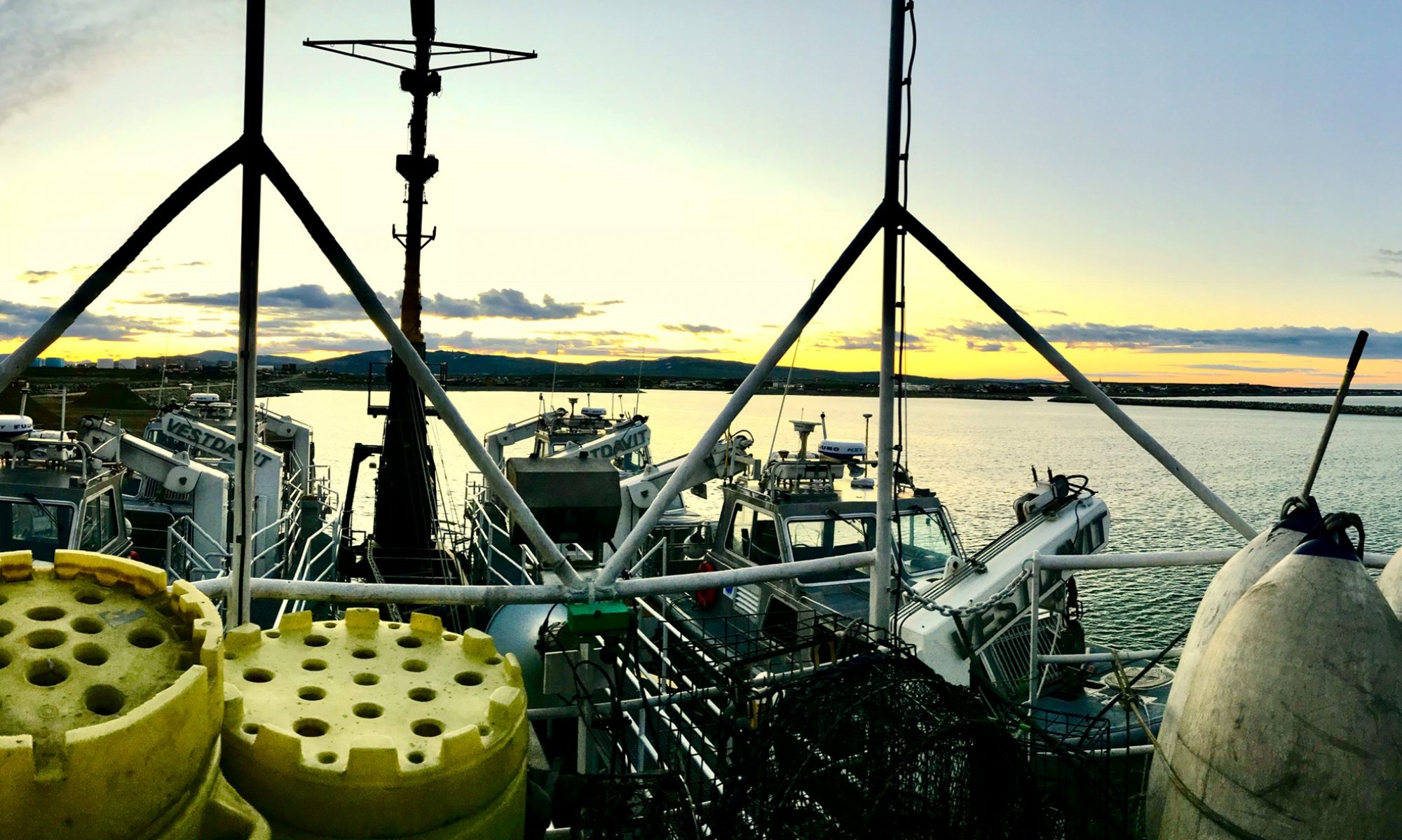
Christopher Faist: Endless Horizon, July 26, 2011

NOAA Teacher at Sea
Chris Faist
Aboard NOAA Ship Henry B. Bigelow
July 20 — August 1, 2011

Mission: Cetacean and Seabird Abundance Survey
Geographical Area: North Atlantic
Date: July 26, 2011

Weather Data
Air Temp:  20 ºC
Water Temp: 20 ºC
Wind Speed: 3 knots
Water Depth: 4141 meters

Science and Technology Log

To quantify sea conditions, scientists use the Beaufort Scale.  Calm waters with no wind is a Beaufort state of zero but when the wind speed increases and white caps start to form the Beaufort state raises to a 4.  Good observation conditions for sighting marine mammals fall between sea state 0-3.  When the white caps form it gets difficult to distinguish between a white cap and a dolphin splash, decreasing our chances of seeing all the animals in our survey area.

Today, the sighting conditions were good with the sea state varying from a 1-3 over the course of the day.  While the conditions were good we did not see any animals for hours.  This was surprising to many of the scientists so we looked more closely at the conditions in the water to investigate the lack of sightings.

Bongo Net
Bongo Net being deployed

Three times a day (morning, noon and night) a system of nets with a probe attached is deployed to sample the water under the ship.  The net is called a Bongo net, due to its dual net design that looks similar to a Bongo drum.  The net is made of a fine mesh that catches small animals swimming below the ship.  The probe, attached to the net, is called a CTD, which stands for conductivity, temperature and depth.  Scientists can use the combination of the animals found in the net and the readings from the CTD to make conclusions about the productivity of the waters around the ship.  The data collected at our noon deployment gave great insight into our lack of visual and acoustic sightings.

During our noon Bongo net deployment an interesting phenomenon was seen in the data.  First, the nets that typically collect animals were nearly empty.  Secondly, the CTD data showed very little change in water density between the surface and 200m.  This lack of change tells scientists that there is very little mixing of the ocean currents in this area of the North Atlantic.  Mixing usually causes colder, nutrient rich water to move toward the surface supplying animals with the oxygen and nutrients they need to grow and reproduce quickly.  When mixing is absent small animals are not as abundant eliminating the food source for the rest of the food chain.  With no food, dolphins and whales move out of the area to more fertile waters.  Hopefully, we will move to more productive areas and increase our cetacean sightings.

Personal Log

Chris Processing Bongo
Chris Processing the Bongo Sample

We have been at sea for 5 days now.  I have figured out my routine and I am really enjoying being away from land.  Surprisingly for a ship, internet speeds are quick, DirectTV is crystal clear and the laundry facilities are efficient.  (It pays to be on one of the newer, technologically advanced ships in NOAA’s fleet. )  The food has been outstanding and I am making some new friends.  Getting up early, 5am, may bothersome, but the sunrises and clear air have made the mornings a great part of the day.  After dinner the crew has a variety of games to pass the time including ladder golf, bean bag toss and darts.  If you think these games are challenging on land, adding the roll of the ship adds a new level of difficulty.

Anne Artz: July 26, 2011

NOAA Teacher at Sea
Anne Artz
Aboard NOAA Ship Delaware II
July 25 — August 5, 2011

Mission: Clam and Quahog Survey
Geographical Area: North Atlantic
Date: July 26, 2011

Weather Data from the Bridge
Location: 40 32.672 N070 43.585 W
Temperature: 18.5 C
Winds:  Easterly at 3-4 knt
Conditions:  Sunny today, some clouds, ocean calm

Science and Technology Log

Our first full day at sea (and at work)!  We left the dock at Woods Hole, MA yesterday at 2 pm and headed out past Martha’s Vineyard and Nantucket.  While steaming towards our sampling site, we practiced two very important safety drills — a fire drill and the abandon ship drill.  The abandon ship drill was unique in that we had to don our survival suits (supposedly in a minute but I think I took longer than that) that protect us in the water from hypothermia and also help keep us afloat.

Survival Suit
Anne Artz in her survival suit

Around 6 pm we reached our first sample location and the “day team” (that’s me and some fellow volunteers) started our work.  The testing protocol is fairly simple: sample sites have been predetermined by computer.  Survey sites are selected based on depth and location (latitude and longitude).  When we reach those locations, a large sled-like cage called a dredge is lowered into the water and dragged along the ocean floor for a prescribed amount of time (generally 5 minutes).

Sampling dredge on the Delaware II
This cage goes on the ocean floor scooping up samples for our analysis.

The dredge is then brought up and the contents emptied onto the deck.  Our work then takes 10-15 minutes to sort through what is brought up, keeping those items we are surveying or counting, and throwing the rest back into the water.  We attempt to identify organisms we bring up and we count all live bivalves, any gastropods, hermit crabs, starfish and all fish.  Species we identify and measure are the surfclam, the ocean quahog, the southern quahog, and sea scallops.  Once we’ve separated out what we need, we weigh the catch then measure the size of each item collected.  We throw everything back into the water and clean up the deck while heading to our next location.  The procedure is repeated about twice each hour.  For our work on the deck we wear protective clothing, hard hats, and of course, a life vest.

Personal Log

There are seven volunteers aboard this trip, including myself.  They are a varied group from all over but are all very interested in ocean science.  Some of them are college graduates, some are still in college and we are all first-timers on this type of research vessel.  We were assigned a 12-hour shift, either noon to midnight or midnight to noon.  I feel fortunate to be on the noon-midnight shift as that means I don’t have to alter my sleeping pattern much.  It’s tiring work but the good part is there are breaks between each haul so most of us have our books with us on the deck (so handy to have a Kindle!).  The crew here is as varied as the volunteers, from all over the country and they are all very good at what they do.  I initially thought having 4 girls sleeping in a room the size of a walk-in closet would be difficult but it’s not.  At any given time two of us are on deck, on duty, so the room is available for sleeping, changing, showering, etc.  We all respect quiet below deck because at any given time, someone is always trying to sleep!

Interesting Things Seen Yesterday

A shark with a rather large fin above the water was following us from a distance for a while — maybe curiosity?  We brought up several skates (they look like rays) the largest being about 12 inches long.  They are incredibly beautiful up close, looking almost angelic.  It seems a shame they have such a bad reputation!

Walter Charuba: Red Skies at Night: July 21st, 2011

NOAA Teacher at Sea
Walter Charuba
Aboard R/V Savannah
July 18 — 29, 2011

Mission: Reef Fish Survey
Geographical Area: Southeast Atlantic Ocean
Date: July 21, 2011

Science and Technology Log

There is an old sailor’s proverb: “Red Sky at night, it will be bright” or “sailors take flight“ or something like that. I just know that I live by this saying and it has caused many a captain to throw away their weather charts. There was a beautiful red sunset last night and I stood at the bow or stern (I am down to two boat locations now) in complete admiration. However, when I started my shift in the morning there was a front moving in with rain clouds and lightning. I must admit I have been pretty calm most of the trip and this has not been due to the Dramamine. Seeing these clouds caused my imagination to get the better part of me, which of course would be the part that includes my brain.  I had images of “The Great Wave” by Hokausai racing in my head.  This outlook was ridiculous because there weren’t even white caps on the waves. The storm never hit us and the day turned out to be excellent.

Dolphins chasing flying fish at night

Another reason last night was special was because I was able to view some dolphins at a very close distance.  First Mate, Michael Richter, made it quite clear that no one was supposed to walk around the boat alone at night, especially the dark upper deck , and especially on the railings. So after daylight, we are limited to the lighted lower deck.  As I was reviewing my constellations, the light seemed to attract these flying fishes. I do not know if this is true, because correlation isn’t always causation, but it looked true.  As I was staring at the flying fishes, a large splash startled everyone. It was a spotted dolphin and a calf jumping for the flying fishes. The dolphins jumped around for about twenty minutes until we took off to our next destination. It was kind of like our own little Sea World, except natural. It was a perfect way to end the night.

Here I am (right) preparing to help with the trap collection

Morning was the time to not only see, but capture, new creatures. My last blog described the deployment of traps, but now I will write about the retrieval of traps. Science Watch Chief, David Berrane termed this “action time.”  The two flotation buoys we drop are significant because, after “soaking” a trap for 90 minutes, the boat returns to these devices and a crew member has to throw a grappling hook at a line between the buoys. We then quickly pull the buoys in next to the boat.  The buoys are lifted up, the line is connected to a “hauler,” and a trap is pulled on board. This may sound simple but it is actually a five person task. The task is very intense and focused because people may trip over the buoys or ropes, or the trap’s line can snap due to weight or current. Hopefully the trap will be filled with fish and the cameras will record useful data from depths ranging from 25 to 83 meters. As soon as the trap is brought on board, the fish are collected and the cameras are disconnected.

The cameras used on the fish traps

The video survey of the reef is just as important as capturing fish, as cameras can assess the population of species that do not go in traps. Zeb Schobernd, the video watch commander, and I do salute him, downloads all the data on board for further viewing during the off season. Imagine all the viewing that has to be done? For instance fifteen videos were taken in one day of our ten day cruise, and there are four or five missions a year. To avoid reef video insanity, the data is viewed in thirty second intervals which is still a great deal of work.

Fish brought on board are immediately classified to species, and then measured individually. Measurement data are called “length frequency,” and hundreds of fish could be measured from one trap. According to a random tally sheet, certain fish are kept to collect “age and growth” data. Again, this could be hundreds of fish. In the ship’s “wet lab,” fish are then dissected. Most fish have a pair of “otolith” bones (i.e., ear stones) in their head.  Otoliths are collected at sea, but sent to a lab where they will be examined under a microscope.  When otoliths are cut by a delicate saw, visible rings tell the age of a fish, similar to how the rings visible on a tree stump can tell the age of a tree. Fish are further dissected to check the condition of their reproductive systems.

In the next blog I will I write about the “CTD” device.

Caitlin Fine: Introduction, July 26, 2011

NOAA Teacher at Sea
Caitlin Fine
Onboard University of Miami Ship R/V Walton Smith
August 2 – 6, 2011

Mission: South Florida Bimonthly Regional Survey
Geographical Area: South Florida
Date: July 26, 2011

Personal Log

Hola! My name is Caitlin Fine and I teach science at Escuela Key (Francis Scott Key School), a dual-language immersion elementary school in Arlington, VA. I am a Virginia native and my heart is constantly torn between the lively activities of the Washington, D.C. area and the peaceful beauty of the Shenandoah Valley. I left Virginia for college and graduate school, but returned 4 years ago to begin my teaching career for Arlington County Public Schools.

Caitlin Fine
On top of Aspen Mountain during a recent trip to Colorado

Although I majored in Political Science and Spanish Literature and I have graduate degrees in Spanish Literature and Multicultural Education, I have always been interested in science. During college, I worked on an organic farm in Andalucia, Spain that practiced permaculture (this is a way of using the land that is sustainable so that the soil does not use-up all of its nutrients). I also traveled around the Southern Cone of South America (Chile, Argentina, Peru, Bolivia, Brazil) studying the geology of the region. As you can see, I have some experience with farming and the mountains. But I have never really spent an extended time at sea — I have never slept on a boat or studied the marine ecosystems up close and personal over a period of time. I hope that I am not seasick!

My interest in science mixed with my love of cooking has created a current obsession — the health of our national and global food and water supplies. Did you know that every time we take medicine or use pesticides on our plants, a small amount of it enters the water supply and some of it ends up in the rivers and oceans nearby where fish and water plants are trying to live?

The science program at Key is a bit different from traditional elementary schools in that there are three science teachers who teach all 630 students. For the past two years, I have taught the Kindergarteners, the 2nd graders and half of the 5th graders. Key kids are amazing scientists — they are full of questions about how the world works and they are not afraid to get busy trying to figure things out on their own through hands-on inquiry and cooperative learning. I cannot wait to return to Key with new knowledge of oceanography, ocean-related careers and ways to monitor the health of the ocean to share with my students and colleagues!

I am so excited to be a Teacher at Sea for the National Oceanic and Atmospheric Administration‘s 2011 Field Season! Teacher at Sea is a program that provides allows Kindergarten through college-level teachers to live and work alongside scientists on research and survey ships. The goal of the program is to help teachers understand our ocean planet, environmental literacy, and maritime work so that they can return to the classroom and share information with their students about what it is like to be a real scientist who studies the ocean.

I will be on a 5-day cruise on the R/V Walton Smith in south Florida.

R/V Walton Smith
This is the R/V Walton Smith

From what I understand, we will be taking measurements across the south Florida coastal marine ecosystem (the southwest Florida shelf, Biscayne and Florida Bays, and the Florida Keys reef tract). The program is important because the research has helped scientists keep an eye on the sensitive marine habitats, especially when the ecosystem has had to deal with extreme events, such as hurricanes, harmful algal blooms or potential oil spill contaminants. We will test the circulation, salinity, water quality and biology of the ecosystem.

Drainage Basin
The currents might move some of the Mississippi River water toward south Florida

During this cruise, I have been told that we might be able to measure Mississippi River water because it might enter our survey track.

Scientists are also going to be trying out new optical measurement tools! It sounds as though I will have a lot to report back to you about!

Please leave me a comment or any questions you have about the cruise.

Please take a moment to take my poll:

Christopher Faist: Dolphins and Crossbows, July 24, 2011

NOAA Teacher at Sea
Chris Faist
Aboard NOAA Ship Henry B. Bigelow
July 20 — August 1, 2011

Mission: Cetacean and Seabird Abundance Survey
Geographical Area: North Atlantic
Date: July 24, 2011

Weather Data
Air Temp:  23 ºC
Water Temp: 21 ºC
Wind Speed: 11 knots
Water Depth: 35 meters

Science and Technology Log

Bottlenose Dolphin bowriding

Continuing our quest to count mammals and seabirds has brought us to shallower waters.  Currently we are moving in an area south of Martha’s Vineyard.  In this area we have had better visibility allowing us to sight species like the south polar skua and bottlenose dolphin.  Increased sightings bring new equipment and tools utilized by scientists to give a clearer picture of the diversity of animals in our survey area.

South Polar Skua
South Polar Skua

In addition to seeing animals through binoculars, scientists also want to learn about animal genetics and vocalizations.  Specialized equipment like a crossbow loaded with a biopsy dart or a towed hydrophone array can give scientists greater insight into the animals they are trying to study.

Pete ready to take a biopsy sample

Pete, one of the marine mammal observers is also tasked with using a crossbow and biopsy dart to take a small sample of whale or dolphin tissue.  When the visual sighting team (using binoculars) spots an animal, they direct the bridge (where the ship is controlled) to steer the ship toward the animal or group of animals.  At this point, Pete begins to prepare his genetic sampling equipment.  On the bow of the ship are two raised platforms, one on each side.  With his crossbow in hand Pete harnesses himself to the ship, climbs on a platform and loads a biopsy dart.  If the animals are close enough he will then fire the dart, which is tethered to the ship, and collect a very, small piece of skin and blubber from the animal.  This tissue sample can be used by scientists to study the animal’s DNA, sex, health, diet, pollution levels and in females, check for pregnancy.

Crossbow loaded with biopsy dart

Another tool used to deepen a scientist’s understanding of marine mammals is a towed hydrophone array.  Included in a thin tube towed behind the ship are underwater microphones or hydrophones.  These are used to listen to noises in the ocean but for this cruise, the hydrophones are tuned to pick up sounds made by marine mammals.

One of the problems associated with using visual sightings to count marine mammals is they only spend a short period at the surface where they can be visually observed.  To ensure that all animals are counted, scientists like Rob and Sandra listen for animals that may be underwater when the ship passes.  Using multiple hydrophones they can use computer software to locate the noises and note the presence of animals that may be missed by visual observers.

Personal Log

Today was our first day of good weather that lasted all day.  What that means is 12 hours on deck looking for animals.  Even though I can take a break whenever I need it, I am worried that if I leave the deck I will miss something interesting.  After that many hours on deck it is great to get some dinner and head for bed.  I have been sleeping really well, making  getting up at 6am to start surveying almost enjoyable.

Next posting I will talk about the CTD/Bongo sampling device that I am helping to deploy every day at lunch.