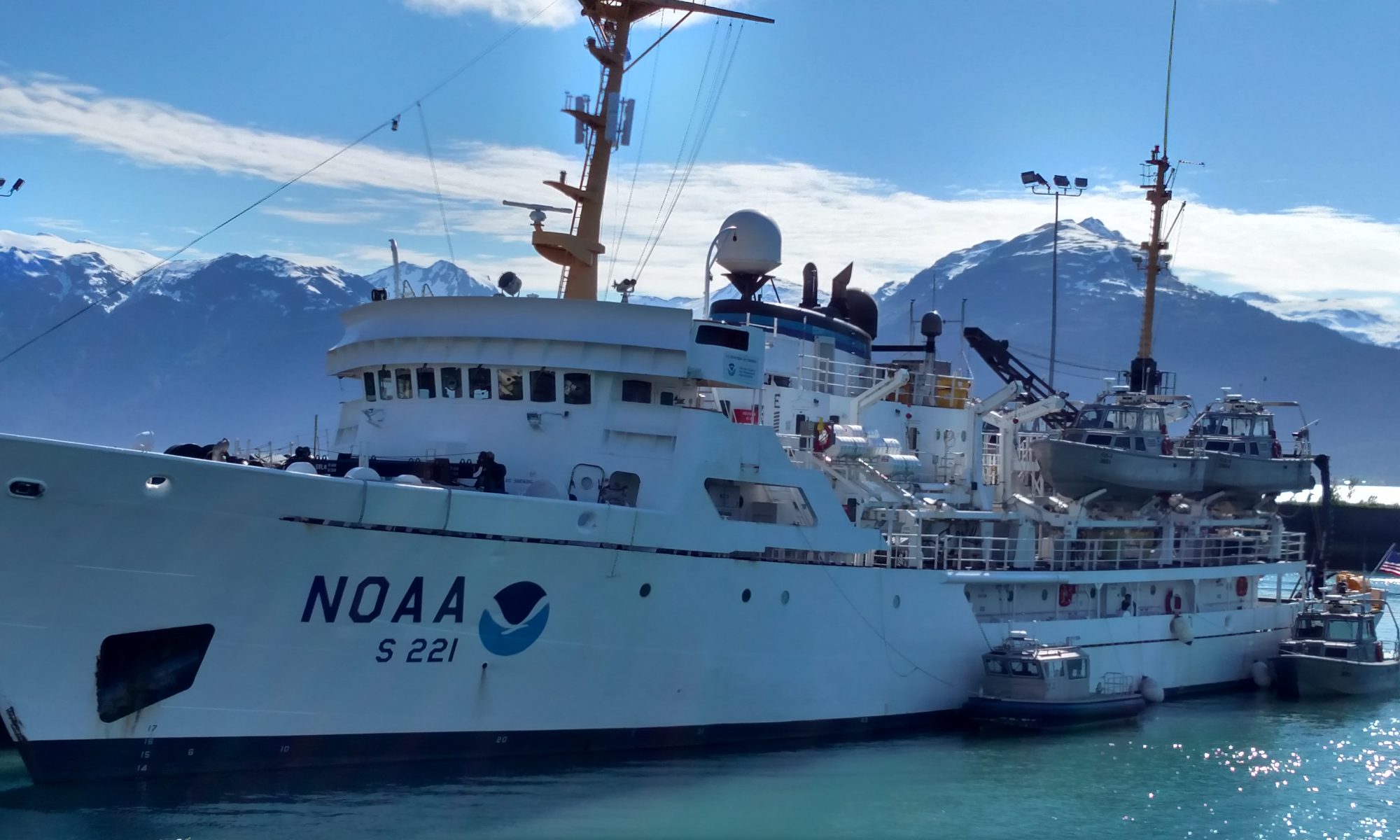
NOAA Teacher at Sea
Chris Faist Aboard NOAA Ship Henry B. Bigelow July 20 — August 1, 2011
Mission: Cetacean and Seabird Abundance Survey Geographical Area: North Atlantic Date: July 27, 2011
Weather Data Air Temp: 17 ºC
Water Temp: 17 ºC
Wind Speed: 15 knots
Water Depth: 4365 meters
Science and Technology Log
Well it happened. This morning I was taking care of a few things before heading to the observation post and while I was below deck they spotted Killer Whales. By the time I got to the deck the animals were gone. Initially, I was disappointed but the day continued with another sighting of Killer Whales, some Risso’s dolphins, a pod of Atlantic Spotted dolphins, a couple of Sperm Whales, a group of Sowerby’s Beaked Whales and a couple of Basking Sharks. This list of animals is long but keep in mind this was over the course of 11 hours of observation.
Marine Mammal Observers use a variety of strategies to keep themselves “fresh” and able to look for animals for long periods of time through every weather condition. The design of their survey procedure allows each observer to take a 30-minute break during each 2-hour session. This gives them time to rest their eyes, get out of the weather and get something to eat. Some of the other techniques to stay sharp may go unnoticed but are important and can only be learned from experienced observers.
Observer with Fireball
Standing for hours and looking through binoculars on a rolling ship is not for everyone. After spending some time observing animals at sea I can pass along a few tricks. The days can be long but playing music can help keep the time moving. Talking to other observers keeps your mind engaged and helps to stay focused. When you start to feel like you need a jolt to stay awake try an Atomic Fireball. These small candies pack a spicy reminder that you need to stay alert. In this picture, one of the observers is holding her Fireball in her hand because she was not able to handle the intense heat.
To get a job as a Marine Mammal Observer you need to withstand these challenges while maintaining your ability to tell the difference between a splash and a white cap from three miles away. Once you do detect the animal you still need to identify the animal with only a quick glimpse of the animal. Below are a few pictures taken recently for you to test your skills. Can you use the links above to correctly ID the animals?
RD IDAtSp ID2SW IDBS ID
Personal Log
Now that I have overcome my run in with seasickness, life at sea is great. We are so far out, over 200 nautical miles, that we have lost our satellite TV connection and that is fine with me. I have seen a variety of species for the first time and I am enjoying being surrounded by people who share my passion for the ocean and marine mammals.
NOAA Teacher at Sea
Anne Artz Aboard NOAA Ship Delaware II July 25 — August 5, 2011
Mission: Clam and Quahog Survey Geographical Area: North Atlantic Date: July 27, 2011
Weather Data from the Bridge Location: 40 08.301N; 72 07.278 W
Direction: 1140 Wind: NW @ 10
Conditions: Breezy, choppy water but warm and sunny, very few clouds
Science and Technology Log
We had an interesting night last night – quite a show from the lightning all around us. We had to stop working on deck due to lightning concerns and the water was definitely choppy. Shortly after midnight we resumed our survey dredging
A little history and information about the ocean quahog is in order, since we’ve been spending most of our time the last few days collecting, counting, weighing, and measuring them (along with a few other things we dredge up – more about those later).
The ocean quahog, or Artica islandica, is a marine bivalve member of the phylum Mollusca. It is native to the North Atlantic (where we are right now) and is commercially harvested as a food source. The ocean quahog lives in deeper water than the more common clam (the ones you can dig up along the beach) and are collected in much the same way as we are doing on the Delaware II, by dredging the bottom, rinsing off the mud, and throwing away all the other things brought up.
We bring up any where from one to three baskets of ocean quahogs with each dredge.
One of the unique characteristics of the ocean quahog is its longevity. They are known to live over 100 years. They are extremely slow-growing and as adults, may take years to add any measurable length to their shells. Both water temperature and population density appear to play a role in their growth. From previous NOAA studies, some of the fastest growing populations occur at the Georges Bank region off the coast of Massachusetts. The National Marine Fisheries Service (NMFS) uses the data collected from this survey to advise policy makers on the best way to protect and ensure the survival of the ocean quahog populations.
So what do we know so far about the ocean quahog’s populations? Besides the fact that they grow slowly, we know they are suspension feeders of phytoplankton and they themselves are food for a variety of other invertebrates including crab, sea stars, urchins, and some fish such as cod. The dredging process damages some ocean quahogs making them susceptible to other predators such as sculpin, skates, and flounder. Every three years the populations in the Northern Atlantic are surveyed and past results indicate the populations are stable despite the dredging methods of collection. The ocean quahog is not considered endangered at this time and is not considered overfished.
Personal Log
The lightning storm was beautiful to watch – the only thing missing was the thunder! Our ship never stops so the engines run continuously, making hearing anything on deck almost impossible. We’ve brought up some incredibly interesting animals – some I’ve never seen or heard of. For example, we’ve brought up numerous “sea mouse” samples.
A sea mouse, or Aprodita aculeata (member of phylum Annelida)
They are actually carnivorous worms who live on the ocean floor and are covered with long hair-like threads, or setae. The ones we’ve brought up are 4-6 inches long. Creepy!
We are currently at survey site 229 which for you students translates to trial number 229. No more complaining to me about having to repeat your experiment 25 times!
NOAA Teacher at Sea
Caitlin Thompson Aboard NOAA Ship Bell M. Shimada August 1 — 14, 2011
Mission: Pacific Hake Survey Geographical Area: Pacific Ocean, Off the U.S. West Coast Date: July 24, 2011
NOAA Ship Bell M. Shimada
This Sunday, I’m headed off to sea! The mission of my cruise is to survey Pacific hake (also called Pacific whiting) populations. Hake is a species of fish that supports a huge fishery off the West Coast. As it states on NOAA’s Fishwatch website, “The Pacific whiting (hake) fishery is one of the largest in the United States. Pacific whiting is primarily made into surimi, a minced fish product used to make imitation crab and other products. Some whiting is also sold as fillets.” I’ll leave from Newport, Oregon, and arrive two weeks later in Port Angeles, Washington. The ship, the Bell M. Shimada, belongs to the National Oceanic and Atmospheric Administration (NOAA). I get to go on the Shimada because of NOAA’s program Teacher at Sea (TAS), which sends teachers aboard research vessels so that we can increase our scientific literacy and bring our new knowledge back to the classroom. I can’t wait. I’ve never even spent a night aboard a ship, so this whole journey will be new for me.
I teach seventh and eighth grade integrated science at Floyd Light Middle School, in the David Douglas School District, in Portland, Oregon. I earned my Master’s in Education at Portland State University and my Bachelor’s of Art in Environmental Science at Mills College, in Oakland, California. In between, I taught English at a public elementary school in Curico, Chile. I love science and I love teaching. As soon as I decided to become a teacher, I made up my mind to participate in TAS, because it will help me teach my students the importance and fun of science.
At a dragon boat race
When I’m not teaching, I paddle with a dragon boat team, spend time with friends and family, and ride my bicycle. I’m always looking for new projects and new things to learn. I’m lucky to live in a city as great as Portland, where there are always interesting events going on around town.
NOAA Teacher at Sea
Staci DeSchryver Onboard NOAA Ship Oscar Dyson July 26 – August 12, 2011
Mission: Pollock Survey Geographical area of cruise: Gulf of Alaska
Location: 57°43.287’N,152°28.867’W
Heading: 242.2° (But we are stationary)
Date: July 26, 2011
Weather Data From the Bridge Cloudy and Light Drizzle
Air Temperature: 14.0°C
Relative Humidity: approx 79%
Science and Technology Log
Well, I have arrived safely and soundly on the NOAA Ship Oscar Dyson. For the next three weeks, we will be catching, catching, catching as many walleye pollock as we possibly can to determine the health of the stock. How is that done, you ask? Well, they send the Teachers at Sea out to the stern of the ship where we gently call them over for processing.
“Here, Fishy, Fishy…” Just kidding.
First, the scientists use acoustics to find concentrated masses of walleye pollock beneath the surface. The echoes appear on a computer screen for the scientists to evaluate. Once they determine that the acoustic signature is indeed pollock, they take a direct sample of the fish by dropping a large net, called a trawl, down to the location of the fish. The net then captures the fish and they are brought to the surface. The procedure is more like “hunting” rather than “fishing” in that the scientists have sophisticated equipment to detect the locations of the fish – they aren’t just attaching a worm to a hook and hoping for the best. They actively seek out locations where they know pollock exist – this helps preserve the stock populations because if they can “see” the echoes on the screen, they can be sure they are pulling up the right species. In addition, the sample sizes that are taken are quite small in comparison to the commercial fishing industries – we take only what we need to get accurate data.
Here I am on the docks getting ready to see my "home away from home" for the first time!
After the fish are caught, they are sent down a ramp for processing. Unfortunately, most of the fish brought to the surface “donate their bodies to science,” as they don’t survive the trip up from depth to the surface. Why don’t the fish survive? Sometimes, it is simply the stress of being caught. But another contributing factor is stress that is put on a special organ in the fish called a gas bladder. It is easily explained using a reverse example.
Remember the video clip from Mythbusters on the “MeatMan?” In the program, the myth claimed that a person’s body would indeed be crushed by the weight of ocean water at a depth of 300 feet. If you recall, the myth was confirmed when “MeatMan’s” helmet caved in after the Mythbusters removed the pressurizing hose from the back of the diver’s suit after the “diver” was lowered to a depth of 300 feet. With pollock, the reverse happens. The pollock’s body is “conditioned” to being at a particular depth. Inside the pollock is a swim bladder that is filled with air that pushes back on the water at the same pressure that the water pushes in on the fish – much like the pressurized diving suit. As long as the pressure remains constant – both pushing outward on the surrounding water and inward on the swim bladder – the fish is fine. When the fish is forced too quickly above a particular depth, the bladder will expand because the outward pressure is no longer strong enough to push in on the bladder – the exact opposite of what happened to the meat man – the bladder expands too quickly, and it can sometimes cause the fish to die. Pollock do have the ability to regulate their swim bladders, but when the are pulled too quickly to the surface by means of say, a net, for example, they can’t adjust to the pressure changes quickly enough. I’ve shortened this complex idea into to a simple and digestible equation:
Person too deep = squish. Fish too shallow = pop.
Despite the fact that the fish usually perish in their journey, they do so to benefit the overall health of the stocks. Researchers gain a wealth of information from the catch. They measure the size, age, sex, and sometimes the stomach contents of each of the fish! As the data gets collected, it is analyzed to determine the overall health of the population so that fishermen know how much is safe to catch and sell for profit without doing harm to the population.
Personal Log
Well, we haven’t left yet. Some complications on the ship have kept us safely in the comfort of our harbor and will most likely keep us there until Friday afternoon or Saturday morning. So, we’ve been keeping busy with tours of the ship, introductions to the ship’s crew, and trips to town to look around and sample the local fare. We are staying on a Coast Guard base, so it’s a secure location that most civilians can’t access. The base is really interesting.
It appears as though a stowaway has made it onboard the Oscar Dyson and overtaken my stateroom! Marshmallow has found his quarters to be comfortable and accommodating. He has also informed me that he would like his bedroom at home to henceforth be referred to as his Stateroom, as it sounds much more prestigious and astute.
I especially enjoy hiking around the peninsula that is attached to the base. All along the road are freshly ripened Salmonberries (which coincidentally do not taste like Salmon. They taste like delicious.) Along the opposite side of the road is a rocky shale beach. About a half a mile down the road is a rotting old dock that is commissioned only by grasses and pony-sized seagulls. It is decaying in the most gorgeous manner – to witness an object simultaneously rusting, collapsing, and growing is a delicious paradox for the imagination.
Like an old World War II veteran, I imagine it not as it appears today, but as a majestic and commanding behemoth – an anchor and a doorway home for the ghosts of a time passed bustling about on its intact surface. It’s a good thing there is no possible way to access it, otherwise I may have found myself out there teasing out the details of its surely magnificent story.
This is the old dock on the peninsula in the harbor. There are trees growing out of it!
When we do leave port, I will be working the night shift. While to some that might seem a bit intimidating, I am actually quite excited. If my shift does not end until 4am, that gives me the luxurious liberty to remain comfortably in my rack until ten am without anyone thinking less of me. Interestingly enough, there are a decent number of people who work nights onboard. This means that there is someone awake at any given hour somewhere on board. It’s hard to feel alone when there is always someone up and about – which is a comfort in the foreign world of a research ship.
For now, there isn’t much to report on other than we are hurrying up and waiting to leave. Hopefully the weather will be friendlier tomorrow for a hike to the top of Mt. Barometer where it is rumored that the view from the top rivals any Hollywood production. Well, maybe except Avatar , but what landscape can compete with an alien land full of glowing trees? I would like to be the judge of that.
NOAA Teacher at Sea
Staci DeSchryver
(Almost) Onboard NOAA Ship Oscar Dyson July 26 – August 12, 2011
Mission: Pollock Survey Geographical area of cruise: Gulf of Alaska Date: July 23, 2011
Personal Log
Hello, from Denver, Colorado! My name is Staci DeSchryver, and I am an Honor’s Earth and Physical Science teacher at Cherokee Trail High School in Aurora, CO. Our school is the newest addition to the Cherry Creek School District family, but starting our ninth year is hardly enough to make us the babies any longer. We are an outstanding school with absolutely outstanding students, and I can’t wait to share this experience with them! I will be starting my eighth year teaching this fall, and my seventh year at CTHS. I’ve been around for a while, and Trail is definitely my teaching home.
This is a picture of me and my husband, Stephen!
I applied tor the NOAA Teacher At Sea program because our oceans are vast, largely unexplored, and a critical planetary resource. I love their mystery. More importantly, I love that we have the technology to uncover what hides beneath the surface. In addition, I am a firm and vocal believer that our ocean fish supplies are a lynchpin in our food supply. How so, you ask? I’ve broken it down into a simple and digestible equation:
Overfishing = fish can’t reproduce to keep up with the demand = fish become scarce = people starve = sad, hungry people.
Therefore, because few people on this planet enjoy being sad or hungry, NOAA (The National Oceanic and Atmospheric Administration) works tirelessly to ensure that we have sustainable fish populations now and in our future.
As part of this tireless work, I have the chance of a lifetime — to sail on the NOAA Ship Oscar Dyson! The Oscar Dyson will be completing a stock assessment survey (data collection) on Walleye Pollock, a smart-looking fish that is a staple of the American (and world) diet. I am excited and nervous! I have never been on a ship before — not even a cruise ship! Come to think of it, I have never entered the ocean past knee-depth. (Thanks, Mom.) While the training has prepared me well, I know nothing can prepare me for the size, depth, and wealth of knowledge and surprises that are surely in store for me.
This is our family mascot, Marshmallow Bear. He usually is a stealthy bear who manages to become a stowaway on all of our travels. Something tells me this isn't the last you will see of him!
Please be sure to check the links to the Ship and the Mission! The sites there explain what we will be doing in clear detail.
As far as a little more information about myself, I am currently packing up, tying up loose ends at home, and making sure all of my electronic equipment is in working order before I leave. I have also just learned from a fellow TASer that using the word “boat” for a “ship” is quite improper etiquette and akin to swearing. How did I miss that? Therefore, I am currently seeking out synonyms for “ship” and “vessel” to keep my writing nice and spicy without angering anyone who holds my life in their hands.
The next time you hear from me, it will be from the Gulf of Alaska on my mission to help protect our fish populations, spread the word about scientific careers, and develop killer lesson plans that teach our students the science of Oceanography! Cheers!