Kristin Hennessy-McDonald: Flotsam and Jetsam, September 23, 2018

NOAA Teacher at Sea

Kristin Hennessy-McDonald

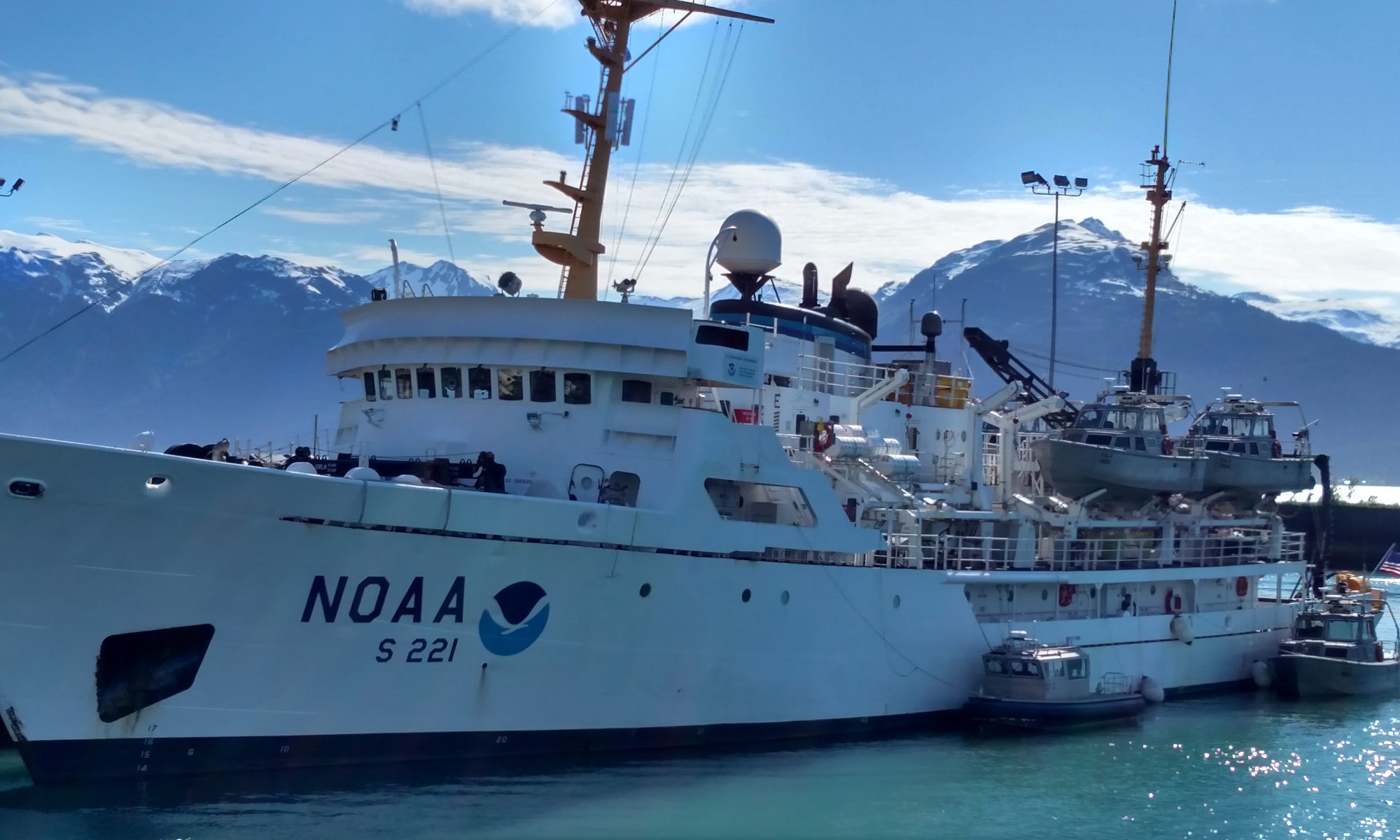
Aboard NOAA Ship Oregon II

September 15 – 30, 2018

Mission: Shark/Red Snapper Longline Survey

Geographic Area of Cruise: Gulf of Mexico

Date: September 23, 2018


Weather Data from the Bridge

Latitude: 3006.07N

Longitude: 08741.32W

Sea Wave Height: 1m

Wind Speed: 8.64 knots

Wind Direction: 199.7

Visibility: 7 nautical miles

Air Temperature: 27.6

Sky: 95% cloud cover


Science and Technology Log

Over the past few days, we’ve fished a mix of station depths, so I’ve gotten to see a number of new species as we’ve moved out into deeper waters.

At a C station, which is a station at depths between 183 and 366 meters, we caught a Mako Shark (Isurus oxyrinchus).  This catch was so unexpected that a number of crew members ventured out to the well deck to snap a picture.  She was a beautiful juvenile between 1-2 years old.

Kristin and Mako Shark
Our current NOAA Teacher at Sea, Kristin Hennessy-McDonald is all smiles when grabbing this quick picture before releasing the female Mako shark. [Photo Credit: Ensign Chelsea Parrish, NOAA]
juvenile female mako shark
Juvenile Female Mako Shark

I also saw my first kingsnake eel, a long eel with a set of very sharp teeth.  On a later station, we caught a juvenile that we were able to bring on deck and examine.  We also caught a Warsaw grouper (Hyporthodus nigritus), which had parasites on its gills and in its fins.  Gregg Lawrence, a member of the night shift on loan from Texas Parks and Wildlife Coastal Fisheries unit, and I removed the otoliths and took samples of the parasites.

Warsaw Grouper
Measuring the Warsaw Grouper [Photo Credit: Gregg Lawrence]


image3
Dissecting a Warsaw Grouper

We had one catch that brought in 20 Red Snappers.  Red Snappers are brought on deck, and a number of samples are taken from each one of them for ongoing assessment of the Red Snapper population.  In addition to the otoliths, which allow the scientists to determine the age of the fish, we also take samples of the gonads, the muscle, the fins, and the stomach.  These allow the scientists to perform reproductive and genetic tests and determine what the snappers ate.  While 4 members of the science team onboard collected samples, Caroline Collatos, the volunteer on the day shift, and I insured that the samples were properly packaged and tagged.  Everyone working together allowed the process to run smoothly.

On the latest B station, which was about 110 meters deep, we caught a number of species, some of which I had not gotten to see yet.  In addition to Gulf smoothound sharks (Mustelus sinusmexicanus), we caught a Scalloped hammerhead shark (Sphyrna lewini) and a Sandbar shark (Carcharhinus plumbeus) that we had to cradle due to their size.  The Sandbar shark was a bit feisty, but I got the chance to tag her before we released her.

Gulf smoothound shark
Gulf smoothound shark (Mustelus sinusmexicanus)
Scalloped hammerhead
Scalloped hammerhead shark (Sphyrna lewini)
Sandbar shark
Sandbar shark (Carcharhinus plumbeus)

We work in the rain.  Thankfully, they had some extra rain gear for me to put on, so that I would not get drenched while we were setting the line.  For the most part, the rainstorms have been sprinkles, but we did have one downpour while we were going toward a station.

rain gear
We work in the rain, so I was loaned some rain gear.


Personal Log

Between setting lines, I have been busy checking up on my studenats’ work back in Memphis.  One of the great things about having a one-to-one school is that the students are able to do their work on Microsoft Teams and turn it in for me to grade it thousands of miles away.  I have loved seeing their how they are doing, and answering questions while they are working, because I know that they are learning about the cell cycle while I am out at sea learning about sharks.

One of the things that has really surprised me over the past week is how much my hands hurt.  It was unexpected, but it makes sense, given how much of the work requires good grip strength.  From insuring that the sharks are handled properly to clipping numbers on the gangions to removing circle hooks from fish on the lines, much of the work on the science team requires much more thumb strength than I had thought about.  I know my students have commented that their hands hurt after taking notes in my class, so I thought they would get a kick out of the fact that the work on the ship has made my hands hurt.

Did You Know?

Sharks are able to sense electrical fields generated by their prey through a network of sensory organs known as ampullae of Lorenzini.  These special pores are filled with a conductive jelly composed primarily of proteins, which send the signals to nerve fibers at the base of the pore.

Quote of the Day

Remove the predators, and the whole ecosystem begins to crash like a house of cards. As the sharks disappear, the predator prey balance dramatically shifts, and the health of our oceans declines.

~Brian Skerry

Question of the Day

How many bones do sharks have in their bodies?

Mark Van Arsdale: Modeling the Ocean, September 24, 2018

NOAA Teacher at Sea

Mark Van Arsdale

Aboard R/V Tiglax

September 11 – 26, 2018


Mission: Long Term Ecological Monitoring

Geographic Area of Cruise: North Gulf of Alaska

Date: September 24, 2018


Weather Data from the Bridge

30 knot easterly winds, rain, waves to eight feet

60.20 N, 147.57 W (Prince William Sound)


Science Log 

Modeling the Ocean

During the last two weeks, scientists aboard the Tiglax will have done over 60 CTD casts, 60 zooplankton tows, measured over one thousand jellies caught Methot Net tows, and collected hundreds of water and chlorophyll samples. What happens with all of this data when we get back?   The short answer is a lot more work. Samples have to be analyzed, plankton have to be counted and measured, DNA analysis work has to be done, and cohesive images of temperature, salinity, and nutrients have to be stitched together from the five different transects.

Preparing for another CTD cast. More than 60 CTD casts were made during our cruise.

Much of this data will eventually be entered into a computer model.  I’ve spent a great deal of time talking with one of the scientists on aboard about how models can be used to answer essential scientific questions about how the Gulf of Alaska works.  Take Neocalanus, the copepods we collected yesterday, for example.  A scientist could ask the question, what factors determine a good versus bad year for Neocalanus?  Or what are the downstream effects on a copepod species of an anomalous warming event like “the blob” of 2014-2015? A model allows you to make predictions based on certain parameters. You can run numerous scenarios, all with different possible variables, in very short periods of time. A model won’t ever predict the future, but it can help a scientist understand the “rules” that govern how the system works.  But a model is only as good as its baseline assumptions, and those assumptions require the collection of real world data.  A computer doesn’t know how fast Neocalanus grows under optimal or sub-optimal conditions unless you tell it, and to tell it, a scientist has to first measure it.

The fishing industry is a billion-dollar piece of the Alaskan economy.  The ocean is getting warmer and more acidic.  Food webs are shifting, and the abundance and distribution of the species we depend upon are changing as a result.  Using models may allow us to better predict what sustainable levels of fish catches will be as conditions in the Gulf of Alaska change.

I also asked the scientists on board about the future of oceanography in light of the advancements in autonomous unmanned vehicles.  Do you still need to send people out to sea when sending a Slocum Glider or Saildrone can collect data much cheaper than a ship filled with twenty scientists?  The answer I got was, “No, at best these technologies will enhance but not replace what we do at sea.  There will always be a place for direct scientific observations.”  We still need oceanographers at sea.

In twenty-one years of teaching I have had lots students go on to be doctors, PA’s, nurses, micro-biologists, geneticists, and a variety of other scientific occupations, but no oceanographers.  I guess I still have some work to do.

Personal Log

The Weather Finally Gets Us

We have had a few showers, bits of wind and waves, but the weather has been remarkably good for a cruise through the North Gulf of Alaska in late September.  This morning, during the night shift the winds started to blow, it started to rain, and the waves came up. When I went to bed around six AM, the wind was blowing thirty knots, and when I woke up at eleven, it was pushing up some pretty rough seas.  Things got really crazy after lunch.  The winds were being channeled right down Night Island Passage and all work was put to a stop.  I retired to my bunk to read, unable to even go outside and take look.  They eventually battened down the hatches; and we changed course to go hide in a bay sheltered from the wind. (Yes, they really do say batten down the hatches.)

By dinner time decisions were made to not work for the night.  It looked better where we were, but the stations we needed to sample were exposed to winds that were still blowing.  No zooplankton sampling for the night meant that it was time to start washing, disassembling, and drying nets.  We used seventeen different nets to sample zooplankton during the course of this trip and all of them needed to be washed and cared for before they got packed up.

Plankton nets hanging to dry (oceanographer laundry.)

Tomorrow we will begin the journey home with two stations un-sampled.  The storm kept us from getting to the last stations, and another storm is just a few days away. Once the decision was made, I think we were all relieved to be heading in.  Doing oceanography is hard work, and being away from lives, work, and family for such extended periods of time is tough.  Some of the scientists on board have spent as much as six or eight weeks at sea this year.  Having been out here for two weeks, I now understand what commitment that takes.

Unless something really interesting happens tomorrow, this will be my last blog.  This trip has been personally challenging, but a rich experience, and I believe it will be formative to my teaching.  I have learned a great deal about oceanography in general, and the Gulf of Alaska in particular.  The Gulf of Alaska is a magical place.  There is life almost everywhere you look.  More than anything I will leave with a deep impression of the dedication that scientists give to the accuracy and integrity of their work.

[Postscript:  Zooplankton and jelly work was done, so I was able to spend the entire last day on the flying bridge.  There was a good amount of swell from the previous day’s storm, but the sun and scenery made it an enjoyable trip back to Seward.  As we left Prince William Sound we were greeted by an abundance of seabirds that had been blown into the Sound by the weather.  On that day, we documented almost as many species as the rest of the trip combined.  We also got to watch a large group of orcas patrolling the area around Danger Island at the entrance to the Sound.  We made our way back to GAK1.  If the weather allows, GAK1 is always sampled at the beginning and ending of any trip.  The weather was beautiful, Bear Glacier and the entrance to Resurrection Bay was alive with color, and I was going home.  It was a great day.]

Views of the southern coast of the Kenai Peninsula as we traveled from Prince William Sound back to Seward.

Animals seen today

  • Sea otters
  • Fewer birds today, bald eagles, kittiwakes, gulls

Mark Van Arsdale: Waking up Copepods, September 23, 2018

NOAA Teacher at Sea

Mark Van Arsdale

Aboard R/V Tiglax

September 11 – 26, 2018


Mission: Long Term Ecological Monitoring

Geographic Area of Cruise: North Gulf of Alaska

Date: September 23, 2018

Weather Data from the Bridge

Variable winds, partially cloudy, calm seas

60.20 N, 147.57 W (Prince William Sound)


Science Log

Waking Up Copepods

One of the scientists on board is interested in the life cycles of a particular species of Neocalanus copepod. Neocalanus is a remarkable looking copepod.  They have long antennae with feathered forks at the ends. They have striking red-orange stripes on their bodies and antennae that reminds you a bit of a candy cane. Neocalanus is an important copepod in the Gulf of Alaska ecosystem, and it typically makes up the largest portion of zooplankton biomass in the spring.

Neocalanus cristatus, photo credit Russ Hopcroft, UAF

Its life cycle is interesting.  If zooplankton were cars, the Neocalanus might be a Toyota Prius.  It’s not fast or fancy, but it’s efficient.  Neocalanus copepods feast in the spring and early summer and then settle down several hundred meters below the surface to enter into a diapause state.  Diapause is a kind of dormancy that involves slowing basic metabolic functions to near zero.  It is a strategy used by other Alaskan arthropods, most notably mosquitos, to survive long winters.  As for why they travel deep into the water column, the answer seems to be that they use less energy in the dark, cold, high pressure waters at depth.  Inside the Neocalanus there is an unmistakable large, sausage shaped sack of oil that should provide the energy reserves needed to survive prolonged diapause.

When the Neocalanus females wake up, they have to restart their metabolism and begin meiotic development of their oocytes (egg cells.) They have previously mated and they store the male’s sperm within their bodies during diapause.  Each of these biological events involves turning on several dozen genes.  What our scientist wants to know is what genes get turned on, in what order, and what environmental clues tell the initial genes to start making RNA. To study all of this, she needs living copepods in diapause.  Our collection process inevitably wakes them up, but it gives her a time zero for observing this transformation.  For the next twelve hours, she separated and preserved copepods every hour for later genetic analysis that may give her insight into when genes turn on and in what order as the copepods wake up.

In order to get her copepods, the night team did a vertical Multi-net tow at four AM.  We dropped the Multi-net down to a depth of 740 meters. The work we were doing was sensitive, as she needed the copepods alive and undamaged.  I was glad to have slept a few hours as we were moving between sampling stations, because what came up in the tow was pretty amazing.  Along with the Neocalanus, there were many other types of zooplankton including the copepod MetridiaMetridia produce an intense bioluminescence when disturbed. When we brought the nets to the surface, the cod ends were glowing electric blue and individual copepods could be seen producing pinpricks of light that were remarkably bright.

Bioluminescence is ubiquitous amongst deep sea species.  Deep sea fishes, jellies, and plankton use it to attract prey, to camouflage their silhouette, to surprise and distract predators, and likely to communicate with members of the opposite sex.  The deep oceans make up 95% of biological habitat on Earth.  If you consider bioluminescence communication a kind of language, it may be the most commonly spoken language on the planet.

Luciferin production and luciferase transcription in the bioluminescent copepod Metridia lucens. Michael Tessler et al (2018)

Personal Log

Protected Waters

Knight Island Passage, Prince William Sound

Waking up in Prince William Sound today felt good.  I was closer to home this morning than at any time since leaving Seward.  The Sound feels comfortable and protected.  Should bad weather come up, and it sounds like it will tomorrow, there are hundreds of sheltered bays to hide in.

Chenega Glacier, Icy Bay, Prince William Sound.

Prince William Sound’s beauties are hard to describe without sounding cliché.  Most striking of all are the large tidewater glaciers.  In the evening, we made our way to Chenga Glacier, to do CTD cast.  It was a quite a sight, as were the three hundred harbor seals hauled out on the floating ice in front of the glacier.

These glaciers directly shape the ecosystem of the Sound.  They provide a large freshwater input that is high in trace minerals, while creating pockets of cold water, which serve as micro-climates within the larger area.  These glaciers are melting at incredible rates, and freshwater inputs are greater than they have been at any time since the last ice age.  Sampling stations that were once near the face of the Chenga and Columbia Glaciers are now miles away from their quickly receding faces. Click here to watch the satellite images of Columbia’s retreat.  This ecosystem is changing, and only through long term ecological monitoring will we know exactly how or what it means.

The completion of the road to the town of Whittier has also changed the Sound.  It’s late September, and most pleasure boaters have stowed their boats for the winter, but the number of boats and people coming into the sound to fish, hunt, and sight see has increased dramatically.  Many Alaskans have come to recognize the coastal gem that lays just seventy miles and one long tunnel through the mountain from Anchorage.

Columbia Glacier 1986 (left) 2011 (right). Image from https://visibleearth.nasa.gov/view.php?id=78657


Animals seen today

  • Lots of harbor seals near Chenega Glacier
  • Sea otters
  • Fewer birds today, mergansers, Kittlitz’s murlets, mew gulls, goldeneyes,


Kristin Hennessy-McDonald: Apex Predators, September 20, 2018

NOAA Teacher at Sea

Kristin Hennessy-McDonald

Aboard NOAA Ship Oregon II

September 15-September 30, 2018


Mission: Shark/Red Snapper Longline Survey

Geographic Area of Cruise: Gulf of Mexico

Date: September 20, 2018


Weather Data from the Bridge

Latitude: 2759.75N

Longitude: 09118.52W

Sea Wave Height: 0m

Wind Speed: 3.72 knots

Wind Direction: 166.48֯

Visibility: 10 nautical miles

Air Temperature: 31.1

Sky: 5% cloud cover


Science and Technology Log

We’ve been out at sea for three full days now and have traveled along the Gulf coast from Alabama to Texas.  The Science Team has run mostly shallow longline sets during this time, meaning that we have fished in depths from 9 to 55 meters.  As we move forward, we will fish stations at these depths and stations at depths of 55 to 183 meters, and from 183 to 366 meters.  The locations of the stations are randomized based on depth and the area that is being fished.  Due to the weather that hit south Texas the week before we joined this leg of the survey, we have been fishing the area that was impassable on the last leg of the survey.

As a member of the science team, there are five jobs that need to be done on each side of the set.  When the line is being cast, someone needs to release the highflyer, clip numbers, sling the bait, work the computer, or cleanup.  When the line comes in, there is a data collector, 2 fish handlers, a hook collector, and the computer person.  The highflyer is the marker that is put on either end of the line, so that the line can be seen from the bridge.  The data that is collected on paper and on the computer on each fish includes the number of the hook that they are on, species, length, and gender.  Additionally, some sharks are tagged and a fin clip is taken.

After a line is set, we check the water using a CTD (Conductivity Temperature Depth) Probe.  It has a GoPro video recorder that takes a video of the water and the sea floor at the site of the line.

IMG_20180917_110752563_HDR
Field Party Chief Kristin Hannan setting up the CTD


IMG_20180919_124813824
CTD ready for deployment

A few of the highlights from the catches so far:  We had one catch that was coming up with mostly empty hooks, but then we caught a scalloped hammerhead shark (Sphyrna lewini).  The shark was large enough that we used a cradle to pull it up to deck level.  I got to insert the tag right below the dorsal fin.

OLYMPUS DIGITAL CAMERA
Kristin Hennessy-McDonald tagging a scalloped hammerhead Photo Credit: Caroline Collatos

We had another survey that caught 49 sharks, including Atlantic Sharpnose Sharks (Rhizoprionodon terraenovae), Blacknose Sharks (Carcharhinus acronotus), Spinner Sharks (Carcharhinus brevipinna), and Blacktip Sharks (Carcharhinus limbatus).  Between these, we had a number of lines that brought up some sharks and a few Red Snapper (Lutjanus campechanus).  I have been able to dissect some of the Red Snapper, and collect their otoliths, which are their ear bones.

IMG_20180919_184623530_HDR
Kristin Hennessy-McDonald holding a Red Snapper

In the time between setting and retrieving lines, one of the ways we kept ourselves busy was by cleaning shark jaws that we had collected.  I look forward to using these in my classroom as an example of an apex predator species adaptation.

Personal Log

During much the 12 hours of off time, I spend my time in my bunk.  Working for 12 hours in the hot sun is exhausting, and it’s nice to have the room to myself while I try to get some rest.  Though I share a bunk with another member of the Science Team, we work opposite shifts.  So, while I’m on deck, she’s sleeping, and visa versa.  As you can see, my daughter sent me with her shark doll, which I thought was appropriate, given that I was taking part in shark research on this ship.

IMG_20180917_094650080
Kristin’s bunk on the Oregon II

While we were going slow one day, we had a pod of dolphins who swam along with us for a while.  They were right beside the ship, and I was able to get a video of a few of them surfacing next to us.

Did You Know?

Many shark species, including the Atlantic Sharpnose shark, are viviparous, meaning they give birth to live young.  These sharks form a placenta from the yolk sac while the embryo develops.

Quote of the Day

Without sharks, you take away the apex predator of the ocean, and you destroy the entire food chain

~Peter Benchley

Question of the Day

While it is a common misconception that sharks do not get cancer, sharks have been found to get cancer, including chondromas.  What type of cancer is that?

Mark Van Arsdale: Marine Debris, September 22, 2018

NOAA Teacher at Sea

Mark Van Arsdale

Aboard R/V Tiglax

September 11 – 26, 2018


Mission: Long Term Ecological Monitoring

Geographic Area of Cruise: North Gulf of Alaska

Date: September 22, 2018

Weather Data from the Bridge

Southeast wind to 20 knots, rain showers, 6-8 with occasional 12 feet seas

59.913 N, 144.321 W (Kayak Island)


Science Log

Marine Debris

The wind came up a bit today, and so did the waves, but we are far enough ahead of schedule that the captain and head scientist decided we should take a two-hour excursion to Kayak Island before taking the eighteen-hour trip into Prince William Sound.  The Tiglax has a pretty deep draft, and the waters surround Kayak Island are shallow, so the boat was anchored about a mile off shore.  The waves were pretty mellow when we departed and it was a pleasant zodiac ride to shore.

The ocean side of Kayak Island is as remote as you can get, but it is covered with human trash. Marine debris is not new, fishing lines, nets, and glass floats have been washing up on beaches for hundreds of years, but the issue changed with the advent of plastics in the 1950’s.  Plastic is buoyant, supremely durable, and absolutely ubiquitous in modern human society.

The beach we walked on faces the ocean and the intense energy of winter storms was obvious.  There were logs thrown up to the high tide of the beach that were nearly four feet in diameter.  The rocks on the beach were polished, rubbed free of their edges.  Driftwood pieces were sanded smooth by the energetic action of waves smashing against rocks.  There were all kinds of interesting things to discover, including fresh bear tracks and some rather large piles of scat.  But more than anything else, there was plastic.  Plastic bottles, plastic fishing floats, fishing line, and wide variety of other refuse.  Some of it below the high tide line, and much of it thrown far back into the dense alder and salmon berry bushes above the high tide line.  Labels and lettering indicated much of the debris was from Asia.  Some of it may have been debris from the large tsunami that hit Japan on March 11, 2011, but much of it was just fishing gear lost during ordinary storms or accidents.

The Kuroshio Current

So how does fishing gear from Taiwan or Japan end up on a remote Alaskan beach?  Currents is the simple answer, specifically, the Kuroshio Current that flows towards the northeast from Japan.  The Kuroshio Current is a swift moving, warm water current, and it pushes debris into the North Pacific Gyre.  A Gyre is clockwise moving merry-go-round of ocean moved by the rotation of the Earth around its axis and by the prevailing winds.  Much of the debris from Asia gets trapped in that Gyre and coalesces into a floating soup of trash known as the Great Pacific Garbage patch. Some of that debris ends up washing ashore on the islands of Northwestern Hawaiian Archipelago, and some of it takes a left-hand turn, getting caught up in the counterclockwise movements of the Gulf of Alaska Current.  Kayak Island sticks out into the Gulf of Alaska like a hitchhiker’s thumb, and does a good job of catching floating debris.

Kayak Island Alaska
Kayak Island Alaska

Marine debris is more than a problem of unsightly litter.  Fishing gear lost in the water keeps on fishing, catching fish, birds, and sea turtles.  Plastic breaks apart into smaller pieces and ends up in the bellies of seabirds, turtles, marine mammals, and fish.  It’s not uncommon to find dead sea birds in the Northwest Hawaiian Islands with bellies completely filled with human trash.  Seabirds don’t consciously eat plastic, but in lower light conditions floating plastic can look like squid or krill.  To a hungry sea turtle, plastic bags and bottles can look like floating jellies and may clog the digestive system of an animal that eats them.  Plastics also concentrate potentially toxic organic chemicals that can work their way up the food chain into the fish and seafood that we eat.

Much to the annoyance of the crew, we picked up some of the larger floats and brought them on board the Tiglax. Larger efforts have been organized to do summer clean-up work on the outer islands of the Prince William Sound, but their efforts are a drop in a very large bucket.  The problem of plastic debris is enormous and in desperate need of a global solution.

Marine debris, Kayak Island.

Personal Log

Big Wave Riders

A rainbow visible as we left Kayak Island.

It doesn’t take long for waves to build in the Gulf of Alaska.  Within an hour and a half, the waves had risen to six feet with occasional ten foot monsters cresting just off the beach.  You could see white caps and even a mile away on the beach you could see the Tiglax bobbing up and down.  Marin, our ever-calm skiff driver, told us in a pleasant voice that the ride would be a little bumpy and that we might be “uncomfortable.”  In reality, it was a harrowing fifteen minutes that seemed to take much longer. I was sitting in front of the zodiac and was thrown several feet in the air more than once as we crested waves much larger than our boat. While on the beach I had discovered an intact 500-watt red lightbulb, used as a squid attractor by fishermen in Asia.  We had seen some of these floating on the surface the last few days, and to me it was the perfect piece of marine debris to take back to my classroom.  Unfortunately, that meant I was riding the bucking bronco that was our zodiac with a very fragile piece of glass in my left hand.  As I was getting air going over each wave, I was very conscious of the potential laceration I was risking to my hand or worse to the rubber zodiac.  Somehow we made it back to the boat, light bulb intact.  For the last two weeks, the Tiglax has grown to feel quite small, even confining, but as we approached the boat it seemed gigantic, dwarfing our skiff with its large steel hull crashing up and down in the waves like a giant hammer.  We tossed our bow line to the crew waiting on the back deck and they held us marginally in place as each of us timed our climb up a safety line with a rising wave.  “Don’t jump, take it slow, wait for the next wave if you need to,” said the captain.  The three other passengers on the zodiac did just as instructed.  The last passenger out, I grabbed the safety line with my right hand, but was unable to climb because of the glass treasure in my left hand. I jumped, skidding onto the back deck as if it was home plate, light bulb still in my left hand.

[Postscript: That lightbulb survived a trip across the Pacific Ocean, washing ashore on a rocky beach, and a trip to the Tiglax by a possibly foolish collector.  However, it only survived 24 hours in my classroom, smashed by an unknown student while I was visiting the bathroom.  Just so you know, high school students are rougher than the Pacific Ocean.]

Red Light Bulb Marine Debris

We all managed to get back on board safely.  The experience and training of the crew really showed through.  When asked later if that was crazy, they answered with a casual dismissal, “just another day at the office.”

We got underway in large seas, six to eight feet, with the occasional twelve-footer.  I don’t know the techniques used to calculate such things, but some of those waves were huge.  As we positioned the boat perpendicular to the waves, each dip into a trough sent spray crashing over the bow of the boat.  I went up to the flying bridge, held on tight to a railing, and enjoyed the ride. The waves were wild and beautiful.  The sun occasionally peaked out from the clouds and the seas reflected a diverse assortment of blue and grey hues.

At the end of Kayak Island there stands the sharp cliffs of Point Elias, a lighthouse at its base, and a rock spire called Pinnacle Rock in front of it.  I’ve seen pictures of this place. It’s an iconic Alaskan image.   I felt lucky to be watching it as we rounded the point and headed into Prince William Sound for the last leg of our trip.

Did you know?

The size of a wave is determined by the multiplication of three variables.  The speed of the wind, the duration the wind blows, and the fetch (distance the wind blows.)  Increase any of those three and waves get bigger.  The size of waves can also be impacted by changing tides or currents and the specific topography of a shoreline.

Animals seen today

  • Stellar Sea Lions
  • Sea otter
  • Lots of birds including Haroquin ducks, double crested cormorants, gulls, common murres, and a blue heron