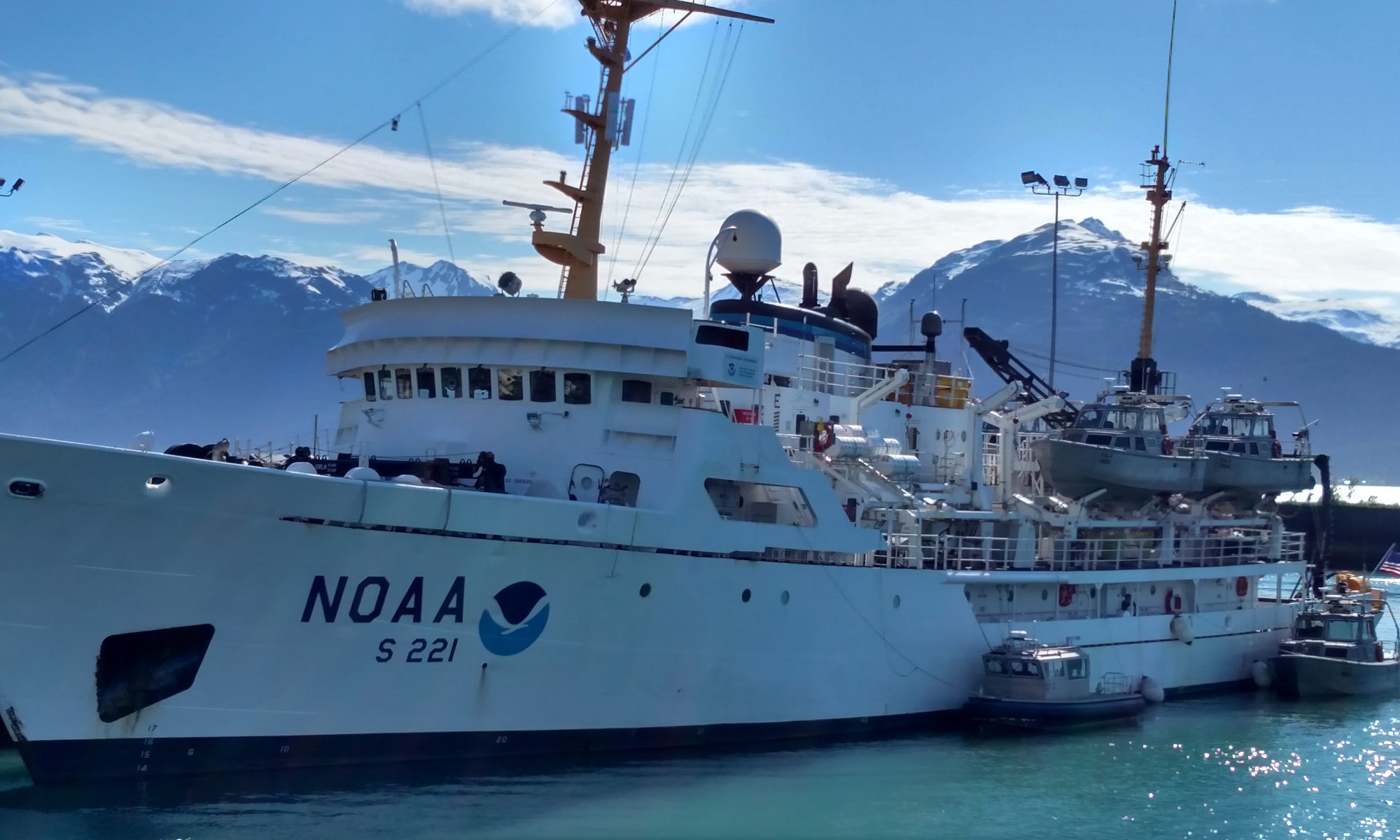
Susan Carty, March 17, 2001

NOAA Teacher at Sea
Susan Carty
Onboard NOAA Ship Ronald H. Brown
March 14 – April 20, 2001

Mission: Asian-Pacific Regional Aerosol Characterization Experiment (ACE-ASIA)
Geographical Area: Western Pacific
Date: March 17, 2001

Today is officially day 3 at sea. We just finished our 8:00 am organization meeting. Each day we post the actual location of the ship. Yesterday we were 26N,161W. Today we will be 34N nd 164 W. Time zone change will occur at around 23:00 hrs. Then we will be 6 hours earlier than the east coast time. We change from zone #10 to zone #11 at 160 W. You can see how just this information alone would be good for an interdisciplinary study with social studies or geography.

We have left the Tradewinds and are now in the Westerlies. Ocean is rougher and
air temp. is much cooler. They expect a period of sun this afternoon and then we could be heading into a rainy front. Last night the rocking of the ship was much more pronounced. I could feel myself rolling around in the bunk. I will try to tape record the sounds at night. They would be perfect for a horror movie. Lots of clanking, groaning, crashing of metal on metal and then water sloshing around. Cool!!!

Today, I had a tour of the bridge. WOW what an awesome sight that is! The technology involved with running this ship is amazing. That will be a place to visit when seas become higher.

The albatross are still following (remember the Rhyme of the Ancient Mariner?)
We had better treat them well.

Today’s testing off the stern was similar to yesterdays. Only today the measurements were not just practice. I learned that the phytoplankton are considered to be “particles” in the sea since they too have influence on the behavior of light in the waters and above the waters. They would definitely be considered to be some of the larger particles. Non the less, they have an impact.

Questions for today: What is a fetch? Why are they different in the Pacific compared to the Atlantic? When sailing, which sea would you prefer to experience and why?

Talk to you tomorrow,
Susan

Susan Carty, March 16, 2001

NOAA Teacher at Sea
Susan Carty
Onboard NOAA Ship Ronald H. Brown
March 14 – April 20, 2001

Mission: Asian-Pacific Regional Aerosol Characterization Experiment (ACE-ASIA)
Geographical Area: Western Pacific
Date: March 16, 2001

First day at sea was terrific! Blue waters like I have never seen. Almost a Royal Blue. We had company off the stern today. Two young albatross having a great time soaring on the air wake behind us.

Questions of the Day: What is so unusual about the albatross? How long can these birds keep flying? Where do they sleep?

A number of practice runs on scientific equipment were performed today. Weather balloon was released (photo to follow) to measure the temperature, pressure, wind speed, humidity, etc.. Later a CTD was lowered into the waters to measure water temperature and conductivity at various depths. (photo to follow)

Two different satellites pass over the ship twice/day. The SeaWifs and the N16. It would be an interesting assignment for students to investigate these satellites in terms of: How they actually work, Who owns and operates them, and What types of images do they produce?

Other scientific was tested as well today. Tomorrow should be the “real thing” with a number of these devices. I will report on them later.

One final exciting happening! A beautiful Mahi Mahi was reeled in off the stern. Actually – no reel was involved, just a thick rope with a lure on the end. Now that’s “Fishin”!

Susan


Susan Carty, March 15, 2001

NOAA Teacher at Sea
Susan Carty
Onboard NOAA Ship Ronald H. Brown
March 14 – April 20, 2001

Mission: Asian-Pacific Regional Aerosol Characterization Experiment (ACE-ASIA)
Geographical Area: Western Pacific
Date: March 15, 2001

We are off into the Pacific! Today and tomorrow we are in the trade winds, so the weather is beautiful! Seas are definitely rolling but it is really like an amusement park ride. Manageable! But, shortly we will be in the Westerlies where they say “batten down the hatches!”  Hope I have my sea legs by then.

Lots of activity on board.  Scientists getting their equipment in order. We had safety drills last night – “Man overboard” and “Abandon ship”. I received my protective gear for the abandon ship drill. Looks like an orange “Gumby “suit.  Lots of safety procedures to learn and respond to.  Ships are very dangerous places!

Sleeping was an interesting exercise. The ships anchor is not attached as securely as it might be. Therefore, we hear loud clinks and clanks during the night. The anti-roll tanks slosh water around particularly when the ship is rocking and rolling. Ear plugs were definitely a necessary piece of gear!

I will let you know what today’s experiments involve if there are any.

Talk to you soon
Susan

Susan Carty, March 14, 2001

NOAA Teacher at Sea
Susan Carty
Onboard NOAA Ship Ronald H. Brown
March 14 – April 20, 2001

Mission: Asian-Pacific Regional Aerosol Characterization Experiment (ACE-ASIA)
Geographical Area: Western Pacific
Date: March 14, 2001

I’m in the hotel in Honolulu getting ready to go to the ship (RON BROWN) for my trip.  We went to the ship yesterday and checked it all out, and I saw my room.  It was fun.  The people seem very nice.  Lots of activity.  People loading food, equipment, and other items.  We spent the whole day with the NOAA camera crew, and we did an interview for the local news last night KHNL (News 8/NBC).

I met my roommate.  We talked a couple times on the phone and via e-mail.  She seems just great.  I also spent some time with Dr. Tim Bates and met some other scientists.  Dr. Bates is very nice.  We also had lunch on the ship yesterday, and the food was good.

Well, I guess this is it; I can’t back out now. It looks like it will be great fun.  It’s beautiful in Honolulu.  I look forward to sending you all e-mail and pictures too.

Susan

Susan Carty, March 10, 2001

NOAA Teacher at Sea
Susan Carty
Onboard NOAA Ship Ronald H. Brown
March 14 – April 20, 2001

Mission: Asian-Pacific Regional Aerosol Characterization Experiment (ACE-ASIA)
Geographical Area: Western Pacific
Date: March 10, 2001

Today, we went to the airport where the C-130 is housed.  The airplane is so awesome and so impressive; it’s overwhelming.  It barely fits in a hanger because it is so big.  We had a great session with Professor Barry Huebert, and he went through the airplane with me and explained all of the different forms of equipment and who designed the equipment, and what it all does. What was really good for me was that everything that Professor Huebert explained to me matched up with what my professor from West Chester gave me about aerosols and the experiments.

It was really exciting to see all of the technicians working on the equipment and getting it connected and hooked up and working on the airplane.  It was a wonderful and awesome experience.  I was also privileged to be able to meet the Department of Commerce Secretary Donald Evans.

Tomorrow we leave for Los Angeles to meet with another scientist; I’ll get a chance to talk to him and interview him and then I’m off to Honolulu.

I’ll write again soon,
Susan