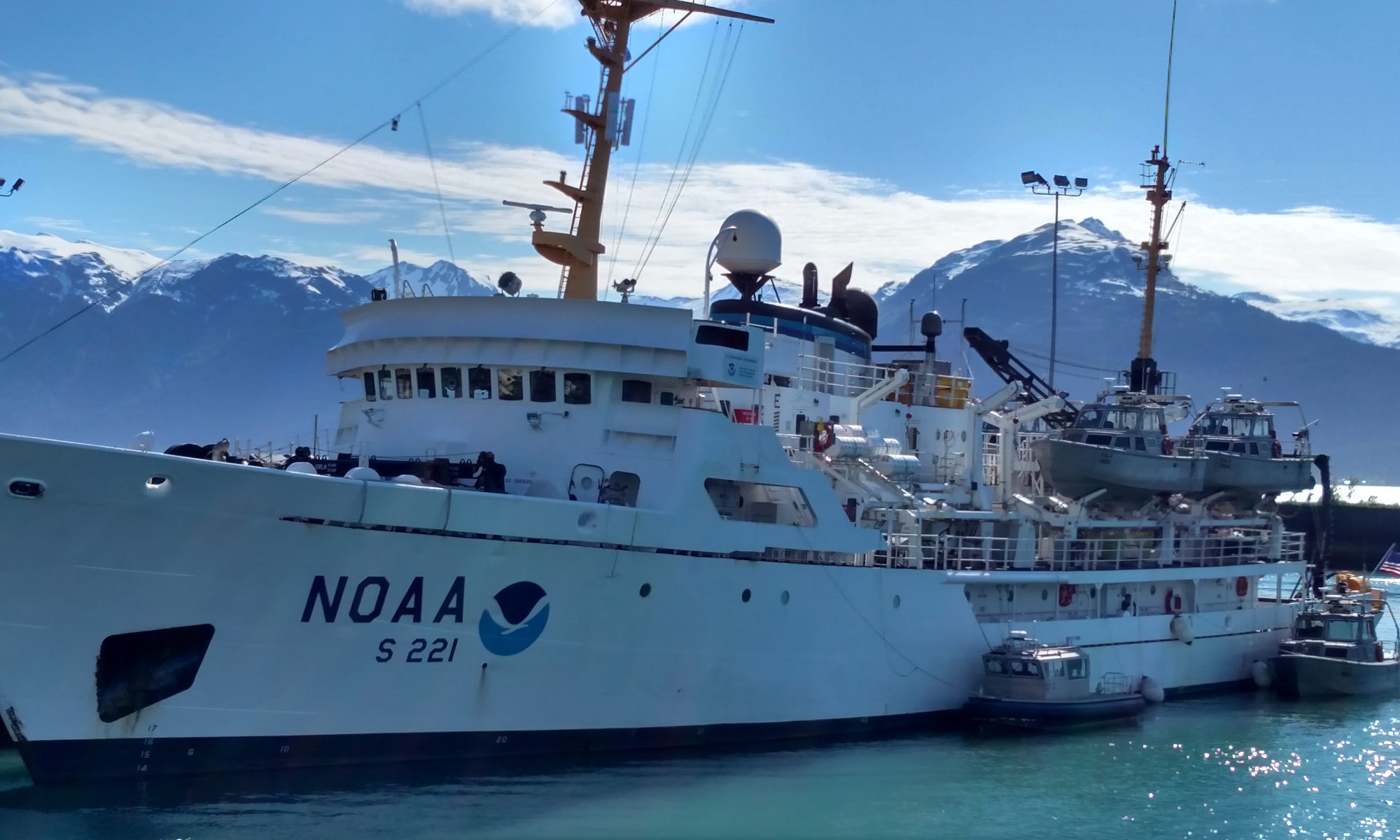
NOAA Teacher at Sea
Jane Temoshok
Onboard NOAA Ship Ronald H. Brown October 2 – 24, 2001
Mission: Eastern Pacific Investigation of Climate Processes Geographical Area: Eastern Pacific Date: October 12, 2001
Latitude: 7 ºS Longitude: 95 ºW Air Temp: 21.2 ºC Sea Temp: 21.1ºC Sea Wave: 3 -4 ft. Swell Wave: 3 – 5 ft. Visibility: 8 miles Cloud cover: 8/8
Science Log
ARGO
An ARGO Float is a small (about 3 feet in length) black tubular shaped instrument that measures temperature and salinity in the water. It’s interesting particularly because it is so simple. The middle part of the instrument, called a bladder, is made of a thick rubber material that can inflated like a balloon. It has a pump inside that inflates or deflates the bladder which changes its volume while keeping the mass the same. A deflated state has an increased density which makes the ARGO sink to a depth of 900 meters below the surface. There it drifts for 10 days collecting data. Then the bladder is inflated so the ARGO rises to the surface and transmits its data to a satellite. When the transmission is complete, it deflates again and begins the whole process anew. This will go on for four years! As part of an international project Dr. Weller, our Chief Scientist, and a group of scientists hope to have 3000 of these in the water all over the world collecting data. We will be deploying a total of 6 at the points marked on the photo. The one you see in the photo was deployed at 2.5 ºS.
An ARGO Float is a small (about 3 feet in length) black tubular shaped instrument that measures temperature and salinity in the water.Map of ARGO float deployments. We will be deploying a total of 6 floats at the points marked on the photo.The ARGO float deployment plan.Dr. Weller, our Chief Scientist, holds an ARGO float.This ARGO float was deployed at 2.5 ºS.
Travel Log
Pilot Whales – My first sighting of whales. So beautiful and graceful. Not good for picture taking though because they blend in so well with the ocean. The weather is fine with a high cloud cover and light winds and no rain.
The crew says this is the calmest water they’ve been in all year! Lucky me!
Question of the day: What would happen to an ordinary styrofoam cup at at depth of 900 m.?
NOAA Teacher at Sea
Jane Temoshok
Onboard NOAA Ship Ronald H. Brown October 2 – 24, 2001
Mission: Eastern Pacific Investigation of Climate Processes Geographical Area: Eastern Pacific Date: October 11, 2001
Latitude: 4 ºS Longitude: 95 ºW Air Temp: 21.0 ºC Sea Temp: 19.0 ºC Sea Wave: 1 – 2 ft. Swell Wave: 3 – 4 ft. Visibility: 10 miles Cloud cover: 8/8
Science Log
Clouds
Today I met with meteorologist Dr, Taneil Uttal from ETL (Environmental Technology Lab) in Boulder, Colorado. She is head of a group that has done cloud studies in the Arctic. On this trip one of the things Dr. Uttal wants to determine is how similar marine clouds are to Arctic clouds. To do this she and her associate Duane Hazen use radiometers and radar which are all packed into a trailer. The whole trailer is on the deck of the RON BROWN. Think of the trailer as a big package of instruments. Duane’s job is to keep the machinery running. In the photo you can see the radar antennae on top of the trailer. It is there to measure the electromagnetic radiation at a certain frequency.
Dr. Taneil Uttal from ETL (Environmental Technology Lab) in Boulder, Colorado.Dr. Uttal’s associate, Duane Hazen.Dr. Uttal and Duane Hazen use radiometers and radar which are all packed into a trailer.In the photo you can see the radar antennae on top of the trailer. It is there to measure the electromagnetic radiation at a certain frequency.
Here is how Dr. Uttal explains what’s going on:
What is a cloud?
________________
A cloud is gazillions of tiny water droplets or ice crystals floating together up in the sky. Some clouds make rain and snow. Some clouds do not. In EPIC we are looking at both kinds of clouds.
What is a Radiometer?
_____________________
Think of a pokemon which has a special power that no other pokemon has. There are many things in the world around us that are just like that. For instance tiny droplets of water floating in the air are beaming certain energies that only water droplets have. If we know what the water droplet energy is like (and we do!), we can measure it and find out how much water there is in a cloud. A radiometer is a special instrument that we have here on the RON BROWN for measuring the special energy of a water droplet so we always know how much water is in the clouds over the ship. The energy of a water droplet can be named by how fast it is. A water droplet has three energies, 20 GHz, 32 GHz and 90 GHz. A GHz is 1,000,000,000 cycles per second.
What is a radar?
_________________
A radar is different from a radiometer because instead of looking for natural energy from something like a water droplet, it beams out its own energy, bounces it off of things in the sky (like water droplets in a cloud), and measures the reflected energy. By looking at the reflected energy, the radar can tell you things about a cloud that are different then what the radiometer tells you. It can tell you about how high a cloud is, how big the droplets are, and how fast the droplets are falling. The radar energy is 35 GHz.
What do you get when you look up with a radar and a radiometer?
_______________________________________________________________
When you put the data from a radar and radiometer together, you can figure out even more things, like how many cloud droplets there are, where the water is located in the cloud, and get an even better guess of how big the droplets are.
What does all this information tell you?
________________________________________
Right now people do not know very much about how clouds reflect sunlight from the sun, reflect warmth that is coming up from the earth, and change things like the temperature on the surface where we live. These things will change depending all the cloud height, how much water it has, how big the droplets are, and how fast they are falling. In EPIC, we want to know which kinds of clouds might make the ocean warmer, and which might make the ocean colder. This can have a big effect on where fish and other ocean animals might want to live and what kind of weather happens over the ocean.
Dr. Uttal is a scientist on board but she is also a mother and wife back in Colorado. Taniel and her husband Rusty, have 2 children – Kalvin, 6th grader at Baseline Middle School and Miranda, a 4th grader at Flatirons Elementary School.
Travel Log
Today I spent time on “the bridge” of the ship. This is the area that controls all the functions of the ship. The captain and his officers are responsible for all that goes on, much like the principal of the school is in charge. The best view can be had from the bridge and there are video cameras that look out over all the decks. The highlight was seeing a pod of porpoises swimming nearby. So graceful! I’m going to keep my eye out for whales.
Question of the Day: What is the fastest creature living in the sea?
NOAA Teacher at Sea
Jane Temoshok
Onboard NOAA Ship Ronald H. Brown October 2 – 24, 2001
Mission: Eastern Pacific Investigation of Climate Processes Geographical Area: Eastern Pacific Date: October 10, 2001
Latitude: 1 ºS Longitude: 95 ºW Air Temp: 22.5 ºC Sea Temp: 19 ºC Sea Wave: 0 – 1 ft. Swell Wave: 3 – 4 ft. Visibility: 8 miles Cloud cover: 6/8
Science Log
Everyone was working in full swing today. Weather balloons being released, water samples being collected, data from every possible source was being analyzed. The big event of the day though, was coming upon the first buoy. A buoy is relatively small, about the size of a small monkey bar set – just big enough for one or two people to climb onto. It has a long rope with an anchor attached at the bottom so it is supposed to stay put. But many times the currents and winds are too strong and it drifts a bit, making it hard to find in the big ocean. Fortunately, it has a sensor on it that helps the ship locate it. This buoy was placed out here last year. It is full of sensors that store information like temperature and salinity (how much salt is in the water) and winds. Using that information, scientists can chart even the smallest changes over long periods of time. Unfortunately this buoy was damaged a while ago and stopped transmitting. Perhaps a ship ran into it or maybe a shark took a bite out it. Today 2 scientists went out in a small boat (see photos) and climbed aboard the buoy and repaired it. Lucky for them, the seas were very calm, but even so, it is very dangerous work. They found the buoy quite damaged probably from a collision with a ship. The buoy was fixed and is now transmitting again.
The sea was very calm, but even so, repairing a buoy is dangerous work.Two scientists traveled to the buoy in a small boat and climbed aboard to repair it. They found the buoy quite damaged, probably from a collision with a ship.The scientists fixed the buoy and now it is transmitting again.
Travel Log
Repairing the buoy took about 2 hours. During that time some of the crew enjoyed fishing off the back of the boat. As Jennifer mentioned in her logs, the bottom of the buoy and the rope that leads down to the anchor act as a special habitat for sea life. Barnacles and mussels attach themselves to the rope and then small fish come to feed on them, The food chain grows quite large so that in a year’s time many big fish, including sharks, can often be seen by a buoy. Today one of the crew caught a 25 pound mahi which was deliciously grilled up for dinner.
Today we also had our first emergency drills. Each person on board is responsible for knowing what to do, where to go, and what to bring for each of the three types of emergencies. The first is your basic fire drill. But since you can’t get off the ship easily, you have to know where to go to be safe. The second one is the “abandon ship” drill. This one is tough because each person must get to her room, put on a life vest, and carry a large orange duffle bag with your “gumby” suit in it down to a lifeboat. A gumby suit is a big bulky rubbery suit that will keep you warm and dry if you have to go into the water. You put it on right over your clothes and it’s really tough to do. I was told that it will be even be harder to do in the middle of a dark and cold night! The last drill is the “man overboard” alarm. What do you do if you were to see someone fall off the ship? Three things: keep your eye on him, throw something in the water that will float like a life ring, and yell for help. Safety is a big concern when you are on a ship.
Question of the Day: How does the ship get fresh water for its passengers?
NOAA Teacher at Sea
Jane Temoshok
Onboard NOAA Ship Ronald H. Brown October 2 – 24, 2001
Mission: Eastern Pacific Investigation of Climate Processes Geographical Area: Eastern Pacific Date: October 9, 2001
Latitude: 1º S Longitude: 92º W Temperature: 84º F Seas: Calm in port
Science Log
There is a flurry of activity getting ready for departure. The crew is very focused checking that everything (and I mean everything!) is strapped down tightly. Then the authorities come on board to check passports and do an inspection. If all is in order we will be on our way shortly.
Photos: Any job that requires moving things around on the deck is overseen by Bruce Cowden, the Chief Bosun. In the first photo you can see Bruce hoisting the gangway, and in the second he is leaning overboard to watch the lifting of the anchor.
Bruce Cowden, the Chief Bosun, hoists the gangway.Bruce Cowden leaning overboard to watch the lifting of the anchor.
Travel Log
We are now underway! The gangplank has been raised, the anchor (all 270 meters of it) is lifted and the ship is moving out to sea. Most everyone is standing on the decks outside taking their last photos of these fabulous islands. Goodbye Galapagos! Goodbye to Lonesome George (a huge turtle that is the last of his kind) and all the other gentle giants. Goodbye to all the beautiful herons, frigates, and blue-footed boobies! And finally, goodbye to all the friendly inhabitants of these islands that are working to preserve them for the future.
NOAA Teacher at Sea
Jane Temoshok
Onboard NOAA Ship Ronald H. Brown October 2 – 24, 2001
Mission: Eastern Pacific Investigation of Climate Processes Geographical Area: Eastern Pacific Date: October 2, 2001
Just got back from a fabulous C-130 flight! It was a long day but well worth it. The video and digital pictures will be amazing. They let me fly the plane!!!!! for real!!!! Then I dropped several air expendable bathythermographs (EXBT) – in other words big plastic tubes out of a hole in the floor of the plane.
The chief scientist, Nick Bond, also gave me a job to do which required using the onboard computers to note the exact time and longitude of each drop. The plane “porpoised” for 6 hours to just south of the equator. Porpoising means we flew at an altitude of 5000 feet for 7 min. and then descended to 100 feet! for 7 minutes and then back up to 5000 ft. Of course Dr. Kermond filmed everything so there will be lots to see. Everybody on board was very accommodating.
Please share my historic flight with my students tomorrow. I’m sure they will be impressed. We did fly over the RON BROWN – just barely because we were only at 100 ft! Then on our way back I was able to speak with Jennifer via the cockpit radio. Very exciting.