Emily Whalen: Station 381–Cashes Ledge, May 1, 2015

NOAA Teacher at Sea
Emily Whalen
Aboard NOAA Ship Henry B. Bigelow
April 27 – May 10, 2015

Mission: Spring Bottom Trawl Survey, Leg IV
Geographical Area of Cruise: Gulf of Maine

Date: May 1, 2015

Weather Data from the Bridge:
Winds:  Light and variable
Seas: 1-2ft
Air Temperature:   6.2○ C
Water Temperature:  5.8○ C

Science and Technology Log:

Earlier today I had planned to write about all of the safety features on board the Bigelow and explain how safe they make me feel while I am on board.  However, that was before our first sampling station turned out to be a monster haul!  For most stations I have done so far, it takes about an hour from the time that the net comes back on board to the time that we are cleaning up the wetlab.  At station 381, it took us one minute shy of three hours! So explaining the EEBD and the EPIRB will have to wait so that I can describe the awesome sampling we did at station 381, Cashes Ledge.

This is a screen that shows the boats track around the Gulf of Maine.  The colored lines represent the sea floor as determined by the Olex multibeam.  This information will be stored year after year until we have a complete picture of the sea floor in this area!
This is a screen that shows the boats track around the Gulf of Maine. The colored lines represent the sea floor as determined by the Olex multibeam. This information will be stored year after year until we have a complete picture of the sea floor in this area!

Before I get to describing the actual catch, I want to give you an idea of all of the work that has to be done in the acoustics lab and on the bridge long before the net even gets into the water.

The bridge is the highest enclosed deck on the boat, and it is where the officers work to navigate the ship.  To this end, it is full of nautical charts, screens that give information about the ship’s location and speed, the engine, generators, other ships, radios for communication, weather data and other technical equipment.  After arriving at the latitude and longitude of each sampling station, the officer’s attention turns to the screen that displays information from the Olex Realtime Bathymetry Program, which collects data using a ME70 multibeam sonar device attached to bottom of the hull of the ship .

Traditionally, one of the biggest challenges in trawling has been getting the net caught on the bottom of the ocean.  This is often called getting ‘hung’ and it can happen when the net snags on a big rock, sunken debris, or anything else resting on the sea floor.  The consequences can range from losing a few minutes time working the net free, to tearing or even losing the net. The Olex data is extremely useful because it can essentially paint a picture of the sea floor to ensure that the net doesn’t encounter any obstacles.  Upon arrival at a site, the boat will cruise looking for a clear path that is about a mile long and 300 yards wide.  Only after finding a suitable spot will the net go into the water.

Check out this view of the seafloor.  On the upper half of the screen, there is a dark blue channel that goes between two brightly colored ridges.  That's where we dragged the net and caught all of the fish!
Check out this view of the seafloor. On the upper half of the screen, there is a dark blue channel that goes between two brightly colored ridges. We trawled right between the ridges and caught a lot of really big fish!

The ME70 Multibeam uses sound waves to determine the depth of the ocean at specific points.  It is similar to a simpler, single stream sonar in that it shoots a wave of sound down to the seafloor, waits for it to bounce back up to the ship and then calculates the distance the wave traveled based on the time and the speed of sound through the water, which depends on temperature.  The advantage to using the multibeam is that it shoots out 200 beams of sound at once instead of just one.  This means that with each ‘ping’, or burst of sound energy, we know the depth at many points under the ship instead of just one.  Considering that the multibeam pings at a rate of 2 Hertz to 0.5 Herts, which is once every 0.5 seconds to 2 seconds, that’s a lot of information about the sea floor contour!

This is what the nautical chart for Cashes Ledge looks like. The numbers represent depth in fathoms.  The light blue lines are contour lines.  The places where they are close together represent steep cliffs.  The red line represents the Bigelow’s track. You can see where we trawled as a short jag between the L and the E in the word Ledge

The stations that we sample are randomly selected by a computer program that was written by one of the scientists in the Northeast Fisheries Science Center, who happens to be on board this trip.  Just by chance, station number 381 was on Cashes Ledge, which is an underwater geographical feature that includes jagged cliffs and underwater mountains.  The area has been fished very little because all of the bottom features present many hazards for trawl nets.  In fact, it is currently a protected area, which means the commercial fishing isn’t allowed there.  As a research vessel, we have permission to sample there because we are working to collect data that will provide useful information for stock assessments.

My watch came on duty at noon, at which time the Bigelow was scouting out the bottom and looking for a spot to sample within 1 nautical mile of the latitude and longitude of station 381.  Shortly before 1pm, the CTD dropped and then the net went in the water.  By 1:30, the net was coming back on board the ship, and there was a buzz going around about how big the catch was predicted to be.  As it turns out, the catch was huge!  Once on board, the net empties into the checker, which is usually plenty big enough to hold everything.  This time though, it was overflowing with big, beautiful cod, pollock and haddock.  You can see that one of the deck crew is using a shovel to fill the orange baskets with fish so that they can be taken into the lab and sorted!

You can see the crew working to handling all of the fish we caught at Cashes Ledge.  How many different kinds of fish can you see?
You can see the crew working to handling all of the fish we caught at Cashes Ledge. How many different kinds of fish can you see? Photo by fellow volunteer Joe Warren


At this point, I was standing at the conveyor belt, grabbing slippery fish as quickly as I could and sorting them into baskets.  Big haddock, little haddock, big cod, little cod, pollock, pollock, pollock.  As fast as I could sort, the fish kept coming!  Every basket in the lab was full and everyone was working at top speed to process fish so that we could empty the baskets and fill them up with more fish!  One of the things that was interesting to notice was the variation within each species.  When you see pictures of fish, or just a few fish at a time, they don’t look that different.  But looking at so many all at once, I really saw how some have brighter colors, or fatter bodies or bigger spots.  But only for a moment, because the fish just kept coming and coming and coming!

Finally, the fish were sorted and I headed to my station, where TK, the cutter that I have been working with, had already started processing some of the huge pollock that we had caught.  I helped him maneuver them up onto the lengthing board so that he could measure them and take samples, and we fell into a fish-measuring groove that lasted for two hours.  Grab a fish, take the length, print a label and put it on an envelope, slip the otolith into the envelope, examine the stomach contents, repeat.

Cod, pollock and haddock in baskets
Cod, pollock and haddock in baskets waiting to get counted and measured. Photo by Watch Chief Adam Poquette.

Some of you have asked about the fish that we have seen and so here is a list of the species that we saw at just this one site:

  • Pollock
  • Haddock
  • Atlantic wolffish
  • Cod
  • Goosefish
  • Herring
  • Mackerel
  • Alewife
  • Acadian redfish
  • Alligator fish
  • White hake
  • Red hake
  • American plaice
  • Little skate
  • American lobster
  • Sea raven
  • Thorny skate
  • Red deepsea crab


I think it’s human nature to try to draw conclusions about what we see and do.  If all we knew about the state of our fish populations was based on the data from this one catch, then we might conclude that there are tons of healthy fish stocks in the sea.  However, I know that this is just one small data point in a literal sea of data points and it cannot be considered independently of the others.  Just because this is data that I was able to see, touch and smell doesn’t give it any more validity than other data that I can only see as a point on a map or numbers on a screen.  Eventually, every measurement and sample will be compiled into reports, and it’s that big picture over a long period of time that will really allow give us a better understanding of the state of affairs in the ocean.

Sunset from the deck of the Henry B. Bigelow

Personal Log

Lunges are a bit more challenging on the rocking deck of a ship!

It seems like time is passing faster and faster on board the Bigelow.  I have been getting up each morning and doing a Hero’s Journey workout up on the flying bridge.  One of my shipmates let me borrow a book that is about all of the people who have died trying to climb Mount Washington.  Today I did laundry, and to quote Olaf, putting on my warm and clean sweatshirt fresh out of the dryer was like a warm hug!  I am getting to know the crew and learning how they all ended up here, working on a NOAA ship.  It’s tough to believe but a week from today, I will be wrapping up and getting ready to go back to school!

Theresa Paulsen: Mission Accomplished, April 2, 2015

NOAA Teacher at Sea
Theresa Paulsen
Aboard NOAA Ship Okeanos Explorer
March 16-April 3rd

Mission: Caribbean Exploration (mapping)
Geographical Area of Cruise: Puerto Rico Trench
Date: April 2, 2015

Weather Data from the Bridge: Partly Cloudy, 26 C, Wind speed 12 knots, Wave height 1-2ft, Swells 2-4ft.

Science and Technology Log:

What are the mappers up to?

After we completed our two priority areas of the cruise, the mappers have been using Knudson subbottom sonar to profile the bottom of the trench. Meme Lobecker, the expedition coordinator sends that data directly to the United States Geological Survey (USGS) for processing. They returned some interesting findings.

The subbottom sonar sends a loud “chirp” to the bottom. It penetrates the ocean floor. Different sediment layers reflect the sound differently so the variation and thickness of the layers can be observed. The chirp penetration depth varies with the sediments. Soft sediments can be penetrated more easily. In the picture below, provided by USGS, you can see hard intrusions with layers of sediments filling in spaces between.

image
The intrusions are basement relief, likely uplifting deformation ridges created by the subduction of the North American Plate. The subduction is now oblique, with the North American and Caribbean plates mostly sliding past each other now – sort of like the San Andreas Fault – but there is still some subduction happening. Subbottom Image and caption courtesy of USGS.

How does the bathymetry look?

In the last two days, I have been really enjoying the incredible details in the bathymetry data the multibeam sonar has gathered. We mapped over 15,000 square miles on our voyage! Using computer software we can now look at the ocean floor beneath us. I tried my hand at using Fledermaus software to make fly-over movies of the area we surveyed (or should I say swim-over movies). Check them out:

I also examined some of the backscatter data. In backscatter images soft surfaces are darker, meaning the signal return is weaker, and the hard surfaces are whiter due to stronger returns. One of the interns, Chelsea Wegner, studied the bathymetry and backscatter data for possible habitats for corals. She looked for steep slopes in the bathymetry and hard surfaces with the backscatter, since corals prefer those conditions.

Intern poster project
Intern Poster Project by Chelsea Wegner

Chelsea Wegner Poster (pdf)

On the next leg, the robotic vehicle on the ship will be used to examine some of the areas we were with high-definition cameras. You can watch the live stream here. You can also see some of the images and footage from past explorations here.
This is a short video from the 2012 expedition to the Gulf of Mexico to tempt you into tuning in for more.

Personal Log:

The people on this vessel have been blessed with adventurous spirits and exciting careers. Throughout the cruise, I heard about and then came to fully understand the difficulty of being away from family when they need us.

I would like to dedicate this last blog to my father, Tom Wichman. He passed away this morning at 80 years of age after battling more than his share of medical issues.  As I rode the ship in today I felt him beside me. Together we watched the pelicans and the boobies fly by. I am very glad I was able to take him on a “virtual” adventure to the Caribbean. He loved the pictures and the blog. I thank the NOAA Teacher at Sea program for helping me make him proud one last time.

My parents
My Parents, Tom and Kate Wichman

“To know how to wonder is the first step of the mind toward discovery” – L. Pasteur. These words decorate my classroom wall but are epitomized by the work that the NOAA Okeanos Explorer and the Office of Exploration and Research (OER) do each day.

Thank you to the Meme, the CO, XO, the science team, and the entire crew aboard the Okeanos for teaching me as much as you did and for helping me get home when I needed to be with family. I wish you all the best as you continue to explore our vast oceans! My students and I will be watching and learning from you!

I would also like to thank all of the people who followed this blog. Your support and interest proves that you too are curious by nature. Life is much more interesting if you hold on to that sense of wonder, isn’t it?

Answers to My Previous Questions of the Day Polls:

1.  Bathymetry is the study of ocean depths and submarine topography.

2. The deepest zone in the ocean is called the hadal zone, after Hades the Greek God of the underworld.

3.  It takes the vessel 19 hours and 10 minutes to make enough water for 46 people each using 50 gallons per day if each of the two distillers makes 1 gallon per minute.

4.  NOAA line offices include:

  • National Environmental Satellite, Data, and Information Service
  • National Marine Fisheries Service
  • National Ocean Service
  • National Weather Service
  • Office of Marine & Aviation Operations
  • Office of Oceanic and Atmospheric Research

5. The pressure on the a diver at 332.35m is 485 pounds per square inch!

6.  The deepest part of the Puerto Rico Trench is known as the Milwaukee Deep.

Thank you for participating!  I hope you learned something new!

Theresa Paulsen: Where There is a Will, There is a Way! April 1, 2015

NOAA Teacher at Sea
Theresa Paulsen
Aboard NOAA Ship Okeanos Explorer
March 16-April 3rd

Mission: Caribbean Exploration (Mapping)
Geographical Area of Cruise: Puerto Rico Trench
Date: April 1, 2015

Weather Data from the Bridge:  Partly Cloudy, 26˚C, waves 1-3ft, swells 3-6ft.

Science and Technology Log:

Dr. Wilford (Bill) Schmidt has demonstrated the saying, “Where there is a will, there is a way,” throughout this  entire cruise.  He knew this voyage would put his new free vehicle design to the test and he came prepared to modify this, tweak that, collaborate with the crew, confer with his university team, test, and repeat.  He is an engineer and that is the name of the game.

1.  The first deployment looked great. The vehicle reached 1000m.  The magnetometer and 3-axis accelerometer worked great.  All systems were a go.  A water sampling device was used as a dummy payload.

FV Dummy Test
The free vehicle with a water sampling device as a dummy payload.


Test Data
Data from the Test Deployment


Crossing fingers for more success.

2.  The next step was to attach a CTD (a probe that measures Conductivity, Temperature, Depth).  The deployment and retrieval process again went smoothly, this time to 2126m, but there was a problem retrieving the log file from the bottom sphere and one of the anchor burn wires did not burn.


FV with CTD
The free vehicle with CTD attached.

Collaboration required with folks on shore and the electronics technicians on this ship.  Tweak this, fix that.

Troubleshooting
Dave Blessing, Electronics Tech, and Bill Schmidt troubleshooting.

Bill opened the spheres to change the batteries for the satellite transponder.

Open Sphere
One of the opened spheres
Keeping a log
Zamara Fuentes keeping a log of all of the adjustments and parameters
Repressurizing the sphere
Rolf Vieten pressurizing the sphere

All systems were a go again.

3.  The crew deployed the free vehicle with the CTD to 4679 m.  It took a little longer to find and retrieve the vehicle.

FV Retrieval
Retrieval of the free vehicle

The data files indicated that the galvanic releases released the anchor prematurely, at about 100 meters from the bottom.  Both spheres worked during the mission.  Data files were retrieved from each.  During inspection water was found in the bottom sphere.  Spalling of the glass (flaking) was seen on the inside.  The leak is assumed to have taken place as the surface under low pressure conditions, otherwise the damage would have been worse.  The electronics were in good shape but the bottom sphere had to be retired.

Oh no!  Is that the end?  Not when you have great minds on board!

This is where engineering in the ocean environment gets tricky.  Bill can’t just head back to the university and make the necessary repairs.  Instead he needs to make use of the very valuable ship time by pinch-hitting.  Bill recalculated the buoyant force on the vehicle with only one sphere.  It might just work!

Tweak this, lighten that, new attachments there. Ready for a float test!

Single sphere float test
The single sphere float test was a success!

Will the single sphere allow it to ascend from the bottom fast enough for us to deploy and retrieve it during our mission?  That question required further testing.  So the crew planned to lower it into the water a short distance with the winch and allow it to float back up.  The weather would not allow it.  The seas were too rough to allow the ship to stay in one place during the vehicle test without dragging the free vehicle thereby negating the results of the test.

Operations team meeting

Plan B?  The operations team hatched a plan to tie the free vehicle to buoys on a long rope.  That allowed the vehicle to sink and be recovered easily if it rose too slowly. First a buoyancy test had to be done to make sure the buoys wouldn’t sink with the vehicle.

Buoy Float Test
Buoy float test

The vehicle rose in less than 10 minutes so the team was back on track!  With a few extras like flags for better visibility, the vehicle was ready to dive!

Preparing for the big dive to 8000+ meters!

4.  The deployment into the trench went smoothly.  The crew had that routine down pat.  After 10 hours it was time for the retrieval.  Everyone gathered at the bridge to try to spot it.

FV lookout
On the lookout for the free vehicle.
Port side lookouts
Port side lookouts
Free Vehicle Returns
The free vehicle returns from the deep!

It successfully collected data down to the bottom at 8379m, a possible record for a free vehicle!

Successful Dive
Bill content with a successful dive

The CTD data was processed and looked great during the descent.

FV CTD data
Free vehicle CTD data from the Puerto Rico Trench

Inspection of the data log showed that while the vehicle was ascending from the bottom, something was triggering a mission cancel order – 28 times!  This bug required more testing and mission simulating before another deployment in the trench.  Just after 8pm, Bill announced his equipment was ready to go for a 6 am deployment the next day.

5.  The next day, the retrieval took a bit longer due to choppier sea conditions.

The crew bringing the free vehicle aboard.

Again the vehicle logs showed “cancel mission” messages during the ascent.  It is confounding Bill and his team back home, because during mission simulations the mission goes to completion without a problem.

In all the voyage has been very constructive for Bill’s engineering team.   They successfully deployed the vehicle to the bottom of the Puerto Rico Trench known to be the deepest part of the Atlantic Ocean.  That is something to celebrate!  They have learned a great deal about what types of modifications they should make to improve the retrieval process.

This was a great first test of the free vehicle design.  The next time out at sea will come soon enough and Bill’s team will be ready!

Personal Log

As the voyage comes to an end and we travel nearer to shore, I am filled with mixed emotions.  I will miss the ocean, the feeling of being a part of an exploration expedition, and these people.  I am also very happy to be going home to my family and my students.  I am looking forward to sharing what I have learned.  I will be looking for partnerships to help get students involved in reseach on our inland sea, Lake Superior.  If you have any suggestions, please leave a comment below!

Exciting moments?  Seeing these creatures!

Whale
Small whale swimming next to the vessel.
Dolphin
A dolphin playing in our wake. Photo credit: Jossue Millan

Other great moments include driving the ship and making video fly-bys of the ocean floor with the bathymetry and backscatter data.  Very awesome!  The videos will be coming soon so stay tuned!

Did you know?

Do you remember the flying fish I wondered about a few blogs ago?  I have never seen them before.  At first I thought I was seeing things.  I thought I saw a very large dragonfly dive into the water.  Then I saw more.  – schools of them jumping away from the boat all at once.  In a blink of an eye they were gone.

A flying fish.  Image courtesy of “Bermuda: Search for Deep Water Caves 2009 Exploration,”  NOAA Ocean Explorer

According to Wikipedia, there are 64 species of flying fish!  They fly out of the water to evade predators.  That’s a pretty cool adaptation!  You can learn more here.

Question of the Day:

Theresa Paulsen: How Low Can You Go? March 29, 2015

NOAA Teacher at Sea
Theresa Paulsen
Aboard NOAA Ship Okeanos Explorer
March 16-April 3rd

Mission: Caribbean Exploration (Mapping)
Geographical Area of Cruise: Puerto Rico Trench
Date: March 29, 2015

Weather Data from the Bridge:  Partly Cloudy, 26.7˚C, waves 1-3ft, swells 2-4ft.

Science and Technology Log:

We launched and recovered a CTD earlier this week.

A CTD (Conductivity, Temperature and Depth probe) is used to study the characteristics of ocean water masses, as well as to insure data quality and accuracy from XBTs (Expendible Bathythermograph). In a previous blog, I discussed how the XBT is used to measure the temperature of the water to a depth of about 760 meters. That coupled with the conductivity sensors on the vessel are used to calculate salinity and pressure to derive a measure of the velocity of sound through water, an important factor when collecting sonar data.

An XBT can be launched while the vessel is underway without pausing the sonar, but it doesn’t collect data all the way to the bottom of the water column.

Launching an XBT
Trying my hand at launching an XBT

A CTD can go all the way to the bottom, depending on the depth of the ocean, the length of the tether cable, and the pressure rating of the frame and equipment making up the CTD.  The titanium frame and equipment making up the CTD currently aboard the Okeanos can be lowered to 6500 meters.   It is very large and requires the vessel to stay put during the entire process since it is tethered to the ship.

Since a CTD collects all three factors involved in the computation of speed of sound in water (salinity, temperature, and depth) and is therefore more accurate than an XBT which only collects temperature, it is used at least annually to provide comparison data for the XBT measurements. This is the reason our scientists used it on this cruise.  Additionally, scientists on board a vessel may want to deploy a CTD more often if water masses are expected to change, or if they are interested in studying other features of the water column such as particulates, gaseous seeps, dissolved oxygen or oxygen reduction potential, or if they want to collect water samples at different depths.

The CTD
Survey Tech, Scott Allen and the CTD.

In the above photo the small red arrow is pointing to the water sample tubes, the large blue arrow to the CTD, and the large red arrow to the altimeter which senses when the probe is within 200 meters from the bottom allowing winch operators to slow the descent to avoid damaging equipment.  Scott Allen is the Survey Tech on board.  His job is to maintain and calibrate the CTD.  He helps launch and recover the CTD and then operates the software to collect and process the data.

CTD Data
Our first CTD launch data.

The CTD software plots the temperature (green), sound velocity (pink), conductivity (yellow), and the salinity (blue) on the x-axes against depth on the y-axis.  You can see locations on the graph where the values for temperature and salinity shift in a significant way with changes in depth.  These shifts can indicate a boundary between different water masses.  The upward spikes in the data are likely caused by some error in the equipment connections.

Let’s conduct an experiment!

Have you ever wondered what would happen to a styrofoam cup if you lowered into the water 2100 meters? The folks here tell me you get some pretty interesting results, so we had to give it a try.

Problem:  Determine the effect of extreme pressure on a styrofoam cups.

Background:  Styrofoam, properly called expanded polystyrene foam, is made by infusing air into polystyrene (a synthetic polymer) using blowing agents. Learn more here.

Hypothesis:  What is your hypothesis?  What do you think will happen to the air pockets if we send the cups to the depths of the ocean?

Procedure:

1.  Decorate your cups, leaving one as a control for comparison after submersion.

Styrofoam Cups
Decorating 12 oz styrofoam cups
Cup Decorations
More cup designs

The Before Picture

2.  Place the cups in a mesh dive bag and attach to a CTD.

Cups ready
Our cups are ready to dive!

3. Lower the CTD to 2100 meters

Launching the CTD
Launching the CTD

4.  Raise the CTD and examine the cups.

Raising the CTD
Raising the cups and CTD

Analysis:

So how much pressure was exerted on the cups at 2100 meters?  We can use this formula to calculate it:

P = pgh

Pressure in a fluid = (density of water) x (acceleration due to gravity) x (height of the fluid above the object).

If the density of seawater is 1027 kg/cubic meter, the acceleration due to gravity is 9.8 m/s/s and the depth is 2100 meters, what is the pressure?

You should get 21 million Pascals (Newtons/square meters) or 21,000 kPa.  If 1 kPa = 0.145 psi, how many pounds of pressure per square inch are exerted on each cup?   About 3000 pounds per square inch.  That’s about the weight of a compact car over each square inch!  For comparison, at sea level the atmospheric pressure is 14.7 psi.

So what happened to our cups under all that pressure?  Check it out!

Cups after dive
Our cups after a dive to 2100m. They are tiny!
Shrunken cups
More shrunken cups.
Shrunken cups
Showing off my shrunken cups.

Conclusion:

Was your hypothesis supported or refuted?  What happened to the air trapped in the styrofoam?

Air extraction is the reason that Dr. Wilford Schmidt uses iron rebar rather than cement to provide the anchor for his free vehicles.  The cement crumbles as the air pockets give way and air is squeezed out.  Cement is not as flexible as the polystyrene.

Free Vehicle
The free vehicle with rebar anchor

What other materials might change under pressure?  If you don’t have access to the deep ocean or a CTD, you could always try a pressure cooker – but be safe!

Personal Log:

I am inspired by all the people working on this vessel.  They are so adventurous and have seen so much.  I wondered what inspired them to do what they do.  Here are some of their answers:

Mapping Intern, Kristin Mello:  Took a class in scuba diving and realized she loved it and wanted to learn more.  Her dive instructor encouraged her to do an internship as a research diver and she has been studying the ocean ever since.

Free Vehicle Tech, Zamara Fuentes:  Built a model of a volcano in school became very interested in geology.  Now she studies tsunami impacts on the Caribbean islands.

NOAA Corps Officer, Nick Pawlenko:  Had never really spent much time on boats as a kid, but was inspired by Clive Cussler novels to explore the ocean.

Expedition Coordinator, Meme Lobecker: Her love of the oceans made her want to put her geography skills and interest in data collection to work in the ocean environment.

Engineer, Chris Taylor:  Wanted to put his love of engineering to work for good pay.  “There is never a dull moment,” he says.

Mapping Watch Lead, Melody Ovard:  Just likes being near the ocean.  “It’s a proximity thing.  I am curious about what goes on in it,” she says.

Free Vehicle Scientist, Bill Schmidt:  Loved surfing and was interested to learn what caused the changes in the surfing conditions day-to-day.  Then he read Willard Bascom’s book, Waves and Beaches, and was hooked.

NOAA Corps Officer, Bryan Pestone:  Swimming competitively and lifeguarding on the beach led him to a degree in marine biology.

Mapping Intern, Jossue Millan:  An astrobiology poster caught his eye in his physics class, which peaked his interest in life in extreme environments.  He enjoys the interdisciplinary sciences.

Teacher at Sea, Theresa Paulsen:  I am inspired by the wonder in a kid’s eye or on a proud parent’s face and by the beauty that surrounds us from the depths of the oceans to the expanses of space.  Life is amazing – and far too short to waste, so we have to make the most of it while we can.

Sunset Image
Thanks for the inspiring conversation everyone!

What inspires you?  Post a comment and let me know!

Did You Know?

For every 10 meters you go below the surface, pressure increases by one atmosphere (14.7 psi).  Scuba instructors typically don’t recommend diving deeper than 40m to decrease the risk of decompression sickness, known as “the bends,” or equipment failures that could lead to drowning.

Question of the Day:

The deepest successful dive in the Guiness Book of World Records is currently 332.35 meters (1090ft)!  Yikes!  Read about it here.

Theresa Paulsen: Ship Navigation, March 28, 2015

NOAA Teacher at Sea
Theresa Paulsen
Aboard NOAA Ship Okeanos Explorer
March 16 – April 3, 2015

Mission: Caribbean Exploration (Mapping)
Geographical Area of Cruise: Puerto Rico Trench
Date: March 28, 2015

Weather Data from the Bridge: Scattered Clouds, 26˚C, Wind speed 13-18 knots, Wave height 5-7ft

Science and Technology Log

Mapping of our first priority area is now compete and we have moved to the priority two area on the north side of the Puerto Rico Trench.  We are more than 100 miles from shore at this point.  Land is nowhere in sight.  Able-Bodied Seaman Ryan Loftus tells me that even from the bridge the horizon is only 6.4 nautical miles away due to the curvature of the earth.  At this point with no frame of reference other than celestial bodies, navigation equipment becomes essential.

The ship uses Global Positioning Systems, GPS units:

GPS Units
GPS Units aboard the vessel

Radar:

Radar display
The radar display.


On the radar display, we are in the center of the circle. Our heading is the blue line. Since this photo was taken near shore, the yellow patches on the bottom indicate the land mass, Puerto Rico. The two triangles with what look like vector lines to the left of us are approaching vessels. On the right, the Automated Identification System displays information about those vessels, including their name, type, heading and speed.  The radar uses two radio beams, an S-Band at 3050 MHz and an X-band at 9410 MHz, to determine the location of the vessel relative to other vessels and landmarks within a 1% margin of error.

Gyrocompasses:

A gyrocompass
A gyrocompass

A standard compass points to the magnetic north pole rather than true north, therefore mariners prefer to use gyrocompasses for navigation.  Before departing, a gyrocompass is pointed to true north.  Using an electric current, the gyroscope in the device is spun very fast so that it will continually maintain that direction during the voyage.  Slight errors build up over time and must be corrected.  The watch standers post the necessary correction on the bridge.  Since the device is electronic, it can feed data into the system allowing for automated navigation and dynamic positioning systems to work well.

ECDIS Screen
The Electronic Chart Display Information System (ECDIIS) Screen

On the Electronic Chart Display Information System (ECDIS) screen, watchstanders can view the course planned by the Expedition Coordinator in charge of the science conducted on the voyage (in red), see the bearing they have set (thin black line), and see the actual course we are on (the black, dashed, arrowhead line).

The Dynamic Postioning System
The Dynamic Positioning System

The dynamic positioning system allows the vessel to remain in one spot in very delicate situations, such as when they lower a tethered device like the robotic vehicle they will be using on the next cruise or a CTD (Conductivity, Temperature and Depth probe).  It is also helpful for docking.

The electronics are able to control the ship due to the ingenious way the engine system is designed.  The diesel engine powers generators that convert the mechanical energy into electrical energy.  This way electrical energy can be used to control main hydraulic propellers at the stern as well as electric bow and side thrusting propellers.

This slideshow requires JavaScript.

What happens if the power goes out and the electronic navigation devices fail?  There are back ups – no worries, students and family!!

The vessel can sail onward.  It is equipped with a magnetic compass and the watchstanders are well versed in reading charts, using a sextant, and plotting courses by hand – they often do that just to check the radar and GPS for accuracy.

The magnetic compass
The superimposed red arrow is directing your attention to the magnetic compass above the bridge.
Using Nautical Charts
Operations Officer, Lt. Emily Rose cross checking the radar and GPS with nautical charts.
Using a Sextant
Seaman Ryan Loftus teaching me how to use a sextant.

They also have a well-used copy of the “bible of navigation,” The American Practical Navigator written in 1802 by Nathaniel Bowditch.

The American Practical Navigator
The American Practical Navigator, The “Bible” of navigation for over 200 years.

They even let me take it for a spin – okay it was about a 90˚ turn – but hey, it feels pretty cool to be at the helm of a 224ft vessel!

At the helm
Steady as she goes! Mrs. Paulsen’s at the helm!

So where are we right now?

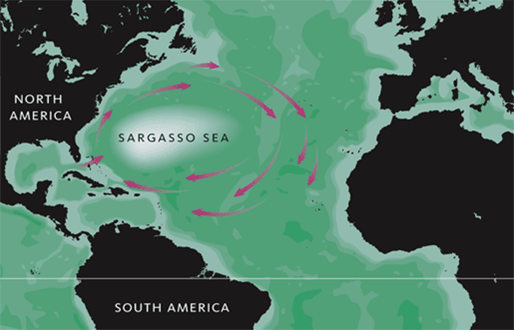
As I said we have begun mapping in our second priority zone, more than 100 miles north of Puerto Rico.  We are near the boundary of the Sargasso Sea.  It is not bordered by land, like other seas.  Instead it is bordered by ocean currents that keep the surface water in one area.

The Sargasso Sea
The Sargasso Sea. Image Credit: US Fish and Wildlife Service

Remember the seaweed I wondered about in an earlier post?  It is called Sargassum.  It grows in rafts in the Sargasso Sea.  This is actually where the Sargasso sea got its name.  According to NOAA’s National Ocean Service, these rafts provide habitat for certain fish and marine life.  Turtles use them as nurseries for their hatchlings.  In recent years large blooms of Sargassum have been washing up on nearby coastlines causing problem along the shore.  (Oct 1, 2014, USA Today)  More research needed!  There are always more questions.  Is this caused by warming oceans, by oil spills, or by a combination?  Nothing lives in isolation.  All life forms are connected to each other and to our environment.  Changes in the ocean impact us all, everywhere on the globe.

A Sargassum Mat. Photo courtesy of NOAA.


Want to explore yourself?  Check out NOAA Corps to become ship officer!

Career Profile of a NOAA Corps Officer:

Acting Executive Officer (XO) Lieutenant Fionna Matheson is augmenting on this leg of the trip, meaning she is filling in for the XO currently on leave.  Otherwise, in her current “land job” she works at NOAA headquarters for the NOAA Administrator, Dr. Kathryn Sullivan.  Dr. Sullivan, a former astronaut and the first American woman to walk in space, reports to the Secretary of Commerce, Penny Pritzker. Working on the headquarters team, LT Matheson learns a great deal about the breadth and importance of NOAA’s mission.

Lt. Fionna Matheson
Lt. Fionna Matheson

To become a member of the NOAA Corps you must have a Bachelor’s degree in Science or Math. It is a competitive process, so some sort of experience with boating is advantageous, but not required.  NOAA Corps officers are trained not only to drive and manage ships, but also to handle emergencies including fire-fighting, and follow maritime law.  They act as the glue between the scientists and the crew (wage mariners), making sure the scientific mission is accomplished and the safety of the crew and the vessel are secure.  Fionna has been part of the corps for 11 years.  She explains that NOAA Corps officers are stationed for about 2 years at sea (with some shore leave) followed by 3 years on land throughout their careers. During her NOAA career, Fionna has sailed in the tropical Pacific maintaining deep-ocean buoys, fished in the North Atlantic, collected oceanographic samples in the Gulf of Mexico, and now mapped part of the Caribbean. She has also worked as part of an aerial survey team in San Diego, studying whales and dolphins.

Fionna’s advice to high school students is this, “The difference between who you are and who you want to be is action.  Take the initial risk.”

Personal Log

What do we do for fun in our free time?

We read.

Jason Meyer, Mapping Watch Lead, reading on the Okeanos.
Jason Meyer, Mapping Watch Lead, reading on the Okeanos during his off hours.

We play games like chess, although I am not very good.  I try, and that is what is important, right?

Chess Tournament
Chief Steward Dave Fare and CO Mark Wetzler playing a warm up game before the chess tournament.

We watch movies – even watched Star Trek on the fantail one evening.   Very fitting since we are boldly going where no one has gone before with our high-resolution sonar.

Movie Night
Movie night on the fantail.

And we watch the sun go down on the ocean.

Sunset
A view from the fantail of the ship.

Mostly, I like watching the water when I have time.   I would have made a great lookout – I should look into it after I retire from teaching.  I have been trying to use my Aquaman powers to summon the whales and dolphins, but so far – no luck.   Maybe on the way back in to shore we’ll catch another glimpse.

What do I miss?

My family and friends.  Hi Bryan, Ben, Laura, Dad, Mom, and the rest of the gang.

My family
My family

And my students and coworkers.  Go Ashland Oredockers!

Ashland Public Schools, Ashland, Wi

I am fortunate to have such supportive people behind me!  Thanks, guys!

I do not miss snow and cold weather, so if you all could warm it up outside in northern Wisconsin over the next week, I’d appreciate it.  I’ll see what kind of strings I can pull with these NOAA folks!   ¡No me gusta la nieve o el frío en la primavera!

Did you know?

Sky conditions on the bridge are determined by oktas.  An okta is 1/8th of the sky.  If all oktas are free of clouds the sky is clear.  If 1-2 oktas contain clouds, the bridge reports few clouds, 3-4 filled oktas equal scattered clouds, 5-7 equal broken clouds, and 8 filled oktas means the sky is overcast.

Question of the Day