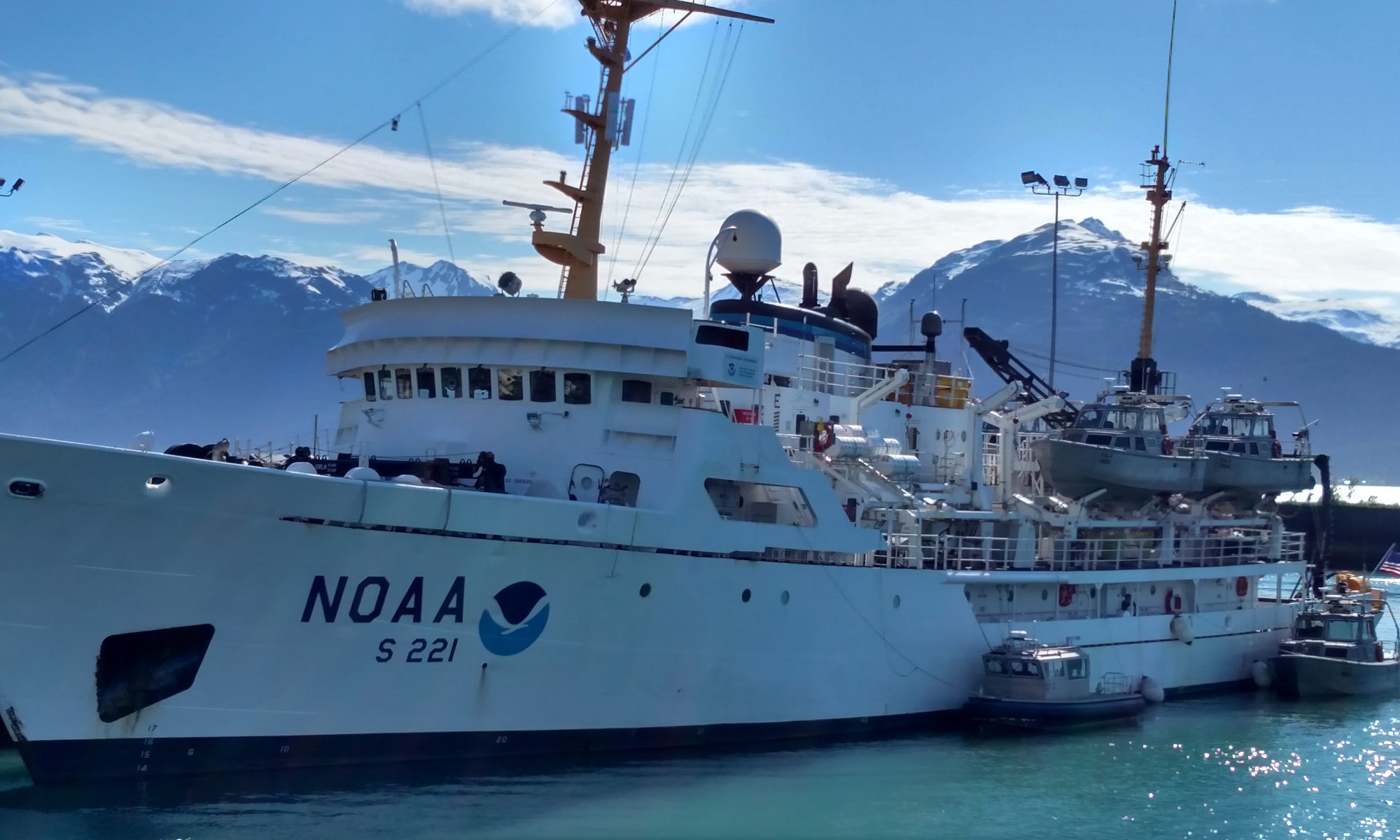
Cristina Veresan, Gone Fishin’, August 1, 2015

NOAA Teacher at Sea
Cristina Veresan
Aboard NOAA Ship Oscar Dyson
July 28 – August 16, 2015

Mission: Walleye Pollock Acoustic-Trawl survey
Geographical area of cruise: Gulf of Alaska
Date: Saturday, August 1, 2015

Data from the Bridge:
Latitude: 58° 39.0′ N
Longitude: 148° 045.8′ W
Sky: Broken clouds
Visibility: 10 miles
Wind Direction: W
Wind speed: 15 knots
Sea Wave Height: 3 feet
Swell Wave: 0 feet
Sea Water Temperature: 15.4° C
Dry Temperature: 13.8° C

Science and Technology Log

So, you might be wondering how our scientists know when it’s time to “go fishin’”? That is, how do they determine if there might be a significant concentration of pollock to deploy a trawl? The answer is acoustics! The ship is equipped with a multitude of acoustic transducers on the bottom of the ship, five of which are primarily used in the pollock population assessment. These transducers both send and receive energy waves; they transmit sound waves down to the ocean floor, which reflect back to the ship. However, if there are obstacles of a different density in the water (like fish), the signal bounces back from that obstacle. The amount of energy that pollock individuals of different lengths return is known to our scientists.

Chief Scientist Darin Jones studies the echogram
Chief Scientist Darin Jones studies the echogram and talks to the bridge

The real-time data from transducers is automatically graphed in what is called an echogram. When we are on our predetermined transect line, the scientist on watch analyzes the echograms to make the determination of when to trawl. The transducers are different frequencies. In general, the higher the frequency, the smaller the object it can detect. To make a final decision on fishing, the scientist must also coordinate with the officers on the bridge who take into account wind speed, wind direction, water currents, and ship traffic. Once we collect the trawl data, scientists use the catch information to assign a species and length designation to the echogram data in order to produce a pollock biomass or abundance estimate. In addition to the pollock we are targeting, we have caught salmon, cod, jellyfish, and a few different types of rockfish.

echogram
Each echogram is from a different frequency transducer

We often catch one type of rockfish, the Pacific Ocean perch (Sebastes alutus), which has a similar acoustic signature as pollock. On the ship, we call this fish POP, and they are difficult to handle because of the sharp spines on their dorsal fin, anal fin, head, and gill covers (operculum). You have to watch out for spine pricks when handling them! Their eyes usually bulge when they come up from depth quickly and gases escape, which is a form of barotrauma. One interesting fact about Pacific Ocean perch is that they are viviparous (give birth to live young); the male fish inserts sperm into the female fish and her egg is fertilized inside her body. These fish can also be incredibly long-lived, with individuals in Alaska reaching almost 100 years old. The Pacific Ocean perch fishery declined in the 1960’s-1970’s due to overfishing, but has since recovered due to increased regulation.

POP
You down with POP?! Yeah, you know me!


Allen Smith, Senior Survey Technician

Shipmate Spotlight: Interview with Allen Smith

What is your position on the Oscar Dyson?
I am the Senior Survey Technician. It’s my second season in this role.

Where did you go to school?
There is no formal training for this position, but you do need a scientific/technical background. I have a BS in geology, and right after college, I worked in technical support for Apple.

What do you enjoy the most about your work?
My favorite part is meeting people and re-connecting with ones I already know. Different scientists rotate in and out and they are my contact with the outside world.

Have you had much experience at sea?
I have worked on ships since 2011. I worked on cruise ship as a cook then I joined NOAA and sailed on the NOAA ship Oscar Elton Sette in Hawai’i as a cook and then later joined the NOAA ship Oscar Dyson as a survey tech. I really wanted to get back into science so I made the switch.

Where do you do most of your work aboard the ship? What do you do?
The domain of the survey technician is the laboratory. We have wet, dry, chemical, and computer/electronics labs aboard the Oscar Dyson. I am responsible for the meteorological, oceanographic, and navigation data that the ship collects full-time. We also help visiting scientists to accomplish their missions using the ship’s resources, like deploying fishing gear, CTD, cameras, or other equipment. Sometimes we do special missions like last year when we went to the Bering Sea for an ice-associated seal survey and our ship had to break through sea ice. During scientific operations, I work a 12-hour shift everyday.

When did you know you wanted to pursue a marine career?
I grew up in Dallas, Texas, which is totally land-locked, so you could say I wanted a change.

What are your hobbies?
No time for hobbies at sea! Just kidding, I like photography and playing guitar and ukulele. When I am not at sea, I enjoy hiking and biking.

What do you miss most while working at sea?
Probably what I miss the most is being able to cook vegetarian meals for myself. 

What is your favorite marine creature?
The red-footed booby because they have so much personality and are very entertaining.

Inside the Oscar Dyson: The Galley

galley
The ship’s galley is always open

The galley is ship-speak for the kitchen and dining area. Our ship stewards (chefs) work really hard to prepare buffet-style meals three times a day. Breakfast is served from 7-8am, lunch from 11am-noon, and dinner from 5-6pm. There is also a salad bar and a soup available for lunch and dinner. One night we even had food popular in Hawai’i: Kalua Pork, ramen stir fry, and chicken katsu! You can also come in the galley 24 hours a day to get coffee, espresso, tea, water, and various snacks. There is even an ice cream freezer! You might notice the chairs in the galley have tennis balls on the ends of the legs, as well as tie downs attached to them; this is to prevent sliding during rough seas.

 Personal Log

One of the challenges of working on a moving platform is seasickness. Nausea can be really debilitating, and it prevents many people from enjoying time on the water. I am not prone to it, but I am aware it could still afflict me at any time. Luckily, we have had very calm seas, and I have felt great, even when typing on the computer or slicing up fish! I brought some anti-seasickness medication with me but I have not needed it yet. I also have some candied ginger with me that I have been enjoying, though not for medicinal purposes.

Good morning from the Oscar Dyson!
Feeling happy, not seasick!

The scenery this week has been incredible as we weave our way through the bays and fjords of the Kenai Peninsula. McCarty fjord, carved 23 miles into the coast, was very impressive. The fjord is flanked by massive green mountains and towering cliffs. This majestic landscape was carved by ancient glaciers. I have spotted a few bald eagles, and, with binoculars, one of the deck crew members saw a brown bear mama and two cubs. As much as I love the open ocean, it’s exciting to be close to shore, so we can enjoy Alaska’s dramatic vistas and wildlife.

I am loving life at sea!

glacier
McCarty Glacier comes out from the clouds

Cristina Veresan, Welcome Aboard the Oscar Dyson, July 29, 2015

NOAA Teacher at Sea
Cristina Veresan
Aboard NOAA Ship Oscar Dyson
July 28 – August 16, 2015 

Mission: Walleye Pollock Acoustic-Trawl survey
Geographical area of cruise: Gulf of Alaska
Date: Wednesday, July 29, 2015

Data from the Bridge
Latitude: 58° 27.7′ N
Longitude: 149° 31.0′ W
Sky: Clear
Visibility: 10 miles
Wind Direction: S
Wind speed: 2 knots
Sea Wave Height: 1 ft.
Swell Wave: 0 ft.
Sea Water Temperature: 14.4° C
Dry Temperature: 14.8° C

Science and Technology Log

We steamed out of the port of Kodiak, sailing northeast into the Gulf of Alaska. From the bow, I looked back and saw the busy harbor, full of fishing boats of all sizes, slowly fade away. Scanning the water, I saw two sea otters floating on their backs with their arms in the air. I spotted a few puffins dotting the surface of the water, with their characteristic black and white plumage and orange beaks. In the distance, a spout rose from the ocean’s surface, evidence of a whale below. The sea was calm and the sun was shining. I breathed in the salty air. I was feeling grateful to be a NOAA Teacher at Sea and ready for this mission.

So what exactly is our mission here aboard the Oscar Dyson? We are conducting fisheries research, primarily a Walleye Pollock Acoustic-Trawl survey. A fish survey is like a scientific fishing trip! The surveys, when conducted consistently and repeatedly over time, allows scientists to monitor trends in fish abundance and changes in the marine ecosystem. The data from these surveys are used, along with data collected from fishermen and other sources, to set sustainable catch limits, ensuring a healthy supply of pollock in the future..

The science team is from the Midwater Assessment and Conservation Engineering (MACE) group of the Alaska Fisheries Science Center in Seattle, Washington. This is the third and final leg of their summer assessment of the walleye pollock population in the Gulf of Alaska. We will be traveling along predetermined, randomized transect lines, and scientists will use acoustic technology, along with catch data from nets towed behind the boat, to assess the pollock population. Walleye pollock is the targeted species, though everything we catch will be identified and measured.

The Oscar Dyson in the Port Of Kodiak, Alaska
A view of Kodiak Harbor
Young Pollock caught in the pocket net of a trawl
Young walleye pollock

You might not have seen walleye pollock on a menu, but you probably have eaten it. Pollock is the “Fish” in McDonald’s “Filet-o-Fish” sandwiches. Pollock are also masters of disguise and can sometimes be found imitating crab meat. Yes, that imitation crab (surimi) in your California roll is usually ground up and re-formed pollock. In fact, the pollock fishery is one of the largest and most valuable in the world. Walleye pollock are a schooling, semi-demersal (bottom) fish that is found at depths up to 1000 feet and widely distributed throughout the North Pacific Ocean. They can grow up to 3.5 feet and live up to about 20 years old. Pollock feed mainly on krill when they are young; when they mature, they eat young pollock and other teleosts (bony fish). That’s right, they are cannibalistic! Recently, after extensive genetic studies, the scientific name of this fish changed from Theragra chalcogramma to Gadus chalcogrammus. This change placed the walleye pollock in an evolutionary lineage that includes the Pacific, Atlantic, and Greenland Cods. In Alaska, about 1.5 million tons of this fish are caught each year. With each fish weighing an average of 3 pounds, that’s about 1 billion fish annually!


Shipmate Spotlight: Emily Collins

Lab Lead Emily Collins

What is your position on the Oscar Dyson? 

I am on the science team, and for all three legs of the survey this summer, I have been the Lab Lead.

Where did you go to school?
I earned a BS in Biology (marine science concentration) from Boston University. I am attending Southern Oregon University in the fall for graduate work in Environmental Education.

What do you enjoy most about your work?
I certainly like playing with fish, but I enjoy the people the most. This is an awesome group of scientists and I really like meeting new people each cruise, too. I enjoy learning new things from different scientists.

Have you had much experience at sea?
Yes, after college, I worked as a fisheries observer for 2 ½ years on various east coast boats from Maine to Virginia and 1 ½ years on boats in Alaska. As an observer, I boarded commercial fishing vessels and kept fishing data on the catch and discarded species and collected biological samples for the National Marine Fisheries Service. I have been on trawlers (pollock, ground fish), gillnet vessels (cod), scallop dredgers, pair trawls (herring), pot vessels (cod) and longliners (halibut, sablefish). Observer data is used to conduct stock assessments, which are used in managing the fisheries.

Where do you do most of your work aboard the ship?
You can usually find me in the wet lab. I am in charge of the wet lab and sampling all the fish that we catch: identifying, weighing, measuring fish and collecting otoliths and other biological samples. I also help with camera operations and data management, so I am often in the Chem Lab or Acoustics Lab on a computer.

When did you know you wanted to pursue a career in science?
I always liked biology and knew it was a career goal. I took a Lindblad Expeditions/National Geographic voyage in the Galapagos my senior year of high school and Sylvia Earle was onboard as an expert naturalist. The snorkeling was unbelievable. I saw so many fish, sea turtles, penguins, and sea lions. That was my inspiration for studying marine biology

What are your hobbies?
I love to travel, hike and snowboard. And I do arts and crafts, like paper arts and beadwork.

What do you miss most while working at sea?
I miss my friends and family the most (Hi Mom!). And being able to eat out at different restaurants.

What is your favorite marine creature?
Bluefin Tuna because they are huge, fast, and they live in the open ocean.

Inside the Oscar Dyson: Staterooms

stateroom
Our sleeping quarters

So once our work is finished, where do we finally get some rest? Staterooms are what you call the sleeping quarters aboard the ship. Emily Collins and I share a stateroom. There are bunk beds, and I am on the top and Emily is on the bottom. We each have a locker to store our clothes, and there is a desk and shelving to stow odds and ends. You have to latch the locker doors closed, or they will slam when the ship moves. There is a head (bathroom) with a toilet, sink and shower attached to our stateroom. It is important to keep voices down in your stateroom and moving through the corridors, as people are sleeping at different times of the day! We have a porthole in our room, but since it is summer in the high latitudes, it is dark for only about 4-5 hours a day. The quarters are cozy but comfortable. I enjoy getting lulled to sleep by the rolling motion of the ship.


Personal Log

As Teacher at Sea, I am an active member of the science team and I have been assigned the day shift, which means that I work from 4am-4pm. I think this shift will be great because it is a little more of a regular schedule, just getting up really early and going to bed really early. I come on shift when it is actually dark and then, after about an hour, I enjoy the sunrise over the water. During the shift, as our work allows, we can break for breakfast and lunch. And we can get coffee as needed…which is a lot!

sunrise
Sunrise over sea

Safety is the first priority of everyone aboard the Oscar Dyson. The ship’s officers have briefed us about safety procedures, and we have participated in drills for different scenarios, such as Man Overboard and Abandon Ship. For the Abandon Ship drill, we grabbed our PFD (personal floatation device) and survival suit from our staterooms and mustered on the deck to find our lifeboat group.

Here’s to a productive and safe voyage aboard the Oscar Dyson!

Survival suit
Trying on my survival suit during an Abandon Ship drill. Photo by Mackenzie Wilson

Cristina Veresan, Teacher (soon to be) at Sea, July 7, 2015

NOAA Teacher at Sea
Cristina Veresan
NOAA Ship Oscar Dyson

Date Range at Sea: July 28 — August 16, 2015

Mission: Walleye Pollock Acoustic-Trawl survey
Geographical Area of Cruise: Gulf of Alaska
Date: July 7, 2015

Introduction

Aloha from Hawai'i!
Aloha from Hawai’i!

Here in Hawai’i, surrounded by the Pacific Ocean on the world’s most remote island chain, I am very aware we live on an ocean planet. In fact, I have always been drawn to the sea, whether tide-pooling as a child, learning to SCUBA dive as a high school student, or spending a semester at sea aboard a sailing ship as a college student. In my role as a science educator I have always tried to inspire students to investigate local marine ecosystems and understand the ocean’s importance to our Earth. Thus, it is a tremendous professional honor to have been selected as a 2015 Teacher at Sea by the National Oceanic and Atmospheric Administration (NOAA).

NOAA’s Teacher at Sea Program, now in its 25th year, provides K-12 or college educators the chance to contribute to current oceanographic research aboard a NOAA vessel. Missions usually fall into three main categories: fishery surveys, hydrographic work, or physical oceanography studies. Participating teachers use this hands-on, real-world learning opportunity not only to develop classroom lessons but also to share the experience in their classrooms, schools, and communities. I am thrilled to report that I have been assigned to a fisheries cruise, a pollock survey aboard NOAA Ship Oscar Dyson. The port of call is Kodiak, Alaska, and I am especially excited about the location because it will be the 50th state I have ever visited! I have always been fascinated by the science, economics, and history of fisheries. The pollock fishery is one of the world’s largest, and these fish are also vital to the Bering Sea ecosystem. I cannot wait to learn more about pollock ecology and see how scientists assess the size and health of pollock populations and, therefore, the sustainability of the fishery.

Walleye Pollock (Gadus chalcogrammus).  photo courtesy of NOAA
Walleye Pollock (Gadus chalcogrammus). Photo courtesy of NOAA

This blog will record my time at sea aboard the Oscar Dyson, but my intent with this first entry is to introduce myself and share a little about my background in teaching. My nearly ten-year career in education has included teaching secondary science in St. Lucie County, Florida, as well as coordinating that school district’s science curriculum, instruction, and assessment as the K-12 Science Curriculum Supervisor. Since moving to Hawai’i, I have taught middle school science (grades 6-8) at Star of the Sea School and served as the school’s Assistant Principal. Working with middle school students is my passion, for I love their energy and curiosity!

Cristina Veresan loves working with middle school students
I love working with middle school students! Photo by E. Johnson

I have always valued experiential learning, whether in the lab or in the field. Here on O’ahu, I enrich my curricula with the unique natural and cultural resources our island provides. One of the projects I am most proud of was a collaboration with the Hawai’i Nature Center; together, we facilitated a yearlong STEM program investigating the effects of climate change on Hawaii’s ecosystems called From Mauka to Makai: Understanding Climate Change in the Ahupua’a. This program included a mountain (mauka) stream study, a coastal (makai) study, and a final conservation project. This place-based program encouraged environmental stewardship. To read more about my teaching, please visit my website.

Conducting a coastal study with students in Hawai'i Kai
Conducting a coastal study with students. Photo by Raphael Ritson-Williams

The ability to transition between the roles of student and teacher, often and with great enthusiasm, has facilitated my success as an educator. I consistently seek out opportunities for professional growth in order to best serve my students. My Teacher at Sea voyage will no doubt be one of those powerful learning opportunities. Doing science at sea is a unique challenge, and I am eager to join the ship’s community and contribute to our shared mission. Indeed, my next blog entry will be from aboard the Oscar Dyson, when I am immersed in the current methods and technologies of fisheries science. For now, I will concentrate on researching previous NOAA pollock surveys, packing plenty of layers to keep me warm, and preparing for this adventure.

Mahalo for reading!

The Pacific Ocean as seen from Malaekahana Beach. I will have a different view soon!