Avery Marvin: Ebbs and Flows and Puffins! July 11, 2013

NOAA Teacher at Sea
Avery Marvin
Aboard NOAA Ship Rainier
July 8 — 25, 2013 

Mission: Hydrographic Survey
Geographical Area of Cruise: Shumagin Islands, Alaska
Date: July 11, 2013

Current Location: 54° 49.6 N, 159° 46.6 W

Weather data from bridge: 8.7°C, good visibility (6-8 miles), light and variable wind, overcast

View of Bird Island Cove from tide gauge installation point

Science and Technology Log:

Today, Rosalind and I were scientists in the field, helping the ship’s crew install tidal equipment in preparation for ocean floor survey work.  This was a complex process, so we decided to walk you through it in a step-by-step question format.

What does a navigation chart show you?

The image below shows a chart of the area that we are in right now. Our first anchor point was off the north coast of Bird Island in a cove. On the chart, you can see many tiny numbers in the water areas, which represent various depths.  These depths are measured in fathoms (1 fathom=6 feet).  This depth information helps mariners stay in safe areas that are not too shallow. The charts also show known hazards such as sub-surface rocks and ship-wrecks. This chart clearly has a lot of white space, signifying many areas were never surveyed.

Shumagin survey area
Part of our survey area. Notice the white spaces around Bird and Chernabura Islands!

But wait, why are the depth numbers “fixed” on the charts? Doesn’t the water level change with the tides?

Yes! It sounds easy to say, “the water is 10 fathoms deep at this point”. However, water is subject to the gravitational pull of the moon and sun, resulting in various water levels or tides throughout the day.  So the water will not always be “10 fathoms deep at this point.” For navigational purposes, the most hazardous water level is the lowest one, so nautical charts show the depth at the low tide water level.  Depending on the location, some places have two high tides and two low tides per day (semi-diurnal) and some places have one high tide and one low tide per day (diurnal). Here in the Shumagin Islands we are on a semi-diurnal mixed tide schedule (meaning that the two highs and two lows are not the same height).

How do you measure the tides each day?

shumagin_tide_zone
Map of the Shumagin Island-Sand Point Tide Zones. Notice how the eastern Shumagin Islands are 6 minutes ahead of Sand Point.

There are permanent tide measuring stations all over the globe that provide information on how to “correct for” and figure out your local tide conditions. For our case, there is a tide station at Sand Point on Popof Island, which is west from our survey area.  Our survey area is in two zones, one which is in the same zone as Sand Point and the other which is in a different zone. Therefore, we installed a tide gauge in the latter to verify that the tidal times and heights of this zone are accurately predicted by the Sand Point values. According to the current information, it says that in the different zone the tides should occur 6 minutes before the tides in Sand Point and to multiply the heights by 0.98.

A tide gauge is a pretty cool device that works by the laws of physics. It is installed (by divers) on the sea floor near a coast-line, in relatively deep water, so that it will always be covered with water. The tide gauge uses the water pressure above to determine the depth of the water column (density of water and gravity are the important factors in making this calculation). The tide gauge stays in place for at least 28 days (one full tidal cycle), after which there is a record of the water level throughout that time period (as we were gathering data), as well as a rough idea of the tidal cycle each month, ready for comparison to the Sand Point data.

How do you know if the tide gauge is working?

To verify that the tide gauge is working, humans (i.e.: Rosalind and I), take water level  measurements (in an area close to the tide gauge) using a giant meter stick or “staff”. In our case, we recorded the average water level height every 6 minutes for 3 consecutive hours.  This 3-hour data set can then be compared to the tide gauge data set for that same time period, and hopefully they will show similar trends.  

Geiger_IMG_1279 (25)
Mike (XO) and Avery, taking water level data using the staff (big meter stick)
Tide staff
This is the tide staff we used to gather water level data for comparison to the tide gauge.
Map of the Shumagin Island-Sand Point Tide Zones. Notice how the eastern Shumagin Islands are 6 minutes ahead of Sand Point.
Graph showing the water height measurements from the tide staff and the tide gauge. Notice how they appear to be increasing at the same rate! That’s good.

What happens if the survey terrain changes over time? Will that affect the water depth?

The ocean floor is above a liquid mantle, so it is possible for there to be terrain changes and this would affect water depth measurements. Thus, as scientists, we must make sure the location of our survey area is “geologically stable”. To do this, we installed “benchmarks”. If you’ve ever been to the highest point on a mountain in the United States, you might have already seen something like this: they are bronze disks that mark important places, used by NOAA as well as other agencies. We stamped our benchmarks with the year and our station data, letter A-E (by hand! with a hammer and letter stamps!), and installed them at roughly 200-foot intervals along the coastline in what we hope is bedrock. Once they were cemented in place, we determined each benchmark’s relative height in relation to the staff using a survey instrument called an optical level – this process is also called “leveling.” At the end of the survey season, the ship will come back and re-level them. If the area is geologically stable, the benchmarks should all be at the same relative heights to one another as they were when they were initially installed. More so, the scientists will also be very pleased because their ocean depth measurements will be reliable going forward in time.

Stamping a benchmark
Cemented benchmark
A benchmark firmly cemented in place.
Avery cements her first benchmark :)
Avery next to her first cemented benchmark 🙂
Rosalind measuring distance between benchmarks
Rosalind measuring the distance between benchmarks

So what next?

Now that we have completed all necessary pre-survey measurements and research, we are ready to begin surveying the coastline and ocean floor.  Happy Hydro!

Personal log

It’s a pretty cool feeling to know that you stepped foot on an island that hasn’t seen human visitors in 20+ years. It was also refreshing to get off the big boat and head to shore for some science fieldwork. I learned all about tide gauge and benchmark installation.  I had several small but important tasks:

  • stamp each bronze benchmark with year and appropriate code using hammer and metal letter stamps
  • mix up cement batter and add to drilled rock hole and under benchmark disc to secure it in place for years to come (much harder than it looks because the cement was like “oobleck” and not very cooperative)
  • measure distance between each benchmark using extra long tape measure
  • take water level data using staff (big meter stick) in water every 6 minutes
Cool anemome I found!
Cool sea anemone I found!

In between tasks, I perused the tide pools for various critters. I saw a few new anemones and got a great shot of one with my new underwater camera.  I absolutely love tide pooling and could spend most of the day doing it.  I also enjoyed observing the puffins flying in and out of their cliff-side home. They tended to leave the cliff in packs probably to do some offshore fishing for herring and capelin. Upon return, presumably with a belly full of fish, some puffins would fly in large circles near their dwelling a few times before finally landing. This bewildered me. I thought, what a waste of energy! So I researched this and found out the following:  Puffins are much better swimmers than flyers and have poor maneuverability while in the air. They sometimes are involved in mid-air collisions or crash landings into rocky slopes. Thus, they “size up” their landing a few times by circling near it before finally flying directly into their vertical burrow entrance.

Their body is mostly adapted for swimming, with short rigid wings helping them to “fly” underwater, to 30+ ft. depths! They have durable bones that endure pressure changes while diving and their body tissues store oxygen. They use anaerobic respiration for long dives. To waterproof their wings, puffins rub their bill on their oil gland several times and then smear this oil all over their feathers. How cool!

We are seeing a lot of Tufted Puffins out here in the Shumigans because it is breeding season (June-August), the time when they return from lonely open waters to rocky islands to mate and raise young. Puffins are monogamous, usually having one partner for many years. Interestingly, a female puffin only lays one egg, which is incubated for around 45 days! Both parents share incubation and feeding duties. Right on! The chick then stays in the nest for around 45 days until ready to fly. I love puffins! They are not only adorable but very well-adapted creatures.

Tufted Puffin
Tufted Puffin

Fun/sad factoid: Alaskan and Canadian natives made reversible parkas out of puffin skin. When it was rainy out, they wore the feathers on the outside and in cold dry weather, they wore the feathers on the inside. It took 45 puffins to make one parka!

Avery Marvin: Discovering Ship Life En Route to the Shumagin Islands, July 9, 2013

NOAA Teacher at Sea
Avery Marvin
Aboard NOAA Ship Rainier
July 8–25, 2013 

Mission: Hydrographic Survey
Geographical Area of Cruise: Shumagin Islands, Alaska
Date: July 9, 2013

Current Location: 54° 49.6 N, 159° 46.6 W

Weather data from bridge: Broken clouds, no wind, 12° C

Orientation to Ship Life:  NOAA Ship Rainier motto: “Teamwork, safety first.”

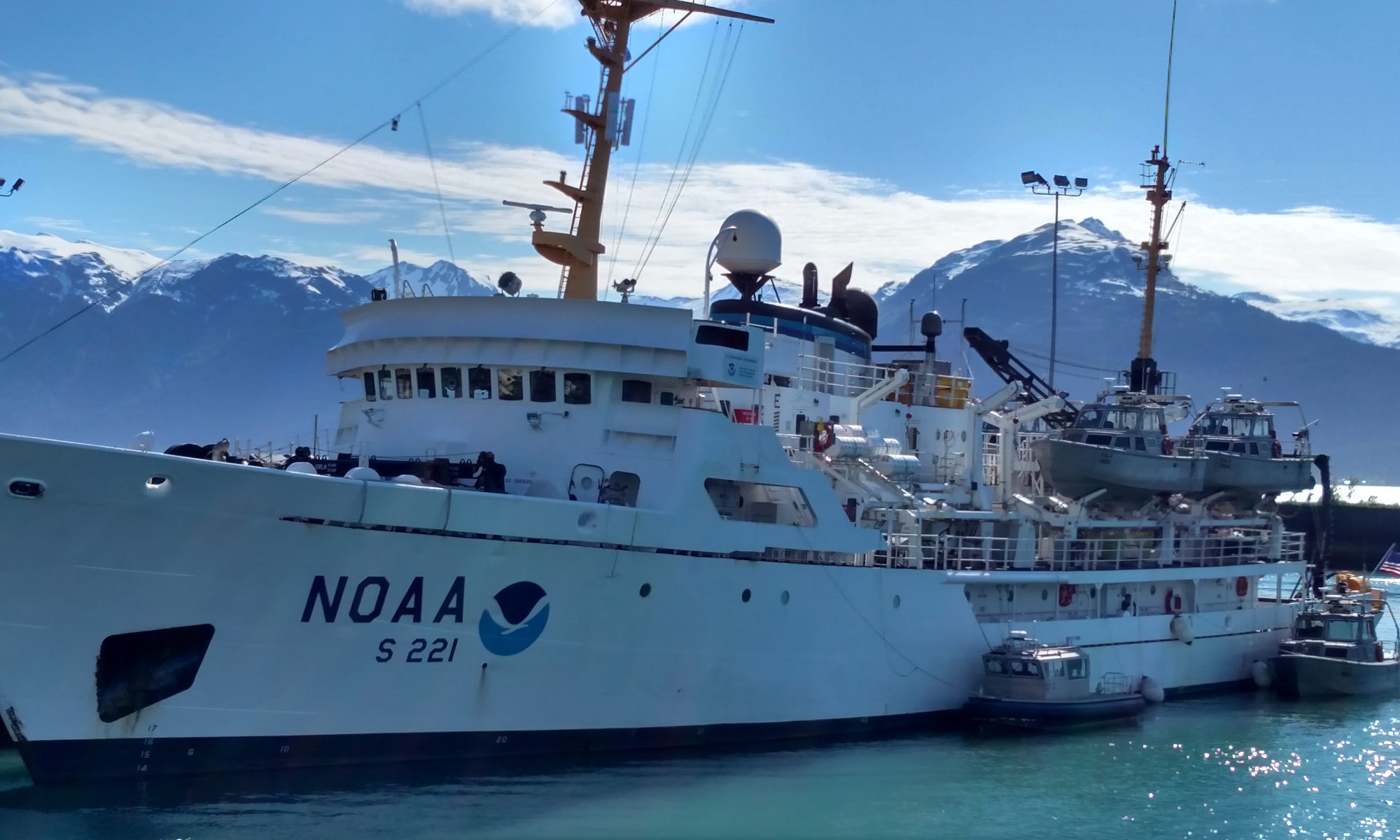
First view of the Rainier in the Kodiak Port
First view of the Rainier in the Kodiak port

Science and Technology Log

Greetings from the NOAA Ship Rainier! It has been a whirlwind two days since we departed from our docking station at the Coast Guard base in Kodiak, AK and Oregon seems a world away here in the remote Shumagin Islands. The trip over took roughly 32 hours and during this time we had the chance to see the many facets of ship life. The crew on board the Rainier have been incredibly welcoming, enthusiastically answering even the most basic questions (of which we Teachers at Sea have many), and have made both myself and the other Teacher at Sea onboard, Rosalind Echols, feel very comfortable.

In this blog post, I’d like to talk about getting acquainted with life on a ship. The Rainier is a complex operation, and each person on the ship wears many hats (which is very much like being a teacher) depending on what is happening on the ship each day. One person might man the bridge (front command center of the ship) in the morning, be part of the dive team in the afternoon, and at night, take the role of the on-call medical officer.

Our course
Our course leaving our docking point in Kodiak

Rosalind and I have both spent considerable time on the bridge in the last two days, watching the navigation process, from “threading the needle” between the red and green buoys in Woman’s Bay where our ship was docked to plotting out the course many hours ahead. We both noticed how important communication is in this process, specifically making sure that everyone is on the same page all the time. Thus there is specific ship language that is used and repeated for every activity. For example: when acknowledging a change of duty, everyone on the bridge responds with “Aye.”

Being a newcomer on a ship can be daunting. My first day on the ship, before we set sail, the only thing I could reliably find was my own stateroom (which has our bunkbed, or “rack”, and bathroom, or “head”). One of the many things the Rainier crew has done for us is to take us on a very thorough tour of the ship, showing us everything from the engine room to the flying bridge (the highest point on the ship outside of the mast, which offers a great view of what is going on). It is important to know how to get around in case of an emergency, so you can get to your assigned “muster” point quickly, and take an alternate route if necessary.

Avery in her "survival suit"
Avery in her “survival suit”

This actually came up not long after we got underway! In the spirit of safety, the whole ship regularly does emergency drills, so once we were in open water,  we had a fire drill which was signaled by one loud long horn. Since we’re on a ship, this isn’t like a school fire drill where everyone leaves the building as fast as possible and waits for the experts to show up. The ship is a self-contained community and it is in everyone’s best interest to keep the ship afloat and functional. Therefore, when the fire drill sounds, everyone heads to their muster station, is checked in (to make sure you are not trapped in the fire!), and then either carries out or is assigned a fire fighting duty such as: attending to the injured, manning the fire hose, preparing to mop up the water, “de-smoking” the area etc. Shortly after the fire drill, we had an abandon ship drill, which again involved us meeting at a specific “muster” station. In this case, we were preparing to abandon ship, so we quickly slipped into our bulky, waterproof, self-inflating “immersion” or “survival” suits and then prepared to exit the ship. We didn’t actually exit the ship but envisioned such a next step. After the two drills, the crew met in the “galley” (eating area)  for a debrief of the two drills led by the XO (Executive Officer) where we discussed what had gone well, what hadn’t and what we should improve upon for next time. It made me feel like I am in very good hands here on the Rainier. In the end, this complex ship operation relies on a dedicated crew who works and communicates well as a team, keeping safety as the number one priority.

Our Geographical Area

Survey area
Part of our survey area, around Bird and Chernabura Islands

While on board, we will be working primarily as part of the Survey Team, the people taking the hydrographic measurements. I will get into much more detail about how this all works once we delve into our first project, but for today, I want to focus on why this work is important and why we are in the Shumagin Islands specifically. When navigating, ships use charts, either electronic or paper, to plot a safe course through an area. In open ocean, you typically don’t have to worry about navigational hazards (rocks, shoals, ship wrecks), but as you get closer to land, these are more and more common, and ships need to be able to avoid them.

Approaching the Shumagins
The Rainier approaches the Shumagin Islands

If you look at a chart of the Shumagins, you can see that there is a lot of “white space”: empty areas with no depth soundings. Most often, we see a string of measurements in a straight line, fairly regular but also fairly sparse. Our CO (Commanding Officer) said that these were most likely done with a lead line, where someone literally took a lead weight on the end of string and dropped it down to the seafloor over the side of the ship, and measured how deep it was in that spot.  While very accurate, it is hard to collect a lot of data about one entire area, and therefore there are many blank spaces.

In deciding where to survey, NOAA creates a priority list. You can find the complete list and list of factors on the Nautical Charts site, but our CO said it comes down to three main factors: age of the last survey, commerce in the area, and recent natural disasters (like Hurricane Sandy, for those of you on the East Coast: the shoreline and sea floor look very different now). As I said earlier, the Shumagins have very sparse data, and it’s old (the most recent survey in the area we are looking at was 1969, at best). Some of the measurements could be from when the Russians surveyed the area, 100+ years ago.  Because the Shumagins are en route from Asia to some North American ports, updated nautical charts are vital for safe mariner travel.

Speaking of remote, the CO said that it might have been 20 years since someone set foot on one of the Shumigan islands. That seems incredible to me! Living in a big city, there are always people around. What about you? What’s the most remote place you’ve ever been? Leave me a comment below to let me know.

Personal Log:

Hi friends!

I have been on lots of boats in my life: canoes, kayaks, rowboats, sailboats, small fishing boats, large fishing boats, a live aboard scuba diving boat in Australia and I even was the sole operator of the Soundkeeper boat one summer in high school. My duties on this boat were unique and environmentally important for I was transferring sewage from large vessels to the hull of my small vessel and at the end of the day this sewage was transferred via a vacuum system to a large holding tank on land. It was both a smelly and fun job! Never though have I lived on a boat quite as large or complex as the Rainier. And it really isn’t that large (Length: 231 ft, breadth: 42 ft., draft: 14.3 ft) in comparison to freight-liners or huge Carnival cruise ships but what’s impressive is the use of space and it’s scientific capabilities.  Hallways are narrow, ladders (stairs) are steep and storage space is maximized. Everything is bolted down to the ground or secured with a bungee cord, which is essential when the boat is in motion.  Besides the normal rooms and amenities you would expect on a live-aboard, the Rainier has several labs, a bridge (front command center) with several hi-tech navigational aides, a technology room (with terabytes of storage), 4 launch boats, 2 skiffs (dingy type boat), 1 rescue boat, 3 cranes and a fancy hydraulic system that puts the launch boats in the water.

Launch being lowered into water

On the food side, there are two 24- hour coffee stations, a fully stocked ice cream freezer (dangerous!) and a big snack basket. The actual meals are pretty darn good and nutritious too. For example, tonight the menu was: stuffed bell peppers, cucumber salad, homemade minestrone soup, halibut, broccoli and coconut cream pie.

I write this post to you in the mess (eating area) as the boat is anchored in the cove of Bird Island which is one of the Shumigan Islands.  I am quite happy we are anchored for many reasons:

1) I have trouble not bumping into things on a moving ship

2) Turns out I am prone to seasickness (Thankfully, anti-nausea pills prevent me from meeting the true Ralph.)

3) I can safely go to the bathroom without injuring myself.

4) I get to go on daily research excursions on the small boats.

5) I get to see many more adorable Puffins!

6) I get to wake up and see the rising sun glisten off the water.

Sunrise in Bird Island Cove

It’s been a good few days so far. I am thrilled there is another Teacher at Sea onboard (Rosalind Echols) with whom I can directly relate and who shares many of the same questions and curiosities about this complex scientific operation as myself. I though, tend to ask more questions (both inane and profound) which in the end helps us both learn more.  We are now getting into the interesting Hydrographic science so the next post will be quite informative and science-y.

Fun factoid: In the 1800’s, the Aleut people of the Aleutian Islands, covered the outside of their homemade sea kayaks with sea lion skin which is both flexible and water repellant.

Have any questions about life at sea or the research I’ll be doing? Leave me a comment below!

Avery Marvin: Excited for this upcoming adventure! July 1, 2013

NOAA Teacher at Sea
Avery Marvin
(Almost) Onboard NOAA Ship Rainier
July 8–25, 2013

Mission: Hydrographic Survey
Geographical area of cruise: Shumagin Islands, Alaska
Date: July 1, 2013

Greetings from the Oregon Coast! Thank you for visiting my blog, and I hope you continue to follow me this summer throughout my 18-day Alaskan adventure aboard the NOAA ship Rainier. I am elated and honored to be a NOAA Teacher at Sea—an experience that will undoubtedly shape me and my classroom instruction for years to come.

NOAA Ship Rainier
NOAA Ship Rainier

My name is Avery Marvin and I am a middle school General Science and high school Biology teacher at Taft 7-12, a mid-size public MS/HS in Lincoln City, on the Oregon coast. I moved here just one year ago, and have been discovering the unique facets of living and teaching in a coastal community ever since.  I continue to be amazed and inspired by the natural surroundings and marine resources (i.e. the NOAA base in Newport, Hatfield Marine Science Center) at my fingertips. Knowing I am New York native, many of my students have quizzically asked me, “Ms. Marvin, why did you move here?” My hope, then, is that through this NOAA experience, I will be further able to inspire and show kids that “here” is a pretty amazing place to be—not just in terms of its natural beauty but its ecological and research significance moreover. With this awareness and education, students hopefully will feel a greater sense of ownership of—and thus appreciate and actively protect—the greatest resource in their very backyard: the ocean.

Diving in Tasmania
Avery dives in the chilly waters of Tasmania, Australia

As an avid adventurer and ocean-goer, I have explored many waters both as a conservationist and a recreationist (i.e. scuba diver, fisherwoman). Yet Alaska is a place I have dreamed of visiting for most of my life, and to be able to combine my experience with like-minded scientists conducting vital ocean research is truly awesome to me.  The Rainier, homeported at the NOAA Marine Operations Center – Pacific in Newport, Oregon, is a hydrographic surveying ship whose primary focus is mapping the sea floor in coastal areas.  The depth data collected on the Rainier is used to update nautical charts. This is crucial work as commercial shippers, passenger vessels and fishing fleets rely on accurate nautical maps to safely traverse various ocean passages.  In the case of Rainier’s work in Alaska, some of the terrain is being surveyed for the first time. Rear Adm Gerd Glang, director of Coast Survey, sums it up best, “Simply put, we have better maps of the moon than of our oceans.”  Several multi-beam sonar systems located on the Rainier as well as on a few smaller launch boats are employed to acquire this mapping data.  This six-minute video  gives a good overview of the mission and daily operations of the Rainier.

My 18-day journey begins on July 8, 2013 in Kodiak, Alaska, where I will be meeting up with the Rainier.  From Kodiak, we travel southwest to the Shumagin Islands, where the majority of the research on this leg of the trip will be conducted. We will then conclude our journey back in the Kodiak port. (Track Rainier’s movement here.) I can’t wait to dive in and absorb all that I can. I am particularly looking forward to working with and learning from all the scientists onboard, seeing the majestic Alaskan landscape and understanding how survey data can be used for mapping vital fisheries habitats.

I hope you will ‘virtually’ join me aboard the Rainier, this summer, and be a witness to some incredible scientific research.  This blog will be updated weekly with interesting stories, pictures and lots of newfound information about our mission at sea.  So check back often and feel free to leave comments and questions for me. If I don’t know the answer, I will ask a brilliant scientist to help me.

“For most of history, man has had to fight nature to survive; in this century he is beginning to realize that, in order to survive, he must protect it.” -Jacques-Yves-Cousteau