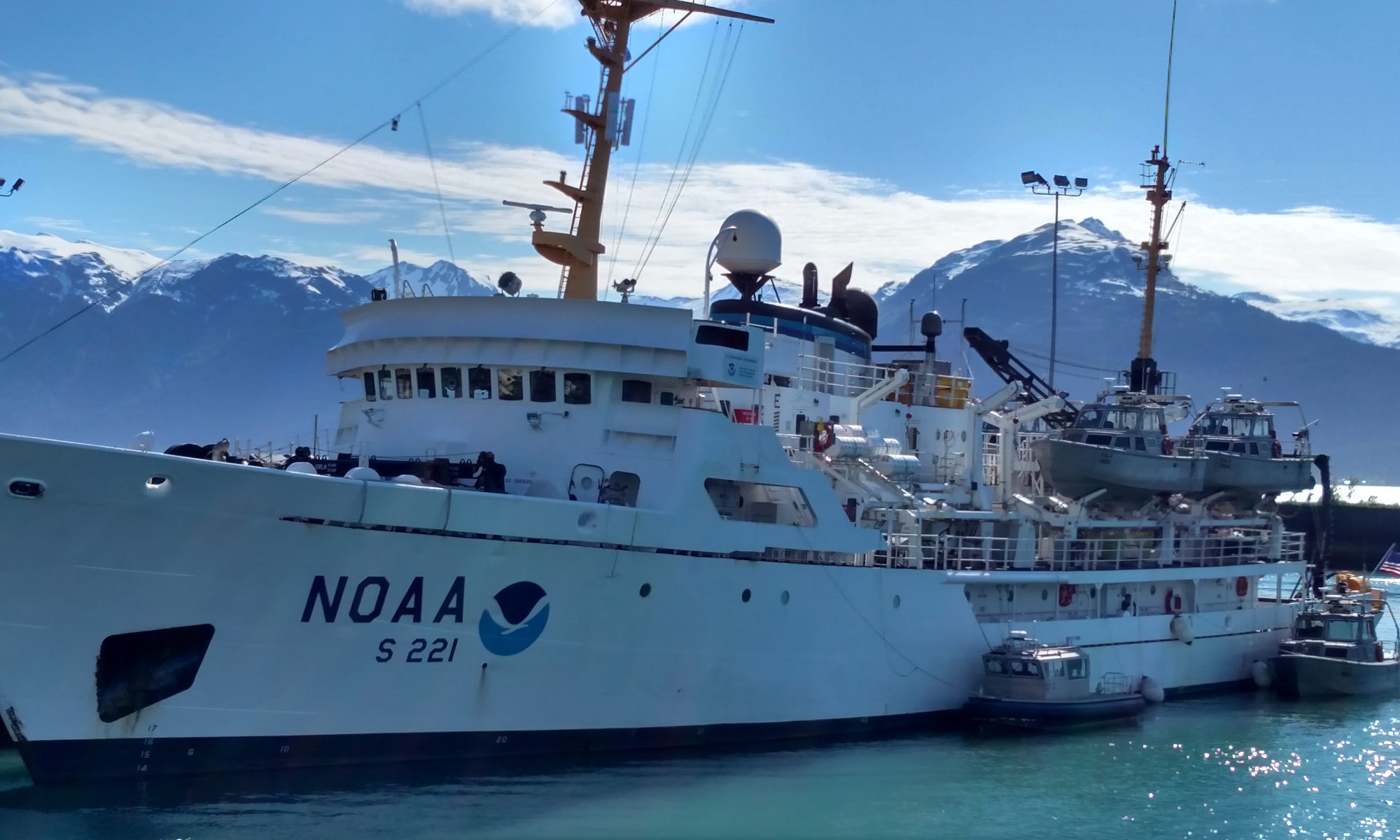
Joshua Gonzalez: Sitting on the Dock of the Bay: August 18, 2025

NOAA Teacher at Sea

Joshua Gonzalez

Aboard NOAA Ship Bell M. Shimada

August 11 โ€“ August 23, 2025

Mission: Integrated West Coast Pelagics Survey (Leg 4)

Geographic Area of Cruise: Pacific Ocean, California Coast

Todayโ€™s Date: August 18, 2025

Weather Data from the Bridge:

Location:  Newport, Oregon

Wind speed: 4.1 kts.

Wave height: 6-7 ft.

Air temp.: 15.5ยฐ C (60ยฐ F)

Sky: Clear

Science and Technology Log

Today we are heading back out to sea., emphasis on back. We had to make a brief stop back in Newport due to a malfunction with the fog horn.  Since it had been very foggy, it was not safe.  We had to wait in Newport for maintenance.

a view of NOAA Ship Bell M Shimada in port at night. it is low tide, so the hull is not very visible above the dock.
NOAA Ship Bell M. Shimada back in Newport.

Therefore, we have not been doing any fishing since my last post.  However, now that it has been repaired we are on our way again.  It will take about 15 hours until we are back at the transects that we need to survey.  We are all very excited to begin fishing again.  In the meantime, in order to learn more about what it takes to be a full time NOAA scientist, I thought it would be a good idea to interview one of the scientists working with me on NOAA Ship Bell M. Shimada about his role on this mission.  

Meet Gary Longo – Research Scientist 2 NOAA Southwest:

a man stands for a photo on the deck of NOAA Ship Bell M. Shimada. we can see the port of Newport in the background.
Gary Longo in Newport.
  1. Why is your work important?  

My work is important because it helps inform management and stock assessors of population structure within federally managed fisheries, because understanding population structure is critical to effective management.

  1. What do you enjoy most about your work?

My favorite part of my job is getting to the point that you see results from data analysis, because often to get to that point it involves time in the field, collecting samples, extracting DNA in the lab, and preparing libraries for sequencing, analyzing the data, and finally starting to see the picture with the results of all your hard work.

  1. Where do you do most of your work?

Most of my work is done at the Southwest Fisheries Center in La Jolla, California.  However the species: pacific sardine, northern anchovy, lingcod, and various rock fish species, that I focus on in my work are generally distributed in the northeast Pacific.

  1. What tool do you use in your work that you could not live without?

My computer, for running analysis and writing up results.

  1. If you could invent any tool to make your work more efficient and cost was no object, what would it be and why?

An autonomous vehicle that hunted fishes and was non lethal but took tissue samples and sequenced each sample’s genome.

  1. When did you know you wanted to pursue a career in science or an ocean career?

When I was at the Monterey Bay Aquarium I realized that my heart wasnโ€™t into medicine, which I was studying at the time.  I was a member at the aquarium and went there all the time and I thought this is what I want to do.

  1. What part of your job with NOAA did you least expect to be doing?

Extra paperwork. 

  1. How do you help wider audiences to understand and appreciate NOAA science?

I try to explain things that I would want my grandmother to understand.  Generally speaking when I am on hikes or birding I speak with curious people and try to engage with them.

  1. How did you become interested in communicating about science?

I became interested when I became a teacherโ€™s assistant in grad school and an instructor in ichthyology at UC Santa Cruz.

  1. Whatโ€™s at the top of your recommended reading list for a young person exploring ocean or science career options?

One of my favorites is Song of the Dodo by David Quamman.  Thatโ€™s a great book about island biogeography and the importance of habitat connectivity

  1. What do you think you would be doing if you were not working for NOAA?

Using my dive masters to share my passion of diving with interested folks.

  1. Do you have any outside hobbies?

I enjoy surfing, birding, hiking, and scuba diving.

Gary and the other scientists working on board NOAA Ship Bell M. Shimada have been amazing.  They are all very passionate about their work, and very knowledgeable about everything we are studying on this mission.  It is inspiring to work with people who care so much about their work.

Personal Log

Maybe some of you have heard the expression, โ€œHurry up and wait.โ€  I have heard that off and on at various times throughout my life.  This part of our mission has seemed to embody the sentiment behind the expression like few other times I have experienced. 

Getting ready for this mission seemed like a whirlwind with balancing my life at home with my family and trying to prepare mentally and physically for my time on NOAA Ship Bell M. Shimada.  Once I was in Newport things slowed down a little while adjusting to life onboard and making our way out to our first transect.  Then business really picked up and everything was full of excitement and energy.  Processing our first catch was a time filled with enough adrenaline to make all of us forget that it was one in the morning. 

Then when the fog horn went out of commission everything came to a proverbial screeching halt.  Hurry up, now wait.  The initial feelings of frustration, restlessness, and even anxiety were pervasive.  There were even temptations to gripe and have a โ€œwoe is meโ€ type of attitude.  Unfortunately, in life sometimes we have to deal with setbacks due to circumstances that are beyond our control.

I work through tough or frustrating situations in life by taking a step back to gain some perspective, and remembering that there are things outside of my life that are bigger and more important.  My hope is built on nothing less.  All other ground is sinking sand.  When I put my life in a better perspective, I know there will be brighter days, and the things that were bothering me no longer seem so pressing. 

Heading out to sea again has reinvigorated everyone onboard.  We are chomping at the bit, and I think we are just going to rip it.  Pull back and let the big dog eat.  There is an excitement that is palpable.  Being with people who care deeply about their work is a blessing.  I want to take back as much as I can from this experience to my classroom for my students, but I want to remember that desire to do my work and do it well most of all.  Hopefully, very soon we will be so busy processing catches and recording data that I will be nearly too tired to write, but when I do Iโ€™m sure Iโ€™ll have lots to say.  Letโ€™s hurry up!

portrait photo of Josh wearing a Teacher at Sea hat and a sweatshirt that says I Survived the Polar Bear Plunge, Bradford Beach, Milwaukee. He stands at the railing, and in the distance we can see the port of Newport.
Heading back out to sea!

Did You Know?

An otolith is a small structure found inside fish which helps them detect sound and keep their balance.  Otoliths grow inside fish throughout their life and can be used to determine their age, almost like a tree, by counting the growth rings.  Pretty cool!

Can you identify this species?

a mola mola swimming on its side at the ocean's surface
Mola Mola, aka. Ocean Sunfish

In my opinion, one of the coolest fish names, mola mola.  They are also referred to as an ocean sunfish.  Mola mola have a jellyfish based diet and can grow to be very large, on average 2200 pounds and six to seven feet wide.  I spotted this one from the flying bridge on our way back to Newport.  I speculate it was a little more than half those sizes.

Robert Markuske: Land to Sea, Early Days, August 17, 2025

Robert Markuske 

Aboard NOAA Ship Oregon II

August 13 – 29, 2025

Mission: Long Shark and Snapper Survey

Geographic Area of Cruise: Gulf of America

Date: August 17, 2025

Weather Data from the Bridge:

Greenwich mean Time: 23:51

Latitude: 25 22.739′ N
Longitude: 82 24.980′ W
Relative Wind speed: 2 Knots
Wind Direction: North – Northwest
Air Temperature: 32.8 Celsius
Sea Surface Temperature: 30.8 Celsius

Hello from the Gulf of America. Hereafter, it will be referred to as the Gulf.

We departed the Port of Miami at 14:20pm EST on August 13th. Below are my early experiences leaving port and getting a crash course before our survey starts. It’s been lots of info quickly; from living at sea on the Oregon II, how we fish, why we fish, what we use to fish, and all the different roles NOAA corps, Steward Crew, Deck Crew, Engineer Crew, and Science team do function on the water.

From the Galley; Port Holes Land to SEA

First and foremost, I have better service and internet at sea than I do at homeโ€”definitely better than at New York Harbor School. Maybe itโ€™s time we really bring marine and maritime tech beyond the decorative portholes on our classroom doors. ๐Ÿ˜‰

Although funny, it makes sense. At sea, doing scientific research on fisheries, things need to be a certain wayโ€”for the sake of quality science directives, the life of the organisms studied, and the quality of life for those walking the corridors and decks of the ship. While transiting from port to our first station in the Gulf, itโ€™s been overwhelmingโ€”in a good wayโ€”but exciting, learning all thatโ€™s needed to truly be a part of the crew.

Why does the Oregon II even go to sea?

An assignment given to my students – albeit over the summer – comment on the blogs. Maybe they were hoping Iโ€™d have no internet connection. They were wrong. Letโ€™s get those comments going.

Mission Objectives:

a wide landscape view of NOAA Ship Oregon II in port; Rob, standing on the dock near the ship, is visible at a distance. We can see the NOAA logo, the letters N O A A, and the number R 332 painted on the hull.
Ready to learn and assist in Oregon 2’s objectives
  1. Conduct a study to assess the distribution, abundance trends, life history (age structure, growth, and reproduction), movement patterns, and habitat of coastal sharks and red snapper (Lutjanus campechanus).
  2. Collect biological and environmental data at survey sites (including water quality parameters).
  3. Tag and release sharks.

For some context on fisheries scientific surveys:

Iโ€™m currently on Leg 2. This survey has four legs. A leg is a separate time at sea within the overall survey. In each leg, different stations are worked to reach objectives. This survey runs down the Atlantic Coast from North Carolina to West Palm Beach, FL, then transits back around past the Florida Keys, and into the Gulf to begin sampling again north of the Dry Tortugas. The legs in the Gulf , data is collected at three different depth strata: shallowest and closer to the coast (9-55 m), midway (55-183 m), and farther out on the continental shelf (183-366 m)โ€”bouncing back and forth along shelf as we move up the western coast of Florida..

The gear used on this survey is bottom longline. But firstโ€”safety. Iโ€™ll get to the science and tech in a bit.

Safety Training & Protocol

Before the ship got underway, we went over a lot of safety procedures in case something were to occur while at sea. We went over what emergency signals are: fire is a 10-second alarm, man overboard is three long blasts, and abandon ship is six short blasts and one long. We were given cards that list our locations for where to muster in the event something occurred. We went over protocol and procedures if any of these events happen. While underway, we did some drills.

While on the ship, we did some drills. I would have to say, practicing for an event where I have to abandon ship was a little fun and emotional. Putting on the immersion suit to save my lifeโ€”keeping you warm, afloat, illuminated, and with your head above waterโ€”in the event I need to abandon ship, is an iconic โ€œteacher at seaโ€ shot, I am told. I should have known; we have them at Harbor School. I’ve seen lots of selfies of kids and VIPs in them, but never had the chance. Itโ€™s an exciting and necessary drill aboard a working vessel.

Parachute Flare Training

We were demoed and practiced two types of flares to be used in different emergency situations. It was the best birthday candle I’ve witnessed to date. I got to set off the parachute flare, and some folks lit off other flares with a birthday serenade. It goes without saying, the reusable Grateful Dead birthday candle from Claraโ€”my partnerโ€”is out of the league of candle celebrations. But the flare demo came close.

While underway, I’ve noticed and learned little things I would normally take for granted and that we don’t need on land.

photo of two kinds of work gloves, a white hard hat, and a life vest with the NOAA logo lying in a pile on a metal table that also contains a measuring board.
Not unfamiliar PPE

Red lights at night help preserve night vision and are just being kind to our shipmates. Watch for the red light blinking on top of the engine roomโ€”that means someoneโ€™s coming up the stairs. The office chairs donโ€™t have wheels. The computers and equipment are cantilevered to the wall. Hard hats go on when things are overhead, and a PFD (personal flotation device) goes on when working close to the edge or near the stern. And when handling animals or fishing gear, weโ€™ve got different gloves for different jobs.

a travel mug in a bright pink cone that stops it from rolling, on a wooden table.
BK Roasters doesn’t go rolling

My coffee cup really needs a stabilizer for this table. Honestly, I might bring one of these into the classroomโ€”Iโ€™m forever spilling or misplacing my coffee.

And of course, the big reminder out here: follow directions. Listen, read, communicate. Feels like Iโ€™ve heard that a million timesโ€”pretty much every teacher, whether at sea or on land, says it.

coffee maker
You smell it through the galley.

Life at sea has its own lessons. Out here, everything needs backups, and things have to work a certain way. Weโ€™re living, working, and doing science on a ship that never stops moving and is always a long way from shore.

Shout out to BK Roasters for supplying a critical piece of material for this mission, good smelling, roasted coffee from the Brooklyn Navy Yard in NYC. My shipmates are saying it’s super smooth!

Science and Technology Log

In order to conduct the data collection and research on sharks, lots of scientific protocols and technology, both computer-based and mechanical, go into the survey. First and foremost, we are fishing. The techniques are similar to those of commercial fishermen. On the longline shark and snapper survey, we use bottom longline.

Graphic design illustration bottom longline fishing gear lying on the sea floor with fish swimming nearby. The bottom long line is connected to a blue fishing vessel in the background.
Bottom longline fishing

Bottom longlines have a mainline weighted to the seafloor with buoy lines marked by flags on either end, called high flyers.

Typically, per watch from 12 p.m.โ€“12 a.m. and/or 12 a.m.โ€“12 p.m., there are 3โ€“4 sets, depending on how far away the stations are and conditions in the Gulf. An orchestrated ballroom dance across the Gulf, except the dance floor is wet, moving, with predictable and sudden changes in environmental conditions. Oh right, and sharks. Brings โ€œthe floor is lavaโ€ to a new level.

Gangionsโ€”short lines clipped to the mainline with hooksโ€”are baited and attached to the mainline (4 mm thick). We bait 100 gangions (3 mm thick) with Atlantic mackerel and circle hooks. This one-nautical-mile line is then deployed off the stern. Note: we use a data collection system on a Toughbook to mark, map, and catalog the numbered hooks that are baited to use later on when hauling.

The most interesting thing I learned, or rather donโ€™t emphasize when I teach about fishing gear types, is that longlines are detached from the vessel. There is a winch (like a big reel) that trails the line from the bow to the stern to set the gear and haul the gear. Upon set, it is released from the ship. Upon hauling it in, we reconnect to the harvesting system.

  • a spool of fishing line bolted to a pallet sitting on the deck of NOAA Ship Oregon II, as seen from the side
  • a spool of fishing line bolted to a pallet sitting on the deck of NOAA Ship Oregon II, as seen from the front; there is a sticker with the NOAA logo that reads HARVESTING SYSTEMS
  • view of the fishing line extended across the breezeway, a narrow side walkway
  • view of the fishing line extended down the breezeway
  • view of the fishing line looping around a pulley mounted at the edge of the wall of the breezeway
  • view of the stern, with a barrel lined with gangions and two high flyers lying on deck

To set the longline, itโ€™s deployed in this order:

As things go into the water, data is collected on the gearโ€”quantity and location.

This all happens from the stern (back of the ship) of the Oregon II:

  • Buoy, High-flyer (high visibility, designed and lit) โ€“ tossed out at the station coordinates.
  • Weights โ€“ connected after some slack from the high-flyer to keep the line on the bottom.
  • 50 gangions with bait, numbered 1โ€“50 โ€“ spaced out along half a nautical mile of mainline.
  • Weights โ€“ to keep the middle section on the bottom.
  • 50 gangions with bait, numbered 51โ€“100 โ€“ spaced out along another half nautical mile of mainline.
  • Weights โ€“ attached at the opposite end to keep the line on the bottom.
  • High-flyer, Buoy (high visibility, designed and lit) โ€“ with some slack given after the weight to keep things accurately placed.

During the soak of the 100 gangions, we are also completing water quality data via a CTD Device ( Conductivity, Temperature and Depth) that measures conductivity, depth, temperature, dissolved oxygen, and Ph. I will describe this in more detail in a later post.

CTD water quality monitoring device; Watching data on descent and ascent

After being deployed its time to let the longline soak for an hour. Then we flip it and reverse it with some twists.

A big twist through the whole process is that you will have live animals on the ship that need to be returned to sea. The idea is to study these animals.

Lastly, as you are hauling up the line, you are simultaneously thinking of the next set. For example, keeping numbered gangions in order and placing hooks correctly in the barrel. If not careful, things can get squirrely quickly.

Note: as things come out of the water, data is collected on the gearโ€”quantity, location, and status of the hook. Howโ€™s the bait looking? Is there a fish on!?!?!

Happens from the bow (front of the ship) of the Oregon II:

  • Buoy โ€“ High-flyer (high visibility, designed and lit) โ€“ A grappling hook is tossed to nab the mainline and pull it toward the vessel. The buoy and high-flyer are pulled onto the vessel, detached from the mainline, the mainline is reconnected to the harvesting winch, and the highflyer brought back to the stern.
  • Weights โ€“ Pulled onto the vessel.
  • 50 gangions with bait โ€“ Status of the hook. Howโ€™s the bait looking? Is there a fish on!?!?
  • Weights โ€“ Pulled onto the vessel.
  • 50 gangions with bait โ€“ Status of the hook. Howโ€™s the bait looking? Is there a fish on!?!?
  • Weights โ€“ Pulled onto the vessel.
  • High-flyer (high visibility, designed and lit), buoy

During the hauls, data is collected on the animals; fin clips taken for genetics, sexed, measured, and weighed. Some animals are tagged.


Fish Hauled in the early days of this mission

Silky SharkCarcharhinus falciformis

Sandbar SharkCarcharhinus plumbeus

Barracuda Sphyraena barracuda

Speckled hind Epinephelus drummondhayi

Yellowedge grouperHyporthodus flavolimbatus

Red PorgyPagrus pagrus

Tiger Shark Galeocerdo cuvier

Sharpnose Rhizoprionodon terraenovae

Gulf SmoothhoundMustelus sinusmexicanus

Snake FishTrachinocephalus myops

Click Common Name for for more info

Personal Log 

I would say writing a personal log is probably the hardest. I’ve been so engaged in learning what we are doing, I haven’t really been thinking about anything other than being a student.

But after some reflection, some workout routines in the corner of the bow, listening to some music, and working off all the great food I’ve been eatingโ€”I am a dessert-after-every-meal type of personโ€”the Chief Steward has won my heart. It’s hard walking past the galley and not grabbing the cooking of the day on a 12-hour shift, in between set and haul.

In the early days of taking this journey, it reminded me of my first year of teaching. With eight hours of doing it, the learning curve is steep and continues to climb. You kind of have no choice, especially when you aren’t getting off the vessel for 17 days.

All in all, I am so grateful for this experience. It’s made me realize how much I underestimate the appreciation I have for both the people who do the work to study our marine life and for those who fish the marine life as a wild food source. It’s a massive world out here on the Gulfโ€”in some distances it’s 800 miles from Texas to Floridaโ€”and on the open ocean. It takes special people both to do the work of studying these animals and to fish them for money.

Instantly, stepping on this ship, it’s place-based learning in stakeholder engagement. It’s a wild world out there. Living and working on a vessel is both a good way and a crash course in stakeholder engagement and cooperation. You kinda have no choice. We could learn a few things on land from the folks that work on the water for research and/or their economic income, specifically when it’s in the realm of fisheries.

Moreover, from the shark wranglers that are my current shipmates.

Animal Sighting:

a brown bird with a long bill rests on a railing of an upper deck of NOAA Ship Oregon II at night
Brown Noddy Chilling

Brown Noddy ( Anous stolidus)

The brown noddy forages over the water and dipping down to catch small squid, other mollusks, aquatic insects and super small fish, like sardines and snatching insects in air too.

AKA -Tuna Bird – Fishermen see it as a sign that tuna are near.

Did you know? 

Sharks are fish.

They live in water, and use their gills to filter oxygen from the water. They don’t have bones. These are a special type of fish known as chondrichthyans because their body is made out of cartilage instead of bones. The further classification of sharks, rays, and skates are known as “elasmobranchs.”

Dorothy Holley: Fair Winds and Safe Sailing, August 15, 2025

Dorothy stands on the dock in front of the bow of NOAA Ship Pisces. we can see the NOAA logo, the letters N O A A, and the number (R) 226 on the hull. Dorothy wears a dark blue shirt with the NOAA logo on it. The sky is a solid bright blue.

NOAA Teacher at Sea

Dorothy Holley

Aboard NOAA Ship Pisces

July 31 โ€“ August 15, 2025

Blog Post #8

Mission: Northeast Ecosystem Monitoring Survey (EcoMon)

Geographic Area of Cruise: Northwest Atlantic Ocean

Date: August 15, 2025

Weather Data from Bridge:

First, Someone named Suzy asked if I am hopeful for the future of our oceans after seeing all the work that is done on my NOAA cruise. I am hopeful every day I get to go to school and see the brilliant young minds that are learning and developing so that they may work to solve our worldโ€™s problems. (Read more here). The dedicated people Iโ€™ve met through NOAA and on NOAA Ship Pisces remind me that we are using science in productive ways, like taking care of our oceans! Are you learning and doing your part? Thank you for reading and asking questions!

Dorothy, in her Teacher at Sea t shirt, life vest, and orange overalls, stands on deck, holding a sieve filled with sampled plankton. we see two small plankton nets stretched out on a small table behind her.
Dorothy and a plankton sieve

Second, the answers to the math problem from the previous BLOG: If we sorted through 1/8 of our Bongo net sample, and identified 20 krill, then we would estimate there to be 160 krill in the total sample. For part 2, the abundance is estimated as the number of krill expected per cubic meter. If the nets filtered through 5 cubic meters of water, we would expect to find 32 krill per cubic meter in this part of the ocean.  (Alert, we’ll soon be calculating energy density in Chemistry!)

two women sit in adjacent chairs on the flying deck, each looking through binoculars out toward the ocean. in front of them is table with a laptop and a large telephoto lens camera.
Observers Observing!

Science at Sea:  Purpose! On purpose! With purpose!

It is hard to believe that my two weeks onboard NOAA Ship Pisces have come to an end. In many ways, it seems like I have just started. But when I reflect on all that I have learned about the science being done at sea, I realize I have been here long enough for some important things to sink in! Iโ€™d like to share some of these things with you.

  1. Many of the Scientists I spoke with said that math wasnโ€™t their thing. You donโ€™t have to like math to do science, you do have to do some math, understand some math, check behind the computers on some math. There is a difference. We donโ€™t live in a binomial world. You canโ€™t say not liking math is a reason to not do math.
  2. Science is a process. It is not a list of boxes to check or things to do. Science is a way of looking at the world. Observe, analyze, reflect, repeat.
  3. Science can be used for good. NOAA Scientists are making our lives better.
  4. We need more scientists. Are you ready? Iโ€™m ready to start a new school year sharing the insights Iโ€™ve learned as a NOAA Teacher at Sea!
orange overalls scrunched down over two work boots await their next use. behind, there are more orange jackets and overalls hanging or resting on a surface.
Gear is ready for next time!

You do the Math: Iโ€™ve worked 12-hour shifts, 3pm-3am each day of the Summer2025 EcoMon meeting Scientists, doing science, seeing Science in action, and developing ways to connect my students with relative, real-world experiences. How many hours of professional development credit should I receive? OR Since a work day is considered to be 8-hours, how many days of โ€œcomp timeโ€ should I earn?  (Teachers in some schools can earn โ€œcompensatory timeโ€ for work done outside of the school day, to be used on teacher workdays, not on regular days with students.) Feel free to post a kind reply in the comments.

Yes, that’s a sea horse!

Interesting Things: As a NOAA Teacher at Sea participant, I have had the privilege to work with an awesome Summer EcoMon 2025 crew. I have basked in the joy of focusing on science and ways to bring back some insights to my classroom in North Carolina. Some observations have come more organically than others. For example, on the Pisces, the mission is clear. Every department is working towards the goal of collecting our scientific data, but not in the same way. At school, our departments are also working, but sometimes our goals are in conflictโ€ฆ Increase test scores? Winning football season? Resume booster? Full stomachs? Social conduit? College acceptance? Understand the world? Develop skills? Create citizens? Workforce development? Avoid gun violence? Learn content?

group photo of seven NOAA Corps officers in blue uniforms lined up on the bridge of NOAA Ship Pisces
The Wardroom

NOAA Corps is responsible for operations, safety, and project completion (possibly like school administration) but they must rotate off the ship after 2 years and they donโ€™t make decisions unilaterally. Their well-honed leadership comes in understanding the institutional knowledge of each department.

I wonder what would happen if our school systems invested in clear missions and departmental leadership. I would settle for โ€œjustโ€ focusing on science! ๐Ÿ˜Š

view through a round porthole window of ocean water that is mostly calm and pale blue, except for the wake of the ship. the sky reveals a pale sunset.
View from the Wet Lab

Teacher at Sea/ Career Spotlight:

As part of my Teacher at Sea work, Iโ€™ve created a game to help my students see many of the people and careers on the NOAA EcoMon cruises. In addition to the Science, NOAA Corps, Deck, and Engineering departments Iโ€™ve been able to highlight in my blog posts, the Stewards, Survey, and Electronic Technician departments are also mission critical.  Come to West Johnston to play my Career Exploration game.

Iโ€™ve also found ways to integrate real world skills and relevant examples into the content I teach. Next year specifically, we will be honing my โ€œDeath at Seaโ€ Forensics Lesson and โ€œOcean Calorimetryโ€ Chemistry lesson. Finally, I will be leading a session called โ€œCome Sail with NOAAโ€ at the NC Science Teacherโ€™s Association PD conference in November. If you would like to learn more about applying to be a NOAA Teacher at Sea, or a Science Teacher in North Carolina, please come check us out. (read more here: NCSTA)

Dorothy takes a selfie on the deck of NOAA Ship Pisces. In the background, we see the ocean and the sky - though the sunset colors are pretty muted - and the bongo nets resting on a suface.
After our last data collection stop, we checked out the last sunset!

Personal Log: I am thankful for my community โ€“ those who have and continue to nurture, teach, and inspire me to observe, learn, enjoy, and be curious! This is going to be the best school year ever!!

moon and its reflection on calm blue waters. a large ship is visible on the horizon at a distance.
Fair winds and safe sailing!

Dorothy Holley: Itโ€™s ALL Chemistry, August 14, 2025

NOAA Teacher at Sea

Dorothy Holley

Aboard NOAA Ship Pisces

July 31 โ€“ August 15, 2025

Blog Post #7

Mission: Northeast Ecosystem Monitoring Survey (EcoMon)

Geographic Area of Cruise: Northwest Atlantic Ocean

Date: August 14, 2025

Weather Data from Bridge:
Latitude: 4025.699
Longitude: 07321.16
Relative Wind speed: 4
Wind Direction: 66
Air Temperature: 23.5
Sea Surface Temperature:
Barometric Pressure: 1011.47
Speed Over Ground: 10.1
Water Conductivity: 4.69
Water Salinity: 31.21

First, Ferdinand asked about Sea Surface Temperature (SST) data the ship is collecting and how to access it. Storm Events, like the Hurricane Dexter and Tropical Storm Erin draw energy from warm ocean waters, which act as their primary fuel source. Warmer waters lead to increased evaporation and provide more latent heat to the storm, allowing it to strengthen. The National Weather Service (NWS) is a part of the National Oceanic and Atmospheric Administration (NOAA) and uses SST data in making forecasts. The data is available publicly here. Thank you for reading and asking good questions!

screenshot from the Windy app. it shows a map of the Atlantic Ocean, including the east coast of the United States, and small lines marking wind direction and speed. the ocean is color coded but the key is not visible.
Images from Windy App

Second, an answer to the math problem on the last BLOG: If each of the enginesโ€™ cylinders has a displacement of 51 liters, and the engine has 12 cylinders, so the total displacement of the engine is 612 liters. The displacement from a car engine could fit into the Pisces 204 times.

Victoria (left) and Rowan (right) wrangle a radiometer

Science at Sea

How do we know that satellite information is valid? The satellites must be calibrated, just like the sensors in all other electronic devices. 

One ongoing project taking place on our NOAA Summer EcoMon cruise is a calibration validation of a NASA PACE satellite measuring plankton. (See more here.) Victoria and Rowan are Biological Oceanographers, studying how light interacts with the ocean. Once a day, when the PACE satellite crosses over our location, they throw out the radiometer, pull it to the surface from different depths, and ensure it is collecting radiation or light data as it sinks to about 1% light transmission.

Victoria and Rowan also test the water with radiometer casts, once per day during satellite overpass. If we are doing a CTD stop, they will use water from the Rosette, but if we arenโ€™t doing a CTD stop they can use water from the flowthrough system in the chem lab sink. This is a special plumbing network that allows seawater from below the ship to be retrieved in the lab spaces. These tests must happen during daylight hours.

The water is filtered out for particulate matter (plankton and other stuff) and colored dissolved organic matter (CDOM). These will eventually be used to characterize coloration through a spectrophotometer, although some of it will go directly to NASA. Thatโ€™s right. They measure the wavelength of water, specifically how the light and color change throughout the water column.

The data are analyzed, triangulated, and compared with data being collected at other places. (Read about another validation team here.) Understanding light saturation might someday help fisheries measure water health in ways that will save money. If areas donโ€™t have plankton, the bottom level of the food chain, then they wonโ€™t have higher levels either and fisheries should look elsewhere to fish.  

Dorothy, wearing her Teacher at Sea t-shirt and holding a notebook with a Teacher at Sea sticker on it, stands in a lab room with one hand resting on a spectrometer, smiling for the photo
Dorothy in the Pisces Chem Lab

Another member of the science crew is collecting dissolved oxygen and dissolved inorganic carbon data as we make our planned stops.  It seems like everything is tied to Chemistry in some way!

infographic about ocean acidification. How will changes in ocean chemistry affect marine life? Carbon dioxide plus water plus carbonate ion results in two bicarbonate ions. Consumption of carbonate ions impedes calcification.
NOAA Graphic showing the Chemistry of Ocean Acidification

You do the Math: If we sorted through 1/8 of our last sample from the Bongo nets, and identified 20 krill, how many krill would you estimate to be in the total sample. Then determine abundance if the nets filtered through 5 cubic meters of water. In other words, how many krill would you estimate we would find per cubic meter in this part of the ocean.  Check in the next blog post for both answers.

Career Spotlight: James Walker, Chief Boatswain.

portrait of man wearing a gray shirt and a gray bucket hat. he stands against the wall of a hallway and we can see a hatch door behind him.
Chief Boatswain James Walker

James Walker serves as Chief Boatswain on NOAA Ship Pisces where he manages a 7-person department. He holds a bachelorโ€™s degree in Human Resources from Park University. Having retired from serving 20-years in the Navy and serving as the Upward Bound Activities Coordinator for the University of Tennessee, James joined NOAA 18 years ago.

He is responsible for running the gear for our science experiments โ€“ cranes, hydro wrenches, A-frames, net grills, bongo nets, and CTD rosettes โ€“ as well as watch, lookout, and security.  Without James and his crew, the experiments could not happen.

He loves playing all sports, especially bowling and baseball. His favorite tool is his computer because it keeps him informed of what is happening on the ship and in the world, but mainly because it keeps him in touch with his family. With his wife and nine children back home in Tennessee (ok, one child escaped to Mississippi), staying in touch is an important task!

photo of a wooden plaque with 25 engraved nameplates. the plaque is titled NOAA Ship Pisces (R 226) Plankowners. A line drawing of NOAA Ship Pisces is mounted toward the top of the plaque, above the nameplates.
Do you see James Walker’s name on the plaque?

Interesting Things: James Walker is also a NOAA Ship Pisces plank owner. That means he is a part of the original crew (since 2009) and has been responsible for establishing the operations. We donโ€™t use that term in the Education-world, but if we did, we would say that Kris Bennet, Heather Earp, Chris Lee, Don Roncska, and Yvette Truman are West Johnston High School plank owners. These five teachers have been at West Johnston since 2003, the first year it was a four-year high school. Plank owners have a way of keeping things even-keeled. I think that every school should have a plank owner plaques!

Personal Log

When I was in high school, my Chemistry teacher Lavonda Ritchie showed me a styrofoam cup that had been sent to the bottom of the ocean and had shrunk. I thought that was the coolest thing ever. But now I have my own styrofoam cup. and bird. and ball. and another cup. I am SOOOOO excited to show my students! Thank you Mrs. Ritchie!!!

Before and after…. our styrofoam birdies shrunk! The picture on the left is before they were sent to the bottom of the ocean. The white, undecorated, styrofoam bird on the right is another way to see how big the birds were before the dive. Increased pressure from all the water molecules pushing down on them at the bottom of the ocean decreased the volume of gas trapped in the styrofoam. The cups and cones (below) were also part of the fun experiment!

Jojo Chang: Let’s Drink Some Salt Water! July 14, 2025

Jojo poses for a photo at the rail of NOAA Ship Bell M. Shimada. She wears a Teacher at Sea beanie, a long-sleeved Bell M. Shimada shirt, and she flashes a peace sign. In the background, we see the Golden Gate Bridge.

NOAA Teacher at Sea

Jojo Chang

Aboard NOAA Ship  Bell M. Shimada

June 30 – July 15, 2025

Mission: Integrated West Coast Pelagics Survey (Leg 2)

Geographic Area of Cruise: Pacific Ocean, California Coast

Date: July 14, 2025

a group photo of 11 people on the flying bridge of NOAA Ship Bell M. Shimada. we can see the mountains and fog bank in the distance; the water reflects a white, cloudy sky.
Science team group photo
Jojo poses for a photo at the rail of NOAA Ship Bell M. Shimada. She wears a Teacher at Sea beanie, a long-sleeved Bell M. Shimada shirt, and she flashes a peace sign. In the background, we see the Golden Gate Bridge.
Jojo and the Golden Gate Bridge

Weather Data from the Bridge

It is our last full day at sea, and the visibility is minimal.  Currently, the bridge is reporting a temperature of 57.2ยฐF and a wind speed of 19 knots. Our sky condition is OVC, with the entire sky filled with clouds; additionally, there is a lot of fog.  Our OPS officer, Brandon Schleiger, emptied the mess hall of every human soul eating lunch when he reported over the loudspeaker, โ€œThere is a blue whale spotted port side, very closeโ€ฆmaybe about 100 yards.โ€

Blue whale spotted port side of NOAA Ship Bell M. Shimada

Surrounded by Salt Water

The number three is an important one for human survival.  It has been said that humans will die after three minutes without oxygen, three days without water, and three weeks without food.  On the Shimada, both oxygen and food have been plentiful, but the water situation is an interesting story.  For a human stranded at sea, the ocean becomes a desert, and finding freshwater might require some unpleasant alternatives like eating fish eyeballs or drinking turtle bloodโ€”definitely (and thankfully) not on Chef Philโ€™s menu. Drinking salt water is generally a bad idea, as it can lead to further dehydration.

First Assistant Engineer Matt Swanson

On board NOAA Ship Bell M. Shimada, desalination is happening all the timeโ€”like magic, but with a lot more plumbing.  I interviewed Matt Swanson (First Assistant Engineer) about how this salt-to-sip transformation happens.  The ship has two methods for converting salt water into freshwater: flash evaporators and reverse osmosis.  Let’s talk about flash evaporation, which sounds like a superhero skill, but itโ€™s just advanced engineering.   First, there are two types of water involved with this: jacket water and salt water. Jacket water is water thatโ€™s purchased on land.  It is dyed traffic-cone orange and used to cool down the shipโ€™s engines, which get much hotter than an August car seat in Arizona. 

Using saltwater for this function would be a one-way ticket to Rustville for the engineโ€™s metal parts, so itโ€™s 100% jacket water for Shimadaโ€™s engines.  As it circulates through, it absorbs engine heat, becoming hot enough to help boil the nearby saltwaterโ€”but donโ€™t worry, the two waters never actually touch. Theyโ€™re separated by titanium plates like awkward dance partners at a middle school dance. When the steam turns back into water, voila! Shimadaโ€™s got distilled water that can be used for drinking, showering, and flushing toilets.

a blue water bottle placed into a water filling station mounted in the wall; it is being filled with water.
Desalinated water station

Home for me is on the island of Oสปahu.  Here, weโ€™re surrounded by saltwater on all sidesโ€”but surprisingly, we donโ€™t have a way to convert seawater to drinkable water on a large scale. Hopefully, at some point in the future, this situation may change. Improvements in Hawaii happen slowly.  Twenty years ago, a seawater desalination facility was approved by Congress. With a projected cost of $204 million, the Kalaeloa Seawater Desalination Facility is designed to produce 1.7 million gallons of freshwater per day, drawn and desalinated straight from the ocean. Oahu desperately needs this important resource for fresh water, but unfortunately, the project is still awaiting permit approval.

Science: Environmental DNA

the conductivity, temperature, and depth rosette rests on a black plastic mat on deck
The Conductivity, Temperature, and Depth (CTD) rosette includes a ring of water sampling bottles.

Environmental DNA, or eDNA, is natureโ€™s version of leaving fingerprintsโ€”except instead of prints, organisms leave behind tiny traces of genetic material in the water. Fish, mammals, birdsโ€ฆ theyโ€™re all unknowingly contributing to a floating soup of clues. By collecting just a bit of water, scientists can discover the species that have recently passed through, like detectives reading the guest list to an underwater party. 

Why take eDNA samples? NOAA reports that eDNA can identify species and characterize their role in the areaโ€™s food web and ecosystem. Also, it offers a powerful, non-invasive way to monitor marine life without disturbing itโ€”no giant nets, no hake fish hauls mixed in with baby sharks called spiny dogfish. This new technology allows scientists to gather information without bycatch.

Jojo, in a Teacher at Sea beanie, orange coat and overalls, and black gloves, holds up a small shark for a photo. a woman in orange overalls stands next to her, smiling.
Jojo holds a spiny dogfish
Spiny dogfish are sticky! This large haul of hake fish was so stuck together with the dogfish that we had to pull out the fire hose to get them out of the hopper.

Maddy and Sam are eDNA NOAA scientists. According to Sam, there are about 100 specific sampling stations along the U.S. West Coast (excluding Alaska), where water is collected and sampled for ocean species each year. In 2024 alone, the Pacific NOAA team took approximately 2,500 water samples

portrait photo of two women dressed in warm jackets leaning toward one another and smiling for the camera; words superimposed on the image read Sam and Maddy, Environmental DNA
NOAA scientists Sam and Maddy study environmental DNA.

Despite being a non-invasive way to sample species,  there are a few drawbacks to this research method.  According to Maddy, there is no way to currently assess the age or sex of the fish being surveyed through eDNA methods. This limits a scientist’s ability to know the health and future of a species.  As eDNA improves, it may be possible to create a full picture of a fish population.  For now, eDNA and fish trawling surveys are working together to get a better picture of what is happening under the sea.

Visual Art and Music in Seafloor Mapping and Acoustics:

Oceantransect lines

During a โ€œlegโ€ at sea, NOAA scientist Rebecca Thomas (respectfully called โ€œRTโ€ by her science crew) calls herself a โ€œfancy fish finder.โ€  She is not only using sound equipment to locate hake fish underwater, but she is also presenting this information in both visual and musical forms.  

Take her ocean floor maps, for example. Mapping the depths of the ocean floor is a remarkable human accomplishment, and knowledge of these depths is important to Rebeccaโ€™s work. Rebecca even customized the color palette to match her mental map of the seaโ€”deeper water in darker tones, shallower areas in lighter ones. As she puts it, โ€œIt just made more sense.โ€ And it worksโ€”the color gradient helps her instantly read depth and spot the elusive โ€œhake snake,โ€ the long, wriggly trail of fish sheโ€™s after.

photo of a computer screen displaying a bathymetric map of Monterey Bay. the map is color coded by depth, ranging from dark blue or purple at the deepest to white at the shallowest. the map counters reveal Monterey Submarine Canyon.
Bathymetric map of the seafloor in Monterey Bay
photo of a computer screen showing backscatter from acoustic survey
This is an example of what the “hake snake” looks like on the sonar data. The green wavey line represents what the scientists are looking for. When they see this, they will make a decision on deploying the huge nets to fish.

But she didnโ€™t stop there. Rebeccaโ€™s also experimenting with turning sonar data into sound, essentially making music out of marine science. Here she explains a composition she created that includes music for a CTD going down into the ocean, an alarm clock waking her up, and a sunrise.  While itโ€™s not the catchy tune of Alan Menkenโ€™s, Under the Sea, it is a helpful way to form a greater understanding of an elaborate water world that is challenging for us, land animals, to understand.

Rebecca Thomas is explaining the sound and music she’s added to her sonar data.

Animals Seen Today:  Humpback whales, blue whale, Pacific whiteside dolphins,  hookarm squid, chili pepper rockfish, tiny octopus, hake, anchovy, purple striped jellyfish, lamprey, seabugs

If possible, it was important to me to help our tiny creatures stay alive.
This octopus is an example of one of my favorite wet lab buddies.

Personal

Another thingโ€”sleeping on this boat? Itโ€™s pretty great! In Hawaii, I opt for the ocean breeze over air conditioning, but out here, the cabin turns into an arctic tundra every night. So naturally, Iโ€™ve assembled a fortress of five blanketsโ€”a Shimada sea cocoon. Sometimes it feels like Iโ€™m gently swaying on a waterbed. Other times, itโ€™s a full-blown rolling magic carpet ride through the waves. Either way, Iโ€™m snoozing like a champion, beneath a sky full of Pacific fog off the coast of California. 

view of bunk beds (berths) in stateroom. they each have heavy sliding curtains. there is a line of drawers beneath the lower berth.
Stateroom

Works Cited

NOAA Ocean Exploration. โ€œEnvironmental DNA (eDNA).โ€ NOAA Ocean Exploration, 13 Sept. 2022, https://oceanexplorer.noaa.gov/technology/edna/edna.html. Accessed 12 July 2025.