Dorothy Holley: Columns of Information, August 5, 2025

NOAA Teacher at Sea

Dorothy Holley

Aboard NOAA Ship Pisces

July 31 – August 15, 2025

Mission: Northeast Ecosystem Monitoring Survey (EcoMon)

Geographic Area of Cruise: Northwest Atlantic Ocean

Blog Post #3, August 5, 2025

Date: August 5, 2025

Weather Data from Bridge:
Latitude: 4259.65 N
Longitude: 07026.35 W
Relative Wind speed: 15
Wind Direction: 356
Air Temperature: 21.3
Sea Surface Temperature: 18.996
Barometric Pressure: 1023.4
Speed over ground: 9.9
Water Conductivity: 4.265
Water Salinity: 31.21

Sky is overcast due to the Canadian wildfires!

First, a Thank you to Pam who posted a comment to my last post. When out at sea, it is good to know someone is reading along!

Second, an answer to the math problem….. If we are out at sea for two weeks, and deploy the Bongo nets at 100 different stops, our team of scientists will deploy and collect plankton over seven times each day, and since there are two groups, we’ll each deploy and collect about 3-4 times each day. (No, we can’t do partial, or fractional, jobs!)

Dorothy, wearing a 35th anniversary Teacher at Sea sweatshirt, takes a selfie from an upper deck. the sun is starting to set in an aquamarine sky over light blue water.
Photo: Sunset while on duty is the best!

Science at Sea:  

Over 70% of our planet’s surface contains water. While we can’t analyze every single drop, we can monitor and evaluate water quality patterns to better understand and predict changes in weather, climate, oceans, and coasts. NOAA scientists’ work supports severe weather preparedness and international shipping.

Photos: Scientist team and Deck team work together to get CTD equipment in place. Photos by LT Karina Urquhart.

The CTD Rosette is an instrument used to collect water samples in the water column at our stops on our Ecosystem Monitoring (EcoMon) Cruise. “CTD” stands for conductivity, temperature and depth. Closer to the ocean floor, the temperature will be colder (lower) and the pressure will be higher. Conductivity describes how well electricity is being conducted and can be used to determine salinity. Taken together, salinity, temperature, and pressure influence water density, which in turn drive ocean currents and influence global climate patterns. Monitoring salinity and temperature patterns helps us better understand marine life distribution and predict changes in our planet’s water cycle.

The CTD Rosette also has oxygen sensors and a fluorometer. There are 12 Niskin bottles that open and close to collect water samples at different depths in the column. Water from three of the bottles is for a project on chlorophyll concentration. We filter water from three different depths to be examined back at the land lab. (Find out more about CTD Rosettes here.)

CTD Rosette waiting for the next stop. Do you see the windmills?!

You do the Math: If I filtered water from 3 CTD Rosette bottles at each of our 100 stops, and it takes 12 minutes to run the protocol to filter each bottle, then how much time (in days) would I spend on the project? Check in the next blog post for the answer.

Interesting Things: There are no landfills in the ocean. So what happens to our waste?! After every meal we scrape our food waste into a bucket and our paper and plastic waste into another bucket. Plates, cups, bowls, and silverware are washed for the next meal. The food waste is pulverized and dumped into the ocean to biodegrade. The other bucket’s waste is incinerated onboard.  

Career Spotlight:

portrait view of Santanna on deck. He is wearing black work gloves, a life vest, and a yellow hardhat. We can see part of a bongo plankton net on deck behind him. The sky is a muted blue, cloudless; the ocean is blue and very calm.
Santanna Dawson, professional mariner

Santanna Dawson has been a part of the deck department on NOAA Ship Pisces for the last year and a half. His team is responsible for everything deck – docking, undocking, equipment, cargo, operations, maintenance, painting, repairing, and even security rounds (in case something comes loose and starts rolling around in the night). He ensures the science experiments actually happen by getting the equipment safely in place.

Santanna speaks with a Gullah Geechee dialect, a mixture of creole and low county charm. And even though he grew up around the ocean in South Carolina, his plan was to follow in his father’s footsteps by joining the Air Force. A car accident after graduation snapped his femur in half, changing everything. Santanna began his career with little knowledge of the maritime industry, working his way up from entry level with training (earning a spot at a maritime school in San Diego) and persistence.  

One tool Santanna says he can’t live without is a hammer. A tool he doesn’t have yet is a Bluetooth screw driver. The next book on his reading list is Can’t Hurt Me by David Goggins.

Santanna was one of the first people I met on the ship, and he made me feel right at home. How is that? It wasn’t the obvious southern drawl (he sounds more Senegalese!) but the fact that Santana recently lived in Knightdale, NC, my hometown! He knows about the beautiful Knightdale Station Park and his son attended Knightdale High School.  As my mom would say, it really is a small world!

Personal Log: It is joyful to get to “do science” every day! Today I saw pilot whales on the flying bridge with binoculars and a fish egg in the lab with a microscope. I hope you get to experience some joy today, too!

Photos by my cabin mate, Alyssa Rauscher

Dorothy Holley: Is it Important to Take Your Temperature? August 2, 2025

NOAA Teacher at Sea

Dorothy Holley

Aboard NOAA Ship Pisces

July 31 – August 15, 2025

Mission: Northeast Ecosystem Monitoring Survey (EcoMon)

Geographic Area of Cruise: Northwest Atlantic Ocean

Date: August 2, 2025

Weather Data from Bridge:
Latitude: N41o30’0’’
Longitude: W67o17’0’’
Sea Wave height: 8 feet waves
Wind speed: 13 kt
Wind Direction: 40o SW
Visibility: overcast
Air Temperature: 20.oC
Barometric Pressure: 30.22 inHg
Sky: gray to clear

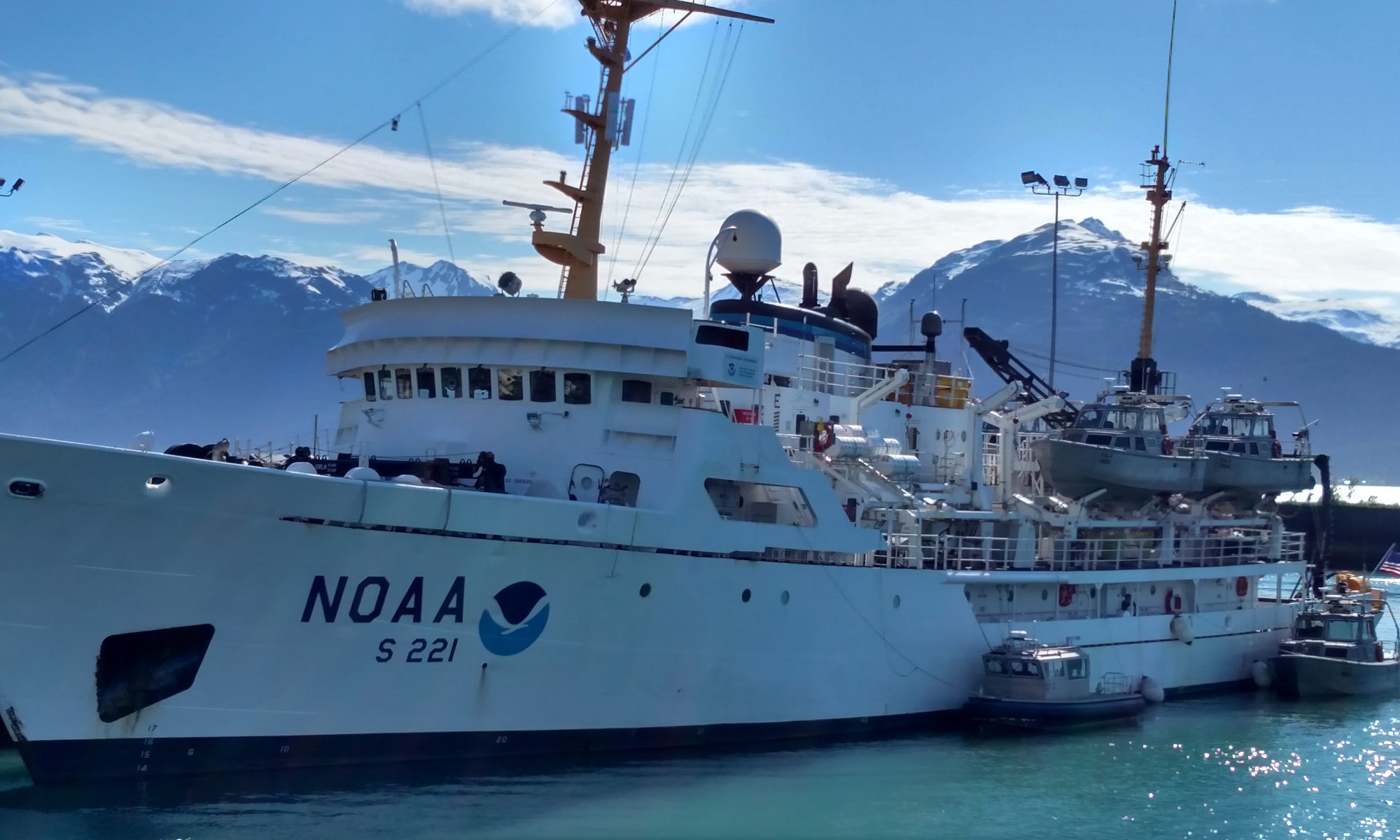
Photos: NOAA Ship Pisces in port in Newport, Rhode Island; NOAA Ship Pisces’ call sign; Teacher at Sea Dorothy Holley and NOAA Ship Pisces.

Science at Sea 

When someone I care about tells me they don’t feel so good, the first thing I want to do is put the back of my hand to their forehead. Do you have a temperature? If so, your body is probably fighting off something. A thermometer can give a more quantitative answer. With more precise data, I can best treat the underlying cause.

Photos: Bongo nets on deck, awaiting deployment; Ed Williams and Alyssa Rauscher deploying the bongo nets; Pulling the nets back on board. Photos by LT Karina Urquhart

NOAA scientists help us take the temperature of our oceans by monitoring plankton – the base of the marine food web. I’m not talking about sticking tiny thermometers into copepods or krill, I’m talking about measuring plankton abundance and composition over time. NOAA collects plankton data four times each year – summer, fall, winter, and spring. With over four decades of plankton data, NOAA scientists are able to help fisheries make informed decisions to maximize production as well as protect vulnerable species. 

Our team uses Bongo nets to collect plankton on this NOAA Summer Ecosystem Monitoring cruise. We will make over 100 (I think there are about 160 planned stations but we probably won’t have time to get to all of them) stops from Cape Hatteras to the Gulf of Maine, collecting samples that will later be sorted and catalogued. (For a more detailed description of Bongos, see Teacher at Sea Tonya Prentice’s blog here)

You do the math: If we are out at sea for two weeks, and deploy the Bongo nets at 100 different stops, how many times does each group need to collect plankton from the Bongo nets each day? Check in the next bog post for the answer.

view of tables in the mess. each of the chairs' legs is capped in a cut tennis ball.
Mess hall or Cafeteria?

Interesting Things: I am surprised by the ways I have been prepared for life on a NOAA ship by classroom life in a public school. The chairs all come with tennis balls on the bottom. In my classroom, we put tennis balls on the chairs so that they don’t make loud noises or create as many scuffs on the floor. Why do you think we have tennis balls on the chairs on a NOAA ship?

photo of the seal of NOAA Ship Pisces, displayed somewhere on the ship. It features an illustration of the ship against a simple map of the Gulf of America, above two swimming fish. on the land of Louisiana, Mississippi, and Alabama, there's a pale image of an old diving helmet and crossed tridents. The seal includes the words NOAA Ship Pisces; R-226; Pascagoula, Mississippi. The circle of the seal is bordered by the design of a rope.
NOAA Ship Pisces home port is Pascagoula, MS
Amanda Jacobsen, Science FIeld Party Chief, NOAA Ship Pisces

Career Spotlight 

Amanda Jacobsen is our Science Field Party Chief. She works in the NOAA Fisheries lab in Rhode Island, and sails on NOAA cruises like this one. She grew up in Connecticut and attended a small, liberal arts school, Connecticut College. While there, Amanda took a broad spectrum of science courses including Biology, Physics, Chemistry, Environmental Science, and even Environmental Law. Her degree in Environmental Studies helps her understand the many impacts on Marine Ecosystems.

Amanda is now a full-time NOAA scientist and a part time graduate student, studying to earn a Master’s degree in Marine Biology from the University of Massachusetts Dartmouth. Her thesis examines the energy of plankton in the food chain. (Alert: we will do bomb calorimetry labs next year with Amanda’s data!) Better understanding the bottom layer of the energy pyramid is important to harvesting all of the tropic levels above it. If you like eating fish or even fish sticks, you will benefit from Amanda’s work because plankton provides food for nearly every creature in the ocean either directly or indirectly!

One tool that Amanda can’t live without is the Katy Clip (shout out to NOAA Ship Henry B. Bigelow survey technician Katy McGinnis!). The Katy Clip helps us wash down the Bongo nets when collecting plankton.

Amanda is currently reading the Red Rising Series by Pierce Brown. She also recommends The Ocean’s Menagerie by Drew Harvell. Amanda enjoys doing just about anything as long as it is outside. I am glad she is helping take the temperature of our oceans so that we might enjoy fishing for many years to come!

group photo of two women and a man lined up on deck against an outer wall of the ship. Dorothy, on the left, and Miles, at right, wear life jackets; Miles also wears a green hard hat. Amanda, at the center, has an intercom radio receiver attached to the neck of her sweatshirt.
A part of our Science team: Dorothy, Amanda, and Miles

Personal Log

The ship is going 24/7, so the scientist are, too! Our team is divided into two groups – one that works 3 am – 3 pm and the other works 3 pm- 3 am. Amanda, Miles and I are in the second group. We get to see the sunset every day, but I probably won’t make it to breakfast!

Sunset over the ocean; the sun has almost dipped beneath the horizon. the sky is mostly clear except a few wisps of low clouds.
Sunset over the Atlantic

Dorothy Holley: Introduction, July 25, 2025

NOAA Teacher at Sea

Dorothy Holley

Aboard NOAA Ship Pisces

July 31 – August 15, 2025

Introduction

Hello! My name is Dorothy Holley and I have been teaching Science in North Carolina for my whole career. While North Carolina does touch the Atlantic Ocean, I live in the capital city of Raleigh, about two and a half hours from the beach. And that’s just it…. my family, my students, my community….. we all think about going to the beach. But what is beyond the sand and the surf? The OCEAN!! Over 70% of the world is water!! That is a LOT of science lab space!!

For the next two weeks, I am going to be a NOAA Teacher at Sea. NOAA stands for the National Oceanic and Atmospheric Administration. NOAA is one of the seven uniformed services of our government, whose roots stretch back to 1807 when President Thomas Jefferson established the Survey of the Coast to create nautical charts for safe navigation. Today NOAA is responsible for weather forecasting, severe weather prediction, climate monitoring and research, ocean and coastal management, deep-sea exploration, as well as data collection and dissemination. In other words, NOAA helps us live better by supporting the economy, protecting life and property, and promoting environmental stewardship. 

a political map of North Carolina, showing Raleigh to be roughly central to the state
Map of North Carolina. Raleigh is in the center. (Credit: World Atlas)

A couple of years ago, I worked in Washington, DC, to grow as an education leader. I wanted to understand how science education was being supported and how I could better prepare my students for life after high school. One of my first “field trips” was to NOAA offices in Maryland where I saw science being used to improve our quality of life.

a courtyard and tidal pool (creating waves that break against a wall) in front of buildings
NOAA headquarters

The picture below shows a Tide Predicting Machine that was designed by the U.S Coast and Geodetic Survey in 1895. Construction began in 1896 and was completed in 1910. The machine was used continually until 1965, when it was replaced by a computer.   

a tide predicting machine - a large metal machine with many moving levers and dials - inside a glass case, on display. there are framed historic photographs of the machine located in and around the glass case.
Tide Predicting Machine, used until 1965

I also got to tour a NOAA “Hurricane Hunter.” These planes fly right into the eye of Hurricanes to gather important and real-time data.

Dorothy, in a blue suit, stands for a photo in front of an airplane on a tarmac - we can see the NOAA logo beyond the wing
Dorothy Holley in front of a Hurricane Hunter
view of a seat inside the airplane on tracks so that it can slide back and forth; a stack of computers or radio equipment in front the chair
Hurricane Hunter airplanes are modified for the mission!

The stickers on the bottom of the plane are like the stickers our football players put on their helmets each season to recognize special achievements on the field.

stickers on the belly of the airplane: first, three rows of flags of different nations; then four rows of red hurricane-shaped stickers containing storm names and dates
Real time data was collected from all of the Hurricanes listed here on the belly of the airplane
close up view of some of the storm stickers, red stickers shaped like a hurricane spiral: they read EPAC Bonny 1976, Frances 1976, Gloria 1976, Emily 1987, Floyd 1987, Florence 1988, Humberto 2001, Iris 2001, Michele 2001
Close-up view of the stickers commemorating the storms this Hurricane Hunter surveyed

Last December, some of the other teachers at West Johnston High School and I participated in a teacher workshop on RESILIENCY. We visited a ghost forest and the second oldest federal marine laboratory in the nation. This NOAA facility in Beaufort, NC conducts scientific research to help us understand and preserve coastal environments, manage sustainable fisheries, and maintain coastal resilience. 

four women in jackets and coats pose for a photo on a beach. behind them, we can see sun bleached stumps and knees of dead cypress trees
Teachers at West Johnston High School in a ghost forest on the NC coast.

As a Teacher at Sea, I will sail on NOAA Ship Pisces to better understand and relate the jobs of the scientists and the science being used. The Teacher at Sea program was established in 1990 and has been in existence for 35 years. Teachers from all 50 states as well as four territories have logged over 20,000 days at sea, sharing thousands of blog posts, conducting more than 100,000 hours of ocean-based research, and relating countless stories of science application.  To become a Teacher at Sea, I had to fill out a lengthy application (which included asking people to write letters of reference on my behalf), attend virtual training sessions, read and fill out quite a bit of paperwork, and speak with a seasoned team of NOAA specialists who are invested in helping teachers make connections for their students. Charts, maps, and calendars have been consulted, checked, and analyzed!

view of a time capsule with a plaque that reads: This geodetic mark was established to commemorate 200 years of science, service, and stewardship to the nation by NOAA and its predecessor agencies and to mark the location of NOAA's 200th Celebration Time Capsule. The materials reflect the essence of NOAA in the year 2007, as well as the agency's rich history, preserved for the benefit of NOAA's future community. Sealed in December, 2007, to be opened in 2032.
NOAA’s 200th Celebration Time Capsule and Geodetic Mark

One special opportunity for me as a Teacher at Sea will be to deploy a DRIFTER and for us to monitor and analyze the drifter data. The Global Drifter Program began in 1979 with over 1,000 drifters already deployed. We can make predictions about marine debris, animal larvae paths, and oil spills, and then track our drifter after it is deployed. This data will ultimately help us make more accurate weather forecasts and track storms and hurricanes.

illustrated diagram of a drifter buoy. a white ball floats at the water line; this is labeled "Surface float - designed for moving on the surface with currents." The float has an Antenna, labeled: "the drifters transmit the data they collect as well as their position via satellite." Data is depicted as a gray triangle extending up from the antenna to a satellite in the sky, which is communicating with a satellite dish on land. Beneath the float, down into the water, extends a black cable, thicker toward the float. It's labeled: "Sensors: Sea Surface Temperature sensor and various measuring systems." The cable connects to what appears to be gray cylindrical tube, waving in the water labeled "Drogue: The buoys have some form of subsurface drogue or sea anchor."
Drifter information
A drifter ready to be deployed! Photo by TAS ’24 Tonya Prentice

I will share my NOAA Teacher at Sea journey here for you to read and to see. You are welcome to ask questions here on the blog and I will ask the team for help in answering them.

I can’t wait to begin this incredible journey!

Fair winds and safe sailing!