Latitude: 57º 9.61 N Longitude: 152º 20.99W Wind Speed: 15 knots Wind Direction: 210 º Air Temperature: 12º Celsius Barometric Pressure: 1013 mb Depth of water column 84 m Surface Sea Temperature: 12º Celsius
Welcome to a tour of the NOAA Ship Oscar Dyson.
Your tour guide today is the Room
11 Bear.
Allow me to explain.
When I am not a Teacher at Sea on the NOAA Ship Oscar Dyson, I am the special education preschool teacher in Room 11 at Nevada Avenue Elementary School in Canoga Park, California. My classroom has a classroom bear (made of construction paper) that “hides” every night when the students go home. In the beginning of the year, he is sort of easy to find, but as the year progresses, he is harder and harder to find. By the end of the year, only a paw or an ear might be showing!
The first
thing my students want to do every morning is look for the bear. When they find it, they excitedly explain where
it is. Speech and language are things we work on in class all the time, and the
bear gives us something fun to talk about! For some students, a single word might
be the goal. Other students may be working on putting a few words together, or
even enough to make a sentence. It’s
also a great time for them to learn prepositional words or phrases to describe
where the bear is hiding, such as next to, under, beneath, or on top of.
Now it’s YOUR turn. I hope you have fun touring the NOAA Ship Oscar Dyson with the Room 11 Bear and finding him in the photos where he decided to hide in a tricky spot. He is in EVERY picture.
Commanding Officer Bear up on the Bridge (the part of the ship above the weather deck which houses the command center).
I also spy a snack that is a favorite of some students in Room 11.
Bear charting our course on the Bridge
Steering the NOAA Ship Oscar Dyson (up on the Bridge)
Binoculars are used to check for whales or other boats before the trawl nets are put out.
Food is cooked in the galley (the nautical term for kitchen)
This is the mess (the nautical term for eating place) where all of the delicious meals are served.
The laundry room
One of the two gyms onboard the NOAA Ship Oscar Dyson
The engine room
There are “fire stations” onboard
in case of an emergency
This is where we put on our waterproof rain gear and high boots before entering the fish lab
High rubber gloves are worn so that we stay somewhat clean and to protect our hands as we use sharp tools and touch jellyfish or pointy quills
Lastly, a visit to the acoustics lab, where the scientists read and analyze the data from the echo sounders and determine when and where to drop the trawl nets.
Latitude: 57º 09.61 N Longitude: 152º 20.99W Wind Speed: 15 knots Wind Direction: 210 º Air Temperature: 12º Celsius Barometric Pressure: 1013 mb Depth of water column 84m Surface Sea Temperature: 12º Celsius
Science and Technology Log
Onboard the NOAA Ship Oscar Dyson with me are two volunteer biologists: Evan Reeve and Nathan Battey. Evan is on the opposite shift, so we often pass each other, but on occasion, we have been in the fish or chem lab at the same time.
Volunteer biologist Evan Reeve
I arrived here knowing very little about fish (other than how to care for a beta fish and how to cook salmon and trout). Evan, on the other hand, is a recent graduate of the University of Washington (or as he likes to say, “U-DUB”) with a degree in Biology (and an emphasis in fish biology). When I say recent, I mean recent. Evan graduated five days before we boarded the ship.
Evan has a remarkable “ready for anything”
attitude whether it is the start of his 12-hour shift, or the end. His background
may be one reason why. Originally from San Diego, he spent his freshman year at
the University of Missouri, Kansas City. A planned-year studying abroad at the
Universidad Veritas in San Jose, Costa Rica got cut short after one semester
due to an illness that forced him to return to San Diego. There, Evan made the decision to serve our
country and joined the Navy. For a few years, he served as a Navy corpsman
stationed with Marine infantry units until he was injured during training. That’s
when Ready-for-Anything Evan resumed his studies, eventually arriving at his
beloved “U-DUB”.
Evan currently lives in Washington, where he volunteers with the NOAA Hatchery Reform Program in Port Orchard, Washington, tracking hatchery released juvenile salmon in Puget Sound using both acoustics and traditional fishing techniques. When a biology professor mentioned the opportunity to spend time on the NOAA Ship Oscar Dyson in the Gulf of Alaska, Evan of course volunteered, eager to participate in a larger scale study involving different fish species. In Puget Sound, the haul is often 10 salmon. In contrast, the haul being studied onboard the Oscar Dyson is often 1000 pounds of Walleye pollock several times a day (along with prowfish, Pacific herring, rockfish, and a lot of jellyfish). Speaking of prowfish, herring, rockfish, and jellyfish…
FUN FISH FACTS AND PHOTOS:
PROWFISH: In my earlier blog, Oh, the Places You’ll Go, I wrote about the lumpsucker being the cutest fish I had ever seen. A close runner up is the baby prowfish.
juvenile prowfish
Every time we get a prowfish in a catch, everyone wants to look at it! We usually get juvenile prowfish which are about the length of my finger. (Adults can get up to 3 feet long.) The juveniles are very soft and smooth looking, and their lower jaw juts out slightly, making them look like they are pouting. Unlike adults prowfish, who spend most of their time near the bottom of the sea floor, juvenile prowfish spend their time in the middle levels of the water column, which is the area we are trawling on the NOAA Ship Oscar Dyson. I was surprised to learn that juvenile prowfish will try to avoid predators by hiding within the bells of large jellyfish.
PACIFIC HERRING, OR AS I LIKE TO CALL THEM, THE RAINBOW FISH:
Pacific herring
As a special education preschool teacher, I often read and discuss The Rainbow Fish (by Marcus Pfister) with my students.
The Rainbow Fish by Marcus Pfister
It is a popular children’s book
about a little fish with very sparkly scales who learns to share. Rainbow Fish
was considered the most beautiful fish in the ocean because of his many sparkly
scales. When a plain, little fish asks for
one of the sparkly scales, Rainbow Fish refuses to share. This makes all the
other fish mad, and they no longer want to play with the Rainbow Fish. In the end,
Rainbow Fish decides to share his sparkly scales with all the other fish,
keeping only one for himself. He is less
beautiful than he was before, but he has new friends and is now the happiest
fish in the sea.
The Pacific herring is similarly covered in sparkly scales, but boy, is he a super sharer (as we say in preschool)! Since herring are a small fish, they compensate for their size by forming schools (or groups of fish that swim together). Swimming in schools protects them as it reduces the likelihood that any one of them will be eaten by a predator. Sometimes we get only one herring with our huge haul of pollock. They are somewhat similar in shape and color. Evan (the volunteer biologist) has a theory: that it’s a herring who got separated from his school and sought protection by joining and blending in with a school of pollock. As a preschool teacher, I love the idea that a group of pollock would allow or even invite a lost little herring to “play” with them.
Other times, we get a lot of herring, and as I mentioned they love to share their sparkly scales. Everything (and everyone) ends up sparkly: the pollock, the fish belt, the measuring boards, the tables, and ME! You can always tell when there is herring in a catch by the sparkly fish scales in my hair.
ROCKFISH: Occasionally a few rockfish are in the trawl net. Rockfish have large eyes, and are not particularly sparkly or cute, but they are delicious! I even learned to fillet them!
My first time filleting a fish
It’s easier than I thought it would be!
It was exciting to later see the rockfish cooked and served for dinner.
The rockfish deliciously prepared by the Chief Steward, Judy Capper
AND FINALLY THE JELLYFISH: Not yet… keep reading…
FIRST,Nathan Battey: Nathan, the other volunteer biologist onboard, is on my shift, and works in the fish lab with me 12 hours a day processing the fish hauls. He is my “go-to fisheries biologist” whenever I need help identifying a fish or jellyfish.”
Volunteer biologist Nathan Battey with a lumpsucker
Since he is originally from Goffstown, New Hampshire, it should not come as a surprise that Nathan ended up on a ship since Goffstown is home to the famous Giant Pumpkin Regatta! Every October, Goffstown residents transform enormous pumpkins into boats. They scoop out the sometimes 1000-pound pumpkins, climb in, and race them down the Piscatoquag River.
Nathan studied biology and earth science at the University of New Hampshire and took a lot of oceanography courses along the way. Since graduating in 2015, he has done a myriad of fascinating things. He quantified nitrogen cycling in the wetlands of coastal New England, worked in a microbiology lab, counted larval fish under a microscope, regulated the upstream passage of salmon on the Seattle fish ladder, worked as a scallop fisheries observer, was a State Park Ranger on the eastern shore of Virginia, and worked with the Lower Elwha Klallam Tribe (alongside NOAA scientists, tribal scientists, fish and wildlife scientists, and National Park scientists) on the recolonization of the Elwha River for salmon and other fish after the dams there were removed. (The tribe had successfully sued the U.S. for the removal of the dams based upon their right to fish there.)
The last two positions were through AmeriCorps, which he highly recommends! AmeriCorps is a network of national service programs. It is sometimes thought of as the domestic Peace Corps since members serve on projects within the United States. According to their website: “AmeriCorps is your moment to take the path less traveled, to break the status quo, to stop talking about the problem and be the solution.” Whatever your passion, it is likely there is an AmeriCorps opportunity perfect for you. There are projects in the fields of education, public safety, health care, and environmental protection. If you are interested in learning more about AmeriCorps, visit https://www.nationalservice.gov/programs/americorps
Nathan is also a talented artist and drew detailed sketches of both marine and bird species which amazed everyone and now hang on the walls of the chem lab.
Nathan’s sketch of the albatross that would visit the ship during fishing times.
He will also be remembered for the nickname he gave to the Chrysaora melanaster jellyfish: Chrysaora melanasty.
Nathan’s sketch of the beautiful but dreaded melanasty
AT LAST, THE JELLYFISH:
Chrysaora melanaster are magnificent creatures. The photo below, captured one night using the drop camera, shows how elegantly they glide through the water with their ribbon-like tentacles flowing gracefully behind them.
Chrysaora melanaster captured on drop camera
It is often my job to grab the jellyfish as they come down the belt, separating them from the pollock. I have held some that are an inch wide, and some that are almost 3 feet wide (and quite heavy). Jellyfish are measured by their bell diameter, or how wide the top part is (not the tentacles).
Here I am with a large Chrysaora melanaster. Before my time on the Oscar Dyson, if I saw a jellyfish in the ocean, I swam away as quickly as I could. Now I probably touch 100 jellyfish per day, albeit with gloves on. Also, look at the sparkly scales in my hair. It must have been a herring day!
Volunteer biologist Evan Reeve and a tangled mess of Chrysaora melanster
The photo above might give you an idea of how the nickname “melanasty” came to be. In the net, all the glorious, long, sticky, ribbon-like tentacles of the Chrysaora melanaster get tangled and attached to all the glorious, long, sticky, ribbon-like tentacles of the other Chrysaora melanaster. As you try to pull one jellyfish off the belt, several more are attached in a slimy mess, and you often get splashed in the face, mouth, or eyes with jellyfish “goo.” One day, dealing with the tangle, Nathan dubbed them “melanasty” and the nickname stuck.
Fishing nets like the ones used on the NOAA Ship Oscar Dyson or on commercial fishing boats can be very expensive. If one plans on doing a bottom trawl (fishing with a net that goes down to the sea floor) one wants to make sure that there are not rocks or other things that can snag or tear the net. If there are too many rocks or boulders or uneven topography, the area is considered “untrawlable”. While computer imagery can provide some guidance with regard to what lies deep beneath the surface, scientists onboard the NOAA Ship Oscar Dyson are hoping that video images taken with an underwater camera can provide a more complete picture and be the basis for a more precise computer model of what areas are in fact untrawlable.
Why is this important? Scientists onboard the NOAA Ship Oscar Dyson are surveying the fish that live in the middle of the water column. However, groundfish surveys need to account for all the fish living on the ocean floor. If the groundfish program can’t trawl in certain areas, then they don’t know what is there. For example, rockfish often live in untrawlable areas. If a groundfish survey can’t put a net in areas where rockfish live, then they won’t really “count” the correct numbers of rockfish in their survey. Data obtained using an underwater camera can help determine what species of rockfish are being underrepresented by the groundfish program.
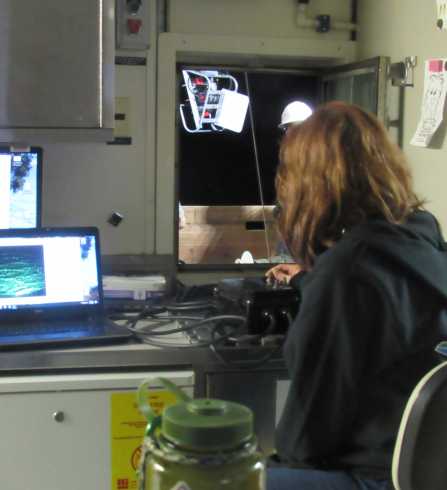
One of the many perks of being on the 4 p.m. to 4 a.m. shift is that I get to watch the drop camera in action! The camera (with its attached light) is slowly lowered to the sea floor.
The drop camera
I have seen the camera take 4 minutes to reach the bottom or as long as 8 minutes depending upon the depth of the water being surveyed. The camera is then “driven” along the bottom (or right above it) for 15 minutes via a control box on the boat (similar to a tiny joystick). I even got to drive it a few times!
My turn to drive!
The images are recorded and also seen in real time on several computer screens on the boat. We have seen rocks, of course, but also jellyfish, sea whips, crabs, anemones, octopuses, sea stars, and a wide variety of fish. One night, there were thousands of sand dollars. It looked like we had come across a buried treasure! It is fascinating to see what is happening deep beneath the boat. It’s kind of like virtual scuba diving!
Sand dollars and brittle stars
Tiger Rockfish
Flatfish
Giant Pacific Octopus
ANOTHER Giant Pacific Octopus!
Kelp Greenling
Quillback
Drop Camera Elementary School Math Fun
If the stereo drop camera takes 8 minutes to reach the bottom when the water is 200 meters deep, how long might it take to reach the bottom if it was:
100 meters
deep? ____________
50 meters
deep? ______________
300 meters
deep? _____________
Personal Log
It’s time to come clean and admit that I suffer from Pareidola. Don’t worry, it’s not contagious, or even dangerous. In fact, I think it’s a lot of fun. You see, Pareidola is a psychological phenomenon where you see patterns. Quite often, people with Pareidola will see faces in objects where there really isn’t one, like on an electrical outlet.
Electrical outlets… do you think they look like faces?
My Pareidola
has reached a new level on the NOAA Ship Oscar Dyson as I am seeing not
just faces but ROBOTS like these:
Robot!
Robot!
Let me
know if you see any robots at your house, and I am on the lookout for more
here!
Latitude: 55º 4.07N Longitude: 156º 42 W Wind Speed: 3.2knots Wind Direction: 96º Air Temperature: 10.3º Celsius Barometric Pressure: 1025.7. mb Surface Water temperature: 11.05º Celsius Depth of water column: 1,057.6 meters
If you love science and exploring, consider a career in the NOAA Corps!
NOAA Corps
The NOAA Corps is one of our nation’s seven uniformed services (along with the Army, Marine Corps, Navy, Air Force, Coast Guard, and Public Health Service Commissioned Officer Corps). NOAA Corps officers are an integral part of the National Oceanic and Atmospheric Administration (NOAA), an agency of the U.S. Department of Commerce. NOAA and the NOAA Corps can trace their lineage to 1807 when President Thomas Jefferson signed a bill for the “Survey of the Coast.” The survey work was done by Army and Naval officers along with civilian men and women. The Coast Survey was actually the first federal agency to hire female professionals! Their duties included charting our nation’s waterways and creating topographic maps of our shorelines, which made our marine highways among the best charted in the world.
Today, the NOAA Corps is an elite group of men and women trained in engineering, earth sciences, oceanography, meteorology, and fisheries science. NOAA is comprised of the National Weather Service, National Marine Fisheries Service (NOAA Fisheries), Office of Oceanic and Atmospheric Research (NOAA Research), National Environmental Satellite, Data and Information Service, National Ocean Service, and the Office of Marine and Aviation Operations. NOAA Corps officers operate NOAA’s ships, fly aircraft, manage research projects, conduct diving operations, and serve in staff positions throughout NOAA.
NOAA Officer Spotlight
ENS Lexee Andonian
I had the opportunity to speak with Ensign (ENS) Lexee Andonian (although by the time this is published Ms. Andonian will have been selected for LTJG (Lieutenant junior grade)! ENS Andonian has been a member of NOAA Corps for almost 2 years, and loves her job, but it was not something she originally considered as a career (or even knew about). She first learned about NOAA while working at a rock climbing gym. A patron mentioned it to her, and offered to show her around a NOAA ship. She went home and googled NOAA. With her interest piqued, she decided to accept the patron’s offer, and went to Newport, Oregon to tour the NOAA Ship Bell M. Shimada (which is actually the sister ship of the NOAA Ship Oscar Dyson. A sister ship means they were based off the same blueprint and can serve similar projects.)
ENS Andonian applied for the NOAA Corps, but was waitlisted. NOAA is highly selective and accepts a very limited number of applicants (approximately 15-25 twice a year.) Undeterred, she applied for the next NOAA class, and was once again waitlisted, but this time she was accepted off the waitlist. After 5 months of training at the Coast Guard Academy, she was ready to begin her assignment onboard a NOAA ship, where additional hands-on training occurs non-stop. Each NOAA Corps member wears a multitude of “hats” while onboard. ENS Andonian is currently the Acting Operations Officer, the Navigation Officer, the Environmental Compliance Officer, and the Dive Officer. ENS Andonian loves that her job allows her to see unique places that many people never get to explore since they are not accessible by plane or car. Asked what she misses the most from home, she said, “Bettee Anne” (her dog).
Science and Technology Log
Today I was introduced to a few new species in the fish lab. Until now, most of the jellyfish have been Chrysaora melanasta, which are beautiful and can be quite large, but today I saw 2 egg yolk jellyfish, aptly named as they look like egg yolks.
Egg yolk jellyfish
I also saw a lumpsucker, which is the cutest fish I have ever seen. Lumpsuckers look like little balls of grey goo. He (or she) seemed to look right at me and kept opening and closing its mouth as if trying to say something. Lumpsuckers have a suction cup on their bottom which allows then to adhere to rocks or other surfaces.
Lumpsucker
Personal Log
As a teacher, I create experiences for my students that will take them out of their comfort zone so that they can realize just how much they are truly capable of. On the NOAA Ship Oscar Dyson, it is my turn to step outside my own comfort zone. If you would have told me a few months ago that I would feel comfortable being elbow-deep in live fish and jellyfish, or dissecting fish to see whether they are male or female, or slicing into a fish’s head to collect otoliths (ear bones), I would not have believed you, but that is how I spend every day onboard the Oscar Dyson, and after 2 weeks, it feels like something I have done all my life. It is an experience I highly recommend to everyone!
A slice is made slightly behind the pollock’s eyes.
Otoliths are then removed using forceps.
Walleye pollock otoliths.
Otoliths are bottled and sent for further analysis.
Latitude: 55º 48.9 N Longitude: 159º 2.3 W Wind Speed: 4.2 knots Wind Direction: 186.5º Air Temperature: 14.7º Celsius Barometric Pressure: 1022.12 mb Depth of water column 84.5 m Surface Sea Temperature: 10 º Celsius
History
On March 30, 1867, Secretary of State Seward purchased Alaska from the Russian Empire for 7.2 million dollars (or 2 cents per square mile). It was deemed a territory for many years until January 3, 1959 when President Eisenhower signed a proclamation admitting Alaska into the United States. The word “Alaska” comes from an Aleut-language idiom that means “object to which the action of the sea is directed.” It is the northernmost and westernmost state in the United States. It is also the largest state. By comparison, it is twice the size of Texas.
Celebrating the Fourth of July, NOAA style
My usual Fourth of July at home includes a bar-b-que, swimming, and attending a fireworks show at night. The Fourth of July celebration on the NOAA ship Oscar Dyson was completely different, and literally a BLAST. At noon, an announcement was made for “all hands” to report to the galley for Fourth of July “mocktails” or fun non-alcoholic drinks. (There is no alcohol on a NOAA ship.) I had a delicious “mimosa” made of orange juice and sparkling cider. Later, we were taken on a wonderful ride past Mitrofania Island.
Approaching Mitrofania Island
Mitrofania Island
Photographs do not do it justice. It was my first time up on the fly bridge (the “roof” of the boat) and I loved being able to take in the 360 degree views. Many people never get to see this part of Alaska as it is not a route commonly taken by cruise ships. The “fireworks” part came the next morning, when “all hands” were again called to the deck to light off expired flares. While some made a popping noise, the one I did produced thick orange smoke for at least 30 seconds. It was, as I said, a literal blast!
Science and Technology
Later, we were back on the bridge but for a sadder reason. A dead whale was floating in the water right near the boat. I asked if anyone comes to pick up dead whales. It was explained to me that if a dead whale washes ashore, it will be picked up and taken for a necropsy to see if the cause of death could be determined. However, if they are at sea, they will be left to decompose and become part of the sea once again.
Whale carcass
On a
happier note, I was sent to the bridge later in the day to see if there were
any whales in the vicinity as we do not fish if whales are nearby. It turned out
that there were 5 whales in the distance (but close enough to see with binoculars).
Whales are somewhat easy to spot as they must come to the surface often to
breathe. When they exhale, they produce a spout of moist air from their
blowhole. Since different species of
whales produce different shape or size spouts, the spout is one way to identify
the type of whale you are seeing. Other identifying features are size, color,
fin shape, and whether they are alone or in a group. Some whale species travel
in groups or pods, while others are more solitary. For example, killer whales
(which are really dolphins) spend much of their time in large groups that
travel and hunt together. Sometimes 4 generations of killer whales will be
found together. In contrast, humpback
whales are more often found alone or with their calf.
Whale Fun Facts
While many
people think that whales spout water, it is actually mostly air. The spout is their exhale. Since they are
mammals, and not fish, they do not have gills, and must come to the surface to
breathe through their blowhole.
A baby
whale is called a calf.
A group of
whales travelling together is called a pod.
The blue
whale is the largest animal in the world. It can grow to be as long as 3 buses,
and its heart is as big as a car. Despite being so large, blue whales eat some
of the smallest marine life, such as the krill discussed in an earlier blog.
A blue whale’s
call is so loud, it can be heard underwater for hundreds of kilometers.
Whales are
warm-blooded, so they need to develop a layer of fat (called blubber) to stay
warm in cold water.
Whale blubber experiment for parents and kids to do together
Make a blubber glove by filling 2 ziploc-type plastic bags with shortening (such as Crisco) and taping them together to form a pocket.
Fill a
bowl with water and ice cubes.
Allow your
child to quickly touch the cold water in the bowl with their bare hand.
Then have your child put his or her hand in the blubber glove, and then put their gloved hand into the cold water.