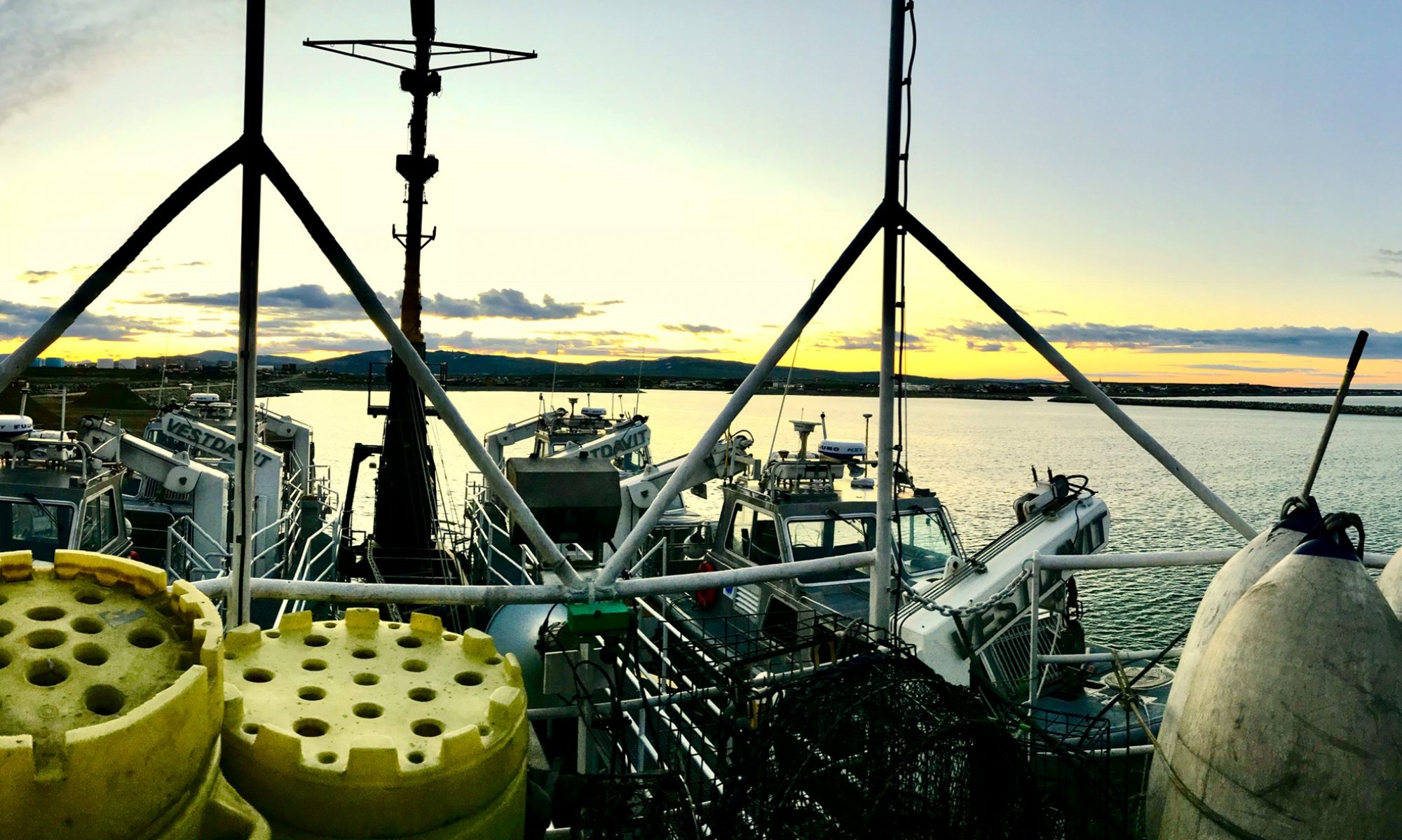
Life at sea can often be unpredictable. When I started my 4am shift I learned that we were having issues with the main engine on the NOAA Ship Oscar Dyson and had to return to Kodiak. This cut my adventure at sea down to just two weeks instead of three. An unexpected bonus from returning to Kodiak was getting to visit the Kodiak Fisheries Research Center.
Science and Technology Log: Kodiak Fisheries Research Center
The Kodiak Fisheries Research Center was built in 1998 using funds from the Exxon-Valdez Oil Spill (1989). The purpose of the center is to provide educational information about the wildlife, marine life, commercial fishing resources and fisheries research programs on the island. Click this link for more information: KFRC
Interview with Kresimir Williams
Fisheries Biologist
Kresimir in the Acoustics Lab Image from TAS Mary Murrian
Official Title
Fisheries Biologist
Normal Job Duties
On this cruise, I am responsible for collecting physical measurements of fish caught in our science trawls, as well as providing support for various acoustic and camera instruments we’re putting in the water.
How long have you been working on Oscar Dyson?
Since it’s first science cruise in 2005, but only for a few weeks each year.
Why the ocean? What made you choose a career at sea?
I got hooked on sea exploration at an early age spending summers on the Croatian coast, snorkeling, fishing, and riding boats. The ocean represents an exploration opportunity that is more “accessible” to us, unlike the deep jungles or space. The edge of our knowledge is never very far in the marine environment. The more time I spend in ocean research, there always seem to many more questions than answers.
What is your favorite thing about going to sea on Oscar Dyson?
I enjoy the scientific challenges and the things that are new each cruise, whether it is some unique types of fish we encounter, or new ways of exploring the sea, such as new instrumentation. There always seem to be new things to see, even after being on these cruises for 15 years. And there are also new people on board that are interesting to meet, people with new perspectives and ideas.
Why is your work (or research) important?
There is a basic component to the work of essentially performing a marine “census” that is the backbone of resource management for the important fisheries that take place here. We have to have good information on the state of the fish populations in order to properly manage sustainable fish harvests. But the results of our surveys also provide essential data for many studies of the ocean, such as climate related fish distributions, questions of fish biology, and marine ecosystem functioning – critical research efforts that are carried on by academic and government researchers. On top of all that, we also do a lot of research into our survey methods, to develop new ways of collecting data and to determine the precision and accuracy of the tools we use. This latter part is more interesting to me.
When did you know you wanted to pursue a career in science or an ocean career?
I was interested in all things oceanic from an early age. I always wanted to work specifically with fish. My toddler doodles were of fish. I’ve followed this path throughout my education and job history, and have no regrets.
What part of your job with NOAA (or contracted to NOAA) did you least expect to be doing?
On the job I somewhat unexpectedly learned how to write computer programs, and to develop and design camera systems. But this is also a very rewarding activity for me.
What are some of the challenges with your job?
As we incorporate more and more advanced technology into our work, trying to keep all of the systems operational requires a broad base of knowledge, spanning from computer networks, underwater optics, electronics, and engineering that can be a little beyond my background. So this is a challenge for me to keep myself up to speed on these aspects of the work and keep our instruments and cameras running smoothly. Also, as scientists we are obligated to share our work with others, which means writing papers and making presentations, which can be a challenge.
What are some of the rewards with your job?
I love discovering new ways of collecting data in the environment, and understanding how fish behavior influences our ability to observe them. Finding answers to research questions relating to these areas is a very rewarding experience for me. There are distinct moments, not very often encountered even in entire careers, when you know that you have found something, possibly something completely new, that produces an excitement that is almost difficult to describe.
Describe a memorable moment at sea.
A positive memorable moment would be when we first started operating cameras inside the trawl and were able to distinguish how fish behaved within the trawl for the first time. The first few tows with the new camera equipment were very exciting. A negative memorable moment: We did run out of coffee on a cruise in the Bering sea a few years ago. Bad scene.
Interview with Caroline Wilkinson
NOAA Corps Junior Officer
NOAA Corps Officer Caroline Wilkinson
Official Title
Junior Officer
Normal Job Duties
Standing bridge watch 8 hours a day, often with a Officer of the Deck in training. As Environmental compliance officer- ensuring the ship meets all required environmental standards for garbage disposal, discharge, etc. As medical officer- ensuring all personnel are physically and mentally fit for sea duty, keeping the hospital clean, tidy, and stocked, responding to medical emergencies at sea. As Imprest officer- maintaining our cash fund and reimbursing crew for missed meals. As Navigation officer- planning our route and ensuring the charts and electronic navigation reflects our intended tracklines.
How long have you been working on Oscar Dyson?
Since December 2015
Why the ocean? What made you choose a career at sea?
I grew up spending summers on Long Island Sound and fell in love with the beach and the smell of the ocean.
What is your favorite thing about going to sea on Oscar Dyson?
The amazing animals, land masses, and weather phenomenon that we get to experience.
Why is your work (or research) important?
The work I do facilitates the scientists ability to collect the necessary data to ensure the pollock population remains sustainable.
When did you know you wanted to pursue a career in science or an ocean career?
As a child, I spent a lot of time out doors looking for bugs and critters; a career in science seemed like a natural next step.
What part of your job with NOAA (or contracted to NOAA) did you least expect to be doing?
I didn’t expect there to be so much paperwork involved with driving the ship!
What are some of the challenges with your job?
The long stints away from friends, family, and civilization.
What are some of the rewards with your job?
Meeting a variety of incredibly smart and talented people and exploring parts of Alaska most people don’t get to experience.
Describe a memorable moment at sea.
Being in the northern Gulf of Alaska at night and spending hours watching the northern lights dance across the sky.
Personal Log
Here is a quick video tribute to the NOAA Teacher at Sea program, the NOAA scientists and Oscar Dyson officers and crew. Thank you!
Education Tidbit:
I have one more NOAA website to share with you. It is a great resource for students who are doing a paper on a particular fish. I use the NOAA Alaska Fisheries Science Center page and information on pollock as my example.
Did You Know?
That the NOAA Teacher at Sea Program has been around for over 25 years! You can learn more about the program by clicking this link: NOAA Teacher At Sea
Carina Fish. Photo credit: J. Hartigan/NOAA/Point Blue/ACCESS
Hannah Palmer Photo credit: J. Hartigan/NOAA/Point Blue/ACCESS
I really enjoyed getting to know all the students, interns and young scientists on board the Fulmar. It was inspiring to learn about what they are studying in their programs at San Francisco State University, University of California at Davis (Bodega Marine Lab), and Sonoma State University. Carina Fish studies geochemistry and paleooceanography as she pursues a PhD in Geology at UC Davis. She is involved in Carbon 14 dating of deep sea corals at the edge of the Cordell Bank. Hannah Palmer (Bodega Marine Lab) is a PhD student at UC Davis studying ocean change in the past, present and future. Kaytlin Ingman studies ecology and marine biology in her graduate program at San Francisco State. Kate Hewett (BML) got her BA and MA in mechanical engineering, and now is working on a PhD in marine science at UC Davis. Sarayu Ramnath and Liz Max conduct experiments on krill at Point Blue Conservation Science and demonstrate their craft at the Exploratorium once a month. Emily Sperou studies marine science at Sonoma State. All these people brought great energy to the mission on board the Fulmar. It’s clear that the senior scientists really enjoyed teaching and mentoring them.
The other day I posed some questions about whale and porpoise behavior:
Photo credit: fisheries.noaa.gov
Why do whales breach? Some hypotheses include that whales breach to shed parasites, slough skin, communicate within their species, exhibit reproductive behavior or just for fun. The consensus within the scientific community is that whales breach to communicate with other whales.
Dall’s porpoise off the bow Photo credit: J. Hartigan/NOAA/Point Blue/ACCESS
It’s pretty obvious that the CA sea lion we saw leaping and twisting as he swam behind the boat was enjoying himself surfing the stern wave, but what about porpoises swimming in front of the boat? The ship’s wake also pushes them forward so they can easily surf the water. They like to surf the bow wave – fun, fun, fun!
Surfing the bow – Video credit: J. Jahncke/NOAA/Point Blue/ACCESS
Other Creatures Seen on the Cruise:
Ocean sunfish (mola mola) This giant fish lives on a diet that consists mainly of jellyfish.
No, it’s not an ocean creature! We found these balloons about 40 km out to sea. Marine mammals can mistake this for food and ingest it, resulting in harm or even death. How can we keep balloons from getting out here? Photo credit: J. Jahncke/NOAA/Point Blue/ACCESS
Did you know?
When exploring the coast, you should keep a 100 meter distance from marine mammals. If the animal appears stressed you are too close.
Personal Log:
Well, it’s true. I’ve been home now for 3 days and it still feels like I’m bobbing on the ocean! Kirsten called this “dock rock” and I can see why.
As we arrived in port on the final day of the cruise, someone asked me, “What were some highlights of the week?” Well, here we go…
I came into this hoping I would see whales, and I did! I was thrilled to see humpback and blue whales, whale flukes, and CA sea lions and Dall’s porpoises surfing the boat’s wake!
I gained a much deeper understanding of the ecosystem monitoring being done and how it’s important for the management and preservation of species.
I appreciate the professionalism and collegiality among the scientists. It inspires me to build coalitions among the school system, scientists and community partners to advance ocean literacy.
I am so impressed by the impressive mentoring of the graduate students (and me!)
And finally, I have great respect for the hard work involved in being on the ocean.
Thank you for teaching me how to assist in conducting the research, and including me in the group. It was fun getting to know you and I look forward to staying in touch as I bring this experience back to the classroom. I am doing a lot of thinking about bringing marine science careers back to the classroom.
To all the crew on the Fulmar – thanks for an amazing experience! and… safety first ! Photo credit: B. Yannutz/NOAA/Point Blue/ACCESS
I loved hearing from you. Thanks for posting your comments!
As I described in another blog, the ACCESS cruise records data about top-level predators, plankton, and environmental conditions as indicators of ecosystem health. Today I’ll explain sampling of plankton and environmental conditions.
Krill from the Tucker Trawl Photo credit: J. Jahncke/ NOAA/Point Blue/ACCESS
a single krill. Photo credit: J. Jahncke/NOAA/Point Blue/ACCESS
a small squid – Video credit: J. Jahncke/NOAA/Point Blue/ACCESS
There are two methods of collecting plankton. The Tucker Trawl, a large net with 3 levels is used to sample organisms that live in deep water (200 meters or more) just beyond the continental shelf. The collected krill and plankton are sent to a lab for identification and counting.
Scientist Dani Lipski (left) and myself with the hoop net. Photo credit: C.Fish/NOAA/Point Blue/ACCESS
Another method of sampling producers and organisms is the hoop net, deployed to within 50 meters of the surface.
Here I am with my daily job of cleaning the CTD. I also prepare labels for the samples, assist with the CTD, Niskin and hoop net, and Tucker Trawl if needed. Photo credit: C. Fish/NOAA/Point Blue/ACCESS
Deploying the CTD and hoop net – Video credit: J. Jahncke/NOAA/Point Blue/ACCESS
Environmental conditions are sampled using the Conductivity, Temperature and Depth (CTD) device. It measures conductivity (salinity) of the water, temperature and depth. The CTD is deployed multiple times along one transect line. Nutrients and phytoplankton are also sampled using a net at the surface of the water. I interviewed several scientists and crew who help make this happen.
An Interview with a Scientist:
Danielle Lipski,Research Coordinator, Cordell Bank National Marine Sanctuary
Dani and myself deploying the CTD Photo credit: C. Fish/NOAA/Point Blue/ACCESS
Why is your work important?
The many aspects of the ocean we sample give a good picture of ecosystem health. It affects our management of National Marine Sanctuaries in events such as ship strikes, harmful algal blooms and ocean acidification.
What do you enjoy the most about your work?
I like the variety of the work. I get to collaborate with other scientists, and see the whole project from start to finish.
Where do you do most of your work?
I spend 4 – 5 weeks at sea each year. The rest of the time I’m in the Cordell Bank National Marine Sanctuary office.
When did you know you wanted to pursue a career in science or an ocean career?
In high school I was fascinated with understanding why biological things are the way they are in the world. There are some amazing life forms and adaptations.
How did you become interested in communicating about science?
I want to make a difference in the world by applying science.
What’s at the top of your recommended reading list for a young person exploring ocean or science career options?
Silent Spring by Rachel Carson
An Interview with a Scientist:
Jaime Jahncke, Ph.D., California Current Director, Point Blue Conservation Science
Jaime checks the echo sounder for the location of krill. Photo credit: NOAA/Point Blue/ACCESS
Why is your work important?
We protect wildlife and ecosystems through science and outreach partnerships.
What do you enjoy the most about your work?
-being outside in nature and working with people who appreciate what I do.
When did you know you wanted to pursue a career in science or an ocean Science?
I always wanted a career in marine science.
What part of your job did you least expect to be doing?
I thought whale study would not be a possibility, and I love whale study. (I started my career studying dolphin carcasses!)
What’s at the top of your recommended reading list for a young person exploring ocean or science career options?
The Story of the Essex – the history behind Moby Dick
An Interview with a NOAA Corpsman:
Brian Yannutz, Ensign, NOAA Corps
Brian on the bridge Photo credit: J. Hartigan/NOAA/Point Blue/ACCESS
Brian retrieving party balloons from the ocean so they won’t harm wildlife. Photo credit: J. Hartigan/NOAA/Point Blue/ACCESS
The NOAA Commissioned Officer Corps (NOAA Corps) is a uniformed service of the United States which provides professionals trained in sciences and engineering. Brian has been working for the NOAA Corps for 3 years. He is responsible for the ship while on watch, and other duties such as safety officer.
Why is your work important?
Among other duties, I drive the ship and operate the winch to deploy the trawl and CTD.
What do you enjoy the most about your work?
I enjoy meeting new people.
Where do you do most of your work?
I’m based out of Monterey, and spend 60 – 90 days per year at sea. I spend 40 hours / week maintaining the boat.
What tool do you use in your work that you could not live without?
-the Vessel Inventory Management System, which is a maintenance program.
When did you know you wanted to pursue a career in science or an ocean career?
In the summer of eighth grade I went to visit relatives in Germany. It was my first time in the ocean. I also spent 15 days in the San Juan Islands.
What’s at the top of your recommended reading list for a young person exploring ocean or science career options?
-the movie “The Life Aquatic”
Let’s Talk about Safety:
Brian is responsible for safety aboard ship and it is a high priority. Before sailing I had to do an immersion suit drill where I put on a heavy neoprene suit in 3 minutes. When on deck everyone wears wear a Personal Flotation Device (PFD), which could be a “float coat” or a “work vest”. A “float coat” looks like a giant orange parka with flotation built in. A “work vest” is a life vest. If you are working on the back deck when the winch line is under tension, you must wear a hard hat. Most people wear waterproof pants and boots to stay dry when hosing down nets.
That’s me, wearing the “gumby” immersion suit! Photo credit: J. Jahncke/NOAA/Point Blue/ACCESS
Bird and Mammals Seen Today in the Bodega Bay Wetlands:
35 Egrets, 1 Great Blue Heron, 1 Snowy Egret, many Brandt’s Cormorants, many Western Gulls
Did you know?
A blue whale spout has the general shape of a fire hydrant, and a humpback whale spout looks more like a fan.
Personal Log:
I suppose you are wondering what I do in my free time. Between my tasks on board, eating, and blogging, I am pretty busy. Getting extra rest is a big deal, because it’s hard work just to keep your balance on a ship. Some evenings, I feel like I have been skiing all day long! I spend a lot of my time on the flying bridge watching wildlife through my binoculars, or chatting with the scientists and crew. It is fabulous to be out here on the ocean.
Highlight of Today:
Watching several Dall’s Porpoises surfing the wake in front of the bow!
Questions of the Day:
Why do porpoises swim in front of the boat?
Why do whales breach? (Breaching is a behavior that looks like jumping out of the ocean on their side.)
I love hearing from you. Keep those comments coming!
One aspect of the ACCESS project is to collect data about top-level predators in the marine ecosystem. The scientists do this by recording observations of marine mammals and seabirds from the flying bridge (top deck) of the ship. I am going to tell you about the standardized method they have for recording observations so they can be quantified and compared year to year. Some of the categories include:
First Cue (The first thing you saw – either splash, spout, or body) .
Method (How did you see it? – by eye, binoculars, etc.) .
Bearing (relative to the bow of the boat: 0 – 360º)
Reticule (a scale that tells you how far it is away from the horizon)
Observer Code (Each scientist has a number).
Observer Side (port, starboard)
Behavior of the animal (traveling, milling, feeding, etc.)
Age (if you can tell)
Sex (if you can tell)
Species (humpback, blue whale, CA sea lion, etc.)
Counts (best, high, low)
The flying bridge of the R/V Fulmar. Photo credit: J. Hartigan/NOAA/Point Blue/ACCESS
Marine mammal and seabird scientists are trained observers for this task that requires complete concentration. I interviewed them to find out more about their jobs.
An Interview with a Scientist:
Jan Roletto, Research Coordinator, Greater Farallones National Marine Sanctuary
Jan assisting with the Tucker Trawl.Photo credit: J. Hartigan/NOAA/Point Blue/ACCESS
Why is your work important?
This long-term monitoring of the ecosystem helps shape, define and enforce the regulations for the National Marine Sanctuaries.
What do you enjoy the most about your work?
I have the (long-term ecosystem) data when I assess damage and define restoration from oil pollution or boat grounding (incidents).
If you could invent any tool to make your work more efficient and cost were no object, what would it be and why?
Funding long-term data studies is a challenge, so I would like a marketing tool such as a fun TV program to market the excitement and drama of marine science.
When did you know you wanted to pursue a career in science or an ocean career?
I enjoyed studying marine mammal behavior, and did a Master’s in anatomy and physiology.
What part of your job did you least expect to be doing? – fundraising!
How did you become interested in communicating about science?
The only way to keep the project sustainable was to communicate in lay terms.
What’s at the top of your recommended reading list for a young person exploring ocean or science career options?
The Doc Ford stories by Randy Wayne White are about a marine biologist ex-CIA agent.
Whatever You Do, Don’t Run (True Tales of a Botswana Safari Guide) by Peter Allison.The stories are based on a Botswana saying “only food runs!”
An Interview with a Scientist:
Ryan Berger, M.Sc., Farallon Program Biologist, Point Blue Conservation Science
Ryan waiting on the back deck while the Tucker Trawl collects krill. Photo credit: J. Hartigan/NOAA/Point Blue/ACCESS
Why is your work important?
We establish a baseline to more fully understand the effects of climate change on marine animals and thereby protect species.
What do you enjoy the most about your work?
My work feels meaningful, I like its diversity, and I enjoy mentoring the next generation of conservation scientists.
Where do you do most of your work?
-on the Farallones Islands, on the ocean and in the office.
What tool do you use in your work that you could not live without?
-a Leatherman, walkie-talkies and a write-in-the-rain notebook while I’m on the Farallones Islands.
If you could invent any tool to make your work more efficient and cost were no object, what would it be and why?
-a tool to see the eggs under the adult birds without disturbing them. You have to have a lot of patience as you wait for the bird to move so you can see if it’s sitting on an egg.
What part of your job did you least expect to be doing?
I did not expect to be an emergency responder for freeing entangled whales.
How did you become interested in communicating about science?
I found a field I’m passionate about and want to communicate an important message about being stewards of the environment for the next generation to enjoy.
What’s at the top of your recommended reading list for a young person exploring ocean or science career options?
The Education of Little Tree is about Native Americans, taking care of the environment.
Do you have an outside hobby?
I enjoy mountain biking, hiking and outdoor activities.
An Interview with a Scientist:
Kirsten Lindquist, Ecosystem Monitoring Manager, Greater Farallones Association
Kirsten spotting seabirds from the flying bridge. Photo credit: NOAA/Point Blue/ACCESS
Why is your work important?
Our Beach Watch and ACCESS program data informs NOAA about the effects of conditions such as oil spills on wildlife. Beach Watch is a citizen science program that extends along the California coast from Año Nuevo to Point Arena.
What do you enjoy the most about your work?
I like being in the field and teaching and communicating why it’s important.
What tool do you use in your work that you could not live without? -binoculars!
When did you know you wanted to pursue a career in science or an ocean career?
When I was a young child I watched “Never Cry Wolf”, a movie about a science researcher named Farley Mowat. I was so taken by it that I told my mom, “I want to do that!”
How do you help wider audiences to understand and appreciate NOAA science?
I teach 150 volunteers through the Beach Watch program.
Do you have an outside hobby?
I like cooking and outdoor activities. Some of the field sites I’ve been are in Antarctica studying penguins, and Guadalupe Island, Mexico, and Chile.
Personal Log:
I am enjoying getting to know the scientists and crew on board. Since I am curious to find out more about what they do, I spend a lot of my free time asking questions. They are interested to know what middle school students learn in science.
the fog bank Photo credit: J. Hartigan/NOAA/Point Blue/ACCESS
Every day I’m fascinated by life at sea. The fog off the California Coast is so dramatic. The other day we emerged from a huge fog bank into sunny skies where it was 15º F warmer!
I mentioned the galley the other day. It still fascinates me how compact everything is here on the boat. Everyone here has a sense of humor too. Check out the shark silverware we use!
the galley Photo Credit: J. Hartigan/NOAA/Point Blue/ACCESS
Shark silverware! Photo credit: J. Hartigan/NOAA/Point Blue/ACCESS
Animals Seen Today:
Purple-striped Jelly – This small one was in the hoop net today, and we saw a larger one off the stern of the boat. Photo credit: J. Hartigan/NOAA/Point Blue/ACCESS
Small organisms in the hoop net – Video credit: J. Jahncke/NOAA/Point Blue/ACCESS
Question of the Day:
How do you tell the difference between the blow (spout) of a blue whale and a humpback whale?
I love hearing from you. Keep those comments coming!
Geographic Area: Near the Maro Reef, Northwest Hawaiian Islands
Date: July 24, 2017
Weather Data from the Bridge:
Location: 23 deg, 39.5 min N, 169 deg, 53.5 min W
Wind: 85 degrees at 12 kts
Pressure: 1017.0
Waves: 2-3 feet at 95 degrees
Swell: 3-4 feet
Temperature 27.5
Wet bulb temp: 26.2
Science Log
Most of us know the first rule of Fight Club – Don’t talk about Fight Club. In previous blogs, we’ve established that if acoustics hears a vocalization from the lab, they do not inform the observers on the flying bridge – at least not until all members of the vocalizations are “past the beam”, or greater than 90 degrees from the front of the ship. Once the vocalizations are past the beam, acoustics can elect to inform the observers based on the species and the specific protocols set for that particular species. The purpose of this secrecy is to control for bias. Imagine if you were a marine mammal observer, headed up for your last two hour shift on your ten hour day. If you stopped by the acoustics lab to say hello and found the acoustician’s computer screens completely covered with localizations from a cetacean, you might change the way you observe for that animal, especially if you had a general idea of what angle or direction to look in. One experimental goal of the study is to eliminate as much bias as possible, and tamping the chatter between acousticians and the visual team helps to reduce some of this bias. But what about the observers? Could they bias one another in any way? The answer to that question is yes, and marine mammal observers follow their own subset of Fight Club rules, as well.
Let’s say for example, a sighting of Melon-Headed Whales is occurring. On the flying bridge, available observers come up to assist in an abundance estimate for that particular group (more on how these estimates are made later). They also help with photographing and biopsy operations, when necessary. Melon-Headed Whales are known to travel in fairly large groups, sometimes separated into sub groups of whales. After spending some time following the group of whales, the senior observer or chief scientist will ensure that everyone has had a good enough opportunity to get a best estimation of the number of Melon Headed Whales present. At this point, it’s time for the observers to write their estimates. Each observer has their own “green book,” a small journal that documents estimation numbers after each observation occurs. Each observer will make an estimation for their lowest, best, and highest numbers. The lowest estimate represents the number of cetaceans the observer knows for certain were present in the group – for example they might say, “There couldn’t possibly be fewer than 30”. The highest estimate represents the number that says “there couldn’t possibly be any more than this value.” The best estimate is the number that the observer feels totally confident with. Sometimes these values can be the same. The point is for each observer to take what he or she saw with their own eyes, factor in what they know about the behavior of the species, and make a solid personal hypothesis as to the quantitative value of that particular group. In a sighting of something like our fictitious Melon Headed Whales, those numbers could be in the hundreds.
Marine Mammal Observer Allan Ligon records his cetacean estimates in his “green book” after a sighting.
Once the documentation is complete in the green books, the observers direct the ship to return back to the trackline, and begin observing again. They never discuss how many animals they saw. This is such an important part of what marine mammal observers do as professionals. At first glance, one would assume that it would be beneficial for all observers to meet following an observation to come to a consensus on the numbers sighted. But there are a lot of ways that discussion on numbers can turn sideways and skew overall data for the study. Let’s take an obvious example to highlight the point.
Imagine if you were a new scientist in the field, coming to observe with far more senior observers. Let’s assume you’ve just spotted a small group of Pygmy Killer Whales and although you are new on the job, you know for an absolute fact that you counted six dorsal fins – repeatedly – through the course of the sighting. If the sighting ends, and the more senior observers all agree that they saw five, the likelihood that you are going to “cave” and agree that there were only five could be higher.
Scientist Paula Olson recording her numbers after a sighting, keeping her information separate from others.
If you never talk about your numbers, you never have to justify them to anyone else. The question often comes up, “What if an observer consistently over or underestimates the number of cetaceans?” It’s much better for the scientists to consistently over or underestimate their counts than to spend time trying to fine tune them against the rule of another’s estimate. If counts skew high or low for a scientist each leg of the trip as the co-workers change, that can create a problem for those trying to analyze the abundances after the study is complete. Further, not discussing numbers with anyone at all ever gives you a very reliable estimation bias over time. In other words, if you consistently over estimate, the people who complete the data analysis will know that about you as an observer and can utilize correction factors to help better dial in cetacean counts. It is because of this potential for estimation bias that all marine mammal observers must never talk numbers, even in casual conversation. You’ll never hear a marine mammal observer over dinner saying, “I thought there were 20 of those spinner dolphins, how many did you think were there?”
Where do these data go after the study is over? Data from each sighting gets aggregated by the chief scientist or other designee and the group size for each sighting is determined. Then, via many maths, summations, geometries, and calculuses, population abundance estimates are determined. This is a dialed-in process – taking the number of sightings, the average sighting group size, the length of the transect lines, the “effective strip width” (or general probability of finding a particular cetacean within a given distance – think smaller whales may not be as easy to see from three miles away, and therefore the correction factor must be taken into account), and finally the probability of detection – and combining those values to create a best estimate for population density within the Hawaiian EEZ.
Scientist Kym Yano on the bow of the ship, trying to get an up-close ID photo.
The probability of detection is an interesting factor in that it used to always be considered as a value of 1 – meaning that if a cetacean shows his friendly (or ferocious) mug anywhere on the trackline (the predetermined path the ship is taking in the search) the value assumes that a mammal observer has a 100% chance of spotting it. This is why there is a center observer in the rotation – he or she is responsible for “guarding the trackline,” providing the overlap between the port and starboard observers in their zero to ninety degree scans of the ocean. Over time, this value has created statistical issues for abundance estimates because there are many situations when a 100% detection rate is just not a realistic assumption. Between the HICEAS 2002 study and the HICEAS 2010 study, these detection factors were corrected for, leading to numbers that were reliable for the individual study itself, but not reliable to determine if populations were increasing or decreasing.
Other factors can play a role in skewing abundance estimates, as well. For example, beaked whales often travel in smaller-sized groups and only remain at the surface for a few minutes before diving very deeply below the surface. Sightings are rare because of their behavior, but it doesn’t necessarily mean that they are declining in population. In HICEAS 2002, there was an unusual sighting of a large group of these whales. When the statistical methods were applied for this group as a whole, the abundance numbers were very high. In 2010, the sighting frequency was more “normal” than finding the anomalous group, and the values for the numbers of these whales dropped precipitously. There wasn’t necessarily a decline in population, it just appeared that way because of the anomalous sighting from 2002. Marine mammal observer Adam Ü assists on a sighting by taking identification photos.
Marine mammal observer Adam Ü assists on a sighting by taking identification photos.
Statistical analysis methods have also changed over the years once scientists took a harder look at some of the variables that the marine mammal observers must contend with in their day to day operations. At the start of every rotation, mammal observers make general observations about the sea conditions – noting changes in visibility, presence of rain or haze, wind speed, and Beaufort Sea State. Observers will go “off effort” if the Beaufort Sea State reaches a 7. To give you an idea of how the sea state changes for increasing numbers, a sea state of Zero is glass-calm. A sea state of 12, which is the highest level on the Beaufort scale, is something I’m glad I won’t see while I’m out here. Come to think of it, we have gone “off effort” when reaching a sea state of 7, and I didn’t care for that much, either.
Most of our days are spent in at least a Beaufort 3, but usually a 4 or 5. Anything above a 3 means white caps are starting to form on the ocean, making it difficult to notice any animals splashing about at the surface, especially at great distances – mainly because everything looks like it’s splashing. Many observers look for splashing or whale blows as changes against the surrounding ocean, and the presence of waves and sea spray makes that job a whole heck of a lot more difficult. Beaufort Sea States are turning out to be a much bigger player in the abundance estimate game, changing the statistical probabilities of finding particular cetaceans significantly.
Everyone loves a cetacean sighting! Corps officers Maggied and Frederick on the bow looking at a dolphin sighting.
One species of beaked whale has a probability of sighting that drops off exponentially with increasing sea state. As sea state goes up, the chances of seeing any cetacean at all decreases. Other factors like sun glare play a role in decreased sightings, as well. When a beaked whale “logs” at the surface in glass calm waters, chances are higher that it will be spotted by an observer. When the ocean comes up, the wind is screaming, and the waves are rolling, it’s not impossible to see a whale, but it sure does get tough.
The good news is that for most species, these abundance estimates account for these variables. For the more stealthy whales, those estimates have some variation, but overall, this data collection yields estimate numbers that are reliable for population estimates.
Personal Log
It is darn near impossible to explain just how hard it is to spot mammals out in the open ocean. But, being the wordy person I am, I will try anyway.
I had some abhorrently incorrect assumptions about the ease at which cetaceans are spotted. These assumptions were immediately corrected the first time I put my forehead on the big eyes. Even after reading the reports of the number of sightings in the Hawaiian EEZ and my knowledge of productivity levels in the tropical oceans, I had delusions of grandeur that there would be whales jumping high out of the water at every turn of the ship, and I’d have to be a blind fool not to see and photograph them in all of their whale-y glory.
I was so wrong.
Imagine trying to find this:
Try spotting this from two miles away. There is a Steno Dolphin under that splash!
In this:
Sun Glare. It’s not easy to find mammals in these conditions.Beaufort 6 sea conditions: When you’re looking for splashes…and it’s all splashes…
Here’s the long and short of it – there were times when we were in pretty decent conditions, and marine mammal observers were “on” a sighting, and I trained the big eyes in exactly the direction and my eyes at the exact distance and I still couldn’t see them. There were times when the mammals pretty much had to be launching themselves out of the water and onto the ship before I was like, “Oh, hey! A whale!” I can think of at least four sightings where this happened – whales were out there, everyone else could see them…and I couldn’t find them if they were pulled out of the water and handed to me in a paper bag. Which is extra disappointing because a) a whale doesn’t fit in a paper bag, and 2) if it did, it would likely soak the bag so that it fell out of the bottom and now I’d have a whale that I couldn’t see anyway who now has a headache and is ornery because someone shoved him in a paper bag that he promptly fell face first out of. And as I’ve learned over the time I’ve been on the ship and through many forays into the wilderness – don’t anger things with teeth.
I have had the good fortune of watching our six marine mammal observers as they do their work and I am continually floored at the ability and deftness in which they do their jobs. I have done a few independent observation rotations – I try to get in at least three each day – and I have only once been able to complete a rotation in the same way the observers do. Looking for forty minutes through the port side big eyes, sitting and guarding the trackline for 40 minutes, and looking for forty minutes through the starboard side big eyes is exhausting. Weather conditions are constantly changing and sometimes unfavorable. The sun could be shining directly in the path of observation, which turns the whole ocean into the carnage that could only be rivaled by an explosion at a glitter factory. While the canopies protect the observers from a large majority of incoming sunlight, there’s usually a few hours in the day where the sun is below the canopy, which makes it blast-furnace hot. Today the winds are blowing juuuuust below the borderline of going off effort due to sea state conditions. Sometimes the wind doesn’t blow at all, or worse – it blows at the exact speed the ship is traveling in – yielding a net vector of zero for wind speed and direction. Out on the open ocean, Beaufort Sea States rarely fall below a 3, so observers are looking through piles of foam and jets of sea spray coming off the waves, searching for something to move a little differently. Trying to look through the big eyes and keep the reticle lines (the distance measures on the big eyes) on the horizon during the observation while the ship moves up and down repeatedly over a five foot swell? I can say from direct experience that it’s really, really hard.
The animals don’t always play nice, either. It would be one thing if every animal moved broadside to the view of the observers, giving a nice wide view of dorsal fin and an arched back peeking out of the water. A lot of cetaceans see ships and “run away.” So, now as an observer, you have to be able to spot the skinny side of the dorsal fin attached to a dolphin butt. From three miles away. Some whales, like sperm whales, stay at the surface for about ten minutes and then dive deep into the ocean for close to an hour. We’re lucky in that if we aren’t on the trackline and spot their telltale blows when they are at the surface, the acoustics team knows when they are below the surface and we can wait until they do surface, so that’s a benefit for everyone on the hunt for sperm whales.
But overall? These things are not easy to find. We aren’t out here on a whale watching tour, where a ship takes us directly out to where we know all the whales are and we have endless selfie opportunities. The scientific team couldn’t bias the study by only placing ourselves in a position to see cetaceans. In fact, the tracklines were designed years ago to eliminate that sort of bias in sampling. Because we cover the whole Hawaiian EEZ, and not just where we know we are going to see whales (looking at you, Kona) there could be times where we don’t see a single cetacean for the whole day. As an observer, that can be emotionally taxing.
And yet, the marine mammal observers persevere and flourish in this environment. Last week, an observer found a set of marine mammals under the surface of the water. In fact, many observers can see mammals under the water, and it’s not as though these mammals are right on the bow of the ship – they are far far away. Most sightings happen closer to the horizon than they do to the ship, at least initially. The only reason why I even have pictures of cetaceans is because we turn the ship to cross their paths, and they actually agree to “play” with us for a bit.
Over the last three weeks, I’ve tried to hone my non-skill of mammal observation in to something that might resemble actual functional marine mammal observation. I have been thwarted thus far. But I have gotten to a certain point in my non-skill – where at first, I was just in glorious cod-faced stupor of witnessing cetaceans, and trying to get as many photos as possible – now, a sighting for me yields a brief moment of awe followed by an attempt to find what the observers saw in order to find the animal. In other words, I “ooh and ah” for a few moments at first, but once I can find them, I start asking myself, “Ok, what do the splashes look like?” “How do the fins look as they come out of the water?” “What does the light look like in front or behind the animal, and would I be able to see that patterning while I’m doing an observation?” So far, I’ve been unsuccessful, but I certainly won’t stop trying. I have to remember that the marine mammal observers who are getting these sightings have been doing this for years and I have been doing this for hours comparatively. Besides, every sighting is still very exciting for me as an outsider to this highly specialized work, and the star-struck still hasn’t worn off. I imagine it won’t for quite some time.
Ship Fun!
Being at sea for 28 days has its advantages when it comes to building strong connections between scientists, crew, and the officers. Everyone pitches in and helps to make life on this tiny city a lot more enjoyable. After all, when you spend 24 hours a day on a ship, it can’t all be work. Take a look at the photos below to see:
Chief Bos’n Chris Kaanaana hosts a shave ice party (a traditional Hawaiian treat) on a Monday afternoon
The scientific team gets fiercely competitive when it comes to cribbage!
The Doc and I making apple pie after hours for an upcoming dessert!Chief Bos’n Chris Kaanaana fires up the smoker for a dinnertime pork shoulder. Yum!
Husband and wife team Scientist Dr. Amanda Bradford and Crewmember Mills Dunlap put ice on a freshly caught Ono for an upcoming meal.Commanding officer CDR Koes makes a whale shaped ice cream cake to “call the whales over” and aid in our search effort.