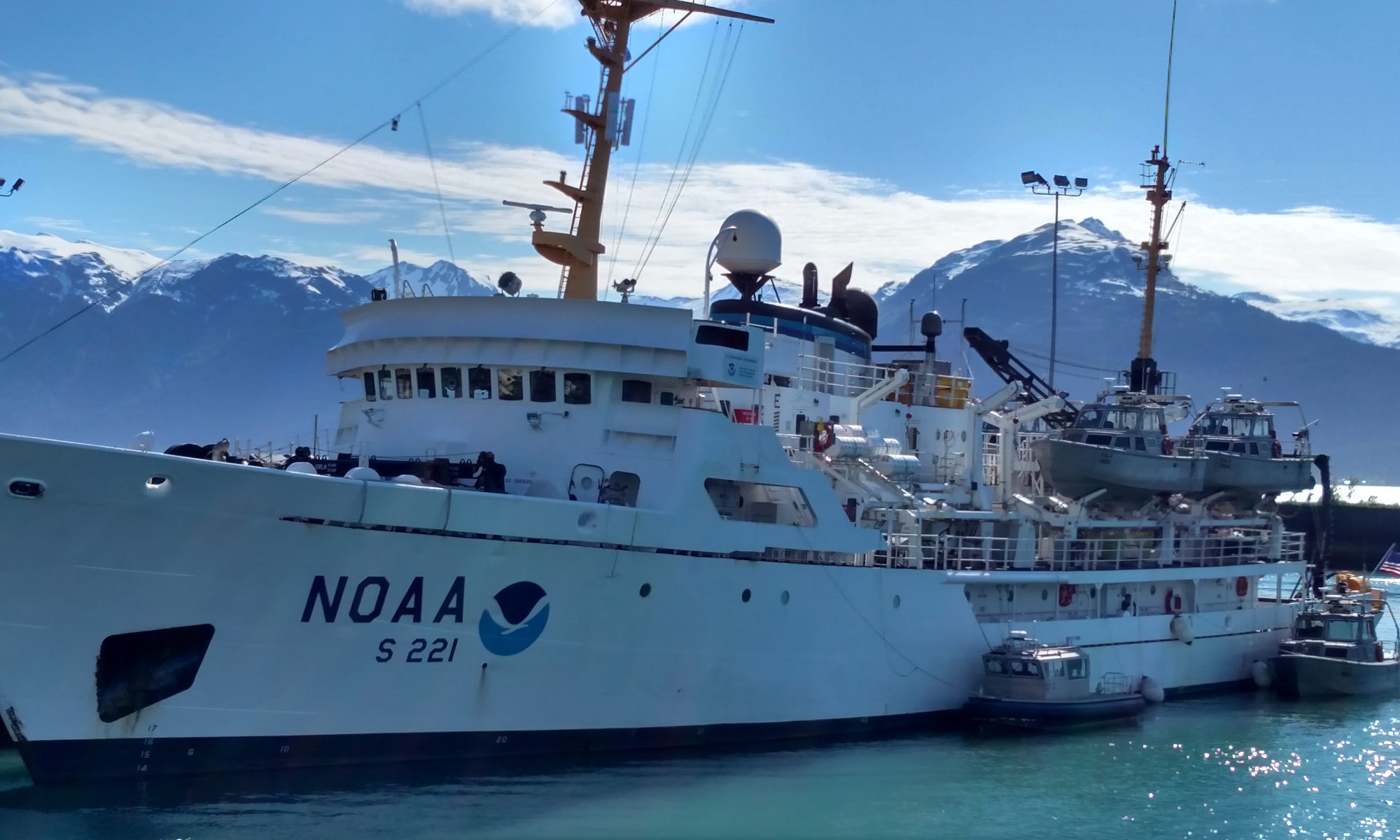
Bill Lindquist: Mapping the Ocean, May 9, 2013

NOAA Teacher at Sea
Bill Lindquist
Aboard NOAA Ship Rainier
May 6-16, 2013

Mission: Hydrographic surveys between Ketchikan and Petersburg, Alaska
Date: May 9, 2013

Weather on board. Taken at 1600 (4:00 in the afternoon)

Clear skies with a visibility of 10+ nautical miles
Light variable wind
Sea wave height – O
Air temperature 17.3° C
Water temperature 7.2° C

It's hard to get enough of this majestic view.
It’s hard to get enough of this majestic view.

Science and Technology Log: Mapping the Ocean

The work we do on board the Rainier is all centered on the task of gathering data of the ocean bottom – shoreline to shoreline. These data are used to update the nautical charts (maps) used by sailors. The project we have been working on is a section of Behm Canal in SE Alaska.

Nautical map of Behm Canal

Hydrographic data on parts of this stretch of water haven’t been updated for over 100 years. The tools and methods utilized have changed significantly during that time. Hydrographers of 1900 lowered a rope tied to a lead weight to the ocean bottom. Measurements were taken on the length of rope. The area we were surveying ranges from 150 to over 300 fathoms (one fathom = 6 feet) deep – that is a lot of rope. At each measure, they sighted a bearing to two or more locations on shore to locate where on the chart they could mark the depth. It’s surprising how closely their data matches what we found with the use of sophisticated modern techniques.

So how is it done? A good activity in the classroom is to make a sounding box with an ocean floor shaped on the bottom of the box. The top is covered and marked with a grid. Skewer sticks can be inserted at the grid corners, pulled out, measured, and transferred to another grid. A map is made. If only it were as easy. Simply put, modern hydrographers ping sound waves (sonar) from the bottom of the ship. The sound waves travel through the water to the ocean bottom and bounce back. We know how fast sound travels so measurements of time can be made and the distance calculated – just like the skewer sticks. If only it were as easy!

See the following website for information on hydrographic survey techniques. http://www.nauticalcharts.noaa.gov/mcd/learnnc_surveytechniques.html

My learning curve has been high as I have tried to understand all the moving variables that need to be taken into account before an accurate map can be made.

Here’s what I am beginning to understand:

  • Starts with referencing benchmarks – both vertical and horizontal (see blog, May 7) to gain a standard of tidal variation (high and low tide can vary by as much as 20 feet) and GPS location.
  • A measurement is made from the ship’s deck to the water surface. The twin sonar beams are located on the bottom of the ship. We know how far it is from the bottom of the ship to the deck – subtracting the deck to the water line gives the distance below the surface the sonar equipment is found at the time of measurement.
  • The chart is marked off in rectangles. A line is marked for the ship to follow. Traveling at 10 knots, the multibeam equipment located on the bottom of the ship pings sound waves and measures how long they take to return from the bottom. A broad swath of ocean bottom can be measured at the same time. These data are transferred to a computer in the plotting lab where the computer archives it and generates visual images as they come in.
  • The speed of sound varies in different water conditions, including temperature and salinity. Making it more complicated, temperature and salinity varies by depth in the water column beneath the ship. To capture these variables, we cast out a Moving Vessel Profiler (MVP) behind the ship while we travel along. The MVP looks like a small torpedo and is affectionately referred to as the fish. Attached is a sensor that reads temperature, conductivity (a measure for salinity), and depth. These data are transferred along a cable bound within the attached line to a computer on board the ship. “Casting” the fish means letting the line out until the fish approaches the bottom of the ocean – or 500 meters of line – whichever comes first. At that point the fish is retrieved. The data acquired as the fish makes its journey is transferred to the Plotting Lab computer.

    The sensor on the "fish" captures temperature, conductivity, and depth data on the water column beneath the ship.
    The sensor on the “fish” captures temperature, conductivity, and depth data on the water column beneath the ship.
  • As the ship moves along the ocean surface it is subjected to constant movement. It pitches up and down from front to back (pitch), rolls side to side (roll), and rises up and down with the ocean swells (heave). As the survey data is collected, heave, roll, and pitch data is captured to allow for adjustments in the sonar data. All of this varies further with the tide level. All these data are captured and fed into the Plotting Lab computer.

    Data from the ship's multibeam sonar comes to the Platting Lab
    Data from the ship’s multibeam sonar comes to the Plotting Lab
  • The ship travels its projected line, turns around and comes back on another.
  • Small boats with similar beams are dispatched to capture the same measurements closer to the shoreline where it is too shallow for the ship (for tomorrow).
  • This continues until the full ocean bottom in our project area is captured.
  • Finally all these data sets are brought together and stored.
  • During the off season, the data sets are utilized to generate the finished nautical charts ending a long, sophisticated process.

Personal Log: Life on the sea

I have to admit the living spaces on board a working ship are a bit tight. My “state room” measures approximately 10’ x 12’ and is shared with a roommate.  In that space are our bunk beds, a sink, desk, and locker closets. I can’t sit up in bed without hitting my head on the bunk above. Shared between two rooms is a bathroom that is only 4’ x 8’ with a head (mariner’s term for a toilet) and shower. All this space rests on a floor that drops with the curve of the ship approximately 10” from one end to the other. The hallways in the ship are narrow and the stairways steep. Everything is bolted or tied to the floor or table to keep them from being tossed about in choppy waters.

While tight, I have yet to hear anyone wish for more. Perhaps the salt that runs in their mariner blood provides the sustenance they need to thrive in these close quarters at sea.

While my shipmates will call the Rainier home for the duration of the research season, I will be on board for only two weeks before I return to the comforts of my own home and spacious bed.  I have to respect these hardy folk for who they are and all they do.

A cozy state room at sea
A cozy state room at sea - looking toward the door.
A cozy state room at sea – looking toward the door.
The shared "head" offers the comforts of home.
The shared “head” offers the comforts of home.
A porthole window offers a majestic view.

Bill Lindquist: Setting Benchmarks, May 7, 2013

NOAA Teacher at Sea
Bill Lindquist
Aboard NOAA Ship Rainier
May 6-16, 2013

Mission: Hydrographic surveys between Ketchikan and Petersburg, Alaska
Date: May 7, 2013

Weather on Board
15 C
Wind at 7 knots
Clear skies

Science and Technology Log: Setting Benchmarks

Morning briefing
Morning briefing

To conduct accurate surveys of the ocean bottom, clear reference points must first be established. Today, I joined a shore team to permanently set official benchmarks into the rock. Yesterday a team located two existing benchmarks in Burroughs Bay, including one put in place in 1891. A hole had been chiseled into the rock followed by a circle around it and an “X” crossing through the hole from one side of the circle to the other. Above the letters B and M (benchmark) were carved in the rock. Weathering and plant growth provided a challenge. There is something intriguing in the transcendence of time, updating work that was performed over a century ago.

Installing a vertical staff to reference visual measurement with electronic

To establish a vertical standard, three new brass benchmarks were cemented into rock with the intention of lasting into the next century. All five benchmarks were precisely located to reference elevation to local tidal data acquired through an electronic tidal gauge installed to capture 30 days of high and low tide data. A diving team anchored one end of a line underwater well beyond the reach of low tide. The other end rose on land high enough to be protected from high tide. These tidal data will be referenced to a visual measurement taken every six minutes for three hours from a vertical staff we installed.

A benchmark in the bedrock
Setting benchmarks
Setting benchmarks
Establishing clear elevation references

Tomorrow a team will install a horizontal control (horcon). A marker was affixed on an island that would collect location data from Global Positioning Satellites (GPS). GPS data is close, but lacks precision. The variance in GPS data will be referenced to the precise location of the horcon to establish an accurate and stable benchmark for all the survey data we will be making.

This preparation and collection of vertical and horizontal benchmarks all come together to provide referential data utilized in the precise creation of updated nautical charts.

Personal Log: Life at Sea (continued)

I had the good fortune to join the Rainier community on the first leg of the 2013 field season and experience early preparation drills and equipment training. En route from Ketchikan to Behm Canal, ship wide emergency drills were conducted to ensure everyone is fully prepared for a quick response to any situation that might arise. The fire drills I am familiar with is limited to getting all kids safely out of the school building, doing a head count to assure all are accounted for, waiting for the all clear, and bringing them back in. A call is made to the fire dept to respond if necessary.

At sea, the fire department is the community on board the ship. Should an emergency arise, lives depend on the preparedness of every individual on board. Our fire drill was an authentic drill. A fire alarm signaled the bridge there was a fire in the laundry room. The bridge quickly alerted all hands on deck. Everyone reported to pre-assigned stations, head counts were made and reported in. The fire response team got the necessary equipment out and evacuated the smoke (the smoke was real). There was no fire department to call. Our lives depended on our own actions.

Another alarm alerted everyone to a catastrophic problem necessitating a call to abandon ship. All hands quickly grabbed their emergency flotation suits readily available in their state rooms and reported to pre-assigned stations where a head count was made. These suits, specially designed to keep us afloat and dry, were quickly donned. This was one we never had to practice in school.

Potentially dangerous work in remote locations necessitates carefully scripted and practiced safety habits. Teams go out in small boats to conduct any necessary work on shore and survey areas too shallow for the ship. All these teams must remain in radio contact and make hourly reports to the ship’s bridge assuring all are individuals are safely accounted for. Should anything happen, there are Rainier crew members that have received specialized medical training preparing them to respond to medical issues occurring on board.

At sea, lives of all on board are in the hands and actions of all on board. Preparedness is key. I am thankful for that commitment.

Spectacular view
Spectacular view

Did you know?

The speed of the ship is not controlled by changing the speed of the engine. The ship’s engines are most efficient when they can maintain a steady speed (revolutions per minute). Instead, the ship’s speed is changed by altering the pitch of the screws (propellers). As the screw turns in the water a difference in pressure from the front to back is created. This pressure difference creates thrust. The more inclined the blades of the screw are, the faster the ship will travel. There are times during the survey when the ship must come to a full stop. Even then, the propeller shafts continue to spin but rotate in a flat plane resulting in no thrust.

Bill Lindquist: Life at Sea, May 6, 2013

NOAA Teacher at Sea
Bill Lindquist
Aboard NOAA Ship Rainier
May 6-16, 2013

Mission: Hydrographic surveys between Ketchikan and Petersburg, Alaska
Date: May 6, 2013

Weather Data from the Bridge

Clear skies
10.5 C (51 F)
Wind: 4 knots out of the south

Science and Technology Log

Navigational Science

My iPhone will pinpoint my location on a highway map and lay out a course to get me wherever I need to go. Navigating by canoe from lake to lake within the Boundary Waters Canoe Area Wilderness (BWCAW) requires a map, compass, and discerning eye. The tools of navigation on board an ocean-going vessel requires far more than a phone or a map and compass, yet similarities do exist. As a guest on the bridge, I had the chance to witness the team effort put in to safely get us where we needed to be. Like canoeing, navigation begins with a map, compass, and a good plan.

Charting a track
Charting a track

A path (track) is drawn on the nautical charts with waypoints identifying track adjustments to be made. Compass headings to get from one waypoint to the next are written in.  Progress along this track is regularly noted on the chart. While paper and pencil keeps the track grounded and secure, the primary navigation on the Rainier is electronic. Digital charts created by earlier surveyors are displayed along with our location pinpointed by GPS data accessed through high power receivers atop the ship – difficult at times in these remote portions of SE Alaska surrounded by the mountains. The track penciled on paper is plotted digitally and the journey begins. The Conn officer reads the map and calls out to the helmsman the heading to take.

At the helm
At the helm

The helmsman repeats it to assure it was heard correctly and turns the ship’s wheel to the new heading noting it with a dry erase marker on a small whiteboard on the helm station. The ship’s heading is indicated by an overhead digital compass display and held steady until the next waypoint is reached. Safe navigation requires a smoothly running team. The Conn officer and helmsman continue back and forth making any necessary adjustments while a third keeps a close eye on the radar. Another scans ahead with binoculars to note any floating debris to avoid.

Keeping a sharp eye ahead

Depth is continuously monitored along with notations of tide and currents. Weather conditions are recorded. All operations are carefully coordinated and monitored by the assigned Officer on the Deck.

Complicating navigation in this part of Alaska is the difference between the geographic north pole and magnetic north pole. Our compasses align with magnetic north – a different place from geographic north or “true north”. All charts and maps reference true north. Failure to account for this difference leads to getting lost. In Minnesota true north and geographic north are so close the difference is seldom noticed. In this area of Alaska the difference between true north and where a compass points is approximately 17 degrees. Fortunately, the ships gyrocompasses automatically account for this difference and report headings aligned with the true north of the charts.

A majestic view off the bow

Following our plan, we made it today from Ketchikan to Burroughs Bay in Behm Canal. Our work plan called for anchoring in the bay and getting to work in the morning. To anchor my canoe I simply throw out a small anchor attached to a rope and am set. Successfully anchoring the Rainier required the joint work of many. Within much of the bay the waters far enough from shore were too deep to gain a sufficient hold to keep the ship in position. With the ship’s Commander in charge, we maneuvered within the bay carefully monitoring the depths to identify a suitable location finally finding a shelf that appeared would work. The drop anchor command was given and 16+ fathoms (one fathom equals 6 feet) of chain held within the confines of the ship for six months quickly reeled out raising clouds of dust. It held.

Dropping anchor
Dropping anchor

Personal Log

Life at sea

There is a palpable pulse to the floating community that must exist to live and work together on a ship at sea. The quarters are close with minimal space to roam. The ongoing work lies amidst the everyday tasks of living causing leisure time to mix with work time. The functions of the ship go on 24 hours a day. On the ship Rainier, distinct, but united groups work side by side: NOAA Corps officers, survey technicians, the maritime crew, stewards, the ship’s engineers, and the occasional Teacher at Sea. To successfully collect the terabytes of data going into the making of new and revised nautical charts, all members of the ship’s personnel must work as a cohesive whole.

I have been blessed with a warm reception from each of these groups. The ship’s Commander and an Ensign welcomed me at the airport ferry and escorted me to the ship. The Ensign helped begin to unravel the labyrinth of passageways that eventually brought me to my state room. A conversation with my roommate gave me a glimpse into the role of the NOAA Corps. A crewman caught me in my roaming and offered a guided tour of the bridge and small boats. I was given an introduction to the personal side of life at sea by another over coffee. Yet another provided an extensive introduction to the complexities of modern navigation found on the bridge.  An engineer provided a close up tour into the bowels of the engine room.  These expressions of welcome were offered freely. It was evident that each of these people are proud members of this Rainier community, living and working side-by-side on a daily basis. Life at sea isn’t for the partially committed. Each of these people give up extended months at a time away from their loved ones in their commitment to this task. I was struck by a conversation with the engineer shared over breakfast. After a break from sea life, he found he had to return to sea to satisfy the salt water coursing in his blood.

I made it. I am officially a teacher at sea. Life is good.

Bill Lindquist: Eager for the Journey, April 24, 2013

NOAA Teacher at Sea
Bill Lindquist
Aboard NOAA Ship Rainier
May 6-16, 2013

Mission: Hydrographic surveys between Ketchikan and Petersburg, Alaska
Date: April 24, 2013

Pre-cruise Log

I am absolutely thrilled at this truly unique opportunity to join a team of scientists aboard NOAA’s research vessel Rainier conducting hydrographic surveys through the Teacher at Sea program.

I am a teacher and have been for the last 34 years. It is a great career. My students have changed over time from my own fifth grade classroom in rural Minnesota, to a science specialist at Crossroads Elementary in the urban core of Saint Paul, to teaching graduate pre-service students at Hamline University. The unifying weave in my teaching fabric has been the creation of learning environments supportive of a collaborative, student-centered, community of learners. Woven into that professional cloth are the fibers of guiding high school kids on canoe trips into the Boundary Waters Canoe Area Wilderness, escorting my elementary students to a residential environmental learning center (Audubon Center of the North Woods), contributing authentic scientific data through GLOBE, visiting community schools in Ghana, flying our sixth grade students’ investigation in a microgravity environment through NASA’s Reduced Gravity Flight program, softening the reluctance of pre-service students to see themselves as teachers of science – exciting them to engage their students in the kind of science learning that strikes at the core of what makes us human, and all the myriad interactions with hundreds of young people as we have shared together in the joy of learning.

Something that has eluded me during my career has been the kind of extended immersion into the doing of science that I expect from this program. I applied six years ago without success. Being gifted this time with this Teacher at Sea opportunity is a realization of a multiple long-held visions, including:

  • Immersion into the doing of science. I am excited to be able to share with my students the first hand experience of being in the scientist role in the practice of doing science in the field – in a more real and felt way than the doing of science we experience in an elementary science lab.
  • Being at sea. I feel at home in a canoe and grew up with a love of being on the water. Seems the Rainier is bigger than my 16.5’ Old Town Penobscot. Minnesota is the land of 10,000 lakes, but a far, far way from the vast expanse of the ocean. With the increasing need to understand the vital impact the oceans play in the global climate systems directly impacting the day-to-day life on the Minnesota prairie, I am excited to bring home first hand experience.
  • Exploring Alaska – the grandeur of the Ketchikan Gateway is spectacularly breathtaking. I have little desire for a tourist cruise – seeing Alaska (albeit a small part) through the eyes of a researcher is thrilling. Though our focus will be viewing the bottom of the ocean – I will be deliberate in taking the time to look up to capture the grandeur of the surrounding landscape. I once had a fascinating conversation with Dan Barry, NASA astronaut, as we prepared for our reduced gravity flight. He told of many astronauts so intently focused on their work during a space walk that, once home, were unable to describe the incredible view impeded only by the visor of their space helmet. In response, he scripted into his program specific commands to look out and “make a memory”. I have little doubt I will not need a reminder to look up from the sonar data collections screen to make memories while cruising through the Gateway. I have my camera ready and fully expect my pictures to run beyond 1000.

I look forward to sharing this grand adventure. Specifically, I hope to share the story with my current class at Hamline. The semester ends while I am at sea, so facilitation of learning will happen while I am on board. They have patiently lived the experience of my acceptance as an alternate while anxiously waiting word of a cruise, to the excitement of successfully being placed aboard the Rainier. I will be working with a former colleague at Crossroads Elementary in Saint Paul, MN to vicariously take her class on an exploration of the ocean bottom off the coast of Alaska. I also hope to share the journey with my grandson, Logan’s class at Westwood Elementary in Traverse City, MI.

In a short week and a bit (May 4) I fly out of the Minneapolis-Saint Paul airport to begin this grand adventure. I can’t wait.

My family
So thankful for all the support of a loving family
Reduced Gravity
Had a chance to fly our sixth graders’ experiment in a reduced gravity environment
In love with the Boundary Waters Canoe Area Wilderness