NOAA TEACHER AT SEA JASON MOELLER ONBOARD NOAA SHIP OSCAR DYSON JUNE 11 – JUNE 30, 2011
NOAA Teacher at Sea: Jason Moeller Ship: Oscar Dyson Mission: Walleye Pollock Survey Geographic Location: Gulf of Alaska Dates: June 21-22, 2011
Ship Data
Latitude: 55.03N
Longitude: -163.08W
Wind: 17.81 knots
Surface Water Temperature: 6.7 degrees celsius
Air Temperature: 10.10 degrees celsius
Humidity: 85%
Depth: 82.03 meters
Personal Log
Welcome back, explorers!
June 21
Today has been the calmest evening since I boarded the Oscar Dyson. The night shift did not fish at all, which meant that I basically had an evening off! Even the evenings we have fished have been relatively calm. It takes us about an hour to an hour and a half to process a haul of fish, and up to this point we average about one haul per night. That gives me quite a bit of down time! When I am on shift, that down time is usually spent in one of two places.
The first spot is the computer lab in the acoustics room. This is the room where we wait for the haul to be brought in. I write the logs, lesson plan, check emails, and surf the web during quiet times.This is the lounge. The cabinet under the TV has over 500 movies, and a movie is usually playing when I walk in. Behind the couch is a large bookshelf with several hundred books, so I have done a fair amount of pleasure reading as well.
When I am not sitting in one of these two places, I am usually running around the ship with my camera taking nature photos. Below are the best nature photos of the past three days.
One of the coolest things about the Aleutian islands has to be the number of volcanoes that can be seen. This is the one on Unimak Island.A second picture of the same volcano.This is just a cool rock formation off of the coast. The Oscar Dyson has been hugging the coast the entire trip, which has been great for scenery.A gull skims the water by the Oscar Dyson.A gull wings toward the Oscar Dyson
June 22
We resumed fishing today! These trawls brought in quite a few species that I had not seen before, along with the ever plentiful pollock.
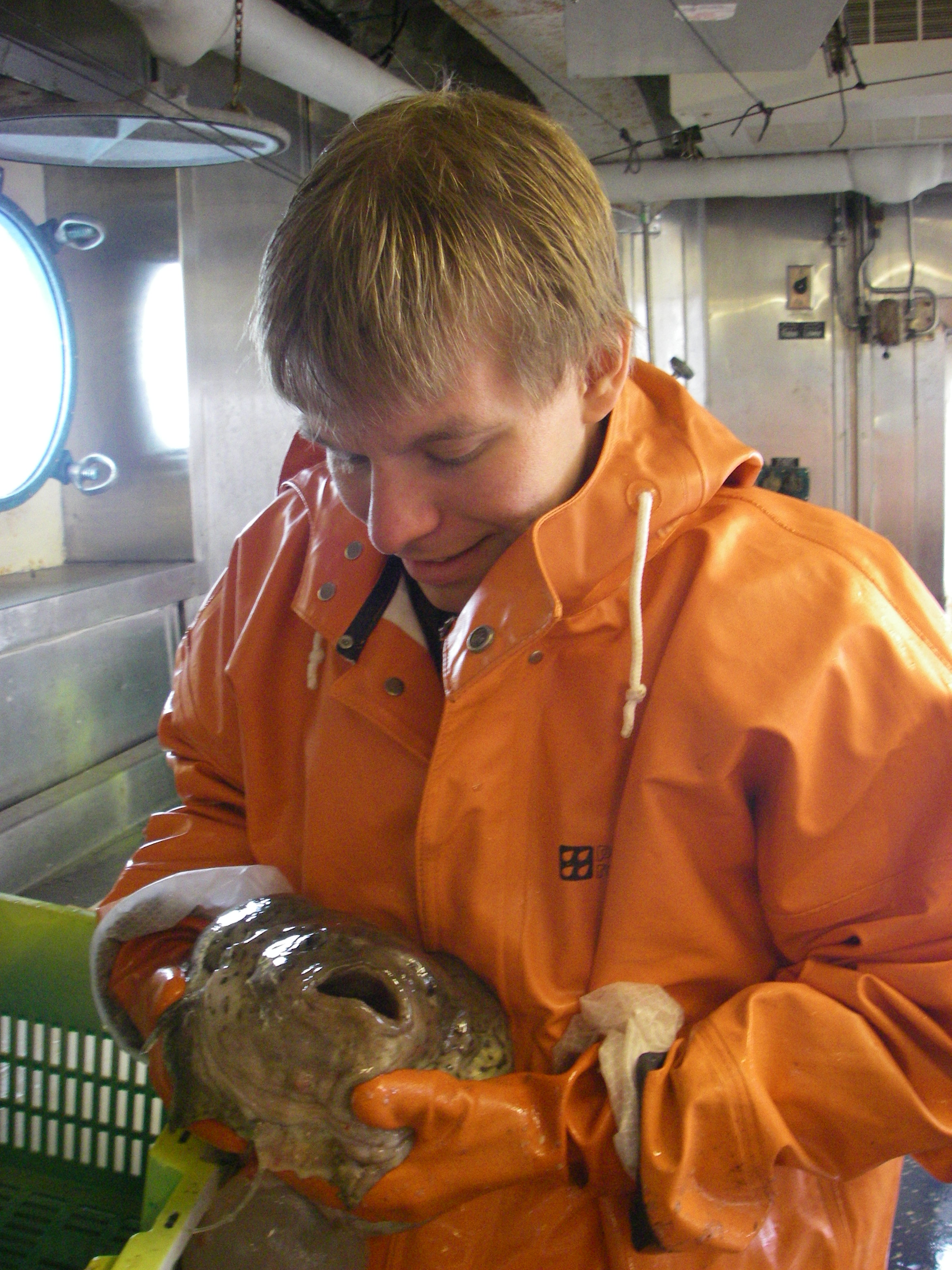
The net, filled with fish!Jason waits for the net to load the fish onto the conveyor belt.Here, I am separating the arrowtooth flounder from the pollock.We managed to catch a skate in the net! Skates are very close relatives to sharks. We quickly measured it and then released it into the ocean.A second photograph of the skate.Do you remember the little lumpsucker from a few posts back? This is what an adult looks like!The lumpsucker was slimy! I tried to pick it up with my bare hands, and the slime gummed up my hands so that I couldn't pick it up! Even with gloves designed for gripping fish I had trouble holding on.A closeup of the lumpsuckerThis fish is called a sculpin.I finally saw a crab! None of us know what was attached to it, but the scientists believe that it was an anemone.This is a starfish the net pulled up.
Science and Technology Log
There is no Science and Technology Log with this post.
Today’s question comes from James and David Segrest, who are two of my homeschool students!
Q. What do you eat while you are on your adventures? Do you get to catch and eat fish?
The food is great! Our chef has a degree in culinary arts, and has made some amazing meals!
I wake up at 2:30 pm for my 4 pm to 4 am night shift, and usually start my day with a small bowl of oatmeal and a toasted bagel. At 5 pm, about two hours after breakfast, dinner is served, and I will eat a huge meal then too. Every meal has two main courses, a vegetable, a bread, and dessert. We have had a wide variety of main courses which have included bratwurst, steak, gumbo with king crab, fish, chicken parmesan, spaghetti with meatballs, and others!
We will often eat some of the fish we catch, usually salmon and rockfish since those provide the best eating. The salmon disappears to the kitchen so quickly that I have not actually been able to get a photo of one! We have not caught a halibut in the trawl net yet, otherwise we would likely have eaten that as well. Yum! We have not yet eaten pollock, as it is viewed as being a much lower quality fish compared with the rockfish and salmon.
NOAA TEACHER AT SEA JASON MOELLER ONBOARD NOAA SHIP OSCAR DYSON JUNE 11 – JUNE 30, 2011
NOAA Teacher at Sea: Jason Moeller Ship: Oscar Dyson Mission: Walleye Pollock Survey Geographic Location: Gulf of Alaska Dates: June 19-20, 2011
Ship Data
Latitude: 54.29 N
Longitude: -165.13 W
Wind: 12.31 knots
Surface Water Temperature: 5.5 degrees Celsius
Air Temperature: 6.1 degrees Celsius
Humidity: 97%
Depth: 140.99 meters
Personal Log
Welcome aboard, explorers!
To be honest, there is not a great deal to write about for the personal log. My daily schedule has settled in quite nicely! I get off work at 4 in the morning, shower, sleep until 2:30 in the afternoon, and then head down to the acoustics room where we track the fish. When we are processing a catch (see the science and technology section of this blog), I am in the fish lab wearing bright orange waterproof clothes that make me resemble a traffic cone.
Jason in fishing gear.
The rest of the time is down time, which is spent reading, working on the blog, learning about the ship, and dreaming up lesson plans that I can use to torment my students. I hope they are interested in a summer fishing trip, as that is the one I am currently planning.
Most of the blog work involves running around and taking photographs. My wife’s camera was soaked beyond repair during the prank that was pulled (see the previous post) as Sarah was holding the camera when the wave came over the railing. Fortunately, there was another camera on board.
Our survey is keeping us very close to the coast and islands of Alaska. As a result, I’ve gotten some gorgeous photos. This place is just beautiful.
An island shrouded by clouds.A waterfall falls off into the ocean.Jason in front of an island. It was a bit windy, but at least it was sunny!Mountaintops visible just above the island coast. Jake took this photo while I was in the fish lab.Sunset over Alaskan waters.
Science and Technology Log
Walleye Pollock waiting to be processed
We finally started fishing! As I mentioned in my very first blog, the Oscar Dyson is surveying walleye pollock, which is an important fish species here in Alaska. Walleye pollock make up 56.3% of the groundfish catch in Alaska, and is eaten in fast food restaurants around the world such as Wendy’s, McDonalds, and Burger King. It is also used to make imitation crabmeat.
Our first catch had a little over 300 walleye pollock, and we processed all of them. Three hundred is an ideal sample size for this species. If, for example, we had caught 2,000 pollock, we would only have processed 300 of the fish, and we would have released the rest of them back into the ocean.
The photo captions below will provide a tour of the fish lab as well as introduce blog readers to the data we wish to collect and how scientists aboard the Oscar Dyson collect it.
This is the conveyor belt. After the catch is pulled on board, it is loaded onto this conveyor belt and moved down the belt and into the lab. At this point, the scientists separate the pollock from the rest of the sea life that was accidentally in the net. Today, the majority of the "extra" sea life were brittle stars, sponges, and a few squid.Once the pollock and other sea life are separated, they are moved to this box to be sexed. In order to do this, we would have to cut the fish open and look at the internal organs of the fish. Once this was done, females would go over the yellow sign on the right and into the box that was hidden behind it. The males went into the box on the left.Once we had determined the pollock's gender, we moved to the measuring station, which was on the other side of the last station. We laid each individual fish on the table on top of the ruler, and then measured the fish from the head to the fork of its tail. We recorded the length by tapping the table at the fork of the fish's tail with a sensor that we carried in our hand. A sensor in the table recorded the data and sent it to the computer monitor seen above the table.Jason measures a pollock on the board!
From this catch (we will do this for any following catch as well) we also took and preserved twenty stomachs from random fish. This was done in order to later analyze what the pollock had eaten before they died. We also took forty otoliths from random pollock as well. An otolith is the ear bone of the pollock, and it is incredibly important to researchers as they will tell the pollock’s age in a similar manner to the way a tree’s rings will.
This is a pollock otolith!After removing the otolith from the fish, they were put into these vials. Each pair of otoliths received their own vial.
While looking at pollock is the main focus of the survey, we did run into some other neat critters in this haul as well!
This is an Atka Mackerel. We also caught a salmon, but I didn't get a good look at it. Our kitchen grabbed it!
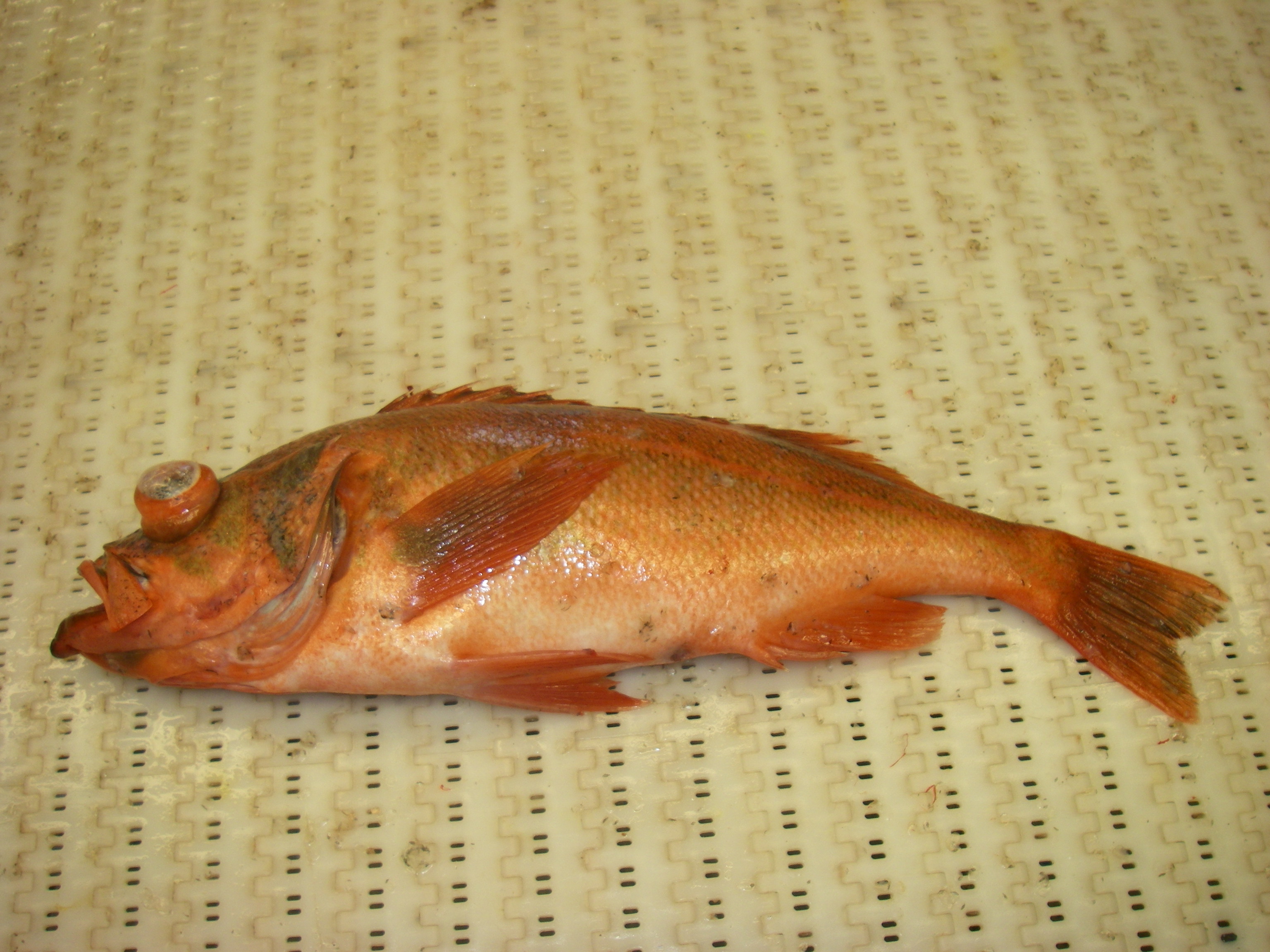
This is a basket starfish. We were trawling close to the bottom and pulled it up in the nets.This is a lumpsucker! They spend their lives on the bottom where they eat slow-moving animals such as worms and mollusks.This is an arrowtooth flounder. These are not very good eating fish, and are not the flounder found in the supermarket. Check out the nasty teeth in the photo below this one!I wouldn't want to be bitten by this fish!Finally, this is a rockfish! The red snapper that we see in the marketplace is often this fish instead.
Today’s question is actually a request. It comes from Tish Neilson, one of our homeschool parents.
Hey Jason –
I had a super favor to ask of you. There is a little girl from Jackson’s school that is a 5th grader and she was recently diagnosed with leukemia. There have been some bracelets created for her that say “Going Bananas for Anna” to show support and several moms and I have gotten together and are putting together a scrapbook for her and trying to get as many people as possible wearing her bracelets in really cool places. Then we are having them take pictures to send to us to put in her scrapbook so she can she how far her bracelets have traveled and how many people are pulling for her. If it’s possible to do so and you would be willing to do it I would LOVE to try and get you a bracelet to take some pictures and send to me from Alaska. Her nickname is Anna Banana and she is always asking for pictures and such so that is why we came up with this idea.
Tish Neilson
Unfortunately, I had left for Alaska before I received the email, and as a result I do not have a bracelet. Hopefully, a sign will work just as well.
Hi Anna! This is Unimak Island! It is one of the Aleutian Islands off the coast of Alaska! Hang in there, we are rooting for you!
NOAA TEACHER AT SEA JASON MOELLER ONBOARD NOAA SHIP OSCAR DYSON JUNE 11 – JUNE 30, 2011
NOAA Teacher at Sea: Jason Moeller Ship: Oscar Dyson Mission: Walleye Pollock Survey Geographic Location: Gulf of Alaska Dates: June 17-18, 2011
Ship Data
Latitude: 52.34 N
Longitude: -167.51 W
Wind Speed: 7.25 knots
Surface Water Temperature: 6.6 Degrees C
Air Temperature: 7.1 Degrees C
Relative Humidity: 101%
Depth: 63.53 meters
All of the above information was found on http://shiptracker.noaa.gov. Readers can use this site to track exactly where I am at all times!
Personal Log
Welcome back, explorers!
It has been a very eventful 24 hours! We have started fishing, but have done so little that I will wait to talk about that in the next log. Tammy, the other Teacher at Sea, has not begun fishing yet, and as we will be writing the science and technology log together, I will save the fishing stories until she has had a chance to fish.
After turning in last night’s log, we managed to spot eight or nine humpback whales on our starboard side that appeared to be feeding at the surface. They were too far away to get any decent photos, but it was a lot of fun to watch the spouts from their blowholes tower up into the air.
Ten whale spouts rise in the distance.
This afternoon started off by dropping an expendable bathythermograph (from here on out this will be referred to as an XBT). The XBT measures the temperature and depth of the water column where it is dropped (there will be more on this in the Science and Technology section). I was told that I would be dropping the XBT this time, and was led off by Sarah and Abby (two of the scientists on board) to get ready.
The first thing I had to do was to get dressed. I was told the XBT would feel and sound like firing a shotgun, so I had to put on eye, ear and head protection. I was also put in a fireman suit to protect my body from the kickback, since I am so small. The XBT launcher is the tube in my hands.This is me launching the XBT. Why no smoke? All we actually needed to do was drop the device over the side. The whole shotgun experience was a prank pulled off by the scientists on all of the new guys. Their acting was great! When I turned towards Sarah at one point with the launcher, she ducked out of the way as if afraid I would accidentally fire it. I fell for it hook, line, and sinker.
However, the prank backfired somewhat. As the scientists were all laughing, a huge wave came up over the side of the ship and drenched us. I got nailed, but since I was in all of the gear, I stayed dry with the hem of my jeans being the only casualty. Sarah didn’t get so lucky. Fun times!
Sarah looking a bit wet.
Science and Technology Log
Today, we will be looking at the XBT (the expendable bathythermograph). Bathy refers to the depth, and thermo refers to the temperature. This probe measures the depth and temperature of the water column when it is dropped over the starboard side of the ship.
“Dropping” isn’t exactly the right phrase to use. We use a launcher that resembles a gun. See the photo below to get an idea of what the launcher looks like.
This is the XBT Launcher.The silver loop is the pin for the launcher. To launch the probe, we pulled the pin and flung out our arm. The momentum pushed the probe out of the tube and into the water below.
The probe.
The probe is connected to a length of copper wire, which runs continuously as the probe sinks through the water column. It is important to launch the probe as far away from the ship as possible, as the copper wire should never touch the ship. If the wire were to touch the ship, the data feed back to the ship would be disrupted and we would have to launch another probe, which is a waste of money and equipment. The survey technician decides to cut the wire when he/she has determined that sufficient data has been acquired. This normally occurs when the probe hits the ocean floor.
This is a quick and convenient way to collect data on the depth and temperature of the water column. While the ship has other methods of collecting this data (such as a Conductivity, Temperature, and Depth (CTD) probe), the XBT is a simpler system that does not need to be recovered (as opposed to the CTD).
A CTD
Data collected from the most recent XBT.
Latitude: 53.20 degrees N
Longitude: 167.46 degrees W
Temperature at surface: 6.7 degrees C
Temperature at bottom: 5.1 degrees C
Thermocline: 0 meters to 25 meters.
The thermocline is the area where the most rapid temperature change occurs. Beneath the thermocline, the temperature remains relatively constant.
Today’s reader questions come from James and David Segrest, who are two of my students in Knoxville Zoo’s homeschool Tuesday classes!
1. Did pirates ever travel the path you are on now? Are there any out there now?
A. As far as I know, there are no pirates currently operating in Alaska, and according to the scientists, there were not any on the specific route that we are now traveling. However, Alaska does have a history of piracy! In 1910, a man named James Robert Heckem invented a floating fish trap that was designed to catch salmon. The trap was able to divert migrating salmon away from their normal route and into a funnel, which dumped the fish off into a circular wire net. There, the fish would swim around until they were taken from the trap.
Workers remove salmon from a fish trap in 1938. Historic Photo Courtesy of the U.S. Fish & Wildlife - Fisheries Collection - Photographer: Archival photograph by Mr. Sean Linehan, NOS, NGS.
For people who liked eating fish, this was a great thing! The salmon could be caught quickly with less work, and it was fresh, as the salmon would still be alive when taken from the trap. For the traditional fisherman, however, this was terrible news. The fishermen could not compete with the traps and found that they could not make a living. The result was that the fishermen began raiding the floating traps, using any means possible.
A barge of salmon going to a cannery. Fishermen could not compete with traps that could catch more fish. Historic Photo Courtesy of the U.S. Fish & Wildlife - Fisheries Collection -Photographer: Archival photograph by Mr. Sean Linehan, NOS, NGS
The most common method used was bribery. The canneries that operated the traps would hire individuals to watch the traps. Fishermen would bribe the watchers, steal the fish, and then leave the area. The practice became so common that the canneries began to hire people to watch the trap-watchers.
2. Have you seen any sharks? Are there any sharks that roam the waters where you are traveling?
Hi James and David! Here is your shark! It's a Pacific Sleeper Shark.The shark in the netAnother image of the shark on the conveyor belt.
This is a Pacific Sleeper Shark. It is called a sleeper shark as it does not appear to move a great deal, choosing instead to glide with very little movement of its fins. As a result, it does not make any noise underwater, making it the owl of the shark world. It hunts much faster fish (pollock, flounders, rockfish) by being stealthy. They are also known to eat crabs, octopus, and even snails! It is one of two animals known to eat giant squid, with the other one being sperm whales, although it is believed that these sharks probably scavenge the bodies of the much larger squid.
The other shark commonly seen is the salmon shark. Hopefully, we will catch one of these and I will have photos later in the trip.
NOAA TEACHER AT SEA JASON MOELLER ONBOARD NOAA SHIP OSCAR DYSON JUNE 11 – JUNE 30, 2011
NOAA Teacher at Sea: Jason Moeller Ship: Oscar Dyson Mission: Walleye Pollock Survey Geographic Location: Gulf of Alaska Dates: June 14-16, 2011
Personal Log
Welcome back, explorers!
June 14
I think I posted my last log too soon, because as soon as I hit the send button interesting things began to happen. First, I was called up to see some Mountain Goats feeding in the wild! I was able to take a picture of them as well! (Well, kind of…)
The mountain goats were so far away I had to use binoculars just to spot them. If you can spot the two tiny white dots to the right of the snow, that is them! There is also one that is on the left hand side in the middle of the photograph. You will have to take my word for it.
While this was going on, the professional members of the science team were still calibrating the sonar that we are going to use to catch the fish! I have explained the process in the captions of the following photographs.
Calibrating starts with these little balls. The one used to calibrate our sonar was made of Tungsten (like the black ball at the top)The ball was suspended underneath the water on three poles, placed in a triangular shape, around the ship. This is a photo of one of the poles.Once the ball was placed underneath the boat, the scientist swept sound waves off of the ball and used the above screen to see where the sound waves were striking the ball and reflecting. This allowed them to adjust the sound waves to hit the ball (or out in the ocean, the fish) exactly where they wanted it. This optimizes the amount of sound coming back to the boat and paints a better picture of what is under the water.
The process took several hours, but once we finished, we headed back out to sea to start the two-day journey towards our first fishing spot!
June 15-16
The most common sight off of the boat for the past two days has been this one.
Water, water, everywhere
We are currently in Unimak Pass, which will lead us to the Bering Sea! Unimak Pass is the fastest sea route from the United States into Asia, and as a result is a common merchant route between Seattle and Japan. It is also the best way to avoid rough seas and bad weather when travelling between the Gulf of Alaska and the Bering Sea, as it receives some cover from the landmass.
The Bering Sea likely needs no introduction, as it is arguably the best crab fishing waters on the planet and is well-known from the television show The Deadliest Catch. Aside from crab, the Bering Sea is teeming with life such as pollock, flounder, salmon, and halibut. As a result of this diverse and tasty biomass, the Bering Sea is an incredibly important area to the world’s fisheries.
Steaming towards our destination has kept us away from any land, but there are still things to do and to see! We did a second dry cast of the net, but this time two different pieces of equipment were tested.
The first piece of equipment was a special net for taking samples. The net has three sections, called codends, which can be opened and closed individually. You can see two of the codends in this photo. On top of the green net, you should see black netting that is lined with white rope. These are the codends.This is a better view of the codends. The codends are opened and closed using a series of six bars. When the first bar is dropped, the first codend is able to take in fish. When the second bar is dropped, the codend is unable to take in fish. The bar system has not worked incredibly well, and there is talk of removing one of the codends to make the net easier to use.The second piece of equipment was this camera, which was attached to the net. It allowed us to see what was coming in the net. Even though this was a dry run and we were not catching anything, I still saw a few Pollock in the camera!
Even though this was a test run and we did not catch any fish, the birds saw the net moving and came to investigate. The remaining photographs for the personal log are of the several species of birds that flew by the boat.
A Northern Fulmar flies alongside the Oscar DysonAn albatross (by the thin wire just below the spot the water meets the horizon) flies away from the Oscar DysonFulmar's and Gulls wheel about the Oscar Dyson, looking for fish.
Science and Technology Log
This section of the blog will be written after we start fishing for Pollock in the next day or so!
New Species
Mountain Goats
Northern Fulmar
Albatross
Gulls
Reader Question(s) of the Day!
First, I owe a belated shout out to Dr. John, Knoxville Zoo’s IT technician. He lent me the computer that I am currently using to post these logs, and I forgot to mention him in the last post. Thanks Dr. John!
The two questions of the day also come from Kaci, a future Teacher at Sea with NOAA.
1. What is it like sleeping on the boat?
A. Honestly, I am being jostled around quite a bit. Part of this is due to the way the beds are set up. The beds go from port to starboard (or right to left for the landlubbers out there) instead of fore to aft (front to back). This means that when the boat rolls, my feet will often be higher than my head, which causes all of blood to rush to my head. I still haven’t gotten used to the feeling yet.
Part of the jostling, though, is my fault. I had heard that most individuals took the bottom bunks given the option, and since I was one of the first individuals on board, I decided to be polite and give my roommate, who outranked me by some 10-15 years at sea, the bottom bunk. It turns out that the reason people pick the bottom bunk is that the top bunk moves around more since it is higher off the floor. I’ve heard stories about people being thrown from the top bunk in heavy seas as well.
The most comfortable place to sleep has turned out to be the beanbag chair in the common room. It is considered rude to go into your room if your shift ends early, as your roommate may still be sleeping. My shift ended two hours early the other night, so I sat down on the beanbag chair to catch some zs. The ship’s rocking was greatly reduced by the bean bag chair, and I slept very well for the next couple of hours.
2. Is it stressful so far?
A. The only stressful part of the trip so far has been the seasickness, which I have not yet been able to shake. The rest of it has been a lot of fun!
NOAA TEACHER AT SEA JASON MOELLER ONBOARD NOAA SHIP OSCAR DYSON JUNE 11 – JUNE 30, 2011
NOAA Teacher at Sea: Jason Moeller Ship: Oscar Dyson Mission: Walleye Pollock Survey Geographic Location: Gulf of Alaska Dates: June 13-14, 2011
Personal Log
Welcome back explorers!
June 13th
A view of the dock as we finally leave!
We are finally underway! The weather cleared up on the 12th, so the rest of our scientific party was finally able to make it in from Anchorage. The scientists did not arrive until later in the day, but at 9:00 in the morning, the Oscar Dyson finally left port in order to run some tests, including a practice cast of the fishing net!
An island in Kodiak Harbor. Kodiak is hidden by the island in this photograph.Open ocean, straight ahead!Casting the net was a tricky process that took about 30-45 minutes. (I did not time the process.) The casting started by unhooking the edge of the net from this giant spool. The net was wrapped tightly around this spool when not in use.Next, the net was hooked to the mechanism that would lower the net in the water. (The mechanism is the yellow object that looks like an upside-down field goal post)This is a photo of the net being hooked up to the casting mechanismOnce attached, the mechanism then pulled up on the net to start unwinding the net from the spool. Once the net was properly unwinding, the net was lowered into the water to begin fishing!
Once the tests were completed, we headed back towards the harbor to pick up the rest of the scientists. Once we were all on the vessel, we held a quick briefing on the ship rules. This was followed by a meeting among the scientists where shifts were handed out. I am on the 4 PM to 4 AM shift, also known as the night shift! Hopefully, I will see some northern lights during the few hours that we actually have darkness. After the meeting and a fast guided tour, I went to bed, as I was extremely seasick. Hopefully, that is a temporary issue.
June 14
I woke up to discover that the ship has anchored in a protected cove for the day in order to calibrate the acoustic devices on board that are used for fishing. This is a time consuming but necessary process as we will need the baseline data that the scientists receive by calibrating the device. However, that means that there is not much to do except for eating, sleeping, watching movies (we have over 1,000 aboard) and enjoying the beautiful scenery. As we are in a quiet cove with no waves, I am not currently sick and decided to enjoy the scenery.
The next four images are from the back of the ship. If printed, you can go from left to right and get a panoramic view.
I know the image is bad, but can you see the white blob in the middle of the water? That is a jellyfish!Here is a photograph from the side of the boat of a snow-capped mountain. Even though it is summer here, there is still quite a bit of snow.This is another image off the side of the boat. A waterfall falls off into the ocean.A closer shot of the waterfall. This place is just gorgeous!
Science and Technology
The Science and technology segment of the blog will be written at the start of the Walleye Pollock survey, which should begin in the next day or so.
Species Seen
Jellyfish!
Arctic Tern
Gulls
Reader Question(s) of the Day
I received a few questions from Kaci, who will be a TAS here in September!
1. What is the temperature here?
A. The temperature has been in the mid to upper 40s, so much cooler then back home in Knoxville, Tennessee, where we were getting 90 degree days! It’s actually been pleasant, and I have not been cold so far on this trip.
2. What did you bring?
A. The temperature affected what I brought in terms of clothing. I started with a weeks worth of shorts and t-shirts, which I stuffed in my check in bag, and then two days worth of clothes in my backpack just in case my checked bag didn’t get it. Our other TAS, Tammy, got stuck here with only the clothes on her back, so a backup set of clothes was necessary. In addition, I have several pairs of jeans, 2-3 sweatshirts, a heavy coat, and under armor to round out the clothing. The under armor and heavy coat have been great, it’s why I haven’t been cold. I also packed all of my toiletries (though I forgot shampoo and had to buy it here.
In terms of electronics, I have my iPod, computer, and my wife’s camera with me. (A special shout out to Olivia is in order here, thanks for letting me use the camera! I am being VERY careful with it!). I have a lot of batteries for the camera, which I have needed since I’ve already gone through a pair!
Just for fun, I brought my hockey goalie glove and ball to use in working out. We have weight rooms aboard the ship, which I will definitely need since the food is fantastic!
I hope that answers those questions, and I will answer more in the next post!