Scott Sperber, July 16, 2009

NOAA Teacher at Sea
Scott Sperber
Onboard Research Vessel Kilo Moana
July 9-17, 2009 

Mission:Woods Hole Oceanographic Institution Hawaii Ocean Time series Station; Albert J. Plueddemann, Chief Scientist
Geographical area of cruise: Central Pacific, north of O’ahu
Date: July 16, 2009

Weather Data from the Bridge 
Temperature: 22.64 C
Humidity: 80.6%

Science and Technology Log 

I am up very early today, 0530, the last full day at sea.  I did not make a log entry yesterday it was a very busy day. The day totaled a full 12 hour hard work day for me.  The day started out a about 0545 with the initial recovery of the old buoy.  The acoustic (sound) release mechanism was triggered and the glass balls cam up to the surface with the rope attached.  The glass balls were in a large cluster once onboard and had to be untangled.

Glass balls coming onboard (left) and popped glass ball (right).

Five of the glass balls have imploded at some time and the glass that had remained had turned into a fine white powder.  After the glass balls were brought onboard and untangled and put into their boxes the chore of bringing the 5 miles of line and cable began.  I started out in the box to flake (lay the rope down) the line as it came in.  After quite a while and a lot of rope the capstan (the vertical winch) broke. It was the only break I had since we began. A break when the brake broke. LOL. The line was cut and placed on the main winch to complete the process.  This slowed the whole procedure down because once the rope was on the winch; we had to unwind it all into its storage boxes. This had to be down 2 times and it set the whole recovery procedure behind about 2 hours. If you remember the procedure of deploying the new buoy, one chain link section at a time with the sensors attached, this procedure was now reversed for the recovery.

Scott in the box (left) and Scott on deck (right).

When the sensors came up each one was taken into the lab, photographed, videoed and a narrative was taken on to the condition of the sensor including what type of marine (ocean) growth had taken place over the year. I was given the task of taking the sensors into the lab, hanging them for photographic purposes and then bring them back outside.  A dirty job but some one had to do it. This process from start to finish, recovery of the buoy to the end of documenting the condition of the sensors took 10 hours.  After this the real fun started, cleaning the sensors. Now we are talking dirty. We had to clean off all marine growth from the sensors so Jeff could then start recovering data. 

Personal Log 

Well today I was able to put on my new steel toed boots. I should have broken them in a couple of times before this; my feet ached at the end of the day, wore a hard hat all day, a safety vest, got to climb into a box with miles of rope, got to smell like an old aquarium.  All and all a great day. Sure didn’t need to ride the bike, Carly passed on it too.

Jeff and the sensors in the lab (left) and dirty sensor with goose barnacles (right).

All this said and done I would really like to take the time to thank all the people who made this possible. I have done many things in my professional career to broaden my professional knowledge and this has got to be one of the best experiences of all.  First and utmost I would like to thank the NOAA Organization.  Without their desire to stress the importance of Science education through increasing the knowledge base of the educators of the world this would not have been possible. Thank you to Dr. Al Plueddemann, Chief Scientist, Dr. Roger Lukas and Dr. Fernando Santiago, both of the University of Hawaii. Not only did they share their wealth of knowledge with me but guided me through the practices of this WHOTS project and confirmed in me my beliefs of the importance of long term research in science.  Thank you to the rest of the Science Party. You all put up with me and showed me how to do what you needed.  Thank you to the Captain and the crew of the R/V Kilo Moana.

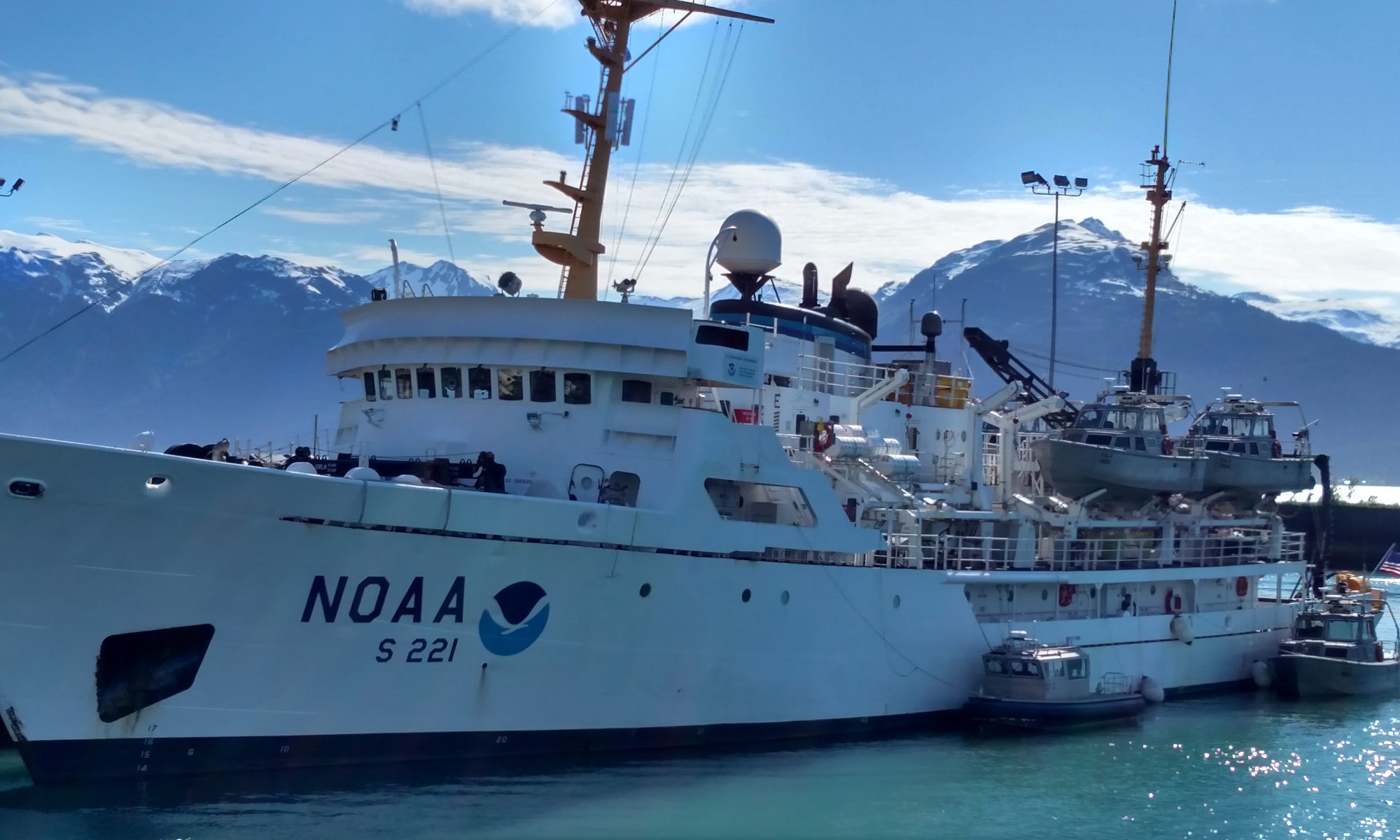
The R/V Kilo Moana (left) and Dr. Plueddeman, Paul Lethaby, Sean Whelan and Dr. Roger Lukas (right).

What a great experience. Thank you to my principal, Robert Weinberg, at Sherman Oaks Center for Enriched Studies and to my students. Keep it up kids, it is you that make SOCES number one.  I would also like to thank my wife.  Without her encouragement and enthusiasm towards our profession, she is also a teacher, I don’t know if I would have applied.  She is my inspiration.  Thank you one and all for allowing me to participate in this career and life enriching experience.

I see skies of blue….. clouds of white Bright blessed days….dark sacred nights And I think to myself …..what a wonderful world

~ Louis Armstrong

Folks on the ship take in the beautiful Hawaiian sunset…

Scott Sperber, July 14, 2009

NOAA Teacher at Sea
Scott Sperber
Onboard Research Vessel Kilo Moana
July 9-17, 2009 

Mission:Woods Hole Oceanographic Institution Hawaii Ocean Time series Station; Albert J. Plueddemann, Chief Scientist
Geographical area of cruise: Central Pacific, north of O’ahu
Date: July 14, 2009

Weather Data from the Bridge 
Temperature: 23.66 C
Humidity: 76.34%

R/V Kilo Moana
R/V Kilo Moana

Science and Technology Log 

Today is another slow scientific day today. So today I am doing some other type of scientific learning, some local marine biology.  Today I am learning about how to fish in the local Hawaiian Islands style.  Breeze Simmons, research associate student level 1, is showing me all of his riggings for various types of fish and fishing conditions.  He is even rigging up something for me so I might have an opportunity to try to catch something later today or tomorrow. I have learned that Mahi has eyes like humans and they can see up to the surface.  They are a very strong food source in the ocean the world record is close 86 pounds and that only took about 18 months of growth. Mahi mahi is also known as the dolphin fish, not to be confused with “Flipper” of dolphin fame, also known as Dorado.  Ahi is tuna, Ono is Wahoo. There are also Marlin and Aku, a member of the mackerel family.

Breeze setting up gear for fishing

I am also sharing the Pacific Ocean with Hurricane Carlos. It’s a big ocean out here and I have not felt any effect from it and we don’t plan to.  Carlos is still off the coast of Mexico now. This is so cool to be on board this ship with all these experts and to be adding to my knowledge. The meteorologists on board say that if Carlos comes close to Hawaii its strength will die out (lose its energy). The weather balloon launches are continuing on schedule every 4 hours with Tom and me taking the 0700 and 1100 launches. Tomorrow promises to be a very hectic day aboard ship.  We will be recovering the old buoy.  Everything will begin at a 0600 and continue all day.

Mahi mahi
Mahi mahi

Personal Log 

Since today is such a mellow day I have taken this opportunity to catch up on some reading, sun, listening to music and continue by bike riding.  It has now become a bit of competition between, Carly, one of the very young interns, 25 years young from the University of Hawaii, and me as to who is riding the most miles each day. Today she rode more.

The ship has an onboard DVD system where movies and such are piped into each berth (room) along with scientific information.  I was in my berth and I put on one of the channels and what did I see that someone had put on in the main lounge? It was an episode of National Geographic and who was on the episode but my good friends from UCLAs’ Marine Biology Department, Dr. Bill Hamner and his wife Peggy. Small world, Peggy wrote one of my letters of recommendation for this expedition. They are part of the reason I am so involved in Ocean Sciences.

Today’s Task 

Look up and find a picture of all the fish that were mentioned above. 

Me and Carly
Me and Carly

Scott Sperber, July 13, 2009

NOAA Teacher at Sea
Scott Sperber
Onboard Research Vessel Kilo Moana
July 9-17, 2009 

Mission:Woods Hole Oceanographic Institution Hawaii Ocean Time series Station; Albert J. Plueddemann, Chief Scientist
Geographical area of cruise: Central Pacific, north of O’ahu
Date: July 13, 2009

Weather Data from the Bridge 
Temperature: 24.13 C
Humidity: 72%

Kuhio setting up for fishing

Science and Technology Log 

The ship moved to the location of the old buoy last night. Visually, what a difference between the two. This one is certainly not the bright yellow color of the new one launched just 3 days ago. Yesterday I mentioned that the two thermometers on the new buoy were not reading identical temperatures and that they were about 0.4 degrees difference.  After asking a few questions I came to be informed that the importance of this particular series of expeditions, WHOTS, is that it is the accuracy of this longevity study that gives it its validity.  NOAA’s value of this study is that the study is an ongoing study not one that collects data brings it back to a lab and analyzes it and that is the end of it.

Science is not a one shot deal.  This is something I have tried to stress with my students over the years.  Good science, good data, is done with multiple sampling, either longevity study or many samples over a shorter period of time.  Any data can happen once but for it to be valid it needs to be substantiated.  For a number of years now the WHOTS study has not only brought back this type of data but has been able to note the small changes in this particular environment.  It has shown how these micro changes, shown over time, have an overall affect on a macro scale. This is the credence of this study is.  The fact that small changes do over a long period of time do show an effect.  The simple fact that the ship stayed on station for 3 days to calibrate the measurements with the new buoy, and then moved to the location of the old buoy shows the effort to make sure that even the most infinitesimal piece of data is made constant and notable.

Fresh Mahi mahi
Fresh Mahi mahi

Today, at this second location, there is being made shallow casts (samplings) with the SEABIRD at depths up to 200m every 4 hours.  These depths are the same depths as those of the instruments on the buoys.  Sometimes during the course of a years study the sensors will have a tendency to drift (change) or jump in their data.  These casts, engineering calibration casts, close to the buoys standardize the CTDs again reading temperature, conductivity, dissolved oxygen and then calculating density. These calibrations of any drifts serve as a comparison over the course of the year and are used to recalibrate the data.  With the recovery of the old buoy, one year worth of data will be downloaded and the similarities of all data with past weather conditions will be analyzed.  Again the sensors that are on the buoy are; MICROCATS, acoustic Doppler current meters and vector measuring current meters.

Personal Log 

Kuhio gave a shot at fishing this morning. Because the old buoy has been in the water for a year it has become a floating reef. So far Kuhio has hooked into and rough aboard 4 Mahi mahi. YUM, fresh fish tonight. I have been told that all over the old buoy and its sensors will be organisms of all types.  Jeff has asked be if I would help scrap off the old sensors.  OH BOY. Dirty smelly job I am sure. 

Scott Sperber, July 11-12, 2009

NOAA Teacher at Sea
Scott Sperber
Onboard Research Vessel Kilo Moana
July 9-17, 2009 

Mission:Woods Hole Oceanographic Institution Hawaii Ocean Time series Station; Albert J. Plueddemann, Chief Scientist
Geographical area of cruise: Central Pacific, north of O’ahu
Date: July 11-12, 2009

Weather Data from the Bridge 
Temperature: 24.2 C

Bringing in the SEABIRD CTD

Science and Technology Log 

Compared to yesterday today is a very slow scientific day.  After releasing the WHOTS buoy, things really calmed down.  Let me take this opportunity to tell you a bit about some of the instrumentation on the buoy itself.  The overall goal of the project is to collect data about the ocean and atmosphere over a long period of time.  These data will serve to help answer questions about such things as global warming and its impact in the tropics. On the buoy itself, pictured in a previous log, there are instruments that measure temperature, humidity, solar radiation, wind direction and speed. A GPS unit keeps track of the buoy’s location at all times. On the buoy there is also an antenna which transmits data to satellites. Each of the two buoys [explain why there are two in the ocean for this 4-day comparison period] in the water has enough slack in the lines to allow for an approximate 2-mile radius circle.

Profile of CTD on shallow casts

The weather balloon launching continues every four hours with teams of two or three taking each launch in shifts. Some CTD casts have been done with the small package SEABIRD CTD.  This is set over the side, lowered down by crane and yo-yoed up and down for about four hours.  During this time, data are sent directly to an onboard computer and collected by the scientists. These data include temperature and salinity. This is important information to assess changes going on in the crucial air/sea interface.

These particular locations, ones where temperature and salinity difference vary worldwide, the thermocline and halocline are dependent on variables such a currents and air temperature.  On the final assent collection bottles are closed to collect water samples for further analysis. With all of this sophisticated instrumentation onboard surface water temperature samples are still taken with the old fashioned method of lowering thermometers into the water several times to take an average reading. Some things never change. The information collected by both the oceanographic crew as well as the meteorological crew aboard is truly showing the links, the association between the interaction of the air and sky, in the crucial air/sea interface.

I found out today that the temperatures on the two thermometers on the WHOTS-6 buoy are not matching. They are off by about 0.4 degrees C; that is the level of precision necessary for this research.  The scientists are looking into which one is closest to the temperatures read on the ship before we move off to the old buoy’s location tomorrow. Apparently, this is not something that can be reconfigured so the scientists need to know which thermometer they can rely on for information. There are two of just about every instrument on the WHOTS buoys. This serves as a backup and a comparison for the same location and enables the greatest accuracy in the data.

Profile of weather balloon sonde

Personal Log 

I’d like to share a bit more about my onboard life. I have gotten acclimated finding my way around the ship (sort of). Well, at least I don’t get lost going to the mess hall anymore.  I am in a berth on an upper bunk with Jeffrey Snyder, one of the primary researchers from the University of Hawaii. The berth is quite comfortable as berths can go since it has been years since I was in a bunk bed. Various alarm clocks go off at anytime at night so the crew can go on their watch.  There is even a ghost alarm that goes off at 01:15 that Jeff and I cannot locate.  Food is not at a shortage. It seems that every time you turn around it is time to eat, and what great food it is too.  There is fresh salad lunch and dinner, fresh fruit, at least 3 entries to choose from each mea and desserts. LA Fitness here I come. I received what I consider a gift today from Fernando Santiago, one of the principle scientists, a DVD of the procedures that are used on the Hawaii Ocean Time-series Project.

July 12, 2009 

Had some down time today after setting off another weather balloon and a great fruit and yogurt breakfast. Took a 7 mile bike ride. You may ask where in the middle of the ocean you can take a 7 mile bike ride.  They have a nice little fitness room on board.

Words of the day: Mahimahi, calibration, dissolved oxygen, interface, thermocline, conductivity, temperature, depth.

Scott Sperber, July 10, 2009

NOAA Teacher at Sea
Scott Sperber
Onboard Research Vessel Kilo Moana
July 9-17, 2009 

Mission:Woods Hole Oceanographic Institution Hawaii Ocean Time series Station; Albert J. Plueddemann, Chief Scientist
Geographical area of cruise: Central Pacific, north of O’ahu
Date: July 10, 2009

The crew readying the glass balls for deployment

Weather Data from the Bridge 
Temperature:  23.83 C

Science and Technology Log 

This morning will be when the WHOTS-6 buoy will be deployed. Via the A-frame on the aft deck, the buoy will be hoisted and placed into the water. This process is done after 40m of chain and MicroCats are lowered into the water. These serve as a keel for the buoy prior to attaching the balance of the chain instruments and then thousands of feet of line which is belayed out by tension and hand over hand from many volunteers, the 80 glass balls that provide for floatation and then the massive anchor weights (air weight of 9300 lbs) to hold the whole thing down to a final depth of 4720m. Each individual section of chain with instrumentation has to me attached prior to releasing the buoy. Note the instrumentation on the top along with the large flat white “tail” to keep the buoy set with the wind.

The WHOTS-6 Buoy. Note the instrumentation on top and the wide white fin.

Along with the oceanographic research and data collecting going on there is also atmospheric data being collected with the use of weather balloons. These helium filled balloons are to be launched every 4 hours for the entire expedition. The balloons are filled to 500 psi (pounds per square inch) of helium, the tanks of which are on board, attached to a calibrated sonde (sensing) device which reads data, temperature, air pressure and humidity and transmits the data back to the ship.  Under the careful and watchful eye of Ludovic Bariteau of CIRES and the University of Colorado, at 0730, I was able to successfully set up and launch the fourth balloon of the study. Thomas Dunn and Julie Kelly, also from the University of Hawaii research team aboard, were there to assist.

Preparing the weather balloon for launch

Personal Log 

I got to launch a weather balloon.  The thrills and new experiences never stop. I am very anxious to take my experiences and new knowledge back to school. I also had to practice putting on a survival suit during our safety drill. Will the fun never end?

Words of the Day: acoustics; Doppler shift; calibrate, psi

Here I am launching a weather balloon! Donning my survival suit
Donning my survival suit