Mark McKay, June 18, 2009

NOAA Teacher at Sea
Mark McKay
Onboard Research Vessel Knorr
June 10 – July 1, 2005

Mission: Ecosystem Survey
Geographical Area: Bering Sea, Alaska
Date: June 18, 2009

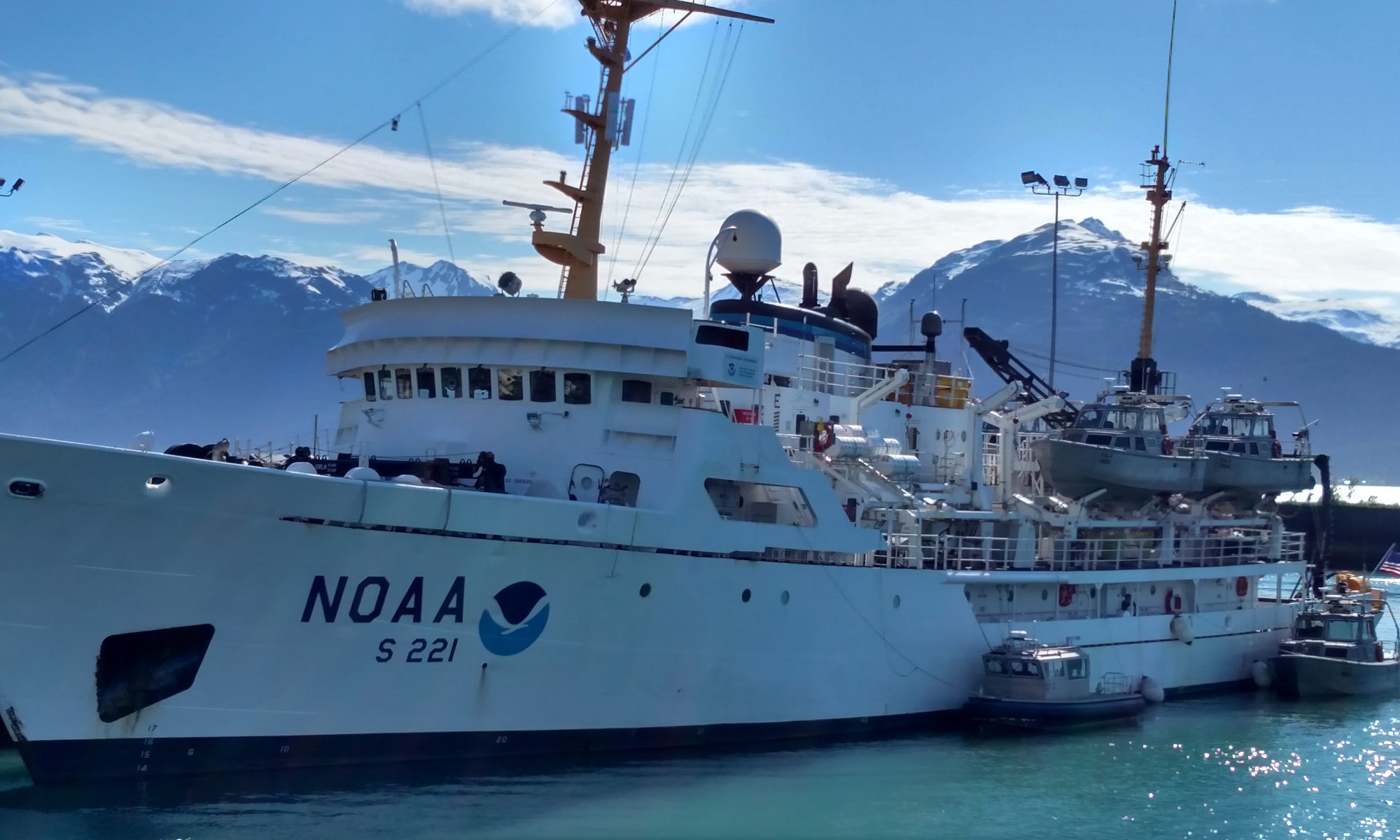
The Oscar Dyson  passing close by
The Oscar Dyson passing close by

Science Log

In the middle of this great big Bering Sea, who would have thought that we would meet up with another research vessel going to the same station at the same time as us? The NOAA ship R/V Oscar Dyson was in our area. This ship’s primary objective is to study and monitor Alaskan pollock and other fisheries in the Bering Sea and Gulf of Alaska. The ship also observes weather, sea state, and other environmental conditions, conducts habitat assessments, and surveys marine mammal and marine bird populations. It’s named after Oscar Dyson, an Alaskan fisheries leader and is homeported in Mr. Dyson’s hometown of Kodiak, Alaska.

Today we found out how a common marine organism can insert its presence and mess carefully planned experiments. The ship has a flow through seawater system, which allows the scientists to monitor the chemistry, and phytoplankton of the water the ship is sail through. We apparently met up with a large number of jellyfish that gummed up several of out instruments. The zooplankton scientists were having trouble with them getting into their plankton nets when they pulled them out of the water. So now it was my turn to experience their effect. Dr. Sambrotto, the missions Chief Scientist has several in instruments that rely on the flow through system and one of them, the one with the smallest tubing got chunks of sticky, gooey jellyfish parts in them. This required tearing down the instrument and cleaning out its tubing. Fortunately the seas were relatively calm and it time more then effort to rectify the situation. The Instrument is back up and collecting data on phytoplankton. Actually, it runs better then before. Its too bad I couldn’t get a picture of them. They apparently are down below the surface right where the ships seawater intake is. I will keep looking. By the time I am writing this however, I believe we have moved away from the “swarm”.

We have been cruising over the large shelf that takes up so much of the Bering Sea. We are getting close to the shelf break, which is where the shelf stops and deep water begins. This is known to be a very biologically active area. This is due to the upwelling of nutrients from the deep. The more nutrients the more phytoplankton, and hence more things that feed on phytoplankton, like zooplankton. And of course there are animals that live on the zooplankton, etc. I have already noticed an increase in the birds present, and I’m really looking forward to getting to this area of the Bering Sea. We should be there Friday morning.

Mark McKay, June 17, 2009

NOAA Teacher at Sea
Mark McKay
Onboard Research Vessel Knorr
June 10 – July 1, 2005

Mission: Ecosystem Survey
Geographical Area: Bering Sea, Alaska
Date: June 17, 2009

Great Weather on the Bering Sea

Science Log

During the night the Knorr turned south westward to start it’s collecting along the CN (Cape Newenhan) line. We had skirted the edge of Bristol Bay before heading back out to into the Bering Sea. The expedition is following a plan that lets it stop at locations they have stopped at in previous years. This allows the scientists to compare data from multiple years so they can get a more accurate picture of what’s happening in the Bering Sea.

When I got up this morning I had to double check to make sure we were still on the Bering Sea and not something more temperate. The sky has been clear and the air temperature has been a “balmy” 45º F. May be I’m getting used to the weather but I had to take my jacket off to stay comfortable. The weather change quickly up here and may be totally different, and more severe later today. Best to be prepared for anything! So far the trip has been surprisingly pleasant. The one thing I’m not used to is the fact that the sun is always up. At 10 o’clock at night I step outside and it’s just like noon back at home.

Looking for critters in the core sample

Today is going pretty much like previous days. Everybody knows their job and goes about it in a efficient manner, meaning don’t get in the way, you are likely to get bowled over. They sent down the Multicore Apparatus again this morning. Hit a pretty sandy bottom but this time they had an unexpected hitchhiker. One of the cores came up with a Echiuran worm. Interesting creature. It has the consistency of a full water balloon, and is similar to the “innkeeper worms” which are common back home in California. Makes is living eating detritus in sediments that it pushes to its mouth with its proboscis (snout). Some types of Echiurans feed by making a “net” of mucus that captures detritus in the water. They then pull in the mucus and eat the captured detritus.

The zooplankton people are having fun with their collecting with one exception. Apparently the waters we have been sailing are fairly heavily populated with Jellyfish. The “Jelly’s” apparently gum up the collection bottles making collection little more difficult. I was watching as they tried to clean them out of their nets and it is a sticky mess. More on that later. For now, dinner! The food on the Knorr is great by the way.

Echiuran Worm
Echiuran Worm

Mark McKay, June 16, 2009

NOAA Teacher at Sea
Mark McKay
Onboard Research Vessel Knorr
June 10 – July 1, 2005

Mission: Ecosystem Survey
Geographical Area: Bering Sea, Alaska
Date: June 16, 2009

Main science lab on the Knorr

Science Log

Well things are starting to settle into a routine here on the Knorr. What appears to be chaos is actually a very well staged operation. Everything has a place and is secured so as it doesn’t become a hazard in rough seas. The researchers and crew all know their jobs and the ship runs like a well-oiled machine. There are several science labs here onboard. The largest is the main lab pictured below, but there are other labs, which serve specific purposes, spread through out the ship. His ship is totally dedicated to Science. One thing I forgot to mention is that the Knorr is the ship that Dr. Robert Ballard used to find the Titanic on September 1, 1985. A lot of history associated with this ship.

Close Up of Collected Zooplankton

Most of the day we have been heading in a northeasterly direction paralleling some really interesting Geology in the North Slope of the Aleutian Islands. We stopped periodically “on station” at specific points of scientific interest. It’s really interesting watching the coordination between the different experiments that are run from the ship. What I thought was really interesting is the work they are doing with zooplankton on this cruise. Zooplankton consists of a range of organism sizes that includes anything from small protozoa’s to large metazoan animals. Examples would include copepods, larval fish and the very important Krill or euphausiids. These crustaceans (Krill) are a very important part of the Bering Sea food chain. Scientists onboard use what is known as a MOCNESS, which is the acronym for Multiple Opening/Closing Net and Environmental Sampling System.

Sorting Zooplankton
Sorting Zooplankton

This system is towed through the water at a speed of 1.5 knots from one of the winches on the ship. This system consists of five or more nets that can be opened or closed under computer control at desired depths. After the system is retrieved from the water, that’s when the fun begins. These scientists have a lot of samples to pick through, so they always like to have help. I got to spend a big chunk of my evening looking through trays of plankton, trying to pick out specific species of copepods, krill, and juvenile fish with tweezers. That was tedious work but we made a game of it, and I had a chance to see lots of examples of local critters. We have been staying close to coastal waters for the last day. Tomorrow we will be heading back out to the west and a bit farther away from coastal waters. I’m looking forward to seeing how both the water chemistry and the organisms we fine there differ from what we have experienced in the last couple of days. Stay tuned!

Mark McKay, June 15, 2009

NOAA Teacher at Sea
Mark McKay
Onboard Research Vessel Knorr
June 10 – July 1, 2005

Mission: Ecosystem Survey
Geographical Area: Bering Sea, Alaska
Date: June 15, 2009

Hanging Valley outside of Dutch Harbor

Science Log

We are underway!!! Got up this morning to a flurry of activity as the Knorr was preparing to get underway. I hooked up with my researcher Dr. Ray Sambrotto from Columbia University. His interests are in phytoplankton and the different chlorophylls they produce. There is a lot of plankton work happening on this cruise, as well as some benthic (seafloor) studies and surveying of seabirds. It’s amazing how much science they squeeze into a cruise. One of the things I saw as we were heading out was a very cool example of a Hanging Valley. This geological feature is formed by glaciers. I saw it when we flew into Dutch Harbor but I didnt get a chance to get a picture of it. As we set out on the Knorr we passed right by it so I got my chance.

 Multicore Apparatus
Multicore Apparatus

The day before we departed was spent storing equipment, testing instruments, and getting settled in our quarters. Problems with equipment not arriving on time wont prevent the start of the mission. We got underway right about 11 am Alaska time and headed for our first station over the Bering Canyon.  Safety is everything onboard the Knorr so before anything really gets started we are required to undergo safety training. The ships crew is very concerned with making sure everyone is safe so they go through procedures in detail.

After the safety briefings and getting some of Dr. Sambrotto’s equipment running, I had a chance to play in the mud. Dr. Shull’s group from Western Washington University is looking at cores of sediment taken from the ocean bottom. Their interest is in how nutrients are cycled through deep-water sediments. They drop the sampling device, called a Multicore, which has specialized sampling bottles to the ocean bottom. The device pulls cores from the seafloor and when the sampling device is retrieved, the scientists have a sample of the sea floor.  My job came after the bottles were retrieved. The process was to slice through the cores at specific depths and save the samples for further analysis. Good way to get really dirty.

Mark McKay, June 10, 2009

NOAA Teacher at Sea
Mark McKay
Onboard Research Vessel Knorr
June 10 – July 1, 2005

Mission: Ecosystem Survey
Geographical Area: Bering Sea, Alaska
Date: June 10, 2009

picture-185Personal Log

Wow! I woke up this morning and it really hit me that in a couple of days I will be on the R/V Knorr heading out of Dutch Harbor, AK heading for the Bering Sea. How cool is that? I have spent the last several weeks making preparations both personally and at my school for this trip. Have a lot to do. Arranging live events with the help of the great ARCUS staff, getting my paperwork done at school, and getting the family situated for me to be gone for a month. The vessel I will be on is called the Knorr and it is owned by the U.S. Navy. It has been operated by Woods Hole Oceanographic Institute since 1970. The ship is named in honor of Ernest R. Knorr who was appointed Chief Engineer Cartographer (mapmaker) of the U.S. Navy Hydrographic office in 1860. This vessel has undergone extensive retrofitting in order to accommodate a wide range of oceanographic tasks. She is stuffed with two instrument hangers, eight scientific work areas, a machine shop, winches and cranes, and some very cool navigation and communications systems. The Knorr and has a propulsion system that allows the ship to move in on direction and more importantly maintain a fixed position in rough seas. This is especially important when deploying it new “long-coring” system that can pull a 60 meter (150 ft) of sediment from the ocean floor. These coring operations give scientists the opportunity to look at past climatic and oceanographic events that occurred on the earth and in the oceans.

Well I had better get back to my preparations. I’m sure I am forgetting something. I will be making updates here frequently so please check it out. IF you would like to know more about the Knorr, or the other Woods Hole Oceanographic Institutes research vessels, go to www.whoi.edu. Next post I will talk more about our particular mission.