Scott Donnelly, April 27, 2008

NOAA Teacher at Sea
Scott Donnelly
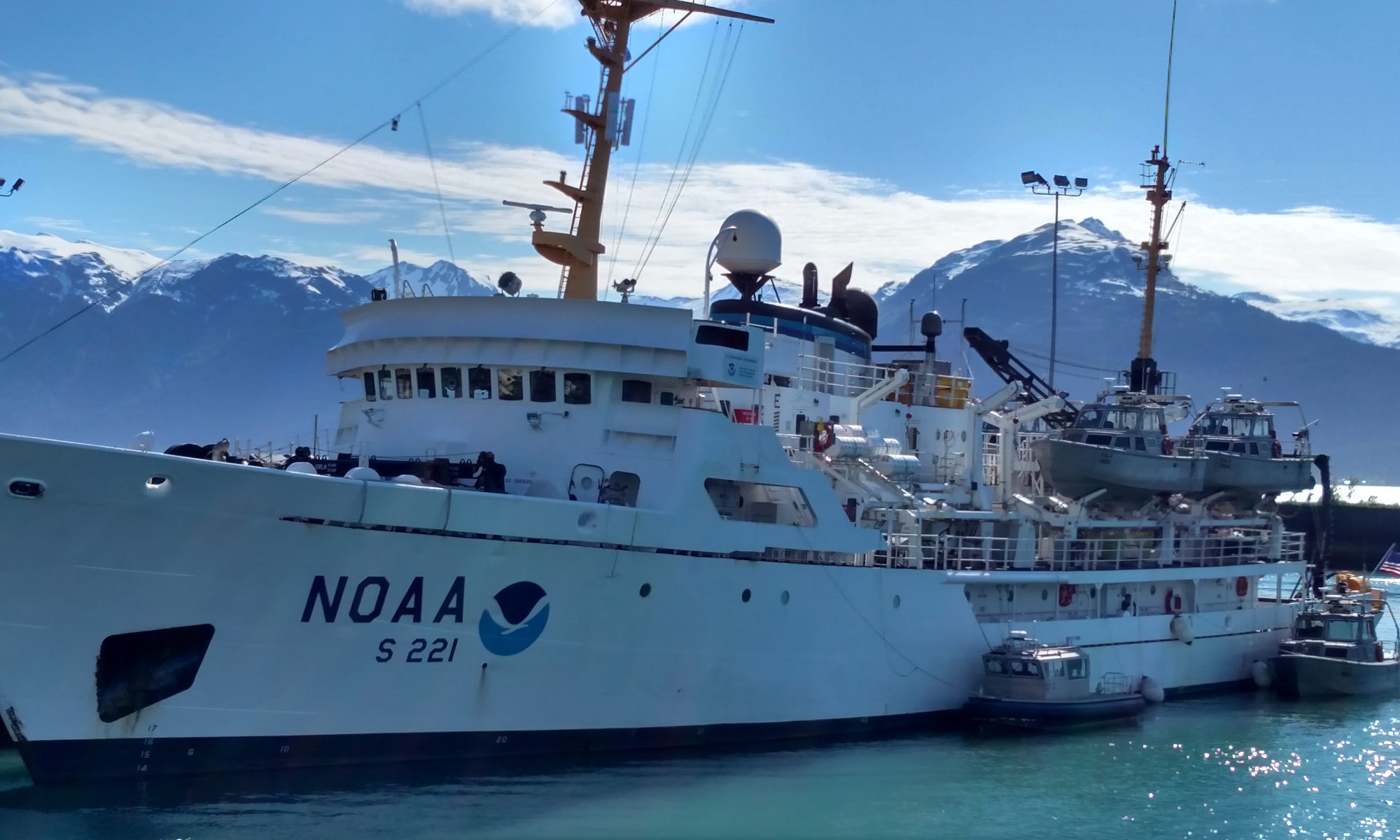
Onboard NOAA Ship McArthur II
April 20-27, 2008

Mission: Assembly of Science Team and Movement of Science Gear/Equipment
Geographical Area: Coos Bay to Astoria, Oregon
Date: April 27, 2008

CTD getting a much needed rest

Weather Data from the Bridge 
Sunrise: 0620 Sunset: 2010
Wind: 10-15 kts
Seas: 2-3 ft
Light rain showers, dense fog, in port.

Science and Technology Log 

Coordinates for today’s measurements (two sampling stations) are 43O30’N, 124O23’W and 125O40’W, six and twenty miles from the coast at depths of 100m (330ft) and 400m (1,315ft) respectively in addition to measurements (three sampling stations) for coordinates 43O40’N, 124O16’W to 125O25’W, three to ten miles from the coast at depths of 80m (265ft) to 120m (395ft). Bob and I have become efficient pros at deploying and retrieving the four biological sampling nets. It takes us no more than 35 minutes to complete all the biological sampling and that includes the ten minute tow required for the Manta net to sample the surface.

Personal Log 

Today is the last day of the cruise. My final 4-hour early morning shift of the cruise went well. The last sampling station for the cruise was completed at ~0930. I spent the morning downloading data, adding information to my NOAA TAS logs, packing my personal gear, cleaning my sleeping area, and enjoying the last few hours on the open ocean from atop the flying bridge philosophically pondering its future and perhaps humanity’s future. In the meantime the NOAA crew was busy making preparations for docking in Coos Bay. For the last leg of the cruise into Coos Bay the science team assembled on the McARTHUR II flying bridge to enjoy the Oregon coastal scenery, relax, and take photos. Lots and lots of photos! I overheard one science team member say that he took 1.7 gigabits of photos during the cruise! Another took over 200 photos in one day alone. Wow! Thank goodness for digital cameras or else that would have been quite expensive to process if film had been used.

Entering the channel to Coos Bay, OR

The cruise’s end was bittersweet. For ten days I had been away from my wife and two young children. I missed them even though I emailed them everyday from the ship. I can’t wait to see them. At the same time though the cruise was so enjoyable in so many ways it’s hard to pinpoint one or two that stand out head and shoulders above the rest. It was hard work no doubt about it and at times I thought I’d never get a decent sleep. But the science team assembled by Chief Scientist Steve Rumrill was from the beginning and to the end a well-oiled machine that understood the mission’s objectives and dealt with problems that came to light in a timely and professional manner. I’m not aware of any issues that arose during the cruise between the science team members themselves or between the science team and NOAA crew. If they existed, then they must have been dealt with and worked out immediately. To me it’s a testament to the professionalism shown by all- science team and NOAA crew- on the cruise and the leadership of those chosen to lead.

The Lorax
The Lorax

Over time I’ll likely forget most of the names of those I met on this cruise. Time and age tend to do that as I’ve already experienced even in my relatively young age. But it’s less likely that I’ll forget the faces, the natural scenes observed, and the conversations had. How could I forget the graceful albatross gliding without effort and with such skill inches above the water without ever flapping its wings? Or the bioluminescence of krill? Or the first time while on the bridge the bow of the ship sunk low in the trough of a wave, the horizon and sky disappearing.

And what’s to become of the world’s oceans? What’s for sure is that for the next twenty years humanity will continue to exert more pressure on the world’s oceans to feed its relentless population growth, satisfy its rapacious appetite for resources, and serve as the transportation conduit to keep the world’s consumer economies afloat (no pun intended). Throughout human history the marine world has always delivered but there are signs that it may be in trouble, too tired to keep up with the maddening pace that the modern world has set, too exhausted to give freely as its finite resources are an ever alarming rate.  I’m reminded of two small, unassuming but prophetic (and hence controversial) children’s books written by Dr. Seuss and Shel Silverstein almost forty years ago, The Lorax and The Giving Tree respectively. I’ve read them to my two children numerous times. After this cruise they make even more sense.

The Giving Tree
The Giving Tree

Without complaint the oceans have given much to humanity. In many ways the oceans are liquid gold. The history of human achievement is defined in large measure by our historical relationship with the marine world. It’s teeming with an abundance of life struggling to survive in the oceans’ harsh salt water environment. The current plight of the marine world represents a defining challenge humans must confront when planning for the future of our troubled planet. The historical narrative of the oceans is written in its sediments, water, and the genetic database of the million of organisms that call the ocean home. The future narrative is being written right now. What is its fate?

In conclusion, this cruise has given me a rarefied, first-hand look at the ocean world in which I live. To be sure our planet is misnamed. Rather than Earth, instead it should be named Oceanus, for our world is a water world that gives so much pleasure and asks for so little in return. What is its fate?

OCEANUS….what is its fate?

Tara Treichel, April 27, 2008

NOAA Teacher at Sea
Tara Treichel
Onboard NOAA Ship Nancy Foster
April 15-27, 2008

Mission: Lionfish Survey
Geographical Area: Atlantic Ocean, off the coast of North Carolina
Date: April 27, 2008

Weather data from the bridge 
Visibility: 10 n.m.
Wind: 11 knots
Waves: 1-2 feet
Ocean swells: 3-4 feet
Sea temperature: 23.0
Air temperature: 23.0

At 120 feet, the water has absorbed red, yellow and green wavelengths of light, muting the brilliant colors of these Lionfish and other reef organisms (the Lionfish in the foreground is partially illuminated by the video camera)

Science and Technology Log 

I wanted to explain a little more about the purpose of the Lionfish study. The technical name of the study is Assessment of Lionfish Ecosystem and Fisheries Impacts. The Principal Investigator/Chief Scientist is Paula Whitfield, who works out of the NOAA Lab in Beaufort, North Carolina. Several years ago, Paula had heard reports of Lionfish seen off the coast of North Carolina. A recreational diver, Paula visited these sites to see for herself; what began as a casual observation turned into the guiding question for a complex Lionfish ecosystem study that is now in its seventh year. As I understand, the guiding questions framing the study are:

  1. Initially the scientists needed to understand, to what extent Lionfish have invaded the coastal waters of the eastern US. Under this broad question fall many sub-questions: Are they successfully reproducing? How large is their population? Are they expanding their geographic range, and is their population growing? Finally, what biological and physical factors may limit their survival (i.e. what environmental conditions do they need to survive)?
  2. After the initial research results revealed a widespread and well-established presence of Lionfish, researchers refined their objectives to better understand the fisheries and ecosystem impact of Lionfish. This is a very broad question and includes many sub-questions such as: What species are they eating? Is the number of “conspicuous fish” species (large and easy to see and count) decreasing in areas where Lionfish are present? Are the number of “cryptic fish” species (small typically prey species that hide within the habitat) decreasing in areas where Lionfish are present?
  3. The scientists also seek to better understand how Lionfish impacts may be further complicated by other variables such as overfishing and climate change. Examining this question requires looking at many other aspects of the marine ecosystem as indicators of ecological health. Sub-questions are: How are the physical and chemical ocean parameters changing over time (e.g. sea temperature, ocean currents, chemical composition)? How are algal populations changing over time? How are invertebrate and soft-bottom communities changing over time?

Initial results of the study were eye-opening. Everywhere the research team went, they found Lionfish. From 20042007, the data across the sampling sites showed an increase in population of well over 300%. Considering that these fish have no known predators, and females release 30,000 eggs at a time, it is not hard to imagine the severe impact that these fish could potentially have on the marine food web and ecosystem. In addition, Lionfish are tropical reef fish, which require warm water to survive and reproduce. As climate change occurs, it is conceivable that Lionfish could expand their range in response to rising sea temperatures or a shift in Gulf Stream currents.

Paula Whitfield (right), Chief Scientist of the study, and I enjoy the sunshine.

Scott Donnelly, April 26, 2008

NOAA Teacher at Sea
Scott Donnelly
Onboard NOAA Ship McArthur II
April 20-27, 2008

Mission: Assembly of Science Team and Movement of Science Gear/Equipment
Geographical Area: Coos Bay to Astoria, Oregon
Date: April 26, 2008

Weather Data from the Bridge 
Sunrise: 0620 Sunset: 2010
Wind: 10-15 kts
Seas: 2 ft
Light rain showers, reduced visibility

NOAA TAS Scott Donnelly ready to deploy a bongo net

Science and Technology Log 

Both the morning and afternoon shifts went off without any problems. Coordinates of the seven sites for the longitudinal sampling along the Coquille Estuary Line are 43O07’N, 124O29’W to 125O15’W extending 2 to 40 miles from shore and from depths of 44m (145ft) to 2,300m (7,550ft).  My tenth 4-hour shift was spent traveling north to the first sampling site along the Umpqua Estuary Line. Coordinates for the longitudinal measurements are 43O40’N, 124O16’W to 125O02’W extending 3 to 40 miles from shore and from depths of 80m (265ft) to 1,300m (4,265ft). See map below.

 Personal Log 

Coordinates for the longitudinal measurements of the first sampling site of my shift
Coordinates for the longitudinal measurements of the first sampling site of my shift

In preparing for Saturday’s early morning shift, I noticed when I walked onto the ship’s fantail that the night sky was clear and stars dotted the dark night heavens. I made my way to the flying bridge to observe the cloudless night sky lit up with millions of stars. All the major constellations visible in the northern hemisphere at this time of year just after midnight were easily seen in all their brilliance and mystery. The cool, crisp salty air added to the beauty of the moment. It made for a peaceful, philosophical moment. But as I have found in my brief stay in Oregon such celestial opportunities do not present themselves often and when they do it’s not for long. Clouds soon appeared, blocking the view and ending any chance to identify and name all the major constellations. After finishing the early morning shift I stayed up until after sunrise to take advantage again of photographing the sun rising above the eastern horizon through a thin layer of clouds.

Such meteorological conditions created a sky painted with various shades and hues of red, orange, and yellow. It was if a giant painter had a brush and painted the sky- his canvas- a riot of colors pleasing to the eye and emotions. The science of immaterial light from the sun interacting with the material gaseous atmosphere and clouds and the timing made for a time of quiet reflection and contemplation of the vastness of the universe and the relative insignificance of the Milky Way galaxy and our blue ocean planet. Tomorrow is the last day of the cruise. I have one more early morning shift. We are scheduled to dock in Coos Bay sometime in the early afternoon.

Sunrise off the southern Oregon coast as seen from NOAA ship McARTHUR II

Tara Treichel, April 26, 2008

NOAA Teacher at Sea
Tara Treichel
Onboard NOAA Ship Nancy Foster
April 15-27, 2008

Mission: Lionfish Survey
Geographical Area: Atlantic Ocean, off the coast of North Carolina
Date: April 26, 2008

One of the Survey Technicians operates the Multi-Beaming mapping system.

Weather Data from the Bridge 
Visibility: 10 n.m.
Wind: 11 knots
Waves: 1-2 feet
Ocean swells: 2-4 feet
Sea temperature: 23.5
Air temperature: 22.0

Science and Technology Log 

In addition to the Lionfish survey, the other research that is being conducted while aboard the NANCY FOSTER is benthic habitat mapping of the ocean floor. This is accomplished using highly sophisticated, computerized multi-beam SONAR technology. Two survey technicians aboard the ship are responsible for running and monitoring the system, which is run all through the night. The operators make sure that the system is recording data properly and that the ship stays on course (within about 5 meters), and process the data as it is recorded. The course is set and followed, lawnmower style, back and forth along long narrow parallel lines, producing a beautiful rainbow colored map coded for “depth by color,” where red is high and blue is low. After five nights of mapping, the white digital nautical chart contains five tiny rainbow swatches, each one representing about 10 square miles of mapped space. Each year the research team adds to the swatches, until one day perhaps the entire bay floor will be mapped. Scientists later use the maps to support their research; in this case, Paula used them to determine where to dive. With countless miles of ocean floor (much of which is sand, or poor fish habitat) and limited time and research budgets, the maps are a critical part of the research effort. 

Tara holds up a specimen that some of the scientists said was the biggest Spiny Lobster they had ever seen!

There are a lot of variables such as temperature and salinity that can  influence the transmission of the sound waves produced by the multi-beam sonar to measure seafloor depth.  In order for the data to be as accurate as possible the survey technicians need to measure these variables throughout the water column using a CTD (conductivity (salinity), temperature and depth). They conduct three CTD ‘casts’ a night by first lowing and raising the CTD on a long cable that is controlled by a winch.

Personal log 

Today, the Chief Engineer caught a Wahoo off the stern of the boat. Wahoo! Can you think of a fish with a cooler name? It’s a cool fish, too, sleek and streamlined, with large jaws and a loud stripy pattern on blue gray skin. It was perfect timing, since a barbeque was planned for our last afternoon at sea. The fish is nearly all muscle, and yielded 25 steaks, almost enough for each one of our full ship of 35 people aboard. How was it, you ask? Delicious! The scientists also caught several large Spiny Lobsters, a Scamp (a Grouper), Hogfish, Sea Bass, and of course, many Lionfish. In addition, they saw a Mola Mola (Sunfish) and several Loggerhead Turtles. 

Scott Donnelly, April 25, 2008

NOAA Teacher at Sea
Scott Donnelly
Onboard NOAA Ship McArthur II
April 20-27, 2008

Mission: Assembly of Science Team and Movement of Science Gear/Equipment
Geographical Area: Coos Bay to Astoria, Oregon
Date: April 25, 2008

Weather Data from the Bridge 
Sunrise: 0620 Sunset: 2010
Wind: 5-10 kts
Seas: 2 ft
Rain likely

A nautical chart of the Coos Bay area

Science and Technology Log 

Longitudinal sampling continues along the Coos Bay Line. Coordinates for all measurements (twelve sampling stations total) along Coos Bay are 43O20’N, 124O27’W to 125O27’ extending 3 to 55 miles from shore and from depths of 50m (165ft) to 2,800m (9,200ft). Today was my seventh (morning) and (afternoon) eighth 4-hour shift. All went well.

Personal Log 

After the morning shift I asked my shift mate and veteran sailboat skipper Bob Sleeth to give me some pointers on how to set a nautical heading using parallel rulers. I know all about latitude and longitude but have never sat down with a nautical chart and looked at all the interesting information found on them. As a kid I watched a lot of old World War II naval films like Midway and Iwo Jima and I remember the scenes where the captain and senior officers are studying a nautical chart of the western Pacific with obvious intensity in order to plot a heading to cut off supplies for the Japanese navy or whatever. I always thought those scenes cool.

NOAA TAS Scott Donnelly charting a marine navigational heading

So here I am thirty years or so later, a happily married father of two and professor of chemistry, in my mind pretending the role of ship’s navigator on the famous WWII battleship USS Missouri as I consult with Capt. Stuart Murray in setting a heading to Tokyo Harbor with General of the Army Douglas MacArthur on board, making last-minute preparations for the surrender of the Empire of Japan ending World War II. I guess I can blame all the fresh ocean air I’ve taken in the past week for such a fantasy.

About mid-morning after a deep sleep I went to the flying bridge (observation deck) located above the ship’s operations bridge to watch the true masters of the sky- the albatross- glide effortlessly just inches above the glassy, mirrored ocean surface. The albatross rarely flaps its wings when flying. Rather, the albatross conserves its energy for its long distance oceanic travels by using the uplift from the wind deflected off ocean waves. Their long, slender, aerodynamically efficient wing structure allows the albatross to stay aloft for hours at a time. They soar in long looping arcs. They indeed are a grand spectacle to observe.

View from the McARTHUR II flying bridge