Kazu Kauinana, May 16, 2006

NOAA Teacher at Sea
Kazu Kauinana
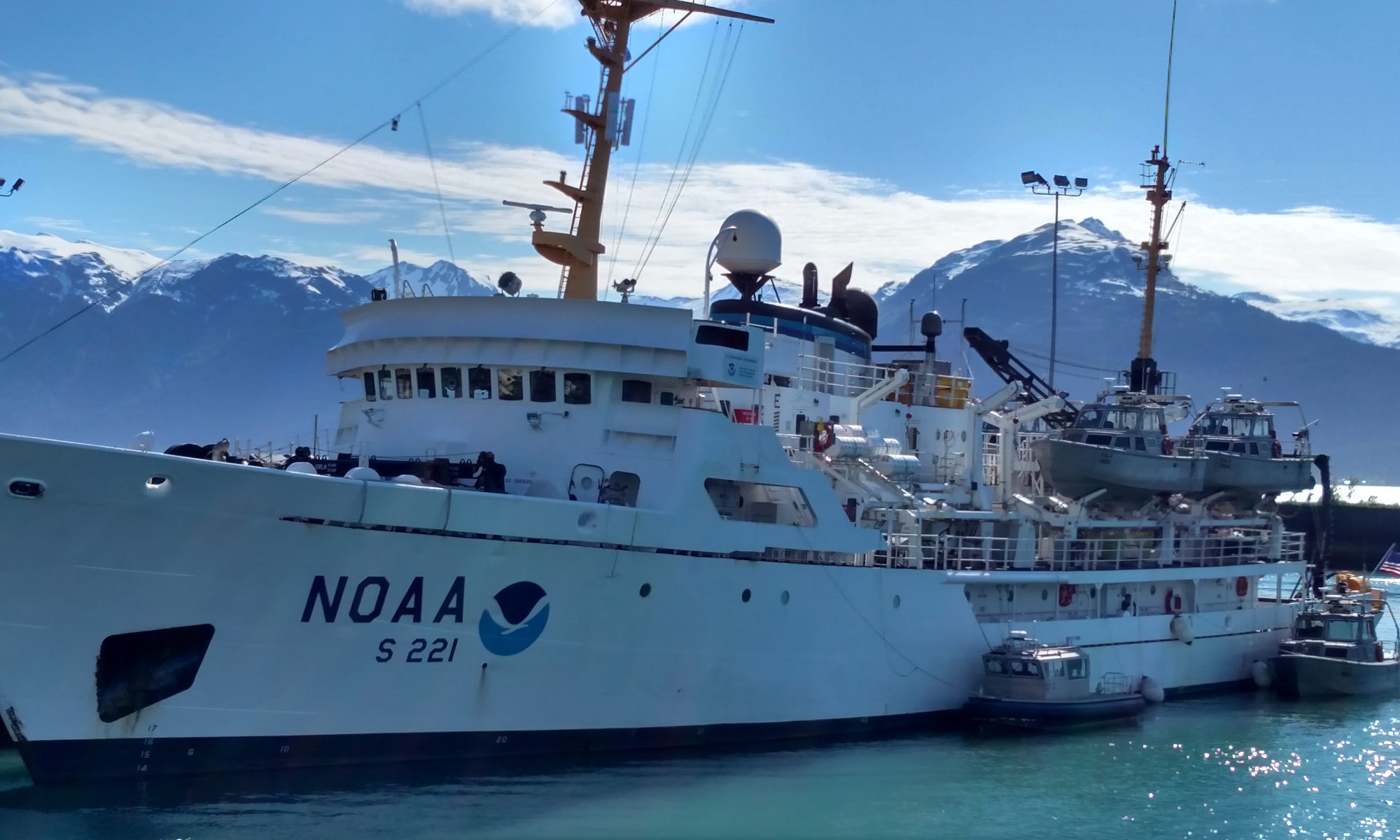
Onboard NOAA Ship Oscar Elton Sette
May 9 – 23, 2006

Mission: Fisheries Survey
Geographical Area: Hawaiian Islands
Date: May 16, 2006

Weather Data from Bridge 
Latitude:  28, 23.9 N
Longitude: 178, 25.0 W
Visibility:  10 NM
Sea wave heights: 2-3
Sea swell heights: 3-4
Seawater temperature: 24.0 C
Sea level Pressure:  1/8 Cumulus

Science and Technology Log 

Today we began to off load gear and seven personnel onto Green Island, the main island of Kure Atoll, as well as the farthest west and last island in the Hawaiian chain.  This island did not experience any bird poaching or guano mining, but in 1960 it became a United States Coast Guard LORAN (long-range navigation) station.  The major features of the station were a barracks, a signal/power building, a transmitter building, a pump house, seven fuel tanks, a 4,000-foot-long runway and a 625-foot-high LORAN tower.  The only features remaining are parts of the barracks and the runway, which is unused and disintegrating. There is also a small pier that is being used by the researchers.  It is now a wildlife refuge under the jurisdiction of the Hawaii Fish and Game Department.

The island is heavily vegetated with not only shrubs, grasses, and crawling vines, but also several kinds of trees. Verbesina is now growing out of control and a landscaper is a part of this crew to eradicate this invasive species.  It grows so thick that it does not allow ground nesting birds like the Blue Faced Booby to utilize them.  It also poisons the ground so that other plants cannot grow where they have established themselves.

I should mention that this is not a quarantine island like Laysan, Lisianski, and Pearl/Hermes.  Too many invasive species had been brought in with the development of the station to warrant that designation.  One of the invaders is a crawling weed with half-inch thorns and easily goes right through your slippers.  When the women opened the barracks to check it out, it was filled with cane spiders on the walls and ceiling; and the floor was covered with a carpet of dead ants that the spiders had eaten.  There are also rats and at one time there was a dog, left there by a rescued shipwrecked crew.  However, it was eaten by a crew that was shipwrecked later on.  The atoll is notorious for shipwrecks.

I saw turtles and seals too.  In fact, I had to get out of the water several times because the seals would swim towards me to see what I was doing there.  We always had to steer clear of all the animals so as not to disturb them or have them become familiar with humans.

Green island is located on the inner side of a large ring of reef.  Within this reef, it is relatively shallow and outside the ring it is very deep; rough water on the ocean side and calm on the lagoon side; and sloping fine sand beaches on the inside and course and rugged on the ocean side.  The camp and pier are on the lagoon side of the island.

Most of the day I was a “mule,” carrying six months worth of supplies from the shuttling Zodiac to the spider’s nest (the barracks). Lots of thorns, soft fine sand, hot sun, but no ticks.

At the end of the day I was rewarded by being allowed to visit the “AHU” (alter or shrine) that the crew from the Hawaiian sailing vessel, The Hokulea, had built on a recent visit to this island.  It is located in a spectacular site on the wild ocean side of the island just up in a safe spot from the water’s edge.  It is comprised of several large coral heads comfortably arranged with a Hawaiian adze placed in the middle, inscribed with the title “NAVIGATING CHANGE.”  I was deeply moved!

Kazu Kauinana, May 15, 2006

NOAA Teacher at Sea
Kazu Kauinana
Onboard NOAA Ship Oscar Elton Sette
May 9 – 23, 2006

Mission: Fisheries Survey
Geographical Area: Hawaiian Islands
Date: May 15, 2006

Weather Data from Bridge 
Latitude:  28, 06.7 N
Longitude: 177, 21.3 W
Visibility: 10 Nm
Wind direction: 095
Wind speed: 17 kts
Sea wave heights: 2-3
Sea swell heights: 5-6
Seawater temperature: 23.2 C
Sea level pressure: 1027.2 Cloud cover: 3/8 Cumulus

Science and Technology Log 

Today we hit Midway Atoll, the largest island we’ve visited so far.  It is covered with tall Ironwood trees and has been well developed by the military.  A large airstrip and an enclosed harbor can be seen on the approach.  We docked at one of the two piers on the northeast side of the island.  Midway is no longer a military base.  It has been turned into a wildlife refuge. The park rangers came over to the boat and gave a briefing and rules of the island. I went for a walk on my own and did not see the Laysan duck because I did not have a guide to the restricted refuge area.  Forty-three ducks from Laysan island were brought here one year ago and 40 have survived.  They have also produced ducklings  so the project is considered to be going well.

I did have a great time just moseying around taking pictures of odd and interesting man-made curiosities.  There was a 12-foot gooney bird between two super huge canons in front of the bowling alley and mall.  Everything had a ghost town sort of look, and there were birds everywhere as usual, but no people.  I made my way to the famous seaplane hanger to get a picture of its bullet-riddled side, but the side had been removed.  In another hanger I found the Midway Military Museum.  It had been the airport arrival and departure area. There were two bombs at the gateway, one 6 feet and the other 20 feet.  There were great paintings of aircraft, some in battle scenes.  Everything was from the 1940s and being alone there kind of creeped me out.  TWILIGHT ZONE.

I made my way to North Beach next to where we docked the ship.  This beach is rated as one of the best four beaches in the world and it lives up to it.  It’s about two miles long and the sand is blinding-white coral. The water is crystal clear and 3-5 feet deep for about a quarter mile out to sea.  You can easily see the abundant fish swimming fearlessly by you, and any Tiger shark approach would give you fair warning.  Even the sand is great because it is made of crushed coral and it stays cool.  It is not silica sand.  I was told that the fishing is great here, but it is catch and release because of sanitaria.

Personal Log 

That evening the OSCAR SETTE had a great barbecue and the whole town was invited.  I think there are only about 30 permanent residents.  It is interesting that most of the help is from Thailand.  I met a Thai artist who does sand-blasted glass illustrations.  I showed him the bust of Chad Yoshinaga that I was doing and then he took me up to his home and showed me his artwork.  I was very impressed with his wildlife and Buddhist images.  He said he just does it to pass the time.

We spent the night at Midway and left at 7 a.m.

Kazu Kauinana, May 14, 2006

NOAA Teacher at Sea
Kazu Kauinana
Onboard NOAA Ship Oscar Elton Sette
May 9 – 23, 2006

Mission: Fisheries Survey
Geographical Area: Hawaiian Islands
Date: May 14, 2006

Weather Data from Bridge 
Latitude:  26, 31.9W
Longitude: 174.57.4W
Wind direction:  100
Wind speed:  22 kts
Sea wave heights: 4’
Sea swell heights: 5-7
Seawater temperature: 24.9c
Sea level water pressure: 1024.
Cloud cover: 3/8, cumulus

Science and Technology Log 

Today I went out to Lisianski (formerly Lisiansky) Island with the supply coordinator and met scientist Jean Higgins and her assistant.  Jean and her assistant, Veronica Decamp, are the only two on the island. There are noticeable differences between Laysan and Lisianski.  Lisianski has fine white sand beaches surrounding the entire island as well as in the interior.  It does not have a lake in the middle like Laysan.  Rather, this sandy island is thickly covered with shrubs.  It appears to be more pristine than Laysan but it shares some of the same human profiteering and devastating environmental history with Laysan.  Lisianski is an atoll whose center crater became filled with fine coral and sand, whereas the Laysan crater filled only partially with debris and then was topped off with water (presently high saline and brine). There are no coconut trees left; eighty had been planted in 1844, but the only trees I saw were Casuarinas dotting the islands here and there.  There was a lot of scaevolas and bunch grass, Ipomoea, Boerhavia, Laysanicum, Solanum nigrum, Sicyos, and Tribulus.

The shoreline and water clarity of Lisianski also differ significantly from Laysan.  There is a steep drop off 3-5 feet deep, and 6-10 feet from where the water laps up onto the sand. This in conjunction with dense, murky water (probably due to the very fine coral sand) makes swimming, bathing or snorkeling, a bad idea.  I witnessed numerous Green sea turtles and Monk seals swimming just a few feet from where I stood on the beach.  A few of the turtles were missing fins or had teeth marks on their carapace from sharks, probably Tiger sharks, that have been seen chasing them.

Something I did not mention about a commonality to all the islands thus far is the littering of dead animals scattered throughout the island.  These are not like beaches on the occupied high islands where there are much fewer animals and scheduled city and county beach machine clean-up crews.  Nature takes its course here and the living pass with dignity.

Lisianski suffered similar environmental disasters as Laysan except for guano mining.  It did, however, go through a period in the early 1900s of Japanese plumage plundering.  Like those words, “Plumage Plundering”?  It means that at least 1.25 million birds were killed on the islands for their feathers. A businessman by the name of Max Schlemmer, who was an agent for the Pacific Guano and Fertilizer Company in 1908, entered into an invalid feather-harvesting-rights contract with Genkichi Yamanouichi of Japan.  This contract also included Laysan. It is estimated that 284,000 birds were killed on Lisianski and close to a million on Laysan.  These are two islands where the birds were so thick on the ground that it was difficult to walk without stepping on them, and with every step, you would sink waist deep into the ground because of the collapsing nest burrows.

In 1910, shortly after the feather poaching was stopped, rabbits were introduced to Lisianski and Laysan. The U.S. Revenue Cutter Thetis made a trip to Lisianski in 1914 and this is a report by Carl Elschner from that visit:

“At the time of my visit, there were two houses on the island which, as well as the phosphate deposits, lay in the former lagoon.  That is, in a depression, which, however, does not contain water any more.  Surrounding the houses are small patches of tobacco, which grow wild, having been brought by Captain Schlemmer.  This is in fact the only vegetation on the island, and there hardly is a blade or stalk of any other plant to be seen with the exception of perhaps two poorly looking specimens of Ipomea, which I saw…  The rabbits introduced have just exterminated the flora…now the rest of these rabbits (we found many dead but very few living ones) will have to submit to starvation.”  (Elschner, 1915: 56)

It is important to note that the island is back to a healthy level due to the efforts of conservationists, scientists, monitoring by the U.S. Coast Guard and Navy, and expeditions such as the one I am on.

Kazu Kauinana, May 13, 2006

NOAA Teacher at Sea
Kazu Kauinana
Onboard NOAA Ship Oscar Elton Sette
May 9 – 23, 2006

Mission: Fisheries Survey
Geographical Area: Hawaiian Islands
Date: May 13, 2006

Weather Data from Bridge 
Latitude:  25, 33.1N
Longitude: 121:28.9W
Visibility:  10nm
Wind direction:  090
Wind speed:  19Kts
Sea wave height: 2-3
Sea swells height: 4-6
Sea water temperature: 24.8
Sea level temperature: 24.8
Sea level pressure: 1021.4
Cloud cover: 4/8, altocumulus, cumulostratus, cumulonimbus, cumulus

Science and Technology Log 

I left the OSCAR SETTE at 8:30 this morning on a Zodiac with cargo and a crew of five for Laysan Island. This island was not a military landing strip so it still looks like what you might imagine a desert island would look like.  It is really beautiful—nice sandy beaches, clear water with coral reefs, low shrubs and grasses, a patch of coconut trees and even a lake.

Sarah Luecke took us on a tour from the beach where we had landed to the hyper-saline lake in the northern, middle of the island.  As with all of the islands, you cannot explore without a guide. Shearwater noddys, Tristan’s petrels, and bonin petrels burrow into the ground to make their nests, and if you do not follow your guide carefully, there is a good chance that you could cave in their nests. We managed to cave in only two, and we had to re-dig the tunnels to make sure the birds could continue using them.  Birds are everywhere and they have no fear of humans. They behave like barnyard birds, so when you are walking you have to go around them, because they will not move.  When they get  irritated with you being too close they clack their beaks like plastic toy wind-up dentures.  The two breeds that are the most oblivious to human space are the large Laysan Albatross and the black-footed Albatross. The chicks are almost as large as the adults, covered with patches of downy molting fuzz, and are really goofy looking.  They plant themselves everywhere, especially on the paths, in front of tent doorways and chairs, and next to your belongings.

It was great to see so many birds, because at about the turn of the century the bird population had been decimated by the Japanese feather industry.  An American Guano contractor had subleased the right to taking wings, breasts, skins, and tons of feathers to the Japanese company.  This went on for at least a couple of years before it was stopped but, by then, the damage was done.  At least a million birds were killed and three out of the five endemic species became extinct.  Fortunately, most of the sea birds came back.

The bird population here had at one time been so dense that you could see the cloud of birds way before you ever saw the island. It was so thick that a guano industry was established here in the late 1800’s into the early 20th century.  The Japanese immigrant workers who worked for Haole American businessmen based on Oahu, had to use picks and axes to break up the caked up thick layers of it.

There had also been an attempt at rabbit farming by a family, but that didn’t work.  It did, however, destroy almost all of the vegetation on the island.  Through a lot of work and expense, the rabbits were eradicated and an intensive replanting program was established and is still active. In spite of all of these man-made disasters, the island today, looks like paradise.  So it did give me a lot of hope that we may still be able to maintain some of the few precious resources that we have left.

Personal Log 

We walked along the beach and saw monk seals in the water and on the beach.  We found a spot where it looked like it would be terrific snorkeling and it was.  After that, it was time to go back to the OSCAR SETTE.

Kazu Kauinana, May 12, 2006

NOAA Teacher at Sea
Kazu Kauinana
Onboard NOAA Ship Oscar Elton Sette
May 9 – 23, 2006

Mission: Fisheries Survey
Geographical Area: Hawaiian Islands
Date: May 12, 2006

Weather Data from Bridge 
Latitude: 25, 21.8N
Longitude: 170, 51.1 W
Visibility: 10 nm
Wind direction: 100
Wind speed: 17 kts
Sea wave height: 2-3
Swell wave height: 4-6
Seawater temperature: 24.8C
Sea level pressure: 1018.3
Cloud cover: 6/8 cumulus, altocumulus, cirrus, cirrocumulus

Science and Technology Log 

My shift on the cetacean watch began at 9:00 this morning.  I started with the Fujinan 25×150, four-mile range, light-gathering, “Big Eye” binoculars.  It was o.k. using the Big eyes looking straight ahead but looking through them at port or starboard was difficult because of the up and down rolling of the boat.  I would switch to smaller hand-held binoculars instead of the deck-mounted Big Eyes.  The water surface conditions were choppy so we did not see any whales, dolphins, or seals.  However, I did spot a yellow spherical shape floating by. We had been instructed that if we did see a mammal to draw exactly what we saw and not to copy the illustrations from the identification book.

I worked the mammal watch detail until 11:00 a.m. and then I went back to work on the clay portrait I am doing of Chad Yoshinaga, the lead scientist.  He is too busy to sit for me but I did manage to take some Polaroids and work from that.  I have to admit, I am proud that he is a local boy who not only made it as a scientist, but he is the lead scientist.  There aren’t very many kids from Hawaii who are in this field; in fact, we are greatly outnumbered by scientists from the continent.  Part of the reason is geography. Kids who study at the U. of Hawaii are getting exposure only to our limited wildlife, whereas the continent has a greater variety.  Beeg mahni fo go sku ova dea.  This will be my ho’okupu (gift) to Chad, the ship, the program, and the crew, who by the way, seem to be entertained by watching me work.

Personal Log 

The ship’s fishermen caught four Ono today.  Each was about four feet long. This was the first catch on the entire trip so far probably due to our passing over a seamount only 600′ deep.  Tomorrow will be better fishing because we will be approaching Laysan Island. I am scheduled to go ashore with the scientists.