Melissa Fye, April 11, 2005

NOAA Teacher at Sea
Melissa Fye
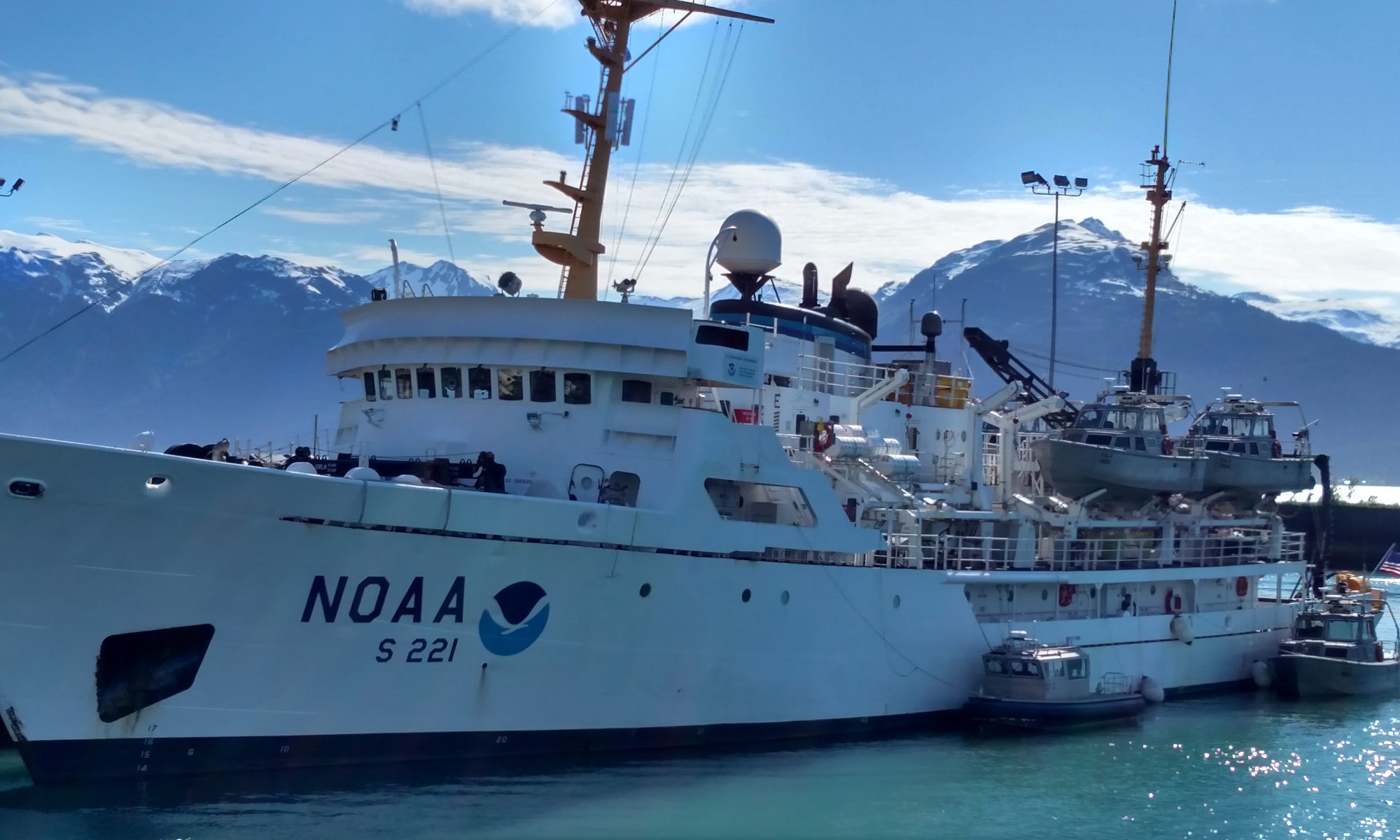
Onboard NOAA Ship Hi’ialakai
April 4 – 25, 2005

Mission: Coral Reef Ecosystem Survey
Geographical Area: Northwest Hawaiian Islands
Date: April 11, 2005

Main Control Console in the Engineering Department

Location: Latitude: 23*36.3’North, Longitude: 164*43.0’W

Weather Data from the Bridge
Visibility: 10
Wind Direction:90
Wind Speed: 14 knots
Sea Wave Height: 2-4 feet
Swell Wave Height: 5-7 feet
Sea Level Pressure: 1018.8
Cloud Cover: 2/8 Cu, As, Si
Temperature outside: 24.4

Science and Technology Log

Early before dawn the HI’IAKALAI departed Bank 66 and headed back toward the French Frigate Shoals.  Upon reaching the French Frigate Shoals, the AHI research boat was launched. Lead scientist Scott Ferguson, surveyor Jeremy Miller, and scientist Jonathan Weiss clamored aboard the AHI for another day of survey with multibeam sonar equipment fixed to the bottom of the AHI.  The AHI can get into the much shallower shoals and atolls to survey the ocean bottom. They surveyed until late in the afternoon near 23 degrees 49.6’North and 166 degrees 18.9′ West. Around 8:30 AM, a second boat, the HI#1 speedboat was deployed towing a CREWS buoy.

Lead scientists for this operation were Kyle Hogrefe and scientist Jeremy Jones, Executive Officer John Caskey, and Joe Chojnacki also accompanied him. This type of buoy is tall and slender and its acronym stands for Coral Reef Early Warning System. One system on board the buoy measures the amount of photosynthesis being made by organisms living in coral in that area of the water. It helps scientists determine if they reef is healthy or not. While on the dive to install the buoy, Jeremy Jones was underneath the buoy to tie it off and a strong current pushed him into the buoy anchor.  He soon resurfaced and scrambled to get back in the water because a 9 foot Tiger Shark was seen nearby. He was brought back to the HI’IAKALAI and examined by the Medical Officer’s onboard. Because this work can be dangerous, the ship crew and scientists are always thinking about safety.

fye_logsoHogrefe and the others returned to the dive operation site to complete the work and to tow in the old CREWS buoy. At 4:45, the AHI research boat returned to the ship and at 5:45 the HI#1 also returned for the night. They were both lifted up on board using a series of cranes. The HI’IAKALAI resumed running benthic habitat mapping lines across deeper parts of the ocean.  I spent the day on a guided tour of the ship’s machinery in the engineering department below decks.  Lobo Thomala, Chief Engineer, guided me through the masses of generators, compressors, ac units, fire fighting equipment, converters, propulsion units, etc. that make the ship sail.  It was interesting to see the main control console, which contained old and new (computerized) versions of controlling the ship. There are several backup ways of steering the ship if the computer systems go down, which would be done manually by the chief engineer in the hull of the ship. The rudder could even be controlled by a system of chains if all else fails. The “brain” of the ship is integrated and controlled by computer systems, and actually some of the systems are DOS, which the chief engineer can read.  GE still makes the parts to replace the DOS system so it will remain that way.

Personal Log

After eating breakfast this morning, I sent out my logs and emails to students and other interested parties. I attended a tour of the working parts of the ship, lead by Chief Engineer Lobo Thomala.  I was shown the water making unit for our drinking water, air compressors, main control console, port power converter, main propulsion unit, etc. It is very tight quarters down below, which actually rides 16 feet below the water’s surface. For some areas you have to wear protective ear wear because the engine room is so loud. It is also very hot in some areas and very cool, air conditioned in the computer areas of the ship. There is fire fighting equipment in every area. The amount of detailed work and responsibility heaped on the engineers was impressive to see.  The Chief Engineer basically controls whether or not the ship sails, and was part of the last graduating class of American Marine Academy in Louisiana. He acts almost as a trainer now, working on a ship, training the other engineers, and moving on to another ship in about a year’s time.

The engineer department on board is actually short handed right now, possessing only 4 engineers, rather than the normal six.  They’ve commented that they are a “dying breed” and it is becoming increasingly difficult to fill positions. I also spent the rest of the evening editing swaths of data about the ocean floor bottom for the scientists and I took readings from the bridge and learned how to do the hourly bridge weather with the Operations Officer. Information on the cloud cover, temperature, sea heights, and pressure are measured (listed at the beginning of each log). The night brought on answering emails from students and a newspaper reporter.

QUESTION OF THE DAY for my fourth grade students: One important piece of weather equipment used on the bridge is a barometer and readings are taken from the barometer every hour. What does a barometer measure? From the information listed at the top of this log, does a barometer measure the  a) temperature  b) cloud cover c) sea level pressure What was the barometric reading for this log?____ What can the barometric pressure tell a sailor about the weather? Think back to low pressure and high pressure warnings…………

Melissa Fye, April 10, 2005

NOAA Teacher at Sea
Melissa Fye
Onboard NOAA Ship Hi’ialakai
April 4 – 25, 2005

Mission: Coral Reef Ecosystem Survey
Geographical Area: Northwest Hawaiian Islands
Date: April 10, 2005

Location: Latitude: 23*36.3’North, Longitude: 164*43.0’W

Weather Data from the Bridge
Visibility: 10
Wind Direction:90
Wind Speed: 14 knots
Sea Wave Height: 2-4 feet
Swell Wave Height: 5-7 feet
Sea Level Pressure: 1018.8
Cloud Cover: 2/8 Cu, As, Si
Temperature outside: 24.4

Dive expedition at Lincoln’s Head

Science and Technology Log

The plan of the day was to arrive back at Necker Island around 8:00 AM. (We were traveling back forth often between the middle of the island chain). Around 8:30 AM the AHI research boat was deployed to run survey lines around the more shallow areas.  9:00 AM brought the deployment of the HI #1 speed boat into the sea. The purpose of its voyage was to replace a SST buoy (Sea Surface Temperature buoy) and anchor an ODP (Ocean Data Platform) at Mokumanamana.  I came along to photograph the work put in to these diving operations.  The transport was rough as it was as warm as normal, and the seas were very choppy.  We arrived at the rock outcropping, and using GPS navigational systems, located the coordinates for where the ODP was to be located on the sea floor. Divers prepared themselves (Scientist Jeremy Jones, Kyle Hogrefe, and Joe Chojnacki, along with ENS Sarah Jones) and all 4 descended about 75 feet under the water to find the device. After 30 minutes they resurfaced unable to find the ODP. They came aboard and regrouped.

A school of dolphins encircled our boat while tactics were being discussed. In effort to conserve air and because the current was strong and pulling them under the water, they decided to only send 2 divers to try to locate the ODP a second time.  Joe Chojnacki and Jeremy Jones resurfaced again after the second try only to be frustrated. The pinger was losing and gaining pings erratically and was found to be useless.

In a last attempt the driver of our boat, Keith Lyons, decided to drive the boat over top of the boat’s GPS coordinates, instead f referring to the diver’s handheld GPS, and asked the divers to put the pinger right into the water to see of they picked up any signal.  The pinger again was unreliable. Finally, Joe Chojnacki stuck his head over the boat, and looking through his snorkeling mask saw the ODP right below us!  Kyle Horgrefe and ENS Sarah Jones scrambled to gear up and went below to tie off a buoy to the ODP so they could resurface and know its location.  The last dive required 3 of the divers to replace the ODP with a new data platform.  An ODP gathers information but that information can only be used once its been retrieved from the ocean’s bottom; unlike a Sea Surface Temperature Buoy which can relay information in real time because it stays on the surface and satellites receive the information all the time. The divers connected a bag, like balloon, to the new ODP to move it into place and reposition it over the former data platform.  The dive was completed but air tanks were low so we drove back to the HI’IALAKAI and exchanged air tanks, dropped off ENS Sarah Jones, and myself. The 3 divers continued on to replace a SST buoy. I didn’t stay aboard for the remainder of the dive because of the rough seas and I was freezing because I didn’t have a wet suit.

Lincoln’s Head (volcanic rock) near dive site

Personal Log

I awoke and ate breakfast. I then began to prepare to go on a dive operation with 3 scientists and ENS Jones this morning.  I slathered on SPF and a bathing suit, shorts, and a rash guard (thin shirt often worn by surfers as protection from salt water irritation).  I donned a hard hat and life vest and borrowed a snorkel and fins from members onboard in case we were in shallow enough waters to snorkel and so I could see the divers working.  We loaded the HI #1 speed boat with tons of equipment and were lowered to the ocean on a pulley system.  The sea was extremely rough and the boat finally broke free from the ship to the rock outcropping where the dives were to be performed. The rock outcropping is nicknamed Lincoln’s Head because the side view looks like Lincoln’s profile. We arrived and performed the diving operations aforementioned in the science log. It was exciting to see the work being done and how precarious diving can be.  It requires a lot of equipment and effort, especially when weather conditions are less than ideal.

Dolphins swam right up to the boat at one point and the divers saw sharks down below. They assured me they were just curious and not very big sharks! Other than that the divers said we were in too deep of water to snorkel and the water was churning because of underwater currents. I couldn’t dive so I sat onboard and photographed the trip and proceeded to get wet from sea spray. Tern birds flew overhead the entire time biting at the buoy, lines, antennae on the boat, and the air bubbles that surfaced from the divers.  The birds mistake anything out of place for food.  Because I wasn’t doing the dive work I got very cold and decided to return to the ship when we dropped off ENS Sarah Jones.

I didn’t get to snorkel this day but hopefully I’ll have another chance in the next 2 weeks. I spent the evening trying to warm myself and recover from the bumps and bruises incurred from getting on and off the HI#1. Everything is very slippery on those boats and it’s easy to lose you balance. Plus, every time we ride up next to the ship, we get doused with water coming out of the bottom of the ship.

QUESTION OF THE DAY for my fourth grade students:  The 2 devices (the SST buoy and the ODP) are put in the ocean by divers so that scientists can gather information about the conditions in the ocean over a long period of time.  By now, in class, you are beginning to learn about different ecosystems in science class. Cause and effect: What are some examples of conditions that could change in the ocean ecosystem that could be discovered from the data being collected by these buoys (name at least 3)? Try to think how weather or man can affect an ecosystem. Here is an example to get you started ……

  1. ocean temperatures could gradually be getting warmer…….. killing the coral reef……..loss of habitat for fish
  2. (hint: salinity (saltiness))
  3.  (hint: ocean water currents)

Melissa Fye, April 9, 2005

NOAA Teacher at Sea
Melissa Fye
Onboard NOAA Ship Hi’ialakai
April 4 – 25, 2005

Mission: Coral Reef Ecosystem Survey
Geographical Area: Northwest Hawaiian Island
Date: April 9, 2005

Sonar computers
Sonar computers

Location: Latitude: 28.5 N, Longitude: 49.3 W

Weather Data from the Bridge
Visibility: 10 nautical miles
Wind Direction: 42
Wind Speed: 16 kts
Sea Wave Height: 3 feet
Swell Wave Height: 3-4 feet
Sea Water Temperature: N/A
Sea Level Pressure: 1021 mb
Cloud Cover: 3/8 SC, AS, Ci

Science and Technology Log

As survey lines continued through the night, the Chief Scientist Scott Ferguson, Joyce Miller, and Jeremy Jones readied the AHI (Acoustic Habitat Investigator) research boat for deployment. Around 7:30 this morning, the 3 boarded the vessel and to engage in more sonar surveying. At noon a shuttle boat was launched with survey scientist Emily Lundblad aboard, to meet up with AHI so she could be trained in using the sonar system aboard the AHI. Scott Ferguson then returned to the HI’IALAKAI. The afternoon led the ship divers to take out another shuttle boat so that a proficiency dive could be conducted.  Around 5:00 pm the AHI and shuttle boat were brought back into the ship and tied up for the night.

Personal Log

Much of this day was spent interviewing personnel while I began to edit data from the swaths taken by the ship’s multibeam sonar system. It can take an hour or more to edit at noise pollution from just one file of data. An exciting part of the day included seeing a humpback whale in the ocean.  It came very close to the ship.  About every 10 minutes its blowhole (spouting water) would appear at the surface along with its tail. It only surfaced three times until it was too far off to see anymore. I finished editing data until dinner time and then succumbed to doing laundry on the ship!

QUESTION OF THE DAY: Using your science book or another resource, find the definition of a mammal.  Is a whale a mammal? Why do you think it comes to the surface every 10 minutes?

Melissa Fye, April 8, 2005

NOAA Teacher at Sea
Melissa Fye
Onboard NOAA Ship Hi’ialakai
April 4 – 25, 2005

Mission: Coral Reef Ecosystem Survey
Geographical Area: Northwest Hawaiian Island
Date: April 8, 2005

Seabirds on Tern Island

Location: Latitude: 28.5 N, Longitude: 49.3 W

Weather Data from the Bridge
Visibility: 10 nautical miles
Wind Direction: 42
Wind Speed: 16 kts
Sea Wave Height: 3 feet
Swell Wave Height: 3-4 feet
Sea Water Temperature: N/A
Sea Level Pressure: 1021 mb
Cloud Cover: 3/8 SC, AS, Ci

Science and Technology Log

The HI’IALAKAI continued running survey lines laid out by scientists across the Pacific Ocean to add to data for the creation of benthic habitat maps. Approximately 10 AM this morning several scientists deployed the AHI research boat with 2 computer engineers aboard from our ship. The engineers were on board to get the new sonar system up and running and correct any glitches as they occurred.  Their services did not require them to be on board for the whole cruise, so they went on the AHI this morning to Tern Island to rendezvous with a small plane to fly them back to Honolulu. I began interviewing Scientist Kyle Hogrefe in the dry lab and he showed me a slide show regarding the GhostNet project and the subtropical convergent zone.  The projects concern the studies of winds and currents converging in the Pacific Ocean, sometimes coming together near the Hawaiian Islands, which entangles and clumps debris from humans (fishing nets, Bic liters, toothbrushes-things littered into the sea) and damages coral reefs and kills marine life, choking or strangling them.

Visiting the seabird sanctuary

Many dead sea animals have been found, the cause of death due to their bodies being full of garbage like lighters and plastics, which ends up getting entangled in their organs or choking them. Mr. Hogrefe works as a Marine Debris Specialist and often goes on diving trips which reclaim some of the pollution that endangers ocean ecosystems. An hour later I boarded a shuttle boat with the Commanding Officer (CO), a deck hand, and chief boatswain to also go to Tern Island and take a tour of the bird, monk seal, and turtle refuge, run by the Fisheries Dep’t (Dep’t of Interior)on the island.  Jennifer, the manager of the sanctuary, led the CO and me on a tour of the half mile long island, which is nothing more than a few research barracks, a landing strip, and thousands of birds. The studies they are conducting for Hawaii’s bird population proved to be very interesting.

At this time, a manager and 3 volunteers are stationed on the island for a minimum of 4 months at a time to count bird eggs, tag chicks, and count the adult species.  Tern Island bird sanctuary has the largest collection of data in the world on the species of birds which spend their lives flying over the ocean and which are indigenous to the Hawaiian Island Chain. The data has been collected for over 30 years, the reproductive rates of the birds are improving, and the work there will lead to the Albatross bird being put on the endangered species list. More than 90 percent of Hawaii’s bird population uses the island as a mating area.  The birds which reproduce on Tern, once adult, may spend up to 4 years flying over the ocean without ever stopping and their bodies have a way for the bird to rest or sleep while in flight. We learned about adaptations, like a waterproofing gland at the base of the bird’s body to protect them from ocean water, and we also saw a monk seal, and 5 huge sea turtles. A binder was also given to me about a unit of lessons called “Navigating Change”, involving the Northwestern Hawaiian Island Chain that can be used to teach respect and understanding of the ocean and environment to 4th and 5th graders. It was an invaluable gift! We then boarded the shuttle back to ship for the 15 minute ride across the ocean. Returned to the HI’IALAKAI at approximately 4:30 PM. A CTD cast was made (Conductivity, Temperature, Depth measurement in the ocean) at approximately 6 pm.  Deck hand/Surveyor Jeremy Taylor lead a group of new surveyors through the steps to conducting a cast and retrieving the data sent up through the cable. Survey lines continued to be performed by the ship at 7 knots.

Bird action!
Bird action!

Personal Log

I was very busy today and it was the most exciting day of the trip so far. I arose to eat breakfast and send out my computer logs, answer emails, and send pictures to my class via the internet.  I soon interviewed scientist Kyle Hogrefe aboard the ship and learned a lot about marine debris, as mentioned in the science log above. I then boarded the shuttle boat to Tern Island, watched the computer engineers take off in their small Cessna plane and took a fantastic tour of the place. The bird sanctuary teemed with thousands of birds!  As soon as you stepped foot on the island, you saw thousands of birds flying and roosting below. Literally thousands of birds blanketed the entire island except for the landing strip in the middle.  The entire place is covered with bird feces and I was rightfully inducted as a visitor when a bird pooped on my leg!  Ha Ha!

There are many interesting species of birds living on the island and the 4 people living there are tracking the reproductive rates of the birds. The sounds the birds make are actually the same sound bites used in the movie, “The Birds!” After a great tour of the place, I saw my first monk seals and gigantic sea turtles and took many pictures.  After returning to the island I spent the afternoon learning how to edit data on the survey computers, so I could help the survey scientists, and I told many members of the crew about the trip to Tern Island since only 4 of us had permits to go.  It was quite an informative and exciting day.  It was energizing to ride across the ocean on a raft type engine boat and see the coral reef beneath!

QUESTION OF THE DAY for my fourth grade students:  If a small plastic bag was found floating in the ocean, and a bird or shark went to eat it, what do you think that small bag looks like to the sea animal (what ocean animal)? After reading the information above, why is it important for humans to recycle?

Melissa Fye, April 7, 2005

NOAA Teacher at Sea
Melissa Fye
Onboard NOAA Ship Hi’ialakai
April 4 – 25, 2005

Mission: Coral Reef Ecosystem Survey
Geographical Area: Northwest Hawaiian Island
Date: April 7, 2005

Location: Latitude:43.0 N, Longitude: 20.0 W

Weather Data from the Bridge
Visibility: 10 miles
Wind Direction: 120
Wind Speed: 12 kts
Sea Wave Height: 2-3 feet
Swell Wave Height: 3-5 feet
Sea Water Temperature: 23.5
Celsius Sea Level Pressure: 1022.0
Cloud Cover: 7/8 Cumulonimbus, Ac, Ci

Processing data at the computers

Science and Technology Log

Early this morning the HI’IALAKAI arrived at Shark Island to conduct a 500 m CTD, (Conductivity, Temperature, and Depth) measuring device, at a location of 50.2 N and 24.8W for about 1 hour. The ship then traveled on towards a launch site for the AHI research boat. In the afternoon the AHI research vessel was lowered into the water so that the chief scientist, Scott Ferguson, and other scientists could run engineering tests on it before using it for a sonar mission.  By mid-afternoon the AHI, which stands for Acoustic Habitat Investigator, was once again lowered into the ocean to begin running survey lines closer into the more shallow, shoal areas surrounding the French Frigate Islands. The surveys were run at 7 knots. The AHI boat looks much like an orange lifeboat but has a metal cabin on top which houses a range of computer monitors and a sonar system to take in data about the ocean floor.

That data was then transported back onto the HI’IALAKAI to be processed. Inside the ship, GIS, or Geological Information Systems scientists, like Emily Lundblad, process saved data on the computers in the drylab on board.  They take one swath of data at a time (think of a swath of data as a line of data -the ship basically runs lines across the ocean much like a lawnmower mows a lawn-trying not to leave any gaps) and edit it on their monitors.  The scientists are looking for errors in data which show up as points or scatters of “dots” for lack of a better word, on the swath. The swath is 3 dimensional on the screen and the scientists put 4 different vantage points of the data on the monitor.  Carefully, outliers of data, or tiny dots of color that lie outside of the more solid path, are deleted.  The outliers, or errors, in this case are usually due to noise pollution.  A school of fish, drilling, or a boat engine can cause extra noise which is picked up by the sonar system, and needs to be edited out of the data. The ship continued to run its own survey lines with its sonar system attached to the hull of the ship.

fye_logsfPersonal Log

Today I awoke after a good night’s sleep.  My stateroom is on the lowest level towards the back of the ship. It is the noisiest room because it is near the cranes that operate, the mess, and engines, but it rides the smoothest.  This means that it rocks the least out of any of the rooms on board because of its location.  Good news to me!  The higher up and more forward you go on the ship, the more the boat sways. There are handrails in all the hallways, bathrooms, decks, etc. so you can hold on while walking on the ship.  I spent the day interviewing more members of the ship, to include the Executive Officer, a deck hand, and a scientist. I stationed myself on the upper deck to watch the AHI research vessel being deployed into the ocean for tests, stood on the bridge for awhile and looked out at La Perouse Pinnacle (23 degrees 46’N, 166 degrees 16’W) a volcanic rock that rises out of the Pacific that is so steep and rugged that it is practically inaccessible. Later, I situated myself in the drylab to observe the scientists editing data.

Then, right before dinner, I gave a presentation to the officers, crew, and scientists in the forward mess about the Teacher At Sea Program and what it entails.  I presented a picture of my class, which is posted on board the HI’IALAKAI, and received a lot of feedback.  Finally, after dinner, I visited the ship’s store for the first time, run by ENS Amy Cox and spent the evening typing logs and watching video from a previous diving cruise, whereas the scientists were studying the ecosystem below the ocean.

QUESTION OF THE DAY for my fourth grade students:  After reading the information under the science log, you need to better understand what an outlier is in data collection.  Ask everyone in the class to write their age on the chalkboard.  Also, include the teacher(s) age in the data, or information, collected on the chalkboard.  Make a graph of the data (remember to include a title, x & y coordinates).  When you are finished you should notice most of the data is close together but a few pieces of data are much different, or lie outside of most of the other ages.  What data is the outlier(s) in the class graph of ages? How can outlier data affect an experiment?

PICTURES OF THE DAY: Scientists processing and editing data on a computer in the drylab/ Research vessel AHI