James Miller, August 20, 2005

NOAA Teacher at Sea
James Miller
Onboard NOAA Ship Rainier
August 13 – 27, 2005

Mission: Hydrographic Survey
Geographical Area: North Pacific, Alaska
Date: August 20, 2005

Location: Anchored in Fish Range Bay; north of Mitrofania Island
Weather: Sunny, low 70’s
Wind: variable
Seas: 1-2 foot swell
Itinerary:  Working in Fish Range Bay area for couple of days

Science and Technology Log 

I was assigned to RA-3 today to do some deep-water surveys northeast of the Island. Had a big breakfast of waffles and eggs because I figured with the rough seas I wouldn’t be interested in eating much for lunch.  I was one of three assigned to the launch. In addition to myself, there was an officer and coxswain.  The past couple days I was the fourth, so I felt good that they trusted me enough working with the boat and equipment that I made up the third spot.

We were delayed about an hour because they couldn’t lower our launch into the water. One of the tracks on the boom that lowers the launch bent the day before so the wheels couldn’t pass through. They had to pull out torches and all sorts of equipment to repair it. Within an hour they were able to temporarily fix it to get the launch in the water but it took the rest of the day to finish the job.  The crew is incredibly skilled and ready to fix anything that breaks onboard.

The survey lines we had today were about 8 miles long.  Considering we can only cruise at about 7 knots when surveying, it took about an hour to complete one line.  The weather wasn’t too bad until we got out into the open ocean.  It was just sloppy. A three to five foot chop tossed us around. In addition, what made it worse was that the survey lines ran parallel to the seas; we were getting tossed from side to side for hours on end.  I was amazed that the sonar signal could accurately collect the bottom data in such rough seas. Apparently the POS System that senses and records all the movement of the boat using an accelerometer is designed to compensate for these situations.

Again, the first thing we had to do was send down the cast.  The cast is the device that collects water temperature, salinity, and density at varying depths, which is then used to calibrate the sonar. We were in 300 feet when we sent it down and it took forever for it to hit bottom and bring it back up.  The pitching boat made it all the more challenging.

We had a very knowledgeable and seasoned coxswain onboard.  He is a big burly guy with a white beard like Santa Claus, and he’s the type that can drink cold black coffee and lukewarm clam chowder in 5 foot seas.  He also made us do two man-over- board drills. When we weren’t paying attention, he would throw a fender overboard and yell out man-over-board.  I learned quickly that they take these drills very seriously.  During the first one, the officer was at the helm, and I had to pull in the fender (person).  During the second one, I was at the helm, and had to turn the boat around and approach without running it over. It definitely broke up the day.

Personal Log 

I have to say I was glad when the day was over.  When I got back onto the ship my head was spinning. Luckily I had no problem with seasickness though and was able to perform my job on the launch.  Had a big dinner of ziti and chicken and then went back to the fantail to try my luck at halibut fishing.  After about an hour, I called it quits. No luck today. At 7:00 a skiff was running people to the beach for a beach party.  It was a good time, but as the sun started setting the bugs started biting.

I’m barely finding time to work on my logs.  Although tomorrow I’m not scheduled to be on a launch and I might be able get caught up.  I’d also like to get up to the plot room where they begin processing the data.

The ship will be getting underway tomorrow to do some deep-water surveying itself. I think we’ll be anchoring on the northeast side of the Island to get out of the bad weather that’s heading our way.  Unfortunately the weather will be with us until we get back to Seward. We will be making a stop off at Kodiak Island for refueling which will be cool. Officer Evans said I might be able to check out the sights for a couple of hours.

James Miller, August 19, 2005

NOAA Teacher at Sea
James Miller
Onboard NOAA Ship Rainier
August 13 – 27, 2005

Mission: Hydrographic Survey
Geographical Area: North Pacific, Alaska
Date: August 19, 2005

Location: Anchored in Fish Range Bay; north of Mitrofania Island
Weather: Sunny, low 70’s
Wind: variable
Seas: 1-2 foot swell
Itinerary:  Working in Fish Range Bay area for couple of days

Science and Technology Log 

I am assigned to launch RA-5 today, which will be working what are called holiday lines. These are small areas that didn’t get adequate coverage the first time they were scanned. Most of the lines were situated very close to shore near the peninsula and a bunch around Mitrofania Island. Being assigned to holidays is very labor intensive for the coxswain (boathandler) because he/she is constantly turning the boat and working very close to shore. Often we had to put somebody (usually me) on the bow to watch we didn’t plow into any rocks. The geology in the area is strange in that it could be 300 feet one second and then 3 inches the next, so running onto rocks is always a concern especially when working close to shore.

The entire crew is working extremely hard to finish up this area on this leg of the trip. The RAINIER is scheduled to be in Prince William Sound on the next leg and will continue surveying until mid-October.  Between November and March the ship is in its homeport of Seattle, WA, getting repairs and preparing for the next season.

There are a few crewmembers onboard who are college students either working for the summer or taking time off to make some money.  Then there are some crewmembers, such as the Chief Steward, that have been on the RAINER for over 30 years.

The surveyors rotate between collecting data at sea and processing the data at NOAA Headquarters.  They are required to be at sea for several months out of the year.  Most of them have a four-year college degree and majored in geology or Graphical Information Systems (GIS), but there are a couple of assistant surveyors with associate degrees.

The officers are onboard for two years before moving on to their next assignment.  They rotate between two years at sea and three years on land.  It’s clearly a difficult lifestyle for those who want a family.  They all have four-year college degrees and usually majored in some sort of engineering, math, or one of the sciences.  After signing on to the NOAA Corps, they are sent to Kings Point Merchant Marine Academy for 3 months of intensive training before getting their first assignment.

Personal Log 

Since we worked so close to shore, my day on RA-5 was great for getting some pictures of wildlife.  There are puffins, and loons everywhere.  When the launch approaches they try to fly but can’t seem to get their fat little bodies airborne, so they skid across the water for about thirty feet and then dive.  Along the shore of the peninsula there were a lot of fresh bear tracks. The grizzly bears in this area are among the largest in the world due to their high protein diet of salmon.  Unfortunately, we didn’t get to see any. Several Sei whales breached near the boat, which was really cool.  It happened very quickly, but I think I was able to get some pictures.  We also saw lots of bald eagles.  They nest high up on the bluffs and when they get hungry they swoop down and grab a puffin or small gull.  The highlight of the day was the seals.  There’s a large rock structure on the south side of the Island that a family of seals inhabit.  The survey we were doing required us to get right up next to the island.  There were at least two dozen seals some of which were huge—over 1000 pounds!  When we approached they stood up and barked at us. Got some great pictures!

When we returned to the ship I decided to do some fishing off the fantail for halibut. Yesterday someone caught a 50-pounder in Fish Range Bay.  After about 45 minutes of bouncing this glow-in-the-dark squid on the bottom, wham.  It felt like I was snagged. It only turned out to be about a 20-pound halibut, but it fought like mad.  My arms were killing me from reeling it up from 200 feet of water.  These fish get over 300 pounds–I can’t imagine!  I just finished cleaning the fish and writing some logs, it’s midnight.  Assigned to RA-3 tomorrow for deep-water surveying.  I’ve got to prepare myself for some rough seas and a long day.

James Miller, August 18, 2005

NOAA Teacher at Sea
James Miller
Onboard NOAA Ship Rainier
August 13 – 27, 2005

Mission: Hydrographic Survey
Geographical Area: North Pacific, Alaska
Date: August 18, 2005

Location: Anchored in Fish Range Bay; north of Mitrofinia Island
Weather: Sunny, low 70’s
Wind: variable
Seas: 1-2 foot swell
Itinerary:  Working in Fish Range Bay area for couple of days

Science and Technology Log 

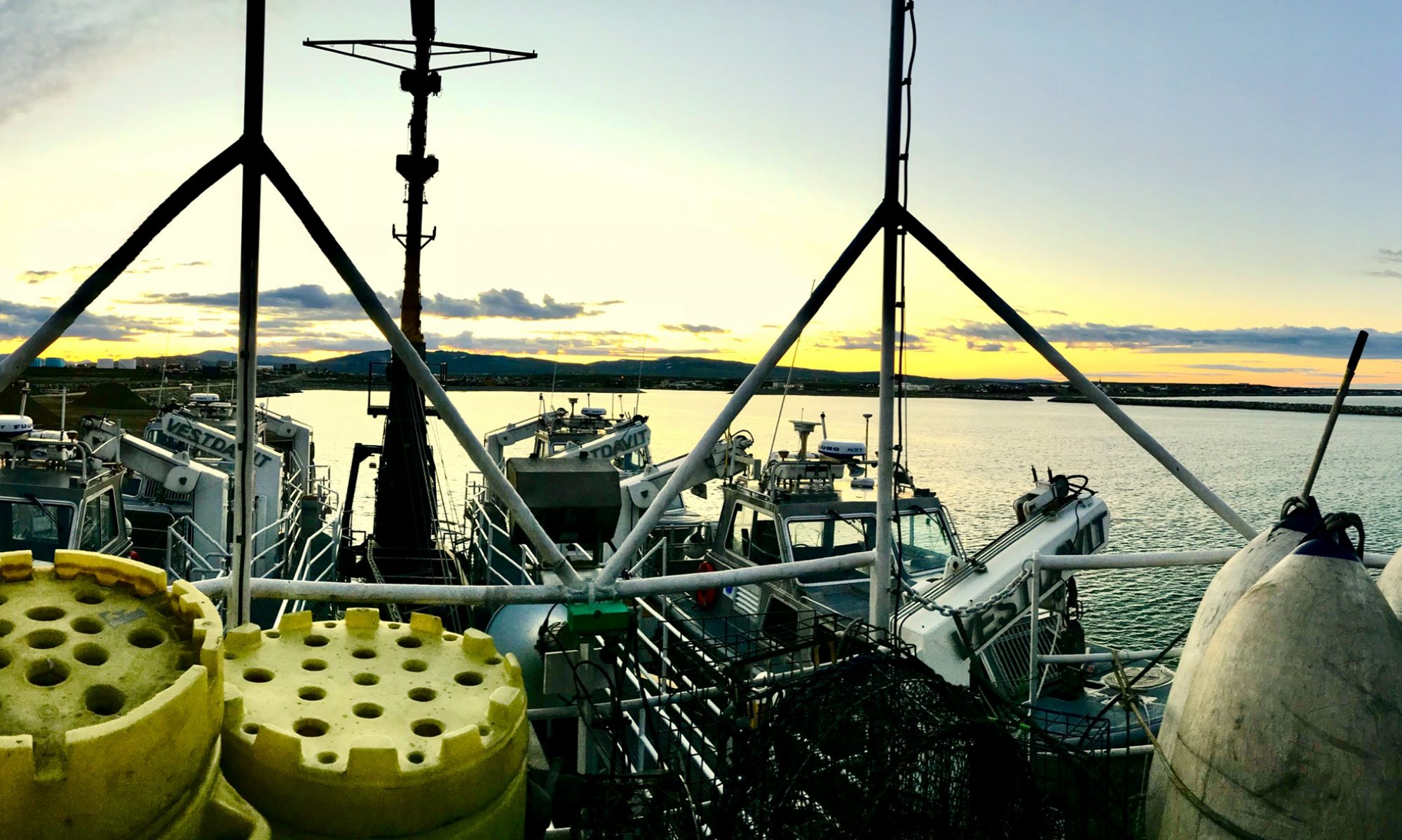
Got up early this morning (6:30am) so I could eat a big breakfast and get my gear loaded into the launch and. I was assigned to launch RA-3 with an Officer, a Surveyor, and a Coxswain (boat handler). Last night I was briefed on all the safety equipment on the launches as well as how to board and disembark.  The survey launches are 29-foot aluminum boats with a small cabin that houses the survey computers. There’s a total of 6 survey launches, two of which are water jet powered for shallow surveys, and the remaining launches have single inboard diesel engines.

The launches are also fitted with either multibeam or single-beam sonars.  The multibeam sonars scan a wide path of the bottom, about three times the depth of the water. For example, if we are in 50 feet of water the sonar cone is scanning a path about 150 feet wide. The multibeam sonars are less powerful than single beam sonars, therefore, are primarily used in shallower waters.  The single beam sonar scans a much narrower path and also uses a more powerful signal and is often used in deeper water.  An astonishing fact for the day is that a single sonar could cost as much as $500,000.  The launch I was in today was fitted with a multibeam.

Our Plan of the Day (POD) indicated that we would be scanning areas around Fish Range Bay. The POD has the track lines that you are to work on laid out on a paper chart. The track lines are also set up on one of the onboard computers.  There are basically three main computers onboard that are all interconnected.

One computer acts as a GPS and has all the track lines we are to follow pre-programmed.  The coxswain also has a terminal at the helm so he/she can steer the boat onto the track line. It’s kind of like a PacMan game for the coxswain, or as they call it “mowing the lawn”.  Depending on where you are working, the track line can be as long as 8 miles long or longer.  We were working relatively close to the shore so our lines for the day were no longer than one mile.

Another onboard computer is designed to record data related to the movement of the boat. As the boat scans a track line the boat rolls (side to side motion), pitches (from front to back), and heaves (up and down).  The sonar single coming from the bottom of the boat is similar to the shape of an ice cream cone.  These motions have an impact on the way the signal records or sees the bottom. So to ensure the quality of the bottom data collected, this motion information is fed into a complex algorithm that will calculate a percent error and apply it to the data.  It’s truly some amazing stuff.

A third computer shows the actual sonar signal and the data it is collecting.  On one of the screens you can see how the signal changes with the motion of the boat.  Another screen shows the track lines you create with each pass of the sonar.  See, the track lines are set up parallel to each other and close enough so that there is overlap.  As you complete a track line the screen shows the actual signal coverage.  On the boat they call this “mowing the lawn” because that is exactly what it looks like you are doing on the computer.  Scanning every inch of the bottom.  Another screen produces a 3-D image of the bottom, and yet another screen shows the motion of the boat in the form of sinusoidal curves.

In addition, before we can begin scanning the bottom we also have to lower a gauge called a cast down to the bottom to record temperature, salinity, and density of the water. After we retrieve it, we hook it up directly to the computer to download the information.  These factors have an impact in the way that the sonar signals travel through the water column; therefore, this data is also fed into the algorithm to ensure high quality readings.

It’s truly amazing how much effort and attention is given to obtaining an accurate image of the ocean bottom.  Their philosophy simply seems to be, if we’re going to do it, let’s do it right!

Personal Log 

It was a very interesting day and I learned much.  I had an opportunity to rotate into each of the positions including steering the launch on track lines and operating the computer.  Since the weather was so good, the CO extended the working day, so we were in the launches for about ten hours today. At lunch, I couldn’t resist fishing for halibut, so I dropped a line down for about ten minutes and caught my first.  It was very small for AK halibut standards, but definitely a trophy fish where I come from.  It’s after eleven o’clock and I’m exhausted.  I looked on tomorrows POD and I’m on RA-5 (the leaker).  This should be interesting!

James Miller, August 17, 2005

NOAA Teacher at Sea
James Miller
Onboard NOAA Ship Rainier
August 13 – 27, 2005

Mission: Hydrographic Survey
Geographical Area: North Pacific, Alaska
Date: August 17, 2005

Weather

Sky: Clouds and rain, low 60’s
Wind: 10-15 kts.
Seas: 6 – 8 foot
Itinerary:  Should arrive in work area tonight (9:30pm). Anchor in Fish Range Bay on peninsula.

Science and Technology Log 

Went up to the bridge last night prior to going to bed.  There’s usually an officer and three crew on a rotating four-hour shift schedule.  It’s reassuring that there is so much redundancy regarding navigational equipment.  The officer on duty (OOD) is constantly checking our position on the chart and comparing it to the radar, and GPS chart plotter. He also does some quick time, distance, speed calculations to determine where we should be at half hour increments, these he marks on the chart (good lesson potential).

We also had a good conversation regarding compass headings.  Typically, smaller boats navigate using magnetic compasses and therefore always steer toward magnetic north. The problem with magnetic north is that charts use true north (north pole) and depending where you are in the world there is a deviation between true and magnetic north (close to 20 degrees where we are). The ship is fitted with both magnetic and gyrocompasses.  The gyro compass points towards true north but requires power.  The ship uses the gyrocompass to navigate but would have to fall back on the magnetic compasses if the ship lost power (which is highly unlikely).

I met with LT Ben Evans and Commanding Officer Guy Noll after lunch for a briefing. They were interested in what specific classes I teach, and the things I wanted to get out of the cruise. They also briefed me about the RAINIER’s mission and where we would be working. They showed me a chart in and around Mitrofania Island.  Charts will typically have depth soundings (in fathoms) every ¼ inch or so.  The map they showed me had a lot of white space with only a few limited depth soundings.  The reason for this is because the area is literally uncharted.  Very few ships or even fishing vessels come into the area because, in Alaska, the ocean bottom rises very quickly and they are concerned about running aground. This is where the RAINIER comes into play.  Its mission is to collect the data to eventually be put on charts.  It sounds like an easy task, however, the process is very complex and lengthy.  I’ll be learning more about the details of this process over the next week and two days.

Seeing the charts really gave me a good visual of where we are heading and the importance of the RAINIER’s mission.  I plan on putting together a bulletin board in my classroom detailing my experiences and the charts would be an excellent addition to it.  I wrote down the chart numbers and asked Navigational Officer Pounds if they had any old ones on board they could part with. He’s going to check for me, but if they don’t, I’ll just order them through NOAA.

Just before dinner I attended a briefing for the survey crew.  These are some of the things I learned:

1) This leg is considered a clean-up leg since they worked the area for three weeks on the previous leg. Apparently there are five open sheets (sheets are designated areas that need surveying) that need to be completed.

2) There is an unstable weather pattern in the area and it will obviously determine whether or not we can finish in this area on this leg.

3) In addition to taking soundings, we will need to pick up a tide gauge and differential GPS station that they put on the island the last leg.

4) The tide gauge sends tide information via satellite to NOAA Headquarters.  Again, very little is known about this area including tide variations.

5) As I understand it, the GPS stations that are set up on the Alaskan peninsula are too far away to be effective, therefore, the differential GPS was temporarily set up on Mitrofinia Island so that the RAINIER could navigate better while working in the area.

6) We will initially be anchoring north of Mitrofania Island in a protected bay on the peninsula called Fish Range Bay.  We will spend a day or two there and then move to Cushing Bay, which is on the north side of Mitrofinia Island.

7) They once again reiterated the fact that they are a bit short-handed this leg and will be relying on me to be part of the launch crews.  I should expect very long days for about 5-6 days.

Personal Log 

I slept very well last night.  I was in such a deep sleep that I almost missed breakfast. I guess it was the rocking of the ship.  The seas are about 6-7 foot and the boat seems to handle it well.  We’re going with the wind so it’s more of a soft but rolling ride.  It’s kind of a funny sight seeing everyone on board bouncing off the walls as they walk down a hallway. My cabin is on the port side on the bottom of the ship, so you can hear the water rushing by the hull, a bit eerie. Although, I guess it’s much better than a cabin next to the engine room.  I’m feeling fine; in fact, I had a big greasy breakfast and a hot dog for lunch. You can be assured I would not eat that kind of food if the seas were getting to me. I feel bad for another visitor onboard whom I’m friendly with.  Unfortunately, he hasn’t found his sea legs yet, but I’m sure he’ll feel better when we get the Fish Range Bay tonight.

The other bad side to this weather is the visibility is terrible.  On our right (starboard) has been the Alaskan Peninsula, and we passed Kodiak Island to our left (port) but could barely make them out.  I hope the weather clears at some point so I can get some good pictures.  I promised my wife!!!

I have to get a good night’s rest tonight because I’m scheduled to be out on a launch for close to 9 hours tomorrow.  After dinner I’ll be working with the survey crew to analyze the data. So it’s going to be a long day, but I’m looking forward to it.

James Miller, August 14, 2005

NOAA Teacher at Sea
James Miller
Onboard NOAA Ship Rainier
August 13 – 27, 2005

Mission: Hydrographic Survey
Geographical Area: North Pacific, Alaska
Date: August 14, 2005

Science and Technology Log 

Most of the day was set aside for administrative duties; however, I did get to meet my temporary roommate, Dave Sinson.  Dave works for NOAA as a surveyor and is assigned to the RAINIER for this leg. Dave and I had an interesting discussion about statistics and his goal to integrate a new software algorithm for analyzing and reporting bottom contour and depth data.  When bottom contour data is collected, the sonar reports points every 10 centimeters.  This, as you can imagine, creates a tremendous amount of data, which explains why their computer system has over 12 terabytes of storage.  Anyway, it would be impossible to illustrate all of this data on navigational charts; therefore it must be averaged in the most efficient and accurate way.  Apparently, to date, all of this “averaging” has been done by hand and there has been much discussion regarding the best method.  In any event, Dave is interested in my knowledge of statistics and I’m obviously interested in hearing more about the new program, in addition to the manual process they are currently using.  This has great potential for lessons because next school year I will be teaching a unit on probability and statistics.

I am also getting a grip on the organizational structure of the ship.  There are six main departments.  You have the Officers (Commanding Officer, Executive Officer, and Junior Officers); Survey Dept. (scientists and survey technicians); Deck Dept. (deals with launching and operating boats, cleaning, and gear); Engineering Dept. (responsible for keeping all the engines and mechanical devices operating); Steward (all food preparation); and Yeoman & Electronics (Administrative and IT).

Personal Log 

Although a bit overwhelmed, I’m enjoying every minute.  I’m never bored and seem to always have something to do or someone to meet with.  When I do have a few minutes I just wander around ship getting more familiar with it, or introduce myself to crewmembers and ask them questions (without being a pest of course).

I did get my ship e-mail address and password for the network.  Although, the computers that I have access to are giving me some trouble, which I’ve heard is not uncommon. I lost some files that contained a couple hours worth of work—we’ve all been there—very frustrating. Dave came to the rescue though and gave me a removable storage chip that I can use to back up all my files.  I think this will solve any future issues.

Went into town today to buy some personal things.  On the way back, I saw a 311-pound halibut hanging outside of one of the charter boat weigh-in areas.  Amazing sight!

The beds are very comfortable and I am sleeping well.  Love the food.

Things to do for tomorrow: 

1) Type my daily logs and e-mail them to NOAA Headquarters.

2) Visit the engine room.

3) Talk more with Dave regarding his work with the data.