Nancy Lewis, September 19, 2003

NOAA Teacher at Sea
Nancy Lewis
Onboard NOAA Ship Ka’imimoana
September 15 – 27, 2003

Mission: Tropical Atmosphere Ocean (TAO)/TRITON
Geographical Area: Western Pacific
Date: September 19, 2003

Plan of the Day:

0700:    Recover /Deploy Equatorial ADCP
Recover CO2 Buoy (if there)  OR
Deploy CO2 Buoy ( if Buoy is missing)

Weather Observation Log:  0100

Latitude:  0 degrees,  0.7′ N
Longitude:  140 degrees., 2.3′ W
Visibility:  12 nautical miles (nm)
Wind direction:  120 degrees
Wind speed:  21 knots
Sea wave height:  3-5 feet
Swell wave height:  5-7 feet
Sea water temperature:  26.0 degrees C
Sea level pressure:  1011.2 mb
Dry bulb pressure:  26.0 degrees C
Wet bulb pressure:  23.8 degrees C
Cloud cover:  3/8 Cumulus, altocumulus

Science and Technology Log

The equator!  For me as for most people, it has always just been “that line around the globe,”  but now that I am out here on this project,  I realize that the equator defines more than just the northern and southern hemispheres of the earth.  It is here that the ocean currents are being intensively studied in order for us to understand the relationship between the oceans and climate.  The 1982-83 El Nino was not predicted by scientists, and it had far-reaching, damaging effects on such diverse places as South America and Australia.  It was then that NOAA funded the Tropical Ocean Global Atmosphere project that is the TAO/Triton array.  Approximately 50 of the buoys are maintained by the U.S. and the other 20 are maintained by Japan.  It took 10 years to complete and in essence, it is a 6,000 mile antennae for scientists to monitor conditions in the equatorial Pacific.

Normally,  the trade winds blow from east to west, but in an El Nino event,  the situation is reversed.

The phenomenon has long been observed by South American fisherman,  and usually occurs around the time of Christmas, hence its name which means “Christ child.”  The great ocean currents are moved by the wind, but around the equator, there are counter, below-sea currents.  Instruments in the TAO/Triton array are involved in collecting important data on these below surface currents.

Each TAO buoy is moored to the bottom of the ocean using steel cable surrounded in plastic and railroad wheels are the anchor.  At various depths on the Nilspin, temperature sensors called thermistors are strapped to the cable.  The cable conducts a signal to the surface of the buoy.  These cables can become damaged (by sharks biting them!) or otherwise degraded, and then the signal will be corrupted. Thus, there is the need for the periodic maintenance which is the main mission of the KA’IMIMOANA.

In addition, some of the buoys are equipped with CO2 sensors, which measure the amount of dissolved CO2 in the water, and which can then be used in studies of global warming.  The buoy which we retrieved today stopped working shortly after it was deployed, and it was not known if it had broken free or what had happened.  As it turned out, the buoy was there, and has been replaced with a fully functioning buoy. Right now, I am looking at innards of that CO2 sensor, which is in the computer lab and is being analyzed by the Chief Scientist.

Personal Log

Early this morning, we recovered the ADCP, which is a subsurface buoy.  Shortly thereafter, we deployed a new ADCP.  ADCP stands for Acoustic Dopplar Current Profiler, and this instrument is used to record data on the below surface currents. I will spend time later discussing this buoy, which looks like a giant orange ball.

I spent much of the day catching up on my daily logs, downloading photos and making several video clips to send to the website.  It appears that the hurricane did a number on the East Coast, and we probably will not have email communication until at least tomorrow.  I have been very happy to get some good questions from the students at Na’alehu School on the Big Island, and I am looking forward to hearing from many more of you next week.

I also spent time today chatting with the Chief Boatswain, Kamaka, a very hard working Hawaiian young man who spreads a lot of aloha wherever he goes.  I have invited Kamaka to come to my school when we get back to Hawaii since he is planning to visit the Big Island.  His girlfriend is Marquesan and lives on Nuku Hiva.

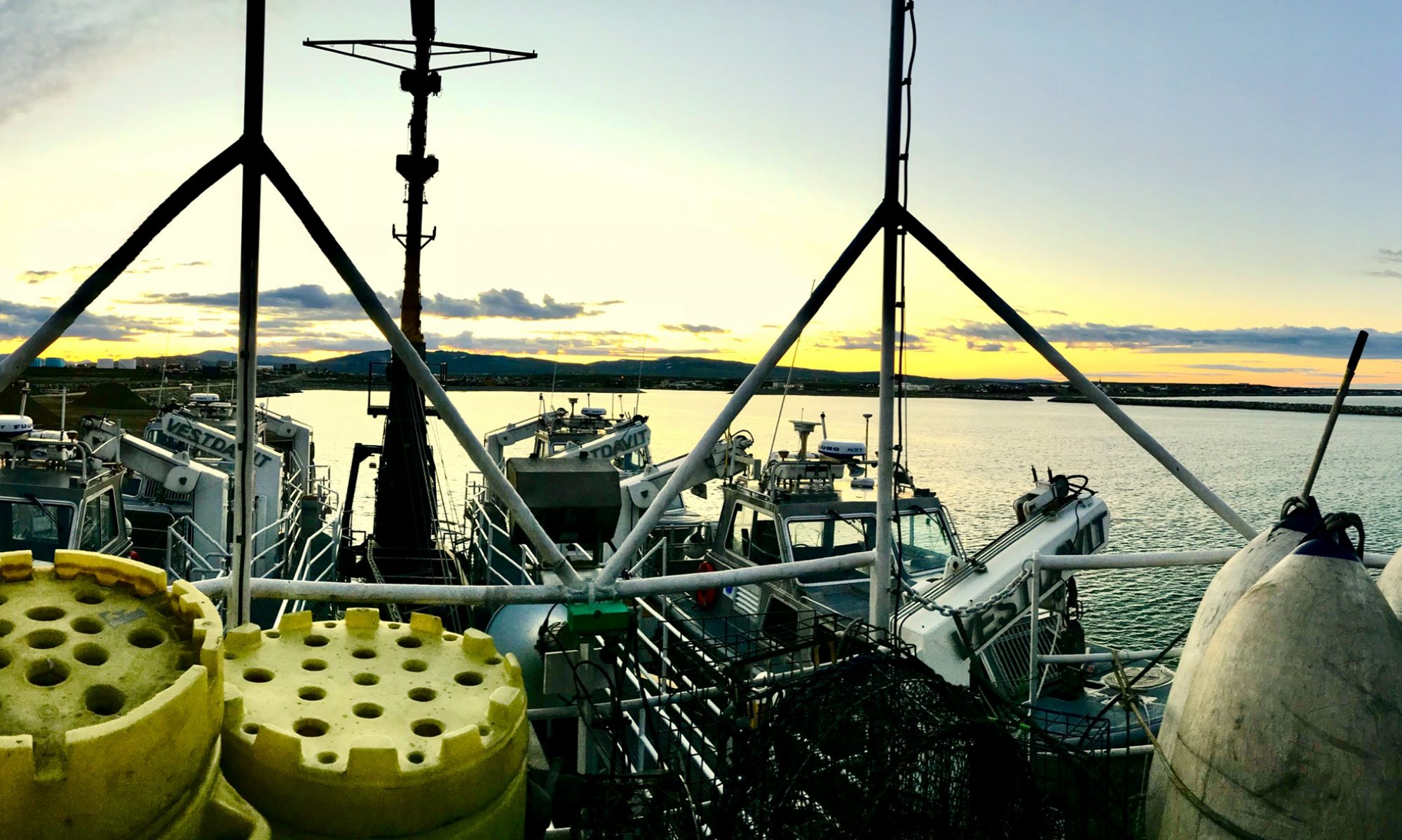
The sunset this evening at the equator was stunningly beautiful,  and there was a rainbow under some misty clouds in the east.  I am hoping my photo was able to capture it for you all.  We shall remain here at the equator overnight, and I am looking forward to the gentle rocking of the ship once I tumble into my berth later this evening.

Question of the Day:   What is the Coriolis effect and how does it relate to winds and ocean currents?

Aloha from the KA’IMIMOANA!

Nancy Lewis

Nancy Lewis, September 18, 2003

NOAA Teacher at Sea
Nancy Lewis
Onboard NOAA Ship Ka’imimoana
September 15 – 27, 2003

Mission: Tropical Atmosphere Ocean (TAO)/TRITON
Geographical Area: Western Pacific
Date: September 18, 2003

Plan of the Day:  

0130:    4  S CTD and SOLO

0840:    3 S CTD and AOML

1545:    Visit  2 S 140 W Buoy w/CTD and AOML

1800:    Shellback Meeting in Main Mess:  Shellbacks Only!  (If you do not know what a shellback is you are not one)

2345:    1 S CTD and SOLO


Weather Observation Log:  0100

Latitude:  2 degrees,55.3′ S
Longitude:  139 degrees,57.2′ W
Visibility:  12 nautical miles (nm)
Wind direction:  080 degrees
Wind speed:  16 knots
Sea wave height:  4-5 feet
Swell wave height:  6-8 feet
Sea water temperature:  26.4 degrees C
Sea level pressure:  
1012.7 mb
Dry bulb pressure:
 26.3 degrees C
Wet bulb pressure:
 24.1 degrees C
Cloud cover:  3/8 Cumulus


See Tomorrow’s Log for info

Nancy Lewis, September 17, 2003

NOAA Teacher at Sea
Nancy Lewis
Onboard NOAA Ship Ka’imimoana
September 15 – 27, 2003

Mission: Tropical Atmosphere Ocean (TAO)/TRITON
Geographical Area: Western Pacific
Date: September 17, 2003

Plan of the Day:

0900:    Recover/Deploy 5 S 140 W Buoy
CTD after anchor drop
AOML Drifter after buoy flyby

Weather Observation Log:  0100

Latitude:  5 degrees, 2′ S
Longitude:  139 degrees, 54.7′ W
Visibility:  12 nautical miles (nm)
Wind direction:  090 Degrees
Wind speed:  21 knots (kts)
Sea wave height:  4-6 feet
Swell wave height:  7-9 feet
Sea water temperature:  26.8 degrees C
Sea level pressure:  1012.7  mb.
Dry bulb temperature:  27.1 degrees C
Wet bulb temperature:  23.8 degrees C
Cloud cover:   2/8 Cumulus

Science and Technology Log

The primary mission of the KA’IMIMOANA is to service and maintain the TAO/Triton array of weather buoys strung out along the equatorial Pacific Ocean. TAO stands for Tropical Atmosphere Ocean and Triton is the name of the Japanese component of the array.  These buoys are jointly maintained by Japan and the U.S.  in an effort to better understand how the oceans affect climate and weather, especially in the regions close to the Equator.

Today I was able to observe first hand the entire operation of retrieving and deploying what used to be called the Atlas buoy.  They are now designated as TAO buoys. These buoys are placed at strategic points north, south and on the Equator.  The first leg of this mission began in Honolulu on August 21, 2003.  Honolulu is the home base port for the KA’IMIMOANA, which I hope you all know means “ocean seeker” in Hawaiian.

OLYMPUS DIGITAL CAMERA
TAO buoys are jointly maintained by Japan and the U.S. in an effort to better understand how the oceans affect climate and weather, especially in the regions close to the Equator.

Tetsuro Isono from JAMSTEC (Japan Marine Science and Technology Center) was on board as part of the Teacher at Sea program for the first leg from Honolulu to Nuku Hiva.  You can access his broadcasts on the NOAA Teacher at Sea website.  Although he was speaking Japanese, an English translation can be printed out for you to follow. In his broadcasts, Tetsuro interviews many of the scientists on board and introduces much of the equipment and buoys that are used in this project.  It would be very helpful for you to view these broadcasts in order to get a working background for the buoys and their operations, but I will also be giving explanations during the project.

The first thing in retrieving the buoy is that is that it is sighted from the bridge of the ship. These are moored buoys, so they remain in position where they are placed. Once the buoy is sighted, the RHIB (Rigid Hull Inflatable Boat) is lowered from the ship, and a crew is sent out to visually inspect and to remove some of the instruments that would be damaged during the retrieval process.  The anemometer, rain gauge, and Patrick Ahearn, the Chief Scientist and one other “volunteer”.  The buoys are usually very slimy and slippery having been out in the ocean for a period of several months, so climbing on the buoy can be a dangerous affair, especially if there are significant waves and swells.

OLYMPUS DIGITAL CAMERA
lowering the Rigid Hull Inflatable Boat (RHIB)

One of my students has asked the question:  “What information is gathered by the buoys?” The buoys gather data constantly on the following:  wind speed and direction, air temperature, relative humidity, rainfall, downwelling shortwave radiation, downwelling longwave radiation, barometric pressure, sea surface and subsurface temperature, salinity, water pressure, and ocean currents.  You can find more details about the instruments for measuring these variables at this website:  http:www.pmel.noaa.gov/tao/proj_over/sensors.shtml.  The data is transmitted via NOAA polar satellites and is actually picked up by computers located on Wallops Island.  This information is used by scientists all over the world who are studying the Pacific Ocean and its relationship to weather and climate, particularly the El Nino and its opposite La Nina.  I will be talking more about these as the cruise progresses.

After the buoy was retrieved, a replacement buoy was deployed.  I will be posting pictures on the website of the marine life growing on the bottom of the buoy, and it must be cleaned, painted and otherwise serviced before it is used again.  The process of retrieving and deploying a new buoy takes approximately 8 hours, as many meters of cable must be spooled on board, and it is amazing to watch this crew work together to bring it all off.  It is a well orchestrated event that I will do more to explain as we go along.

Lewis retrieved buoy
The retrieved buoy must be cleaned, painted and otherwise serviced before it can be used again.

Personal Log

Today was a full day indeed for me, and thankfully I was over my initial seasickness.  The opening act of the morning was my first ride in the RHIB to go out to the buoy.  You can see from the weather observations that it was by no means calm seas, so the ride out to the buoy was pretty exciting.

I was then put to work helping to spool the Nilspin cable which attaches the mooring to the buoy.  The spooling operation takes a long time, and even the XO (Executive Officer) joins in to help.  I observed the entire retrieval and deployment operation, and it basically took the whole day.

After dinner, I began training with Randy Ramey, the Survey Technician in charge of the CTD’s.  I was actually involved in every aspect of the operation under Randy’s expert guidance and Tom Nolan, the scientist from NASA was also on hand.  I will save an explanation of the CTD for another day, but this instrument is really fascinating to me.

It has been a long and exciting day, but very satisfying. I am still learning my way around the ship and getting used to the shipboard schedule  I would like to invite anyone who is looking at the website to e-mail your questions to me, which I can include the answer to on my daily logs. Before I close, let me pose a question for you: What is the Doppler effect?

My thanks go out to my colleagues and students at Na’alehu Elementary and Intermediate School for helping to make this project a success, and I wish you all a fond Aloha!

Nancy Lewis


Nancy Lewis, September 16, 2003

NOAA Teacher at Sea
Nancy Lewis
Onboard NOAA Ship Ka’imimoana
September 15 – 27, 2003

Mission: Tropical Atmosphere Ocean (TAO)/TRITON
Geographical Area: Western Pacific
Date: September 16, 2003

Nuku Hiva, Marquesas Islands, French Polynesia

0815       Anchor Aweigh:  Underway

Weather Observation Log:  0100

Latitude:  8 degrees, 56.7′ S
Longitude:  139 degrees, 59.1′ W
Visibility:  12 nautical miles (nm)
Wind direction:  100 degress
Wind speed:  18 knots (kts)
Sea wave height:  5-6 feet
Swell wave height:  5-7 feet
Sea water temperature:  27.2 degrees C
Sea level pressure:  1013.8 mb (millibars)
Dry bulb temperature:  28.0 degress C
Wet bulb temperature:  23.0 degrees C
Cloud cover:  2/8 Cumulus, Altocumulus

Personal Log

Today is my first full day on the KA’IMIMOANA, and we steamed out of the harbor of Nuku Hiva at 8:15 am past the huge rocks that guard both sides of the bay.  I was out on the forward deck for much of the morning, admiring the striking coastline of Nuku Hiva as we got underway in what were somewhat rough sea conditions.  I took some pictures of the dramatic cliffs that break off sharply down to the sea with not a sign of any human habitation. I was somewhat wistful at departing this very unspoiled island, but thought, perhaps some day I will get to return.  After all, I never in my life expected to ever visit such a remote spot as the Marquesas Islands.  Off in the distance, so shrouded in mist it seemed almost a mirage, could be faintly discerned another one of the Marquesas Islands, its craggy peaks rising up like castle ramparts in a fairy tale. I remained on deck taking in the salty breeze, but the ship was heaving up and down in seas that were at least 6-9 feet.

I thought I should go back to my stateroom and finish my unpacking and arranging my things, as everything on board a ship has to be “ship-shape,” meaning neat, clean  and orderly.  I was aware that I really wasn’t feeling all that well, having developed somewhat of a queasy feeling from the rocking of the ship while in the bay at Nuku Hiva. I went outside a few more times to catch some final glimpses of  island we were leaving behind, and it  seemed that the seas were definitely rough.  Uh, oh, I had heard horror stories about some crew members being seasick for days on end.  By this time, I was feeling quite ill.  I talked to several “old hands” on board, and several urged me to take it easy, and maybe try and sleep.  We were steaming to our destination at 4 degrees South Latitude from Nuku Hiva, which is at 8 degrees South latitude, and so were basically headed north, along the 139th meridian of Longitude.   We had no buoy operations scheduled today, so I decided it would be best to just take it easy.

There is nothing worse than being seasick, although I never really got that bad.  I took some more Dramamine and hoped for the best.  The few times I did get up in the afternoon to go down to the mess for some tea,  I saw other crew members, and they were telling me it was unusually rough, and I was not the only one feeling sick.  So there isn’t much to tell about today, except that they say that a little seasickness comes with first going to sea until you get your “sea legs”.  As I turned in for the night, I imagine my face looked a little green, and I was fervently hoping I would get those legs as quickly as possible.

From the Plan of the Day:  Notice:  ” Secure all items for sea”

Does that include lunch?

Aloha from the KA!

Nancy Lewis, September 15, 2003

NOAA Teacher at Sea
Nancy Lewis
Onboard NOAA Ship Ka’imimoana
September 15 – 27, 2003

Mission: Tropical Atmosphere Ocean (TAO)/TRITON
Geographical Area: Western Pacific
Date: September 15, 2003

Nuku Hiva:  Marquesas Islands, French Polynesia

Personal Log

Several of us piled in Rose Corser’s Land Rover and were dropped of at the school in Taiohae, where we soon found the principal’s office.  I was pressed into service as interpreter since the principal did not speak English.  We were directed to one of the classes, where Tom Nolan and Tetsuro Isono made a short presentation to the students.  “Le professeur” explained a little about the mission of the KA’IMIMOANA,  and I was able to understand a quite bit of what he said.  Except for the language being French, I would have thought I was in a classroom in Hawaii.

The students then came outside with us and sang to us in the Marquesan language.  With the bay in the background, the KA moored in the harbor, it was one of those “island moments.”  Our objective today was definitely one of diplomacy and good will.

OLYMPUS DIGITAL CAMERA
Students from the school in Taiohae sing in the Marquesan language.

Our next stop was the Mayor’s office where there was to be a presentation from the KA’IMIMOANA to the VIP’s of Nuku Hiva.  The current mayor of Nuku Hiva was there, along with the past 2 mayors, the island Chief, the head of the Gendarmerie (Police) and the French representative for Nuku Hiva.  Captain Mark Ablondi presented them with an enlarged satellite photo of Nuku Hiva.  Many speeches were made, expressing appreciation for the collaborative work of all the parties in the effort to better understand the world’s oceans.

It was now time to take the water taxi out to the KA’IMIMOANA for the tour given to the VIP’s. This was my first time on board the ship, in fact, my first time on board any ship! I joined in the VIP tour of what would be my floating home for the next 2 weeks.

Lewis VIP tour
The VIP tour of NOAA Ship KA’IMIMOANA.

After lunch on board, a class of students from the school joined us and I enjoyed trying out my French with them, and just generally enjoying being around the kids.  By the time they served ice cream in the mess, several of the crew on board had become celebrities, signing autographs and the subject of many 14 year old girls’ giggles.

For the last night on Nuku Hiva almost the entire crew went out for pizza after saying our goodbyes to Rose and Diana, the manager of The Pearl.  It was nearly eleven by the time we took the water taxi to the ship, and I was shown to my stateroom.  Tetsuro had flown back to the States, and I was taking over his berth on the ship.  I must admit that my few hours on board earlier in the day had  given me a bit of a queasy stomach, so I regretfully swallowed some dramamine before turning the lights out.  We would get underway in the morning continuing the work of the KA’IMIMOANA near the equator.

Bon nuit and au revoir Nuku Hiva!