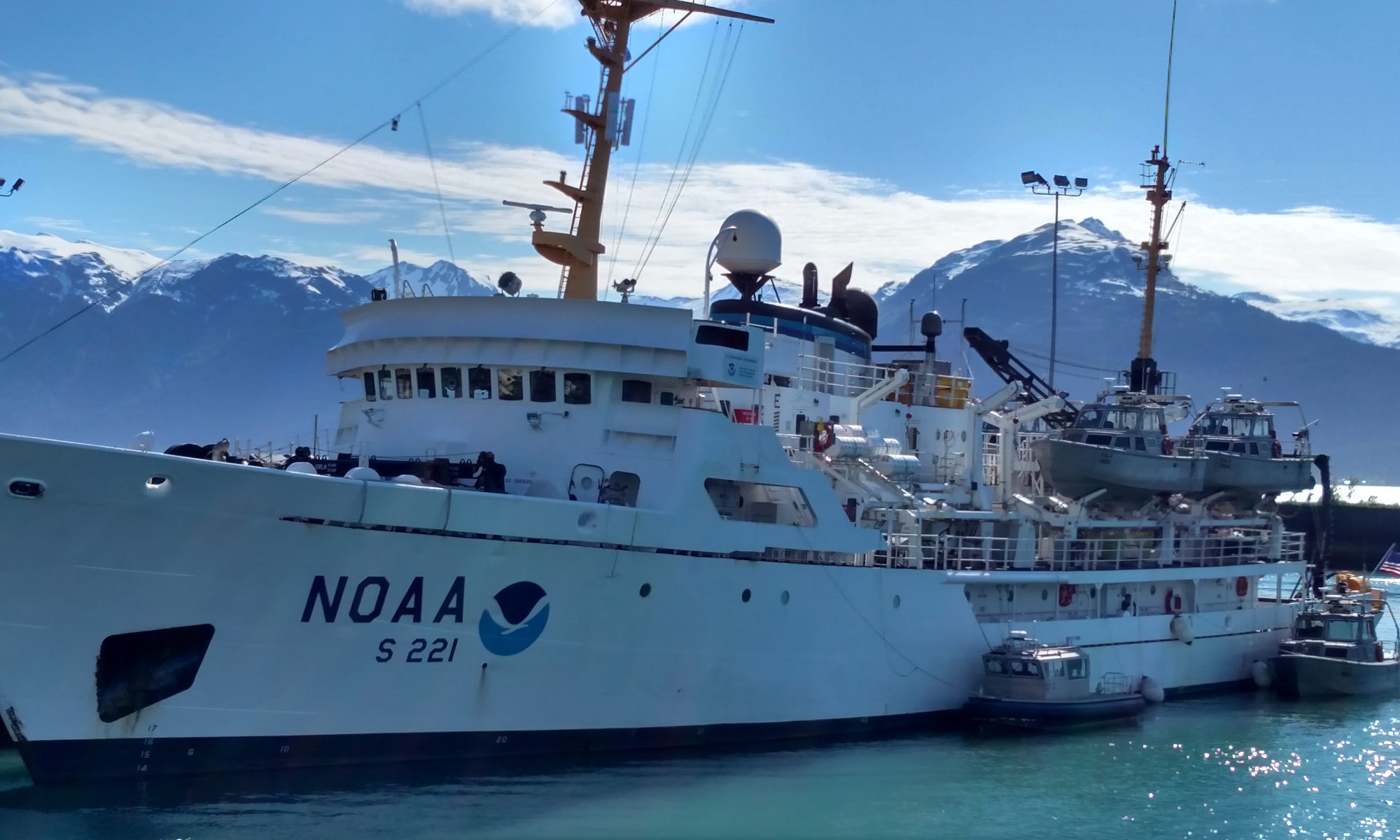
NOAA Teacher at Sea
Kathy Virdin
Onboard NOAA Ship Rainier
July 20 – 28, 2004
Mission: Hydrographic Survey
Geographical Area: Eastern Aleutian Islands, Alaska
Date: July 26, 2004
Latitude:55 degrees 17.192 minutes N.
Longitude: 160degrees 32.214 minutes W.
Visibility: 6 nautical miles
Wind direction: Light
Wind speed: Airs
Sea wave height: 0-1 ft.
Swell wave height: 0-1 ft.
Sea water temperature:10.6 C.
Sea level pressure:998.9 mb.
Cloud cover: Cloudy
Science and Technology Log
Today I interviewed Nicola Samuelson, who is an ensign. Her job on the RAINIER is multi-faceted. She is responsible for the ship’s safety, must represent the Captain when he is not here, drive the ship from point A to B as assistant navigation officer, preparing the ship’s sail plan, and is also a morale officer, who plans activities for the crew when they are in port. She has an undergraduate degree and a master’s degree in ocean engineering. She works in four hour shifts and as an officer, may be on 24-hr. duty when the ship is in port. She chose this job because she enjoys the beautiful scenery, likes the important survey work they do, and enjoys working in a setting where you must bring a camera. She also has an interesting background that steered her in the direction of working for NOAA. She grew up on a sailing vessel as her parents sailed around the world. She was home schooled on the boat and sailed around the South Pacific from the time she was three years old until she was twelve years old. They would stop in various ports, such as New Caledonia, Fiji Islands, Samoa, New Zealand, Singapore, Malaysia, New Guinea, and Thailand when they needed to pick up supplies or work for a while. She only lived on land for the first time when she was 17 years old. She grew up speaking English and French as her parents spoke both languages. Because of her upbringing, she knew she wanted a job where she would be on the ocean. After graduate school, she received three months of NOAA officer training, where she learned firefighting skills, first aid, navigation, and how to drive a ship. She feels that her job is extremely significant, since some of the waters in Alaska have never been surveyed.

An area that the RAINIER just surveyed, that covered 30 miles by 50 miles only had about 5 depth soundings. Ships would have to go around that area, because it’s just too dangerous to navigate through without the true depth measurements on the charts. A ship needs 40 feet of water clearance below deck level in order to successfully navigate the waters. Lack of accurate charts means that cruise and cargo ships are limited in where they can sail in the Alaskan waters. Opening up new areas, because of their surveys, means NOAA is contributing toward improvement of safety, commerce and tourism.
Personal Log
We have learned today, that because of an oil leak, the RAINIER will go into port early. We’ll have an all hands on deck meeting this afternoon to find out the exact plans. It will be interesting to find our how a ship this size will handle repairs. The weather has turned off pretty this afternoon, so those of the crew who are not working have gone on deck to fish. They will pack their catches in ice to mail back to their families. Fishing in Alaska is some of the best in the world!
NOAA Teacher at Sea
Kathy Virdin
Onboard NOAA Ship Rainier
July 20 – 28, 2004
Mission: Hydrographic Survey
Geographical Area: Eastern Aleutian Islands, Alaska
Date: July 25, 2004
Latitude:55degrees 17.215 N.
Longitude: 160 degrees 32.231 W.
Visibility:1 nautical mile
Wind direction:140 degrees
Wind speed: 10 kts.
Sea wave height: 0-1 ft.
Swell wave height: 2-3 ft.
Sea water temperature:10 degrees C.
Sea level pressure: 997.4 mb.
Cloud cover:Cloudy, light rain
Science and Technology Log
Today we had a visitor from Tenix Lads, Inc. named Mark Sinclair who does LiDAR depth readings for NOAA. LiDAR means light detection and ranging. It is done from a small aircraft, flying at an altitude of 1800-2200 ft. They over fly an area with two laser beams that measure the surface of the water and the depth of the water. They get the difference in these heights, with geometric corrections for tides and other factors, to give them the ocean floor depths. They are able to take an incredible 324 million soundings in an hour! Their information is used for nautical charting, coastal zone management, coastal engineering, oil and gas development, military applications and research and development. They will identify depths, buoys, beacons, lighthouses, kelp areas on digital display (via computers) and on spreadsheets. The benefits of the LiDAR technology is that it is very cost effective, has amazing speed, and greater safety. They do 200% coverage of an area by measuring lines and then taking new lines in between the first lines. They run a swath beam that is 192 meters, which is larger than the ones that the RAINIER does. Each beam of pulsar light is 15 meters with 4 meters in between.
They are finding changes that need to be made on maps that date back to the 1940s. NOAA contracts with this company to do soundings for them and NOAA picks small segments of these areas to do spot checks with the ship to compare accuracy. So far, they have been extremely accurate. At this point in time, they are not comfortable with the greater depth measurements that the RAINIER does, but expect that to change in the future. Various crew members that I’ve spoken with foresee this becoming the depth measurement instrument of the future. Eventually, all depth readings may be done from satellites, which could become very accurate, as well as safe. Right now, NOAA will continue to use both methods.
Personal Log
I spent the day working on the computer, listening to the LiDAR presentation and reading the information about this new system. It’s very interesting to predict how useful this will become in the next 10-20 years. I’d love to see some of my students flying the airplanes that will send back this newer technology. Right now, the RAINIER is anchored while launches go out to do shallow survey each day. It’s fascinating to watch them lower the launches and bring them back onto the boat. They use hydraulic winches that raise and lower the boats. Everyone has to be very careful at this point, wearing hard hats, because it’s a time when equipment failure could bring a dangerous situation. Generally three or four people go out on each day’s launch. They have several more days of launches scheduled, then they must go to the Kodiak Coast Guard base to refuel.

NOAA Teacher at Sea
Kathy Virdin
Onboard NOAA Ship Rainier
July 20 – 28, 2004
Mission: Hydrographic Survey
Geographical Area: Eastern Aleutian Islands, Alaska
Date: July 24, 2004
Latitude: 55 degrees 17.194 N.
Longitude: 160 degrees 32.23 W.
Visibility: 3 nautical miles
Wind direction: 100 degrees
Wind speed: 10 kts.
Sea wave height: 1-2 ft.
Swell wave height: 2-3 ft.
Sea water temperature: 10 degrees C.
Sea level pressure: 1002.0
Cloud cover: Cloudy with rain
Science and Technology Log
Today we went out on a launch (my first in the Shumagin Islands). We traveled near the area of Simeon Bight to run lines to check depth measurement. An example of why this is so important is that in one of their launches, they found after an earthquake, a 30 meter drop-off near a fault line. This wasn’t on any charts because it had been caused by the earthquake itself. Before they begin the depth measurements, it’s vital that they take a cast with the salinity, pressure and temperature instrument. This information is then hooked directly into the computer to be calculated into the depth findings, so that the depth can be corrected by these factors. We ran cross lines (lines that cris-crossed each other) as a quality check to be sure that no area had been missed. The transducer (which sends out a multi-beam swath of sound) is lowered into the water by a mechanical arm. This is high-tech stuff! The computers are also recording the GPS (global position system) location of our boat at all times. When we learn the depths of the waters we pass over, we have to know exactly where we are in order to record this on nautical charts. Out of 24 satellites, we need at least 5-7 within range plotting our location to ensure accuracy. The computers divide the screen into sections which show our depth reading, a picture of the ocean floor by sonar calculations and the range our instruments will accurately reflect. We have traveled a range of 88 meters in depth to 6.7 meters in depth. Interestingly, one possible technology that is being tested and may be the best method of the future is called Lidar, which means sonar transmitted from an airplane, which flies over coastal areas and can give a depth reading on land and in the ocean. The RAINIER is testing one area that has been measured by Lidar to compare our measurements with theirs to check their accuracy. This would be a safer method, since lowering the launch boats and retrieving them has a certain amount of risk.
We’ve just seen some lazy puffins that are swimming on top of the water, which makes them look like sitting ducks. As we return to the RAINIER in the late afternoon, we bring back a lot of data that the survey technicians will assess and correct to be submitted to the cartographers.
Personal Log
We had a rainy, foggy afternoon on the water while we were surveying, with clouds that hovered over the green, craggy cliffs. It makes a beautiful sight. We felt we got a lot accomplished and returned with some good data. In talking with various members of the crew, I’ve gotten some good ideas to use in my lesson plans as they help me think of ways to explain their operations that will simplify it, such as flashlights taped together to represent a multi-beam sonar swath. I’m going to catch up tonight on correspondence, and refine my lesson plan ideas tomorrow. I can’t wait to take all these ideas back to the classroom!
NOAA Teacher at Sea
Kathy Virdin
Onboard NOAA Ship Rainier
July 20 – 28, 2004
Mission: Hydrographic Survey
Geographical Area: Eastern Aleutian Islands, Alaska
Date: July 23, 2004
Latitude:55 degrees 43.34’N
Longitude: 159 degrees 10.967’ W
Visibility: 10 nautical miles
Wind direction: 175 degrees
Wind speed: 8 kts.
Sea wave height: 0-1 ft.
Swell wave height: 0-1 ft.
Sea water temperature: 11.7 C.
Sea level pressure: 1016.2 mb.
Cloud cover: Cloudy
Science and Technology Log
Today we have been in transit to the Shumagin Islands. Two launches were sent out to do Reson (shallow to mid-depth) measurements and one launch did the Elac (mid-depth to deep waters). This area really needs accurate depth measurement, since it’s an area where fishermen come frequently. The information that is received and processed on board the RAINIER is then sent to the Nautical Data Branch of NOAA where it is interpreted and made into the hydrographic sheets with added interpretative data. Then it next goes to a production team who apply it to charts. The next step for the information is to go to the Update Service branch which combines all data and puts it in the final form of nautical charts that is used by the Navy, cargo ships, tanker ships and all mariners (such as fishermen). So the RAINIER plays a vital role in getting critical information to those who use it daily to ensure their safety.
I was able to catch several of the crew for an interview. I interviewed Megan Palmer, who is a survey technician. To prepare for her job, Megan received a degree in geography and received additional training in computer systems, including the complex GIS system. She explained that NOAA is moving toward electronic nautical charts that will allow you to set your scale close or far away on the computer, depending on what you need. Alarms will go off if you get into shallow water. However, there will always be a need for nautical charts and that’s where NOAA excels. Megan enjoys her job as it gives her the opportunity to see Alaska while being on the water, and the chance to look for the unexpected in surveys. Often, she is part of the team that is charting waters that have very few depth soundings. She also enjoys the fact that NOAA tests software to see how well it works and then make recommendations to companies to improve features that the survey technicians need. She notes that there is definitely a need for more survey technicians and that it’s a rewarding and exciting career for any student who loves the ocean and wants to travel.
Personal Log
Today we had the thrill of seeing a whale swimming in the distance while we all tried to take a picture (very difficult since it moves in the water so quickly). We dropped anchor tonight in the Shumagin Is. We’ll stay here several days while the survey launches run lines in different areas. We’ve entered into an area of heavy fog and it was neat to hear the fog horn being sounded every few minutes as we move through the water. I enjoyed looking a computer file of pictures that show all the places the RAINIER has been in Alaska. Beautiful scenery!