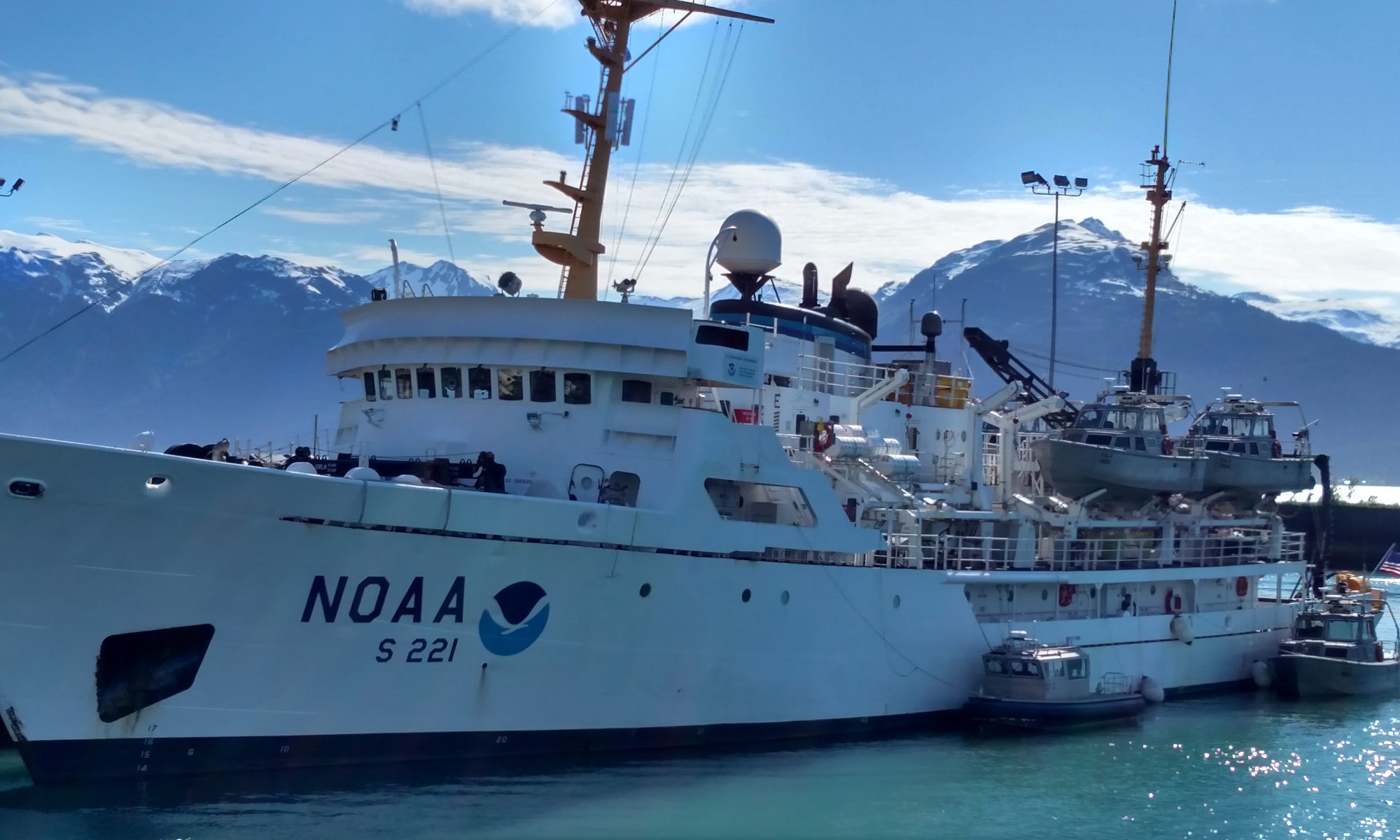
Dana Tomlinson: Day 16, March 16, 2002

NOAA Teacher at Sea

Dana Tomlinson

Aboard NOAA Ship Ka’imimoana

March 1 – 27, 2002

Date: Saturday, March 16, 2002
Lat: 8°S
Long: 110°W
Seas: 2-5 ft
Visibility: unrestricted
Weather: partly to mostly cloudy, possibility of rain showers
Sea Surface Temp: 82-86°F
Winds: 5-10 knots
Air Temp: 85-74°F

Today was kind of bittersweet for me but I doubt the crew feels that way. Today, we recovered the buoy at 8°S 110°W and deployed a new one. This will be the last time I have to see the buoy operations, as it is the last recovery/deployment until after the Galapagos Islands – and that’s where I get off. The crew goes on to Manzanillo, Mexico, and then returns to Honolulu, their home base. The operations went perfectly on both ends today, and now the crew gets a chance to catch up on everything they can’t do when they’re doing buoy ops.

We are now in transit from the 110°W line directly east to the 95°W line. We will be in transit for several days. During that time, like I said, the crew will be getting their regular chores done and the scientists will be preparing for the buoy “fly bys” we’ll be doing on the 95°W line. A fly by is when we locate the buoy, the scientists go out to it in the RHIB to check on it, and then fix anything that needs fixing or calibrating with the instrumentation. This transit is a chance for everyone to catch their breath for this next round of operations.

Question of the Day: 

The ship is traveling at about 12 knots. How long will it take us to get from the 110°W to the 95°W? Hint: you’re going to have to find out how many miles it is between degrees of longitude – Internet anyone?

Answer of the Day: 

Once again, Brian R. of San Diego tells me that the Pacific Ocean, on the average, is 13,740 ft deep, or about 4188 meters deep. But does anyone know how deep it is at its deepest point??? Let me hear from you. 🙂

Til tomorrow,
🙂 Dana

Dana Tomlinson: Day 15, March 15, 2002

NOAA Teacher at Sea

Dana Tomlinson

Aboard NOAA Ship Ka’imimoana

March 1 – 27, 2002

Date: Friday, March 15, 2002
Lat: 6.2°S
Long: 111°W
Seas: 4-6 ft
Visibility: unrestricted
Weather: partly to mostly cloudy
Sea Surface Temp: 82-86°F
Winds: SE 10-15 knots
Air Temp: 85-74°F

Today was the day that we rounded up our wayward buoy. The buoy was deployed in April 2001 at 5°S 110°W. In November 2001, NOAA scientists knew that it was drifting freely. By the time we found it (it has a tracking device on it) it had drifted one degree south and one degree east. That’s 60 nautical miles in two directions!

Once we pulled it on board, one could see fairly clearly what had happened. There were scrapes on the sides of the buoy (the toroid, or “donut” section) where something like a boat/ship had rubbed up to it. There was a steel cable that had been attached to it and the nylon rope had been cut. So, the theory is that a fishing vessel attached itself to the buoy with the steel slingshot device. It yanks the buoy out of place and it’s easy to catch all the fish that use the buoy’s shade as their ecosystem.

Speaking of the buoy’s fish, while we were bringing in the buoy, folks on board that were not working were fishing the bounty of the ocean with a rod and reel. Several mahi mahi graced our table at dinner that evening – served by Clem four different ways (I think the mahi mahi in coconut sauce was the favorite.)! That woman is amazing. You NEED to use the gym on board to work off her good cooking!

Not to be overshadowed by the morning’s events was the day’s live broadcast. This was our third general broadcast and was the very first ever tried by NOAA out of doors. We had our studio on the buoy deck today. On the live broadcast, Cmdr. Tisch, Chief Scientist McPhaden and I dedicated tomorrow’s buoy to be deployed at 8°S 110°W to Education in America. The bulk of the show was scientist Ben Moore giving us a cook’s tour of the buoy deck’s equipment, and Dr. McFaden talked about our wayward buoy. It was a great show. We can still hook you up for the live broadcasts on 3/18, 3/20 and 3/22 if you’re interested.

Question of the Day:

 This is going to be a bit of a toughie, and might need some Internet research on your part, but it’s interesting. When do most oceanographers consider to be the beginning of modern oceanography? Or, another way of putting it is, what started modern oceanography? Hint: it’s before 1900.

Answer of the Day: 

The question was: how many branches of the armed services are there and what are they? Dennis M. of Lakeside CA got it exactly correct. There are 5 branches of the armed services: Army, Navy, Air Force, Marines, Coast Guard. PLUS, there are two other uniformed branches: NOAA and the US Public Health Service. Great job, Dennis. 🙂

Til tomorrow,
🙂 Dana

Dana Tomlinson: Day 14, March 14, 2020

NOAA Teacher at Sea

Dana Tomlinson

Aboard NOAA Ship Ka’imimoana

March 1 – 27, 2002

Date: Thursday, March 14, 2002
Lat: 6°S
Long: 110°W
Seas: 4-7 ft
Visibility: unrestricted (3-5 mi. in rainstorms)
Weather: mostly cloudy with possible rainstorms
Sea Surface Temp: 82-86°F
Winds: E 10-15 knots
Air Temp: 87-74°F

Today, we deployed a buoy at 5°S but we have not recovered the 5°S buoy. That’s because the little devil is at about 6.2°S due to currents, wind or being pulled by a boat. After the deployment, we did a deep cast to almost 3500m. Check the photos to see what that can do to styrofoam! We’ll get to the approximate location tonight of the wayward buoy and pick it up in the morning. I will be doing a CTD tonight.

Today, we also did our third safety drill since we boarded in San Diego. I have written and mentioned in my broadcasts how important safety is here. We have always had fire drills and abandon ship drills. Each week something different is added. The first week, we did an evacuation drill where we practiced putting on the evacuation (“gumby”) suit. Last week, we practiced using the water hoses in case of fire, and this week it was learning how to shoot the line throwing rocket.

I was given the honor of shooting off the rocket. All hands were called to the aft deck to hear Ens. Kroening and Ltcdr. Schleiger explain to us how to use the line throwing rocket. We would need to use it if ever we needed to get a line to another ship or land and it was too far to throw the line. For practice, we use a decoy that is shot off the fantail of the ship. Wearing my safety glasses and headgear, I shot the decoy. Successful launch! The line flew about 100 meters. Bad news: had to pull in the decoy and coil it up for next time.

Question of the Day: 

Today, we did a cast to about 3500 meters. How deep does the Pacific Ocean get?

Answer of the Day: 

Both Vanessa P. and Brian R. of San Diego were the only ones to try the fairing question and they were both right. A fairing is a smooth structure put on the outside of something. Its function is to reduce drag. In our case, the fairings are pieces of plastic about 3 inches wide and about a foot long that are snapped on to the top 250m of wire below the buoy in locations around the equator where the currents are very strong. The hope is that these fairings will reduce the drag on the wire and not allow it to be pulled so far off its intended location.

Til tomorrow,
🙂 Dana

Dana Tomlinson: Day 13, March 13, 2002

NOAA Teacher at Sea

Dana Tomlinson

Aboard NOAA Ship Ka’imimoana

March 1 – 27, 2002

Date: Wednesday, March 13, 2002

Lat: 2°S
Long: 110°W
Seas: 3-6 ft
Visibility: unrestricted
Weather: partly to mostly cloudy
Sea Surface Temp: 80-84°F
Winds: E 10-15 knots
Air Temp: 86-76°F

This morning was jam-packed. I got up and outside on deck in the hopes of tagging along on a little half hour RHIB ride to visit the buoy at 1.5oS. A RHIB is a Rigid Hulled Inflatable Boat. I was in luck – there was room. The plan was to replace the anemometer that was missing (vandalism? strong winds? who knows), and to put on a brand new pressure sensor as a brand new experiment.

Once again, things don’t always go as planned. After doing everything they had planned to do, the scientists couldn’t get the correct readings on their computers for the instrumentation. They spent about an hour and a half standing on the buoy in the blazing sun trying to fix the problem several different ways, and finally just replaced the tube entirely with new instrumentation.

During that time, I was circling the buoy in the RHIB, taking pictures and enjoying the scenery. I saw schools of mahi mahi jumping out of the water – possibly escaping the pilot whales that were spotted (not by me, unfortunately). I was also getting worried as I had to be back on the ship to do a live broadcast. Ultimately, when the scientists had to go back to the ship to get some new parts, they delivered me back at the same time. And the live broadcast went very well today, too. Look for all our live broadcasts in streaming video format on the website when we return.

Question of the Day: 

How many branches of the armed services are there and what are they?

Answer of the Day: 

The first person to answer the Pollywog/Shellback question was Brian R. from San Diego, but Mrs. Mackay’s class from San Diego got it correct also. A pollywog is a seagoer who has never crossed the equator on a ship. A Shellback is someone who has crossed the equator on a ship AND has gone through a Shellback ceremony. We have crossed the equator, but the ceremony hasn’t occurred yet. When it does, I’ll tell you about it, if I can. 🙂

Til tomorrow,
🙂 Dana

Dana Tomlinson: Day 12, March 12, 2002

NOAA Teacher at Sea

Dana Tomlinson

Aboard NOAA Ship Ka’imimoana

March 1 – 27, 2002

Date: Tuesday, March 12, 2002
Lat: .5°S
Long: 110°W
Seas: 2-4 ft.
Visibility: unrestricted
Weather: partly to mostly cloudy
Sea Surface Temp: 77-82°F
Winds: N/NE 5 knots
Air Temp: 88-76°F

As it turns out, the ADCP (Acoustic Doppler Current Profiler) was rigged up to deploy when I went outside this morning. The scientists had determined a new method of having it enter the water so there would be even less likelihood of anything going wrong. And they did a great job, because it was a very easy deployment. Mission accomplished – there’s an ADCP successfully collecting data on the equatorial currents at 110°W for the next year.

There was even more excitement to come for me, however. I had the privilege of being the first Teacher at Sea to ever have a buoy dedicated to her school. At 1130 today, Cdr. Tisch, Chief Scientist McPhaden and I each signed a large NOAA sticker on which we had written “Emory Elementary School, San Diego CA.” The gentlemen placed it on the plastic covering of the instrumentation and when it was deployed at the equator 110°W, that sticker actually kept its face to us until we could no longer read it. What’s truly amazing is that very buoy was the very first buoy that NOAA ever deployed in 1979. Our school is very honored.

The deployment of the Emory buoy took quite a while today because of the many fairings that the crew had to put on the wire line that goes down 250m below the buoy. Tomorrow is also a busy day on board. We are doing several CTD casts (Conductivity, Temperature and Depth), and we will be going by the buoy at 2°S to check on it, but we’re not recovering it.

Question of the Day: 

What is a fairing and what does it do?

Answers of the Days: 

Due to the weekend, there are several questions to catch up on. Here we go:

From Friday: No one answered this one correctly, so I’m going to give it to you. GMT is Greenwich Mean Time. It is 7 hours ahead of us here in Mountain Time and it is where all time is based because it is the 0 degree line of longitude. In nautical letters, zero is Zulu, hence, Zulu time. So, if it’s 9pm here in Mountain time, in GMT it is 4am.

From Saturday: Ditto on no answer for this one (come on you guys!!).
TAO stands for Tropical Atmosphere Ocean.

From Sunday: Karen R. in San Diego knows that MBARI stands for Monterey Bay Aquarium Research Institute. And Vanessa P.(again!) in San Diego knows that pelagic means of the open ocean. And Brian R. in San Diego knows that chlorophyll is the green matter found in certain cells of plants, algae and some bacteria and it’s important because it changes light energy into chemical energy.

Til tomorrow,
🙂 Dana