Andrea Schmuttermair, Anchors Away from Kodiak, July 7, 2015

NOAA Teacher at Sea
Andrea Schmuttermair
Aboard NOAA Ship Oscar Dyson
July 5 – 25, 2015

Mission: Walleye Pollock Survey
Geographical area of cruise: Gulf of Alaska
Date: July 7, 2015

Weather Data from the Bridge:

Latitude: 56 36.1N
Longitude: 156 04.1W

Visibility: 10nm
Speed: 12 knots
Wind Speed: 4 knots
Wind Direction: 202 degrees
Surface Water Salinity:35.31
Air Temperature: 12.6 C
Barometric Pressure: 1004.6 mbar
Sky: SCT (scattered clouds)

TASAK15 (12)
One of the signs from my walk along the docks in Kodiak. I learned a lot about Kodiak and the fishing industry by reading these signs.

Science and Technology Log:

The walleye pollock fishing industry is the largest commercial fishing industry in the country, and one of the largest fishing industries in the world. Have you eaten fish sticks? Filet-O-Fish from McDonald’s? Imitation crab? If your answer is yes to any of these questions, then you have eaten walleye pollock. Since pollock supports such a large industry, scientists need to carefully monitor its abundance each year. Bring on the scientists and crew on board the Oscar Dyson to make this mission possible.

TIn summer, and in a few locations in winter, scientists head out to assess the walleye pollock population in both the Bering Sea and in the Gulf of Alaska. The summer survey alternates between the two areas, and this summer we are traveling in the Gulf of Alaska for our survey. This second leg (out of 3 legs total) will head counterclockwise around the island of Kodiak. This survey, conducted by the Midwater Assessment and Conservation Engineering Program at the Alaska Fisheries Science Center in Seattle, uses acoustic technology to gather data on the distribution and abundance of fish, which provides researchers with pertinent information about the walleye pollock population.

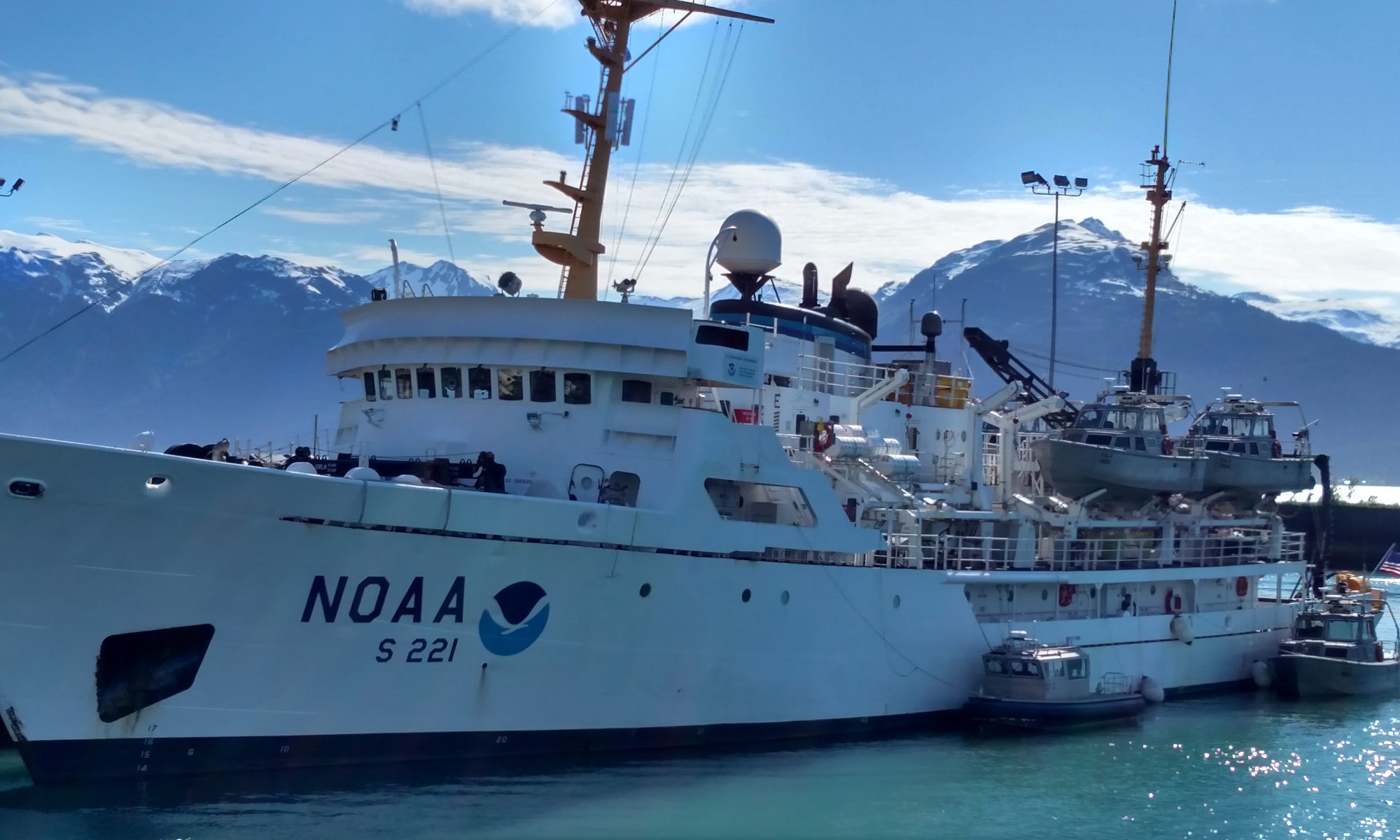
The Oscar Dyson at Pier 2 before departure from Kodiak.

The Oscar Dyson is a relatively new ship, equipped with noise quieting technology in order to create as little acoustic disturbance as possible when out at sea. Another neat feature crucial to the work of the Dyson is the acoustic transducers located on the bottom of the ship. There are several of these transducers, which are composed of small ceramic disks, and they help scientists detect ocean life and map the seafloor. If you are like me, you are probably wondering what a transducer is, right? It took me a couple of explanations and analogies in order to understand what was happening in these tiny devices. Remember, sound waves are pressure waves that move through a medium, in this case water. The transducer converts electrical energy to mechanical energy, expanding and contracting with electrical signal it receives. This expansion and contraction creates sound waves that move through the water away from the transducers. After sending the pressure waves the transducer switches modes to “listen” to the incoming waves. When the sound waves hit something in the water they are reflected back to the transducer. These reflected waves that are received by the transducers indicate the presence of obstacles in the water. An analogy for this process is that the transducer first acts as a speaker and then as a microphone.

The transducers on the bottom of the ship sending out a signal to the ocean floor.

Five of these transducers are being used for the pollock survey in order to detect pollock and other ocean life. The information the transducer receives back is automatically graphed on the computer. Scientists and other crew members can view and analyze this graph, and will use this information to determine when it is appropriate to send out a trawl to collect fish. There are also several transducers located around the bottom of the ship that are gathering information about the ocean floor. Hydrographic surveys use this technology as they map the sea floor. I am amazed at where we have come with technology, especially out at sea. Stay tuned for my next post to learn about more amazing technology we are using on board!

Personal Log:

TASAK2015 (30)
Ready to fly on this little plane from Anchorage to Kodiak.

Lucky. That is how I would describe myself when I landed at the Kodiak airport on my flight from Anchorage. First, I was lucky that the flight I was scheduled on made it to Kodiak on its first attempt, as flights are often cancelled for poor weather or low visibility. Planes have been known to turn around and fly back to Anchorage if they can’t make a safe landing in Kodiak. I am also feeling very lucky to have the opportunity to partake in yet another assignment as a NOAA Teacher at Sea, in another area of the country I haven’t yet explored.

I arrived in Kodiak on the 4th of July, and was swept up from the airport by one of the NOAA Corps officers, ENS Justin Boeck. We weren’t scheduled to depart on the Oscar Dyson until Monday, July 6th, so Justin gave me a quick tour of the ship. I wasn’t sure what to expect of the Oscar Dyson, but when my first thoughts climbing on board were that it would take me a week to find my way around! It is much larger than the last ship I was on, the Oregon II, down in the Gulf of Mexico.

Trying to take advantage of the nice weather, I decided to explore the area before we left. The town of Kodiak is quaint, and in walking through the downtown area, it is clear that fishing has been and will continue to be integral to the way of life here.

The science crew came in on the 4th as well from Seattle. I met them all when we went out to dinner Saturday evening. Even though we are going to be sleeping on the ship for next 2 nights before we depart, meals won’t be served until we are underway. I did manage to track down some good sushi and seafood places here in town, and am quite satisfied!

This sculpture was made entirely of trash found in the ocean.

On Sunday, the weather turned for the worse, which made the walk into town for coffee a wet one. If you think weather changes quickly in Colorado, try coming to Alaska. My favorite image of the weather status was at a little shop in Homer, Alaska, which outlined a box with a marker on the window and wrote, “If you want to know the weather, look here.”

That afternoon, I was given a little orientation on what some of my tasks would be on the ship, as there is quite a bit going on in addition to the pollock survey. I will be spending most of my time in the acoustics lab analyzing data, the wet lab processing our catches, and chem lab for some of the special projects.

In the evening, the weather cleared just long enough for me to convince ENS Gilman (ok, he didn’t really need any convincing- he was just as excited as I was) to head down to the pier to test out the Waverunner, the ROV made by the students in my class. While the visibility was not the best, we were able to see plenty of moon jellies, sea anemones and some kelp beds. The ROV handled pretty well in the ocean, although we did have some difficulties bringing it back up when it went down too deep. Students, do you have any suggestions for how we could account for this? Any suggestions or modifications we need to make?

We were supposed to be leaving early afternoon on Monday, however due to the bad weather, several of our crew members had not yet made it in to Kodiak. They finally made it over later that afternoon and we left port at 11pm. I stayed up to watch the sun set as we were leaving port (yes, it does actually set in parts of Alaska), and pushed myself to stay awake for a few more hours. I’ll be working the night shift for the next few weeks, which means I’m on duty from 4pm-4am. The faster I can get myself used to this schedule, the better off I’ll be. The first days in Kodiak have been a blast, and I am excited to begin conducting our survey!

Checking out the ship before we set sail.

Did you know? Acoustic transducer technology has been in use since World War II.

Where on the ship is Wilson?

IMG_6055

Wilson, our ring tail camo shark (so aptly named by our awesome science crew) , has been enjoying his time on the ship as much as I have. He has traveled all over the place, and is having fun with the crew on board. Can you guess where he is in the picture above?

Andrea Schmuttermair, Wander-lusting for Alaska, June 24, 2015

NOAA Teacher at Sea
Andrea Schmuttermair
Soon to be Aboard NOAA Ship Oscar Dyson
July 6 – 24, 2015

Mission: Walleye Pollock Survey
Geographical area of cruise: Kodiak, AK
Date: June 24, 2015

TAS2012
Ms. Schmuttermair on the Oregon II, 2012

Wanderlust (n): a strong desire or urge to wander or travel and explore the world.

As I sit writing this initial blog post on the beach here in San Diego, California, I find myself reminiscent of the summer of 2012, the “summer of ships”, as I referred to it. In June of 2012, I was preparing for adventures of a lifetime, for I would be on board not one but two ships throughout that summer. The first, the mighty Oregon II, one of NOAA’s fishery vessels, conducting research in the Gulf of Mexico. The second, a luxurious cruise ship, sailing the waters of Alaska. Little did I know I would be sitting here, 3 years later, eagerly anticipating my voyage back to Alaska yet again on board one of NOAA’s fishery vessels, again as a Teacher at Sea.

Andrea and Wesson
Ms. Schmuttermair and Wesson

My name is Andrea Schmuttermair, and I am currently an elementary teacher at the Colorado STEM Academy just north of Denver, Colorado. I just finished my 11th year teaching, and I have had the privilege to teach some amazing students in Germany, California, and Colorado. I have a lot of fun with my students (like 3D printing sharks and coding our own reaction timer), and strive to give them as many engaging science experiences as I can. Outside of the classroom, you can find me creating opportunities for new adventures and experiences through travel and the outdoors. I love to hike and backpack the trails in Colorado with my faithful companion, Wesson. Traveling to new, uncharted territory is also a frequent occurrence.

I first learned about the Teacher at Sea program back in 2008, and it immediately went on my bucket list. After a couple years of applying, I was accepted as a TAS in 2012 and helped scientists conduct the SEAMAP Summer Groundfish Survey in the Gulf of Mexico. To say I enjoyed it would be an understatement. It was by far one of the best experiences I have had, so much so, that when given the option to reapply, I knew I just had to. I am thrilled to be heading back to Alaska, this time wearing a different hat, to help scientists conduct the walleye pollock survey. The Walleye pollock is a key species in one of the largest fishing industries in the world. I am looking forward to helping scientists with this important research.

My students spent the last several months of school immersed in the fascinating world of the ocean. Being in a landlocked state, the ocean was still relatively undiscovered for them, yet it drew my students in with a desire and passion I couldn’t feed quick enough. From engaging in problem/project based learning to studying ocean animals and their adaptations to skyping with our favorite shark scientist, Dr. Mikki, to creating 3D printed models of new ocean discoveries, I knew my students had found a niche and a passion for learning. They weren’t done yet though. After some brainstorming, we decided to spend the last month of school on an in-depth project learning about and building our very own underwater ROVs. Inspired by NOAA and James Cameron’s recent film, our class learned about how ROVs are built and how they are used in research in the ocean. Very fascinating! We ended our year building 5 ROVs, which culminated in a competition running them through various challenges. The winning ROV, the Waverunner, is coming with me on this trip to swim through the Alaskan waters off the shore in Kodiak. How cool is that?!

This slideshow requires JavaScript.

 I am counting down the days until I head out to sea. Stay tuned for my next entry on board the mighty Oscar Dyson!

Did you know…that the scientific name for the Walleye Pollock was recently changed? After extensive genetic studies, researchers decided to change the scientific name from Theragra chalcogramma to Gadus chalcogrammus. Read more about it here.

Do you…have any questions about the research being done on Walleye pollock? Leave your questions in the comments below!

*Photos courtesy of Caine Delacey and Andrea Schmuttermair

Andrea Schmuttermair: Back On Solid Ground, July 7, 2012

NOAA Teacher at Sea
Andrea Schmuttermair
Aboard NOAA Ship Oregon II
June 22 – July 3

Mission: Groundfish Survey
Geographical area of cruise: Gulf of Mexico
Date: July 7, 2012

Personal Log

As I write this final post, I sit at a cafe looking out at the Pacific Ocean. A cool ocean breeze kisses my face, and the smell of the salty sea air fills my nostrils. Different from the damp air and blazing sun that inhabit the Gulf of Mexico, yet the ocean all the same. I know I am in my element, and will soak in as much ocean as possible before heading back to land-locked Colorado.

I have spent a lot of time this past week thinking about my trip on the Oregon II, at sea with people passionate about the work they do. I can’t help but think how lucky I am to have had this amazing, once in a lifetime opportunity (although I am certain I will do this again) to not only participate in real-life science, but to be able to share this experience with my students.

scientists in the galley
A few of us scientists hanging out in the galley.

I have spent some time talking about the scientists that were on board with me on the Oregon II, and I must say that my experience would not have been the same had it not been for these people I worked so closely with. When traveling, it is not only important to see the sights and soak in the culture, but to also get to know the locals. Hear their story. Spend time with them. Listen to them. I placed as much importance on getting to know some of the scientists and crew on board as I did the work that we were doing. In that, I know I have made lasting relationships.

night shift
Our night shift team: Me, Alonzo, Lindsey, Alex, and Renee.
all scientists
All the scientists on the Oregon II

The more I talk to my friends and family and fellow teachers back at home, I am realizing that working on a ship is not for everyone. In fact, it takes a special person to spend a good portion of their years on a ship, away from friends and family, up to their elbows (quite literally) in fish. The adventurous side of me absolutely loved this, and hopes to do it again in the future. Alonzo, my watch leader, says I am welcome back any time. Well, Alonzo, I may just take you up on that one of these days.

Towards the end of my cruise, I had the opportunity to interview one of the junior NOAA Corps officers on board the Oregon II, ENS Junie Cassone. In her interview, she talks about life in the NOAA Corps and how one can become a NOAA Corps officer.

Watch the interview with ENS Cassone here: Interview with ENS Cassone.

My final post would not be complete without a few last critter pics, as I’ve started naming my ever-growing file. Here are some of my favorite critters from our last few trawls.

hermit crab
One cute little hermit crab!
seahorse
A seahorse we found amongst the Sargassum.
bashful crab 2
A flame-streaked box crab (Calappa flammea)- my new favorite of the bashful, or shameful, crabs
lion fish
Alex showing off one of his lionfish

To wrap up, I’d like to post one final Critter Query. When we brought up out trawls, I noticed some fish had this red bulge coming out of their mouths. I had never seen this before, and inquired what it was. Do you know what it is and what causes it?

fish
What is the red bulge coming out of the mouth of this fish and what is the cause of it?

Andrea Schmuttermair: A Lesson in Chemistry, July 1, 2012

NOAA Teacher at Sea
Andrea Schmuttermair
Aboard NOAA Ship Oregon II
June 22 – July 3, 2012

Mission: Groundfish Survey
Geographical area of cruise: Gulf of Mexico
Date: July 1, 2012 

Ship  Data from the Bridge
Latitude: 2957.02N
Longitude: 8618.29W
Speed: 10 knots
Wind Speed: 9.65
Wind Direction: S/SE
Surface Water Salinity:35.31
Air Temperature: 28.2 C
Relative Humidity: 76%
Barometric Pressure: 1017 mb
Water Depth:  57.54 m

Science and Technology Log

water from CTD
Here I’m filling up the BOD jar with our salt water samples from the CTD cast.

Reminiscent of my days in high school chemistry, today I had the opportunity to work with our Chief Scientist, Brittany, on completing the daily titration. If you remember, getting readings on the dissolved oxygen in the water is an important part of this survey as we locate any hypoxic (less than 2 mg of oxygen per liter of water) zones or anoxic (no oxygen) zones. This is done with a computerized device on the CTD, but we want to make sure that our readings are accurate. Because “chemistry never lies”, this is how we ensure our readings are accurate.

With our CTD, we have the ability to collect water samples at various depths. We do not collect water samples at every CTD, but rather one or two a day during the daytime hours. We collect water from the bottom to see if there is any expansion of hypoxia.

orion meter
Using the Orion dissolved oxygen meter to measure the amount of dissolved oxygen in our sample.

When the CTD comes back up, we use an Orion dissolved oxygen meter, which is a handheld device, to get a dissolved oxygen reading from our samples. We put the probe on the end of the meter gently into the containers of water on the CTD to get our reading. We will use this number in conjunction with the information sent from the CTD to our dry lab to check against our titration results.

Once we have the reading with the probe, we are ready to take some samples for our titration. We then take the water samples in the cylinders, rinse out our 300 mL BOD (biological oxygen demand) glass bottles a few times with that water, and then fill the botttles up with the sea water from the bottom. These samples are brought back to our Chem Lab (short for chemistry, as I’m sure you figured out) where we will test the amount of dissolved oxygen.

adding manganese sulfate
Adding the manganese sulfate to our sample.
This is after I’ve added the manganese sulfate and iodide. Now we have to wait for it to settle.

We are using the Winkler method to find the amount of dissolved oxygen in our water samples. The first step in this process is to put 2mL of manganese sulfate into the bottle. After that, we also add 2 mL of azide- iodide. With those 2 chemicals added, we carefully replace the stopper and give the bottle a good shake. We then can wait about 10-15 minutes for the chemicals to settle at the bottom. Pipettes are used to add the liquids and allow us to be very precise in our measurements.

after settling 1
Here is our sample after it has settled.

After the particles have settled at the bottom, we add 2 mL of sulfuric acid (which can be a dangerous chemical if used inappropriately), replace the stopper, and shake the bottle again gently. The sulfuric acid “fixes” the solution. Finally we add 2 mL of starch to the solution, which is a blue indicator when we put it in but turns the solution a burnt orange color. Now we are ready to titrate!

adding to beaker
Our sample solution being poured into the beaker, ready for the titration. Inside the beaker is a magnetic stirrer.
finished titration
Now you can see the solution is clear in color, meaning our titration is finished. We are ready to determine the amount of dissolved oxygen.

Prepared beforehand was a burette filled with phenylarsine oxide, what we use to drip into the sample. We pour the sample into a beaker and place it on a magnetic plate. We’ve placed a magnetic stirrer in the beaker so it gently stirs the solution while we are titrating. We let the phenylarsine oxide slowly drip into the sample  until it turns clear. When it does this, we note the amount of phenylarsine oxide that we put in the sample (which is equivalent to the amount of oxygen in the water), and the number should match (or be very close) to the reading of dissolved oxygen that we received from the CTD and the Orion dissolved oxygen meter.

This process is quite simple yet yields important results and is just one of the ways scientists verify their data.

Bioluminscence

One other interesting thing happened the other night on one of our shifts. We had brought in a bongo tow and were looking into the codends to see what we got. When Alex began rinsing the sample with some salt water, the whole codend began to illuminate. Why did it illuminate? Bioluminescence.  Bioluminescence is essentially a chemical reaction that produces light. Many marine critters can produce bioluminescence, as seen below.

bioluminescence
Bioluminescence in our bongo tow.

Personal Log

One of the things I’ve probably enjoyed the most about my trip so far are the relationships I’ve formed with the people on board. As a teacher, one of my top priorities is to build and maintain relationships with my students, both past and present. That became a bit more of a challenge to me this past year as I took on a new position and began teaching 600 students rather than the 30 I was used to.

Alonzo
Our watch leader, Alonzo, waiting to weigh our next catch.

I’ve come to love working with the scientists on the night watch, as each of them brings something to the table. Our watch leader, Alonzo, has a wealth of knowledge that he gladly shares with each of us, pushing us to learn more and find the answer for ourselves. I’ve improved immensely on identifying the different fish, crabs and shrimp we find (thanks to Lindsey, who is my partner in crime for making up silly ways to remember these crazy Latin names for all our species). Where I came in knowing names of very few if any types of Gulf critters, I can now confidently identify 15-20 different species. I’m learning more about how to look for the subtle differences between different species, and Alonzo has been able to sit back and be that “guide on the side” while we work and input all of our data. His patient demeanor has allowed all of us to become more self-sufficient and to become more confident in the knowledge we have gained thus far on this trip.

Alex
Alex with a sharksucker

Alex, another one of the scientists on my watch, shows an endless enthusiasm for marine science. He shares in my excitement when a trawl comes up, and the both of us rush out there to watch the net come up, often guessing how big we think the catch is going to be. Will it fill one basket? Two? Six? It’s even more exciting when we get inside and lay it out on the conveyor belt and can really examine everything carefully. His wish finally came true today as we are now in the eastern part of the Gulf. Alex is studying lionfish (Pterois volitans) for his research, and of course has been hoping to catch some. Today we caught 4, along with a multitude of other unique critters that we have not seen yet. Alex’s enthusiasm and passion for science is something I hope my students can find, whether it be in marine science, biology, or meteorology- whatever it is they love is what I hope they pursue.

Lindsey
Lindsey and Alex, getting ready to work.

Lindsey and Renee are both graduate students. Rene wanted to gain some experience and came on the ship as a volunteer. What a better way to get a hands-on experience! Lindsey has joined us on this cruise because she is doing research on Sargassum communities. She has been able to collect quite a few Sargassum  samples to include in her research for her thesis. Lindsey, like Alex, is very passionate and excited about what she does. I’ve never seen someone more excited to pull up a net full of Sargassum (which I’m sure you remember is a type of seaweed) in order to sift through and find critters. She has a great eye, though, because she always manages to find even the tiniest of critters in her samples. Just yesterday she found a baby seahorse that couldn’t have been more than a few millimeters long! Outside I hear her giggle with glee- I know this is because she has found a Sargassum fish, which is her all-time favorite.

deck crew
Our night shift deck crew- Tim, Chuck and Reggie

Our night watch would not be complete without the deck crew, Tim, Reggie and Chuck, who are responsible for helping us lower the CTD, Neuston and bongo tows, and for the trawl net. Our work could not be done without them.

William, one of our engineers, took me down into the engine room the other day. First impressions- it was hot and noisy! It was neat to see all the different machines. The ship makes its own water using a reverse osmosis system, which takes water from the ocean and converts it into drinking water for us (this water is also used for showers and sinks on board). One interesting note is that the toilets actually use salt water rather than fresh water so that we conserve our fresh water.

reverse osmosis
Our reverse osmosis systems.

I cannot believe how fast this leg has gone and that we only have a few more shifts to go before we return to the Oregon II’s  home port of Pascagoula. As we’ve moved into the eastern waters of the Gulf, we have seen a lot of different types of critters. On average, our most recent trawls have been much more brightly colored. We are near some coral reefs too- in our trawls we have pulled up a bit of coral and sponge. The markings on some of the fish are very intriguing, and even fish we’ve seen before seem to be just a little brighter in color out here.

Due to the fact that we are finding very different critters, my list of favorites for today has greatly increased! Here are just a few:

scorpion fish
The mouth of a scorpion fish. We’ve caught a bunch of these since we hit the eastern Gulf.
sea horse
A baby seahorse we pulled out of our Neuston tow. He was hiding in the Sargassum.
red snapper
One of our biggest red snappers.
box crab
This is another type of bashful crab, also known as the flame-streaked box crab (Calappa flammea).
octopus
This octopus sure liked my hard hat!

Andrea Schmuttermair: Collecting Data, June 30, 2012

NOAA Teacher at Sea
Andrea Schmuttermair
Aboard NOAA Ship Oregon II
June 22 – July 3

Mission: Groundfish Survey
Geographical area of cruise: Gulf of Mexico
Date: June 30, 2012

Ship  Data from the Bridge
Latitude: 2830.05N
Longitude: 8955.4W
Speed: 10 knots
Wind Speed: 7.11
Wind Direction: S/SW
Surface Water Salinity: 29.3
Air Temperature: 28.4C
Relative Humidity: 63%
Barometric Pressure: 1012 mb
Water Depth: 257.19m

Don’t forget to follow the Oregon II at: www.shiptracker.noaa.gov

Science and Technology Log

fish board
This is the fish board we use for measuring each critter in our sample.

Now that we’ve talked about how we collect, sort, and measure our catch, let’s take a closer look at the way we measure, weigh and sex our critters.

When measuring the critters, we use a fish board that is activated by a magnetic wand to measure the animal to the nearest millimeter.

When the fish is placed on the measuring line, we touch the magnetic wand to the board and the length is recorded into our computer program, FSCS (Fisheries Scientific Computer System).

Depending on the type of fish we catch, there are different ways to measure it.

scorpion fish total legnth
Here is Alex measuring the total length of our scorpion fish.
total length measurement
This is how we would measure a fish for its standard length, which is just before the tail fin starts.
fork length measure
This is how we would measure a fish for its fork length.
Cutlass measuring
For fish such as this cutlassfish, we measure the length from the head down to the anus, as seen here on the board.

When we are done measuring, the fish is placed on a scale to determine its weight to the nearest gram. When we confirm the weight of the fish, that weight is automatically put in the computer for us- no need to enter it manually.

Our last task is to determine the sex of the fish. For many fish, this is done by making an incision in the belly of the fish from their anus to their pelvic fins. It’s easiest to determine the sex when it is a female with eggs. In the males, you can see milt, or sperm, which is a milky white color.

male fish
This is a male fish. Notice the arrow pointing to the testes.
female fish
Here we have a female fish.

For the flatfish, you can see the female’s ovaries when you hold the fish up to the light. Males lack this feature.

male flat fish
This is a male flat fish.
female flat fish
Here we have a female flat fish- notice her gonads.

Because we were catching quite a few shrimp earlier in the leg, I got pretty good at sexing the shrimp. Remember, we take samples of 200 for each type of shrimp, and we often had more than one type of shrimp in each trawl. Male shrimp have a pestama on their first pleura to attach onto the females. The females are lacking this part. Although it’s not necessarily an indication of sex, on average the female shrimp tend to be larger than the males.

male shrimp
Here is a male shrimp.
female shrimp
Here we have a female shrimp, which is lacking a pestama.

You  know from my previous post what we do with the data we gather from the shrimp, but what about the other fish? With the other fish and critters we catch, we use the data to compare the distribution across the Gulf and to compare it to the historical data we’ve collected in the past to look for trends and changes.

Sometimes scientists also have special requests for samples of a certain species. Some scientists are doing diet studies to learn more about what certain types of fish eat.  Other studies include: species verification, geographic range extensions, age and growth, and distribution. Through our program, we have the ability to create tags for the scientists requesting the samples, allowing us to bag and freeze them to send to labs when we return to land.

showers
There are 2 communal showers for our use on the bottom deck.

Personal Log

I’ve had a few people ask me what the living quarters and the food is like on the ship, so I wandered around the ship with my camera the other day to snap some shots of the inside of the Oregon II. There are 17 staterooms on board. Most of the staterooms are doubles, such as mine, and are equipped with bunk beds to sleep on. It makes me reminisce of my days at camp, as it’s been a while since I’ve slept on a bunk bed! We have a sink and some cabinets to store our belongings. Once a week they do room inspections to ensure our rooms are neat and orderly. Most importantly, they want to make sure that our belongings are put away. If we hit rough waters, something such as a water bottle could become a dangerous projectile.

Walter, doing what he loves

My stateroom is on the bottom deck, where there are also communal showers and toilets for us to use. We can do our laundry down here, providing the seas aren’t too rough. Most of the staterooms are on this bottom deck, as the upper 2 levels are the “living areas” of the ship. On the main deck is the galley, where we eat all our meals, or where we head to when we are trying to make it through the shift to grab a snack or a cup of coffee. This tends to be right around 4:30/5:00am for me, especially when we aren’t too busy. I’ve gotten used to the night shift now, but it still can be tiring, especially when we have a long wait in between stations. Our stewards take very good care of us, and there is always something to snack on. Meals have been pretty tasty too, with plenty of fresh seafood. My favorite!

chart room
Junie, one of the NOAA Corps officers, working in the chart room on the navigational charts

On the top deck we have the lounge, a place where we hang out in between shifts. We have quite a good movie selection on board, but to be honest we haven’t had the time to take advantage of it. They’ve kept us very busy on our shifts so far, and today is one of the first days we’ve had a lot of downtime. Outside we also have some workout equipment- a bike and a rowing machine- to use on our off time. When you set the rowing machine out on deck, it’s almost like you are rowing right on the ocean!

dive
LT Harris, LT Miller, and Chris getting ready for the dive. Jeff and Reggie help them prepare.

The other day, 2 of the NOAA Corps officers, LT Harris and LT Miller (who is also the XO for the Oregon II) and 2 of the deck crew, Chris and Tim, got ready to go out on a dive. NOAA Corps officers need to do a dive once a month to keep up their certification. Sometimes they may need to fix something that is wrong with the boat, and other dives are to practice certain dive skills. They dove in the Flower Gardens, which is a national marine sanctuary with a wide diversity of sea life. I was hoping they’d see a whale shark, but no such luck. We stopped all operations for the duration of their dive.

Favorite Catch of the Day: Here are a few cool critters we pulled up today. In addition to these critters, we also started seeing some sea stars, lots of scallops, and a variety of shells.

angel shark
An angel shark
jelly soup
How about some jelly soup?
(there are about 500 jellies in there!)
large flounder
Southern Flounder
roundel skate
A roundel skate

Critter Query: This isn’t a critter question today, but rather a little bit of NOAA trivia. 

What is the oldest ship in the NOAA fleet and where is its home port?

Don’t forget to leave your answers in the comments below!