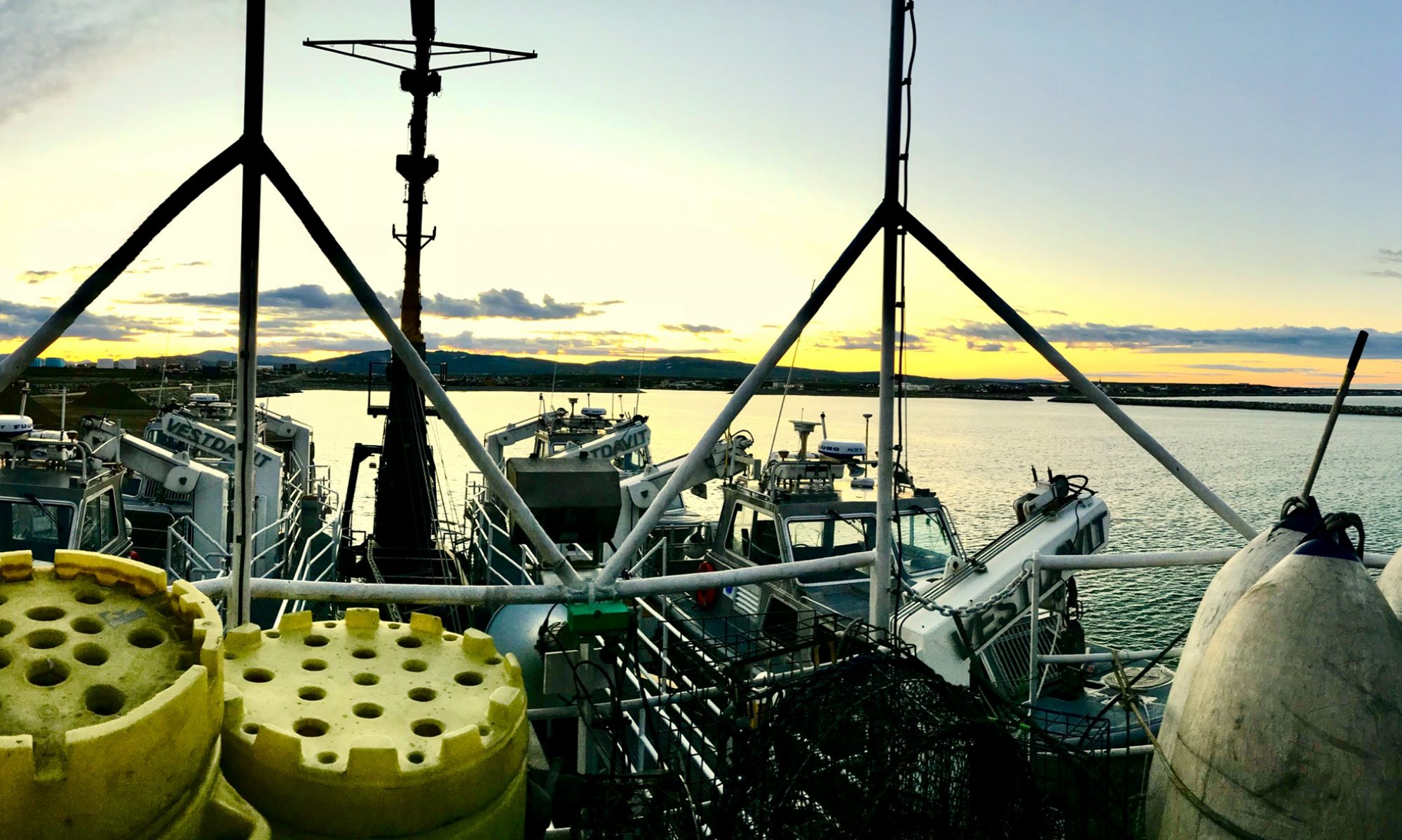
Weather from the Bridge: Time:05:56 am Latitude:61.05 N Longitude:178.51 W Wind Direction: 300 N Wind Speed:12.5 knots Sea Temperature:8.0 C (46.4 F) Air Temperature:9.5 C (49.10 F) Barometric Pressure:1008 mb Foggy skies
Foggy Skies
SCIENCE & TECHNOLOGY LOG:
Wednesday, July 28: after a cloudy and foggy day, (Picture of a ship on Russian waters)the weather finally changed and the afternoon became sunny and clear, very pleasant to be on deck. For the past several days we have been navigating in the Russian territorial waters of the Bering Sea, for which we have permission, as testified by a letter in Russian posted on the bridge. Alaska used to be a possession of Russia, until October 18, 1867 it became a territory of the United States.
We can still see Russian Orthodox churches still open today in some islands of Alaska. Pretty soon the direction of the current transect or line course, will bring us as close as 12.6 miles from land. At one point we were close to 14 miles off Cape Navarin, but there was fog in the distance and without notice the beautiful afternoon disappeared and I was not able to see Russia. Later on during the afternoon trawl, while sorting the catch of Pollock, a big fish came out on the conveyor:it was a Chum Salmon or Dog fish” said Dr. Mikhail Stepanenko, a Russian scientists working with his colleague Elena Gritsay, from the Vladivostok School of Fisheries, collaborating in the Walleye Pollock survey to help improve the management of Russian fisheries. According to Mikhail it was most likely that the chum salmon had been born in Japanese waters, and had migrated to spawn near Cape Navarin.
Chum Salmon
After I measured it then I dissected the fish to see if it was male or female. The organs were slightly different in size and location than the Pollock, but basically the same. The pillora seca was very large, engulfing the long stomach and liver, and the kidneys were right behind the swim bladder. The presence of an organ called gonads or testes confirmed that it was a male. I tried to locate the otolith, for my classroom collection bu could not locate it. There was also a very interesting fish in the catch: a Toad Lump sucker, a very cute looking fish that resembled a blow fish because it was swollen like a balloon. It had a suction orifice in the underbelly too.
PERSONAL LOG:
I noticed that in this cruise there is an atmosphere of professional collaboration between scientists and the crew. There is also a sense of collegiate amongst all the scientists working on board the Oscar Dyson. The Pollock Survey is the primary mission, but there are other parallel missions going on: the seabird survey, done by Marty and Liz, and the marine mammal survey, done by Patty, Paula, and Ernesto. To do research on the Bering Sea is very challenging due to the remote locations, and the storms, winds, large waves, and extreme weather. The need for oceangoing vessels to work in these extreme conditions makes it very expensive, so when ships like the Oscar Dyson are deployed, different missions are planned to “piggyback” along. I was very impressed by the international collaboration in the mission, with the two Russian scientists on board conducting research on the Pollock fisheries, since part of the transects done by the Oscar Dyson covered Russian territorial waters as well. The fact the one Mexican scientist, a Filipino cook, and a Dominican teacher at sea were part of this cruise added more countries to the mission. Just like us, fish travel in different waters, local and international, and they too are citizens of the world’s oceans. I wanted to commend NOAA’s administration for providing career opportunities to minorities, Latinos, and women to work as scientists, technicians, Corps officers, and crew.
“Una Cooperacion Internacional” Durante todo el trayecto de este crucero de Monitoreo del Pollock he notado un ambiente de profesionalismo entre el personal cientifico y la tripulacion, asi tambien como un ambiente de colegiatura enter los diferentes cientificos trabajando a bordo del Oscar Dyson. La mision primaria es el Monitoreo del Pollock, pero a su vez hay otras misiones paralelas a la mision principal, como son el Estudio de las Aves Marinas,por Liz y Marty, asi como el Estudio de los Mamiferos Marinos, por Patty,Paula, y Ernesto. Hay que entender que hacer investigacion cientifica en el Estrecho de Bering es una tarea logistica complicada por lo remoto del lugar, lo extremo del clima, asi como gigantescas olas. Solo se pueden usar barcos de navegacion oceanica que son muy costosos, por lo que cuando embarcaciones como el Oscar Dyson son lanzadas, multiples misiones son planeadas al mismo tiempo tambien. Me llamo mucho la atencion la cooperacion internacional, especialmente los dos cientificos rusos a bordo, que tambien relizaban estudios del Pollock, lo cual tiene mucho sentido, debido a que gran parte de la investigacion cubria aguas territoriales rusas. El hecho de que un biologo Mexicano, un filipino (Ray el cocinero), y un Maestro en el Mar dominicano tambien forman parte de este crucero le agregan mas paises a la mision. Yo quiero felicitar a la administracion de NOAA por proveer oportunidades de carreras profesionales tanto a minorias, como a Latinos, y a mujeres para trabajar como cientificos, tecnicos, Cuerpo de Oficiales o como tripulantes. Yo creo que esto es un gran incentivo para que mas jovenes estudiantes de escuela intermedia y secundaria puedan perseguir carreras profesioanles en Conservacion Ambiental.
NOAA Teacher at Sea Obed Fulcar NOAA Ship Oscar Dyson July 27, 2010 – August 8, 2010
Mission:Summer Pollock survey III Geograpical Area:Bering Sea, Alaska Date: August 7, 2010
Weather from the Bridge:
Time:04:42 am Latitude:61.04 North Longitude:178.06 West Wind Speed:10.74 knots Wind Direction:50 degrees North Sea Temperature:8.99 C (48.02 F) Air Temperature:8.2 C (46.76 F) Barometric Pressure: 1010.1 millibars Cloudy Skies
SCIENCE AND TECHNOLOGY LOG:
Me with a pollock
Friday, July 23: The Walleye Pollock survey has been conducted since 1979, every summer by MACE (Midwater Assessment and Conservation Engineering) part of the Alaska Fisheries Science center (AFSC). The sea was quite calm compared to the last days, giving us a break from sea sickness. The other day I missed the trawl, but I will not today. As soon as we saw the fish in the Acoustic sonar screens I knew it was trawling time, so I ran up to the bridge to witness the whole thing. The started deploying an Aleutian Wind Trawler or AWT net that was attached to a giant winch with huge ropes and chains. The long net had a front orange section with smaller openings compared to the back. I was invited to come to deck by deckhand Buddy Gould. He is a veteran New england fisherman from Rhode Island, now living in Florida.
Buddy Gould
I asked permission from Commanding Officer CO Mike Hashlyck , and went on deck wearing a PFD, and a hard hat. After trawling the net behind the ship for what felt like an eternity, it was finally hauled back, the catch of Pollock was then spilled into a box leading to the wet labfor slicing and dicing. I went inside an put on rain boots, a plastic jacket and a jumpsuit, plus elbow high plastic glove and got down to slice and measure Pollock. While sorting out the fish we found a Pacific Flounder and a Rock sole fish, both flat bottom fish. For the next several days while conducting the survey, I kept dissecting the content of the stomachs of everal fish to find out what they have been eating. I learned that the main diet of Pollock was made up of animal plankton called Euphasiids, also known as krill.
Krill
These small organisms are arthropods or segmented invertebr ates (without internal skeleton), and just like shrimps, and crabs, their bodies are covered by an exoskeletonor shell, with paired antennae, pincers, and legs. They were present in the stomach of all the specimens in a pink color mass. There was one large maturity level 4/5 Pollock that when I opened its stomach, a large Northen Pacific shrimp came out of it. Then in later catches I observed that all the stomachs were very dark-blue looking. When I opened the stomach of one fish there was a dark purple mass of another arthropod called Pelagic amphipods, or sea fleas. Amphipods swim drifting in the water column and are larger than euphasiids or krill, wich instead formed massive swarms swimming at great depths by day but heading to suface by night. I was able to witness this pattern when once the echogram from the acoustic radar showed a swarm of krill drifting from the surface to the bottom as the sun was rising.
Pelagic amphipods
Animal Species observed:
Arrowtooth Flounder (Atheresthes stomias), Northern Rock Sole fish (Lepidopsetta polyxystra), Northern Pacifi Shrimp
I realized that this tiny organism (the krill) is crucial for the survival not only of many animals in the ocean, but ultimately of us humans. We have historically harvested the rich waters of the Bering Sea for food, and most recently as a source of cheap protein to feed cattle and even pets. Disasters such as the recent massive oil spill from the tracgic explosion of the Deep Horizon oil platform, own by giant multinational BP, and the Exxon Valdez oil spill in Alaska during the 80’s are examples of how fragile the marine ecosystem is. But the number one threat to ocean fisheries is actually overfishing exploitation of the ocean resources. I heard stories about the foreign fleets that come to Russian waters and overfish with impunity, while at the same time processing, canning, and packing all their catch aboard their ships, taking it all back to their countries, without sharing any jobs opportunities with the local communities. Historically local fishing fleets have fished sustainably, bringing back to local ports the catch, allowing canneries, and fish markets to also benefit from it. We have to spread the word about this injustice and begin to question our own habits, to see what can we change in our consumption that will have a positive impact in this urgent matter.
“Echando la Red en Alta Mar” El mareo de ayer no me permitio participar en la pesca del Pollock, pero no hoy! Tan pronto me entere, subi al puente para observar lo todo. Mi buen amigo del personal de cubierta, Buddy Gould pescador de Rhode Island radicado en la Florida, me invito a bajar a cubierta. Despues de ahbe asegurado permiso del Oficial Comandante Mike Holshyck, baje a la cubierta con chaleco flotador y casco de seguridad a cuestas. La anaranjada Red de Arrastre fue lanzada al mar por unos gigantescos rollos de cables y cadenas pesadas. Luego de lo que parecio una eternidad, la red fue traida a bordo y la pesca fue depositada en una rampa en la cubierta por una grua pesada. Yo fui adentro rapidamente y me vesti con guantes, poncho, pantalones, y botas de plastico y me puse las manos a la obra: a picar los pescados! Durante el proceso note que los estomagos de los pescados cambiaron de color rosado a color purpura. El contenido de los estomagos incluia un plankton-animal llamado Euphasiid o Krill, un artropodo (invertebrados parecidos al camaron y el cangrejo), asi como otro llamadoAmphipods, los cuales constituyen la dieta primaria de especies de peces como el Pollock, y el Salmon, asi como de las ballenas jorobadas. El krill no solo es primordial para estas especies marinas sino para la raza humana, que depende de las reservas alimenticias del Estrecho de Bering como gran fuente de proteina. Es lamentable que este fragil recurso natural no sea celosamente cuidado, cuando vemos como el desastre del derrame de la Plataforma Petrolera Deep Horizon en el Golfo de Mexico, y en los 80’s del Exxon Valdez en Alaska, puede facilmente hacer desaparecer la pesqueria. Pero el enemigo numero uno de este recurso natural es realmente la pesca desmedida por parte de flotas pequeras extranjeras que viene a las aguas del Estrecho de Bering, pescando indiscriminadamente. Estos barcos no solo pescan, si no que procesan y empaquetan todo a bordo sin dejar si quiera oportunidad a las comunidades locales de participar del beneficio sostenido. Tenemos que hacer eco de esta injusticia y autoanalizar nuestros habitos a fin de ver que podemos cambiar para poder hacer un impacto positivo.
The Kilo Moana left port on July 27, 2010. It is based out of the University of Hawaii. We will be mooring a 4,000 pound buoy which will measure water temperatures, conductivity, and current flow as well as taking other important oceanic measurements. It will take about five hours to moor it properly. Mooring means to anchor it to a particular place or location. We are heading north of Oahu about 110 kilometers, which is about 68 miles. So far, the ship has sailed smoothy. It is a catamaran-style of ship, which keeps it stable in all types of surf conditions.
From speaking to the scientists on the mission, I have learned that is takes months, if not years, to build and implement these enormous buoys. Needless to say, it is much different from setting a “No Swimming” buoy.
This buoy will take measurements which will be used to calibrate models generated by other scientists. Likewise, we will be recovering an old mooring, cleaning it, and returning it to port. The entire mission will last eight days.
Today, Wednesday, we actually deployed the buoy and the instruments that are suspended below it. To help you understand how it is working, imagine that you have a beach ball with a rope attached to it. A series a knots have been tied into the rope. The beach ball is then released into a pool of water and the rope dangles below the part of the beach ball that is floating on the surface of the water. Each knot represents a different scientific instrument; each instrument collects real-time data.
How I helped was that I held the line which helped guide the chains and instruments into the water. I was reponsible for keeping the chains and instruments away from one of the ship’s propellars. It was a bit strenuous and unsettling, for if the instruments and chain drift into the propellar, then the mission is destroyed. I am happy to report that this did not happen.
After the instruments were guided into the water, a series of lines were attached and lowered as well. This process took several hours to complete, and we had to help feed the line out into the ocean. After the line was lowered, a series of glass balls were attached and slowly released following the lines. Once these balls were released, they stayed afloat. However, a 9,300 pound anchor was then attached and released into the ocean, causing the balls and line to descend into the ocean. Finally, the anchor descended about 4,700 meters (1,651 feet) and the buoy was finally moored to the seafloor.
There are many different groups of people working aboard the ship, Oscar Dyson – Scientists, NOAA Corps officers, Deck Hands, Engineers, Survey Technicians, and Cooks. Within the science department, there are 12 members aboard and two Teachers at Sea which totals to 14 souls. For this third leg of pollock surveys, the chief scientist is Taina Honkalehto. Her job aboard the ship is to plan the scientific activities and make the decisions on how best to carry out that plan. Of the scientist crew, there are two Russian scientists that are conducting their own research in collaboration with NOAA.
This pollock survey, which focuses on determining abundance and distribution, is an important component of the fishing industry in the United States. According to The Bering Sea Project, “The largest concentrations of pollock occur in the eastern Bering Sea,” and more specifically, “Walleye pollock support the largest single commercial fishery in the U.S., producing the largest catch of any one species inhabiting the 200-mile US Exclusive Economic Zone.” Additionally, the pollock industry is incredibly important to the people living in Dutch Harbor and Unalaska because pollock is one of the main fishes processed there and has helped classify Dutch Harbor as America’s #1 fishing port in the USA for fish landed (NOAA, 2009).
View of a spread out group of pollock as seen from the computer screen. Notice in the far right corner a red spot. That shows that at that location, the fish are densely packed. The red, yellow, and green-blue line represent the seafloor.
There are two summer surveys being conducted to estimate the Bering Sea pollock population: Acoustic-Trawl Survey and the Bottom-Trawl Survey. Currently on the Oscar Dyson we are conducting the Acoustic -Trawl Survey. After we catch the fish, we combine the acoustics, fish samples, and CTD deployment data, to draw conclusions that help us estimate population size and ecological factors of pollock. Remember, in order for pollock to live where they do, they need food and so when we extract stomach samples, we are looking for what pollock prey upon (mostly krill). Besides, food, other important aspects of their habitat must be in place for their survival. The CTD data – water temperature, salinity, nutrients, oxygen, and chlorophyll – help us understand how the distribution of pollock has changed in past years and may also provide information about how it could change in the future.
However, not all of the scientists on board are collecting data related to pollock. Currently we have two other subgroups with one observing seabirds and the other observing marine mammals. The crew observing seabirds have a goal of observing species seen during the tour to determine seabird species distribution and abundance. The marine mammal observers are working to obtain current data on cetacean species distribution and abundance.
The Teachers At Sea (TAS), which currently include Obed Fulcar (New York, New York) and myself (Dutch Harbor, AK) have an important role of working under the scientists and other crew members to learn about the research being conducted in an attempt to bring real science into the classrooms.
A large group of fish scattered about from the perspective of the transducer.
Because acoustics is a major tool used in pollock survey, I feel it would be beneficial to provide a few details on how it works. Remember, referring to Blog #2 “the ship has Transducers that send pings of sound energy down through the ocean and when they hit some object, such as the bottom of the ocean or a fish, in this case they are hitting the swim bladders of the fish, some of the energy in the sound ping is returned to the ship and received by our echo sounding system in the acoustics lab of the ship.” It is important to note that the acoustics under the water are different than in the air because the pressure in each location is different. Inside the acoustics lab there are many different screens that display the pings at different frequencies of sound waves. We know that jellyfish tend to show up the best from the low frequencies. Acoustics is a good tool to use to study pollock because pollock is the primary fish species inhabiting the middle-waters of the Bering Sea shelf. For example, bottom fish are difficult to see because the acoustic signals from the seafloor are too strong and tend to hide the bottom fish signals. Acoustic signals that we see on the computer screen rely on the actual physiological make-up of the fish. Also, the behavior of pollock plays a role in how we can see them acoustically. For example, salmon do not swim in large schools like pollock. When we see large schools of pollock on the acoustic screens, density determines the color – blue usually is reflecting a couple fish whereas red represents a high density of fish – and the shape of the schools tend to be typical of pollock. Through acoustics, we are able to survey pollock over a wide area and gain information regarding their distribution and population.
Prior to fishing, we consistently monitor the screens as the ship travels up and down the rectangular transects you can see when you view the ship’s path on ShipTracker. When we observe schools of fish, we need to decide whether they are large enough to sample the fish with the trawl. Because we also want to target certain ages of fish, it is important to be able to estimate their size.
We can estimate size through a method using additional measurements from the acoustic data. We draw a box around an area that is not densely packed with pollock so it is easier to distinguish an individual acoustic image of a fish. The software we have gives us the average intensity of the acoustic pixels. We call this intensity target strength which translates to the size of the echo. Because the size of the swim bladder is proportional to the size of the fish, we can use the intensity of the echo off the swim bladder to estimate the size of the pollock. In short, target strength depends on the size of the swim bladder and features of the swim bladder can be used to predict fish size.
Acoustic image from the bridge. The bottom blue streak is a large group of fish that ducked under the net. The horseshoe shape is the net. The blue inside the horseshoe are the fish.
We can use an equation for calculating decibels to help us estimate the size of the fish in the school we might target. For my friends and students who are math gurus, the equation is TS = 20Log(length cm) + b20. The b20 variable is different for different fish species and so for Walleye Pollock in the Bering Sea, b20 is -66. Therefore, the equation for Walleye Pollock is TSpollock = 20Log(length cm) – 66.
To provide an example of how the equation works, lets say that the average length of a two year-old pollock is 25 cm and that is the size we want to target. We take that 25 centimeters and “plug it” into the section of the equation that stands for length in centimeters. Scientific calculators are wonderful devices for logarithms as they have the Log function already installed, and if you plug in 20Log(25) – 66 into the calculator, the answer -38.4 translates into the target strength that would show up on the screen. So if we find schools of pollock and see that the target strength is close to -38.4, then we know the echosounder is observing two-year old pollock.
Once acoustics have determined that we need to fish, they send the coordinates they want the Officer of the Deck (OOD, a.k.a. the NOAA Corps officer on watch on the bridge) to follow and the officers drive the ship to the location. On the bridge of the ship, the scientists are able to see the acoustic screens and are able to keep an eye on the location of the fish, relative to the transducer underneath. From there the Lead Fisherman or Chief Bosun operates the machinery required to put the trawls in the ocean. After the large mesh net is placed in the ocean, the crew put on a sensor that measures water depth and temperature. They also install a tool, called a headrope unit, that is similar to a mini transducer which makes an image of the mouth of the net and allows the scientists to watch fish entering the net from the bridge.
Senior Survey Technician, Kathy Hough, and Ordinary Seaman, Frank Footman, installing the head-rope unit.
Once the fish are caught, the deck crew will draw the nets back onto the boat using hydraulics. From the stern (back of the boat), the fish go into the fish lab on a conveyer belt where we sort, sex, measure, and extract stomachs and otoliths. Since being on the ship, during my shift we have been averaging two trawls per day.
How is the information we collect used?
On the ship, we are collecting raw data, entering into our computers, and analyzing what we see. From there, we can draw conclusions based on what we have observed from our samples. However, there are other scientists at work here. For example, perhaps you are interested in working with computers and want to be involved with wildlife. Some of the scientists help design the computer programs we use and maintain them. Perhaps boat life is not your “cup of tea.” All the stomach and otolith samples we collect need to be sent into a lab to be analyzed by a stomach or otolith expert. The data they compile from the samples we collect get added into our publication at the end of the survey. There are also scientists that compile our conclusions about what we saw on the ocean and they create models to show population trends and predict future abundance. From that information, a council of scientists, industry representatives, and others of interest, get together and determine things such as fishing quotas. Also, don’t forget that there are teachers, like me, aboard who take some of the scientific information or scientific processes and educate students about real science in the real world.
If you want to obtain a job working in the sciences department of NOAA, some courses of study that will increase your chances of becoming involved include but are not restricted to: Marine Biology, Chemistry, multiple levels of mathematics, Computer Science, Writing. Versatility is another key factor to consider for any job you may want to pursue as the more background information you have, the more information you can “bring to the table.” For example, perhaps you love music. An understanding of decibels and how sound is carried at different frequencies is incredibly useful in acoustical sciences. Foreign Language is always beneficial as you will continually work with people from all over the world and remember, there are two scientists currently on the ship who are from Russia! Therefore, in my opinion, don’t forget about your electives when choosing your courses because the more rounded you are, the greater your chances are for success!
Personal Log:
My morning started off fantastic as I was able to launch an XBT into the water again. By the time I was beginning to type this blog we passed over a school of pollock and decided that we needed to turn around and go fishing. Approximately two hours of sorting commenced before I was able to return. I learned that acoustics is a very difficult concept to explain as there are many factors in mathematics and physics that are complicated to translate into layman’s terms. I ended up spending a lot of time reading a textbook on the research the theories of using acoustics on wild fish. Please do not hesitate to ask in the comment box below this post if you have questions!!!
Overall, there was a good assortment of fish today and I stayed fairly busy in the fish lab collecting pollock sample data!
Me giving the fish a layer of water so that they slide down the chute and onto the conveyor belt easier.
Animals Seen Today:
Walleye Pollock
Silver Salmon
Northern Fulmar
Parakeet Auklet
Short-tailed Shearwater
Least Auklets
Tufted Puffin
Thick-billed Murre
Northern Fur Seal
Something to Ponder:
Life at sea can be an amazing experience but there are many things people may take for granted when living on land. For example, consider the possibility of becoming hurt on the job, or developing a medical condition such as a rash or appendicitis. From the middle of the ocean, it is very difficult to reach a doctor to get a diagnosis. On board the ship, we have some medical supplies but typically there is not a licensed doctor on board the ship. Would you know how to respond to an emergency if it were to happen? If you have taken a First Aid or CPR class, do you remember what you need to do? How would you react? What would you do to reach help? Who could respond to your call?
For the Oscar Dyson we have the following protocols:
1. Contact the medical officer on board for an initial diagnosis.
2. If the condition requires advanced medical care, he or she will contact the medical officer on call at the NOAA Marine Operations Center.
3. In the case of an emergency and when the Marine Center cannot be contacted, he or she will contact the Maritime Medical Assistance (MMA).
4. If needed, we will arrange for a medevac (medical evacuation) which could involve the US Coast Guard and/or head back to port.
NOAA Teacher at Sea Obed Fulcar NOAA Ship Oscar Dyson July 27, 2010 – August 8, 2010
Mission:Summer Pollock survey III Geograpical Area:Bering Sea, Alaska Date: July 27,2010
Weather from the Bridge:
Time:05:26 am Latitude:59.27 N Longitude:176.58 W Wind Speed:11.8 knots Wind Direction:219 degrees W Sea Temperature:9.4 C (48.92 F) Air Temperature:8.27 C (46.88 F) Barometric Pressure:1008 mb Foggy skies
SCIENCE & TECHNOLOGY LOG:
Conveyor Belt
Thursday, July 22 (continuation): After my bout with motion sickness, I felt a lot better so I decided to finish my shift. Around 1400 (2pm) upon returning to the Acoustic lab suddenly I smelled the fish:they were trawling for Pollock! I rushed to the wet lab to find Darin and Story, my fellow Teacher at Sea, and a young scientist named Kathy Hough already in full gear, surveying the Pollock. The catch was coming down a chute and spilling over a conveyor where the fish was sorted out by sizes.
The targeted size Pollock was placed in crates to record the weight on a digital scale, while the rest, together with any giant jelly fish, or Northern Sea Nettle (Chrysaora melanaster) caught in the net were return overboard.
Northern Sea Nettle
The next part of the survey involved dissecting each fish using a scalpel, making a cut across the left side of the underbelly in order to determine the sex and the content of the stomach. There was a large chart showing pictures of the way the female reproductive organs or ovaries and the male testes looked like at each level or size from 1 to 4.
The males were named “blokes” and the females“sheilas” (I believe these to be Australian terms). After the dissection the length of each fish was recorded automatically using a whitemeasuring board with a yellow metric ruler featuring a magnetic strip.
The final step involved selected specimens getting a cut above their heads in order to remove two tiny ear bones or “Otolith” that every bone fish have. They are used to determine the growth of the fish, and together with samples of stomach content they were preserved and placed in a freezer to be sent to a NOAA laboratory in Seattle for further analysis.
PERSONAL LOG:
Working with the Pollock Survey has really hit home. All this fish made me think about “Sharky”our Brook Trout resident born 3 years ago in our cold water aquarium at MS319, as part of“Trout in the Classroom” a program where New York city students learn about conservation by raising trout from eggs to fingerlings, or juvenile size, and then they get to release them in a cold water stream upstate New York.
Trout is another fish that is part of the Alaska ecosystem, living and spawning in streams along the coast. The trawling reminded me of when we cast ourSeine nets on the Harlem River, as part of our Environmental Education after school program, in order to identify the fish and collect the data, just like the survey. I made a great connection when Darin, the young scientist working with us on the Pollock survey, told me thatPollock is called “Bacallao” in Portuguese. This reminded me that back in New York City, I noticed that for the past years in every “bodega” (spanish grocery store) the packaging containing Bacalao nowadays say Pollockinstead of what traditionally used to be Cod fish. Apparently there is an specie of Atlantic Pollock that has been historically consumed in Europe and in the Mediterranean countries of Portugal and Spain, so it is no surprise that we have incorporated Bacalao as part of the traditionalcooking of the Dominican Republic. Every self-respecting Dominican knows that Bacalao is a staple of Dominican cuisine.
Sex organs of pollock
I never liked fish as a child, and I remember that Bacalao was the only fish I actually enjoyed eating until this day, well seasoned in tomato sauce and onions, accompanied with rice beans or with yucca. This reminds me of another fish part of the dominican culinary culture: a form of dried, smoked fish (very smelly) known as“Arenque”. This fish, widely sold in bodegas and open markets is usually cooked in a paella style rice called “locrio”.
Pollock
I had a hunch that Arenque was Spanish for Herring, another fish like Pollock, found in the waters of the Bering Sea. After a little research I found out that indeed Arenque and Herring were the same. Arenque is the Spanish word for the Atlantic Herring (Clupea harengus), commonly fished and consumed in Spain, Portugal, and South America. Humm…Arenque=harengus (Latin),whence the English nameHerring. Eureka! Days later some Pacific Herring was caught in one of the trawls and I noticed it had large shiny scales, dark blue on the top, and silver ones in the underbelly. Some where cooked for diner that night and the meat was very tasty, looking like… Arenque.
New Vocabulary: Arenque, Bacallao, Bodega, Brook Trout (salvelinus fontanelis),Herring, Otolith, Seine Net, Scalpel
“Monitoreo del Bacallao”
El mareo no me permitio participar en la pesca de hoy, pero desde que me senti mejor fui directo a la cubierta donde una grua de carga habia depositado los peces en una rampa de aluminio hacia el Laboratorio Humedo. Ya adentro encontre a Story, mi colega maestra, Darin, y una joven cientifico llamada Kathy, que ya estaban trabajando con los pescados. El proceso consistia en separar el Pollock de otras especies como el Herring, y la Medusa Gigante, que despues de tomarse el peso eran arrojados por la borda. El Pollock era pues separado por sexo, entre “Blokes” machos, y “Sheilas”, hembras (terminos australianos), y esto se hacia por medio de diseccion, donde tambien se analizaba el contenido del estomago, usando un poster con fotos de los organos internos del Pollock a diferentes edades como guia.
Luego de la diseccion procedimos a medir cada uno de los pescados, Story los machos, y yo las hembras, usando una tabla blanca con una cinta metrica amarilla, que contenia una cinta magnetica. Cada pescado era medido automaticamente al colocarse cuidadosamente a lo largo de la cinta metrica, y el conteo era registrado en una pantalla de computador con el nombre del cientifico. Me senti muy orgulloso al ver mi nombre como el cientifico de turno! El paso final era el de remover el “Otolith” o hueso del oido, usado para medir el crecimiento del pez, que junto a el contenido del estomago se preservaba para enviarse a los laboartorios de NOAA en Seattle. Tanto pescado me hizo pensar en “Sharky” la trucha mascota que hemos estado criando en el aquario de la escuela como parte del programa “Truchas en El Salon de Clases”. Tambien me recorde de cuando mis estudiantes tiran las redes de pesca para estudiar las especies acuaticas del Rio Harlem, como parte del programa de Educacion Ambiental que dirijo en la escuela MS319. Tambien estudiando el Pollock, aprendi que los portugueses le llaman“Bacallao”, casi identico a la palabra “Bacalao”, que es como lo llamamos en Republica Dominicana. Otro pez que junto al Bacalao son parte de la cocina tradicional dominicana es el Arenque. Yo tenia una corazonada que el Arenque era la misma palabra de un pez que en Ingles se llama “Herring”, tambien muy abundante en Alaska. Despues de hacer una investigacion, Eureka! resolvi el misterio. Arenque es la palabra usada para referirse al Clupea harengus o Arenque Atlantico, de donde viene tambien el termino Herring=harengus=Arenque. Todo Dominicano que se respeta sabe que el Bacalao y el Arenque son parte de la comida tradicional dominicana.