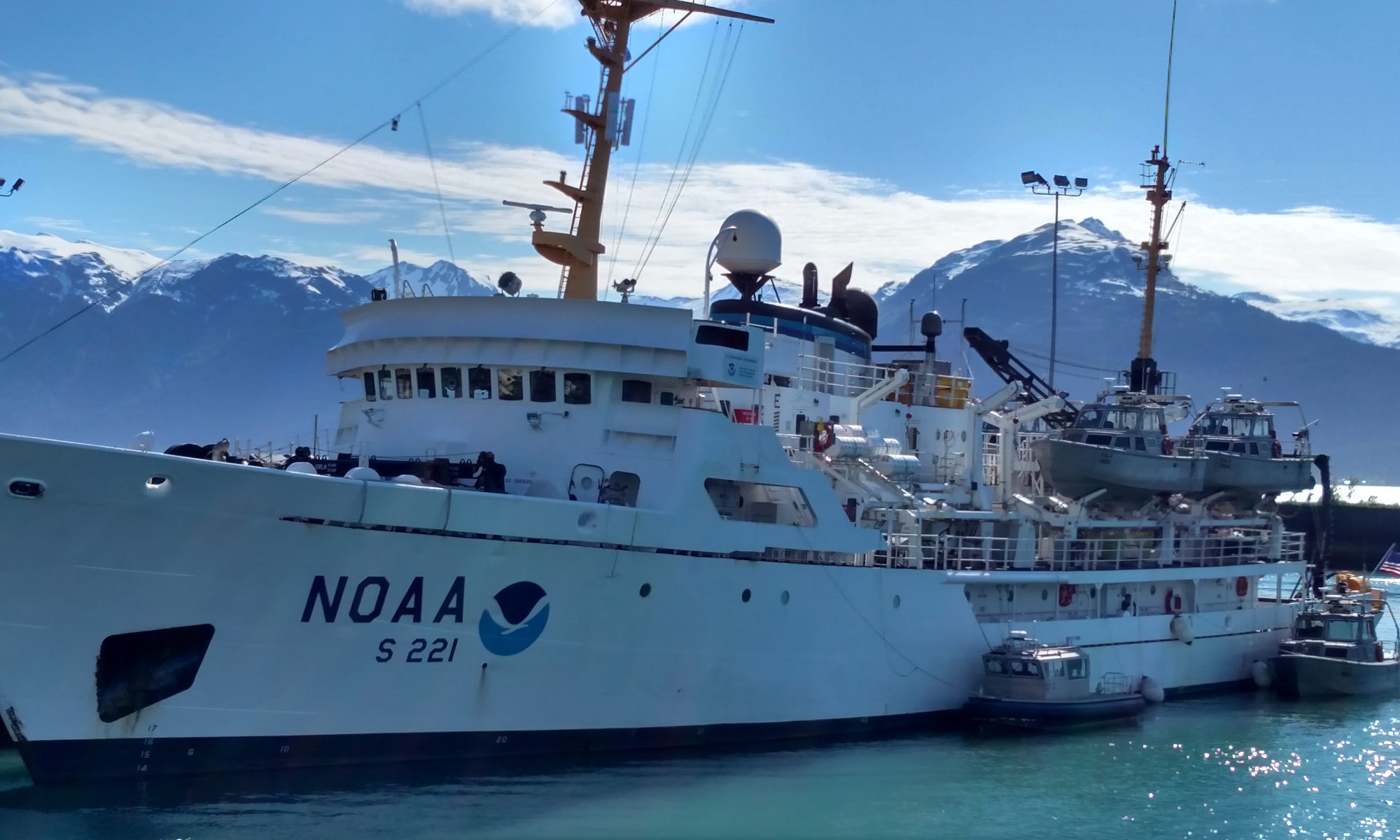
Richard Jones & Art Bangert, January 7, 2010

NOAA Teacher at Sea
Richard Jones
Onboard NOAA Ship KAIMIMOANA
January 4 – 22, 2010

Mission: Oceanographic Survey
Geographical Area: Hawaiian Islands
Date: January 7, 2010

Cups heading to the depths

Science Log

Today was a day of transit. We did a lot of work on the buoys, preparing them for deployment and Rick, with the help of Tonya our Chief Survey Technician, got about half of the cups that his students decorated for ‘shrinking’ into the mesh bags to attach to the deep CTD when we do one . The CTD is a rosette of bottles that are sent to depth, in this case 3000 meters (how many feet is that and how many atmospheres of pressure?) where water samples and a record of the Conductivity (salinity), Temperature, and Depth are taken. These CTD’s will help provide a double check for the electronic data that our buoys collect and add to the data used to model El Nino/La Nina. One of the side activities of the CTD is to send down the cups to be squeezed by the pressure. We also have a cup of similar size that will be used as a control so that students will be able to see the changes that the cups undergo. Rick also has brought along a Styrofoam wig head from his daughter Teri to see the effect on a larger scale.

In addition to our work on the buoys we had our first at sea drills including an abandon ship drill.But since we had a similar drill in port we only were required to muster to our stations with our exposure suits, long sleeve shirt, head cover, and long pants and wear our personal flotation device.

Ship safety drill
Ship safety drill

A wee bit rocky today.We have a swell that seems to be coming from the starboard (right) aft quarter, which gives the ship a strange movement that has made some of the folks a little queasy.Ships tend to roll (movement around an imaginary line running bow to stern) pitch (movement up and down around an imaginary line running 90 degrees to the direction of roll) and yaw (movement left or right of the imaginary line running bow to stern).Today the KA is doing all three at the same time which is why we are encouraged to take Meclizine HCL (Dramamine) for a few days prior to the trip and for the first few days at sea. Taking this makes it easier for the crew to function in an environment that has un-natural motion without getting ‘seasick’. Even with the weird motion of the ship, we still have work to do and for us “newbies” things to learn before we are allowed to do them, like learn how to set the ‘painter line’ for the RHIB so that we will stay attached to the ship in the advent that the engine of the RIHB doesn’t start or other various bad things that can happen to a little boat in a big ocean. We didn’t actually ride in the RHIB today, we simply learned how to enter the boat, where to sit , where the emergency items are located, and how to start and steer the boat.

Out on the deck
Out on the deck

One of the tasks that needs to be done prior to the deployment of our first Buoy at 8N:155W is to determine (as close as possible) the ideal position for the buoy’s anchor. To do this it is essential to know the true depth of the ocean and the topography (collectively called bathymetry) of the area within a few miles of the target latitude and longitude for the buoy.Brian, our Chief Scientist, will determine the depth and location for the anchor by using both satellite sea surface heights and actual sonar depth data from ships that have been in the area. In reality, there really isn’t much hard data, physical sonar tracks, for much of the ocean and much of the depth is determined by the actually height of the sea surface as measured by satellite. These measurements take into account variables, such as orbit of the satellite, atmospheric effects on radar, and tides and compare the computer result to a mathematical ellipsoid model of the Earth’s shape. Sounds pretty complicated, and it is, but we can use this calculated sea surface to help determine the depth of the ocean since the surface mirrors the actual topography of the ocean floor. For Academy students, you will have the opportunity to do two activities from the American Meteorological Society (AMS) that will help you understand what it is that we are attempting to do.

Bathymetric map
Bathymetric map
Catch of the day!
Catch of the day!


Richard Jones & Art Bangert, January 6, 2010

NOAA Teacher at Sea
Richard Jones
Onboard NOAA Ship KAIMIMOANA
January 4 – 22, 2010

Mission: Survey
Geographical Area: Hawaiian Islands
Date: January 6, 2010

Science Log

The KA is under her own steam, well actually diesel and electric, and we are making 10 knots (you should figure out how fast that is in miles per hour) at a heading of 173 degrees. The KA uses diesel generators to create the current to drive here electric propulsion motors. She is a vey quit ship because of this configuration which was part of her original deign…to be quite. The KA is a former Navy antisubmarine warfare ship and needed to be quiet to play her role listening for submarines that might have been lurking around the oceans. Now that quiet nature makes it nice for those of us about to have our first night at sea.

Our current position was 157degrees 51 minutes and 7 seconds west longitude (157:51:07 W) and 22 degrees 55 minutes and 8 seconds north latitude (22:55:09N) at 19:30 lcl on the 5th of January. At that time we had been at sea for about five hours and have many more to go on our way to work the 155 W Buoy line. Sunset was fantastic, but very short. It seems to take almost no time to go from day to night here in the tropics. You can see how it looks behind some of the “birds” (anemometers) that will measure windspeed and direction on the buoys. We are now (09:10 lcl) about 40 nautical miles south of the Big Island and can just see it in the distance. It will be some time before we see land again.

Since we are running a little slow on the internet I will simply post a few images from our first day rather than a video. I will attempt to post a video or two later on but currently we are limited on our bandwidth to about 128K.

For two days I have been overwhelmed as I observed all of the aspects of the crew’s preparation for the TAO mission to Samoa. I am fascinated with everything about this operation – watching the crew load the ship, observing the ship being fueled, viewing the massive nuclear submarines located in Pearl Harbor, and assembling the sensors that collect climate data from each of the buoys we will deploy. Yesterday, in preparation for our voyage, we continued to calibrate instruments and assemble sensors.Last night was our first night at sea, I slept like a baby -the gentle rocking of the boat was like being in a giant cradle.

Richard Jones & Art Bangert, January 5, 2010

NOAA Teacher at Sea
Richard Jones
Onboard NOAA Ship KAIMIMOANA
January 4 – 22, 2010

Mission: Survey
Geographical Area: Hawaiian Islands
Date: January 5, 2010

Science Log

The ship has been in port at Pearl Harbor most of the day. We got underway about ten to ten this morning to transit to the fuel pier. We have been loading fuel and getting the various instruments ready for deployment. One of the more memorable things for me was passing by the USS Arizona Memorial and thinking about all the history that has gone on here. It makes one pause and think of the value of our freedom and the price paid for that freedom.

One of the more mundane, but important tasks today has been to check all the sensors and to make sure that the electrical connections are all correct. I even had the opportunity to crawl under the test bench to make sure the connections for the long wave and short wave UV sensors were connected to the correct test leads.

Richard Jones & Art Bangert, January 4, 2010

NOAA Teacher at Sea
Richard Jones
Onboard NOAA Ship KAIMIMOANA
January 4 – 22, 2010

Mission: Survey
Geographical Area: Hawaiian Islands
Date: January 4, 2010

The ship is underway

Personal Log

Art and I arrived at Pearl at 7AM today at the Visitor Check-in and ID office. We were a half hour early and were still 12th and 13th in line. The process was pretty slow, but we got picked up by one of the science crew (James) when we got our passes around 8:15AM. We then went the ship and came on board durning the first of three drills for the day. Within in a few minutes of getting to the ship we were already involved in the ship board fire drill. Both Art and I were shlepping fire fighting equipment to the “fire scene”, I had a ventilation hose and Art a really big, and nasty looking, pry bar. It looked like a pry bar on steroids. After the fire drill it was the abandon ship drill, where we all put on our “gumby” suits ( I wish I had thought to have my camera ready first thing) and exchanged our old whistles for new ones without cork balls. After the abandon ship drill, it was man overboard and then we were able to stand down by about 10AM. Once the drills were done it was time to get with moving the equipment to the ship and setting up the instruments. The process of meeting the crew, loading the equipment and stores, and setting up the science stuff took until almost 6PM.